heater CHEVROLET CAMARO 1996 4.G Owners Manual
[x] Cancel search | Manufacturer: CHEVROLET, Model Year: 1996, Model line: CAMARO, Model: CHEVROLET CAMARO 1996 4.GPages: 402, PDF Size: 21.38 MB
Page 82 of 402
Downloaded from www.Manualslib.com manuals search engine Engine Coolant Heater (Option)
I
Plugging the cord into an ungrounded outlet
could cause an electrical shock. Also, the wrong
kind of extension cord could overheat and cause
a fire. You could be seriously injured. Plug the
cord into a properly grounded three-prong
110-volt AC outlet.
If the cord won’t reach, use a
heavy-duty three-prong extension cord rated for
at least
15 amps.
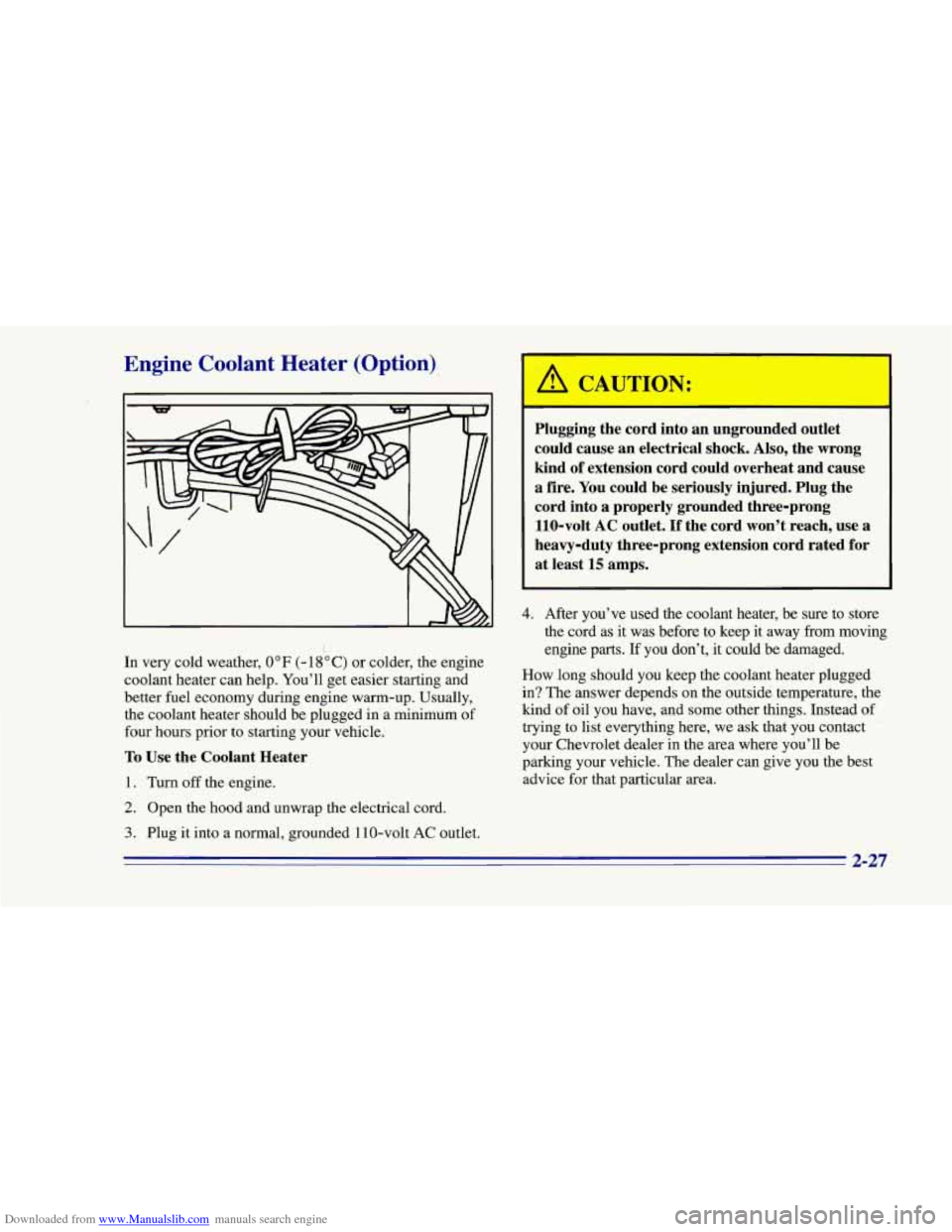
In very cold weather, 0°F (- 18 O C) or colder, the engine
coolant heater can help. You’ll get easier starting and
better fuel economy during engine warm-up. Usually,
the coolant heater should be plugged in a minimum
of
four hours prior to starting your vehicle.
To Use the Coolant Heater
1. Turn off the engine.
2. Open the hood and unwrap the electrical cord.
3. Plug it into a normal, grounded 1 10-volt AC outlet.
4. After you’ve used the coolant heater, be sure to store
the cord as it was before to keep it away from moving
engine parts.
If you don’t, it could be damaged.
How long should you keep
the coolant heater plugged
in? The answer depends on the outside temperature, the
kind
of oil you have, and some other things. Instead of
trying to list everything here, we ask that you contact
your Chevrolet dealer in the area where you’ll be
parking your vehicle. The dealer can give you the best
advice for that particular area.
2-27
Page 145 of 402
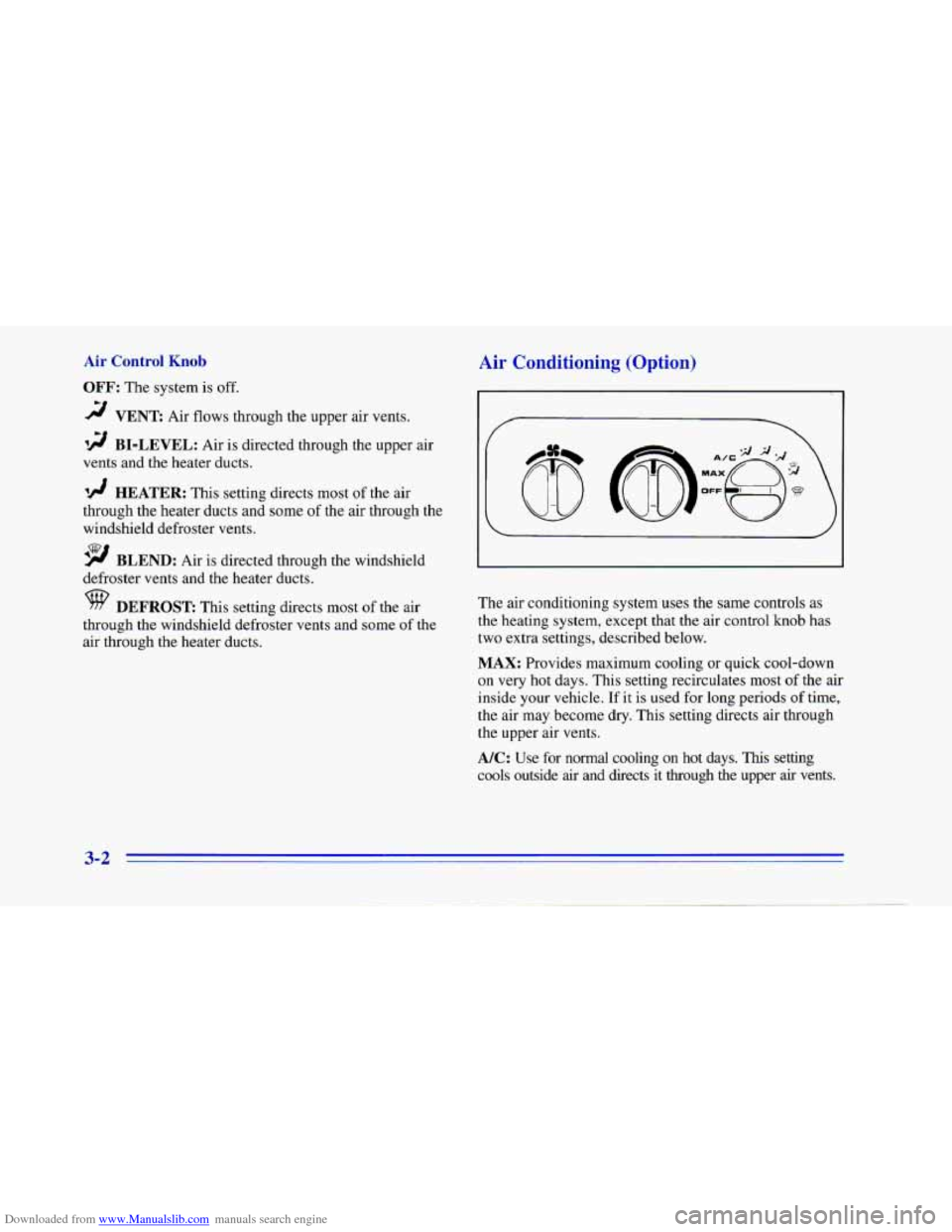
Downloaded from www.Manualslib.com manuals search engine Air Control Knob
OFF: The system is off.
VENT Air flows through the upper air vents.
12 BI-LEVEL: Air is directed through the upper air
vents and the heater ducts.
'!A HEATER: This setting directs most of the air
through the heater ducts and some
of the air through the
windshield defroster vents.
9 BLEND: Air is directed through the windshield
defroster vents and the heater ducts.
DEFROST: This setting directs most of the air
through the windshield defroster vents and some of the
air through the heater ducts.
Air Conditioning (Option)
The air conditioning system uses the same controls as
the heating system, except that the air control knob has
two extra settings, described below.
MAX: Provides maximum cooling or quick cool-down
on very hot days. This setting recirculates most
of the air
inside your vehicle. If it is used for long periods
of time,
the air may become dry. This setting directs air through
the upper air vents.
A/C: Use for normal cooling on hot days. This setting
cools outside air and directs it through the upper
air vents.
3-2
Page 146 of 402
Downloaded from www.Manualslib.com manuals search engine The air conditioner compressor operates in MAX, A/C,
BI-LEVEL, BLEND and DEFROST when the outside
temperature is above freezing. When the air conditioner
is
on, you may sometimes notice slight changes in your
vehicle’s engine speed and power. This is normal,
because the compressor uses power and the system is
designed to cycle the compressor on and off to keep the
desired cooling and help fuel economy.
Cooling
The air conditioner works best if you keep your
windows closed. On
very hot days, open the windows
just long enough for the hot air to escape.
1. Turn the air control knob to A/C for normal cooling.
For faster cooling, move the knob
to MAX.
comfortable setting.
2. Turn the temperature control knob to a
3. Turn the fan control knob to the desired speed.
Heating
The heater works best if you keep your windows closed
while using it.
1. Turn the air control knob to HEATER.
2. Turn the fan control knob to the desired speed.
3. Turn the temperature control knob to a
comfortable setting.
If your vehicle is equipped with an optional engine coolant
heater, you can use it in cold weather (around 20°F/-8”C
or lower) to improve heater performance on initial
start up.
Because an engine coolant heater warms the engine
coolant, your vehicles heating system can more quickly
and efficiently provide heat for your vehicle’s passenger
area. See “Engine Coolant Heater”
in the Index.
Bi-Level Heating
You may want to use bi-level heating on cool, but sunny
days. This setting directs
cool air toward your body and
warmer air toward your feet.
1. Turn the air control knob to BI-LEVEL.
2. Turn the temperature control knob to a
comfortable setting.
3. Turn the fan control knob to the desired speed.
3-3
Page 147 of 402
Downloaded from www.Manualslib.com manuals search engine Ventilation System
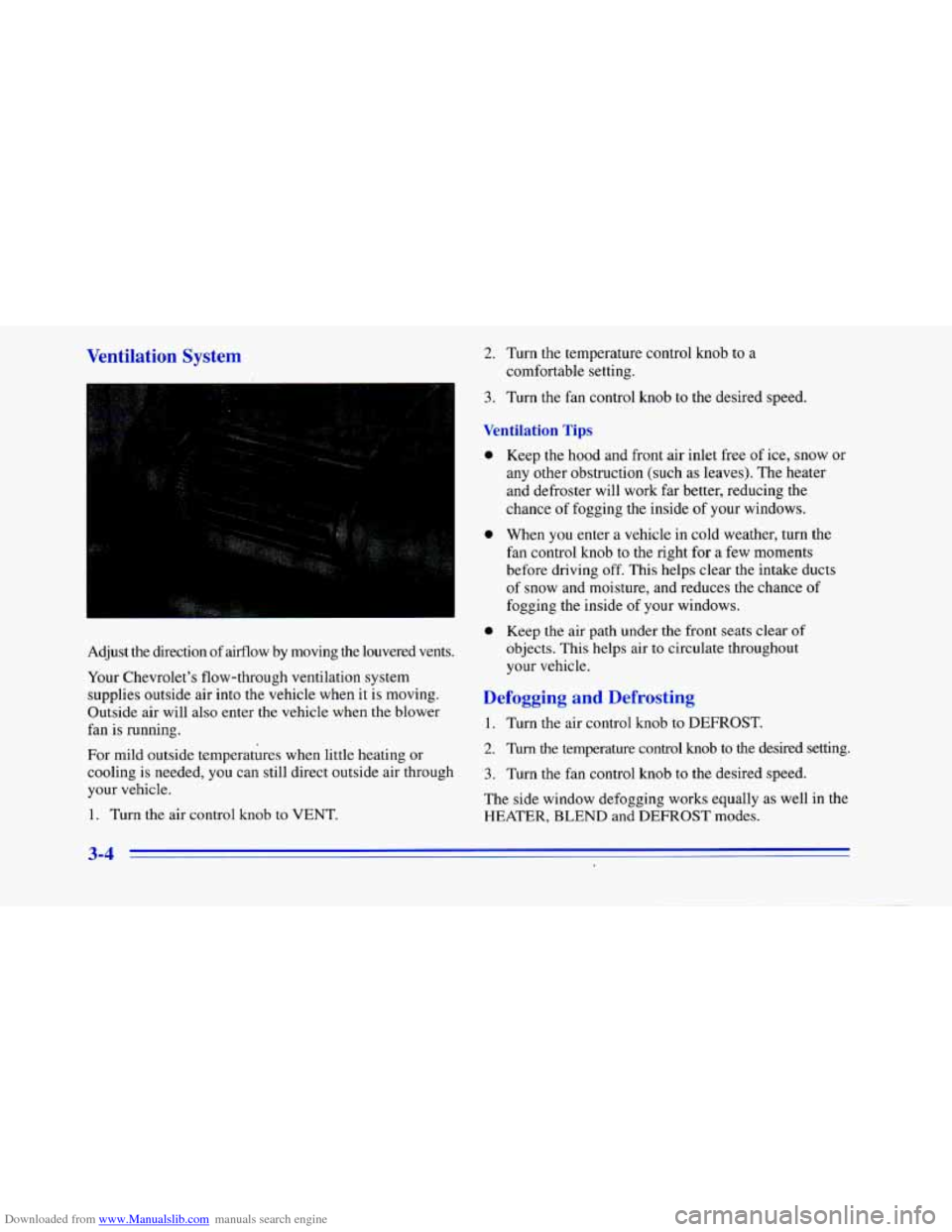
Adjust the direction of airflow by moving the louvered vents.
Your Chevrolet’s flow-through ventilation system
supplies outside air into the vehicle when it is moving.
Outside air will also enter the vehicle when the blower
fan is running.
For mild outside temperatures when little heating or
cooling is needed, you can still direct outside air through
your vehicle.
1. Turn the air control knob
to VENT.
2. Turn the temperature control knob to a
comfortable setting.
3. Turn the fan control knob to the desired speed.
Ventilation Tips
0
0 Keep the hood and front air inlet free of ice, snow or
any other obstruction (such as leaves). The heater
and defroster will work far better, reducing the
chance of fogging the inside
of your windows.
When
you enter a vehicle in cold weather, turn the
fan control knob to the right for a few moments
before driving off. This helps clear the intake ducts
of snow and moisture, and reduces the chance of
fogging the inside of your windows.
Keep the air path under the front seats clear of
objects. This helps air to circulate throughout
your vehicle.
Defogging and Defrosting
1. Turn the air control knob to DEFROST.
2. Turn the temperature control knob to the desired setting.
3. Turn the fan control knob to the desired speed.
The side window defogging works equally as well
in the
HEATER, BLEND and DEFROST modes.
3-4
Page 194 of 402
Downloaded from www.Manualslib.com manuals search engine Run your engine only as long as you must. This saves
fuel. When you run the engine, make it go a little faster
than just idle. That is, push the accelerator slightly. This
uses less fuel for the heat that
you get and it keeps the
battery charged. You will need a well-charged battery to
restart the vehicle, and possibly for signaling later on
with your headlamps. Let the heater run for awhile.
Then, shut the engine off and close the window almost
all the way to preserve the heat. Start the engine again
and repeat this only when you feel really uncomfortable
from the cold. But do it as little as possible. Preserve the
fuel
as long as you can. To help keep warm, you can get
out of the vehicle and do some fairly vigorous exercises
every half hour or
so until help comes.
Loading Your Vehicle
' OCCUPANTS
VEHICLE CAP. WT.
TIRE-LOADING INFORMATION
FRT.
CTR. RR. TOTAL LBS. KG
MAX. LOADING & GVWR SAME AS VEHICLE
CAPACITY WEIGHT XXX COLD TIRE
TIRE
SIZE SPEED PRESSURE
RTG PSI/KPa
FRT.
RR.
SPA.
IF TIRES ARE HOT, ADD 4PSIi28KPa
SEE OWNER'S MANUAL FOR ADDITIONAL
INFORMATION
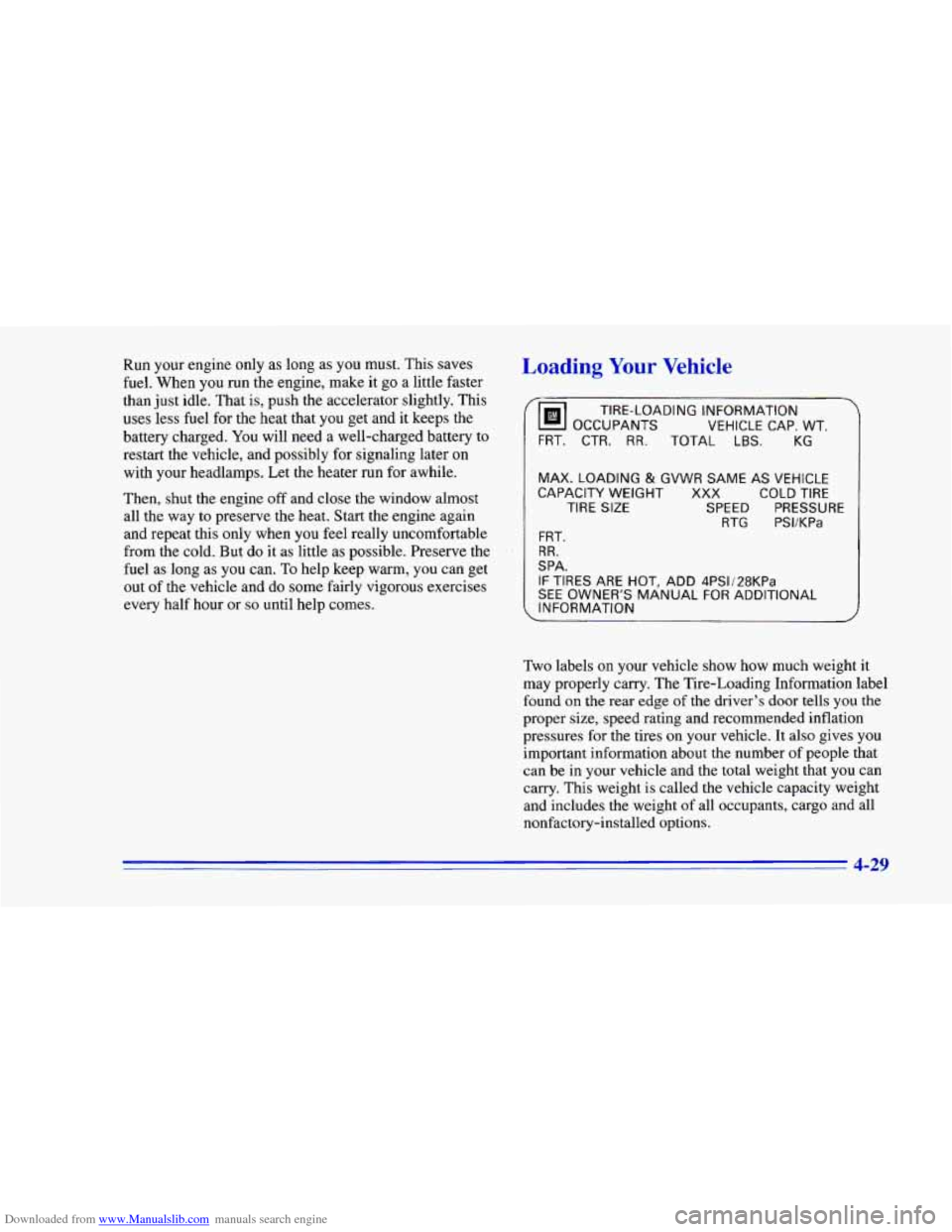
Two labels on your vehicle show how much weight it
may properly carry. The Tire-Loading Information label
found on the rear edge of the driver's door tells you the
proper size, speed rating and recommended inflation
pressures for the tires on your vehicle.
It also gives you
important information about the number
of people that
can be
in your vehicle and the total weight that you can
carry. This weight is called the vehicle capacity weight
and includes the weight of all occupants, cargo and all
nonfactory-installed options.
4-29
Page 222 of 402
![CHEVROLET CAMARO 1996 4.G Owners Manual Downloaded from www.Manualslib.com manuals search engine If No Steam Is Ci ling Fro] YC r Engine
If you get the overheat warning but see or hear no
steam, the problem may not be too serious](/img/24/8065/w960_8065-221.png "CHEVROLET CAMARO 1996 4.G Owners Manual Downloaded from www.Manualslib.com manuals search engine If No Steam Is Ci ling Fro] YC r Engine
If you get the overheat warning but see or hear no
steam, the problem may not be too serious")
Downloaded from www.Manualslib.com manuals search engine If No Steam Is Ci ling Fro] YC r Engine
If you get the overheat warning but see or hear no
steam, the problem may not be too serious. Sometimes
the engine can get a little too hot when you:
Climb a long hill on a hot day.
Stop after high-speed driving,
Idle for long periods in traffic.
0 Tow a trailer.
11 you get the overheat warning with no sign of steam,
try this for a minute or
so:
1. If you have an air conditioner, turn it off.
2. Turn on your heater to full hot at the highest fan
speed and open the window as necessary.
3. If you’re in a traffic jam, shift to NEUTRAL (N);
otherwise, shift to the highest gear while
driving
-- AUTOMATIC OVERDRIVE (@)
or DRIVE (D) for automatic transmissions.
If you no longer have the overheat warning, you can drive.
Just
to be safe, drive slower for about 10 minutes. If the
warning doesn’t come back on, you can drive normally.
If the warning continues, pull over, stop, and park your
vehicle right away. If
there’s still no sign
of steam, you can idle the engine
for two or three minutes while you’re parked,
to see
if the warning stops. But then,
if you still have the
warning,
turn 08 the engine and get everyone out of
the vehicle until it cools down.
You may decide not to lift the hood but to get service
help right away.
V8 Engine
Page 224 of 402
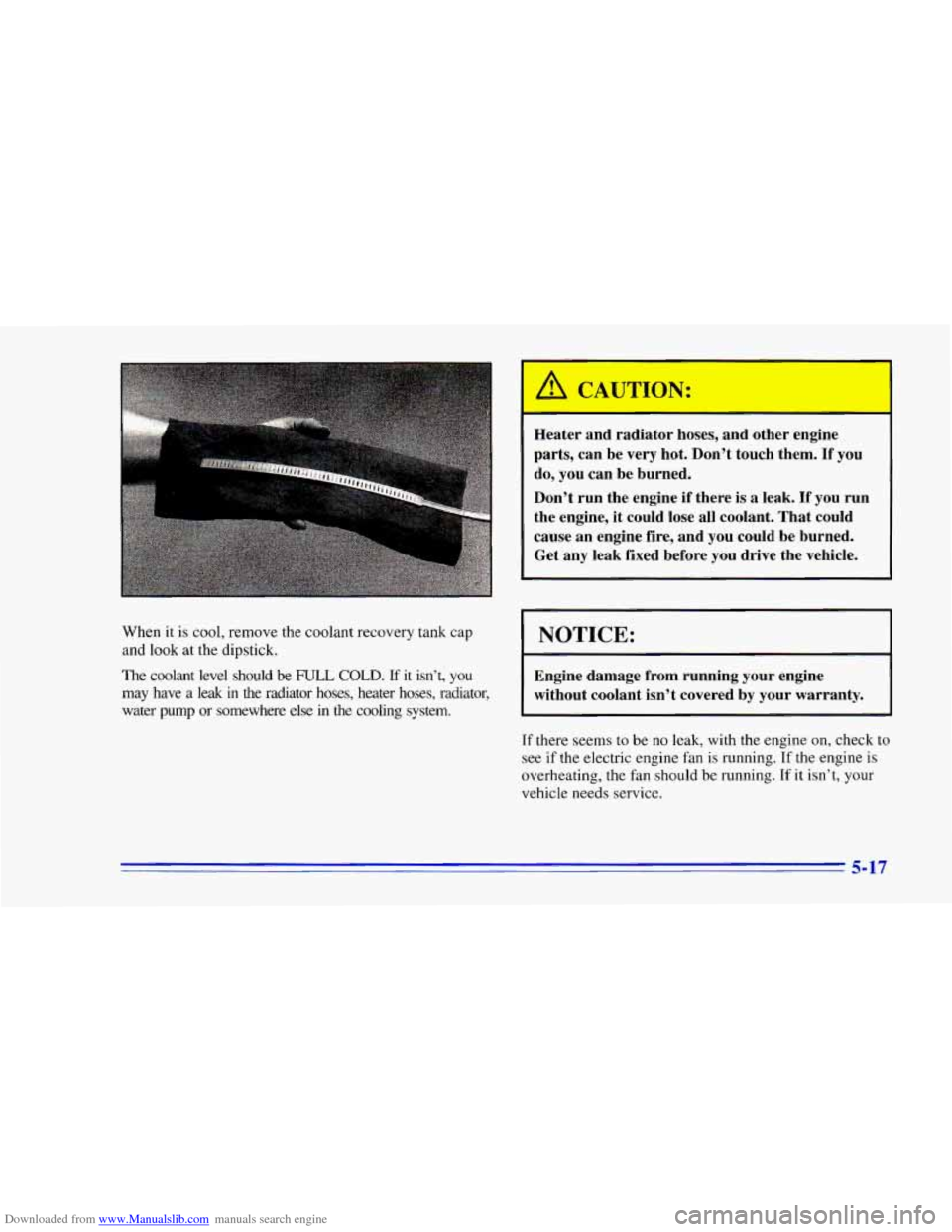
Downloaded from www.Manualslib.com manuals search engine When it is cool, remove the coolant recovery tank cap
and look at the dipstick.
The coolant level should
be FULL COLD. If it isn’t, you
may have a leak in the radiator hoses, heater hoses, radiator,
water pump or somewhere else in the cooling system.
Heater and radiator hoses, and other engine
parts, can be very hot. Don’t touch them.
If you
do, you can be burned.
Don’t run the engine if there is a leak.
If you run
the engine, it could lose all coolant. That could
cause an engine fire, and
you could be burned.
Get any leak fixed before you drive the vehicle.
NOTICE:
~~~
Engine damage from running your engine
without coolant isn’t covered by your warranty.
If there seems to be no leak, with the engine on, check to
see if the electric engine
fan is running. If the engine is
overheating, the fan should be running.
If it isn’t, your
vehicle needs service.
5-17
Page 225 of 402
Downloaded from www.Manualslib.com manuals search engine A
How to Add Coolant to the Coolant
Recovery Tank
If you haven’t found a problem yet, but the coolant level
isn’t at
FULL COLD, add a 50/50 mixture of clean
water (preferably distilled) and DEX-COOL ’ (orange-colored, silicate-free) antifreeze at the coolant
1 recovery tank. (See “Engine Coolant” in the Index
~ for more information.)
i
A CAUTION:
Adding only plain water to your cooling system
can be dangerous. Plain water, or some other
liquid like alcohol, can boil before the proper
coolant
mix will. Your vehicle’s coolant warning
system
is set for the proper coolant mix. With
CAUTION: (Continued)
- - -
plain water or the wrong mix, your engine could
get too hot but you wouldn’t get the overheat
warning. Your engine could catch fire and you or
others could be burned. Use a
50/50 mix of clean
water and DEX-COOL
TM antifreeze.
NOTICE:
In cold weather, water can freeze and crack the
engine, radiator, heater core and other parts.
Use the recommended coolant and the proper
coolant mix.
5-18
t
Page 232 of 402
Downloaded from www.Manualslib.com manuals search engine You can be burned if you spill coolant on hot
engine parts. Coolant contains ethylene glycol,
and
it will burn if the engine parts are hot
enough. Don’t spill coolant on a hot engine.
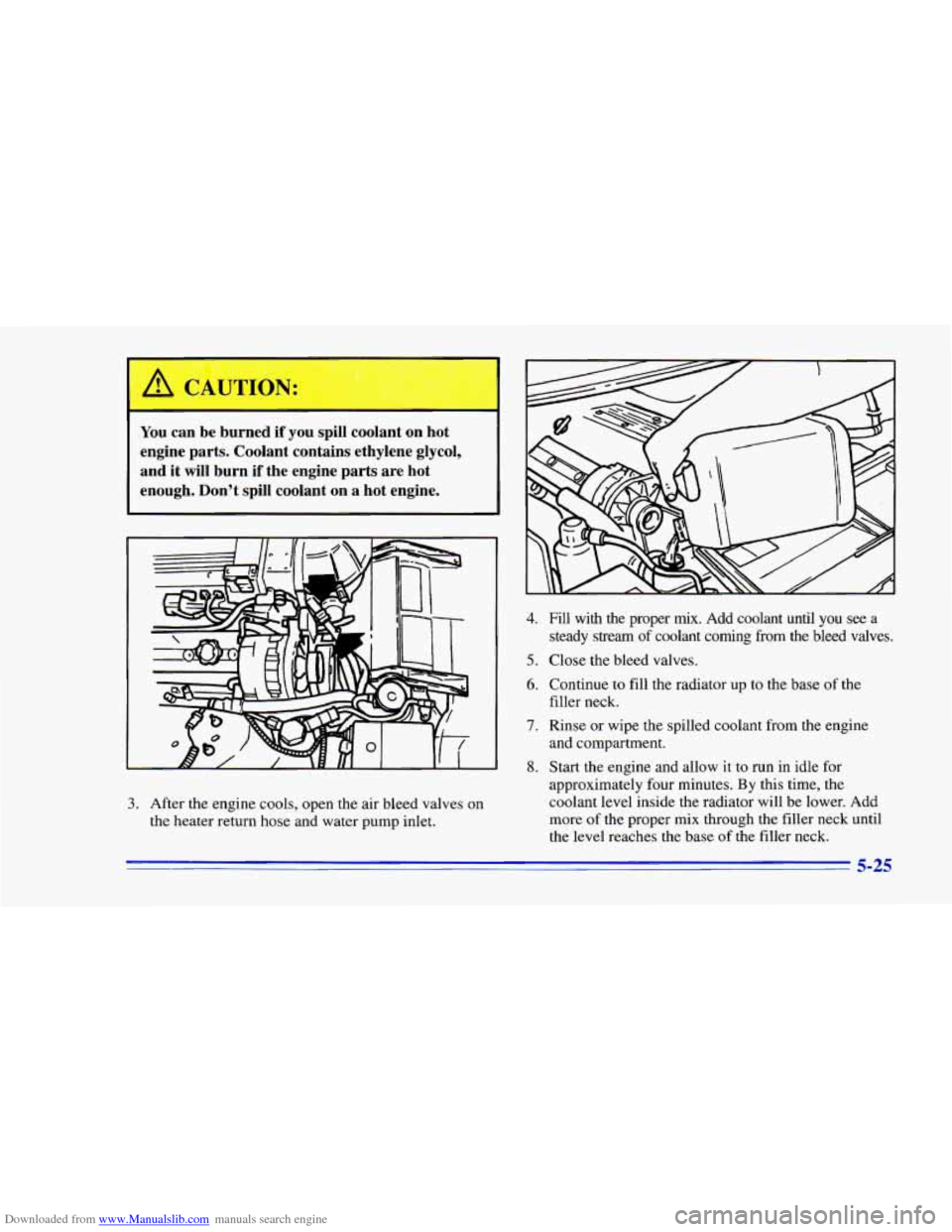
3. After the engine cools, open the air bleed valves on
the heater return hose and water pump inlet.
4. Fill with the proper mix. Add coolant until you see a
5. Close the bleed valves.
6. Continue to fill the radiator up to the base of the
7. Rinse or wipe the spilled coolant from the engine
and compartment.
8. Start the engine and allow it to run in idle for
approximately four minutes.
By this time, the
coolant level inside the radiator will be lower. Add
more
of the proper mix through the filler neck until
the level reaches the base of the filler neck.
steady stream
of coolant coming
from the bleed valves.
filler neck.
5-25
Page 277 of 402
Downloaded from www.Manualslib.com manuals search engine What to Use
Standard Differential
Use Axle Lubricant (GM Part No. 1052271) or
SAE 80W-90 GL-5 gear lubricant.
Limited-Slip Differential
To add lubricant when the level is low, use Axle
Lubricant (GM
Part No. 12345977). To completely refill
after draining, add 2 ounces (59
ml) of Limited-Slip
Differential Lubricant Additive (GM
Part No. 1052358).
Then fill to the bottom
of the filler plug hole with Axle
Lubricant (GM Part
No. 12345977).
Engine Coolant
The cooling system in your vehicle is filled with new
DEX-COOL
TM (orange-colored, silicate-free) engine
coolant. This coolant is designed to remain in your
vehicle for
5 years or 100,000 miles (166 000 km),
whichever occurs first.
The following explains your cooling system and how to add coolant when it is low. If you have a problem with
engine overheating
or if you need to add coolant to your
radiator, see “Engine Overheating” in the Index.
A 50/50 mixture of water and the proper coolant for
your Chevrolet will:
Give freezing protection down to -34°F (-37°C).
0 Give boiling protection up to 265 “F (1 29°C).
Protect against rust and corrosion.
Help keep the proper engine temperature.
Let the warning lights and gages work as they should.
NOTICE:
When adding coolant it is important that you use
DEX-COOL (orange-colored, silicate-free)
coolant meeting
GM Specification 6277M.
If silicated coolant is added to the system,
premature engine, heater core
or radiator
corrosion may result.
In addition, the engine
coolant
will require change sooner -- at
30,000 miles (50 000 km) or 24 months,
whichever occurs first.
6-26
I b