belt CHEVROLET CAMARO 1997 4.G Owner's Guide
[x] Cancel search | Manufacturer: CHEVROLET, Model Year: 1997, Model line: CAMARO, Model: CHEVROLET CAMARO 1997 4.GPages: 404, PDF Size: 20.96 MB
Page 47 of 404
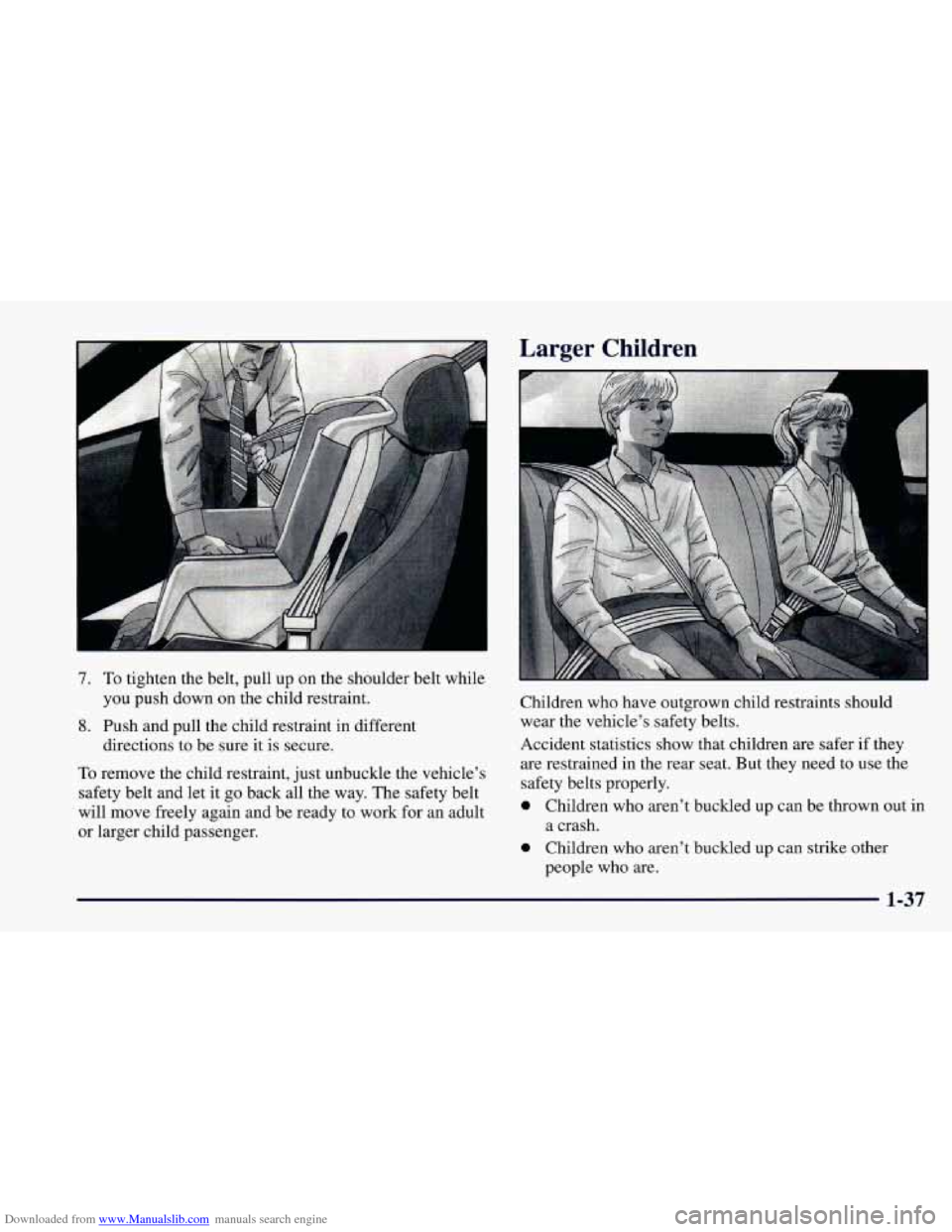
Downloaded from www.Manualslib.com manuals search engine 7. To tighten the belt, pull up on the shoulder belt while
you push down on the child restraint.
8. Push and pull the child restraint in different
directions to be sure it is secure.
To remove the child restraint, just unbuckle the vehicle’s
safety belt and let it go back all the way. The safety belt
will move freely again and be ready to work for an adult
or larger child passenger.
Larger Children
I
Children who have outgrown child restraints should
wear the vehicle’s safety belts.
Accident statistics show that children are safer if they
are restrained
in the rear seat. But they need to use the
safety belts properly.
0 Children who aren’t buckled up can be thrown out in
0 Children who aren’t buckled up can strike other
a crash.
people who are.
1-37
Page 48 of 404
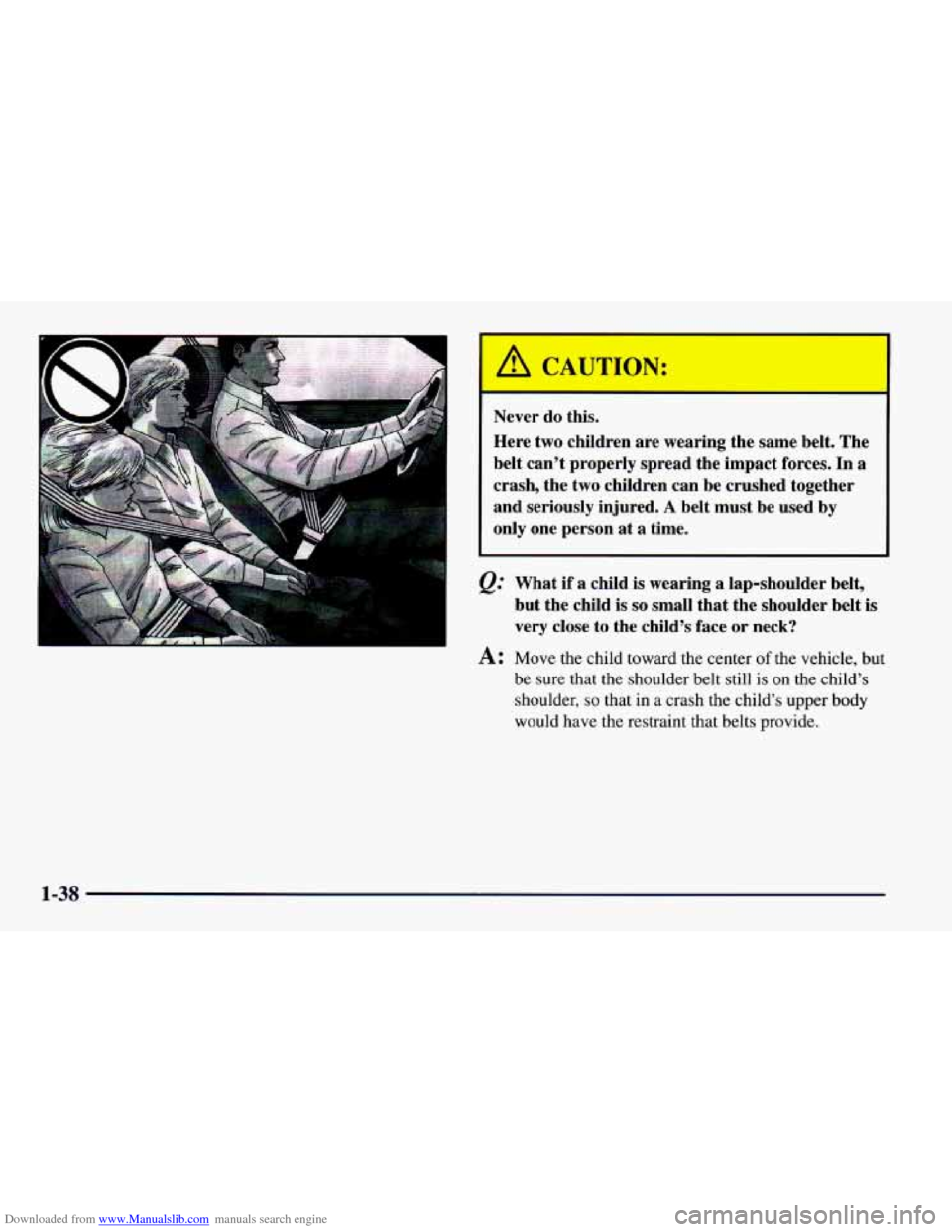
Downloaded from www.Manualslib.com manuals search engine A CAUTION:
Never do this.
Here two children are wearing the
same belt. The
belt can’t properly spread the impact
forces. In a
crash, the two children can be crushed together
and seriously injured.
A belt must be used by
only one person at a time.
What
if a child is wearing a lap-shoulder belt,
but the child is
so small that the shoulder belt is
very close to the child’s face
or neck?
A: Move the child toward the center of the vehicle, but
be sure that
the shoulder belt still is on the child’s
shoulder,
so that in a crash the child’s upper body
would have the restraint that belts provide.
1-38
Page 49 of 404
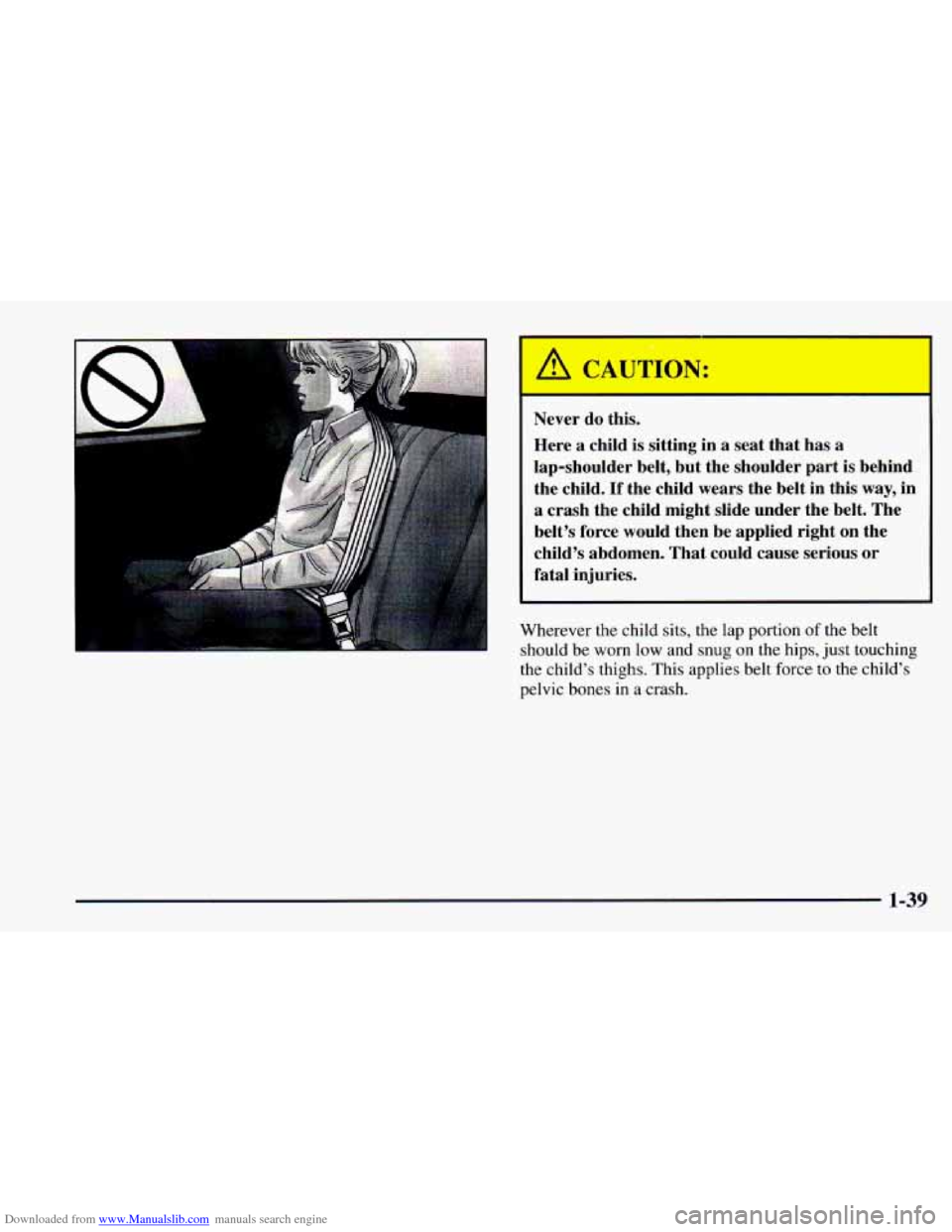
Downloaded from www.Manualslib.com manuals search engine I Never do this.
Here
a child is sitting in a seat that has a
lap-shoulder belt, but the shoulder part is behind
the child.
If the child wears the belt in this way, in
a crash the child might slide under the belt. The
belt’s force would then be applied right on the
child’s abdomen. That could cause serious or
fatal injuries.
Wherever the child sits, the lap portion of the belt
should be worn low and snug
on the hips, just touching
the child’s thighs. This applies belt force to the child’s
pelvic bones in a crash.
1-39
Page 50 of 404
Downloaded from www.Manualslib.com manuals search engine Safety Belt Extender
If the vehicle’s safety belt will fasten around you, you
should
use it.
But if a safety belt isn’t long enough to fasten, your
dealer will order you an extender. It’s free. When you go
in to order it, take the heaviest coat you will wear,
so the
extender will be
long enough for you. The extender will
be just for you, and just
for the seat in your vehicle that
you choose. Don’t let someone else use it, and use it
only
for the seat it is made to fit. To wear it, just attach it
to the regular safety belt.
Checking Your Restraint Systems
Now and then, make sure the safety belt reminder light
and all your belts, buckles, latch plates, retractors and
anchorages are working properly. Look for any other
loose or damaged safety belt system parts.
If you see
anything that might keep a safety belt system from
doing its job, have it repaired.
Torn or frayed safety belts may not protect you in a
crash. They can rip apart under impact forces.
If a belt is
torn or frayed, get a new one right away.
Replacing Restraint System Parts
After a Crash
If you’ve had a crash, do you need new belts?
After a very minor collision, nothing may be necessary.
But if the belts were stretched, as they would be if worn
during a more severe crash, then you need new belts.
If belts are cut or damaged, replace them. Collision
damage also may mean
you will need to have safety belt
or seat parts repaired or replaced. New
parts and repairs
may be necessary even if the belt wasn’t being used at
the time of the collision.
If an air bag inflates, you’ll need to replace air bag
system parts. See the part on the air bag system earlier in
this section.
Also look for any opened or broken air bag covers, and
have them repaired or replaced. (The air bag system
does not need regular maintenance.)
Page 54 of 404
Downloaded from www.Manualslib.com manuals search engine Door Locks
Unlocked doors can be dangerous.
Passengers
-- especially children -- can easily
open the doors and fall out. When a door is
locked,
the inside handle won’t open it.
Outsiders can easily enter through an unlocked
door when you slow down or stop your vehicle.
This may not
be so obvious: You increase the
chance of being thrown out of the vehicle in
a
crash if the doors aren’t locked. Wear safety belts
properly, lock your doors, and you will be far
better off whenever you drive your vehicle.
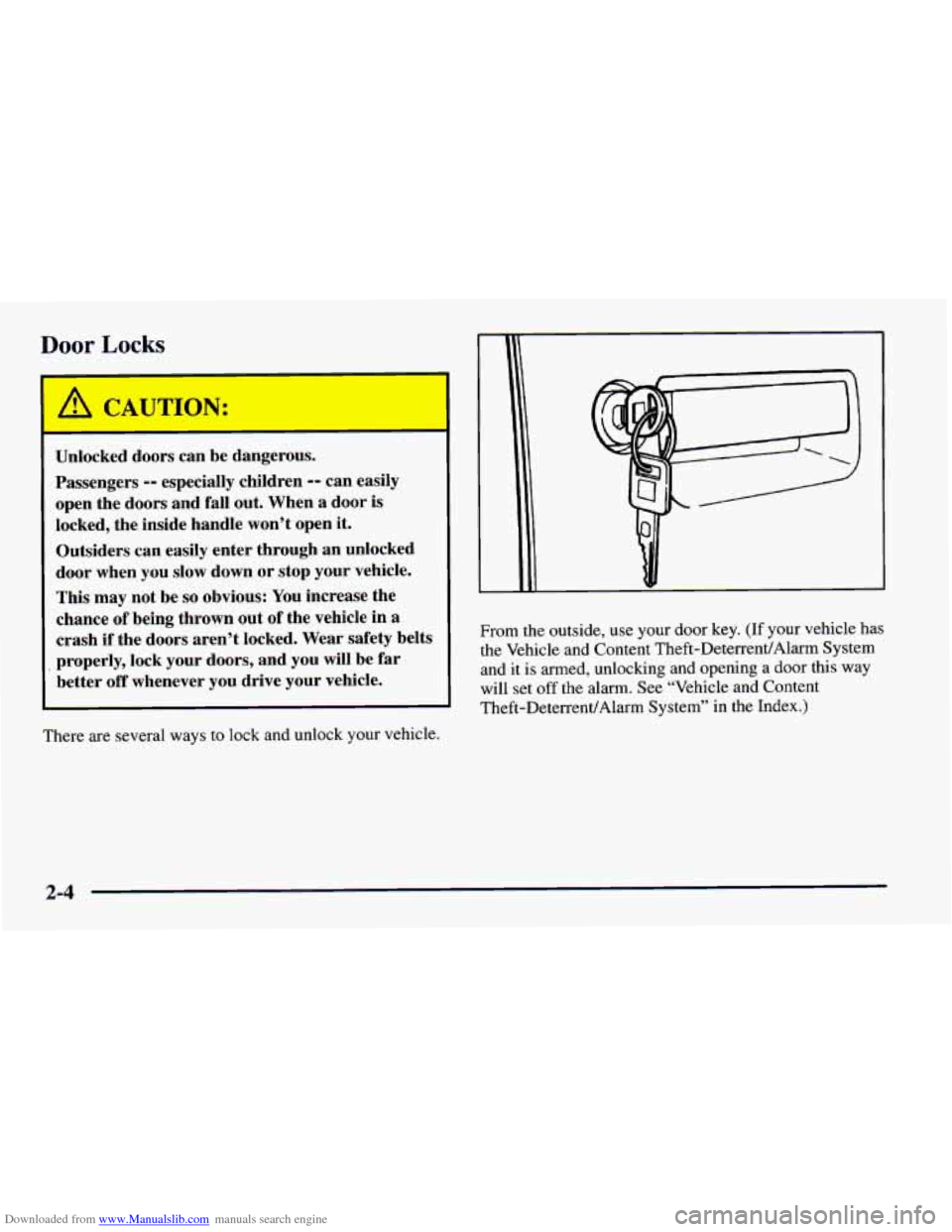
There are several ways to lock and unlock your vehicle. From the
outside, use your door key. (If your vehicle has
the Vehicle and Content Theft-DeterrentlAlarm System
and it is armed, unlocking and opening a door this way
will set off the alarm. See “Vehicle and Content
Theft-DeterrentlAlarm System” in the Index.)
2-4
Page 120 of 404
Downloaded from www.Manualslib.com manuals search engine Installing the Boot Cover
After lowering the convertible top, you’ll want to install
the boot cover. The three-piece boot cover is stored in a
bag
in the trunk.
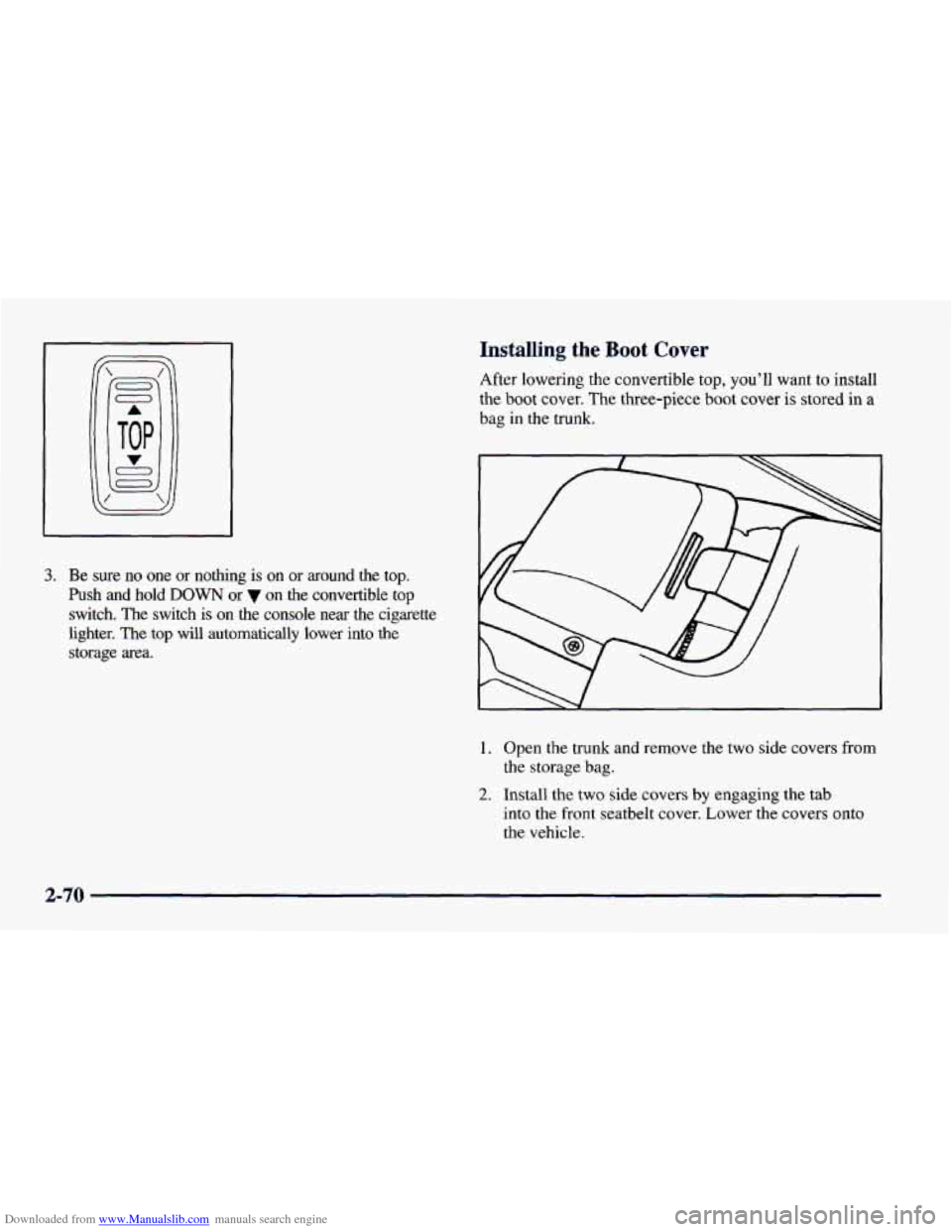
3. Be sure no one or nothing is on or around the top.
Push and hold
DOWN or on the convertible top
switch.
The switch is on the console near the cigarette
lighter. The top will automatically lower into the
storage area.
1. Open the trunk and remove the two side covers from
the storage bag.
2. Install the two side covers by engaging the tab
into the front seatbelt cover. Lower the covers onto
the vehicle.
2-70
Page 128 of 404
Downloaded from www.Manualslib.com manuals search engine Safety Belt Reminder Light
When the key is turned to RUN or START, a chime will
come on for about eight seconds to remind people to
fasten their safety belts.
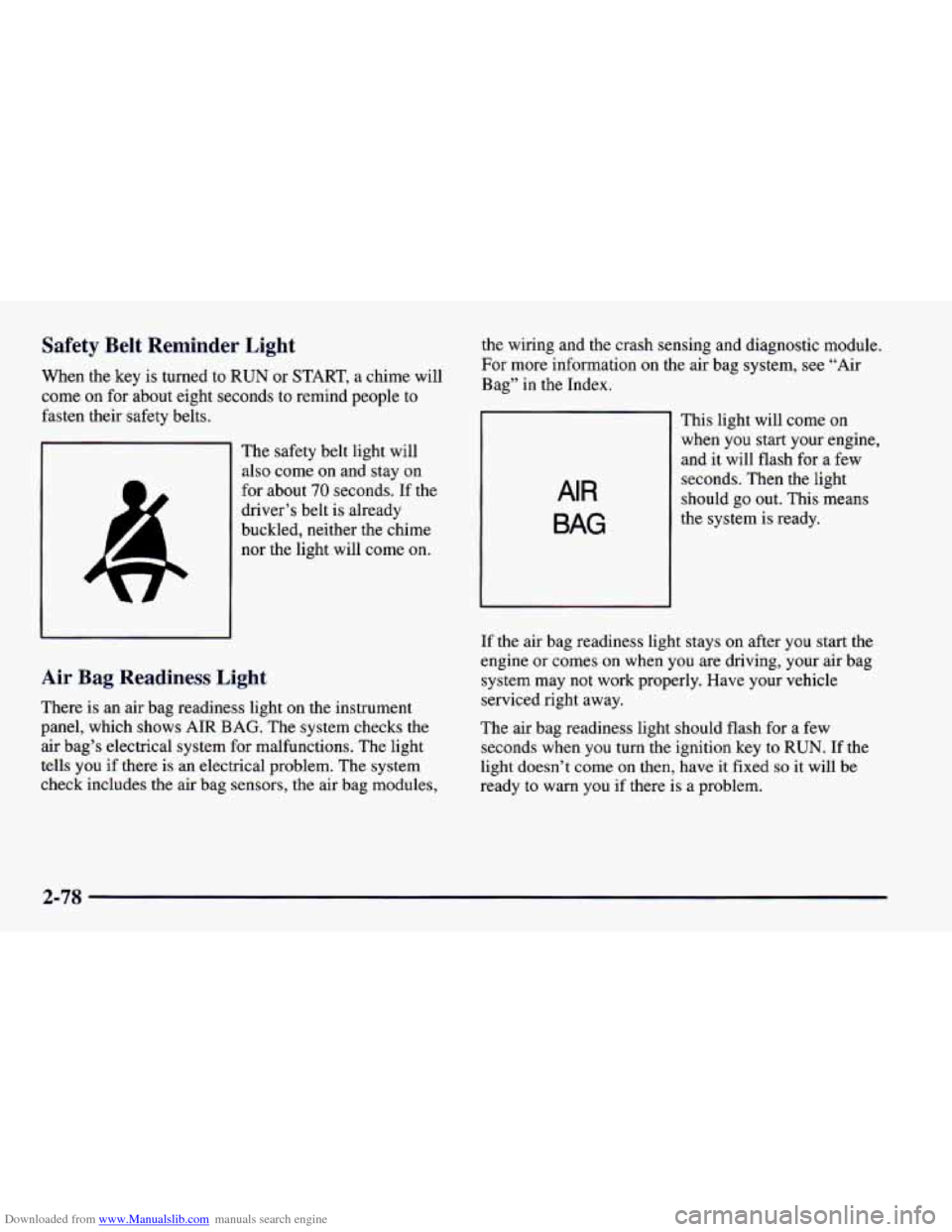
The safety belt light will
also come on and stay on
for about
70 seconds. If the
driver’s belt is already
buckled, neither the chime
nor the light will come
on.
Air Bag Readiness Light
There is an air bag readiness light on the instrument
panel, which shows
AIR BAG. The system checks the
air bag’s electrical system for malfunctions. The light
tells you if there is an electrical problem. The system
check includes the air bag sensors, the air bag modules, the wiring and the
crash sensing and diagnostic module.
For more information on the air bag system, see “Air
Bag” in the Index.
AIR
BAG
This light will come on
when you start your engine,
and it will flash for
a few
seconds. Then the light
should go out. This means
the system is ready.
If the air bag readiness light stays on after you start the
engine or comes
on when you are driving, your air bag
system may not work properly. Have your vehicle
serviced right away.
The air bag readiness light should flash for a few
seconds when you turn the ignition key to
RUN. If the
light doesn’t come on then, have
it fixed so it will be
ready to warn you if there is a problem.
2-78
Page 163 of 404
Downloaded from www.Manualslib.com manuals search engine Care of Your Cassette Tape Player
A tape player that is not cleaned regularly can cause
reduced sound quality, ruined cassettes or a damaged
mechanism. Cassette tapes should be stored in their
cases away from contaminants, direct sunlight and
extreme heat. If they aren’t, they may not operate
properly or may cause failure of the tape player.
Your tape player should be cleaned regularly after every
50 hours of use. Your radio may display CLN to indicate
that you have used your tape player for
50 hours without
resetting the tape clean timer.
If this message appears on
the display, your cassette tape player needs to be
cleaned. It will still play tapes, but you should clean it as
soon as possible
to prevent damage to your tapes and
player. If you notice a reduction
in sound quality, try a
known good cassette to see if
it is the tape or the tape
player at fault. If this other cassette has
no improvement
in sound quality, clean the tape player. Cleaning
may be done with a scrubbing action,
non-abrasive cleaning cassette with pads which scrub
the tape head as the hubs
of the cleaner cassette turn. It
is normal for the cassette to eject while cleaning. Insert
the cassette at least three times to ensure thorough
cleaning.
A scrubbing action cleaning cassette is
available through your Chevrolet dealership.
You may also choose a non-scrubbing action, wet-type
cleaner which
uses a cassette with a fabric belt to clean
the tape head. This type
of cleaning cassette will not
eject and, it may
not clean as thoroughly as the
scrubbing type cleaner.
After you clean the player, press and hold
EJECT for
five seconds to reset the
CLN indicator. The radio will
display
--- to show the indicator was reset.
Cassettes are subject to wear and the sound quality may
degrade over time. Always make sure the cassette tape
is in good condition before you have your tape
player serviced.
3-23
Page 166 of 404
Downloaded from www.Manualslib.com manuals search engine Defensive Driving
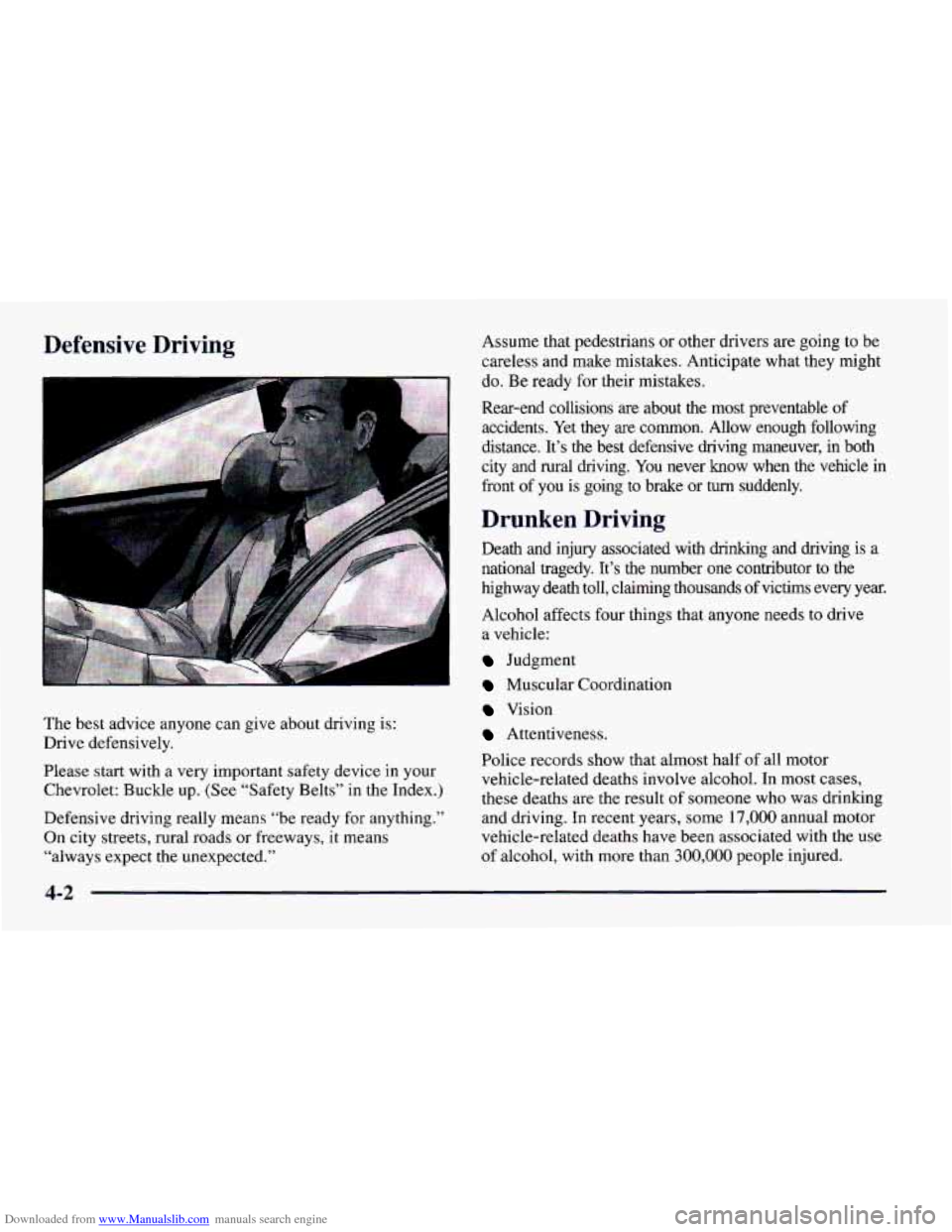
The best advice anyone can give about driving is:
Drive defensively.
Please start with a very important safety device
in your
Chevrolet: Buckle up. (See “Safety Belts” in the Index.)
Defensive driving really means “be ready for anything.”
On city streets, rural roads or freeways, it means
“always expect the unexpected.” Assume that pedestrians
or other
drivers are going to be
careless and make mistakes. Anticipate what they might
do.
Be ready for their mistakes.
Rear-end collisions
are about the most preventable of
accidents. Yet they are common. Allow enough following
distance. It’s the best defensive driving maneuver, in
both
city and rural driving. You never know when the vehicle in
front of
you is going to brake or turn suddenly.
Drunken Driving
Death and injury associated with drinking and driving is a
national tragedy.
It’s the number one contributor to the
highway death toll, claiming thousands
of victims every year.
Alcohol affects four things that anyone needs to drive
a vehicle:
Judgment
Muscular Coordination
Vision
Attentiveness.
Police records show that almost half of all motor
vehicle-related deaths involve alcohol.
In most cases,
these deaths are the result of someone who was drinking
and driving. In recent years, some
17,000 annual motor
vehicle-related deaths have been associated with the use
of alcohol, with more than
300,000 people injured.
4-2
Page 176 of 404
Downloaded from www.Manualslib.com manuals search engine Steering in Emergencies
There are times when steering can be more effective
than braking. For example,
you come over a hill and
find a truck stopped in your lane, or a car suddenly
pulls out from nowhere, or a child darts
out from
between parked cars and stops right in front
of you.
You can avoid these problems by braking -- if you
can stop in time. But sometimes you can’t; there isn’t
room. That’s the time for evasive action
-- steering
around the problem.
Your Chevrolet can perform very well in emergencies
like these. First apply your brakes. (See “Braking in
Emergencies” earlier
in this section.) It is better to
remove as much speed
as you can from a possible
collision. Then steer around the problem,
to the left
or right depending
on the space available. An
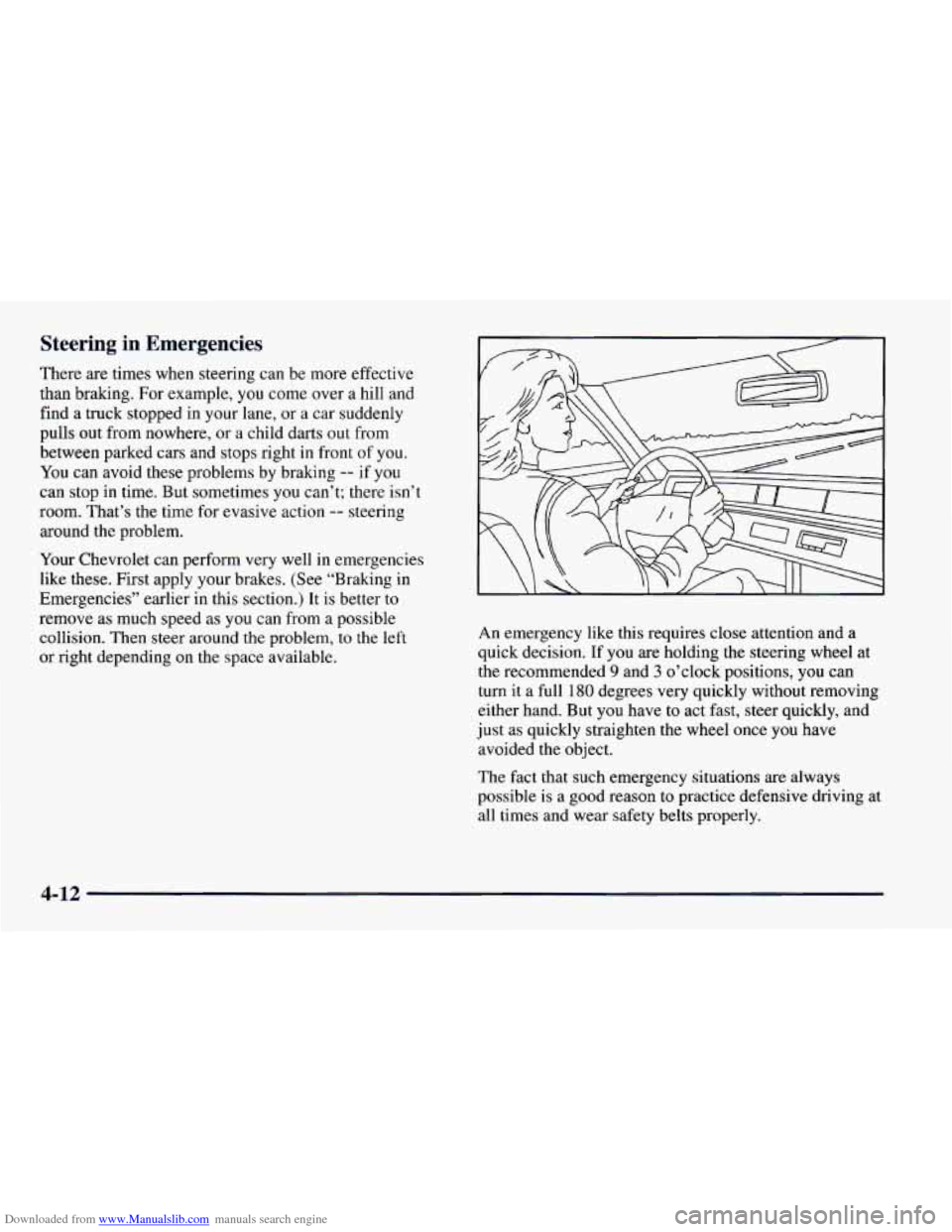
emergency like this requires close attention
and a
quick decision. If you are holding the steering wheel at
the recommended 9 and 3 o’clock positions, you can
turn it a full 180 degrees very quickly without removing
either hand. But you have
to act fast, steer quickly, and
just as quickly straighten the wheel once you have
avoided the object.
The fact that such emergency situations are always
possible is a good reason
to practice defensive driving at
all times and wear safety belts properly.
4-12