warning light CHEVROLET CAMARO 1998 4.G User Guide
[x] Cancel search | Manufacturer: CHEVROLET, Model Year: 1998, Model line: CAMARO, Model: CHEVROLET CAMARO 1998 4.GPages: 402, PDF Size: 21.2 MB
Page 152 of 402

Downloaded from www.Manualslib.com manuals search engine It may vary with engine speed, outside temperature and
oil viscosity, but readings above the red area show the
normal operating range. Readings in the red area tell
you that the engine is low on oil, or that you might have
some other oil problem. See “Engine Oil” in
the Index.
Don’t keep driving if the oil pressure is low. If
you do, your engine can become so hot that it
catches fire. You or others could be burned.
Check your oil as soon
as possible and have your
vehicle serviced.
NOTICE:
Damage to your engine from neglected oil
problems can be costly and
is not covered by
your warranty.
Low Oil Light
This warning light should
come on while you are
starting your engine.
If
the light doesn’t come on,
have
it repaired.
LOW OIL
I
If the light stays on after starting your engine, your
engine oil level may be too low. You may need to add
oil. See “Engine Oil’’ in the Index.
NOTICE:
The oil level monitoring system only checks the
oil level when you are starting your engine. It
does not keep monitoring the level once the
engine is running. Also, the oil level check only
works when the engine has been turned
off long
enough for the
oil to drain back into the oil pan.
2-84
Page 153 of 402
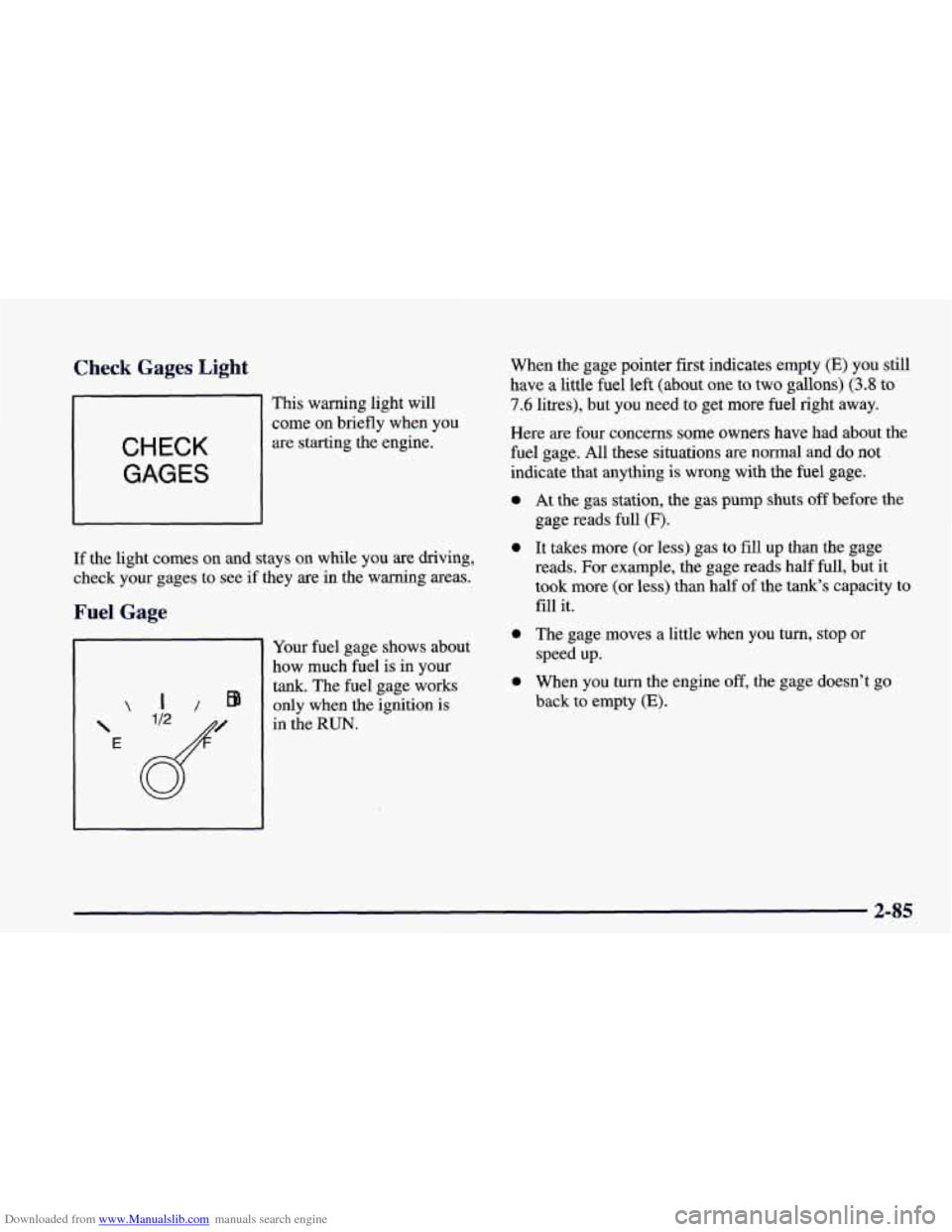
Downloaded from www.Manualslib.com manuals search engine Check Gages Light
CHECK
GAGES
This warning light will
come on briefly when you
are starting the engine.
If the light comes on and stays on while you are driving,
check your gages to see if they are in the warning areas.
Fuel Gage
Your fuel gage shows about
how much fuel is in your
tank. The fuel gage works
only when the ignition is
in the
RUN.
When the gage pointer first indicates empty (E) you still
have a little fuel left (about one to two gallons)
(3.8 to
7.6 litres), but you need to get more fuel right away.
Here are four concerns some owners have had about the
fuel gage. All these situations are normal and do not
indicate that anything
is wrong with the fuel gage.
0 At the gas station, the gas pump shuts off before the
gage reads full
(F).
0 It takes more (or less) gas to fill up than the gage
reads. For example, the gage reads half full, but it
took more (or less) than half of the tank’s capacity to
fill it.
0 The gage moves a little when you turn, stop or
speed up.
0 When you turn the engine off, the gage doesn’t go
back to empty (E).
2-85
Page 187 of 402
Downloaded from www.Manualslib.com manuals search engine Anti-Lock Brakes (ABS)
Your vehicle has anti-lock brakes (ABS). ABS is an
advanced electronic braking system that will help
prevent
a braking skid.
When you start your engine, or when
you begin to drive
away, your anti-lock brake system will check itself. You
may hear a momentary motor or clicking noise while
this test is going on, and you may even notice that your
brake pedal moves or pulses
a little. This is normal.
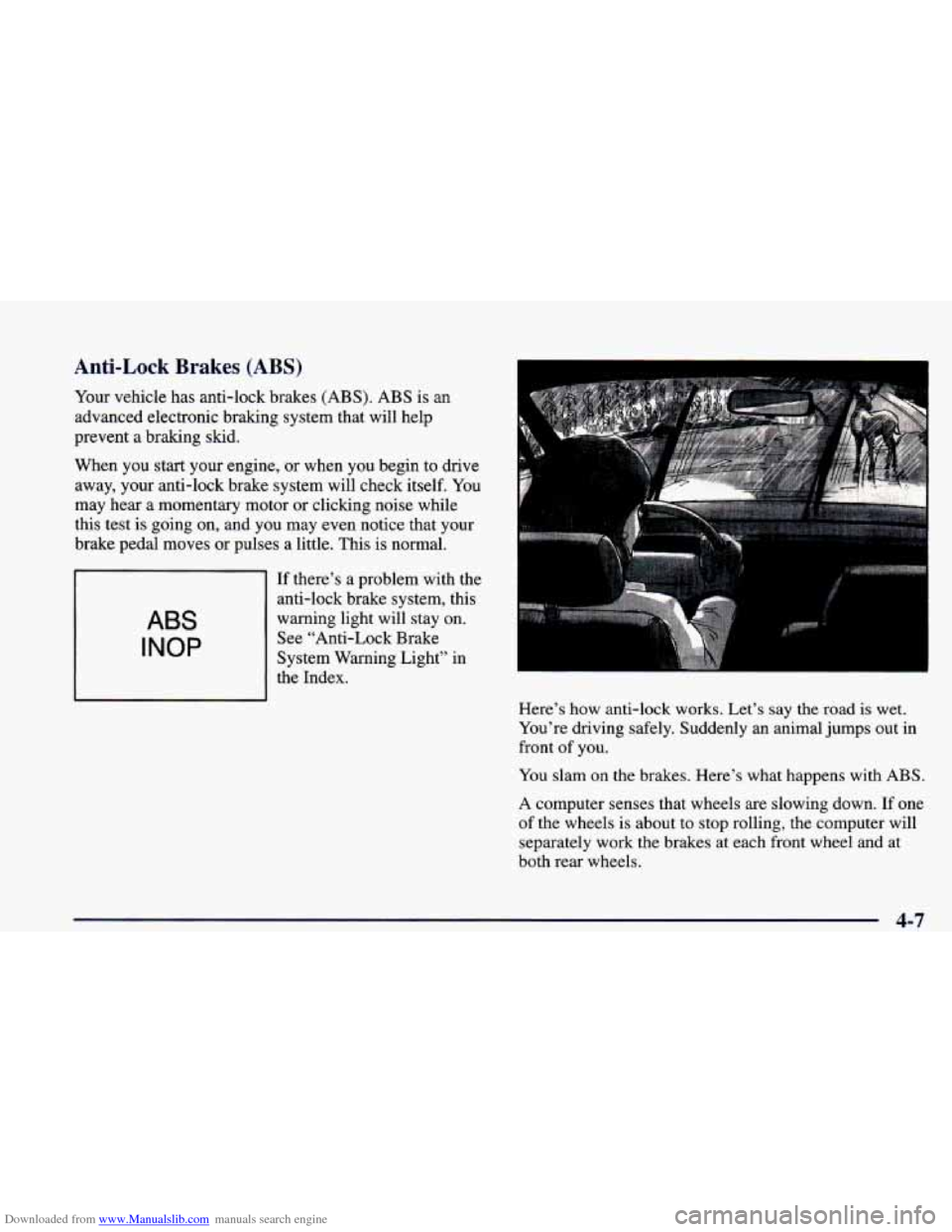
ABS
INOP
If there’s a problem with the
anti-lock brake system, this
warning light will stay on.
See “Anti-Lock Brake
System Warning Light” in
the Index.
Here’s how anti-lock works. Let’s say the road
is wet.
You’re driving safely. Suddenly an animal jumps out in
front
of you.
You slam on the brakes. Here’s what happens with ABS.
A computer senses that wheels are slowing down. If one
of the wheels is about to stop rolling, the computer will
separately work the brakes at each front wheel and at
both rear wheels.
4-7
Page 189 of 402
Downloaded from www.Manualslib.com manuals search engine ASR (Acceleration Slip Regulation) System
(Option:
V8 Engine)
Your vehicle may have a traction control system called
ASR that limits wheel spin. This is especially useful in
slippery road conditions. The system operates only if it
senses that one or both of the rear wheels are spinning or
beginning to lose traction. When this happens, the
system works the rear brakes and reduces engine power
(by closing the throttle and managing engine spark) to
limit wheel spin.
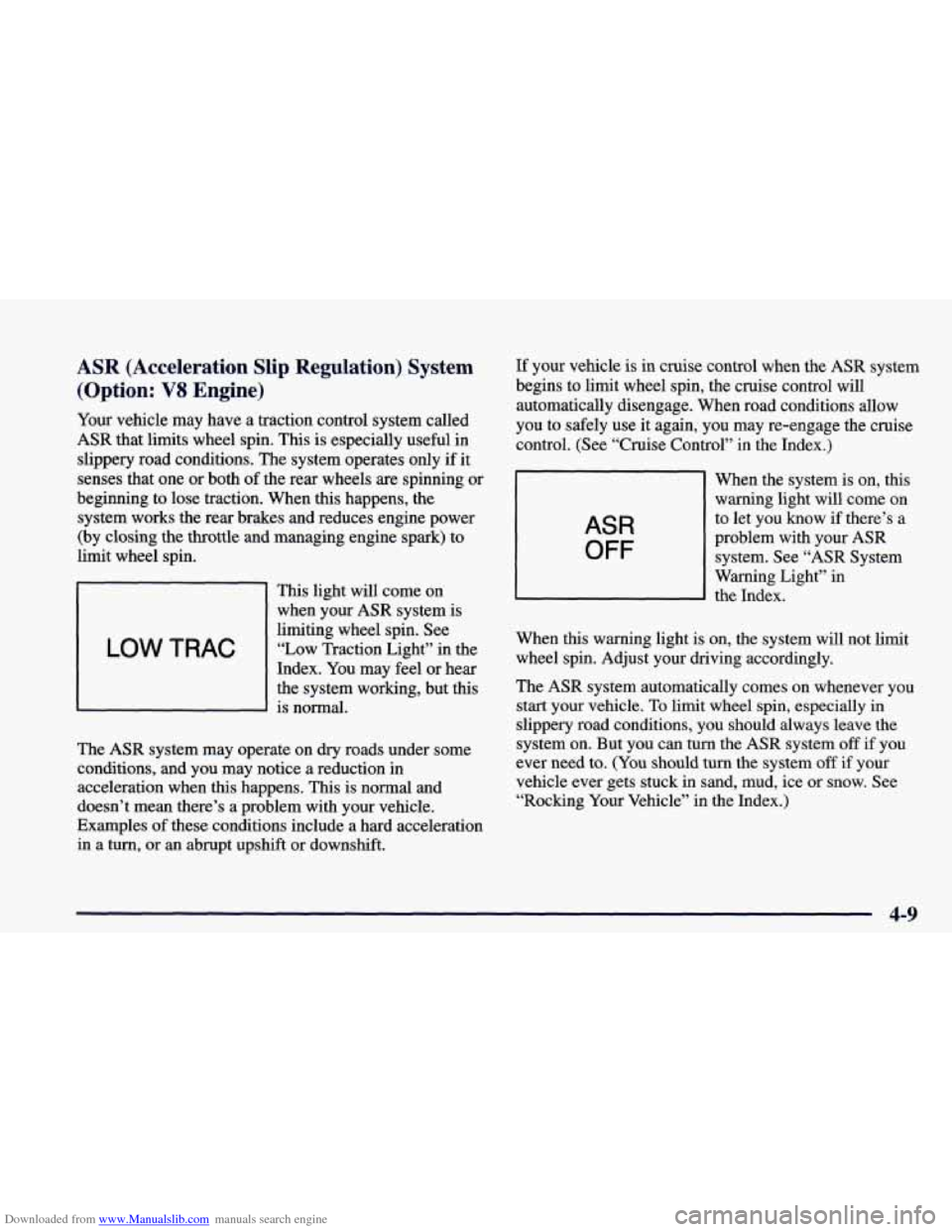
This light will come on
when your ASR system is
limiting wheel spin. See
“Low Traction Light”
in the
Index.
You may feel or hear
the system working, but this
is normal.
The ASR system may operate on
dry roads under some
conditions, and you may notice a reduction in
acceleration when this happens. This is normal and
doesn’t mean there’s a problem with your vehicle.
Examples
of these conditions include a hard acceleration
in a turn, or an abrupt upshift or downshift.
If your vehicle is in cruise control when the ASR system
begins to limit wheel spin, the cruise control will
automatically disengage. When road conditions allow
you to safely use it again, you may re-engage the cruise
control. (See “Cruise Control”
in the Index.)
ASR
OFF
When the system is on, this
warning light will come on
to let you know
if there’s a
problem with your
ASR
system. See “ASR System
Warning Light” in
the Index.
When this warning light is on, the system will not limit
wheel spin. Adjust your driving accordingly.
The ASR system automatically comes on whenever you
start your vehicle. To
limit wheel spin, especially in
slippery road conditions, you should always leave the
system on. But you can turn the ASR system off
if you
ever need to.
(You should turn the system off if your
vehicle ever gets stuck in sand, mud, ice or snow. See
“Rocking Your Vehicle’’ in the Index.)
4-9
Page 190 of 402
Downloaded from www.Manualslib.com manuals search engine 1
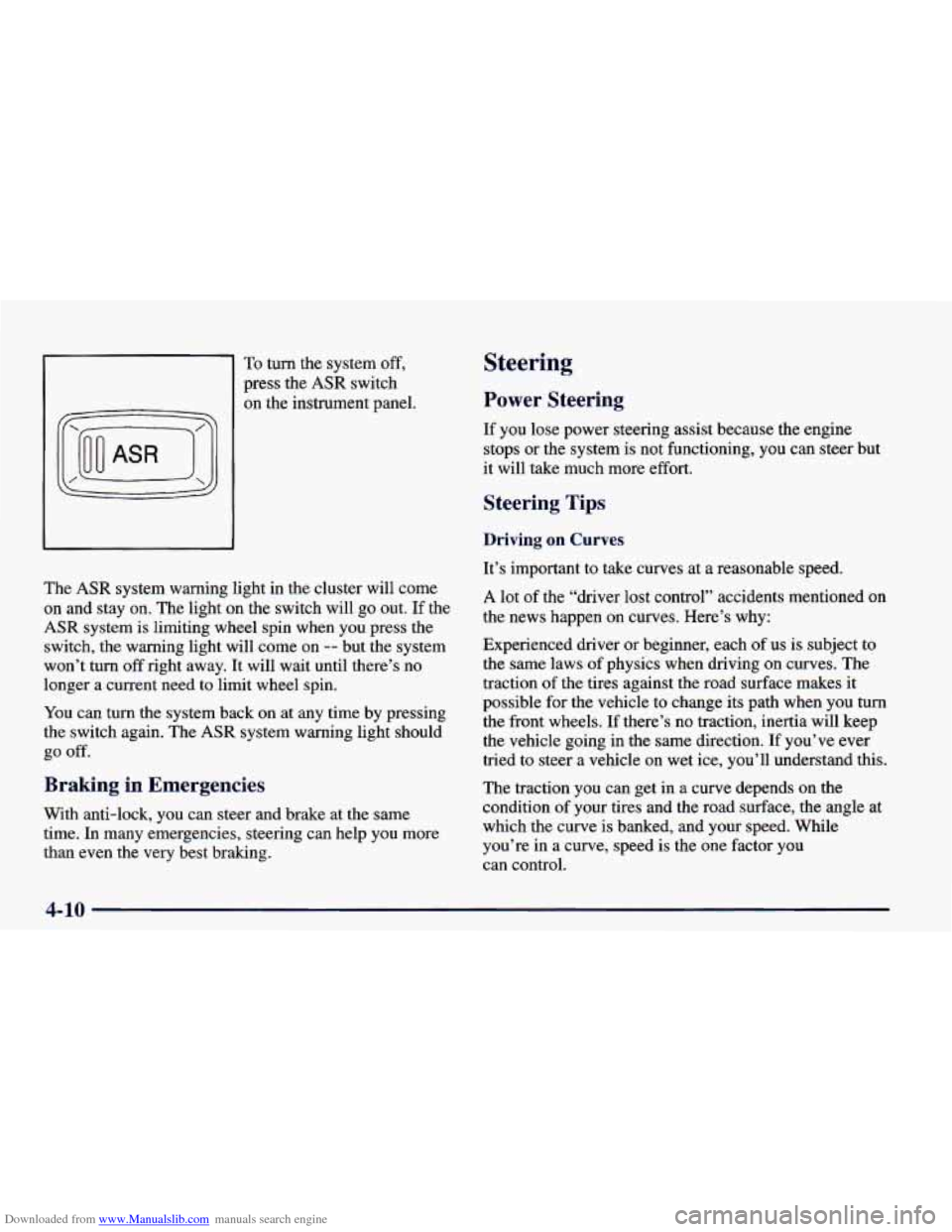
To turn the system off,
press the ASR switch
The
ASR system warning light in the cluster will come
on and stay
on. The light on the switch will go out. If the
ASR system is limiting wheel spin when you press the
switch, the warning light will come on
-- but the system
won’t turn off right away. It will wait until there’s no
longer a current need to limit wheel spin.
You can turn the system back on at any time by pressing
the switch again. The
ASR system warning light should
go off.
Braking in Emergencies
With anti-lock, you can steer and brake at the same
time. In many emergencies, steering can help you more
than even the very best braking.
Steering
Power Steering
If you lose power steering assist because the engine
stops or the system is not functioning, you can steer but
it will take much more effort.
Steering Tips
Driving on Curves
It’s important to take curves at a reasonable speed.
A lot of the “driver lost control” accidents mentioned on
the news happen on curves. Here’s why:
Experienced driver or beginner, each of us is subject to
the same laws of physics when driving on curves. The
traction of the tires against the road surface makes it
possible for the vehicle to change its path when you turn
the front wheels. If there’s no traction, inertia will keep
the vehicle going in the same direction. If
you’ve ever
tried to steer a vehicle on wet ice, you’ll understand this.
The traction you can get in a curve depends on the
condition
of your tires and the road surface, the angle at
which the curve is banked, and your speed. While
you’re in a curve, speed is the one factor you
can control.
4-10
Page 200 of 402
Downloaded from www.Manualslib.com manuals search engine Here are ways to increase your safety in city driving:
0
0
0
Know the best way to get to where you are going.
Get a city map and plan your trip into an unknown
part of the city just as you would for a
cross-country trip.
Try to use the freeways that rim and crisscross most
large cities. You’ll save time and energy. (See the
next part, “Freeway Driving.”)
Treat a green light as a warning signal.
A traffic light
is there because the corner
is busy enough to need it.
When a light turns green, and just before
you start to
move, check both ways for vehicles that have not
cleared the intersection or may be running the
red light.
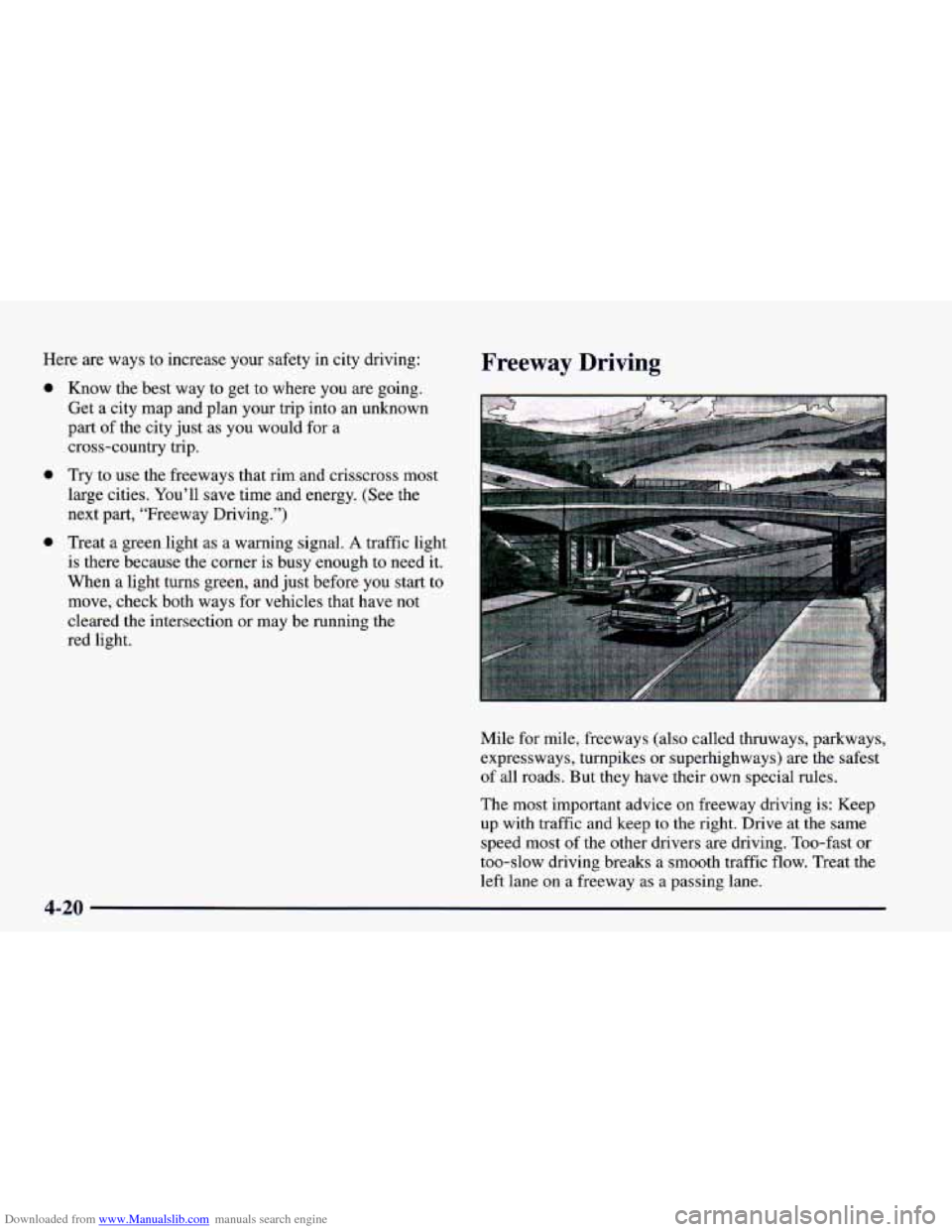
Freeway Driving
Mile for mile, freeways (also called thruways, parkways,
expressways, turnpikes or superhighways) are the safest
of all roads. But they have their own special rules.
The most important advice on freeway driving is: Keep
up with traffic and keep
to the right. Drive at the same
speed most
of the other drivers are driving. Too-fast or
too-slow driving breaks a smooth traffic flow. Treat the
left lane on a freeway as a passing lane.
Page 205 of 402
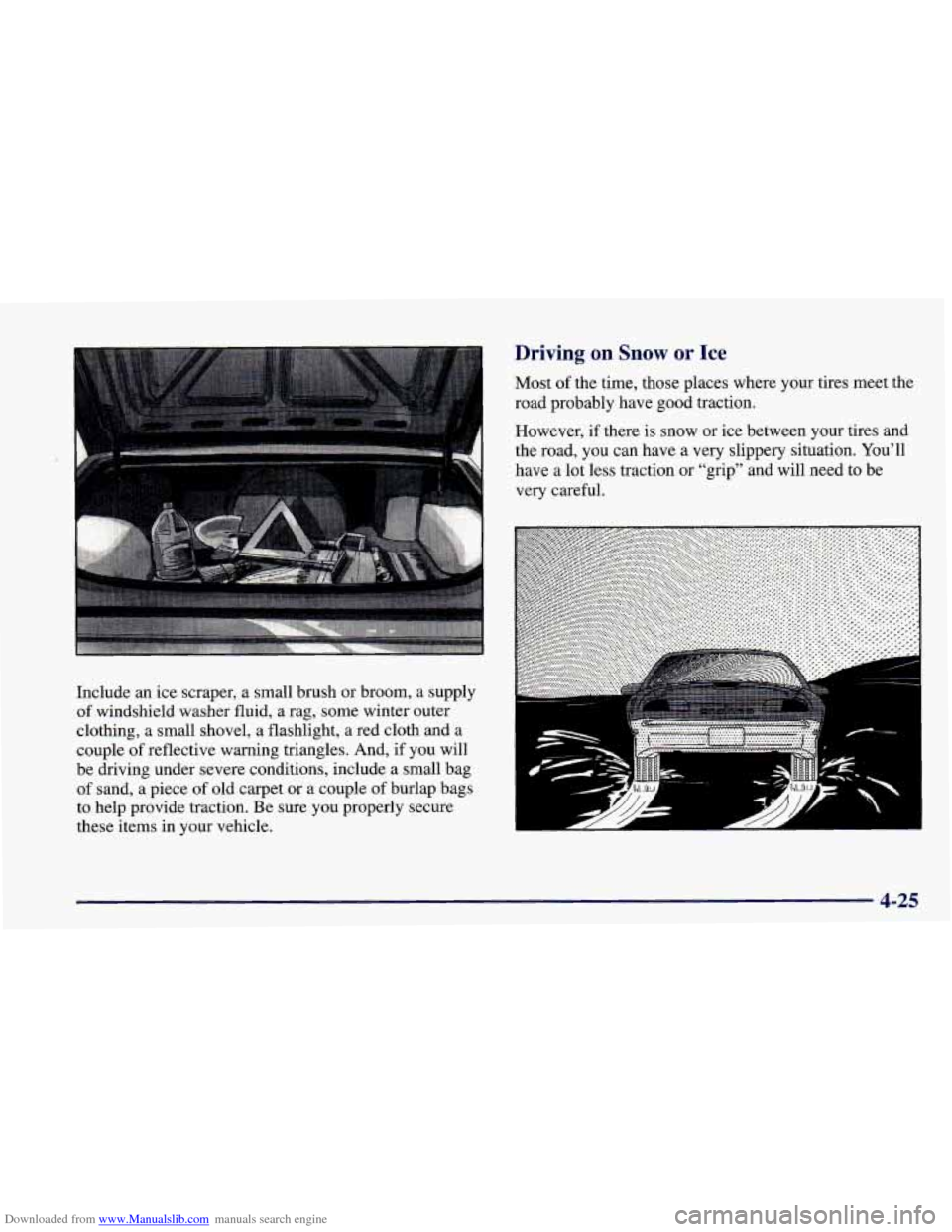
Downloaded from www.Manualslib.com manuals search engine Include an ice scraper, a small brush or broom, a supply
of windshield washer fluid, a rag, some winter outer
clothing, a small shovel, a flashlight, a red cloth and a
couple of reflective warning triangles. And, if you will be driving under severe conditions, include a small bag
of sand, a piece
of old carpet or a couple of burlap bags
to help provide traction. Be sure you properly secure
these items in your vehicle.
Driving on Snow or Ice
Most of the time, those places where your tires meet the
road probably have good traction.
However, if there is snow or
ice between your tires and
the road, you can have a very slippery situation. You’ll
have a lot less traction or “grip” and will need to be
very careful.
4-25
Page 232 of 402
Downloaded from www.Manualslib.com manuals search engine Engine Overheating
You will find a coolant temperature gage on your
vehicle’s instrument panel. You may also find a low
coolant warning light on your vehicle’s instrument panel
(5.7L V8 Engine).
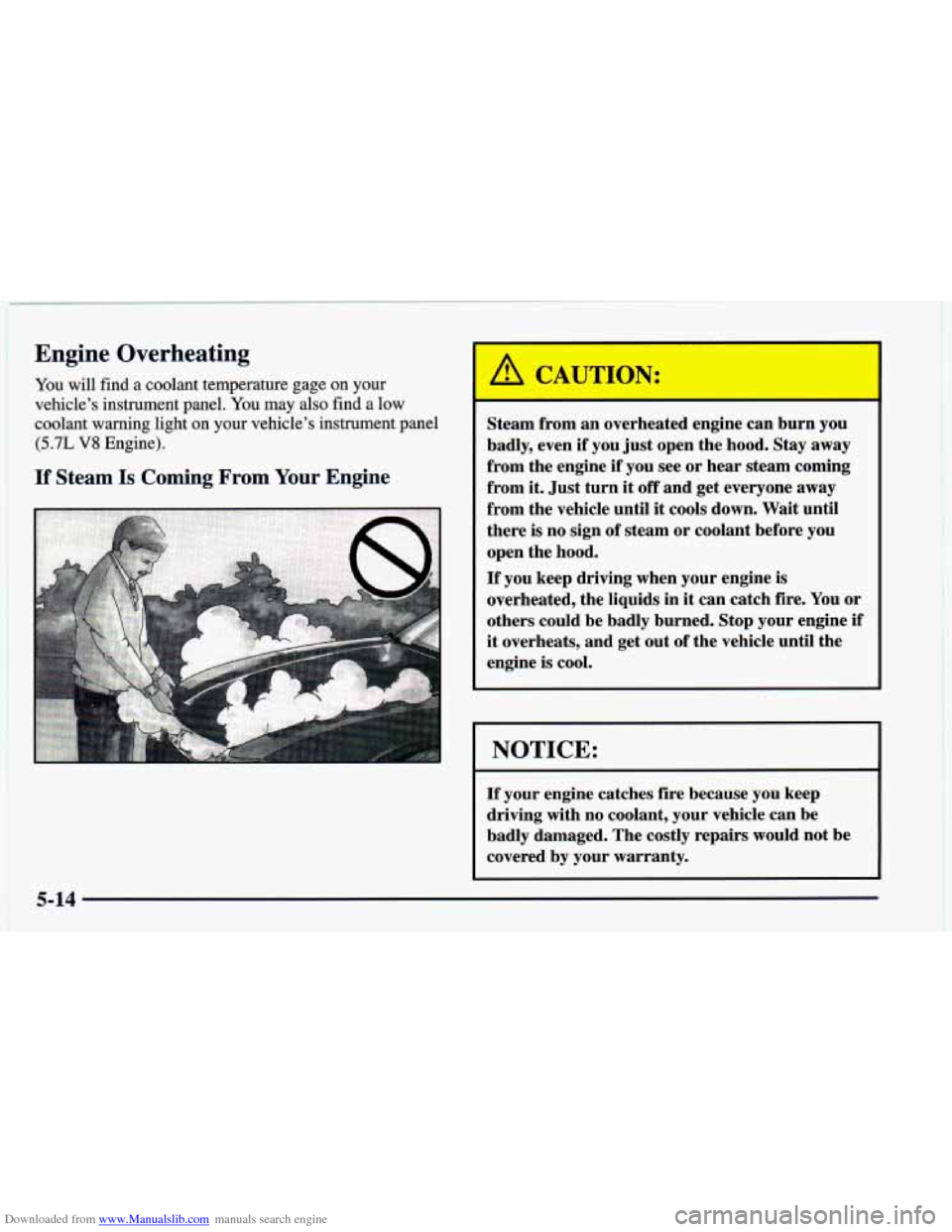
If Steam Is Coming From Your Engine
Steam from an overheated engine can burn you
badly, even if you just open the hood. Stay away
from the engine
if you see or hear steam coming
from it. Just turn
it off and get everyone away
from the vehicle until
it cools down. Wait until
there is no sign of steam or coolant before you
open the hood.
If you keep driving when your engine is
overheated, the liquids in
it can catch fire. You or
others could be badly burned. Stop your engine
if
it overheats, and get out of the vehicle until the
engine is cool.
NOTICE:
If your engine catches fire because you keep
driving
with no coolant, your vehicle can be
badly damaged. The costly repairs would not be
covered by your warranty.
5-14
Page 285 of 402
Downloaded from www.Manualslib.com manuals search engine A 50/50 mixture of water and DEX-COOL@ coolant will:
0 Give freezing protection down to -34°F (-37°C).
0 Give boiling protection up to 265°F (129°C).
0 Protect against rust and corrosion.
0 Help keep the proper engine temperature.
0 Let the warning lights and gages work as
they should.
NOTICE:
When adding coolant, it is important that you use
only
DEX-COOL@ (silicate-free) coolant.
If coolant other than DEX-COOL is added to
the system, premature engine, heater core
or
radiator corrosion may result. In addition, the
engine coolant
will require change sooner -- at
30,000 miles (50 000 km) or 24 months,
whichever occurs first. Damage caused
by the
use
of coolant other than DEX-COOL@ is not
covered by your new vehicle warranty.
What to Use
Use a mixture of one-half clean water (preferably
distilled)
and one-half DEX-COOL’ coolant which
won’t damage aluminum parts.
If you use this mixture,
you don’t need to add anything else.
Adding only plain water to your cooling system
can be dangerous. Plain water,
or some other
liquid like alcohol, can boil before the proper
coolant mixture will. Your vehicle’s coolant
warning system is set for the proper coolant
mixture. With plain water
or the wrong mixture,
your engine could get too hot but you wouldn’t
get the overheat warning. Your engine could
catch fire and you or others could be burned.
Use a
50/50 mixture of clean water and
DEX-COOL@ coolant.
6-27
Page 385 of 402
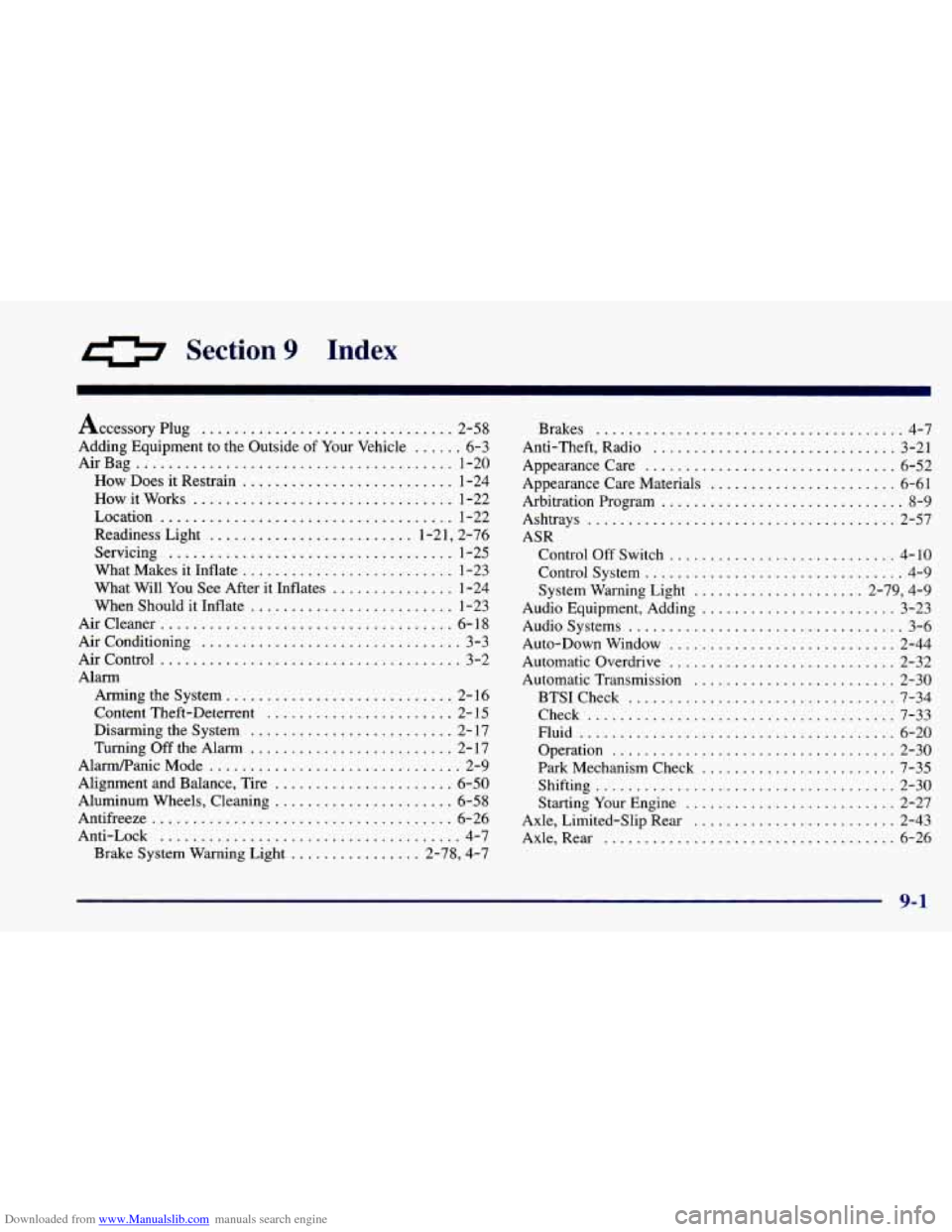
Downloaded from www.Manualslib.com manuals search engine 0 Section 9 Index
Accessory Plug ............................... 2-58
AirBag
....................................... 1-20
How Does it Restrain .......................... 1-24
How it Works ................................ 1-22
Location
.................................... 1-22
Readiness Light
......................... 1-21, 2-76
Servicing
................................... 1-25
What Makes it Inflate
.......................... 1-23
What Will You See After it Inflates
............... 1-24
When Should it Inflate
......................... 1-23
Air Cleaner
.................................... 6- 18
Air Conditioning
................................ 3-3
Aircontrol ..................................... 3-2
Alarm
Arming the System
............................ 2-16
Content Theft-Deterrent
....................... 2- 15
Disarming the System ......................... 2- 17
Turning
Off the Alarm ......................... 2-17
AlarmPanicMode
............................... 2-9
Alignment and Balance, Tire
...................... 6-50
Aluminum Wheels, Cleaning
...................... 6-58
Antifreeze
..................................... 6-26
Anti-Lock
..................................... 4-7
Brake System Warning Light
................ 2-78, 4-7
Adding Equipment to the Outside
of Your Vehicle ...... 6-3
Brakes
...................................... 4-7
Anti.Theft. Radio
..............................
Control Off Switch ............................ 4-10
Control System
................................ 4-9
System Warning Light
..................... 2.79. 4.9
Audio Equipment. Adding
........................ 3-23
Audio Systems
.................................. 3-6
Auto-Down Window
............................ 2-44
Automatic Overdrive
............................ 2-32
Automatic Transmission
......................... 2-30
BTSICheck
................................. 7-34
Check
...................................... 7-33
Fluid
....................................... 6-20
Operation
................................... 2-30
Park Mechanism Check
........................ 7-35
Shifting
..................................... 2-30
Starting Your Engine
.......................... 2-27
Axle, Limited-Slip Rear
......................... 2-43
Axle, Rear
.................................... 6-26
9-1