ECU CHEVROLET CAMARO 2010 5.G Owner's Guide
[x] Cancel search | Manufacturer: CHEVROLET, Model Year: 2010, Model line: CAMARO, Model: CHEVROLET CAMARO 2010 5.GPages: 378, PDF Size: 5.75 MB
Page 127 of 378
Black plate (45,1)Chevrolet Camaro Owner Manual - 2010
Instruments and Controls 4-45
Keep the original hand-held
transmitter for use in other vehicles
as well as for future Universal Home
Remote programming. It is also
recommended that upon the sale
of the vehicle, the programmed
Universal Home Remote buttons
should be erased for security
purposes. See“Erasing Universal
Home Remote Buttons” later in this
section.
When programming a garage door,
park outside of the garage. Park
directly in line with and facing the
garage door opener motor-head
or gate motor-head. Be sure that
people and objects are clear of the
garage door or gate that is being
programmed.
It is recommended that a new
battery be installed in your
hand-held transmitter for quicker
and more accurate transmission
of the radio-frequency signal.Programming the Universal
Home Remote System
For questions or help programming
the Universal Home Remote
System, call 1‐800‐355‐3515
or go to www.homelink.com.
Programming a garage door opener
involves time-sensitive actions, so
read the entire procedure before
starting. Otherwise, the device will
time out and the procedure will have
to be repeated.
To program up to three devices:
1. Hold the end of your hand-held transmitter about 3 to 8 cm
(1 to 3 inches) away from the
Universal Home Remote buttons
while keeping the indicator
light in view. The hand-held
transmitter was supplied by
the manufacturer of your
garage door opener receiver
(motor-head unit). 2. At the same time, press and
hold both the hand-held
transmitter button and one
of the three Universal Home
Remote buttons to be used to
operate the garage door. Do not
release the Universal Home
Remote button or the hand-held
transmitter button until the
indicator light changes from a
slow to a rapidly flashing light.
You now may release both
buttons.
Some entry gates and garage
door openers may require
substitution of Step 2 with the
procedure noted in “Gate
Operator and Canadian
Programming” later in this
section.
Page 192 of 378
Black plate (16,1)Chevrolet Camaro Owner Manual - 2010
8-16 Driving and Operating
the weight of the vehicle, all
occupants, fuel, and cargo.
Never exceed the GVWR for
the vehicle, or the Gross Axle
Weight Rating (GAWR) for either
the front or rear axle.
And, if there is a heavy load,
it should be spread out. See
“Steps for Determining Correct
Load Limit”earlier in this
section.
{WARNING
Do not load the vehicle any
heavier than the Gross
Vehicle Weight Rating
(GVWR), or either the
maximum front or rear Gross
Axle Weight Rating (GAWR).
If you do, parts on the vehicle
can break, and it can change
the way the vehicle handles.
These could cause you to
(Continued)
WARNING (Continued)
lose control and crash. Also,
overloading can shorten the
life of the vehicle.
If you put things inside the
vehicle —like suitcases,
tools, packages, or anything
else —they will go as fast as
the vehicle goes. If you have to
stop or turn quickly, or if there is
a crash, they will keep going.
{WARNING
Things you put inside the
vehicle can strike and injure
people in a sudden stop or
turn, or in a crash.
.Put things in the cargo
area of the vehicle. In the
cargo area, put them as
(Continued)
WARNING (Continued)
far forward as you can.
Try to spread the weight
evenly.
.Never stack heavier
things, like suitcases,
inside the vehicle so that
some of them are above
the tops of the seats.
.Do not leave an
unsecured child restraint
in the vehicle.
.When you carry something
inside the vehicle, secure
it whenever you can.
.Do not leave a seat folded
down unless you need to.
Page 226 of 378
Black plate (50,1)Chevrolet Camaro Owner Manual - 2010
8-50 Driving and Operating
.Vehicles with automatic
transmissions can tow in
D (Drive) but M (ManualMode) is recommended.
See “Manual Mode” inAutomatic
Transmission
on page 8‑26for
more information. Use a lower
gear if the transmission shifts
too often. For vehicles with a
manual transmission, it is better
not to use the highest gear.
.Use the cruise control when
towing.
.Obey speed limit restrictions.
Do not drive faster than the
maximum posted speed for
trailers, or no more than 90 km/h
(55 mph), to reduce wear on the
vehicle.
Driving with a Trailer
Towing a trailer requires experience.
Get familiar with handling and
braking with the added trailer
weight. The vehicle is now longer
and not as responsive as the
vehicle is by itself.
Check all trailer hitch parts and
attachments, safety chains,
electrical connectors, lamps, tires
and mirror adjustments. If the trailer
has electric brakes, start the vehicle
and trailer moving and then apply
the trailer brake controller by hand
to be sure the brakes are working.
During the trip, check regularly to be
sure that the load is secure, and the
lamps and trailer brakes are working
properly.
Towing with a Stability Control
System
When towing, the sound of the
stability control system might be
heard. The system is reacting to the
vehicle movement caused by the
trailer, which mainly occurs during
cornering. This is normal when
towing heavier trailers.
Following Distance
Stay at least twice as far behind the
vehicle ahead as you would when
driving the vehicle without a trailer.
This can help to avoid situations
that require heavy braking and
sudden turns.
Passing
More passing distance is needed
when towing a trailer. Because the
rig is longer, it is necessary to go
much farther beyond the passed
vehicle before returning to the lane.
Page 251 of 378
Black plate (19,1)Chevrolet Camaro Owner Manual - 2010
Vehicle Care 9-19
Use a 50/50 mixture of clean,
drinkable water and DEX-COOL®
coolant. If using this mixture,
nothing else needs to be added.
This mixture:
.Gives freezing protection down
to−37°C (−34°F), outside
temperature.
.Gives boiling protection up
to 129°C (265°F), engine
temperature.
.Protects against rust and
corrosion.
.Will not damage aluminum parts.
.Helps keep the proper engine
temperature.
Notice: If an improper coolant
mixture is used, the engine could
overheat and be badly damaged.
The repair cost would not be
covered by the vehicle warranty.
Too much water in the mixture
can freeze and crack the engine,
radiator, heater core, and other
parts.
Checking Coolant
The vehicle must be on a level
surface when checking the coolant
level.
Check coolant as follows:
1. Turn the ignition OFF.
2. Locate the coolant recovery bottle. See Engine Compartment
Overview on page 9‑6.
3. Turn the coolant dipstick cap counterclockwise and slowly pull
out the dipstick.
4. There are maximum andminimum markings on the
dipstick. When the engine is
cold, the coolant level should be
at or above the MIN mark on the
dipstick. After the vehicle has
been driven and the engine is at
normal operating temperature,
the level should be somewhere
between half full and the
maximum mark.
5. If the coolant level is correct, replace the dipstick and turn the
cap clockwise to secure.
Page 252 of 378
Black plate (20,1)Chevrolet Camaro Owner Manual - 2010
9-20 Vehicle Care
How to Add Coolant to the
Coolant Recovery Bottle
{WARNING
You can be burned if you spill
coolant on hot engine parts.
Coolant contains ethylene glycol
and it will burn if the engine parts
are hot enough. Do not spill
coolant on a hot engine.
Notice: This vehicle has a
specific coolant fill procedure.
Failure to follow this procedure
could cause the engine to
overheat and be severely
damaged. Notice:
If an improper coolant
mixture is used, the engine could
overheat and be badly damaged.
The repair cost would not be
covered by the vehicle warranty.
Too much water in the mixture
can freeze and crack the engine,
radiator, heater core, and other
parts.
Add coolant as follows:
1. Turn the coolant overflow bottle
dipstick cap counterclockwise
and slowly pull out the dipstick.
2. Pour the coolant into the coolant recovery bottle.
3. When the level is correct, replace the dipstick and turn
the cap clockwise to secure.
How to Add Coolant to the
Radiator
{WARNING
You can be burned if you spill
coolant on hot engine parts.
Coolant contains ethylene glycol
and it will burn if the engine parts
are hot enough. Do not spill
coolant on a hot engine.
Notice: This vehicle has a
specific coolant fill procedure.
Failure to follow this procedure
could cause the engine to
overheat and be severely
damaged.
Page 255 of 378
Black plate (23,1)Chevrolet Camaro Owner Manual - 2010
Vehicle Care 9-23
3. If there is no coolant visible orthe level is low, slowly fill the
system through the radiator cap
opening with a 50/50 mixture of
clean, drinkable water and a
DEX-COOL
®coolant until full.
Wait 30 seconds for coolant to
settle and top off if the level
drops.
Do not spill coolant on the
accessory drive belts.
If a spill occurs, rinse the belt
with fresh water.
4. Start the engine.
5. With the engine idling, top off the coolant through the radiator cap
opening until full.
Wait 30 seconds for the coolant
to settle and top off, if the level
drops.
6. Once the system is full, put the radiator cap back on by turning
clockwise. 7. Turn the engine OFF.
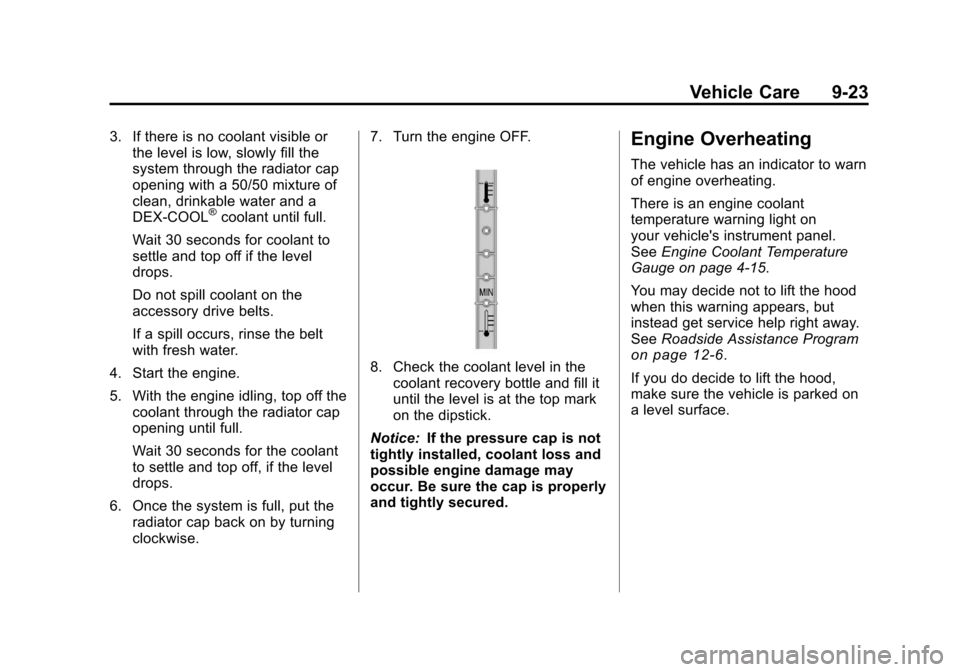
8. Check the coolant level in the
coolant recovery bottle and fill it
until the level is at the top mark
on the dipstick.
Notice: If the pressure cap is not
tightly installed, coolant loss and
possible engine damage may
occur. Be sure the cap is properly
and tightly secured.
Engine Overheating
The vehicle has an indicator to warn
of engine overheating.
There is an engine coolant
temperature warning light on
your vehicle's instrument panel.
See Engine Coolant Temperature
Gauge on page 4‑15.
You may decide not to lift the hood
when this warning appears, but
instead get service help right away.
See Roadside Assistance Program
on page 12‑6.
If you do decide to lift the hood,
make sure the vehicle is parked on
a level surface.
Page 317 of 378
Black plate (85,1)Chevrolet Camaro Owner Manual - 2010
Vehicle Care 9-85
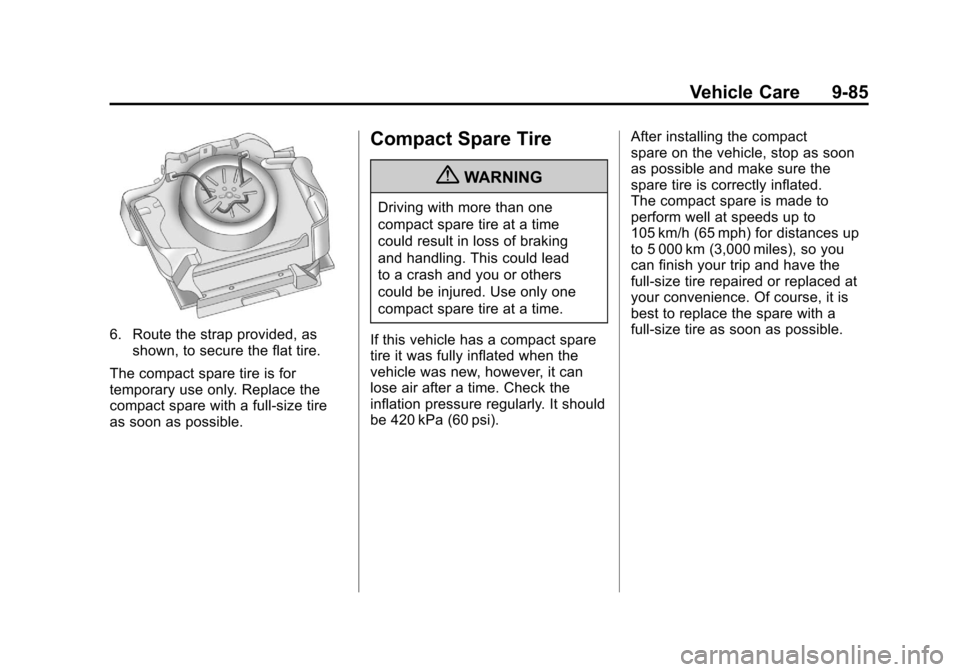
6. Route the strap provided, asshown, to secure the flat tire.
The compact spare tire is for
temporary use only. Replace the
compact spare with a full-size tire
as soon as possible.
Compact Spare Tire
{WARNING
Driving with more than one
compact spare tire at a time
could result in loss of braking
and handling. This could lead
to a crash and you or others
could be injured. Use only one
compact spare tire at a time.
If this vehicle has a compact spare
tire it was fully inflated when the
vehicle was new, however, it can
lose air after a time. Check the
inflation pressure regularly. It should
be 420 kPa (60 psi). After installing the compact
spare on the vehicle, stop as soon
as possible and make sure the
spare tire is correctly inflated.
The compact spare is made to
perform well at speeds up to
105 km/h (65 mph) for distances up
to 5 000 km (3,000 miles), so you
can finish your trip and have the
full-size tire repaired or replaced at
your convenience. Of course, it is
best to replace the spare with a
full-size tire as soon as possible.
Page 355 of 378
Black plate (7,1)Chevrolet Camaro Owner Manual - 2010
Customer Information 12-7
Chevrolet and General Motors of
Canada Limited reserve the right to
limit services or payment to an
owner or driver if they decide the
claims are made too often, or the
same type of claim is made many
times.
Services Provided
.Emergency Fuel Delivery:
Delivery of enough fuel for the
vehicle to get to the nearest
service station.
.Lock‐Out Service:Service to
unlock the vehicle if you are
locked out. A remote unlock
may be available if you have
OnStar
®. For security reasons,
the driver must present
identification before this
service is given.
.Emergency Tow From a Public
Road or Highway: Tow to the
nearest Chevrolet dealer for
warranty service, or if the vehicle
was in a crash and cannot be driven. Assistance is also given
when the vehicle is stuck in the
sand, mud, or snow.
.Flat Tire Change:
Service to
change a flat tire with the spare
tire. The spare tire, if equipped,
must be in good condition and
properly inflated. It is the owner's
responsibility for the repair or
replacement of the tire if it is not
covered by the warranty.
.Battery Jump Start: Service to
jump start a dead battery.
Services Not Included in
Roadside Assistance
.Impound towing caused by
violation of any laws.
.Legal fines.
.Mounting, dismounting,
or changing of snow tires,
chains, or other traction devices.
.Towing or services for vehicles
driven on a non-public road or
highway.
Services Specific to Canadian
Purchased Vehicles
.Fuel Delivery: Reimbursement
is approximately $5 Canadian.
Diesel fuel delivery may be
restricted. Propane and other
fuels are not provided through
this service.
.Lock-Out Service: Vehicle
registration is required.
.Trip Routing Service: Detailed
maps of North America are
provided when requested either
with the most direct route or the
most scenic route. There is a
limit of six requests per year.
Additional travel information is
also available. Allow three
weeks for delivery.
Page 365 of 378
Black plate (17,1)Chevrolet Camaro Owner Manual - 2010
Customer Information 12-17
Radio Frequency
Identification (RFID)
RFID technology is used in some
vehicles for functions such as tire
pressure monitoring and ignition
system security, as well as in
connection with conveniences
such as key fobs for remote door
locking/unlocking and starting, and
in-vehicle transmitters for garage
door openers. RFID technology in
GM vehicles does not use or record
personal information or link with
any other GM system containing
personal information.
Radio Frequency
Statement
This vehicle has systems that
operate on a radio frequency that
comply with Part 15 of the Federal
Communications Commission (FCC)
rules and Industry Canada
Standards RSS-210/220/310.
Operation is subject to the following
two conditions:
1. The device may not causeinterference.
2. The device must accept any interference received, including
interference that may cause
undesired operation of the
device.
Changes or modifications to any of
these systems by other than an
authorized service facility could void
authorization to use this equipment.
Page 368 of 378

Black plate (2,1)Chevrolet Camaro Owner Manual - 2010
i-2 INDEX
B
Battery . . . . . . . . . . . . . . . . . . . . . . . . 9-29Jump Starting . . . . . . . . . . . . . . . . . 9-86
Load Management . . . . . . . . . . . . . 5-6
Power Protection . . . . . . . . . . . . . . 5-7
Voltage and ChargingMessages . . . . . . . . . . . . . . . . . . . 4-31
Blade Replacement, Wiper . . . . 9-32
Bluetooth . . . . . . . . . . 6-21, 6-22, 6-25
Brakes . . . . . . . . . . . . . . . . . . . . . . . . . 9-27 Antilock . . . . . . . . . . . . . . . . . . . . . . . 8-31
Assist . . . . . . . . . . . . . . . . . . . . . . . . . 8-33
Fluid . . . . . . . . . . . . . . . . . . . . . . . . . . 9-28
Parking . . . . . . . . . . . . . . . . . . . . . . . 8-32
System Messages . . . . . . . . . . . . 4-32
Braking . . . . . . . . . . . . . . . . . . . . . . . . . 8-4
Break-In, New Vehicle . . . . . . . . . 8-17
Bulb Replacement . . . . . . . . . . . . . 9-41
Fog Lamps . . . . . . . . . . . . . . . . . . . 9-40
Halogen Bulbs . . . . . . . . . . . . . . . . 9-36
Headlamp Aiming . . . . . . . . . . . . . 9-33
Headlamps . . . . . . . . . . . . . . . . . . . 9-36
Headlamps, FrontTurn Signal and
Parking Lamps . . . . . . . . 9-37, 9-38 Bulb Replacement (cont.)
High Intensity Discharge
(HID) Lighting . . . . . . . . . . . . . . . 9-36
License Plate Lamps . . . . . . . . . 9-41
Taillamps, Turn Signal and
Stoplamps . . . . . . . . . . . . . . . . . . 9-40
Buying New Tires . . . . . . . . . . . . . . 9-65
C
Calibration . . . . . . . . . . . . . . . . . . . . . . 4-8
California Fuel Requirements . . . . . . . . . . . 8-45
Perchlorate MaterialsRequirements . . . . . . . . . . . . . . . . 9-3
Warning . . . . . . . . . . . . . . . . . . . . . . . 9-3
Canadian Vehicle Owners . . . . . . . . iii
Capacities and
Specifications . . . . . . . . . . . . . . . . 11-2
Carbon Monoxide Engine Exhaust . . . . . . . . . . . . . . . 8-25
Trunk . . . . . . . . . . . . . . . . . . . . . . . . . . 1-8
Winter Driving . . . . . . . . . . . . . . . . 8-10
Cautions, Danger, and Warnings . . . . . . . . . . . . . . . . . . . . . . . . iv
CD Player . . . . . . . . . . . . . . . . . . . . . 6-14
Center Console Storage . . . . . . . . 3-1 Chains, Tire . . . . . . . . . . . . . . . . . . . 9-71
Charging System Light . . . . . . . . 4-20
Check
Engine Light . . . . . . . . . . . . . . . . . . 4-20
Ignition Transmission Lock . . . 9-32
Child Restraints Infants and Young
Children . . . . . . . . . . . . . . . . . . . . . 2-39
Lower Anchors and Tethers for Children . . . . . . . . . 2-45
Older Children . . . . . . . . . . . . . . . . 2-36
Securing . . . . . . . . . . . . . . . . 2-50, 2-52
Systems . . . . . . . . . . . . . . . . . . . . . . 2-41
Where to Put the Restraint . . . 2-43
Circuit Breakers . . . . . . . . . . . . . . . 9-42
Cleaning Exterior Care . . . . . . . . . . . . . . . . . 9-90
Interior Care . . . . . . . . . . . . . . . . . . 9-95
Climate Control Systems . . . . . . . 7-1
Clock . . . . . . . . . . . . . . . . . . . . . . . . . . . 4-8
Cluster, IP . . . . . . . . . . . . . . . . . . . . . 4-11
Clutch, Hydraulic . . . . . . . . . . . . . . 9-15
Collision Damage Repair . . . . . 12-10
Compact Spare Tire . . . . . . . . . . . 9-85
Compass . . . . . . . . . . . . . . . . . . . . . . . 4-8
Compass Messages . . . . . . . . . . . 4-32