roof CHEVROLET CAMARO 2011 5.G User Guide
[x] Cancel search | Manufacturer: CHEVROLET, Model Year: 2011, Model line: CAMARO, Model: CHEVROLET CAMARO 2011 5.GPages: 414, PDF Size: 6.24 MB
Page 74 of 414
Black plate (28,1)Chevrolet Camaro Owner Manual - 2011
3-28 Seats and Restraints
Your vehicle has seat-mounted side
impact airbags. Your vehicle may
or may not have roof-rail airbags.
SeeAirbag System on page 3‑23.
Seat-mounted side impact and
roof-rail airbags are intended to
inflate in moderate to severe side
crashes. In addition, these roof‐rail
airbags are intended to inflate in a
severe frontal impact. Seat-mounted
side impact and roof-rail airbags will
inflate if the crash severity is above
the system's designed threshold
level. The threshold level can vary
with specific vehicle design.
Seat-mounted side impact
airbags are not intended to
inflate in frontal impacts, near-frontal
impacts, rollovers, or rear impacts. A seat-mounted side impact airbag
is intended to deploy on the side of
the vehicle that is struck. Roof-rail
airbags are intended to deploy on
both sides in some high threshold
frontal impacts.
In any particular crash, no one
can say whether an airbag should
have inflated simply because of
the damage to a vehicle or because
of what the repair costs were.
For frontal airbags, inflation is
determined by what the vehicle hits,
the angle of the impact, and how
quickly the vehicle slows down.
For seat-mounted side impact and
roof-rail airbags, deployment is
determined by the location and
severity of the side impact.What Makes an Airbag
Inflate?
In a deployment event, the sensing
system sends an electrical signal
triggering a release of gas from the
inflator. Gas from the inflator fills the
airbag causing the bag to break out
of the cover and deploy. The inflator,
the airbag, and related hardware are
all part of the airbag module.
Frontal airbag modules are located
inside the steering wheel and
instrument panel. For vehicles with
seat-mounted side impact airbags,
there are airbag modules in the side
of the front seatbacks closest to
the door. For vehicles with roof-rail
airbags, there are airbag modules in
the ceiling of the vehicle, near the
side windows that have occupant
seating positions.
Page 75 of 414
Black plate (29,1)Chevrolet Camaro Owner Manual - 2011
Seats and Restraints 3-29
How Does an Airbag
Restrain?
In moderate to severe frontal or
near frontal collisions, even belted
occupants can contact the steering
wheel or the instrument panel.
In moderate to severe side
collisions, even belted occupants
can contact the inside of the
vehicle.
Airbags supplement the protection
provided by safety belts. Frontal
airbags distribute the force of the
impact more evenly over theoccupant's upper body, stopping
the occupant more gradually.
Seat-mounted side impact and
roof-rail airbags distribute the
force of the impact more evenly
over the occupant's upper body.
But airbags would not help in
many types of collisions, primarily
because the occupant's motion
is not toward those airbags. See
When Should an Airbag Inflate? on
page 3‑27
for more information.
Airbags should never be regarded
as anything more than a supplement
to safety belts.
What Will You See After
an Airbag Inflates?
After the frontal airbags and
seat-mounted side impact airbags
inflate, they quickly deflate, so
quickly that some people may not
even realize an airbag inflated.
Roof-rail airbags may still be at least
partially inflated for some time after
they deploy. Some components of
the airbag module may be hot for
several minutes. For location of the
airbag modules, see What Makes
an Airbag Inflate? on page 3‑28.
Page 77 of 414
Black plate (31,1)Chevrolet Camaro Owner Manual - 2011
Seats and Restraints 3-31
In many crashes severe enough
to inflate the airbag, windshields
are broken by vehicle deformation.
Additional windshield breakage
may also occur from the right front
passenger airbag.
.Airbags are designed to inflate
only once. After an airbag
inflates, you will need some
new parts for the airbag system.
If you do not get them, the
airbag system will not be there
to help protect you in another
crash. A new system will include
airbag modules and possibly
other parts. The service manual
for your vehicle covers the need
to replace other parts.
.The vehicle has a crash sensing
and diagnostic module which
records information after a
crash. SeeVehicle Data
Recording and Privacy on
page 13‑17 andEvent Data
Recorders on page 13‑17.
.Let only qualified technicians
work on the airbag systems.
Improper service can mean that
an airbag system will not work
properly. See your dealer for
service.
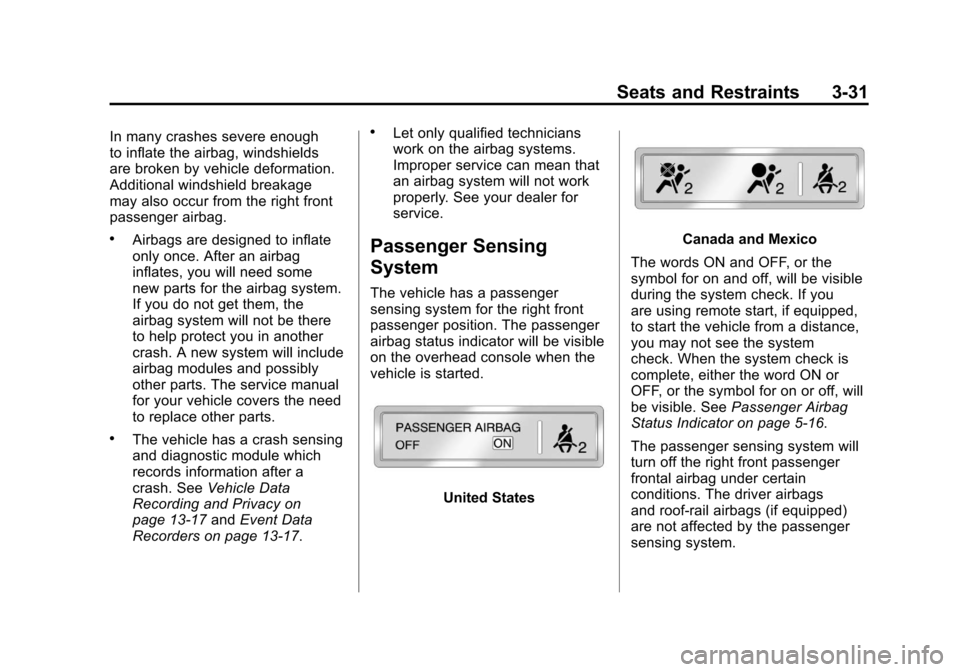
Passenger Sensing
System
The vehicle has a passenger
sensing system for the right front
passenger position. The passenger
airbag status indicator will be visible
on the overhead console when the
vehicle is started.
United States
Canada and Mexico
The words ON and OFF, or the
symbol for on and off, will be visible
during the system check. If you
are using remote start, if equipped,
to start the vehicle from a distance,
you may not see the system
check. When the system check is
complete, either the word ON or
OFF, or the symbol for on or off, will
be visible. See Passenger Airbag
Status Indicator on page 5‑16.
The passenger sensing system will
turn off the right front passenger
frontal airbag under certain
conditions. The driver airbags
and roof‐rail airbags (if equipped)
are not affected by the passenger
sensing system.
Page 82 of 414
Black plate (36,1)Chevrolet Camaro Owner Manual - 2011
3-36 Seats and Restraints
Servicing the
Airbag-Equipped Vehicle
Airbags affect how the vehicle
should be serviced. There are
parts of the airbag system in
several places around the vehicle.
Your dealer and the service manual
have information about servicing
the vehicle and the airbag system.
To purchase a service manual, see
Service Publications Ordering
Information on page 13‑15.
{WARNING
For up to 10 seconds after the
ignition is turned off and the
battery is disconnected, an airbag
can still inflate during improper
service. You can be injured if you
are close to an airbag when it
inflates. Avoid yellow connectors.
They are probably part of the
airbag system. Be sure to follow
proper service procedures, and
make sure the person performing
work for you is qualified to do so.
Adding Equipment to the
Airbag-Equipped Vehicle
Q: Is there anything I might addto or change about the vehicle
that could keep the airbags
from working properly?
A: Yes. If you add things that
change the vehicle's frame,
bumper system, height, front end
or side sheet metal, they may
keep the airbag system from
working properly. Changing or
moving any parts of the front
seats, safety belts, the airbag
sensing and diagnostic module,
steering wheel, instrument
panel, roof-rail airbag modules,
ceiling headliner or pillar garnish
trim, front sensors, side impact
sensors, or airbag wiring can
affect the operation of the airbag
system.
Page 308 of 414
Black plate (46,1)Chevrolet Camaro Owner Manual - 2011
10-46 Vehicle Care
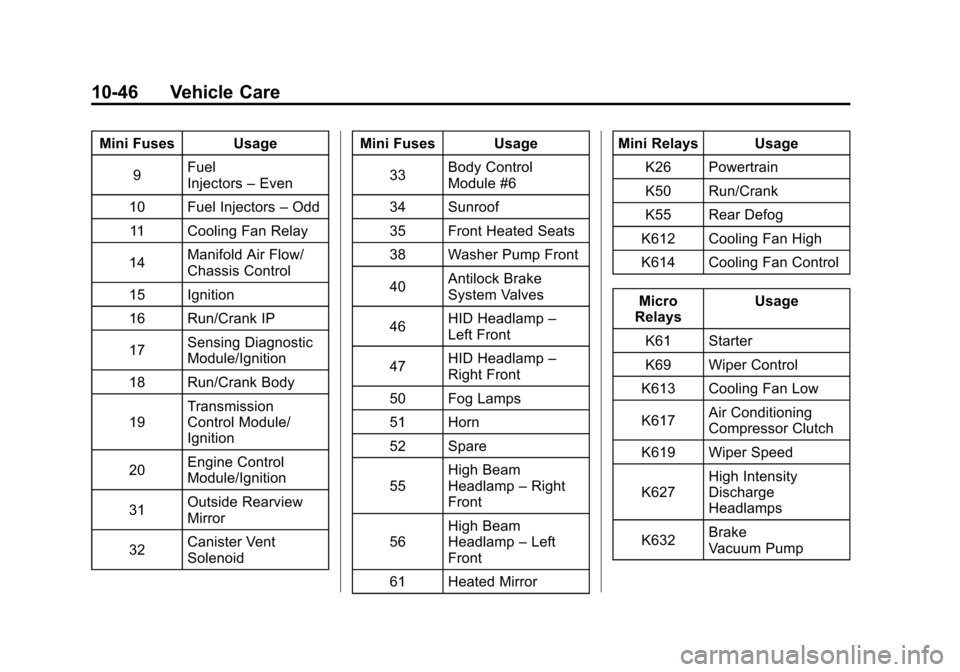
Mini Fuses Usage9 Fuel
Injectors
–Even
10 Fuel Injectors –Odd
11 Cooling Fan Relay
14 Manifold Air Flow/
Chassis Control
15 Ignition
16 Run/Crank IP
17 Sensing Diagnostic
Module/Ignition
18 Run/Crank Body
19 Transmission
Control Module/
Ignition
20 Engine Control
Module/Ignition
31 Outside Rearview
Mirror
32 Canister Vent
Solenoid Mini Fuses Usage
33 Body Control
Module #6
34 Sunroof
35 Front Heated Seats
38 Washer Pump Front
40 Antilock Brake
System Valves
46 HID Headlamp
–
Left Front
47 HID Headlamp
–
Right Front
50 Fog Lamps
51 Horn
52 Spare
55 High Beam
Headlamp
–Right
Front
56 High Beam
Headlamp
–Left
Front
61 Heated Mirror Mini Relays Usage
K26 Powertrain
K50 Run/Crank
K55 Rear Defog
K612 Cooling Fan High
K614 Cooling Fan Control
Micro
Relays Usage
K61 Starter
K69 Wiper Control
K613 Cooling Fan Low
K617 Air Conditioning
Compressor Clutch
K619 Wiper Speed
K627 High Intensity
Discharge
Headlamps
K632 Brake
Vacuum Pump
Page 370 of 414
Black plate (4,1)Chevrolet Camaro Owner Manual - 2011
11-4 Service and Maintenance
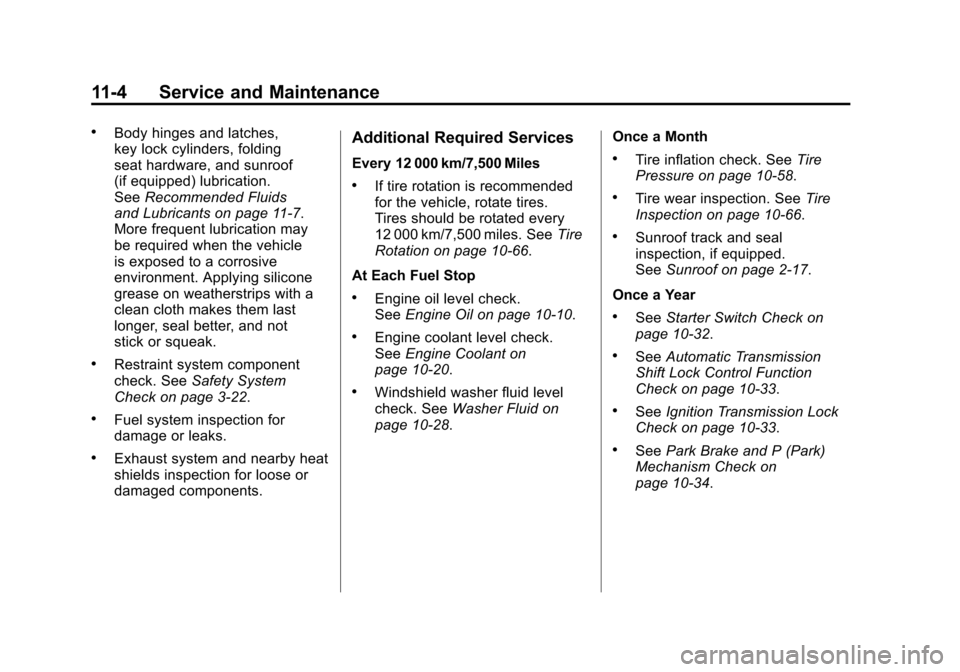
.Body hinges and latches,
key lock cylinders, folding
seat hardware, and sunroof
(if equipped) lubrication.
SeeRecommended Fluids
and Lubricants on page 11‑7.
More frequent lubrication may
be required when the vehicle
is exposed to a corrosive
environment. Applying silicone
grease on weatherstrips with a
clean cloth makes them last
longer, seal better, and not
stick or squeak.
.Restraint system component
check. See Safety System
Check on page 3‑22.
.Fuel system inspection for
damage or leaks.
.Exhaust system and nearby heat
shields inspection for loose or
damaged components.
Additional Required Services
Every 12 000 km/7,500 Miles
.If tire rotation is recommended
for the vehicle, rotate tires.
Tires should be rotated every
12 000 km/7,500 miles. See Tire
Rotation on page 10‑66.
At Each Fuel Stop
.Engine oil level check.
See Engine Oil on page 10‑10.
.Engine coolant level check.
SeeEngine Coolant on
page 10‑20.
.Windshield washer fluid level
check. See Washer Fluid on
page 10‑28. Once a Month
.Tire inflation check. See
Tire
Pressure on page 10‑58.
.Tire wear inspection. See Tire
Inspection on page 10‑66.
.Sunroof track and seal
inspection, if equipped.
See Sunroof on page 2‑17.
Once a Year
.See Starter Switch Check on
page 10‑32.
.See Automatic Transmission
Shift Lock Control Function
Check on page 10‑33.
.See Ignition Transmission Lock
Check on page 10‑33.
.See Park Brake and P (Park)
Mechanism Check on
page 10‑34.
Page 411 of 414

Black plate (9,1)Chevrolet Camaro Owner Manual - 2011
INDEX i-9
Rearview Mirrors . . . . . . . . . . . . . . 2-14Automatic Dimming . . . . . . . . . . . 2-14
Reclining Seatbacks . . . . . . . . . . . . 3-4
Recommended Fluids and Lubricants . . . . . . . . . . . . . . . . . . . . 11-7
Recommended Fuel . . . . . . . . . . . 9-48
Records Maintenance . . . . . . . . . . . . . . . . .11-10
Recreational Vehicle Towing . . . . . . . . . . . . . . . . . . . . . . 10-95
Reimbursement Program,
GM Mobility . . . . . . . . . . . . . . . . . . 13-7
Remote Keyless Entry (RKE) System . . . . . . . . . . . . . . . . . . . . . . . . 2-3
Remote Vehicle Start . . . . . . . . . . . 2-5
Replacement Bulbs . . . . . . . . . . . 10-43
Replacement Parts Airbags . . . . . . . . . . . . . . . . . . . . . . . 3-38
Maintenance . . . . . . . . . . . . . . . . . . 11-9
Replacing Airbag System . . . . . . 3-38
Replacing LATCH System Parts After a Crash . . . . . . . . . . . 3-52
Replacing Safety Belt System Parts After a
Crash . . . . . . . . . . . . . . . . . . . . . . . . 3-22 Reporting Safety Defects
Canadian Government . . . . . . 13-16
General Motors . . . . . . . . . . . . . 13-17
U.S. Government . . . . . . . . . . . 13-16
Restraints Where to Put . . . . . . . . . . . . . . . . . 3-45
Retained Accessory
Power (RAP) . . . . . . . . . . . . . . . . . 9-24
Ride Control Systems Limited Slip Rear Axle . . . . . . . . 9-43
Messages . . . . . . . . . . . . . . . . . . . . 5-38
Roads Driving, Wet . . . . . . . . . . . . . . . . . . . 9-8
Roadside Assistance Program . . . . . . . . . . . . . . . 13-7, 13-10
Roof
Sunroof . . . . . . . . . . . . . . . . . . . . . . . 2-17
Rotation, Tires . . . . . . . . . . . . . . . . 10-66
Routing, Engine Drive Belt . . . . . 12-4
Running the Vehicle While Parked . . . . . . . . . . . . . . . . . . . . . . . 9-29S
Safety Belts . . . . . . . . . . . . . . . . . . . . 3-8
Care . . . . . . . . . . . . . . . . . . . . . . . . . . 3-22
Extender . . . . . . . . . . . . . . . . . . . . . . 3-21
How to Wear Safety BeltsProperly . . . . . . . . . . . . . . . . . . . . . 3-11
Lap-Shoulder Belt . . . . . . . . . . . . 3-17
Messages . . . . . . . . . . . . . . . . . . . . 5-39
Reminders . . . . . . . . . . . . . . . . . . . . 5-14
Replacing After a Crash . . . . . . 3-22
Use During Pregnancy . . . . . . . . 3-21
Safety Defects Reporting Canadian Government . . . . . . 13-16
General Motors . . . . . . . . . . . . . 13-17
U.S. Government . . . . . . . . . . . 13-16
Safety System Check . . . . . . . . . . 3-22
Satellite Radio . . . . . . . . . . . . . . . . . 7-10
Scheduled Maintenance . . . . . . . 11-2
Scheduling Appointments . . . . . 13-10
Sealant Kit, Tire . . . . . . . . . . . . . . 10-78
Seatback Latches . . . . . . . . . . . . . . 3-6
Page 412 of 414

Black plate (10,1)Chevrolet Camaro Owner Manual - 2011
i-10 INDEX
SeatsAdjustment, Front . . . . . . . . . . . . . . 3-3
Head Restraints . . . . . . . . . . . . . . . 3-2
Heated Front . . . . . . . . . . . . . . . . . . 3-6
Power Adjustment, Front . . . . . . 3-4
Rear . . . . . . . . . . . . . . . . . . . . . . . . . . . 3-7
Reclining Seatbacks . . . . . . . . . . . 3-4
Securing Child Restraints . . . . . . . . . . . . . . 3-52, 3-54
Security Vehicle . . . . . . . . . . . . . . . . . . . . . . . 2-10
Service Accessories andModifications . . . . . . . . . . . . . . . . 10-3
Doing Your Own Work . . . . . . . . 10-4
Engine Soon Light . . . . . . . . . . . . 5-18
Maintenance Records . . . . . . .11-10
Maintenance, General Information . . . . . . . . . . . . . . . . . . 11-1
Parts Identification Label . . . . . 12-1
Publications Ordering Information . . . . . . . . . . . . . . . . 13-15
Scheduling Appointments . . . 13-10
Vehicle Messages . . . . . . . . . . . . 5-39 Servicing the Airbag . . . . . . . . . . . 3-36
Shift Lock Control Function
Check, Automatic
Transmission . . . . . . . . . . . . . . . . 10-33
Shifting Into Park . . . . . . . . . . . . . . . . . . . . . . 9-24
Out of Park . . . . . . . . . . . . . . . . . . . 9-25
Signals, Turn and Lane-Change . . . . . . . . . . . . . . . . . 6-5
Spare Tire Compact . . . . . . . . . . . . . . . . . . . . 10-90
Specifications and Capacities . . . . . . . . . . . . . . . . . . . . 12-2
Speedometer . . . . . . . . . . . . . . . . . . . 5-8
StabiliTrak OFF Light . . . . . . . . . . . . . . . . . . . . . 5-23
StabiliTrak
®System . . . . . . . . . . . 9-39
Start Vehicle, Remote . . . . . . . . . . 2-5
Starter Switch Check . . . . . . . . . 10-32
Starting the Engine . . . . . . . . . . . . 9-21
Steering . . . . . . . . . . . . . . . . . . . . . . . . 9-5 Fluid, Power . . . . . . . . . . . . . . . . 10-27
Wheel Adjustment . . . . . . . . . . . . . 5-2
Wheel Controls . . . . . . . . . . . . . . . . 5-2 Storage Areas
Center Console . . . . . . . . . . . . . . . . 4-1
Convenience Net . . . . . . . . . . . . . . 4-1
Glove Box . . . . . . . . . . . . . . . . . . . . . 4-1
Storing the Tire Sealant and Compressor Kit . . . . . . . . . 10-84
Stuck Vehicle . . . . . . . . . . . . . . . . . . 9-12
Sun Visors . . . . . . . . . . . . . . . . . . . . . 2-17
Sunroof . . . . . . . . . . . . . . . . . . . . . . . . 2-17
Symbols . . . . . . . . . . . . . . . . . . . . . . . . . . iv
System
Infotainment . . . . . . . . . . . . . . . . . . . 7-1
T
Tachometer . . . . . . . . . . . . . . . . . . . . . 5-8
Taillamp Indicator Light . . . . . . . . 5-25
TaillampsTurn Signal, and
Stoplamps . . . . . . . . . . . . . . . . 10-42
Text Telephone (TTY) Users . . . 13-6
Theater Dimming . . . . . . . . . . . . . . . 6-6
Theft-Deterrent Systems . . . . . . . 2-12 Immobilizer . . . . . . . . . . . . . . . . . . . 2-11
Time . . . . . . . . . . . . . . . . . . . . . . . . . . . . 5-4