cooling CHEVROLET CAMARO 2013 5.G User Guide
[x] Cancel search | Manufacturer: CHEVROLET, Model Year: 2013, Model line: CAMARO, Model: CHEVROLET CAMARO 2013 5.GPages: 404, PDF Size: 5.45 MB
Page 257 of 404

Black plate (9,1)Chevrolet Camaro Owner Manual (Include Mex) - 2012
Vehicle Care 10-9
A. Underhood Electrical Center.See Engine Compartment Fuse
Block on page 10‑40.
B. Engine Coolant Recovery Bottle and Cap. See Engine Coolant
on page 10‑19.
C. Engine Oil Dipstick. See Engine
Oil on page 10‑10.
D. Engine Oil Fill Cap (Out of View). See Engine Oil on
page 10‑10.
E. Engine Cover on page 10‑10. F. Engine Cooling Fans (Out of
View). See Cooling System on
page 10‑18.
G. Power Steering Reservoir and Cap (Under Engine Cover). See
Power Steering Fluid on
page 10‑26.
H. Brake Master Cylinder and Hydraulic Clutch Reservoir
(if equipped with manual
transmission). See Brakes on
page 10‑28 orHydraulic Clutch
on page 10‑15. I. Remote Positive (+) Terminal.
See Battery on page 10‑30.
J. Engine Air Cleaner/Filter on
page 10‑16.
K. Windshield Washer Fluid Reservoir. See Washer Fluid on
page 10‑27.
L. Radiator Fill Cap (Out of View). See Engine Coolant on
page 10‑19.
Page 266 of 404
Black plate (18,1)Chevrolet Camaro Owner Manual (Include Mex) - 2012
10-18 Vehicle Care
Cooling System
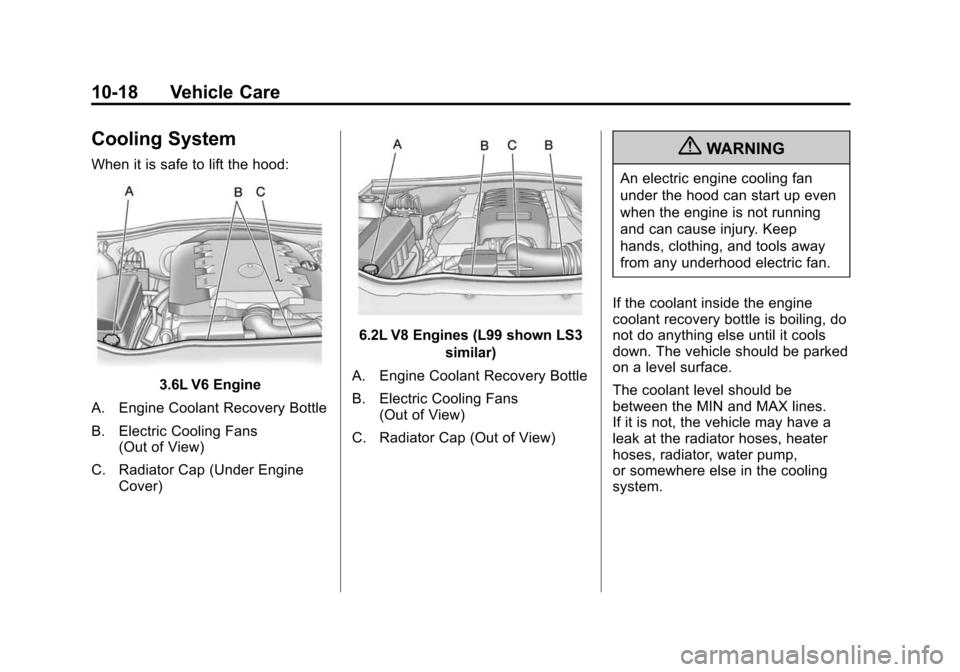
When it is safe to lift the hood:
3.6L V6 Engine
A. Engine Coolant Recovery Bottle
B. Electric Cooling Fans (Out of View)
C. Radiator Cap (Under Engine Cover)
6.2L V8 Engines (L99 shown LS3
similar)
A. Engine Coolant Recovery Bottle
B. Electric Cooling Fans (Out of View)
C. Radiator Cap (Out of View)
{WARNING
An electric engine cooling fan
under the hood can start up even
when the engine is not running
and can cause injury. Keep
hands, clothing, and tools away
from any underhood electric fan.
If the coolant inside the engine
coolant recovery bottle is boiling, do
not do anything else until it cools
down. The vehicle should be parked
on a level surface.
The coolant level should be
between the MIN and MAX lines.
If it is not, the vehicle may have a
leak at the radiator hoses, heater
hoses, radiator, water pump,
or somewhere else in the cooling
system.
Page 267 of 404
Black plate (19,1)Chevrolet Camaro Owner Manual (Include Mex) - 2012
Vehicle Care 10-19
{WARNING
Heater and radiator hoses, and
other engine parts, can be very
hot. Do not touch them. If you do,
you can be burned.
Do not run the engine if there is a
leak. If you run the engine, it
could lose all coolant. That could
cause an engine fire, and you
could be burned. Get any leak
fixed before you drive the vehicle.
If there seems to be no leak,
with the engine on, check to see
if the electric engine cooling fans
are running. If the engine is
overheating, the fans should be
running. If it is not, the vehicle
needs service. Turn off the engine. Notice:
Using coolant other than
DEX-COOL
®can cause premature
engine, heater core, or radiator
corrosion. In addition, the engine
coolant could require changing
sooner, at 50 000 km (30,000 mi)
or 24 months, whichever occurs
first. Any repairs would not be
covered by the vehicle warranty.
Always use DEX-COOL
(silicate-free) coolant in the
vehicle.Engine Coolant
The cooling system in the vehicle is
filled with DEX-COOL®engine
coolant. This coolant is designed to
remain in the vehicle for 5 years or
240 000 km (150,000 mi), whichever
occurs first.
The following explains the cooling
system and how to check and add
coolant when it is low. If there is a
problem with engine overheating,
see Engine Overheating on
page 10‑24.
Page 268 of 404
Black plate (20,1)Chevrolet Camaro Owner Manual (Include Mex) - 2012
10-20 Vehicle Care
What to Use
{WARNING
Adding only plain water or some
other liquid to the cooling system
can be dangerous. Plain water
and other liquids, can boil before
the proper coolant mixture will.
The coolant warning system is set
for the proper coolant mixture.
With plain water or the wrong
mixture, the engine could get too
hot but you would not get the
overheat warning. The engine
could catch fire and you or others
could be burned. Use a 50/
50 mixture of clean, drinkable
water and DEX-COOL coolant.Use a 50/50 mixture of clean,
drinkable water and DEX-COOL
coolant. If using this mixture,
nothing else needs to be added.
This mixture:.Gives freezing protection down
to
−37°C (−34°F), outside
temperature.
.Gives boiling protection up to
129°C (265°F), engine
temperature.
.Protects against rust and
corrosion.
.Will not damage aluminum parts.
.Helps keep the proper engine
temperature.
Notice: If an improper coolant
mixture is used, the engine could
overheat and be badly damaged.
The repair cost would not be
covered by the vehicle warranty.
Too much water in the mixture
can freeze and crack the engine,
radiator, heater core, and other
parts. Never dispose of engine coolant by
putting it in the trash, pouring it on
the ground, or into sewers, streams,
or bodies of water. Have the coolant
changed by an authorized service
center, familiar with legal
requirements regarding used
coolant disposal. This will help
protect the environment and your
health.
Checking Coolant
The vehicle must be on a level
surface when checking the coolant
level.
Check coolant as follows:
1. Turn the ignition off.
2. Locate the engine coolant
recovery bottle. See Engine
Compartment Overview on
page 10‑6.
Page 270 of 404
Black plate (22,1)Chevrolet Camaro Owner Manual (Include Mex) - 2012
10-22 Vehicle Care
How to Add Coolant to the
Radiator
{WARNING
You can be burned if you spill
coolant on hot engine parts.
Coolant contains ethylene glycol
and it will burn if the engine parts
are hot enough. Do not spill
coolant on a hot engine.
Notice: This vehicle has a
specific coolant fill procedure.
Failure to follow this procedure
could cause the engine to
overheat and be severely
damaged.
{WARNING
An electric engine cooling fan
under the hood can start up even
when the engine is not running
and can cause injury. Keep
hands, clothing, and tools away
from any underhood electric fan.
{WARNING
Steam and scalding liquids from a
hot cooling system can blow out
and burn you badly. They are
under pressure, and if you turn
the surge tank pressure
cap —even a little —they can
come out at high speed. Never
turn the cap when the cooling
system, including the surge tank
pressure cap, is hot. Wait for the
cooling system and surge tank
pressure cap to cool if you ever
have to turn the pressure cap.
If coolant is needed, add the proper
mixture directly to the radiator, but
be sure the cooling system is cool
before this is done. If no coolant is visible in the engine
coolant recovery bottle, add coolant
as follows:
3.6 L V6 Engine Fill Procedure
1. Locate the radiator cap. See
Engine Compartment Overview
on page 10‑6.
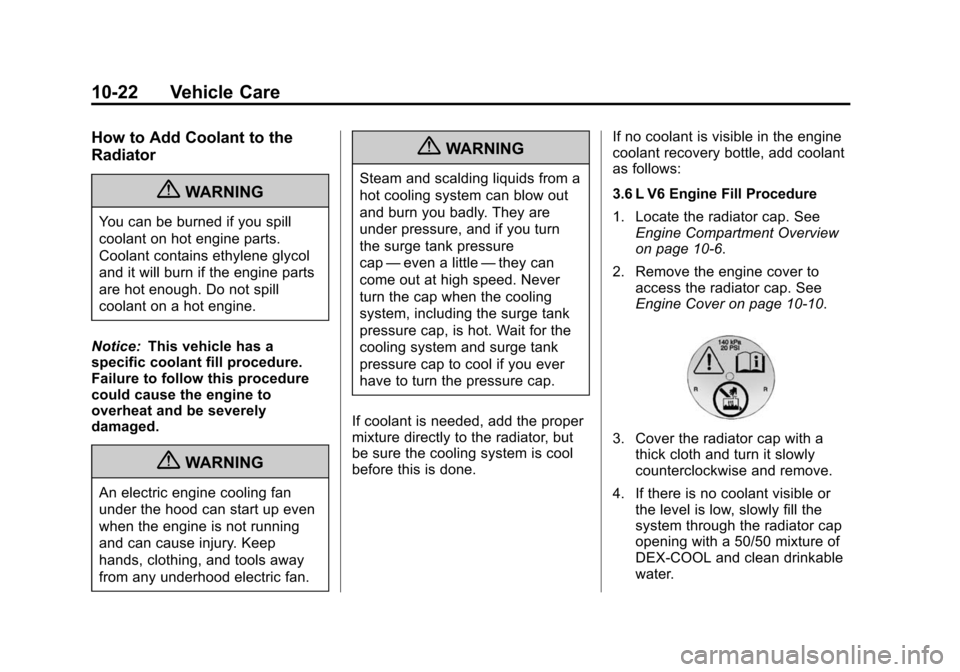
2. Remove the engine cover to access the radiator cap. See
Engine Cover on page 10‑10.
3. Cover the radiator cap with athick cloth and turn it slowly
counterclockwise and remove.
4. If there is no coolant visible or the level is low, slowly fill the
system through the radiator cap
opening with a 50/50 mixture of
DEX-COOL and clean drinkable
water.
Page 272 of 404
Black plate (24,1)Chevrolet Camaro Owner Manual (Include Mex) - 2012
10-24 Vehicle Care
If a spill occurs, rinse the belt
with fresh water.
4. Start the engine.
5. With the engine idling, top off the coolant through the radiator cap
opening until full.
Wait 30 seconds for the coolant
to settle and top off, if the level
drops.
6. Once the system is full, put the radiator cap back on by turning
clockwise.
7. Turn the engine off.
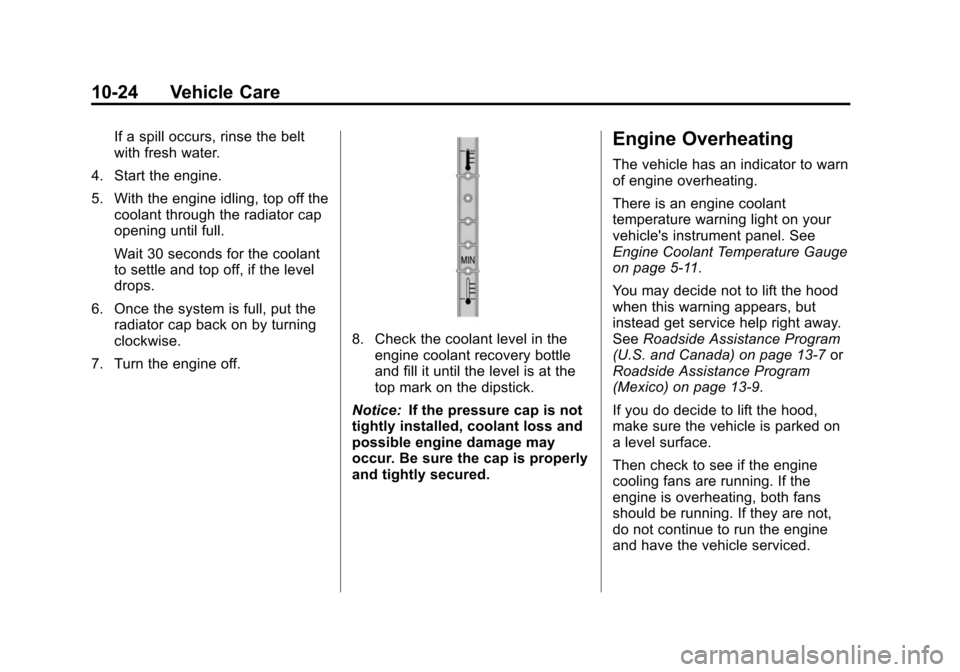
8. Check the coolant level in the engine coolant recovery bottle
and fill it until the level is at the
top mark on the dipstick.
Notice: If the pressure cap is not
tightly installed, coolant loss and
possible engine damage may
occur. Be sure the cap is properly
and tightly secured.
Engine Overheating
The vehicle has an indicator to warn
of engine overheating.
There is an engine coolant
temperature warning light on your
vehicle's instrument panel. See
Engine Coolant Temperature Gauge
on page 5‑11.
You may decide not to lift the hood
when this warning appears, but
instead get service help right away.
See Roadside Assistance Program
(U.S. and Canada) on page 13‑7 or
Roadside Assistance Program
(Mexico) on page 13‑9.
If you do decide to lift the hood,
make sure the vehicle is parked on
a level surface.
Then check to see if the engine
cooling fans are running. If the
engine is overheating, both fans
should be running. If they are not,
do not continue to run the engine
and have the vehicle serviced.
Page 290 of 404
Black plate (42,1)Chevrolet Camaro Owner Manual (Include Mex) - 2012
10-42 Vehicle Care
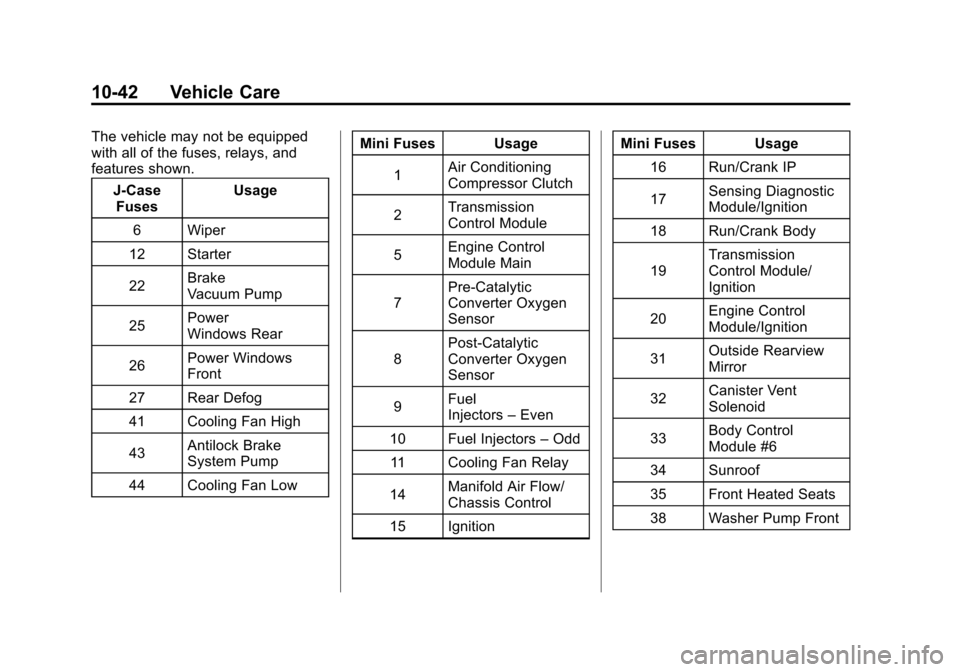
The vehicle may not be equipped
with all of the fuses, relays, and
features shown.J-CaseFuses Usage
6 Wiper
12 Starter
22 Brake
Vacuum Pump
25 Power
Windows Rear
26 Power Windows
Front
27 Rear Defog
41 Cooling Fan High
43 Antilock Brake
System Pump
44 Cooling Fan Low Mini Fuses Usage
1 Air Conditioning
Compressor Clutch
2 Transmission
Control Module
5 Engine Control
Module Main
7 Pre-Catalytic
Converter Oxygen
Sensor
8 Post-Catalytic
Converter Oxygen
Sensor
9 Fuel
Injectors
–Even
10 Fuel Injectors –Odd
11 Cooling Fan Relay
14 Manifold Air Flow/
Chassis Control
15 Ignition Mini Fuses Usage
16 Run/Crank IP
17 Sensing Diagnostic
Module/Ignition
18 Run/Crank Body
19 Transmission
Control Module/
Ignition
20 Engine Control
Module/Ignition
31 Outside Rearview
Mirror
32 Canister Vent
Solenoid
33 Body Control
Module #6
34 Sunroof
35 Front Heated Seats
38 Washer Pump Front
Page 291 of 404
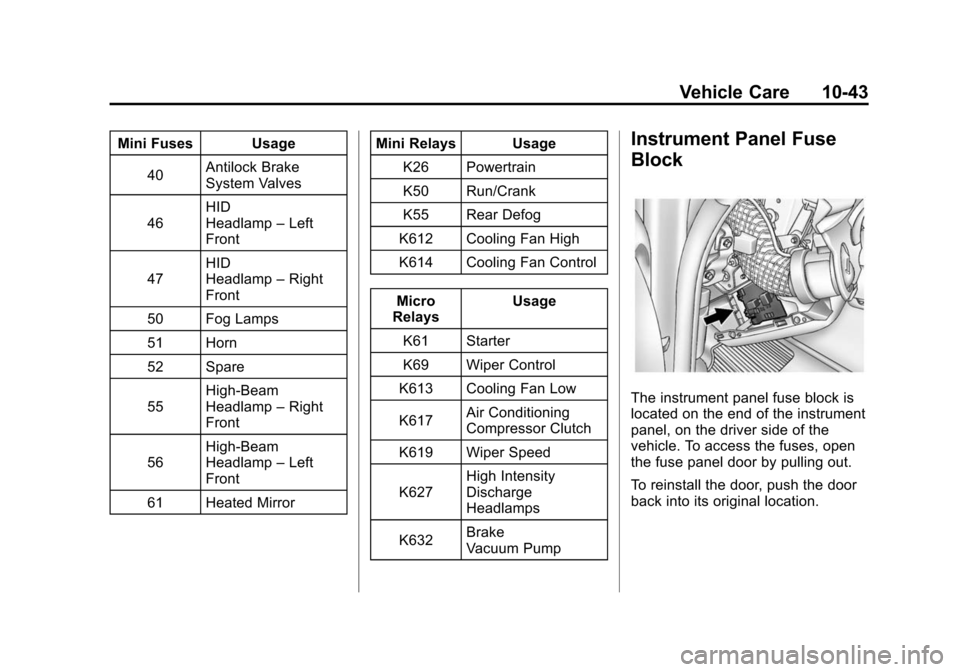
Black plate (43,1)Chevrolet Camaro Owner Manual (Include Mex) - 2012
Vehicle Care 10-43
Mini Fuses Usage40 Antilock Brake
System Valves
46 HID
Headlamp
–Left
Front
47 HID
Headlamp
–Right
Front
50 Fog Lamps
51 Horn
52 Spare
55 High‐Beam
Headlamp
–Right
Front
56 High‐Beam
Headlamp
–Left
Front
61 Heated Mirror Mini Relays Usage
K26 Powertrain
K50 Run/Crank
K55 Rear Defog
K612 Cooling Fan High
K614 Cooling Fan Control
Micro
Relays Usage
K61 Starter
K69 Wiper Control
K613 Cooling Fan Low
K617 Air Conditioning
Compressor Clutch
K619 Wiper Speed
K627 High Intensity
Discharge
Headlamps
K632 Brake
Vacuum PumpInstrument Panel Fuse
Block
The instrument panel fuse block is
located on the end of the instrument
panel, on the driver side of the
vehicle. To access the fuses, open
the fuse panel door by pulling out.
To reinstall the door, push the door
back into its original location.
Page 315 of 404
Black plate (67,1)Chevrolet Camaro Owner Manual (Include Mex) - 2012
Vehicle Care 10-67
{WARNING
Using the wrong replacement
wheels, wheel bolts, or wheel
nuts can be dangerous. It could
affect the braking and handling of
the vehicle. Tires can lose air,
and cause loss of control, causing
a crash. Always use the correct
wheel, wheel bolts, and wheel
nuts for replacement.
Notice: The wrong wheel can
also cause problems with bearing
life, brake cooling, speedometer
or odometer calibration,
headlamp aim, rear differential,
bumper height, vehicle ground
clearance, and tire or tire chain
clearance to the body and
chassis.
See If a Tire Goes Flat on
page 10‑68 for more information.
Used Replacement Wheels
{WARNING
Replacing a wheel with a used
one is dangerous. How it has
been used or how far it has been
driven may be unknown. It could
fail suddenly and cause a crash.
When replacing wheels, use a
new GM original equipment
wheel.
Tire Chains
{WARNING
Do not use tire chains. There is
not enough clearance. Tire chains
used on a vehicle without the
proper amount of clearance can
cause damage to the brakes,
suspension, or other vehicle
parts. The area damaged by the
tire chains could cause loss of
control and a crash. Use another
type of traction device only if its
manufacturer recommends it for
the vehicle's tire size combination
and road conditions. Follow that
manufacturer's instructions. To
avoid vehicle damage, drive
slowly and readjust or remove the
traction device if it contacts the
vehicle. Do not spin the wheels.
If traction devices are used, install
them on the rear tires.
Page 349 of 404
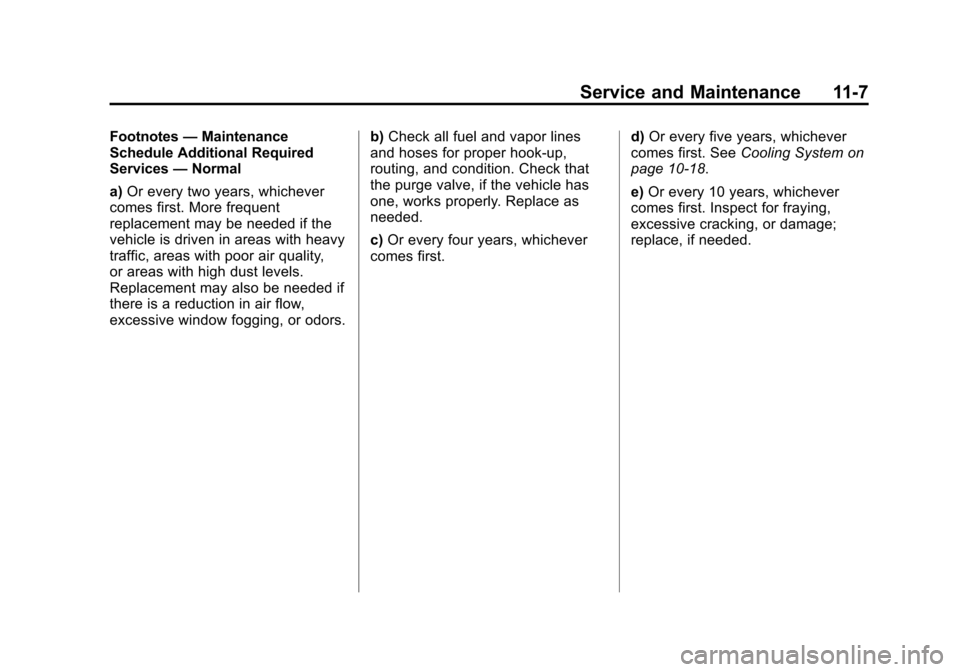
Black plate (7,1)Chevrolet Camaro Owner Manual (Include Mex) - 2012
Service and Maintenance 11-7
Footnotes—Maintenance
Schedule Additional Required
Services —Normal
a) Or every two years, whichever
comes first. More frequent
replacement may be needed if the
vehicle is driven in areas with heavy
traffic, areas with poor air quality,
or areas with high dust levels.
Replacement may also be needed if
there is a reduction in air flow,
excessive window fogging, or odors. b)
Check all fuel and vapor lines
and hoses for proper hook‐up,
routing, and condition. Check that
the purge valve, if the vehicle has
one, works properly. Replace as
needed.
c) Or every four years, whichever
comes first. d)
Or every five years, whichever
comes first. See Cooling System on
page 10‑18.
e) Or every 10 years, whichever
comes first. Inspect for fraying,
excessive cracking, or damage;
replace, if needed.