heater CHEVROLET CAMARO SS 2010 User Guide
[x] Cancel search | Manufacturer: CHEVROLET, Model Year: 2010, Model line: CAMARO SS, Model: CHEVROLET CAMARO SS 2010Pages: 372, PDF Size: 1.91 MB
Page 251 of 372
Notice:Using coolant other
than DEX-COOL®can cause
premature engine, heater core,
or radiator corrosion. In addition,
the engine coolant could require
changing sooner, at 50 000 km
(30,000 miles) or 24 months,
whichever occurs rst. Any
repairs would not be covered by
the vehicle warranty. Always use
DEX-COOL
®(silicate-free) coolant
in the vehicle.
Engine Coolant
The cooling system in the vehicle
is filled with DEX-COOL®engine
coolant. This coolant is designed to
remain in the vehicle for five years
or 240 000 km (150,000 miles),
whichever occurs first.
The following explains the cooling
system and how to check and add
coolant when it is low. If there is a
problem with engine overheating,
seeEngine Overheating on
page 9-24.
What to Use
{WARNING
Adding only plain water to the
cooling system can be dangerous.
Plain water, or some other liquid
such as alcohol, can boil before
the proper coolant mixture will.
The vehicle’s coolant warning
system is set for the proper
coolant mixture. With plain water
or the wrong mixture, the engine
could get too hot but you would
not get the overheat warning.
The engine could catch fire and
you or others could be burned.
Use a 50/50 mixture of clean,
drinkable water and DEX-COOL
®
coolant.Use a 50/50 mixture of clean,
drinkable water and DEX-COOL
®
coolant. If using this mixture,
nothing else needs to be added.
This mixture:
•Gives freezing protection
down to−37°C (−34°F),
outside temperature.
•Gives boiling protection up
to 129°C (265°F), engine
temperature.
•Protects against rust and
corrosion.
•Will not damage aluminum parts.
•Helps keep the proper engine
temperature.
Notice:If an improper coolant
mixture is used, the engine could
overheat and be badly damaged.
The repair cost would not be
covered by the vehicle warranty.
Too much water in the mixture
can freeze and crack the engine,
radiator, heater core, and other
parts.
Vehicle Care 9-19
Page 252 of 372
Checking Coolant
The vehicle must be on a level
surface when checking the coolant
level.
Check coolant as follows:
1. Turn the ignition OFF.
2. Locate the coolant recovery
bottle. SeeEngine Compartment
Overview on page 9-6.
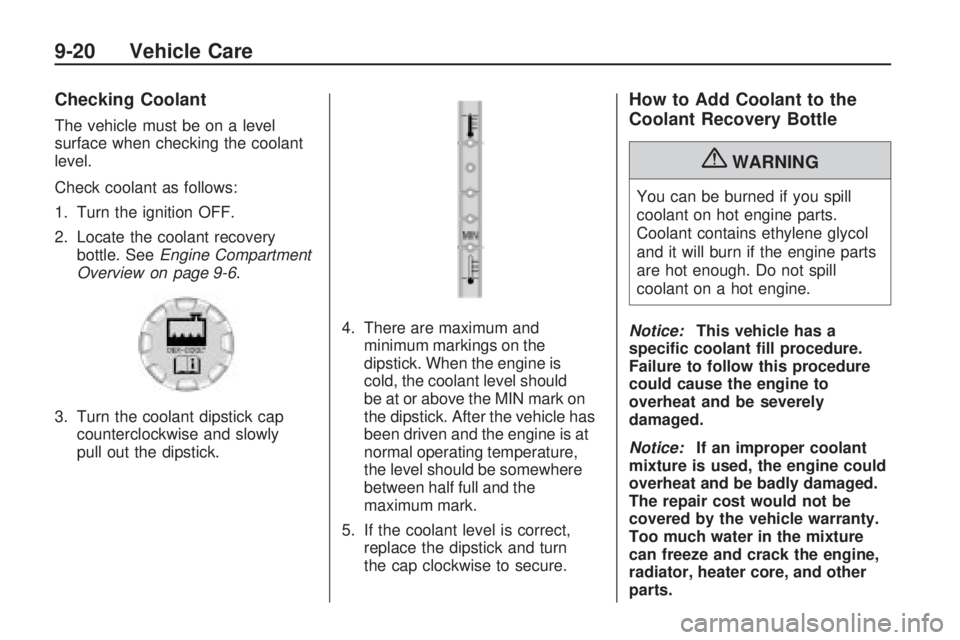
3. Turn the coolant dipstick cap
counterclockwise and slowly
pull out the dipstick.4. There are maximum and
minimum markings on the
dipstick. When the engine is
cold, the coolant level should
be at or above the MIN mark on
the dipstick. After the vehicle has
been driven and the engine is at
normal operating temperature,
the level should be somewhere
between half full and the
maximum mark.
5. If the coolant level is correct,
replace the dipstick and turn
the cap clockwise to secure.
How to Add Coolant to the
Coolant Recovery Bottle
{WARNING
You can be burned if you spill
coolant on hot engine parts.
Coolant contains ethylene glycol
and it will burn if the engine parts
are hot enough. Do not spill
coolant on a hot engine.
Notice:This vehicle has a
specic coolant ll procedure.
Failure to follow this procedure
could cause the engine to
overheat and be severely
damaged.
Notice:If an improper coolant
mixture is used, the engine could
overheat and be badly damaged.
The repair cost would not be
covered by the vehicle warranty.
Too much water in the mixture
can freeze and crack the engine,
radiator, heater core, and other
parts.
9-20 Vehicle Care
Page 257 of 372
If No Steam Is Coming From
The Engine Compartment
If an engine overheat warning is
displayed but no steam can be seen
or heard, the problem may not be too
serious. Sometimes the engine can
get a little too hot when the vehicle:
•Climbs a long hill on a hot day.
•Stops after high-speed driving.
•Idles for long periods in traffic.
•Tows a trailer.
If the overheat warning is displayed
with no sign of steam:
1. Turn the air off.
2. Turn the heater on to the highest
temperature and to the highest
fan speed. Open the windows
as necessary.3. In heavy traffic, let the engine idle
in N (Neutral) while stopped. If it
is safe to do so, pull off the road,
shift to P (Park) or N (Neutral) and
let the engine idle.
If the temperature overheat gage is
no longer in the overheat zone or an
overheat warning no longer displays,
the vehicle can be driven. Continue
to drive the vehicle slow for about
10 minutes. Keep a safe vehicle
distance from the car in front of you.
If the warning does not come back
on, continue to drive normally.
If the warning continues, pull over,
stop, and park the vehicle right away.
If there is no sign of steam, idle
the engine for three minutes while
parked. If the warning is still
displayed, turn off the engine until it
cools down. Also, see “Overheated
Engine Protection Operating Mode”
later in this section.
Power Steering Fluid
The power steering fluid reservoir is
located under the engine cover on
the driver side toward the front of the
engine compartment. SeeEngine
Compartment Overview on page 9-6.
When to Check Power
Steering Fluid
It is not necessary to regularly
check power steering fluid unless
you suspect there is a leak in
the system or an unusual noise is
heard. A fluid loss in this system
could indicate a problem. Have the
system inspected and repaired.
Vehicle Care 9-25
Page 275 of 372
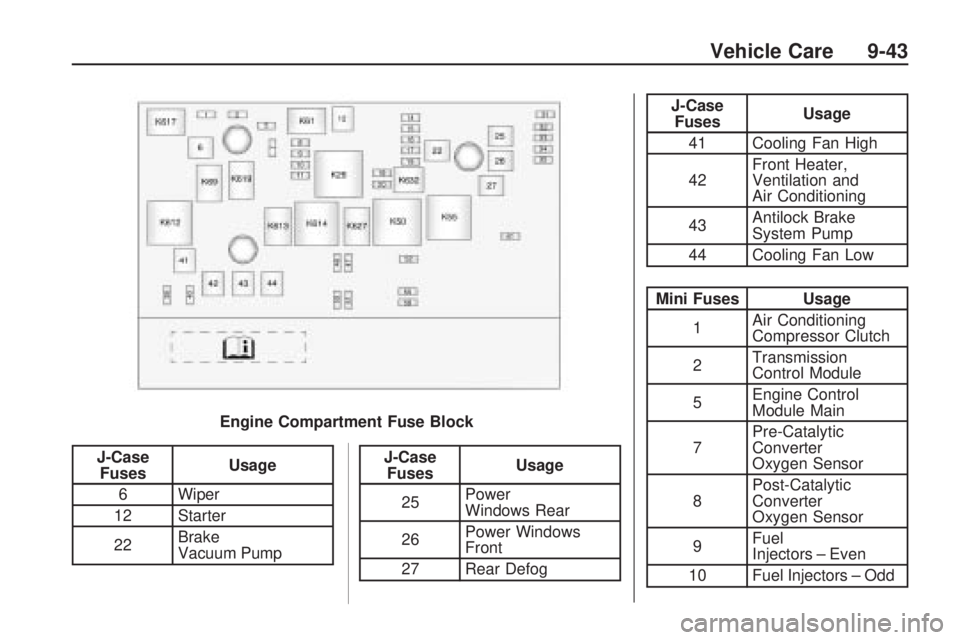
J-CaseFuses Usage
6 Wiper
12 Starter
22 Brake
Vacuum PumpJ-Case
Fuses Usage
25 Power
Windows Rear
26 Power Windows
Front
27 Rear Defog
J-Case Fuses Usage
41 Cooling Fan High
42 Front Heater,
Ventilation and
Air Conditioning
43 Antilock Brake
System Pump
44 Cooling Fan Low
Mini Fuses Usage
1 Air Conditioning
Compressor Clutch
2 Transmission
Control Module
5 Engine Control
Module Main
7 Pre-Catalytic
Converter
Oxygen Sensor
8 Post-Catalytic
Converter
Oxygen Sensor
9 Fuel
Injectors – Even
10 Fuel Injectors – Odd
Engine Compartment Fuse Block
Vehicle Care 9-43
Page 366 of 372
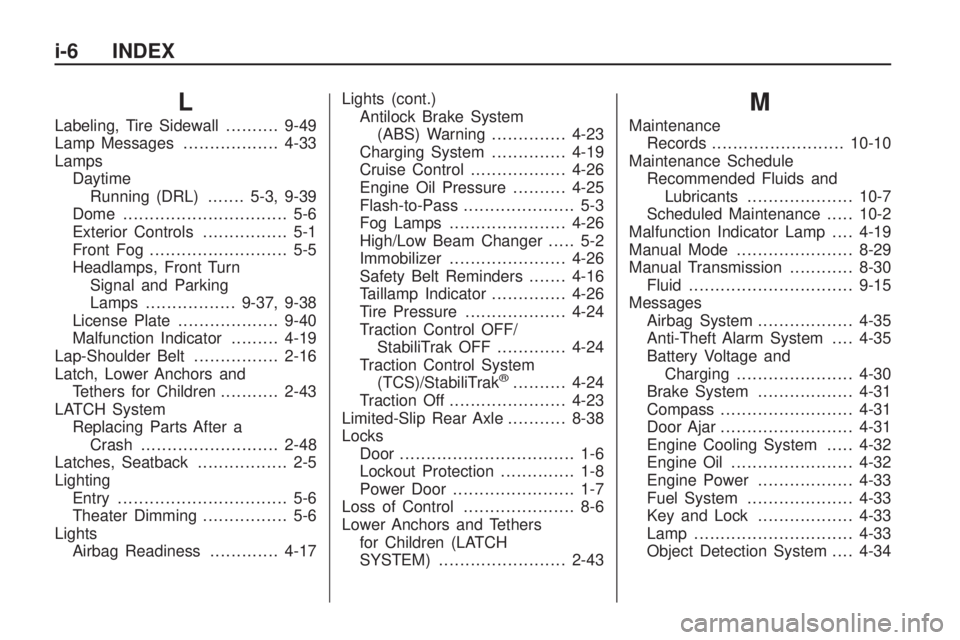
L
Labeling, Tire Sidewall..........9-49
Lamp Messages..................4-33
Lamps
Daytime
Running (DRL).......5-3, 9-39
Dome ............................... 5-6
Exterior Controls................ 5-1
Front Fog.......................... 5-5
Headlamps, Front Turn
Signal and Parking
Lamps .................9-37, 9-38
License Plate...................9-40
Malfunction Indicator.........4-19
Lap-Shoulder Belt................2-16
Latch, Lower Anchors and
Tethers for Children...........2-43
LATCH System
Replacing Parts After a
Crash..........................2-48
Latches, Seatback................. 2-5
Lighting
Entry................................ 5-6
Theater Dimming................ 5-6
Lights
Airbag Readiness.............4-17Lights (cont.)
Antilock Brake System
(ABS) Warning..............4-23
Charging System..............4-19
Cruise Control..................4-26
Engine Oil Pressure..........4-25
Flash-to-Pass..................... 5-3
Fog Lamps ......................4-26
High/Low Beam Changer..... 5-2
Immobilizer......................4-26
Safety Belt Reminders.......4-16
Taillamp Indicator..............4-26
Tire Pressure...................4-24
Traction Control OFF/
StabiliTrak OFF.............4-24
Traction Control System
(TCS)/StabiliTrak
®..........4-24
Traction Off......................4-23
Limited-Slip Rear Axle...........8-38
Locks
Door ................................. 1-6
Lockout Protection.............. 1-8
Power Door ....................... 1-7
Loss of Control..................... 8-6
Lower Anchors and Tethers
for Children (LATCH
SYSTEM)........................2-43
M
Maintenance
Records.........................10-10
Maintenance Schedule
Recommended Fluids and
Lubricants....................10-7
Scheduled Maintenance.....10-2
Malfunction Indicator Lamp....4-19
Manual Mode......................8-29
Manual Transmission............8-30
Fluid...............................9-15
Messages
Airbag System..................4-35
Anti-Theft Alarm System....4-35
Battery Voltage and
Charging......................4-30
Brake System..................4-31
Compass.........................4-31
Door Ajar.........................4-31
Engine Cooling System.....4-32
Engine Oil.......................4-32
Engine Power..................4-33
Fuel System....................4-33
Key and Lock..................4-33
Lamp ..............................4-33
Object Detection System....4-34
i-6 INDEX
Page 370 of 372
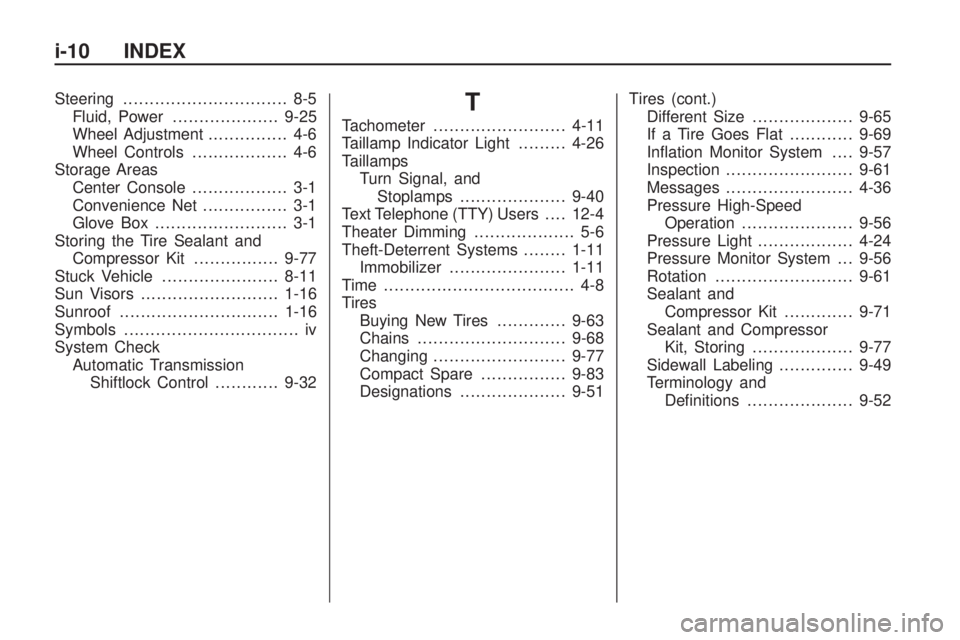
Steering............................... 8-5
Fluid, Power....................9-25
Wheel Adjustment............... 4-6
Wheel Controls.................. 4-6
Storage Areas
Center Console.................. 3-1
Convenience Net................ 3-1
Glove Box......................... 3-1
Storing the Tire Sealant and
Compressor Kit................9-77
Stuck Vehicle......................8-11
Sun Visors..........................1-16
Sunroof..............................1-16
Symbols................................. iv
System Check
Automatic Transmission
Shiftlock Control............9-32T
Tachometer.........................4-11
Taillamp Indicator Light.........4-26
Taillamps
Turn Signal, and
Stoplamps....................9-40
Text Telephone (TTY) Users....12-4
Theater Dimming................... 5-6
Theft-Deterrent Systems........1-11
Immobilizer......................1-11
Time .................................... 4-8
Tires
Buying New Tires.............9-63
Chains............................9-68
Changing.........................9-77
Compact Spare................9-83
Designations....................9-51Tires (cont.)
Different Size...................9-65
If a Tire Goes Flat............9-69
Inflation Monitor System....9-57
Inspection........................9-61
Messages........................4-36
Pressure High-Speed
Operation.....................9-56
Pressure Light..................4-24
Pressure Monitor System . . . 9-56
Rotation..........................9-61
Sealant and
Compressor Kit.............9-71
Sealant and Compressor
Kit, Storing...................9-77
Sidewall Labeling..............9-49
Terminology and
Definitions....................9-52
i-10 INDEX