power steering CHEVROLET CAMARO SS 2010 User Guide
[x] Cancel search | Manufacturer: CHEVROLET, Model Year: 2010, Model line: CAMARO SS, Model: CHEVROLET CAMARO SS 2010Pages: 372, PDF Size: 1.91 MB
Page 205 of 372

Manual Mode
Tap Shift
Tap Shift allows the driver to
manually control the automatic
transmission. To use Tap Shift, the
shift lever must be in M (Manual
Mode). Vehicles with this feature
have flags on the top of the steering
wheel to indicate to the driver the
location of the switches on the back
of the steering wheel. Tap the leftswitch to downshift, and the right
switch to upshift. A display in the
Driver Information Center will show
which gear the vehicle is in.
SeeDriver Information Center (DIC)
on page 4-27for more information.
While using the Tap Shift feature,
the vehicle will have firmer, quicker
shifting for increased performance.
You can use this for sport driving or
when climbing or descending hills, to
stay in gear longer, or to down shift
for more power or engine braking.
The transmission will only allow
you to shift into gears appropriate
for the vehicle speed and engine
Revolutions Per Minute (RPM).
The transmission will not
automatically shift to the next higher
gear if the engine RPM is too high.
If shifting is prevented for any
reason, the message Shift Denied
will appear in the DIC, indicating
that the transmission has notshifted gears. While in the Tap
Shift mode, the transmission will
not automatically downshift on
hard acceleration.
When coasting to a stop, the
V6 transmission will automatically
downshift to 1 (First) gear, and the
V8 transmission will automatically
downshift to 2 (Second) gear.
A 1 (first) gear start can be selected
using the Tap Shift controls on
V8 models When accelerating from
a stop the transmissions will hold
these gears until the driver manually
selects higher gears using the Tap
Shift controls.
When accelerating the vehicle from
a stop in snowy and icy conditions,
you may want to shift into second
gear. A higher gear ratio allows you
to gain more traction on slippery
surfaces.
Driving and Operating 8-29
Page 233 of 372
Vehicle Care
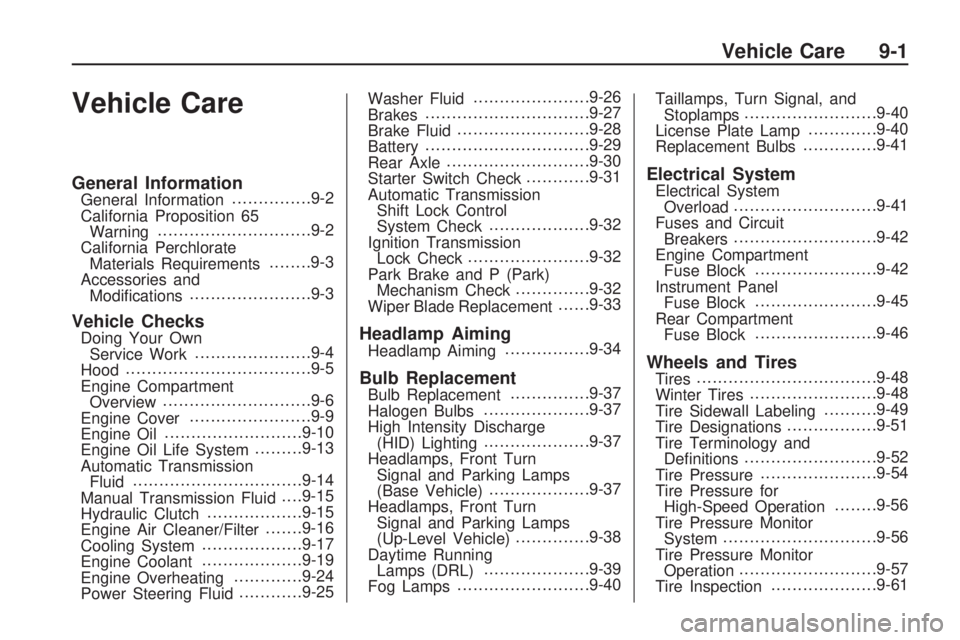
General InformationGeneral Information...............9-2
California Proposition 65
Warning.............................9-2
California Perchlorate
Materials Requirements........9-3
Accessories and
Modifications.......................9-3
Vehicle ChecksDoing Your Own
Service Work......................9-4
Hood...................................9-5
Engine Compartment
Overview............................9-6
Engine Cover.......................9-9
Engine Oil..........................9-10
Engine Oil Life System.........9-13
Automatic Transmission
Fluid................................9-14
Manual Transmission Fluid. . . .9-15
Hydraulic Clutch..................9-15
Engine Air Cleaner/Filter.......9-16
Cooling System...................9-17
Engine Coolant...................9-19
Engine Overheating.............9-24
Power Steering Fluid............9-25Washer Fluid......................9-26
Brakes...............................9-27
Brake Fluid.........................9-28
Battery...............................9-29
Rear Axle...........................9-30
Starter Switch Check............9-31
Automatic Transmission
Shift Lock Control
System Check...................9-32
Ignition Transmission
Lock Check.......................9-32
Park Brake and P (Park)
Mechanism Check..............9-32
Wiper Blade Replacement......9-33Headlamp AimingHeadlamp Aiming................9-34
Bulb ReplacementBulb Replacement...............9-37
Halogen Bulbs....................9-37
High Intensity Discharge
(HID) Lighting....................9-37
Headlamps, Front Turn
Signal and Parking Lamps
(Base Vehicle)...................9-37
Headlamps, Front Turn
Signal and Parking Lamps
(Up-Level Vehicle)..............9-38
Daytime Running
Lamps (DRL)....................9-39
Fog Lamps.........................9-40Taillamps, Turn Signal, and
Stoplamps.........................9-40
License Plate Lamp.............9-40
Replacement Bulbs..............9-41
Electrical SystemElectrical System
Overload...........................9-41
Fuses and Circuit
Breakers...........................9-42
Engine Compartment
Fuse Block.......................9-42
Instrument Panel
Fuse Block.......................9-45
Rear Compartment
Fuse Block.......................9-46
Wheels and TiresTires..................................9-48
Winter Tires........................9-48
Tire Sidewall Labeling..........9-49
Tire Designations.................9-51
Tire Terminology and
Definitions.........................9-52
Tire Pressure......................9-54
Tire Pressure for
High-Speed Operation........9-56
Tire Pressure Monitor
System.............................9-56
Tire Pressure Monitor
Operation..........................9-57
Tire Inspection....................9-61
Vehicle Care 9-1
Page 239 of 372
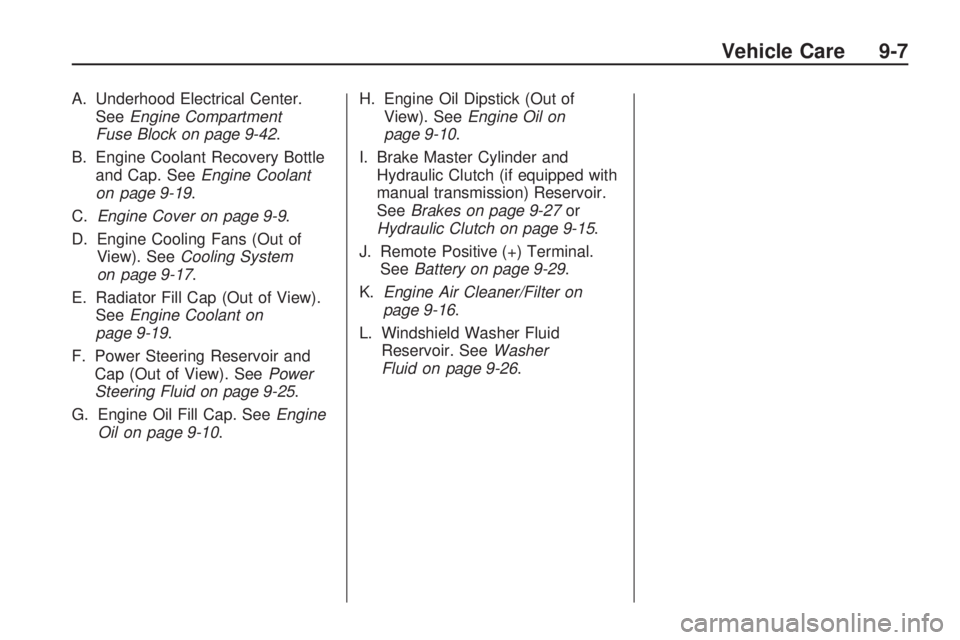
A. Underhood Electrical Center.
SeeEngine Compartment
Fuse Block on page 9-42.
B. Engine Coolant Recovery Bottle
and Cap. SeeEngine Coolant
on page 9-19.
C.Engine Cover on page 9-9.
D. Engine Cooling Fans (Out of
View). SeeCooling System
on page 9-17.
E. Radiator Fill Cap (Out of View).
SeeEngine Coolant on
page 9-19.
F. Power Steering Reservoir and
Cap (Out of View). SeePower
Steering Fluid on page 9-25.
G. Engine Oil Fill Cap. SeeEngine
Oil on page 9-10.H. Engine Oil Dipstick (Out of
View). SeeEngine Oil on
page 9-10.
I. Brake Master Cylinder and
Hydraulic Clutch (if equipped with
manual transmission) Reservoir.
SeeBrakes on page 9-27or
Hydraulic Clutch on page 9-15.
J. Remote Positive (+) Terminal.
SeeBattery on page 9-29.
K.Engine Air Cleaner/Filter on
page 9-16.
L. Windshield Washer Fluid
Reservoir. SeeWasher
Fluid on page 9-26.
Vehicle Care 9-7
Page 241 of 372
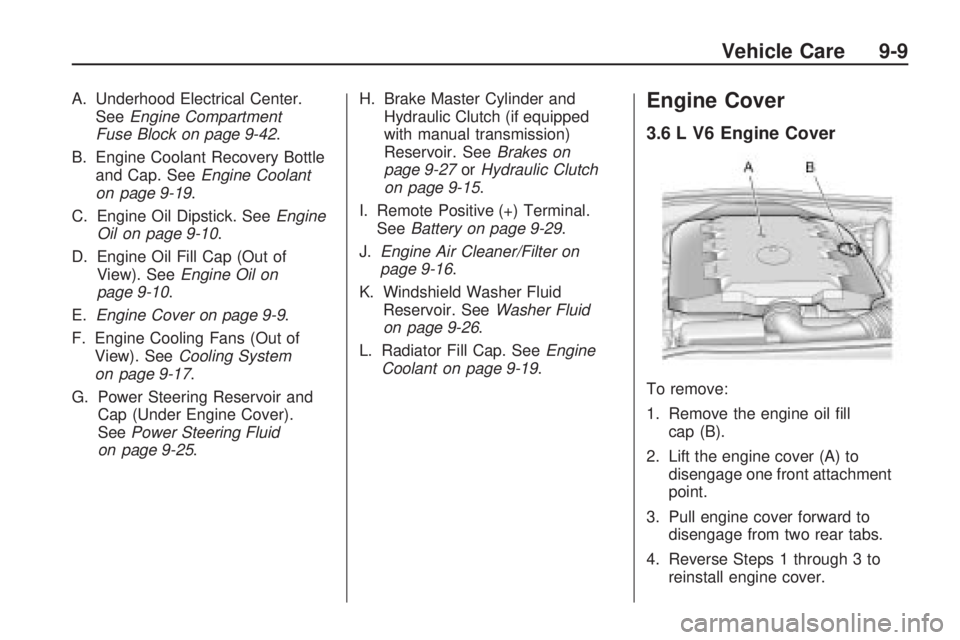
A. Underhood Electrical Center.
SeeEngine Compartment
Fuse Block on page 9-42.
B. Engine Coolant Recovery Bottle
and Cap. SeeEngine Coolant
on page 9-19.
C. Engine Oil Dipstick. SeeEngine
Oil on page 9-10.
D. Engine Oil Fill Cap (Out of
View). SeeEngine Oil on
page 9-10.
E.Engine Cover on page 9-9.
F. Engine Cooling Fans (Out of
View). SeeCooling System
on page 9-17.
G. Power Steering Reservoir and
Cap (Under Engine Cover).
SeePower Steering Fluid
on page 9-25.H. Brake Master Cylinder and
Hydraulic Clutch (if equipped
with manual transmission)
Reservoir. SeeBrakes on
page 9-27orHydraulic Clutch
on page 9-15.
I. Remote Positive (+) Terminal.
SeeBattery on page 9-29.
J.Engine Air Cleaner/Filter on
page 9-16.
K. Windshield Washer Fluid
Reservoir. SeeWasher Fluid
on page 9-26.
L. Radiator Fill Cap. SeeEngine
Coolant on page 9-19.Engine Cover
3.6 L V6 Engine Cover
To remove:
1. Remove the engine oil fill
cap (B).
2. Lift the engine cover (A) to
disengage one front attachment
point.
3. Pull engine cover forward to
disengage from two rear tabs.
4. Reverse Steps 1 through 3 to
reinstall engine cover.
Vehicle Care 9-9
Page 257 of 372
If No Steam Is Coming From
The Engine Compartment
If an engine overheat warning is
displayed but no steam can be seen
or heard, the problem may not be too
serious. Sometimes the engine can
get a little too hot when the vehicle:
•Climbs a long hill on a hot day.
•Stops after high-speed driving.
•Idles for long periods in traffic.
•Tows a trailer.
If the overheat warning is displayed
with no sign of steam:
1. Turn the air off.
2. Turn the heater on to the highest
temperature and to the highest
fan speed. Open the windows
as necessary.3. In heavy traffic, let the engine idle
in N (Neutral) while stopped. If it
is safe to do so, pull off the road,
shift to P (Park) or N (Neutral) and
let the engine idle.
If the temperature overheat gage is
no longer in the overheat zone or an
overheat warning no longer displays,
the vehicle can be driven. Continue
to drive the vehicle slow for about
10 minutes. Keep a safe vehicle
distance from the car in front of you.
If the warning does not come back
on, continue to drive normally.
If the warning continues, pull over,
stop, and park the vehicle right away.
If there is no sign of steam, idle
the engine for three minutes while
parked. If the warning is still
displayed, turn off the engine until it
cools down. Also, see “Overheated
Engine Protection Operating Mode”
later in this section.
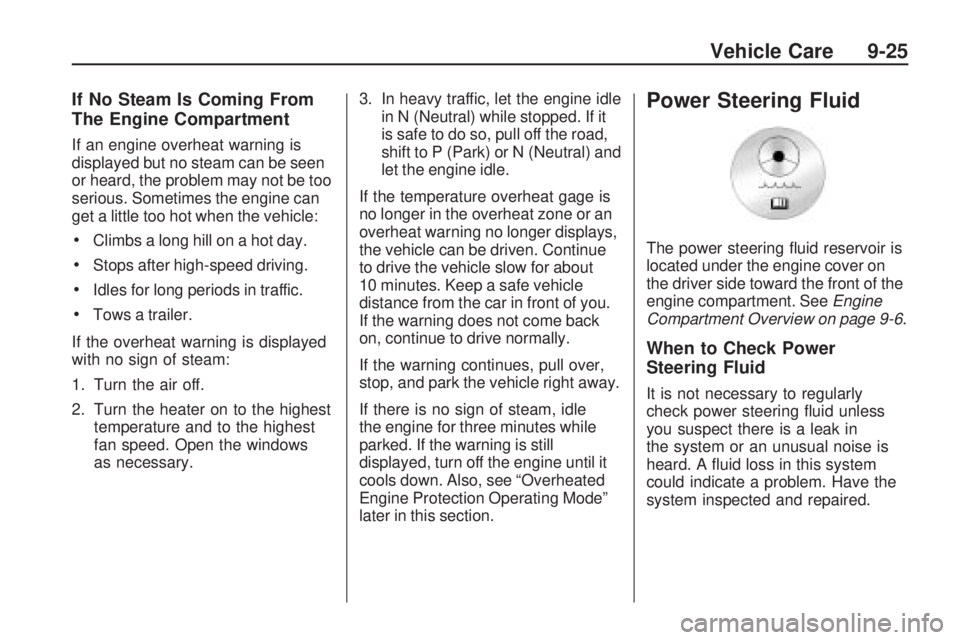
Power Steering Fluid
The power steering fluid reservoir is
located under the engine cover on
the driver side toward the front of the
engine compartment. SeeEngine
Compartment Overview on page 9-6.
When to Check Power
Steering Fluid
It is not necessary to regularly
check power steering fluid unless
you suspect there is a leak in
the system or an unusual noise is
heard. A fluid loss in this system
could indicate a problem. Have the
system inspected and repaired.
Vehicle Care 9-25
Page 258 of 372
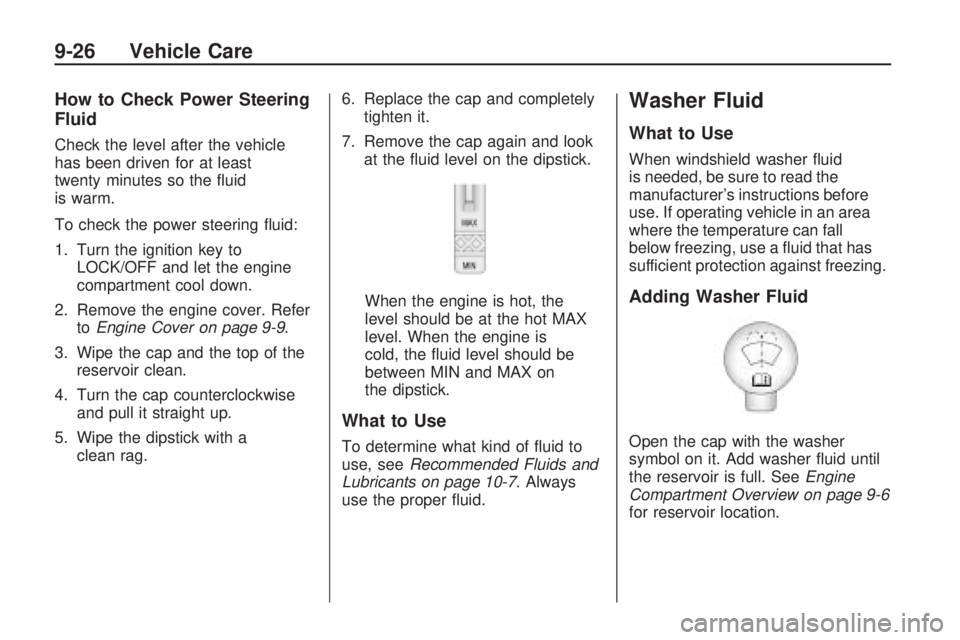
How to Check Power Steering
Fluid
Check the level after the vehicle
has been driven for at least
twenty minutes so the fluid
is warm.
To check the power steering fluid:
1. Turn the ignition key to
LOCK/OFF and let the engine
compartment cool down.
2. Remove the engine cover. Refer
toEngine Cover on page 9-9.
3. Wipe the cap and the top of the
reservoir clean.
4. Turn the cap counterclockwise
and pull it straight up.
5. Wipe the dipstick with a
clean rag.6. Replace the cap and completely
tighten it.
7. Remove the cap again and look
at the fluid level on the dipstick.
When the engine is hot, the
level should be at the hot MAX
level. When the engine is
cold, the fluid level should be
between MIN and MAX on
the dipstick.
What to Use
To determine what kind of fluid to
use, seeRecommended Fluids and
Lubricants on page 10-7. Always
use the proper fluid.
Washer Fluid
What to Use
When windshield washer fluid
is needed, be sure to read the
manufacturer’s instructions before
use. If operating vehicle in an area
where the temperature can fall
below freezing, use a fluid that has
sufficient protection against freezing.
Adding Washer Fluid
Open the cap with the washer
symbol on it. Add washer fluid until
the reservoir is full. SeeEngine
Compartment Overview on page 9-6
for reservoir location.
9-26 Vehicle Care
Page 278 of 372

Fuses Usage
F10 Spare
F11 Spare
F12 Spare
F13 Display
F14OnStar
®Universal
Hands Free Phone
F15Body Control
Module 3
F16Body Control
Module 4
F17 Power Outlet 1
F18 Power Outlet 2
F19Steering Wheel
Controls Backlight
F20 Spare
F21 Spare
F22 Spare
F23 Trunk
F24Automatic Occupant
Sensing
Fuses Usage
F25Body Control
Module 1
F27Body Control
Module 8
F28 Spare
F29Body Control
Module 5
F30Body Control
Module 7
Circuit
BreakersUsage
CB7 Passenger Seat
CB26 Driver Seat
Relays Usage
K10Retained Accessory
Power
K605 Not Used
K609 Trunk
Rear Compartment
Fuse Block
The rear compartment fuse block is
located on the right side of the trunk
behind a cover. Remove the six
convenience net retainers, the rear
sill plate, and the two passenger side
trim retainers, then swing the trim out
of the way.
9-46 Vehicle Care
Page 284 of 372
Tire Terminology and
Denitions
Air Pressure:The amount
of air inside the tire pressing
outward on each square inch
of the tire. Air pressure is
expressed in pounds per square
inch (psi) or kilopascal (kPa).
Accessory Weight
:This means
the combined weight of optional
accessories. Some examples
of optional accessories are,
automatic transmission, power
steering, power brakes, power
windows, power seats, and air
conditioning.
Aspect Ratio
:The relationship
of a tire’s height to its width.
Belt
:A rubber coated layer of
cords that is located between the
plies and the tread. Cords may
be made from steel or other
reinforcing materials.Bead
:The tire bead contains
steel wires wrapped by steel
cords that hold the tire onto
the rim.
Bias Ply Tire
:A pneumatic
tire in which the plies are laid
at alternate angles less than
90 degrees to the centerline
of the tread.
Cold Tire Pressure
:The
amount of air pressure in a tire,
measured in pounds per square
inch (psi) or kilopascals (kPa)
before a tire has built up heat
from driving. SeeTire Pressure
on page 9-54.
Curb Weight
:The weight of
a motor vehicle with standard
and optional equipment including
the maximum capacity of fuel,
oil, and coolant, but without
passengers and cargo.DOT Markings
:A code
molded into the sidewall of
a tire signifying that the tire
is in compliance with the U.S.
Department of Transportation
(DOT) motor vehicle safety
standards. The DOT code
includes the Tire Identification
Number (TIN), an alphanumeric
designator which can also
identify the tire manufacturer,
production plant, brand, and
date of production.
GVWR
:Gross Vehicle Weight
Rating. SeeVehicle Load
Limits on page 8-12.
GAWR FRT
:Gross Axle
Weight Rating for the front axle.
SeeVehicle Load Limits on
page 8-12.
GAWR RR
:Gross Axle
Weight Rating for the rear axle.
SeeVehicle Load Limits on
page 8-12.
9-52 Vehicle Care
Page 335 of 372

Recommended Fluids, Lubricants, and Parts
Recommended Fluids and Lubricants
UsageFluid/Lubricant
Engine Oil (V6 Engine) Engine oil which meets GM Standard GM6094M and displays the
American Petroleum Institute Certified for Gasoline Engines starburst
symbol. To determine the proper viscosity for the vehicle’s engine, see
Engine Oil on page 9-10
.
Engine Oil (V8 Engines) The engine requires a special engine oil meeting GM Standard GM4718M.
Oils meeting this standard can be identified with the American Petroleum
Institute (API) Certified for Gasoline Engines starburst symbol. However,
not all synthetic API oils with the starburst symbol will meet this GM
standard. Look for and use only an oil that meets GM Standard GM4718M.
For the proper viscosity, see
Engine Oil on page 9-10.
Engine Coolant 50/50 mixture of clean, drinkable water and use only DEX-COOL
®
Coolant. See
Engine Coolant on page 9-19 .
Hydraulic Brake System Hydraulic Brake Fluid (GM Part No. U.S. 88862806, in Canada 88862807).
Hydraulic Clutch System Hydraulic Brake Fluid (GM Part No. U.S. 88862806, in Canada 88862807). Windshield Washer Optikleen
®Washer Solvent.
Hydraulic Power Steering System DEXRON®-VI Automatic Transmission Fluid.
Parking Brake Cable Guides Chassis Lubricant (GM Part No. 12377985, in Canada 88901242) or
lubricant meeting requirements of NLGI #2, Category LB or GC-LB.
Automatic Transmission DEXRON
®-VI Automatic Transmission Fluid.
Manual Transmission (V6 Engine) SAE 75W-90 GL5 Gear Oil (GM Part No. U.S. 88862475,
in Canada 88862476).
Service and Maintenance 10-7
Page 364 of 372
Engine (cont.)
Coolant
Temperature Gage.........4-14
Cooling System................9-17
Cooling System
Messages....................4-32
Cover............................... 9-9
Drive Belt Routing.............11-4
Exhaust...........................8-25
Oil Pressure Gage............4-12
Overheating.....................9-24
Power Messages..............4-33
Pressure Light..................4-25
Running While Parked.......8-26
Starting...........................8-19
Engine Oil
Life System.....................9-13
Messages........................4-32
Temperature Gage............4-13
Entry Lighting........................ 5-6
Equipment, Towing...............8-55
Event Data Recorders.........12-14
Extender, Safety Belt............2-20
Exterior Lamp Controls........... 5-1F
Filter
Engine Air Cleaner............9-16
Flashers, Hazard Warning....... 5-4
Flash-to-Pass........................ 5-3
Flat Tire..............................9-69
Flat Tire, Changing...............9-77
Fluid
Automatic Transmission.....9-14
Brakes............................9-28
Power Steering.................9-25
Washer...........................9-26
Fog Lamps
Bulb Replacement.............9-40
Front................................ 5-5
Light...............................4-26
Front Seats
Adjustment........................ 2-3
Heated............................. 2-6
Fuel...................................8-43
Additives.........................8-45
Economy Driving................ 8-2
Filling a Portable Fuel
Container.....................8-48Fuel (cont.)
Filling the Tank.................8-46
Fuels in Foreign
Countries.....................8-45
Gage ..............................4-11
Gasoline Specifications......8-44
Management, Active..........8-25
Recommended.................8-44
Requirements, California....8-45
System Messages.............4-33
Fuses
Engine Compartment
Fuse Block...................9-42
Fuses and Circuit
Breakers......................9-42
Instrument Panel Fuse
Block...........................9-45
Rear Compartment
Fuse Block...................9-46
G
Gages
Engine Coolant
Temperature.................4-14
Engine Oil Pressure..........4-12
Engine Oil Temperature.....4-13
i-4 INDEX