ECU CHEVROLET CAMARO SS 2010 Owner's Guide
[x] Cancel search | Manufacturer: CHEVROLET, Model Year: 2010, Model line: CAMARO SS, Model: CHEVROLET CAMARO SS 2010Pages: 372, PDF Size: 1.91 MB
Page 122 of 372

OnStar System
OnStar®System
OnStar uses several innovative
technologies and live advisors to
provide a wide range of safety,
security, information, and
convenience services. If the airbags
deploy, the system is designed to
make an automatic call to OnStar
Emergency advisors who can
request emergency services be sent
to your location. If the keys are
locked in the vehicle, call OnStar
at 1-888-4-ONSTAR to have a
signal sent to unlock the doors.OnStar Hands-Free Calling,
including 30 trial minutes good for
60 days, is available on most
vehicles. OnStar Turn-by-Turn
Navigation service, with one trial
route, is available on most vehicles.
Press the OnStar button to have
an OnStar advisor contact Roadside
Service.
OnStar service is provided subject
to the OnStar Terms and Conditions
included in the OnStar Subscriber
glove box literature.
Some services such as Remote
Door Unlock or Stolen Vehicle
Location Assistance may not be
available until the owner of the
vehicle registers with OnStar.
After the first prepaid year, contact
OnStar to select a monthly or
annual subscription payment plan.
If a payment plan is not selected,
the OnStar system and all services,
including airbag notification andemergency services, may be
deactivated and no longer
available. For more information
visit www.onstar.com (U.S.)
or www.onstar.ca (Canada), or
press the OnStar button to speak
with an advisor.
Not all OnStar services are available
on all vehicles. To check if this
vehicle is able to provide the
services described below, or for a
full description of OnStar services
and system limitations, see the
OnStar Owner’s Guide in the glove
box or visit www.onstar.com
(U.S.) or www.onstar.ca (Canada),
contact OnStar at 1-888-4-ONSTAR
(1-888-466-7827) or TTY
1-877-248-2080, or press the
OnStar button to speak with an
OnStar advisor 24 hours a day,
7 days a week.
4-42 Instruments and Controls
Page 125 of 372

Some examples are damage to
important parts of the vehicle in a
crash, hills, tall buildings, tunnels,
weather or wireless phone network
congestion.
Your Responsibility
Increase the volume of the radio if
the OnStar advisor cannot be heard.
If the light next to the OnStar buttons
is red, the system may not be
functioning properly. Press the
OnStar button and request a vehicle
diagnostic. If the light appears clear
(no light is appearing), your OnStar
subscription has expired and all
services have been deactivated.
Press the OnStar button to confirm
that the OnStar equipment is active.Universal Remote
System
SeeRadio Frequency Statement
(US, Can) on page 12-15for
information regarding Part 15 of
the Federal Communications
Commission (FCC) Rules and
RSS-210/211 of Industry and
Science Canada.
Universal Remote
System Programming
If there is one square Light Emitting
Diode (LED) indicator light next to
the Universal Home Remote buttons,
follow the instructions below.This system provides a way to
replace up to three remote control
transmitters used to activate devices
such as garage door openers,
security systems, and home
automation devices.
Do not use the Universal Home
Remote with any garage door
opener that does not have the stop
and reverse feature. This includes
any garage door opener model
manufactured before April 1, 1982.
Read the instructions completely
before attempting to program
the Universal Home Remote.
Because of the steps involved,
it may be helpful to have another
person available to assist you
with programming the Universal
Home Remote.
Keep the original hand-held
transmitter for use in other vehicles
as well as for future Universal
Home Remote programming.
Instruments and Controls 4-45
Page 126 of 372

It is also recommended that upon
the sale of the vehicle, the
programmed Universal Home
Remote buttons should be erased
for security purposes. See “Erasing
Universal Home Remote Buttons”
later in this section.
When programming a garage door,
park outside of the garage. Park
directly in line with and facing
the garage door opener motor-head
or gate motor-head. Be sure that
people and objects are clear of the
garage door or gate that is being
programmed.
It is recommended that a new
battery be installed in your
hand-held transmitter for quicker
and more accurate transmission
of the radio-frequency signal.Programming the Universal
Home Remote System
For questions or help programming
the Universal Home Remote
System, call 1-800-355-3515
or go to www.homelink.com.
Programming a garage door opener
involves time-sensitive actions,
so read the entire procedure before
starting. Otherwise, the device
will time out and the procedure will
have to be repeated.
To program up to three devices:
1. Hold the end of your hand-held
transmitter about 3 to 8 cm
(1 to 3 inches) away from the
Universal Home Remote buttons
while keeping the indicator
light in view. The hand-held
transmitter was supplied by
the manufacturer of your
garage door opener receiver
(motor-head unit).2. At the same time, press and hold
both the hand-held transmitter
button and one of the three
Universal Home Remote buttons
to be used to operate the
garage door. Do not release
the Universal Home Remote
button or the hand-held
transmitter button until the
indicator light changes from
a slow to a rapidly flashing
light. You now may release
both buttons.
Some entry gates and garage
door openers may require
substitution of Step 2 with
the procedure noted in “Gate
Operator and Canadian
Programming” later in this
section.
4-46 Instruments and Controls
Page 192 of 372
If you put things inside the
vehicle — like suitcases,
tools, packages, or anything
else — they will go as fast as
the vehicle goes. If you have to
stop or turn quickly, or if there
is a crash, they will keep going.
{WARNING
Things you put inside the
vehicle can strike and injure
people in a sudden stop or
turn, or in a crash.
•Put things in the trunk of
your vehicle. In a trunk,
put them as far forward
as you can. Try to spread
the weight evenly.
(Continued)
WARNING (Continued)
•Never stack heavier
things, like suitcases,
inside the vehicle so that
some of them are above
the tops of the seats.
•Do not leave an unsecured
child restraint in the
vehicle.
•When you carry something
inside the vehicle, secure
it whenever you can.
•Do not leave a seat folded
down unless you need to.
Starting and
Operating
New Vehicle Break-In
Notice:Follow these
recommended guidelines during
the rst 2 414 km/1,500 miles of
driving this vehicle. Parts have a
break-in period and performance
will be better in the long run.
For the rst 2 414 km/
1,500 miles:
•Avoid full throttle starts and
abrupt stops.
•Do not exceed
4,000 engine rpm.
•Avoid driving at any one
constant speed, fast or slow.
•Do not drive above 160 km/h
(100 mph).
8-16 Driving and Operating
Page 226 of 372

•Vehicles with automatic
transmissions can tow in D (Drive)
but M (Manual Mode) is
recommended. See “Manual
Mode” inAutomatic Transmission
on page 8-26for more
information. Use a lower gear if
the transmission shifts too often.
For vehicles with a manual
transmission, it is better not
to use the highest gear.
•Use the cruise control when
towing.
•Obey speed limit restrictions.
Do not drive faster than the
maximum posted speed for
trailers, or no more than 90 km/h
(55 mph), to reduce wear on the
vehicle.
Driving with a Trailer
Towing a trailer requires experience.
Get familiar with handling and
braking with the added trailer weight.
The vehicle is now longer and not as
responsive as the vehicle is by itself.
Check all trailer hitch parts and
attachments, safety chains, electrical
connectors, lamps, tires and mirror
adjustments. If the trailer has electric
brakes, start the vehicle and trailer
moving and then apply the trailer
brake controller by hand to be sure
the brakes are working.
During the trip, check regularly to
be sure that the load is secure, and
the lamps and trailer brakes are
working properly.
Towing with a Stability
Control System
When towing, the sound of the
stability control system might be
heard. The system is reacting to the
vehicle movement caused by the
trailer, which mainly occurs during
cornering. This is normal when
towing heavier trailers.
Following Distance
Stay at least twice as far behind the
vehicle ahead as you would when
driving the vehicle without a trailer.
This can help to avoid situations that
require heavy braking and sudden
turns.
Passing
More passing distance is needed
when towing a trailer. Because the
rig is longer, it is necessary to go
much farther beyond the passed
vehicle before returning to the lane.
8-50 Driving and Operating
Page 229 of 372

Maintenance When Trailer
Towing
The vehicle needs service more
often when pulling a trailer. See this
manual’s Maintenance Schedule or
Index for more information. Things
that are especially important in trailer
operation are automatic transmission
fluid, engine oil, axle lubricant, belts,
cooling system and brake system.
It is a good idea to inspect these
before and during the trip.
Check periodically to see that all
hitch nuts and bolts are tight.
Engine Cooling When Trailer
Towing
The cooling system may temporarily
overheat during severe operating
conditions. SeeEngine Overheating
on page 9-24.
Trailer Towing
Before pulling a trailer, there are
three important considerations that
have to do with weight:
•The weight of the trailer.
•The weight of the trailer tongue.
•The total weight on your
vehicle’s tires.
Weight of the Trailer
How heavy can a trailer safely be?
It should never weigh more than
1,000 lbs (454 kg). But even
that can be too heavy.
It depends on how the rig is used.
For example, speed, altitude, road
grades, outside temperature and
how much the vehicle is used to pull
a trailer are all important. It candepend on any special equipment
on the vehicle, and the amount of
tongue weight the vehicle can carry.
See “Weight of the Trailer Tongue”
later in this section for more
information.
Maximum trailer weight is calculated
assuming only the driver is in the tow
vehicle and it has all the required
trailering equipment. The weight
of additional optional equipment,
passengers and cargo in the tow
vehicle must be subtracted from
the maximum trailer weight.
Ask your dealer/retailer for our
trailering information or advice, or
you can write us at our Customer
Assistance Offices. SeeCustomer
Assistance Offices on page 12-3
for more information.
Driving and Operating 8-53
Page 252 of 372
Checking Coolant
The vehicle must be on a level
surface when checking the coolant
level.
Check coolant as follows:
1. Turn the ignition OFF.
2. Locate the coolant recovery
bottle. SeeEngine Compartment
Overview on page 9-6.
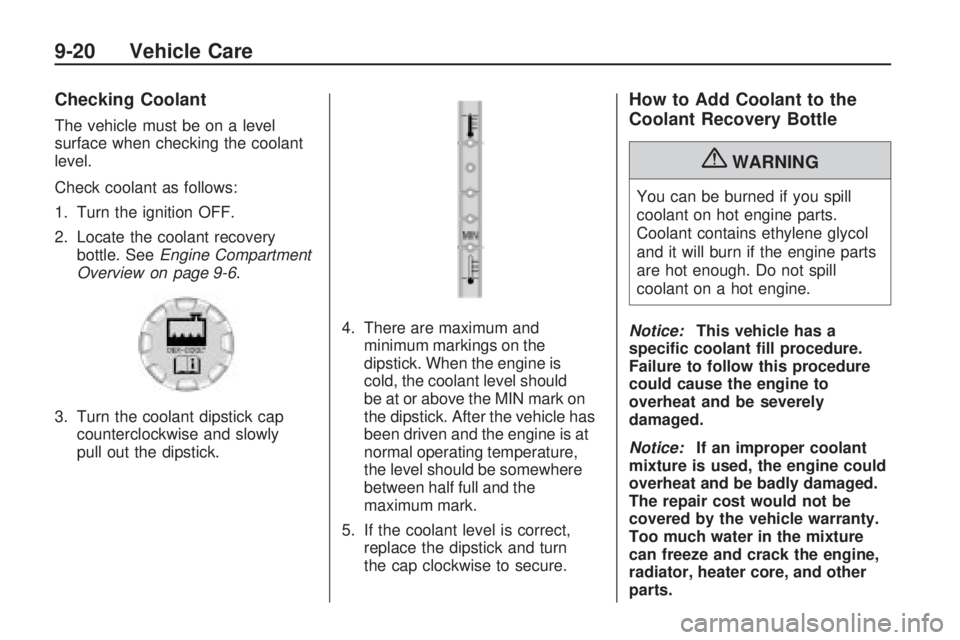
3. Turn the coolant dipstick cap
counterclockwise and slowly
pull out the dipstick.4. There are maximum and
minimum markings on the
dipstick. When the engine is
cold, the coolant level should
be at or above the MIN mark on
the dipstick. After the vehicle has
been driven and the engine is at
normal operating temperature,
the level should be somewhere
between half full and the
maximum mark.
5. If the coolant level is correct,
replace the dipstick and turn
the cap clockwise to secure.
How to Add Coolant to the
Coolant Recovery Bottle
{WARNING
You can be burned if you spill
coolant on hot engine parts.
Coolant contains ethylene glycol
and it will burn if the engine parts
are hot enough. Do not spill
coolant on a hot engine.
Notice:This vehicle has a
specic coolant ll procedure.
Failure to follow this procedure
could cause the engine to
overheat and be severely
damaged.
Notice:If an improper coolant
mixture is used, the engine could
overheat and be badly damaged.
The repair cost would not be
covered by the vehicle warranty.
Too much water in the mixture
can freeze and crack the engine,
radiator, heater core, and other
parts.
9-20 Vehicle Care
Page 253 of 372
Add coolant as follows:
1. Turn the coolant overflow bottle
dipstick cap counterclockwise
and slowly pull out the dipstick.
2. Pour the coolant into the coolant
recovery bottle.
3. When the level is correct,
replace the dipstick and turn
the cap clockwise to secure.
How to Add Coolant to the
Radiator
{WARNING
You can be burned if you spill
coolant on hot engine parts.
Coolant contains ethylene glycol
and it will burn if the engine parts
are hot enough. Do not spill
coolant on a hot engine.Notice:This vehicle has a
specic coolant ll procedure.
Failure to follow this procedure
could cause the engine to
overheat and be severely
damaged.
{WARNING
An electric engine cooling fan
under the hood can start up even
when the engine is not running
and can cause injury. Keep
hands, clothing, and tools away
from any underhood electric fan.
{WARNING
Steam and scalding liquids from
a hot cooling system can blow
out and burn you badly. They are
under pressure, and if you turn the
surge tank pressure cap — even a
little — they can come out at high
speed. Never turn the cap when
the cooling system, including the
surge tank pressure cap, is hot.
Wait for the cooling system and
surge tank pressure cap to cool
if you ever have to turn the
pressure cap.
If coolant is needed, add the proper
mixture directly to the radiator,
but be sure the cooling system
is cool before this is done.
Vehicle Care 9-21
Page 255 of 372
6.2 L V8 Engine Fill Procedure
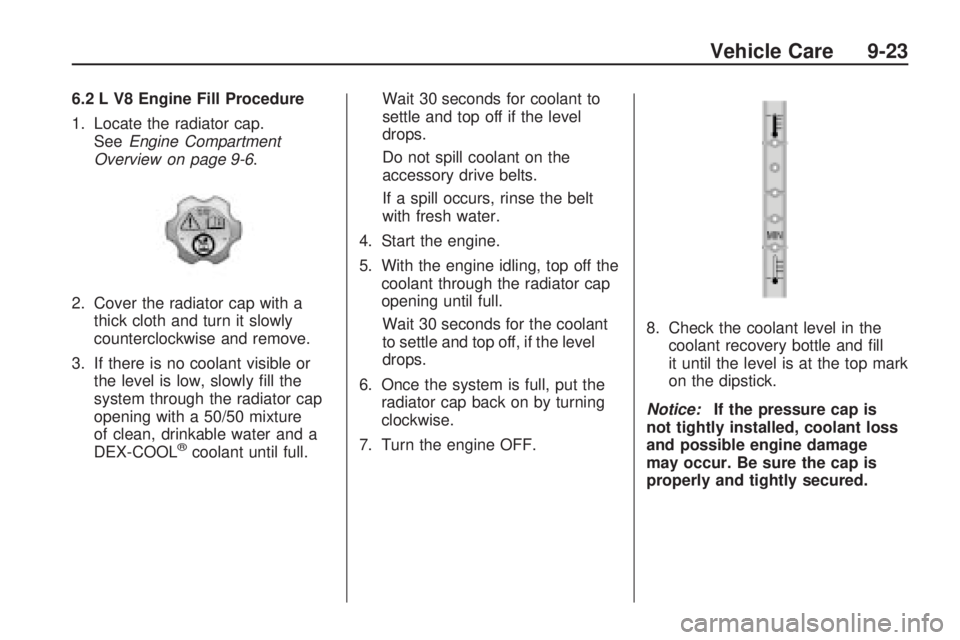
1. Locate the radiator cap.
SeeEngine Compartment
Overview on page 9-6.
2. Cover the radiator cap with a
thick cloth and turn it slowly
counterclockwise and remove.
3. If there is no coolant visible or
the level is low, slowly fill the
system through the radiator cap
opening with a 50/50 mixture
of clean, drinkable water and a
DEX-COOL
®coolant until full.Wait 30 seconds for coolant to
settle and top off if the level
drops.
Do not spill coolant on the
accessory drive belts.
If a spill occurs, rinse the belt
with fresh water.
4. Start the engine.
5. With the engine idling, top off the
coolant through the radiator cap
opening until full.
Wait 30 seconds for the coolant
to settle and top off, if the level
drops.
6. Once the system is full, put the
radiator cap back on by turning
clockwise.
7. Turn the engine OFF.8. Check the coolant level in the
coolant recovery bottle and fill
it until the level is at the top mark
on the dipstick.
Notice:If the pressure cap is
not tightly installed, coolant loss
and possible engine damage
may occur. Be sure the cap is
properly and tightly secured.
Vehicle Care 9-23
Page 315 of 372
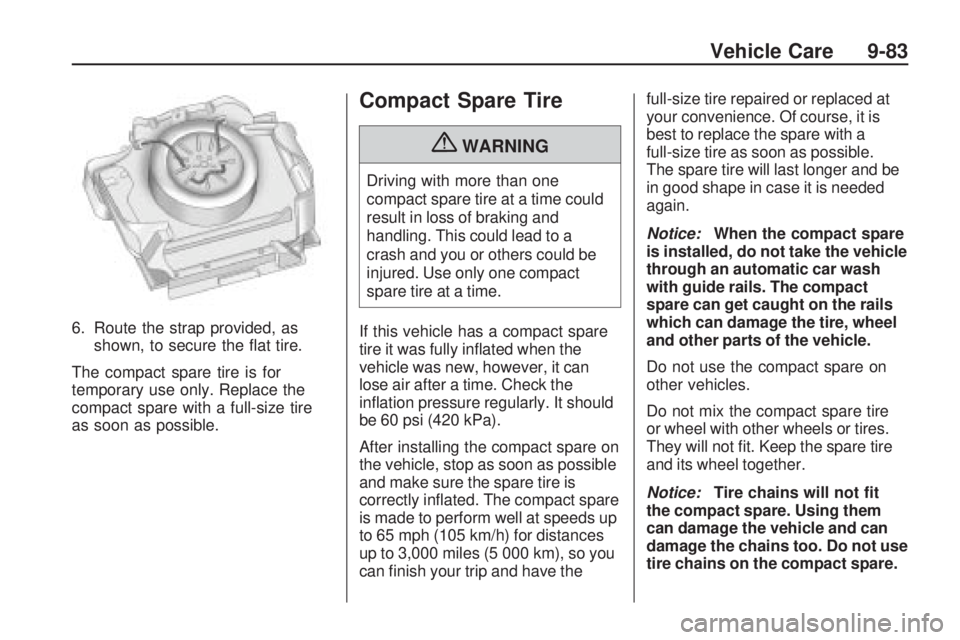
6. Route the strap provided, as
shown, to secure the flat tire.
The compact spare tire is for
temporary use only. Replace the
compact spare with a full-size tire
as soon as possible.
Compact Spare Tire
{WARNING
Driving with more than one
compact spare tire at a time could
result in loss of braking and
handling. This could lead to a
crash and you or others could be
injured. Use only one compact
spare tire at a time.
If this vehicle has a compact spare
tire it was fully inflated when the
vehicle was new, however, it can
lose air after a time. Check the
inflation pressure regularly. It should
be 60 psi (420 kPa).
After installing the compact spare on
the vehicle, stop as soon as possible
and make sure the spare tire is
correctly inflated. The compact spare
is made to perform well at speeds up
to 65 mph (105 km/h) for distances
up to 3,000 miles (5 000 km), so you
can finish your trip and have thefull-size tire repaired or replaced at
your convenience. Of course, it is
best to replace the spare with a
full-size tire as soon as possible.
The spare tire will last longer and be
in good shape in case it is needed
again.
Notice:When the compact spare
is installed, do not take the vehicle
through an automatic car wash
with guide rails. The compact
spare can get caught on the rails
which can damage the tire, wheel
and other parts of the vehicle.
Do not use the compact spare on
other vehicles.
Do not mix the compact spare tire
or wheel with other wheels or tires.
They will not fit. Keep the spare tire
and its wheel together.
Notice:Tire chains will not t
the compact spare. Using them
can damage the vehicle and can
damage the chains too. Do not use
tire chains on the compact spare.
Vehicle Care 9-83