light CHEVROLET CAMARO SS 2010 Manual PDF
[x] Cancel search | Manufacturer: CHEVROLET, Model Year: 2010, Model line: CAMARO SS, Model: CHEVROLET CAMARO SS 2010Pages: 372, PDF Size: 1.91 MB
Page 213 of 372
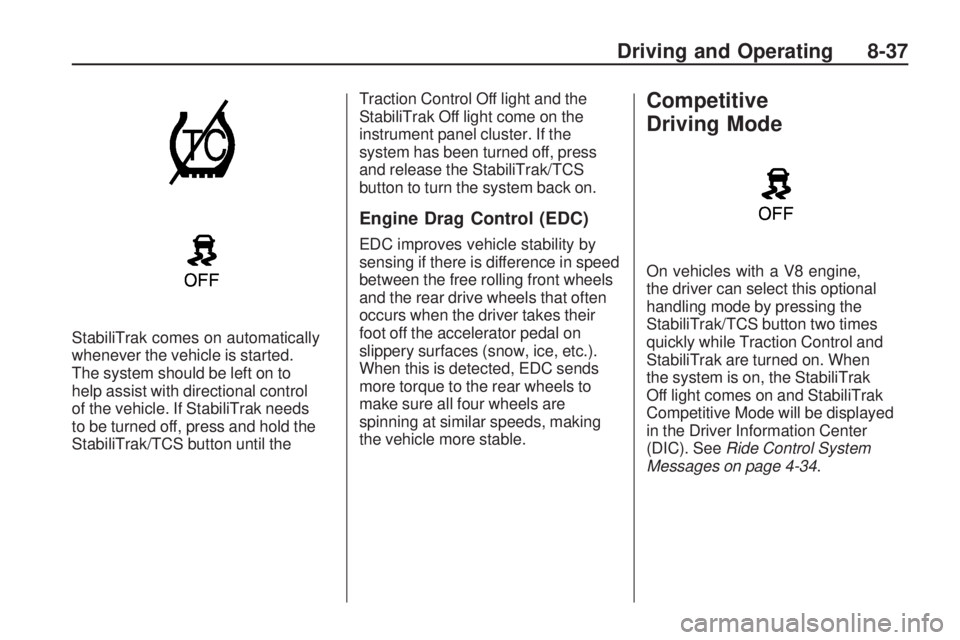
StabiliTrak comes on automatically
whenever the vehicle is started.
The system should be left on to
help assist with directional control
of the vehicle. If StabiliTrak needs
to be turned off, press and hold the
StabiliTrak/TCS button until theTraction Control Off light and the
StabiliTrak Off light come on the
instrument panel cluster. If the
system has been turned off, press
and release the StabiliTrak/TCS
button to turn the system back on.
Engine Drag Control (EDC)
EDC improves vehicle stability by
sensing if there is difference in speed
between the free rolling front wheels
and the rear drive wheels that often
occurs when the driver takes their
foot off the accelerator pedal on
slippery surfaces (snow, ice, etc.).
When this is detected, EDC sends
more torque to the rear wheels to
make sure all four wheels are
spinning at similar speeds, making
the vehicle more stable.
Competitive
Driving Mode
On vehicles with a V8 engine,
the driver can select this optional
handling mode by pressing the
StabiliTrak/TCS button two times
quickly while Traction Control and
StabiliTrak are turned on. When
the system is on, the StabiliTrak
Off light comes on and StabiliTrak
Competitive Mode will be displayed
in the Driver Information Center
(DIC). SeeRide Control System
Messages on page 4-34.
Driving and Operating 8-37
Page 215 of 372
Setting Cruise Control
{WARNING
If you leave your cruise control
on when you are not using cruise,
you might hit a button and go into
cruise when you do not want to.
You could be startled and even
lose control. Keep the cruise
control switch off until you want
to use cruise control.
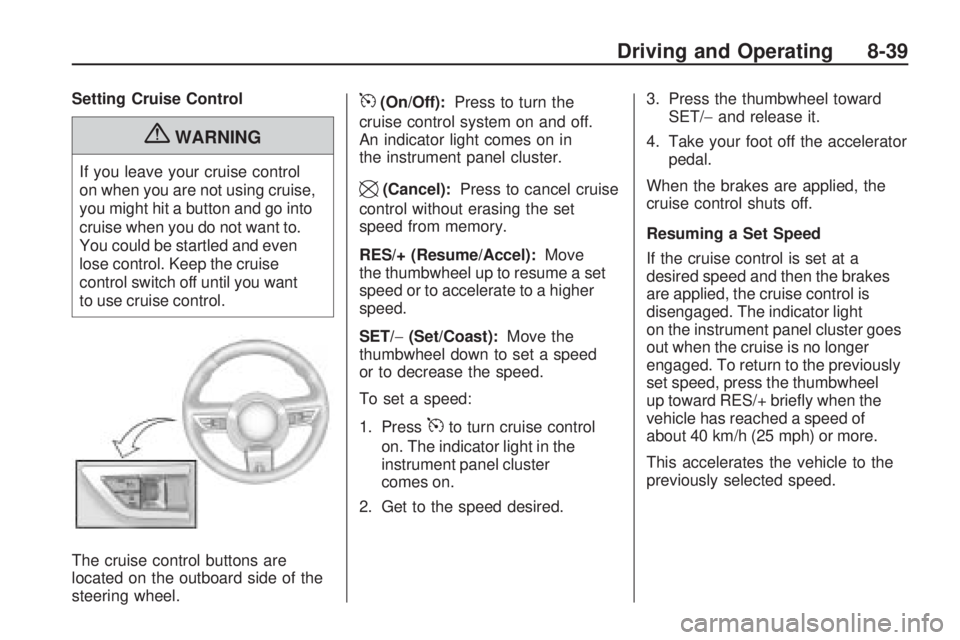
The cruise control buttons are
located on the outboard side of the
steering wheel.
5(On/Off):Press to turn the
cruise control system on and off.
An indicator light comes on in
the instrument panel cluster.
\(Cancel):Press to cancel cruise
control without erasing the set
speed from memory.
RES/+ (Resume/Accel):Move
the thumbwheel up to resume a set
speed or to accelerate to a higher
speed.
SET/−(Set/Coast):Move the
thumbwheel down to set a speed
or to decrease the speed.
To set a speed:
1. Press
5to turn cruise control
on. The indicator light in the
instrument panel cluster
comes on.
2. Get to the speed desired.3. Press the thumbwheel toward
SET/−and release it.
4. Take your foot off the accelerator
pedal.
When the brakes are applied, the
cruise control shuts off.
Resuming a Set Speed
If the cruise control is set at a
desired speed and then the brakes
are applied, the cruise control is
disengaged. The indicator light
on the instrument panel cluster goes
out when the cruise is no longer
engaged. To return to the previously
set speed, press the thumbwheel
up toward RES/+ briefly when the
vehicle has reached a speed of
about 40 km/h (25 mph) or more.
This accelerates the vehicle to the
previously selected speed.
Driving and Operating 8-39
Page 216 of 372
Increasing Speed While Using
Cruise Control
There are two ways to go to a
higher speed.
•Disengage the cruise control,
but do not turn it off.
•If the cruise control system is
already engaged, press the
thumbwheel up toward RES/+
and hold it until the vehicle
accelerates to the desired speed,
and then release the switch.
To increase the speed in small
amounts, press the thumbwheel
up toward RES/+ briefly and then
release it. Each time this is done,
the vehicle goes about 1.6 km/h
(1 mph) faster.
Reducing Speed While Using
Cruise Control
If the cruise control system is
already engaged,
•Push the thumbwheel toward
SET/−and hold until the desired
lower speed is reached, then
release it.
•To slow down in very small
amounts, push the thumbwheel
toward SET/−briefly. Each time
this is done, the vehicle goes
about 1.6 km/h (1 mph) slower.
Passing Another Vehicle While
Using Cruise Control
Use the accelerator pedal to
increase the vehicle’s speed.
When you take your foot off the
pedal, the vehicle will slow down
to the previously set cruise control
speed.
Using Cruise Control on Hills
How well the cruise control works
on hills depends upon the vehicle’s
speed, load, and the steepness of
the hills. When going up steep hills,
you might have to step on the
accelerator pedal to maintain the
vehicle’s speed. When going
downhill, you might have to brake
or shift to a lower gear to maintain
the vehicle’s speed. When the
brakes are applied the cruise
control shuts off.Ending Cruise Control
There are three ways to end the
cruise control:
•Step lightly on the brake pedal
or clutch; when cruise control
disengages, the indicator light
on the instrument panel cluster
goes out.
•Press5to turn off the cruise
control system.
•Press\to disengage the cruise
control.
Erasing Speed Memory
The cruise control set speed
memory is erased when the cruise
control or the ignition is turned off.
8-40 Driving and Operating
Page 217 of 372

Object Detection
Systems
Ultrasonic Parking Assist
For vehicles with the Ultrasonic
Rear Parking Assist (URPA)
system, it assists the driver with
parking and avoiding objects while
in R (Reverse). URPA operates at
speeds less than 8 km/h (5 mph),
and the sensors on the rear bumper
detect objects up to 2.4m (8 feet)
behind the vehicle, and at least
20 cm (8 inches) off the ground.
{WARNING
The Ultrasonic Rear Parking
Assist (URPA) system does not
replace driver vision. It cannot
detect:
•objects that are below the
bumper, underneath the
vehicle, or if they are too
close or far from the vehicle
•children, pedestrians,
bicyclists, or pets.
If you do not use proper care
before and while backing; vehicle
damage, injury, or death could
occur. Even with URPA, always
check behind the vehicle before
backing up. While backing, be
sure to look for objects and check
the vehicle’s mirrors.The display is located in the center
of the rear seat back filler panel
trim and uses three color-coded
lights to provide distance and
system information.
Driving and Operating 8-41
Page 218 of 372
How the System Works
URPA comes on automatically
and the display briefly illuminates
to indicate the system is working
when the shift lever is moved into
R (Reverse).
If the vehicle is traveling faster
then 8 km/h (5 mph) in reverse,
the red light on the rear display
flashes.
Objects must be at least 20 cm
(8 inches) off the ground and below
trunk level, and within 2.4m (8 feet)
from the rear bumper to be detected.
The distance may be less during
warmer or humid weather.
A single beep sounds the first time
an object is detected between 1.0 m
(40 inches) and 2.4m (8 feet) away.
Beeping occurs continuously when
the vehicle is 0.6 m (23 inches) or
closer to an object.The following describes how the URPA display lights appear as the vehicle
gets closer to a detected object:
Description
MetricEnglish
amber light 2.4 m8 ft
amber/amber lights 1.0 m40 in
amber/amber/red lights
and continuous beeping for five seconds 0.6 m
23 in
amber/amber/red lights flashing and continuous beeping for five seconds 0.3 m
1 ft
PARK ASSIST OFF displays
on the Driver Information Center (DIC)
to indicate that URPA is off.
The message disappears after
a short period of time. See
Object Detection System
Messages on page 4-34 for other
URPA messages.
8-42 Driving and Operating
Page 219 of 372

When the System Does Not
Seem to Work Properly
If the URPA system does not
activate due to a temporary
condition, the message PARK
ASSIST OFF displays on the DIC
and a red light comes on the rear
URPA display when the shift lever is
moved into R (Reverse). This can
occur under the following conditions:
•The ultrasonic sensors are not
clean. Keep the vehicle’s rear
bumper free of mud, dirt, snow,
ice and slush. For cleaning
instructions, seeExterior Care
on page 9-88.
•A trailer was attached to the
vehicle, or an object was hanging
out of the trunk during the last
drive cycle, making the red light
come on in the rear display.
Once the attached object is
removed, URPA will return
to normal operation.
•A tow bar is attached to the
vehicle.
•The vehicle’s bumper is
damaged. Take the vehicle to
your dealer/retailer to repair the
system.
•Other conditions may affect
system performance, such as
vibrations from a jackhammer or
the compression of air brakes on
a very large truck that is near the
vehicle.
If the system is still disabled, after
driving forward at least 25 km/h
(15 mph), take the vehicle to your
dealer/retailer.
Fuel
Use of the recommended fuel
is an important part of the proper
maintenance of this vehicle. To help
keep the engine clean and maintain
optimum vehicle performance, we
recommend the use of gasoline
advertised as TOP TIER Detergent
Gasoline.
Look for the TOP TIER label on the
fuel pump to ensure gasoline meets
enhanced detergency standards
developed by auto companies. A list
of marketers providing TOP TIER
Detergent Gasoline can be found
at www.toptiergas.com.
Driving and Operating 8-43
Page 220 of 372
The 8th digit of the Vehicle
Identification Number (VIN) shows
the code letter or number that
identifies the vehicle’s engine.
The VIN is at the top left of the
instrument panel. SeeVehicle
Identication Number (VIN) on
page 11-1.
Recommended Fuel
If the vehicle has the 3.6L V6 engine
(VIN Code V), use regular unleaded
gasoline with a posted octane rating
of 87 or higher. If the octane rating is
less than 87, you might notice an
audible knocking noise when you
drive, commonly referred to as spark
knock. If this occurs, use a gasoline
rated at 87 octane or higher as soon
as possible. If you are using gasoline
rated at 87 octane or higher and you
hear heavy knocking, the engine
needs service.
If the vehicle has the 6.2L V8 engine
(VIN Code W) or the 6.2L V8 engine
(VIN Code J), use premium unleaded
gasoline with a posted octane
rating of 91 or higher. For best
performance, use premium unleaded
gasoline with a posted octane
rating of 93. You can also use
regular unleaded gasoline rated at
87 octane or higher, but the vehicle’s
acceleration could be slightly
reduced, and you might notice aslight audible knocking noise,
commonly referred to as a spark
knock. If the octane is less than 87,
you might notice a heavy knocking
noise when you drive. If this occurs,
use a gasoline rated at 87 octane
or higher as soon as possible.
Otherwise, you could damage the
engine. If you are using gasoline
rated at 87 octane or higher and you
hear heavy knocking, the engine
needs service.
Gasoline Specications
At a minimum, gasoline
should meet ASTM specification
D 4814 in the United States or
CAN/CGSB-3.5 or 3.511 in Canada.
Some gasolines contain an
octane-enhancing additive called
methylcyclopentadienyl manganese
tricarbonyl (MMT). We recommend
against the use of gasolines
containing MMT. SeeFuel
Additives on page 8-45for
additional information.
8-44 Driving and Operating
Page 223 of 372
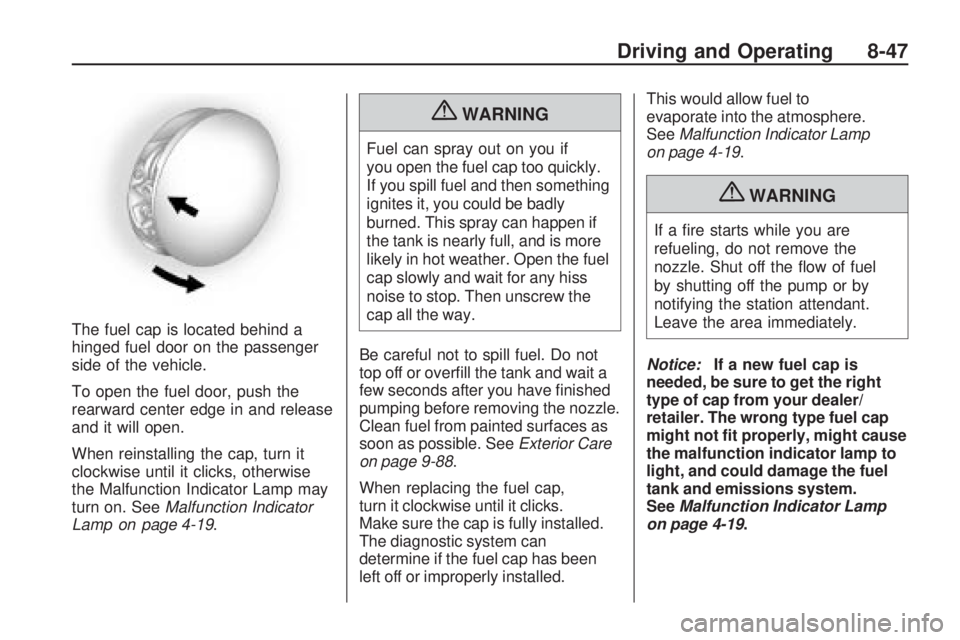
The fuel cap is located behind a
hinged fuel door on the passenger
side of the vehicle.
To open the fuel door, push the
rearward center edge in and release
and it will open.
When reinstalling the cap, turn it
clockwise until it clicks, otherwise
the Malfunction Indicator Lamp may
turn on. SeeMalfunction Indicator
Lamp on page 4-19.
{WARNING
Fuel can spray out on you if
you open the fuel cap too quickly.
If you spill fuel and then something
ignites it, you could be badly
burned. This spray can happen if
the tank is nearly full, and is more
likely in hot weather. Open the fuel
cap slowly and wait for any hiss
noise to stop. Then unscrew the
cap all the way.
Be careful not to spill fuel. Do not
top off or overfill the tank and wait a
few seconds after you have finished
pumping before removing the nozzle.
Clean fuel from painted surfaces as
soon as possible. SeeExterior Care
on page 9-88.
When replacing the fuel cap,
turn it clockwise until it clicks.
Make sure the cap is fully installed.
The diagnostic system can
determine if the fuel cap has been
left off or improperly installed.This would allow fuel to
evaporate into the atmosphere.
SeeMalfunction Indicator Lamp
on page 4-19.
{WARNING
If a fire starts while you are
refueling, do not remove the
nozzle. Shut off the flow of fuel
by shutting off the pump or by
notifying the station attendant.
Leave the area immediately.
Notice:If a new fuel cap is
needed, be sure to get the right
type of cap from your dealer/
retailer. The wrong type fuel cap
might not t properly, might cause
the malfunction indicator lamp to
light, and could damage the fuel
tank and emissions system.
SeeMalfunction Indicator Lamp
on page 4-19.
Driving and Operating 8-47
Page 233 of 372
Vehicle Care
General InformationGeneral Information...............9-2
California Proposition 65
Warning.............................9-2
California Perchlorate
Materials Requirements........9-3
Accessories and
Modifications.......................9-3
Vehicle ChecksDoing Your Own
Service Work......................9-4
Hood...................................9-5
Engine Compartment
Overview............................9-6
Engine Cover.......................9-9
Engine Oil..........................9-10
Engine Oil Life System.........9-13
Automatic Transmission
Fluid................................9-14
Manual Transmission Fluid. . . .9-15
Hydraulic Clutch..................9-15
Engine Air Cleaner/Filter.......9-16
Cooling System...................9-17
Engine Coolant...................9-19
Engine Overheating.............9-24
Power Steering Fluid............9-25Washer Fluid......................9-26
Brakes...............................9-27
Brake Fluid.........................9-28
Battery...............................9-29
Rear Axle...........................9-30
Starter Switch Check............9-31
Automatic Transmission
Shift Lock Control
System Check...................9-32
Ignition Transmission
Lock Check.......................9-32
Park Brake and P (Park)
Mechanism Check..............9-32
Wiper Blade Replacement......9-33Headlamp AimingHeadlamp Aiming................9-34
Bulb ReplacementBulb Replacement...............9-37
Halogen Bulbs....................9-37
High Intensity Discharge
(HID) Lighting....................9-37
Headlamps, Front Turn
Signal and Parking Lamps
(Base Vehicle)...................9-37
Headlamps, Front Turn
Signal and Parking Lamps
(Up-Level Vehicle)..............9-38
Daytime Running
Lamps (DRL)....................9-39
Fog Lamps.........................9-40Taillamps, Turn Signal, and
Stoplamps.........................9-40
License Plate Lamp.............9-40
Replacement Bulbs..............9-41
Electrical SystemElectrical System
Overload...........................9-41
Fuses and Circuit
Breakers...........................9-42
Engine Compartment
Fuse Block.......................9-42
Instrument Panel
Fuse Block.......................9-45
Rear Compartment
Fuse Block.......................9-46
Wheels and TiresTires..................................9-48
Winter Tires........................9-48
Tire Sidewall Labeling..........9-49
Tire Designations.................9-51
Tire Terminology and
Definitions.........................9-52
Tire Pressure......................9-54
Tire Pressure for
High-Speed Operation........9-56
Tire Pressure Monitor
System.............................9-56
Tire Pressure Monitor
Operation..........................9-57
Tire Inspection....................9-61
Vehicle Care 9-1
Page 248 of 372

Engine Air Cleaner/Filter
SeeEngine Compartment
Overview on page 9-6for the
location of the engine air
cleaner/filter.
When to Inspect the Engine
Air Cleaner/Filter
Inspect the air cleaner/filter at the
MaintenanceIIintervals and replace
it at the first oil change after each
50,000 mile (80 000 km) interval.
See “Schedule Maintenance” in
Service and Maintenance for more
information. If driving in dusty/dirty
conditions, inspect the filter at each
engine oil change.
How to Inspect the Engine Air
Cleaner/Filter
To inspect the air cleaner/filter,
remove the filter from the vehicle
and lightly shake the filter to release
loose dust and dirt. If the filter
remains caked with dirt, a new
filter is required.
To inspect or replace the engine air
cleaner/filter:
1. Open the hood. SeeHood on
page 9-5.
2. Locate the air filter housing
on the front of the driver
side of the engine compartment.
SeeEngine Compartment
Overview on page 9-6.
3.6 L V6 Engine Air Cleaner/
Filter Housing shown
(6.2 L V8 Engines similar)
9-16 Vehicle Care