warning CHEVROLET CAPTIVA SPORT 2013 User Guide
[x] Cancel search | Manufacturer: CHEVROLET, Model Year: 2013, Model line: CAPTIVA SPORT, Model: CHEVROLET CAPTIVA SPORT 2013Pages: 374, PDF Size: 6.66 MB
Page 38 of 374
Black plate (12,1)Chevrolet Captiva Sport Owner Manual - 2013 - crc - 11/12/12
2-12 Keys, Doors, and Windows
Exterior Mirrors Convex Mirrors
{ WARNINGA convex mirror can make things,
like other vehicles, look farther
away than they really are. If you
cut too sharply into the right lane,
you could hit a vehicle on the
right. Check the inside mirror or
glance over your shoulder before
changing lanes.
The passenger side mirror is convex
shaped. A convex mirror's surface is
curved so more can be seen from
the driver seat. Power Mirrors
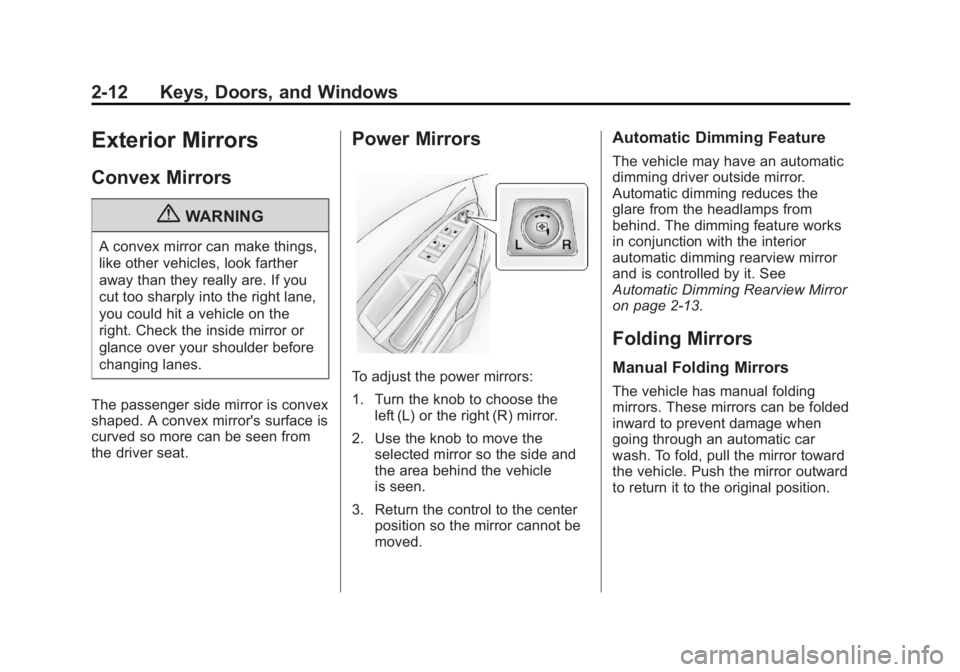
To adjust the power mirrors:
1. Turn the knob to choose the
left (L) or the right (R) mirror.
2. Use the knob to move the
selected mirror so the side and
the area behind the vehicle
is seen.
3. Return the control to the center
position so the mirror cannot be
moved. Automatic Dimming Feature The vehicle may have an automatic
dimming driver outside mirror.
Automatic dimming reduces the
glare from the headlamps from
behind. The dimming feature works
in conjunction with the interior
automatic dimming rearview mirror
and is controlled by it. See
Automatic Dimming Rearview Mirror
on page 2 ‑ 13 .
Folding Mirrors Manual Folding Mirrors The vehicle has manual folding
mirrors. These mirrors can be folded
inward to prevent damage when
going through an automatic car
wash. To fold, pull the mirror toward
the vehicle. Push the mirror outward
to return it to the original position.
Page 40 of 374
Black plate (14,1)Chevrolet Captiva Sport Owner Manual - 2013 - crc - 11/12/12
2-14 Keys, Doors, and Windows
Windows
{ WARNINGNever leave a child, a helpless
adult, or a pet alone in a vehicle,
especially with the windows
closed in warm or hot weather.
They can be overcome by the
extreme heat and suffer
permanent injuries or even death
from heat stroke. Power Windows
{ WARNINGChildren could be seriously
injured or killed if caught in the
path of a closing window. Never
leave keys in a vehicle with
children. When there are children
in the rear seat, use the window
lockout button to prevent
operation of the windows. See
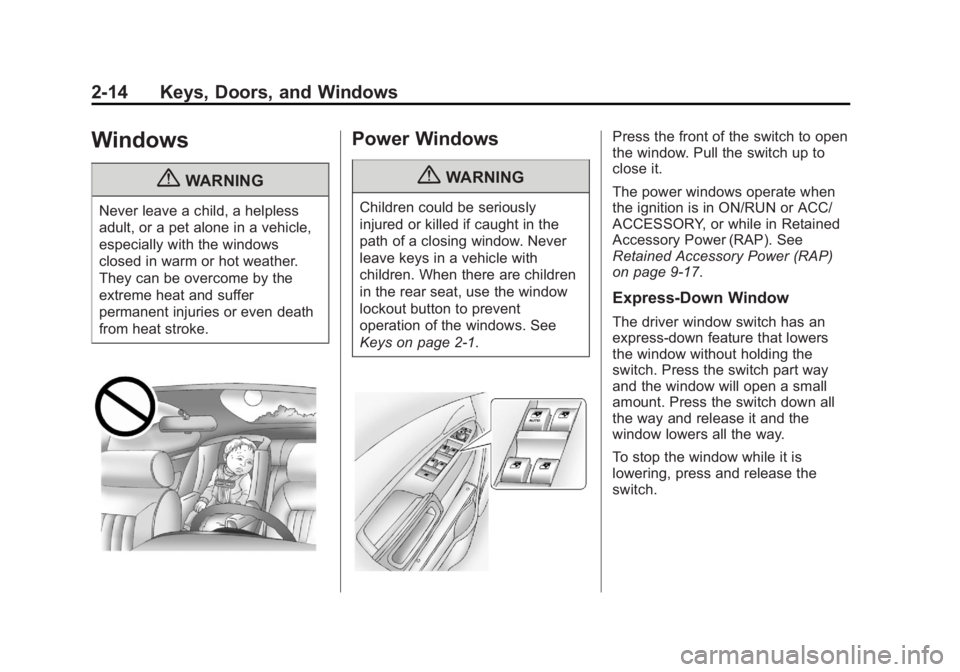
Keys on page 2 ‑ 1 . Press the front of the switch to open
the window. Pull the switch up to
close it.
The power windows operate when
the ignition is in ON/RUN or ACC/
ACCESSORY, or while in Retained
Accessory Power (RAP). See
Retained Accessory Power (RAP)
on page 9 ‑ 17 .
Express-Down Window The driver window switch has an
express-down feature that lowers
the window without holding the
switch. Press the switch part way
and the window will open a small
amount. Press the switch down all
the way and release it and the
window lowers all the way.
To stop the window while it is
lowering, press and release the
switch.
Page 44 of 374
Black plate (2,1)Chevrolet Captiva Sport Owner Manual - 2013 - crc - 11/12/12
3-2 Seats and Restraints
Head Restraints
{ WARNINGWith head restraints that are not
installed and adjusted properly,
there is a greater chance that
occupants will suffer a neck/
spinal injury in a crash. Do not
drive until the head restraints for
all occupants are installed and
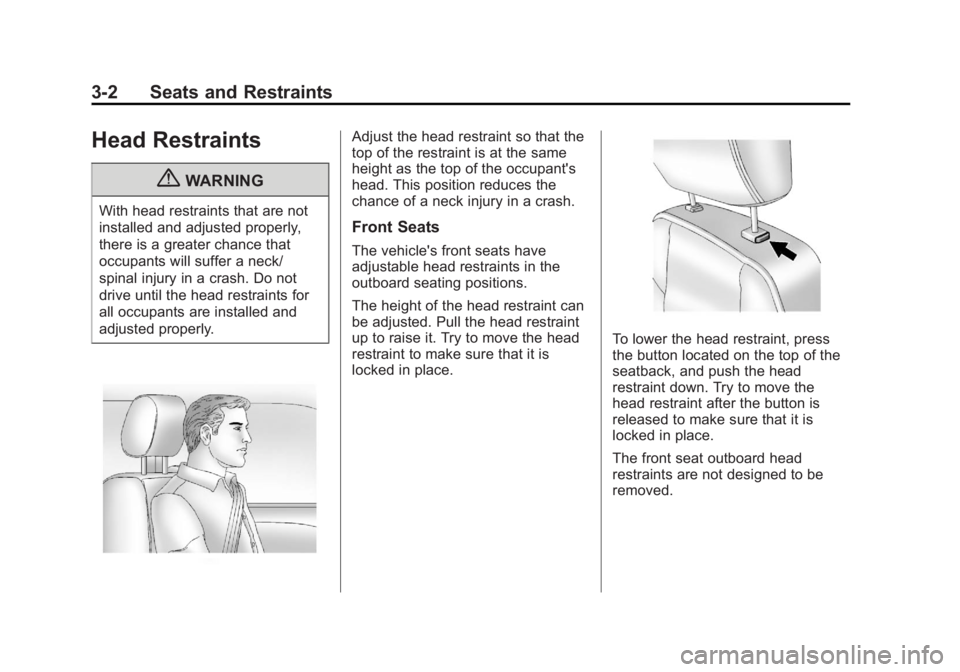
adjusted properly. Adjust the head restraint so that the
top of the restraint is at the same
height as the top of the occupant's
head. This position reduces the
chance of a neck injury in a crash.
Front Seats The vehicle's front seats have
adjustable head restraints in the
outboard seating positions.
The height of the head restraint can
be adjusted. Pull the head restraint
up to raise it. Try to move the head
restraint to make sure that it is
locked in place. To lower the head restraint, press
the button located on the top of the
seatback, and push the head
restraint down. Try to move the
head restraint after the button is
released to make sure that it is
locked in place.
The front seat outboard head
restraints are not designed to be
removed.
Page 45 of 374
Black plate (3,1)Chevrolet Captiva Sport Owner Manual - 2013 - crc - 11/12/12
Seats and Restraints 3-3Rear Seats The vehicle's rear seats have
adjustable head restraints in the
outboard seating positions that can
be adjusted the same way as the
front head restraints.
Rear outboard head restraints are
not designed to be removed.
Active Head Restraints The vehicle has an active head
restraint system in the front seating
positions. These automatically tilt
forward to reduce the risk of neck
injury if the vehicle is hit from
behind. Front Seats Seat Adjustment
{ WARNINGYou can lose control of the
vehicle if you try to adjust a driver
seat while the vehicle is moving.
Adjust the driver seat only when
the vehicle is not moving.
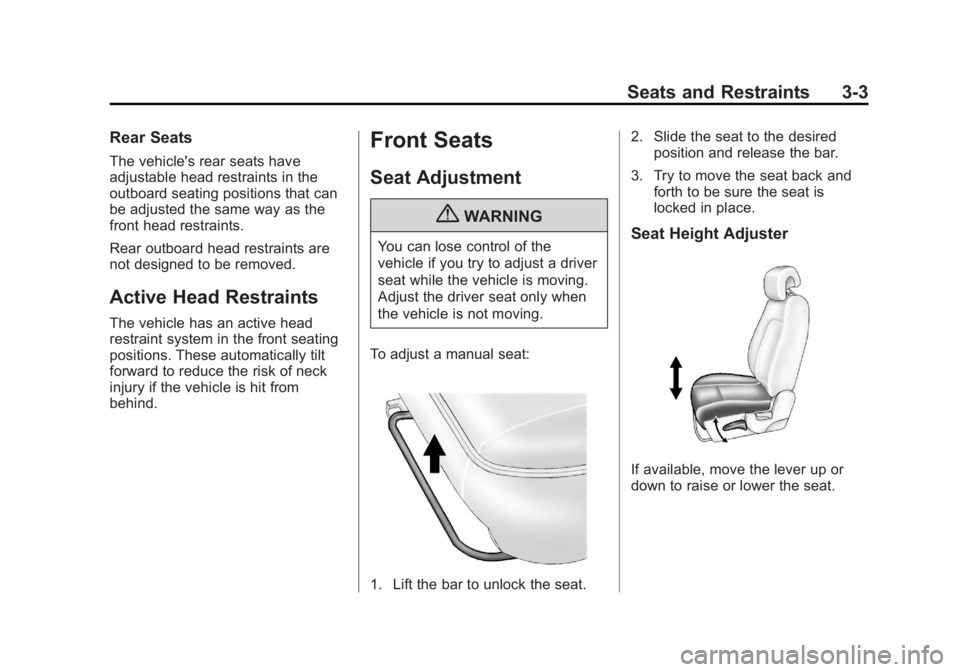
To adjust a manual seat:
1. Lift the bar to unlock the seat. 2. Slide the seat to the desired
position and release the bar.
3. Try to move the seat back and
forth to be sure the seat is
locked in place.
Seat Height Adjuster
If available, move the lever up or
down to raise or lower the seat.
Page 47 of 374
Black plate (5,1)Chevrolet Captiva Sport Owner Manual - 2013 - crc - 11/12/12
Seats and Restraints 3-5
Reclining Seatbacks
{ WARNINGSitting in a reclined position when
the vehicle is in motion can be
dangerous. Even when buckled
up, the safety belts cannot do
their job.
The shoulder belt will not be
against your body. Instead, it will
be in front of you. In a crash, you
could go into it, receiving neck or
other injuries.
The lap belt could go up over
your abdomen. The belt forces
would be there, not at your pelvic
bones. This could cause serious
internal injuries.
For proper protection when the
vehicle is in motion, have the
seatback upright. Then sit well
back in the seat and wear the
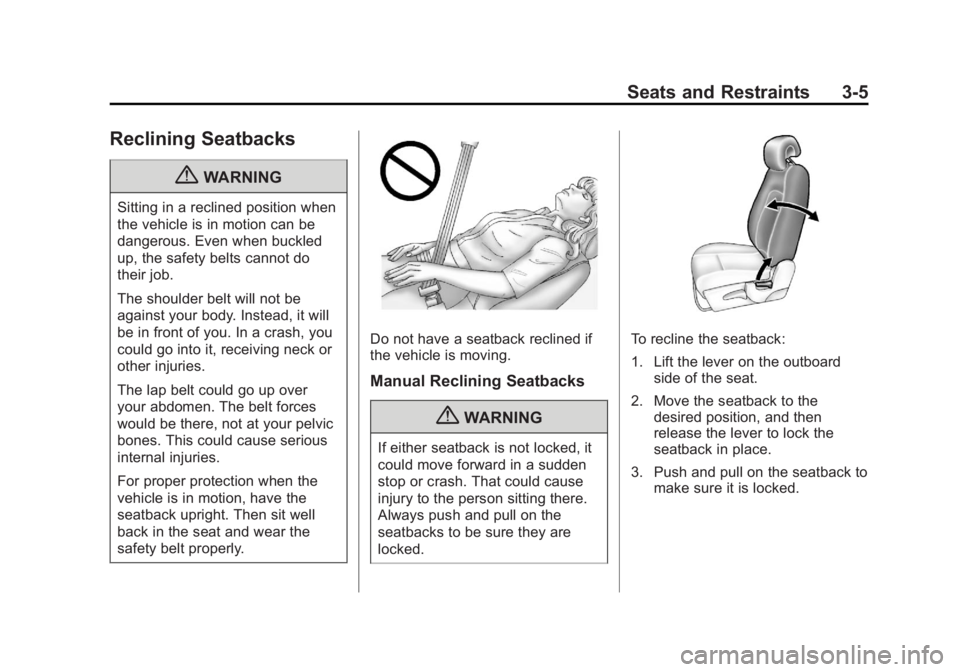
safety belt properly. Do not have a seatback reclined if
the vehicle is moving.
Manual Reclining Seatbacks
{ WARNING
If either seatback is not locked, it
could move forward in a sudden
stop or crash. That could cause
injury to the person sitting there.
Always push and pull on the
seatbacks to be sure they are
locked. To recline the seatback:
1. Lift the lever on the outboard
side of the seat.
2. Move the seatback to the
desired position, and then
release the lever to lock the
seatback in place.
3. Push and pull on the seatback to
make sure it is locked.
Page 48 of 374
Black plate (6,1)Chevrolet Captiva Sport Owner Manual - 2013 - crc - 11/12/12
3-6 Seats and Restraints To return the seatback to the upright
position:
1. Lift the lever fully without
applying pressure to the
seatback, and the seatback will
return to the upright position.
2. Push and pull on the seatback to
make sure it is locked.
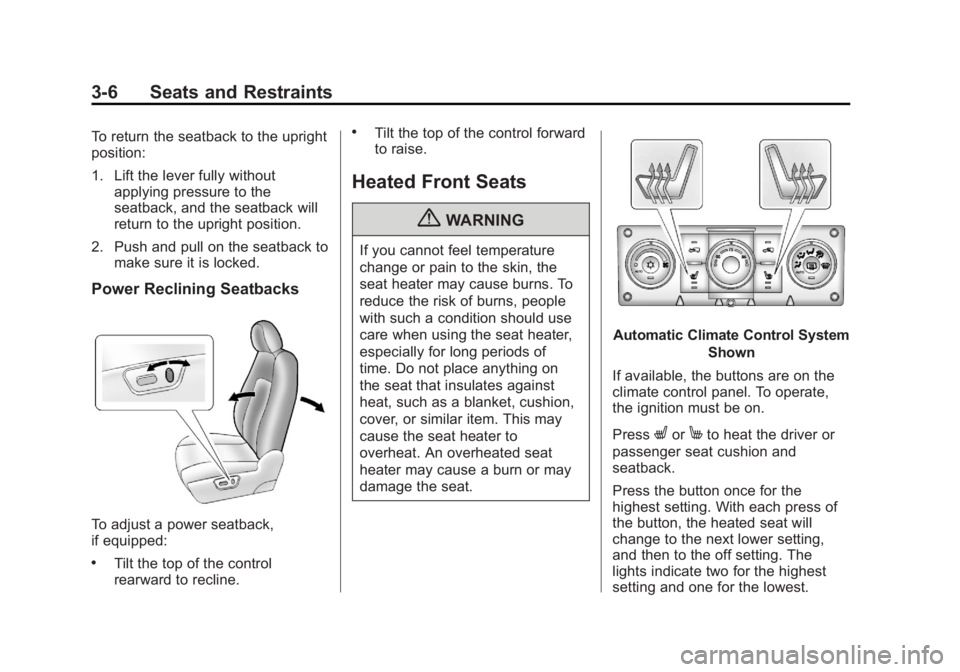
Power Reclining Seatbacks
To adjust a power seatback,
if equipped: .
Tilt the top of the control
rearward to recline. .
Tilt the top of the control forward
to raise.
Heated Front Seats
{ WARNINGIf you cannot feel temperature
change or pain to the skin, the
seat heater may cause burns. To
reduce the risk of burns, people
with such a condition should use
care when using the seat heater,
especially for long periods of
time. Do not place anything on
the seat that insulates against
heat, such as a blanket, cushion,
cover, or similar item. This may
cause the seat heater to
overheat. An overheated seat
heater may cause a burn or may
damage the seat. Automatic Climate Control System
Shown
If available, the buttons are on the
climate control panel. To operate,
the ignition must be on.
Press
L or
M to heat the driver or
passenger seat cushion and
seatback.
Press the button once for the
highest setting. With each press of
the button, the heated seat will
change to the next lower setting,
and then to the off setting. The
lights indicate two for the highest
setting and one for the lowest.
Page 49 of 374
Black plate (7,1)Chevrolet Captiva Sport Owner Manual - 2013 - crc - 11/12/12
Seats and Restraints 3-7The passenger seat may take
longer to heat up.
Folding Seatback The front passenger seatback may
fold flat.
{ WARNINGIf you fold the seatback forward to
carry longer objects, such as skis,
be sure any such cargo is not
near an airbag. In a crash, an
inflating airbag might force that
object toward a person. This
could cause severe injury or even
death. Secure objects away from
the area in which an airbag would
inflate. For more information, see
Where Are the Airbags? on
page 3 ‑ 20 and Vehicle Load
Limits on page 9 ‑ 10 .{ WARNINGThings you put on this seatback
can strike and injure people in a
sudden stop or turn, or in a crash.
Remove or secure all items
before driving.
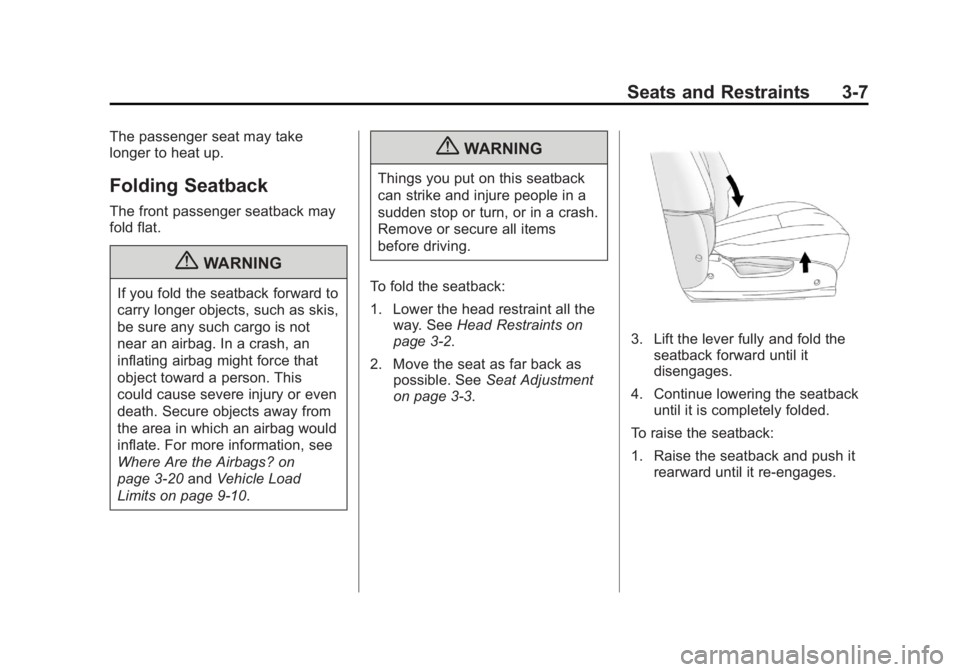
To fold the seatback:
1. Lower the head restraint all the
way. See Head Restraints on
page 3 ‑ 2 .
2. Move the seat as far back as
possible. See Seat Adjustment
on page 3 ‑ 3 . 3. Lift the lever fully and fold the
seatback forward until it
disengages.
4. Continue lowering the seatback
until it is completely folded.
To raise the seatback:
1. Raise the seatback and push it
rearward until it re-engages.
Page 50 of 374
Black plate (8,1)Chevrolet Captiva Sport Owner Manual - 2013 - crc - 11/12/12
3-8 Seats and Restraints
{ WARNINGIf either seatback is not locked, it
could move forward in a sudden
stop or crash. That could cause
injury to the person sitting there.
Always push and pull on the
seatbacks to be sure they are
locked.
2. Push and pull on the seatback to
make sure it is locked in place. Rear Seats Folding the Seatback
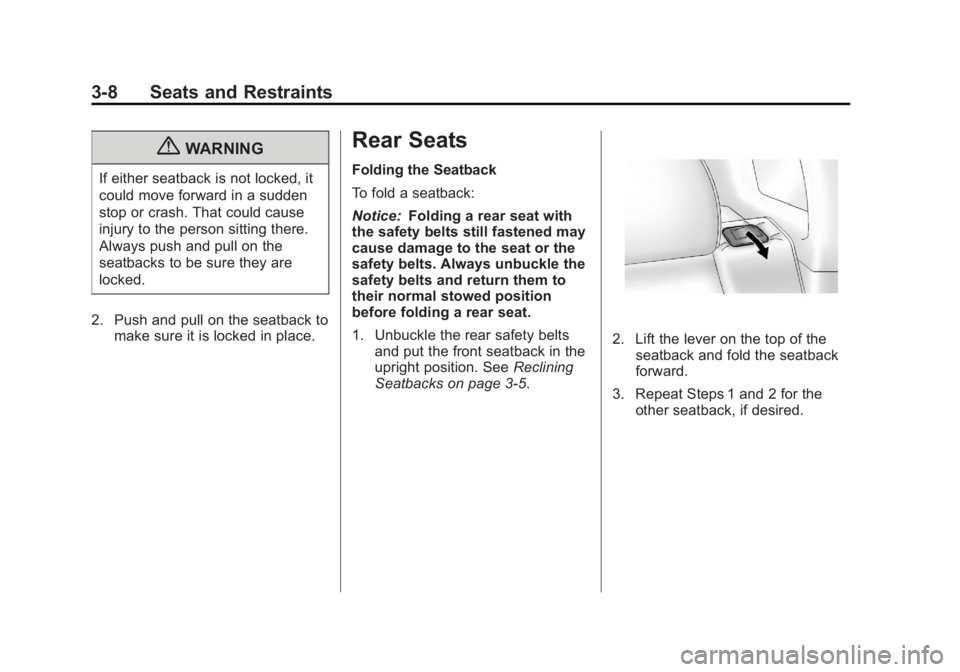
To fold a seatback:
Notice: Folding a rear seat with
the safety belts still fastened may
cause damage to the seat or the
safety belts. Always unbuckle the
safety belts and return them to
their normal stowed position
before folding a rear seat.
1. Unbuckle the rear safety belts
and put the front seatback in the
upright position. See Reclining
Seatbacks on page 3 ‑ 5 . 2. Lift the lever on the top of the
seatback and fold the seatback
forward.
3. Repeat Steps 1 and 2 for the
other seatback, if desired.
Page 51 of 374
Black plate (9,1)Chevrolet Captiva Sport Owner Manual - 2013 - crc - 11/12/12
Seats and Restraints 3-9Raising the Seatback
{ WARNINGIf either seatback is not locked, it
could move forward in a sudden
stop or crash. That could cause
injury to the person sitting there.
Always push and pull on the
seatbacks to be sure they are
locked.
{ WARNINGA safety belt that is improperly
routed, not properly attached,
or twisted will not provide the
protection needed in a crash. The
person wearing the belt could be
seriously injured. After raising the
rear seatback, always check to be
sure that the safety belts are
properly routed and attached, and
are not twisted. To return the seatback to the upright
position:
1. Lift the seatback up and push it
back into place.
2. Push and pull the top of the
seatback to be sure it is locked
into position.
3. Make sure the safety belts are
not twisted or caught in the
seatback.
4. Repeat Steps 1 and 2 for the
other seatback, if necessary.
When the seatback is not in use, it
should be kept in the upright, locked
position.
Reclining the Seatback
To recline the seatback:
1. Lift and hold the lever on top of
the seatback.
2. Tilt the seatback rearward, and
then release the lever.
3. Repeat Steps 1 and 2 for the
other seatback, if desired. Safety Belts This section of the manual
describes how to use safety belts
properly. It also describes some
things not to do with safety belts.
{ WARNINGDo not let anyone ride where a
safety belt cannot be worn
properly. In a crash, if you or your
passenger(s) are not wearing
safety belts, injuries can be much
worse than if you are wearing
safety belts. You can be seriously
injured or killed by hitting things
inside the vehicle harder or by
being ejected from the vehicle. In
addition, anyone who is not
buckled up can strike other
passengers in the vehicle.
(Continued)
Page 52 of 374
Black plate (10,1)Chevrolet Captiva Sport Owner Manual - 2013 - crc - 11/12/12
3-10 Seats and Restraints WARNING (Continued)It is extremely dangerous to ride
in a cargo area, inside or outside
of a vehicle. In a collision,
passengers riding in these areas
are more likely to be seriously
injured or killed. Do not allow
passengers to ride in any area of
the vehicle that is not equipped
with seats and safety belts.
Always wear a safety belt, and
check that all passenger(s) are
restrained properly too.
This vehicle has indicators as a
reminder to buckle the safety belts.
See Safety Belt Reminders on
page 5 ‑ 11 . Why Safety Belts Work
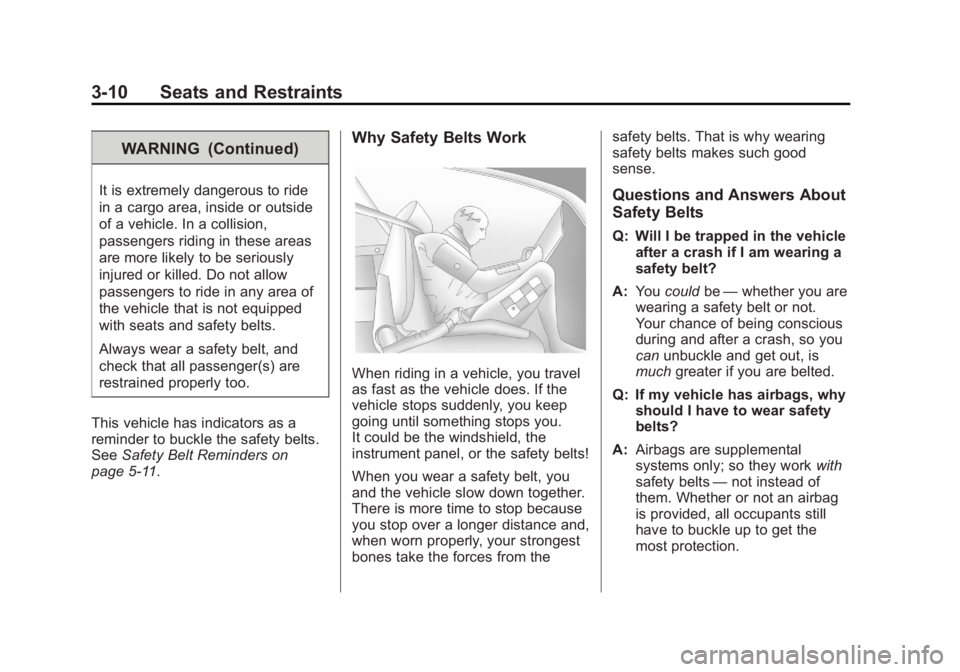
When riding in a vehicle, you travel
as fast as the vehicle does. If the
vehicle stops suddenly, you keep
going until something stops you.
It could be the windshield, the
instrument panel, or the safety belts!
When you wear a safety belt, you
and the vehicle slow down together.
There is more time to stop because
you stop over a longer distance and,
when worn properly, your strongest
bones take the forces from the safety belts. That is why wearing
safety belts makes such good
sense.
Questions and Answers About
Safety Belts Q: Will I be trapped in the vehicle
after a crash if I am wearing a
safety belt?
A: You could be — whether you are
wearing a safety belt or not.
Your chance of being conscious
during and after a crash, so you
can unbuckle and get out, is
much greater if you are belted.
Q: If my vehicle has airbags, why
should I have to wear safety
belts?
A: Airbags are supplemental
systems only; so they work with
safety belts — not instead of
them. Whether or not an airbag
is provided, all occupants still
have to buckle up to get the
most protection.