jump start CHEVROLET CAPTIVA SPORT 2013 Owners Manual
[x] Cancel search | Manufacturer: CHEVROLET, Model Year: 2013, Model line: CAPTIVA SPORT, Model: CHEVROLET CAPTIVA SPORT 2013Pages: 374, PDF Size: 6.66 MB
Page 2 of 374
Black plate (2,1)Chevrolet Captiva Sport Owner Manual - 2013 - crc - 11/12/12
2013 Chevrolet Captiva Sport Owner Manual MElectrical System . . . . . . . . . . . . 10-30
Wheels and Tires . . . . . . . . . . . 10-36
Jump Starting . . . . . . . . . . . . . . . 10-65
Towing . . . . . . . . . . . . . . . . . . . . . . 10-69
Appearance Care . . . . . . . . . . . 10-72
Service and Maintenance . . . 11-1
General Information . . . . . . . . . . 11-1
Maintenance Schedule . . . . . . . 11-3
Special Application
Services . . . . . . . . . . . . . . . . . . . . 11-8
Additional Maintenance
and Care . . . . . . . . . . . . . . . . . . . . 11-9
Recommended Fluids . . . . . . . 11-12
Maintenance Records . . . . . . . 11-15 Technical Data . . . . . . . . . . . . . . . 12-1
Vehicle Identification . . . . . . . . . 12-1
Vehicle Data . . . . . . . . . . . . . . . . . . 12-2
Customer Information . . . . . . . 13-1
Customer Information . . . . . . . . 13-2
Reporting Safety Defects . . . . 13-17
Vehicle Data Recording and
Privacy . . . . . . . . . . . . . . . . . . . . 13-19
OnStar . . . . . . . . . . . . . . . . . . . . . . . 14-1
OnStar Overview . . . . . . . . . . . . . 14-1
OnStar Services . . . . . . . . . . . . . . 14-2
OnStar Additional
Information . . . . . . . . . . . . . . . . . . 14-5
Index . . . . . . . . . . . . . . . . . . . . . i-1
Page 207 of 374
Black plate (19,1)Chevrolet Captiva Sport Owner Manual - 2013 - crc - 11/12/12
Driving and Operating 9-19The shift lock release is always
functional except in the case of an
uncharged or low voltage (less than
9 volt) battery.
If the vehicle has an uncharged
battery or a battery with low voltage,
try charging or jump starting the
battery. See Jump Starting on
page 10 ‑ 65 for more information.
To shift out of P (Park):
1. Apply the brake pedal.
2. Press the shift lever button.
3. Move the shift lever to the
desired position.
If you still are unable to shift out of
P (Park):
1. Fully release the shift lever
button.
2. Hold the brake pedal down and
press the shift lever button
again. 3. Move the shift lever to the
desired position.
If you still cannot move the shift
lever from P (Park), consult your
dealer or a professional towing
service.
Parking over Things
That Burn
{ WARNINGThings that can burn could touch
hot exhaust parts under the
vehicle and ignite. Do not park
over papers, leaves, dry grass,
or other things that can burn. Engine Exhaust
{ WARNINGEngine exhaust contains carbon
monoxide (CO) which cannot be
seen or smelled. Exposure to CO
can cause unconsciousness and
even death.
Exhaust may enter the vehicle if: .
The vehicle idles in areas
with poor ventilation (parking
garages, tunnels, deep snow
that may block underbody
airflow or tail pipes). .
The exhaust smells or
sounds strange or different. .
The exhaust system leaks
due to corrosion or damage. .
The vehicle exhaust system
has been modified, damaged,
or improperly repaired.
(Continued)
Page 236 of 374

Black plate (2,1)Chevrolet Captiva Sport Owner Manual - 2013 - crc - 11/12/12
10-2 Vehicle Care When It Is Time for New
Tires . . . . . . . . . . . . . . . . . . . . . . 10-50
Buying New Tires . . . . . . . . . . . 10-51
Different Size Tires and
Wheels . . . . . . . . . . . . . . . . . . . 10-52
Uniform Tire Quality
Grading . . . . . . . . . . . . . . . . . . . 10-53
Wheel Alignment and Tire
Balance . . . . . . . . . . . . . . . . . . . 10-54
Wheel Replacement . . . . . . . . 10-55
Tire Chains . . . . . . . . . . . . . . . . . 10-55
If a Tire Goes Flat . . . . . . . . . . 10-56
Tire Changing . . . . . . . . . . . . . . 10-57
Compact Spare Tire . . . . . . . . 10-64
Jump Starting Jump Starting . . . . . . . . . . . . . . 10-65
Towing Towing the Vehicle . . . . . . . . . 10-69
Recreational Vehicle
Towing . . . . . . . . . . . . . . . . . . . . 10-69
Appearance Care Exterior Care . . . . . . . . . . . . . . . 10-72
Interior Care . . . . . . . . . . . . . . . . 10-75
Floor Mats . . . . . . . . . . . . . . . . . . 10-78 General Information For service and parts needs, visit
your dealer. You will receive
genuine parts and trained and
supported service people.
Accessories and
Modifications Adding non ‐ dealer accessories or
making modifications to the vehicle
can affect vehicle performance and
safety, including such things as
airbags, braking, stability, ride and
handling, emissions systems,
aerodynamics, durability, and
electronic systems like antilock
brakes, traction control, and stability
control. These accessories or
modifications could even cause
malfunction or damage not covered
by the vehicle warranty. Damage to vehicle components
resulting from modifications or the
installation or use of non ‐ GM
certified parts, including control
module or software modifications, is
not covered under the terms of the
vehicle warranty and may affect
remaining warranty coverage for
affected parts.
GM Accessories are designed to
complement and function with other
systems on the vehicle. See your
dealer to accessorize the vehicle
using genuine GM Accessories
installed by a dealer technician.
Also, see Adding Equipment to the
Airbag-Equipped Vehicle on
page 3 ‑ 29 .
Page 239 of 374
Black plate (5,1)Chevrolet Captiva Sport Owner Manual - 2013 - crc - 11/12/12
Vehicle Care 10-51. Engine Air Cleaner/Filter on
page 10 ‑ 11 .
2. Power Steering Fluid Reservoir.
See Power Steering Fluid on
page 10 ‑ 19 .
3. Engine Cooling Fan (Out of
View). See Cooling System on
page 10 ‑ 13 .
4. Engine Oil Dipstick (Out of
View). See “ Checking Engine
Oil ” under Engine Oil on
page 10 ‑ 8 .
5. Engine Oil Fill Cap. See “ When
to Add Engine Oil ” under Engine
Oil on page 10 ‑ 8 .
6. Windshield Washer Fluid
Reservoir. See “ Adding Washer
Fluid ” under Washer Fluid on
page 10 ‑ 20 . 7. Brake Fluid Reservoir. See
Brakes on page 10 ‑ 20 .
8. Remote Positive (+) Terminal.
See Jump Starting on
page 10 ‑ 65 .
9. Battery on page 10 ‑ 23 .
10. Engine Coolant Surge Tank
and Pressure Cap. See
“ Checking Coolant ” under
Engine Coolant on page 10 ‑ 14 .
11. Remote Negative (-) Terminal.
See Jump Starting on
page 10 ‑ 65 .
12. Engine Compartment Fuse
Block on page 10 ‑ 30 .
Page 241 of 374
Black plate (7,1)Chevrolet Captiva Sport Owner Manual - 2013 - crc - 11/12/12
Vehicle Care 10-71. Engine Air Cleaner/Filter on
page 10 ‑ 11 .
2. Engine Oil Fill Cap (Out of
View). See “ When to Add Engine
Oil ” under Engine Oil on
page 10 ‑ 8 .
3. Power Steering Fluid Reservoir
(Out of View). See Power
Steering Fluid on page 10 ‑ 19 .
4. Engine Cover. See Engine
Cover on page 10 ‑ 7 .
5. Engine Oil Dipstick (Out of
View). See “ Checking Engine
Oil ” under Engine Oil on
page 10 ‑ 8 .
6. Engine Cooling Fans (Out of
View). See Cooling System on
page 10 ‑ 13 . 7. Windshield Washer Fluid
Reservoir. See “ Adding Washer
Fluid ” under Washer Fluid on
page 10 ‑ 20 .
8. Brake Fluid Reservoir. See
Brakes on page 10 ‑ 20 .
9. Remote Positive (+) Terminal.
See Jump Starting on
page 10 ‑ 65 .
10. Battery on page 10 ‑ 23 .
11. Engine Coolant Surge Tank.
See “ Checking Coolant ” under
Engine Coolant on page 10 ‑ 14 .
12. Remote Negative (-) Terminal.
See Jump Starting on
page 10 ‑ 65 .
13. Engine Compartment Fuse
Block on page 10 ‑ 30 .Engine Cover
Engine Cover (3.0L V6)
1. Oil Fill Cap
2. Engine Cover Bolt
3. Engine Cover
To remove:
1. Remove the oil fill cap (1).
2. Remove the engine cover
bolt (2).
3. Raise the engine cover (3) to
release it from the retainers.
Page 257 of 374

Black plate (23,1)Chevrolet Captiva Sport Owner Manual - 2013 - crc - 11/12/12
Vehicle Care 10-23.
If brake fluid is spilled on the
vehicle's painted surfaces,
the paint finish can be
damaged. Be careful not to
spill brake fluid on the
vehicle. If you do, wash it off
immediately.
Battery Refer to the replacement number
shown on the original battery label
when a new battery is needed. See
Engine Compartment Overview on
page 10 ‑ 4 for battery location.
{ WARNING
Battery posts, terminals, and
related accessories contain lead
and lead compounds, chemicals
known to the State of California to
cause cancer and reproductive
harm. Wash hands after handling. Vehicle Storage
{ WARNINGBatteries have acid that can burn
you and gas that can explode.
You can be badly hurt if you are
not careful. See Jump Starting on
page 10 ‑ 65 for tips on working
around a battery without
getting hurt.
Infrequent Usage: Remove the
black, negative ( − ) cable from the
battery to keep the battery from
running down.
Extended Storage: Remove the
black, negative ( − ) cable from the
battery or use a battery trickle
charger.
All-Wheel Drive When to Check Lubricant
It is not necessary to regularly
check the transfer case fluid unless
a leak is suspected or an unusual noise is heard. A fluid loss could
indicate a problem. Have it
inspected and repaired.
Starter Switch Check
{ WARNINGWhen you are doing this
inspection, the vehicle could
move suddenly. If the vehicle
moves, you or others could be
injured.
1. Before starting this check, be
sure there is enough room
around the vehicle.
2. Firmly apply both the parking
brake and the regular brake.
See Parking Brake on
page 9 ‑ 25 .
Do not use the accelerator
pedal, and be ready to turn off
the engine immediately if it
starts.
Page 299 of 374

Black plate (65,1)Chevrolet Captiva Sport Owner Manual - 2013 - crc - 11/12/12
Vehicle Care 10-65
Jump Starting For more information about the
vehicle battery, see Battery on
page 10 ‑ 23 .
If the vehicle battery has run down,
you may want to use another
vehicle and some jumper cables to
start your vehicle. Be sure to use
the following steps to do it safely.
{ WARNINGBatteries can hurt you. They can
be dangerous because: .
They contain acid that can
burn you. .
They contain gas that can
explode or ignite. .
They contain enough
electricity to burn you.
If you do not follow these steps
exactly, some or all of these
things can hurt you. Notice: Ignoring these steps
could result in costly damage to
the vehicle that would not be
covered by the warranty.
Trying to start the vehicle by
pushing or pulling it will not
work, and it could damage the
vehicle.
1. Check the other vehicle. It must
have a 12-volt battery with a
negative ground system.
Notice: Only use a vehicle that
has a 12-volt system with a
negative ground for jump
starting. If the other vehicle does
not have a 12-volt system with a
negative ground, both vehicles
can be damaged. 2. Get the vehicles close enough
so the jumper cables can reach,
but be sure the vehicles are not
touching each other. If they are,
it could cause a ground
connection you do not want. You
would not be able to start your
vehicle, and the bad grounding
could damage the electrical
systems.
To avoid the possibility of the
vehicles rolling, set the parking
brake firmly on both vehicles
involved in the jump start
procedure. Put the transmission
in P (Park) before setting the
parking brake.
Notice: If any accessories are left
on or plugged in during the jump
starting procedure, they could be
damaged. The repairs would not
be covered by the vehicle
warranty. Whenever possible,
turn off or unplug all accessories
on either vehicle when jump
starting the vehicle.
Page 300 of 374
Black plate (66,1)Chevrolet Captiva Sport Owner Manual - 2013 - crc - 11/12/12
10-66 Vehicle Care 3. Turn off the ignition on both
vehicles. Unplug unnecessary
accessories plugged into the
cigarette lighter or the accessory
power outlet. Turn off the radio
and all lamps that are not
needed. This will avoid sparks,
helping save both batteries and
the radio.
4. Open the hood on the other
vehicle and locate the
positive (+) and negative ( − )
terminal locations on that
vehicle.
Open the hood on your vehicle
and find the remote positive (+)
and remote negative ( − ) jump
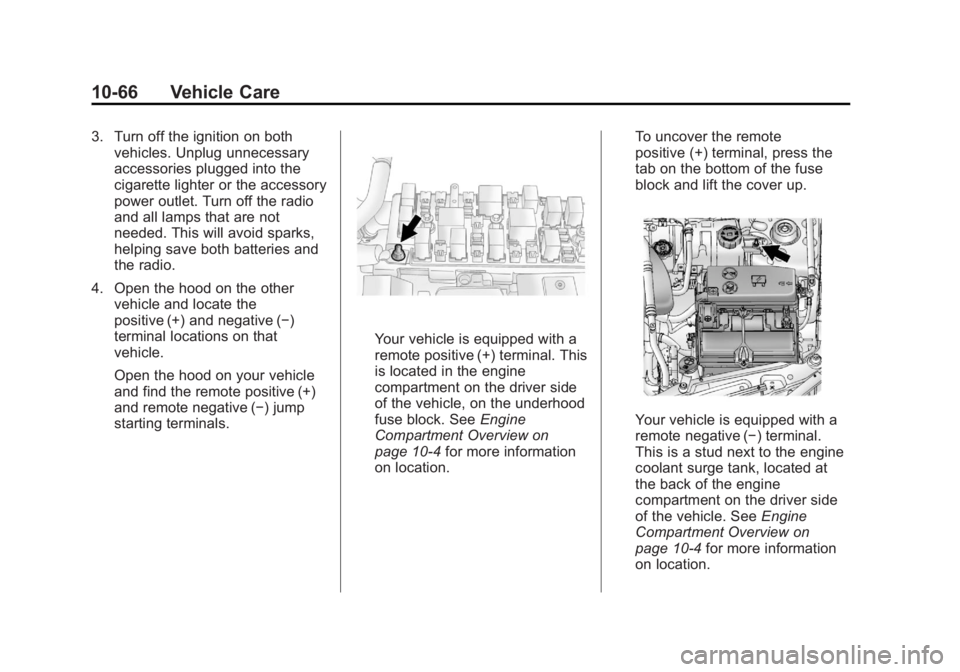
starting terminals. Your vehicle is equipped with a
remote positive (+) terminal. This
is located in the engine
compartment on the driver side
of the vehicle, on the underhood
fuse block. See Engine
Compartment Overview on
page 10 ‑ 4 for more information
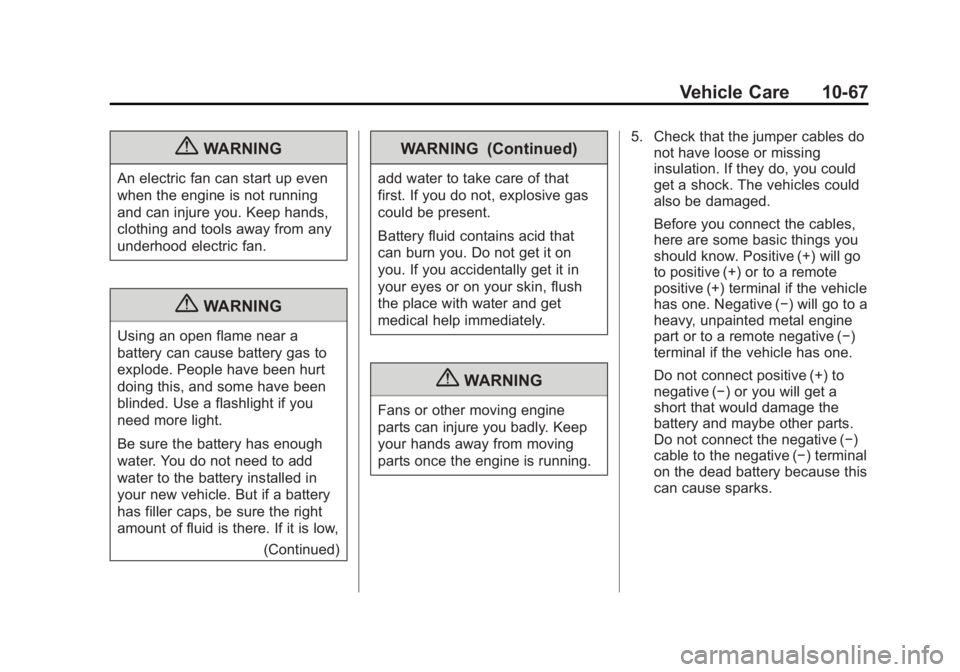
on location. To uncover the remote
positive (+) terminal, press the
tab on the bottom of the fuse
block and lift the cover up.
Your vehicle is equipped with a
remote negative ( − ) terminal.
This is a stud next to the engine
coolant surge tank, located at
the back of the engine
compartment on the driver side
of the vehicle. See Engine
Compartment Overview on
page 10 ‑ 4 for more information
on location.
Page 301 of 374
Black plate (67,1)Chevrolet Captiva Sport Owner Manual - 2013 - crc - 11/12/12
Vehicle Care 10-67
{ WARNINGAn electric fan can start up even
when the engine is not running
and can injure you. Keep hands,
clothing and tools away from any
underhood electric fan.
{ WARNINGUsing an open flame near a
battery can cause battery gas to
explode. People have been hurt
doing this, and some have been
blinded. Use a flashlight if you
need more light.
Be sure the battery has enough
water. You do not need to add
water to the battery installed in
your new vehicle. But if a battery
has filler caps, be sure the right
amount of fluid is there. If it is low,
(Continued) WARNING (Continued) add water to take care of that
first. If you do not, explosive gas
could be present.
Battery fluid contains acid that
can burn you. Do not get it on
you. If you accidentally get it in
your eyes or on your skin, flush
the place with water and get
medical help immediately.
{ WARNING
Fans or other moving engine
parts can injure you badly. Keep
your hands away from moving
parts once the engine is running. 5. Check that the jumper cables do
not have loose or missing
insulation. If they do, you could
get a shock. The vehicles could
also be damaged.
Before you connect the cables,
here are some basic things you
should know. Positive (+) will go
to positive (+) or to a remote
positive (+) terminal if the vehicle
has one. Negative ( − ) will go to a
heavy, unpainted metal engine
part or to a remote negative ( − )
terminal if the vehicle has one.
Do not connect positive (+) to
negative ( − ) or you will get a
short that would damage the
battery and maybe other parts.
Do not connect the negative ( − )
cable to the negative ( − ) terminal
on the dead battery because this
can cause sparks.
Page 302 of 374
Black plate (68,1)Chevrolet Captiva Sport Owner Manual - 2013 - crc - 11/12/12
10-68 Vehicle Care 6. Connect the red positive (+)
cable to the positive (+) terminal
on the vehicle with the dead
battery. Use a remote
positive (+) terminal if the vehicle
has one.
7. Do not let the other end touch
metal. Connect it to the
positive (+) terminal of the good
battery. Use a remote
positive (+) terminal if the vehicle
has one.
8. Now connect the black
negative ( − ) cable to the
negative ( − ) terminal of the good
battery. Use a remote
negative ( − ) terminal if the
vehicle has one.
Do not let the other end touch
anything until the next step. The
other end of the negative ( − )
cable does not go to the dead
battery. It goes to a heavy,
unpainted metal engine part or
to a remote negative ( − ) terminal
on the vehicle with the dead
battery. 9. Connect the other end of the
negative ( − ) cable away from the
dead battery, but not near
engine parts that move. The
electrical connection is just as
good there, and the chance of
sparks getting back to the
battery is much less.
10. Now start the vehicle with the
good battery and run the
engine for a while.
11. Press the unlock symbol on the
remote keyless entry
transmitter to disarm your
security system, if equipped.
12. Try to start the vehicle that had
the dead battery. If it will not
start after a few tries, it
probably needs service. Notice: If the jumper cables are
connected or removed in the
wrong order, electrical shorting
may occur and damage the
vehicle. The repairs would not be
covered by the vehicle warranty.
Always connect and remove the
jumper cables in the correct
order, making sure that the
cables do not touch each other or
other metal.
Jumper Cable Removal
Reverse the sequence exactly when
removing the jumper cables.