air condition CHEVROLET CAVALIER 1984 1.G Owner's Manual
[x] Cancel search | Manufacturer: CHEVROLET, Model Year: 1984, Model line: CAVALIER, Model: CHEVROLET CAVALIER 1984 1.GPages: 105, PDF Size: 24.23 MB
Page 86 of 105
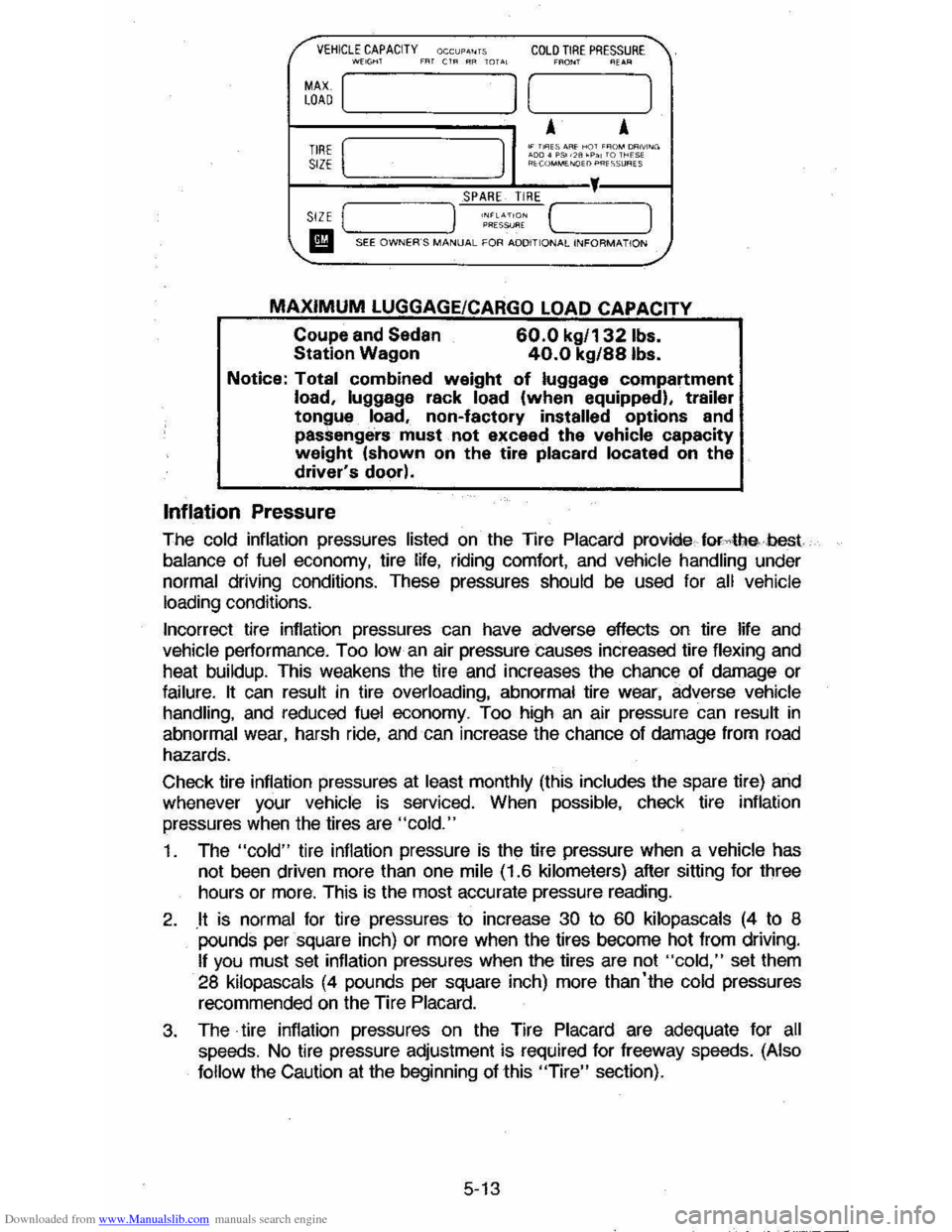
Downloaded from www.Manualslib.com manuals search engine /" VEHICLE CAPACITY OCCUP."TS COLD TIRE PRESSURE ' , ~~, mT CtR RR TOTAL C_, ~E~R
MAX [ LOAD I [ 1
A A TIRE [ I
.. T"ES AAf ,.qT ,~o ... OONiNG '00' "50 ". 'P" TO THE'" SIZE R'V,""ME>.<:lEl) PR"5lJRES
SPARE TIRE ,
SIZE ( )
MAXIMUM LUGGAGE/CARGO LOAD CAPACITY
Coupe and Sedan Station Wagon 60.0 kg/' 321bs. 40.0 kg/88Ibs.
Notice: Total combined weight of luggage compartment load, luggage rack load (when equipped), trailer tongue load, non-factory installed options and
passenge'rs' must. not exceed the vehicle capacity weight (shown on the tire placard located on the driver's door).
Inflation Pressure
The cold inflation pressures listed on the Tire Placard provide forAIlebest
balance of fuel economy, tire life, riding comfort, and vehicle handling under normal driving conditions. These pressures should be used for all vehicle
loading conditions.
Incorrect tire inflation pressures can have adverse effects on tire life
and vehicle performance. Too Iowan air pressure causes increased tire flexing and
heat buildup. This weakens the tire and increases the chance of damage or
failure. It can result in tire overloading, abnormal tire wear, adverse vehicle handling, and reduced fuel economy. Too high an air pressure can result in
abnormal wear, harsh ride, and can increase the chance of damage from road
hazards.
Check tire inflation pressures at
least monthly (this includes the spare tire) and
whenever your vehicle is serviced. When possible, check tire inflation
pressures
when the tires are "cold."
1. The "cold" tire inflation pressure is the tire pressure when a vehicle has
not been driven more than one mile (1.6 kilometers) after sitting for three
hours or
more. This is the most accurate pressure reading.
2. .It is normal for tire pressures to increase 30 to 60 kilopascals (4 to 8 pounds per square inch) or more when the tires become hot from driving.
If you must set inflation pressures when the tires are not "cold," set them
28 kilopascals (4 pounds per square inch) more than'the cold pressures
recommended on the Tire Placard.
3. The· tire inflation pressures on the Tire Placard are adequate for all speeds. No tire pressure adjustment is required for freeway speeds. (Also
follow
the Caution at the beginning of this "Tire" section).
5-13
Page 89 of 105
Downloaded from www.Manualslib.com manuals search engine • Install the chains on the front tires as tightly as possible, then tighten them
again after driving 1/4 to 1/2 mile (0.4 to 0.8 kilometer). The use of chains
on the rear tires is not recommended; the chains may contact and
possibly damage the vehicle. If you intend to use chains on the rear tires, be sure
there is enough clearance.
• Do not exceed 45 mph (70 km/h), or the chain manufacturer's speed limitation, if lower.
• Drive in a restrained manner and avoid large bumps, potholes, severe turns and other manuevers which CQuid cause the tires to bounce up and down.
• Follow any other instructions of the chain manufacturer which do not
disagree with the above.
Spare Tire
For the use and installation of your spare tire, see "In Case of Emergency,"
Section 3 of this manual.
Tire Replacement
CAUTION:" 00 not mix different tire construction types (such as radial, bias, and biasbetted) on your vehicle exceptio emergencies, because your vehicle's handling could be affected and may result in loss Of control. This caution does not apply to a compact spare tire furnished with your vehicle.
On most vehicles originally eqUipped with radial tires, you will find a TPC Spec.
No. (Tire Performance Criteria Specification Number)
molded into the tire
sidewall
near the tire size marking. This shows that the tire meets rigid size
and performance standards which were developed for your vehicle. The TPC
Spec. No. assures a proper combination of endurance,
handHng, load capacity,
ride and traction on wet, dry, or snow-covered surfaces. When you replace your tires with tires having the same TPC Spec. No., your new tires will be
compatible with your vehicle.
When replacing tires with those not having a TPC Spec. No., you should use
the same size, load range, and construction type (bias, bias-belted, or radial)
as the original tires on your vehicle. A different size or type of tire may affect
such things as ride, handling, speedometer/odometer calibration, vehicle
ground clearance, and tire or tire chain clearance to the body or chassis. If
replacing only a single tire, it should be paired on the same axle with the least worn tire of the other three.
Uniform Tire Quality Grading
The following information relates to the tire grading system developed by the
United States
National Highway Traffic Safety Administration which will grade
tires by traction and temperature performance. (This applies only to vehicles
sold in the United States.)
Traction -A, B, C
The traction grades, from highest to lowest are: A, S, and C. They represent
the tire's
::ability to stop on wet pavement as measured under controlled
conditions on specified government test
~urfaces of asphalt and concrete. A
tire marked C may have poor traction performance.
Warning: The traction grade assigned to this tire is based on braking (straight
ahead) traction tests
and does not include cornering (turning) traction.
5-16
Page 90 of 105
Downloaded from www.Manualslib.com manuals search engine ,
Temperature -A, B, C
The temperature grades are A (the highest), B, and C, representing the tire's
resistance 10 the generation of heat and its ability 10 dissipate heat when tested
under controlled conditions on a specified indoor laboratory test wheel.
Sustained high temperature can cause the material of the tire to degenerate
and reduce tire life, and excessive temperature can lead to sudden tire failure .
The grade
C corresponds 10 a level of performance which all passenger car
tires must meet under the Federal Motor
Vehicle Safety Standard No. 109. Grades B and A represent higher levels of performance on the laboratory lest
wheel than the ",nimum required by law.
Warning : The temperature grade forlhis tire is established for a tire that is properly inflated and not overloaded . . Excessive speed, underinflation, or
excessive loading, either separately or in combination , can cause heal buildup and possible tire failure .
These grades are molded on the sidewalls 01 passenger car tires.
While
the tires available as 'standard or optional equipment .on General
Motors vehicles may vary with respect to these grades, all such tires meet General Motors performance s!andards and have been approved for
use on General Motors vehicles. All passenger car tires must conform to Federal safety requirements in addition to these grades.
You
should replace your tires when:
1 . The tires are worn to a point where 1.6
milHmeters (2/ 32 inch) or less t.read remains, or the cord or fabric is showing. '.
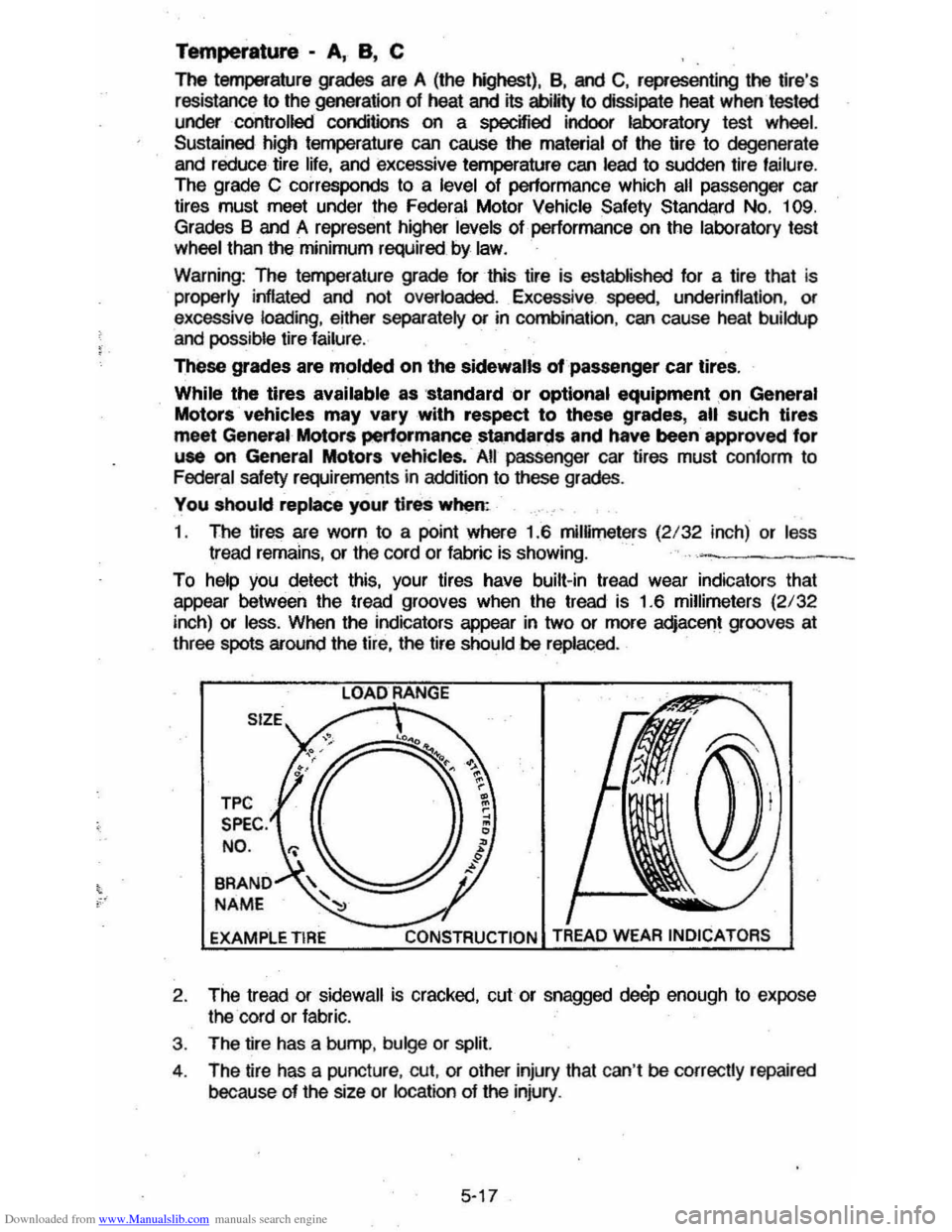
To help you detect this, your tires have built-in tread wear indicators that
appear between the tread grooves when the tread is 1.6 millimeters
(2/32
inch) or less. When the indicators appear in two or more adjacent grooves at
three spots around the tire, the tire should be replaced.
TPC
SPEC. NO .
BRAND
NAME
EXAMPLE TIRE LOAD
RANGE
CONSTRUCTION
2
. The tread or sidewall is cracked, cut or snagged deep enough to expose
the cord or fabric.
3. The tire has a bump , bulge or split.
4 . The tire has a puncture , cut, or other injury thai can 't
be correctly repaired
because of the size or
location of the injury .
5-17
Page 96 of 105
Downloaded from www.Manualslib.com manuals search engine FUSES AND CIRCUIT BREAKERS
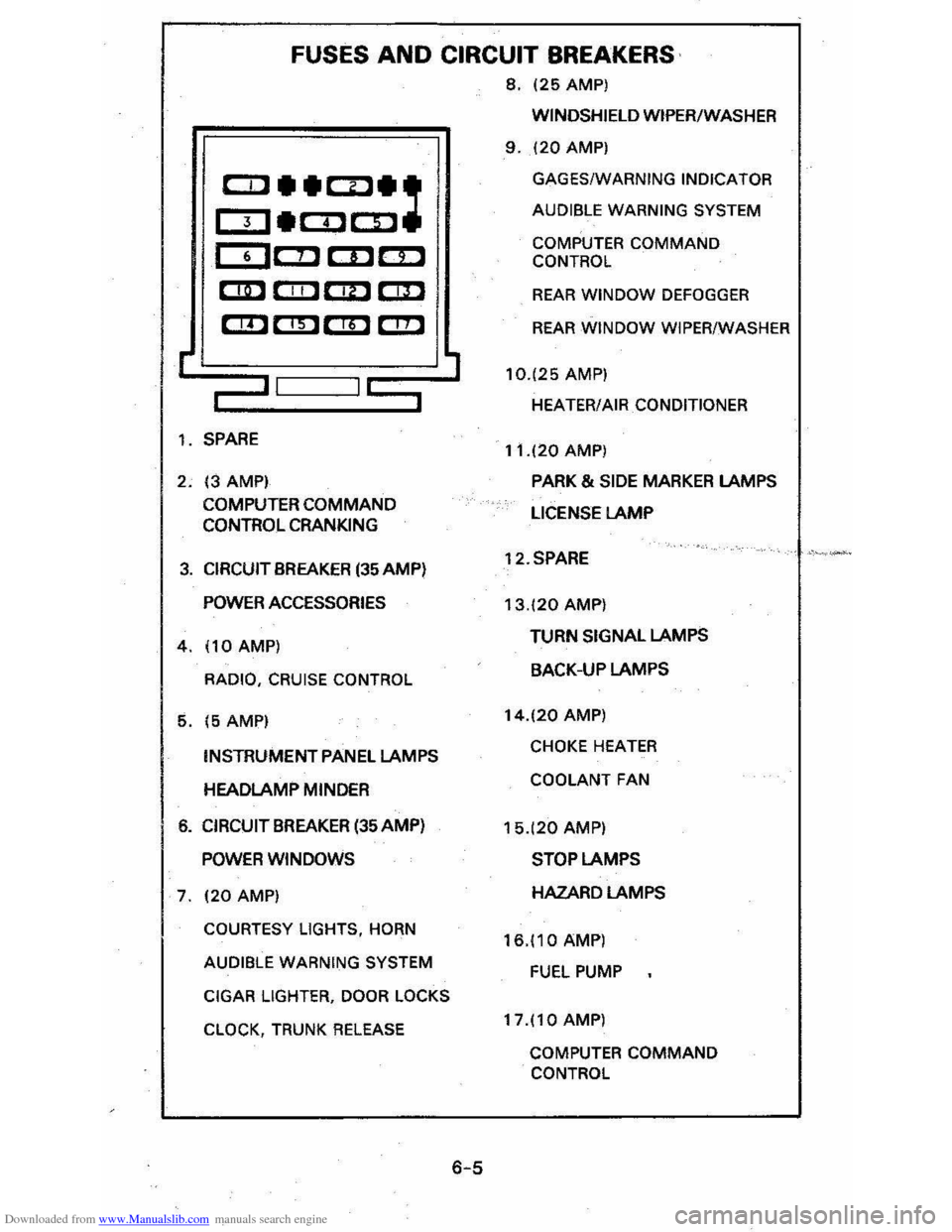
8, 125 AMP)
r
CCl __ CD_:
OJ_COCD
CDC!J CDc::D
CD CIIl C!D r::m
em em em C!!l
,-II I~
1, SPARE
2, 13 AMPI
COMPUTER
COMMAND CONTROL CRANKING
3, CIRCUIT BREAKER (35 AMP)
POWER ACCESSORIES
4,110AMP)
RADIO, CRUISE CONTROL
5, 15 AMPI
INSTRUMENT PANEL LAMPS
HEADLAMP MINDER
6, CIRCUIT BREAKER (35 AMP)
POWER WINDOWS
7, 120 AMP)
COURTESY LIGHTS, HORN
AUDIBLE WARNING SYSTEM
CIGAR
LIGHTER, DOOR LOCKS
CLOCK,
TRUNK RELEASE
6-5
WINDSHIELD WIPER/WASHER
9, 120 AMP)
GAGES/WARNING INDICATOR
AUDIBLE WARNING SYSTEM
COMPUTER COMMAND
CONTROL
REAR WINDOW DEFOGGER
REAR WINDOW WIPER/WASHER
10,125
AMP)
HEATER/AIR
CONDITIONER
11,120 AMP)
PARK & SIDE MARKER LAMPS
LICENSE
LAMP
12,SPARE
13,120 AMP)
TURN SIGNAL LAMPS
BACK-UP LAMPS
14,120 AMP)
CHOKE HEATER
COOLANT FAN
15,(20 AMP)
STOP LAMPS
HAZARD LAMPS
16,110 AMP)
FUEL PUMP
17,110 AMP)
COMPUTER COMMAND
CONTROL
Page 103 of 105
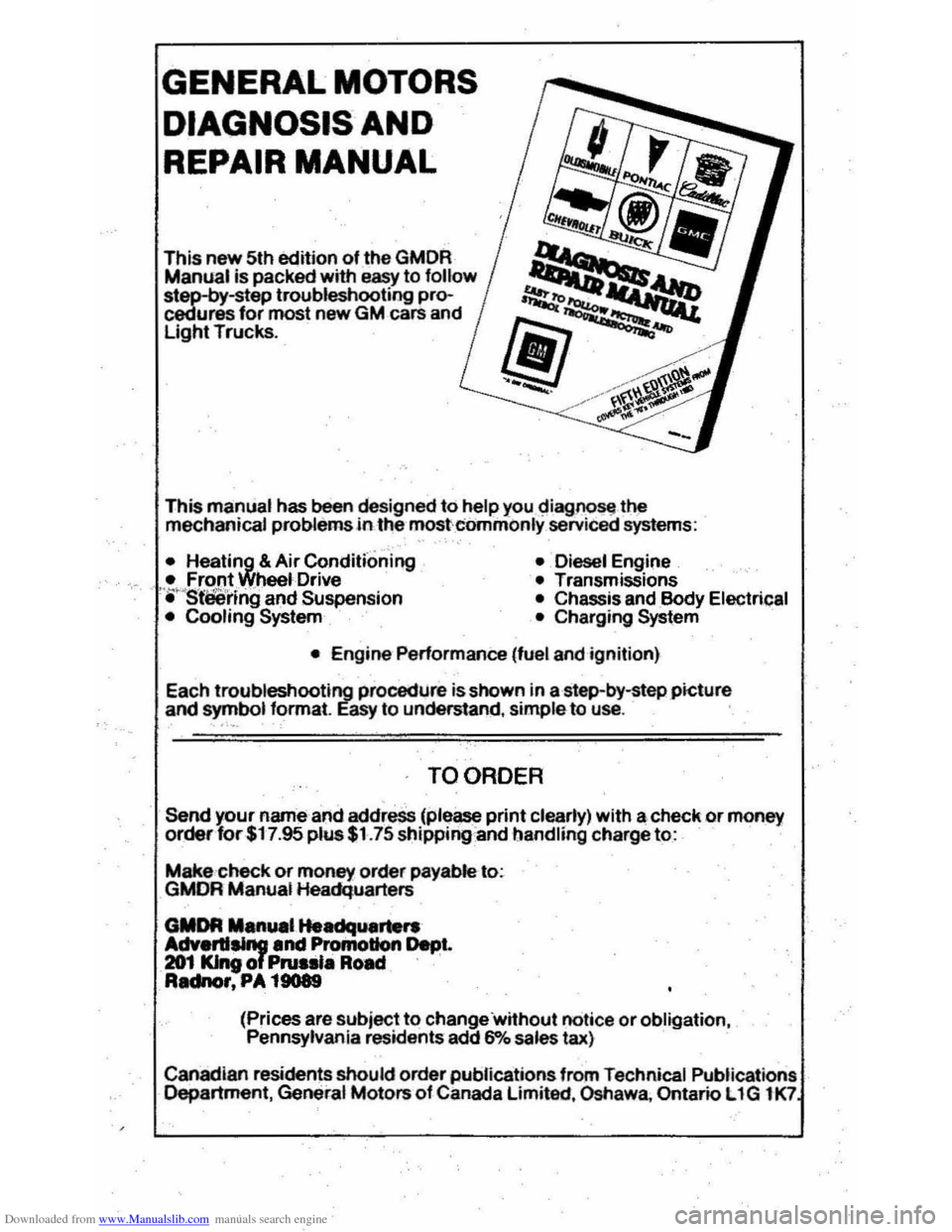
Downloaded from www.Manualslib.com manuals search engine GENERAL MOTORS
DIAGNOSIS
AND
REPAIR MANUAL
This new 5th edition of the GMDR Manual is packed with easy to follow
step-by-step troubleshooliog procedures for most new GM cars and Light Trucks.
This
manual has been designed to help you <;liagnoS4j t~ mechanical problems.;n the most-cOmmonly serviced systems:
• , H , ea, t, i, ng & Air Condition 'ing
• Front Wheel Drive " " ·Sfeeririg and Suspension • Cooling System
• Diesel Engine • Transmissions • Chassis and Body Electrical • Charging System
• Engine Performance (fuel and ignition)
Each troubleshooting procedure is
Sho" wn in a step-by-step pi<:ture and symbol formal. Easy to understand, simple to use . '
rOORDER
Send your name and address (pl"ase print clearly) with a check or money order for $17.95 plus$I.75shippingand bandling cha'geto:
Make·check or money order payable to: GMOR Manual Headquarters
GMDR M.nual Helldqu ....... Advertising .nd Promotion Dept_ 201 King of Prussia Road ' ' R.dnor, PA 19089
(Prices are subject to change without notice or obligation,
Pennsylvania residents add 60/. sales tax)
Canadian residents
should order publications from Technical Publications Department, General Motors of Canada Limited, Oshawa , Ontario LIG lK7