maintenance CHEVROLET CAVALIER 1984 1.G Owner's Manual
[x] Cancel search | Manufacturer: CHEVROLET, Model Year: 1984, Model line: CAVALIER, Model: CHEVROLET CAVALIER 1984 1.GPages: 105, PDF Size: 24.23 MB
Page 78 of 105
Downloaded from www.Manualslib.com manuals search engine Oil Identification Logo
A logo (symbol) has been developed to help you select the oil you should use,
and it probably will be included on oil cans sometime during 1983. The top
portion of the logo shows the oil quality by API designations such as SF, SFI
CC, or others. The center portion of the logo will probably show the SAE
viscosity grade, such as SAE 5W-30. "Energy Conserving," shown in the lower portion, indicates that the oil has fuel-saving capabilities.
Change Intervals
The oil and oil filter change intervals for your engine are based on the use of
SF-quality oils and high-quality fi~ers such as AC oil filters. Using oil other
than SF-quality, or oil and filter change intervals longer than
recommended could reduce engine life. Damage to engines due to improper
maintenance or use of incorrect
oil quality and/ or viscosity is not covered by
the Chevrolet new car warranties.
Your engine was
filled with a high-quality engine oil when it was built. You do
not have to change this oil before the first recommended change interval.
Oil
and filter change intervals depend upon how you use your vehicle. The
following should assist in determining the proper oil and fi~er change intervals:
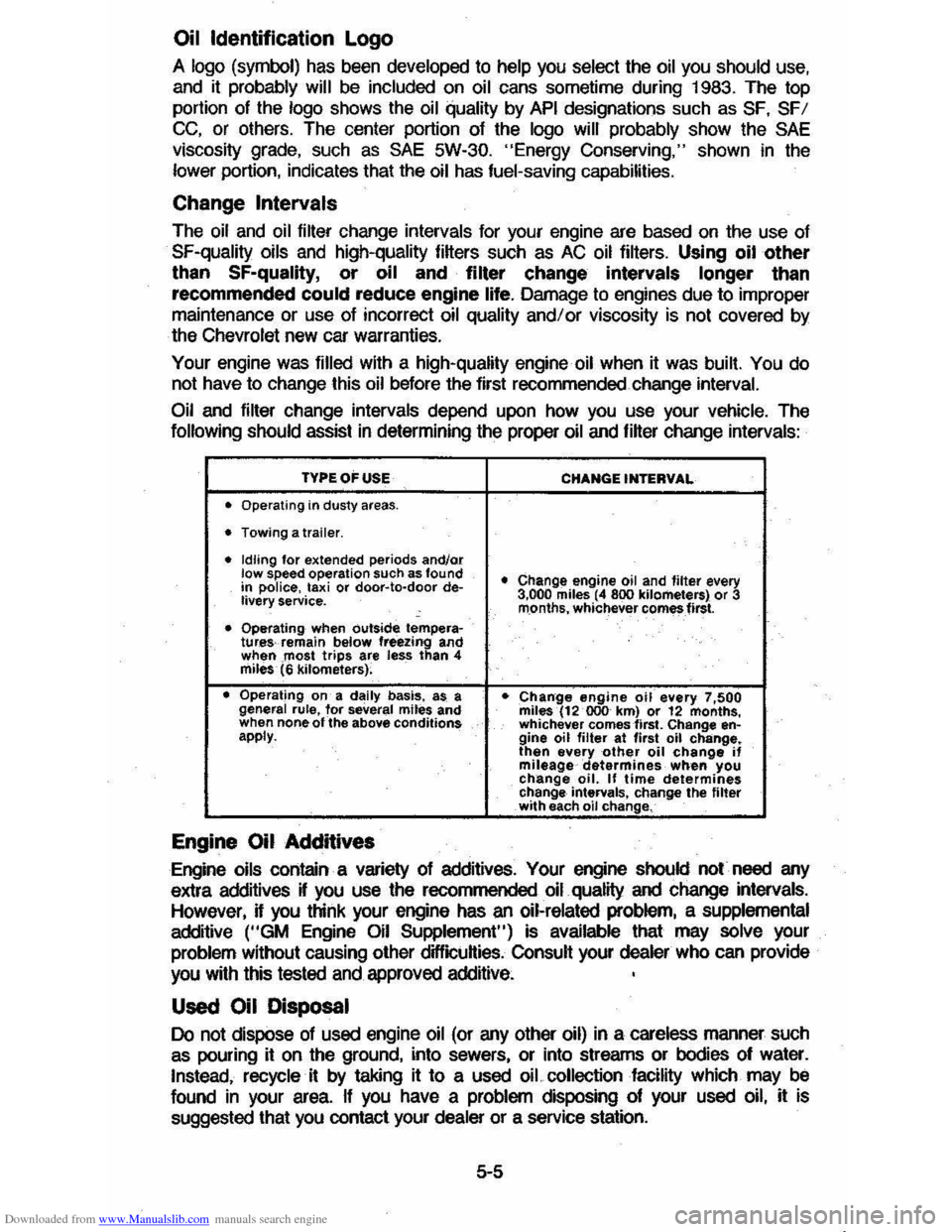
TVPEOFUSE CHANGE INTERVAL
• Operating
in dusty areas.
• Towing a trailer.
• Idling for extended periods andlor low speed operation such as found • Change engine oil and filter every
in police, taxi or door-Ie-door de-livery service. 3,000 miles (4 800 kilometers) or 3
rn.onths, whichever comes first.
• Operating when outside tempera-tures-remain below freezing and when most trips are less than 4 miles' (6 kilometers)~
• Operating on a daily basis, as a • Chan:ge engine oil every 7,500 general rule, for several miles and miles (12 000-km) or 12 months,
when none of the above conditions whichev.er comes first. Change en·
apply. gine oil filter at first oil change. then every other oil change if mileage determines· when you change oil. If time determines change intervals, change the filter with each oil change.
Engine Oil Additives
Engine oils contain a variety of additives. Your engine should not need any
extra additives
K you use the recommended oil quality and change intervals. However, H you think your engine has an oil-related problem, a supplemental
additive ("GM Engine Oil Supplement") is available that may solve your problem without causing other difficuHies. Consu~ your dealer who can provide
you
w~h this tested and approved additive.
Used Oil Disposal
Do not dispose of used engine oil (or any other oil) in a careless manner such
as pouring it on the ground, into sewers, or into streams or bodies of water.
Instead, recycle it by taking it to a used oiL collection facility which may be
found
in your area. If you have a problem disposing of your used oil, it is
suggested that you contact your
dealer or a service station.
5-5
Page 79 of 105
Downloaded from www.Manualslib.com manuals search engine AUTOMATIC TRANSAXLE FLUID RECOMMENDATIONS
Use the Proper Fluid
Use only automatic transmission fluid labeled DEXRON'" II. You can buy this
fluid from your dealer or other service outlets.
Check the Fluid Level with Care
Check the automatic transaxle fluid level at each engine oil change. Driving
with too much or too
little fluid can damage the transaxle.
To check the fluid
level, first set the parking brake, then start the engine in
"P"(Park), and let idle for two minutes . You must check the fluid level with the
engine running at slow
idle and the vehicle level.
You cannot read the correct fluid level if you have just driven the vehicle for a
long time at high speed, in city traffic in hot weather, or if the vehicle has been
pulling a trailer. Wait
until the fluid has cooled down (about 30 minutes).
Remove the dipstick located
On the driver's side forward of the cowl. Carefully
touch the wet end of the dipstick to find out if the fluid is cool, warm or hot. Wipe it clean and push it back in until the cap seats. Pull out the dipstick and
read the fluid level.
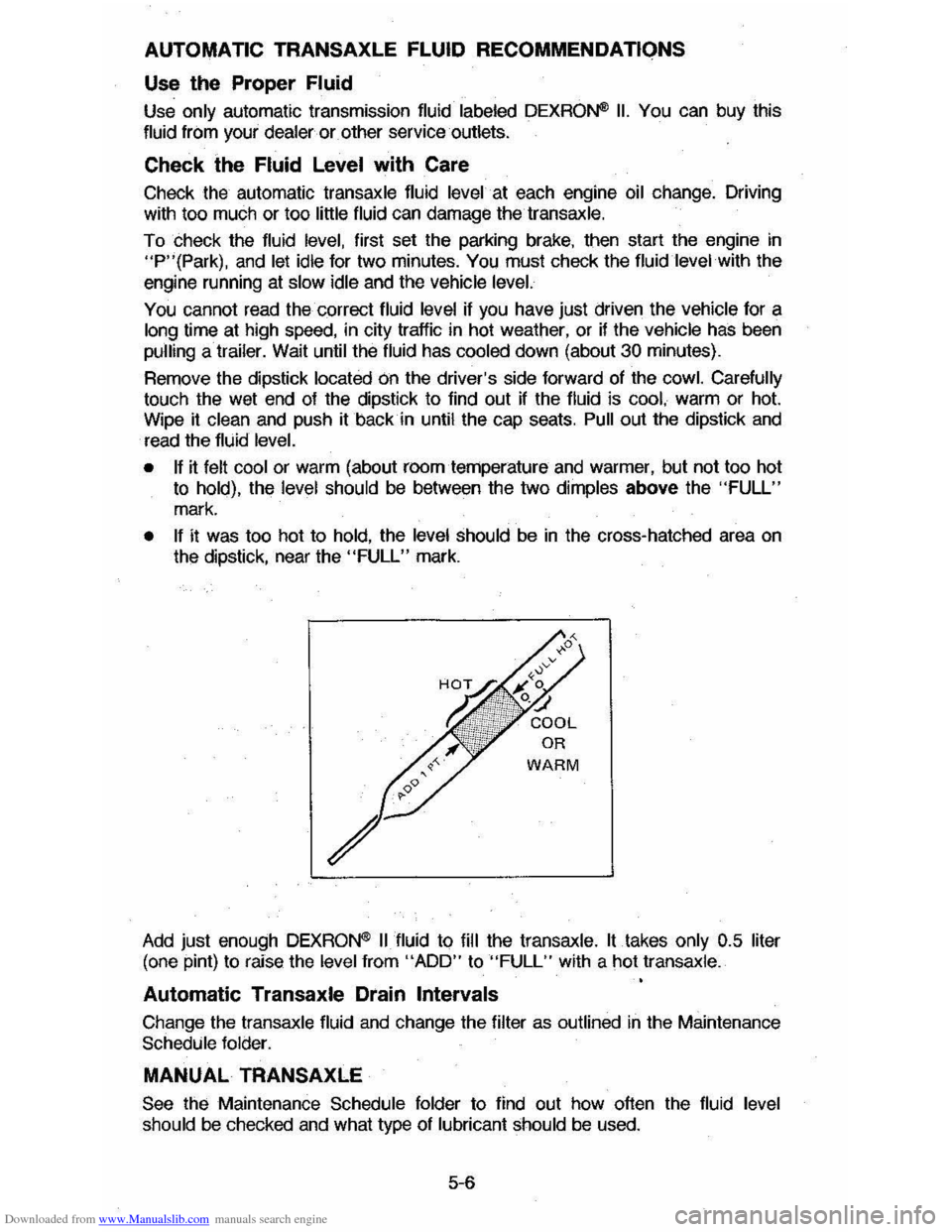
• If it felt cool or warm (about roomternperature and warmer, but not too hot
to hold), the level should be between the two dimples above the "FULL"
mark.
• If it was too hot to hold, the level should be in the cross-hatched area on the dipstick, near the "FULL" mark.
Add just enough DEXRON'" II fluid to fill the transaxle. It takes only 0.5 liter
(one pint) to raise the level from "ADD" to "FULL" with a hot transaxle.
Automatic Transaxle Drain Intervals
Change the transaxle fluid and change the filter as outlined in the Maintenance Schedule folder.
MANUAL TRANSAXLE
See the Maintenance Schedule folder to find out how often the fluid level should be checked and what type of lubricant should be used.
5-6
Page 81 of 105
Downloaded from www.Manualslib.com manuals search engine The cooting system was filled at the factory with a quality coolant that meets
GM Specifications.
~ is important to use proper coolant to prevent damage to
cooling system components . Coolants meeting GM Specification 1825-M or
those specially formulated for aluminum co"1JOflent protection should be used.
The cooling system is designed to use coolant (a mixture of ethylene glycol ,
corrosion inhibitors and water) rather than plain water. The coolant solution
must be used year round
to provide:
• freezing protection down to -37'C (-34'F),
• boiling protection up to 128 'C (262'F),
• protection against rust and corrosion in the cooling system,
• the proper engine temperature for efficient operation and emission control,
and
• proper operation of the coolant temperature light or gage .
See the Maintenance Schedule folder to find out when the coolant must be
replaced . Note that changing the coolant is needed
to make certain that all
parts
of the cooling system work well.
.-~~~~--~-.
CooUng System Care
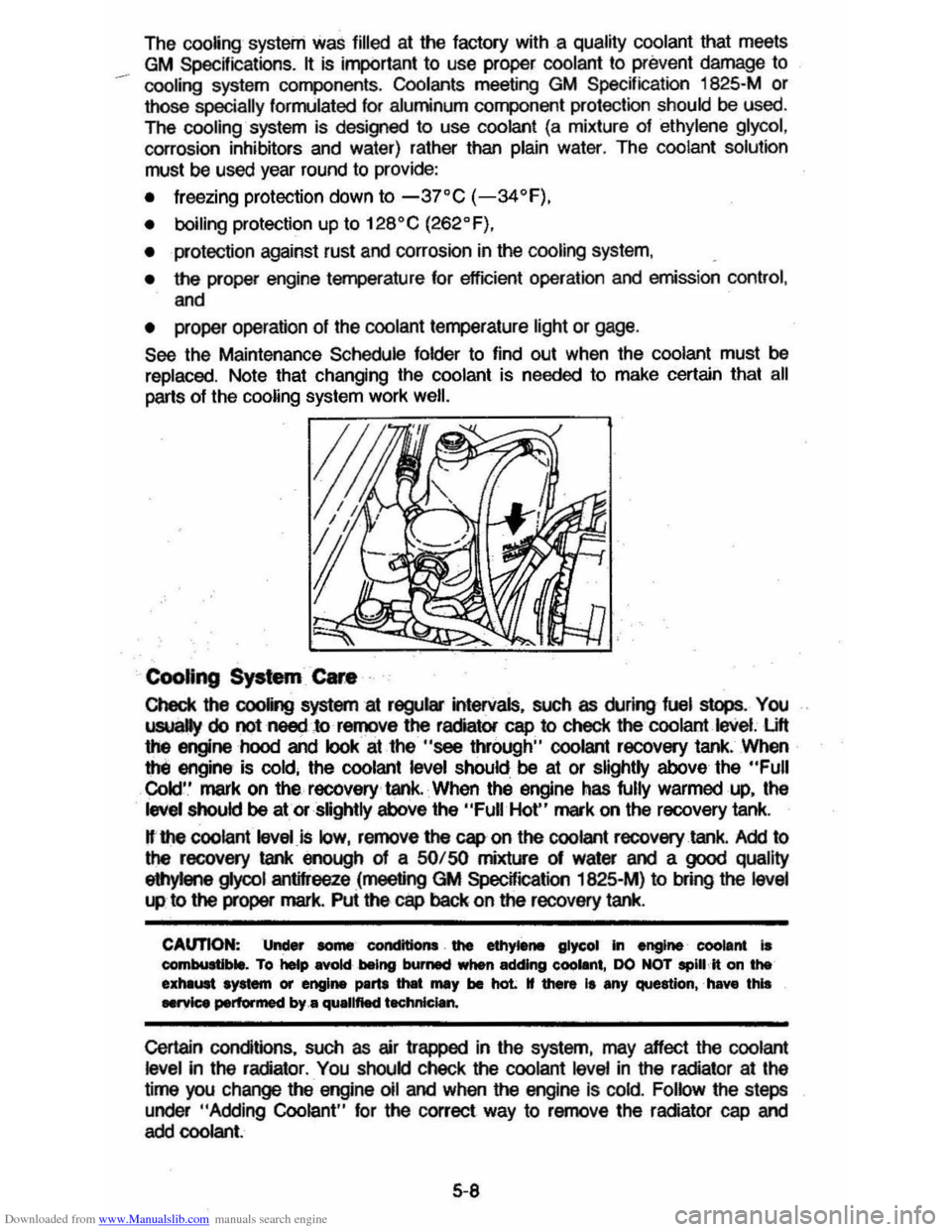
Check the cooling system at regular intervals, such as during fuel sI
Cold' .' mark on the recovery ' tank. When the engine has fully warmed up, the
level should be at or slightly above the "Full Hot" mark on the recovery tank.
H·the coolant level is low, remove the cap on the coolant recovery tank. Add to the recovery tank enough of a SO/ SO mixture 01 water and a good quality
eIIlyIene gIyool antifreeze (meeting GM SpecWication 1825-M) to bfing the level
"" to the proper mark. Pui the cap back on the recovery tank.
CAUTION: Under some' condttlons . the ethytene glycol In engine' coolant is combultlble. To help Rold being burMCf when adding eoollnt, DO NOT spill It on the exhliUlt system or engine ~rtI tMt mIIy be haL tf there It any question,' have this .....,ice performed by .• quallftecl t.chnlclan.
Certain conditions, such as air trapped in the system, may effect the coolant level in the radiator . You should check the coolant level in the radiator at the
time you change the engine 011 and when the engine Is cold. Follow the steps
under
"Adding Coolant" for the correct way to remove the radiator cap and add coolant.
5-8
Page 83 of 105
Downloaded from www.Manualslib.com manuals search engine Radiator Pressure Cap
The radiator cap, a 105 kPa (15 psi) pressure type, must be installed tightly, otherwise coolant may be lost and damage to engine may resuK from
overheating . Radiator pressure cap
should be checked periodically for proper
operation .
If replacement is required, an AC cap is recommencled.
ACCELERATOR LINKAGE
Lubricate all pivot points with .engine oil at the interval shown in the
Maintenance
Schedule. Do not lubricate the accelerator cable.
AIR CLEANER ELEMENT
When replacement of air cleaner fmer element is necessary, an AC air Imer
elemenl
is recornmencled .
See your Maintenance Schedule for change intervals . Operation of vehicle in
dusty areas will necessitate more frequent replacement. Your dealer can be of
assistance
in determining the proper replacement frequency for the conditions
under which you operate your
vehicle.
CAUTION: The air cleaner a* functions ... name arrestor in the event of engine backfire . The -air cleaner ehould be lnstaIIed at an times unit .. III removal is neceaary for repair or maintenance. To help reduce the-risk of pereonal Injury and lor property damage , be sure that no one 18 ne.-the engine comJ*1ment before starting the engine wiU'l the air cleaner removed. If engine backfire occurs with the air cleaner remowd, thwe could be-a burst of flame and posaibly other fnln the engine compartment.
HOOD LATCHES AND HOOD HINGE
SeetHe Maintenance Schedule folder to find out how to lubricate hood.latch ·
and hood hinge assembly .
BRAKE MASTER CYLINDER
Check masler cylinder fluid· level in the reservoir at the interval shown in the Maintenance Schedule . If the fluid is low in the reservoir, it should be filled to
the maximum
level line with Delco Supreme No. 11 or OOT-3 fluids.
POWER STEERING SYSTEM
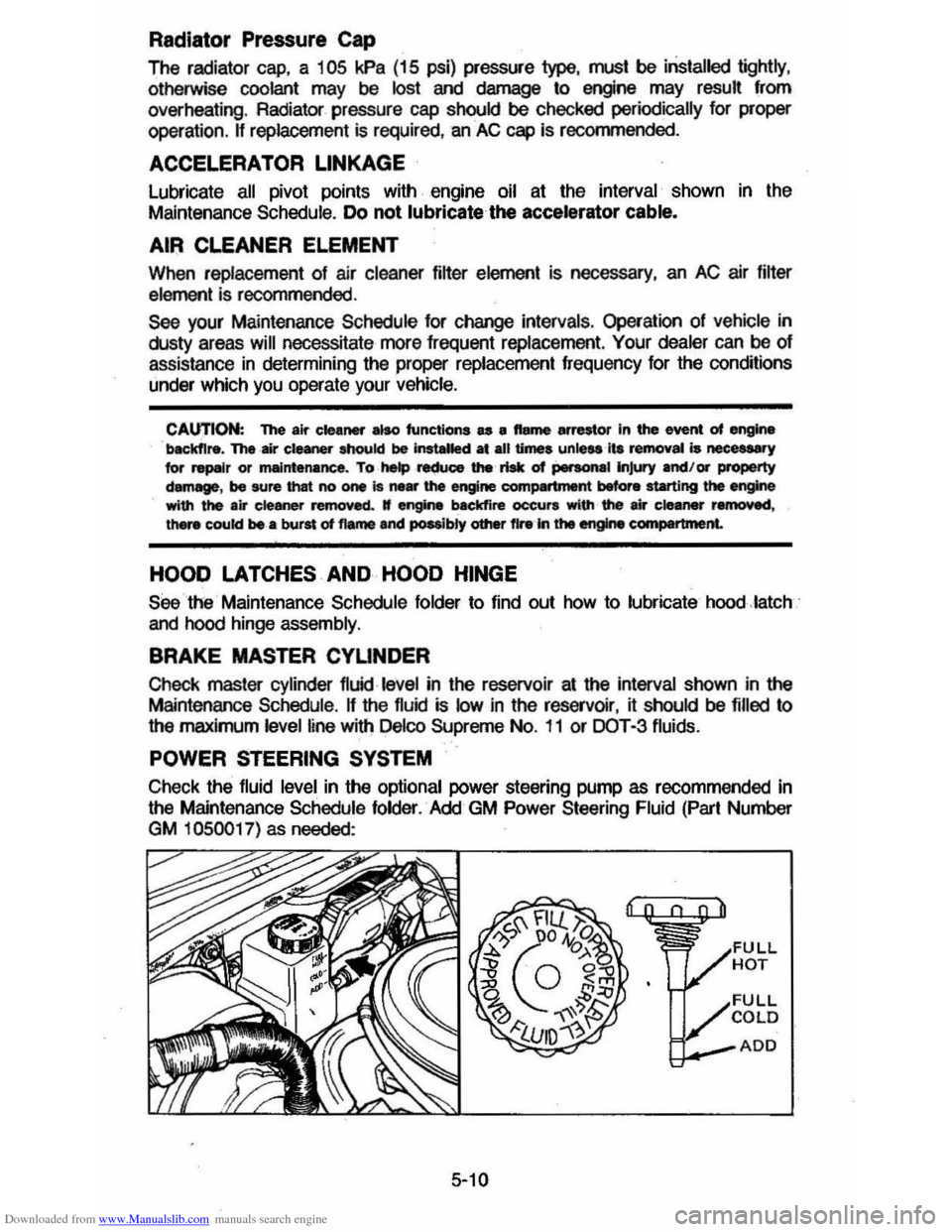
Check the fluid level in the optional power steering pump as recommended in
the Maintenance Schedule folder. Add GM Power Steering Fluid (Part Number
GM 1050017) as needed:
5-10
Page 84 of 105
Downloaded from www.Manualslib.com manuals search engine • If the fluid is warmed up (about 66"C or 150"F -- hot to the touch), the
fluid level should be between the "HOT" and "Cold" marks on the power steering reservoir.
• If cool (about 21"C or 70"F), the fluid level should be between the "Add" and "Cold" marks.
This fluid does not need periodic changing.
FRONT SUSPENSION AND STEERING LINKAGE
Lubricate fillings at the interval shown in the Maintenance Schedule with water
resistant
EP Chassis Lubricant which meets GM Specification 6031M.
NOTICE: Ball joints should not be lubricated unless their temperature is -12"C (10"F), or-higher. During cold weather, they should be allowed to warm up as necessary before
being lubricated or damage to the ball jOint could occur.
FREEDOM BATTERY
Your new vehicle has a Delco FREEDOM battery. It needs no periodic
maintenance.
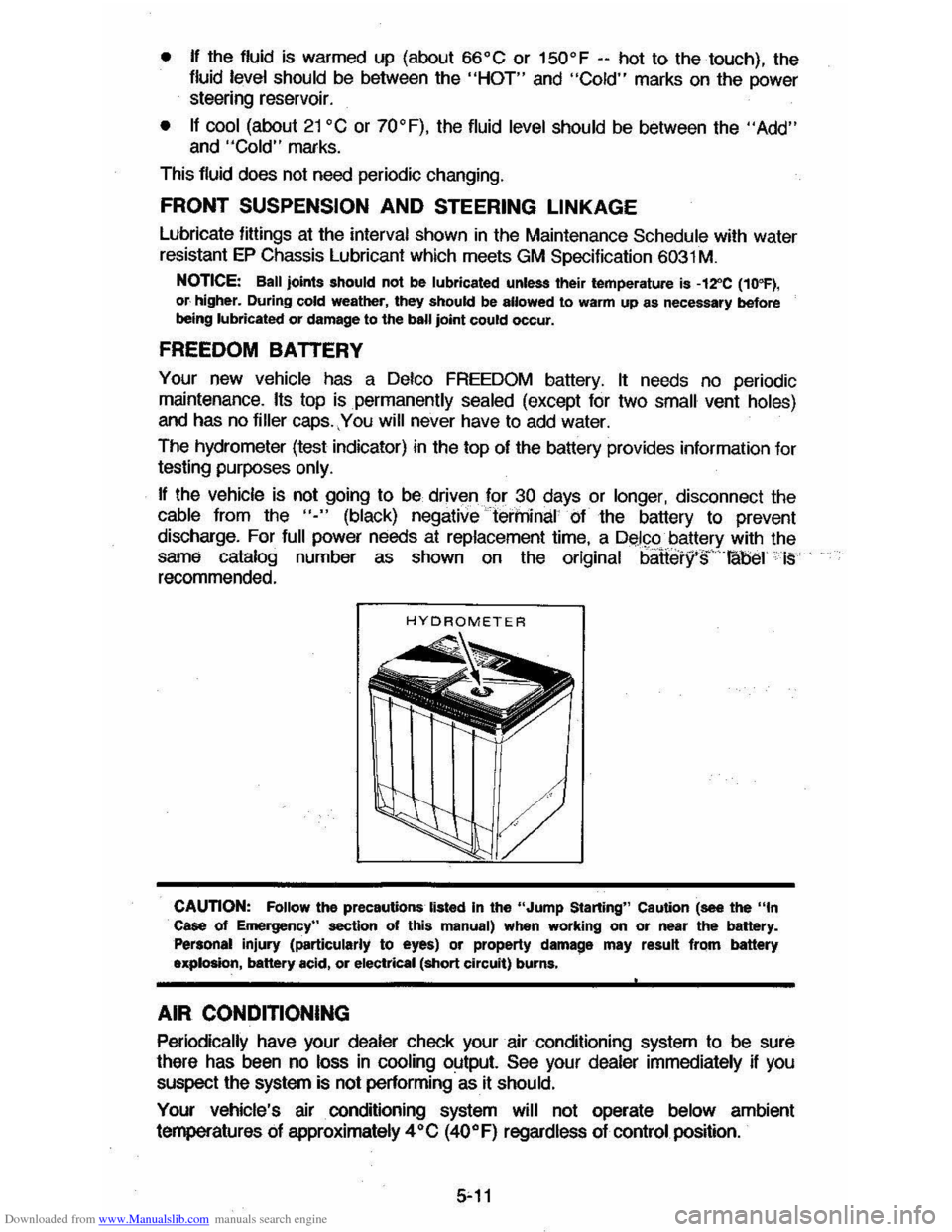
Its top is permanently sealed (except for two small vent holes) and has no filler caps. ,You will never have to add water.
The hydrometer (test indicator) in the top of the battery provides information for
testing purposes only.
If the vehicle is not going to be driven .f?r 30 days or longer, disconnect the cable from the "-" (black) negative terminal of the battery to prevent
discharge. For
full power needs at replacement time, a Del~o battery with the sarne catalog number as shown on the original battery'if . !abel " is recommended.
CAUTION: Follow the precautions listed in the "Jump Starting" Caution (see the "In Case of Emergency" section of this manual) when working on or near the battery. Personal injury (particularly to eyes) or property damage may result from battery explosion, battery acid, or electrical (Short circuit) burns.
AIR CONDITIONING
Periodically have your dealer check your air conditioning system to be sure
there has been no loss in cooling output. See your dealer immediately if you
suspect the system is not performing"as it should.
Your vehicle's air conditioning system will not operate below ambient
temperatures of approximately
4·C (40·F) regardless of control position.
Page 87 of 105
Downloaded from www.Manualslib.com manuals search engine 4. Always use a tire pressure gage when checking inflation pressures (we
suggest you purchase a
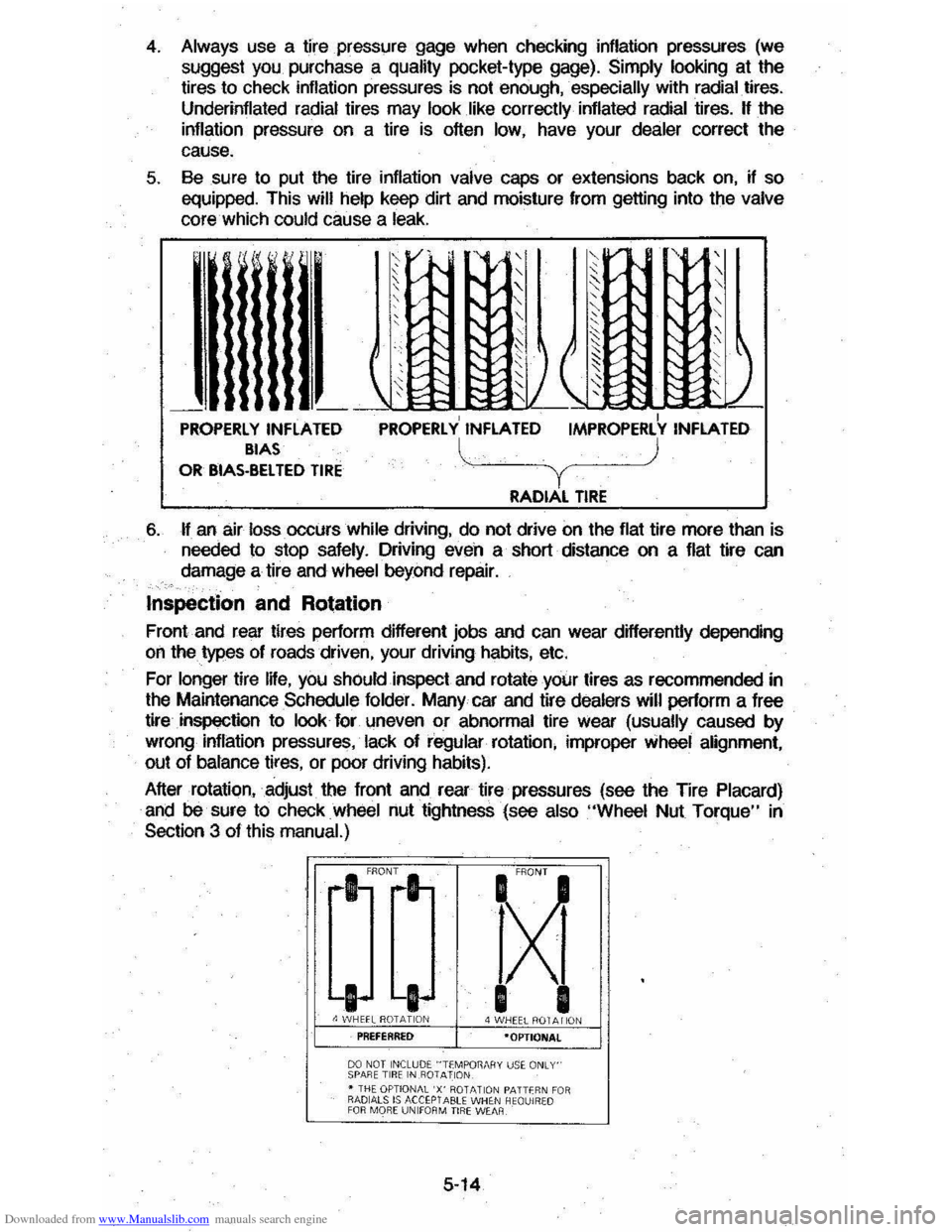
quality pocket-type gage). Simply looking at the tires to check inflation pressures is not enough, . especially with radial. tires.
Underinflated radial tires may look like correctly inflated radial tires. H the
inflation pressure on a tire is often low, have your dealer correct the
cause.
5. Sesure to put the tire inflation valve caps or extensions back on, if so
equipped. This will help keep dirt and moisture from getting into the valve core which could cause a leak.
't! [' V-. , ,-',/ ,
~v"
, " ,
, ,,-I"-v " I'V " ' v-I'-,
" "
,/ " I~ ~::;: ~ ~, ,/
~ J ( " ~ ~ ~ r;S ) :::: ~ ~ t;: ~/ 2~ t: ,
\' , --I PROPERLY INflATED PROPERLY INFLATED IMPROPERLY INFLATED BIAS l ) OR BIAS-BelTED TIRE Y RADIAL TIRE
6. H an air loss. occurs while driving, do not drive on the flat tire more than is
needed to stop safely. Driving even a short distance on a flat tire can
damage a tire and
wheel beyond repair.
Inspection and Rotation
Front and rear tires perform different jobs and can wear differently depending
on the types of roads driven, your driving habits, etc.
For
longer tire IHe, you shOuld inspect and rotate your tires as recommended in
the Maintenance Schedule folder. Many car and tire dealers will perform a free
tire
inspection to look for \meven or abnormal tire Wear (usually caused by
wrong inflation pressures, lack of regular rotation, improper wheel alignment,
out of bslance tires, or poor driving habits).
After rotation, adjust the front and rear tire pressures (see the Tire
Placard)
and be sure to check wheel nut tightness (see also "Wheel Nut Torque" in
Section 3 of this manual.)
fXi
I I 4 WHEEL ROT A I iON ·OPTIONAl
00 NOT INCLUDE "TfMPOT1MIY uS~ ONLY' SPARE TIR E IN .R01 AllON • THE OPTIONAL 'X' ROTATIO N PATTfR N FO R RADIALS IS ACCEPTABU WHE N HEQUIRW
FOR MO RE UNIfOR M TIRE WEAR
5-14
Page 88 of 105
Downloaded from www.Manualslib.com manuals search engine CAUTION; Whenever a wheel is changed, always remove any corrOsion that may be present on inside of wheeland wheel mounting surface on vehicle. Installing wheels
without good metal·to--metalcontact at the mounting surfaces can cause wheel nuts to
loosen, which can later allow a wheel to come off while the vehicle -is moving, possibly
causing loss of control.
Alignment and Balance
Proper wheel alignment improves tire tread life. Your vehicle's suspension
parts should be inspected often and
aligned when needed. (See the
Maintenance
Schedule Folder for more information.) Ball joints have built-in
wear indicators and some movement in the joints is normal.
Improper alignment • will not-cause the vehicle to vibrate. However, improper
alignment can cause:
• the tires to roll at an angle, which will result in faster tire wear;
• your tires _ to wear unevenly;
•
your vehicle to "pull" to the left or right.
Proper tire balancing provides the
best riding comfort and helps reduce tire
tread wear. Out-of-balance tires can cause annoying vibration and uneVen tire
wear such as cupping and flat spots.
Traction
Driving, cornering, and braking traction are reduced -w~ater. snovv' ic:e., gravel, or other material is on the road. Adjust driving practices and vehiCia
speed to road conditions.
When driving on wet
or sluShy roads, a wedge of water can build up between
the tire and road. This is known as hydroplaning, and may cause partial or
complete loss of traction, vehicle control, and stopping ability.
To red\ICe the chance of traclion loss, follow these tips:
1. Slow down during rainstorms or when roads are slushy.
2. StoW down if the road has standing water or puddles.
3. Replace the tires when the tread wear indicators are showing.
4. Keep the tires properly inflated.
H your vehicle has Tpc radial tires (see "Tire Replacement" in this section),
yoU, .lifes were designed to provide better snow traction. In fact, these tires
shOuld be adequate for driving in mO$ wiAter conditions. Howeve" ij you do feel you do need to buyconvenlional snow tires, be sure they are the same
size, load range, and .construction type (bias, bias· belled, Or radial) as your
other tires.
Tire Chain$ or Similar Traction Devices
If you buy tire chains for your car, make sure they are'designated as SAE
Class "S" type chaios. Use of other types of chains may cause damage to
your vehicle.
Use
of chains may adversely affect your vehicle's handling. -When using
chains: (1) adjust speed to road conditions, (2) avoid sharp turns, and (3) when
possible, avoid
locked-wheel braking.
In addition, to help prevent chain damage to your vehicle:
5-15
Page 98 of 105
Downloaded from www.Manualslib.com manuals search engine CONSUMER INFORMATION -
VEHICLE STOPPING DISTANCES
INTRODUCTION
This table contains information on stopping distances as required by the
Consumer Information Regulations issued by the National Highway Traffic
Safety Administration of the United States Department of Transportation, As permitted by the regulation, data for various models with differing options and
accessories are grouped in a single table, Since the regulations require that
the least favorable figures for any specific model in the group be
reported for the entire group, the actual performance of most vehicles in
the group will be better than the figures reported.
Data for stopping distances is derived from tests conducted with new
vehicles
under optimum road conditions by highly skilled test drivers and are not necessarily representative data for a used vehicle, for many road conditions. or for the abilities of most drivers.
STOPPING DISTANCE DATA
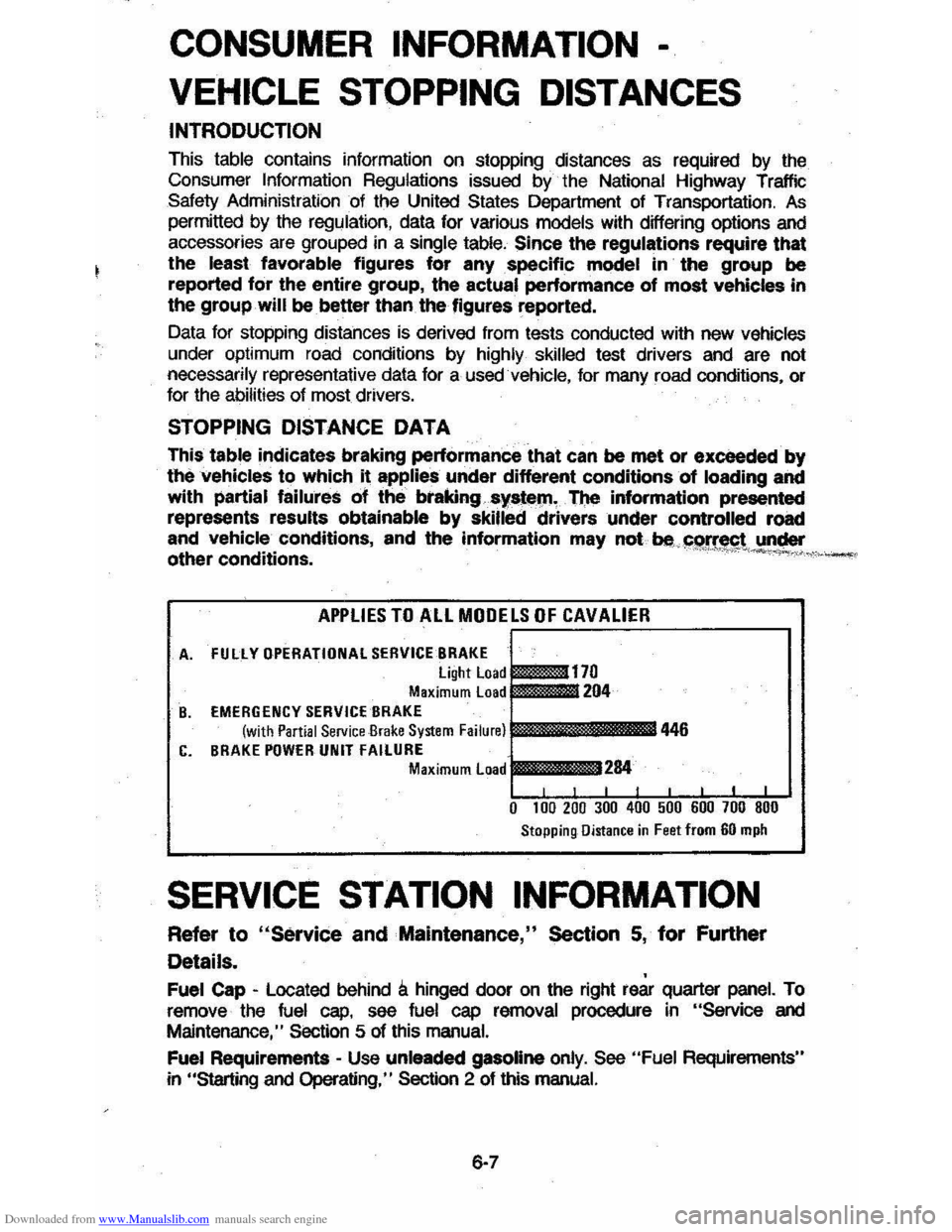
This table indicates braking performance that can be met or exceeded by
the vehicles to which it applies under different conditions of loading and
with
partial failures of the brakingsy"tl>l)'I, TI)e information prl>S8nted represents results obtainable by skilled drivers under controlled road
and
vehicle conditions, and the information may not be. !1e!!~t under
other conditions. " --"M.v,,>_.
APPLIES TO ALL MODELS OF CAVALIER
A. FUllY GPERATIGNAl SERVICE BRAKE
~170 light Load Maximum Load 204 B. EMERGENCY SERVICE BRAKE (with Partial Service Brake System Failure) 446 C. BRAKE PGWER UNIT FAilURE Maximum Load I 284 ,
0 100 200 300 400 500 600 700 800
Stopping Distance in Feet from 60 mph
SERVICE STATION INFORMATION
Refer 10 "Service and Mainlenance," Section 5, for Further
Details.
Fuel Cap -Located behind Ii hinged door on the right rea. quarter panel. To
remove the fuel cap, see fuel cap removal procedure in "Service and
Maintenance," Section 5 of this manual.
Fuel
Requirements -Use unleaded gasoline only. See "Fuel Requirements"
in "Starting
and Operating," Section 2 of this manual.
6·7
Page 99 of 105
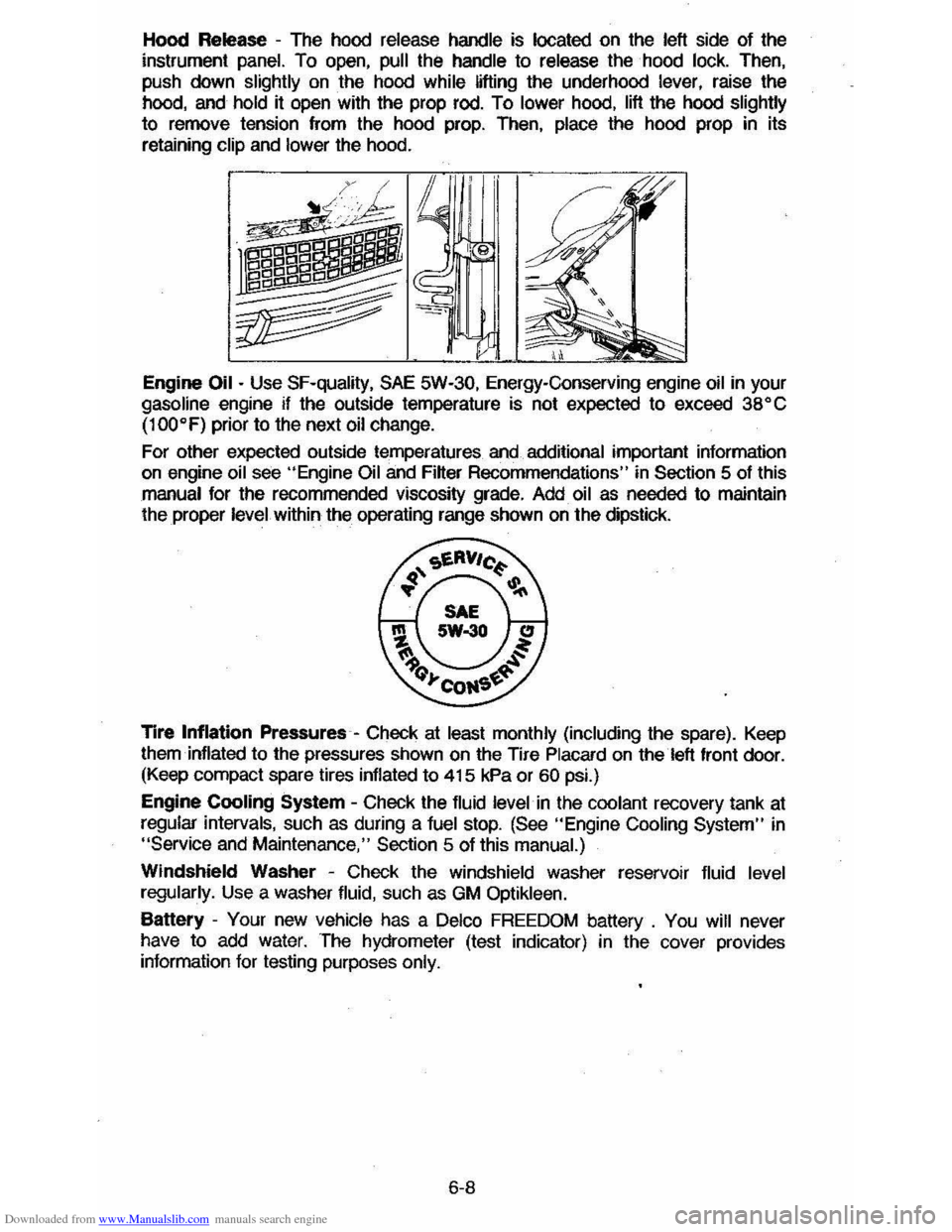
Downloaded from www.Manualslib.com manuals search engine Hood Release -The hood release handle is located on the left side of the
instrument panel. To open, pull the handle to release the hood lock. Then,
push down
slightly on the hood while lifting the underhood lever, raise the
hood, and hold it open with the prop rod. To lower hood, lift the hood slightly
to remove tension from the hood prop. Then, place the hood prop in its
retaining
clip and lower the hood.
Engine
Oil - Use SF-quality, SAE 5W-30, Energy-Conserving engine oil in your gasoline engine if the outside temperature is not expected to exceed 38" C
(100"F)
prior to the next oil change.
For other expected outside temperatures
and additional important information on engine oil see "Engine Oil and Filter Recommendations" in Section 5 of this
manual for the recommended viscosity grade. Add oil as needed to maintain
the proper level within the operating range shown on the dipstick.
Tire
Inflation Pressures -Check at least monthly (including the spare). Keep
them inflated to the pressures shown on the Tire Placard on the left front door. (Keep compact spare tires inflated to 415 kPa or 60 psi.)
Engine
Cooling System -Check the fluid level in the coolant recovery tank at
regular intervals, such as during a fuel stop. (See "Engine Cooling System" in "Service and Maintenance," Section 5 of this manual.)
Windshield Washer -Check the windshield washer reservoir fluid level
regularly. Use a washer fluid, such as GM Optikleen.
Battery -Your new vehicle has a Delco FREEDOM battery . You will never
have to add water. The hydrometer (test indicator) in the cover provides information for testing purposes only.
6-8
Page 100 of 105
Downloaded from www.Manualslib.com manuals search engine SECTION 7
Accessory Position, Steering CoIl.m Lock 2-7 AIr Cir ctJlalioo. . 2-26 Ai' Cleaner. 5-,0 Air Conditio ning ............ . 2-27 M ainte nance .. Antenna . 5-\1 2 -35 5-8 Antifreeze (See Coo~ng System) .. Appearance cae ...• ....•.. 4·t .... ...... 2 -25 ASh Tra y .. Automatic T 'ansalC!e Fluid Chedi: . ___ .. . _ ..... _ ._ ... ... . Maintenance .. Notice ,. .. Op$ralion .. Surter Safety Switch Axlo, Drive-Fluid Level Ball Joints. Ba"&,y
· ....... 5-6 .... 5'-6 2,13 · .... 2 -12 2'13
........ . 5-11 5-1 I
Caution.. 5-11 Emergenc y Starling.. 3-1 Freedom.. .. 3·1 , 5-11 Gas caution . ___ ............. ..... ... . ...... .... 3·, Specilicalions .... ... ... ... .. ... .. .. . T esl indlealor .. Belor e Driving Your cavalier .. B loc k Healer, Engine Blower, Ventilating .. Brakes Driving Through Deep Water "
Parking Brake .. P eda l TraVel .. Power ... SelI·AqusIing ...... ... ..... .. ... .. .. . T railer ..... . Warning Light .. Br eak -In Period Cars Pulrng Tra~ars New Car .. Bucke l Seats .. R ttelininQ .. Bulbs and Fuses ..
""_ Jad< Operation . Stowage ............. ... ... .. .... •..•. • _ ..
Key RemiAder .. Cap FIJI:II .. R adiator Capa.cities .. carbon Monoxide Caution .. Cargo Cover (Hatchback) .. cargO Cover (Station Wagon) ... Carrier, Infant Safety .. cataIytlc Converter .. care .... OwNheatng ....... . Changing Wheels and Tl"es .. Ct\IICI Restraint.. Cigarette lightsr ..
. .... 6 -1 . . . 5-1 1 1-1 2-11 2-25
2 -18
2 -19
2·18 •.••.•. 2, 18 2-1 8 ....... ... .. 2· 3 2·22
2-2
2-2
1 -5
1-5
6 ·3. 6·4 . 6-5
3 ·5 . 3-6 ........ . 3-5
· ....... 2·'
5 -1 5-10 .... .. 6-1 2 -1 2-38 2 -39 1·11 5-2 ...... .... 5-2 ..3 -3 ....•.••. . 3·5 1-11 · ..... 2-25
INDEX
7-1
C1eri'9 c;a.pet care .. Caution .. Exteriof Finish and Trim Fabri c and Interio r Trim .. Solvents Racomme nded Spot Removal. Vinyl Top .. C kl tch
. .... 4·' . ..... 4 -' 4 -' 4 -1
4 -1
..,
4-3
PeDa l Acl/Ustmeot ........ ... ... ... .......... ........ 5·7 Cold Wealhet Starting ... ... ... ...... ... ... ...... 2·11 CooIiIl9 System care. .. . 5 ·8 Coolan t Rocommeodation 5-9 Overhea ting caution. 3-3 Courtosy Lights .. 6-3 Cruis e Con trof 2-16 Defay Wipo( Sys tem ....................... ,.. 2 -9 [)jmensions, Ve)jcle.. . ......... 6-1 [Xsc Brake Wear IrKicator .......... 2-20 Door locks ' -3 Power Door l ocks ... Drive Axle
"""" Seal Adjus tment. .. Driving on Slippery Surfaces Electn c Fan .. Electric al System Battory .. Bulbs .• . . FI.ISOS ..•..• Emergency. In Case Of . Brake W~ning Liglt .. 1
-3
.• 5·6
1 -5 2 -\' .... ~::<',~~-
5 '11, 6·2 '·3 6-4. 6·5 . .... ..... .. 3 · . ... 2 ·22 Geoefator hdicalor... . ...... 2 ·2 1 Hazru"d Warring . .,fLashef ... -'. __ .... ,,, 3 ·1 Jaddng T o Change Wheels 3·5 Jump Starling with Auxi~ary Banel)'. . 3· Overhe.1tod Radiator.. 3·3 Pushing To Start.. 3-I Spar e Trre.. . . .................... 3-5 , 3·6 Towing.. 3·6 Engine Block Heater ... Codo .. CooIO>g •••.
2 ·' , . . .. . 6·5
5 ·7
8I:haust Gas Caution ............... ... ... ... ... 2-1 Flooded, Staring Procedlre ................ 2·11 Qvome ating ................... ....... .... ............. . 3-3 Serial NulTlbef.. . .... 6-5 Specifications . ............... . ..... . .. ..... .......... 6-' Starting... 2·10 Temperature Gage.. 2 ·24 TefTlP(Iralure Light. 2 -21 EnginO Oil Capacity .. Dipstick •• F~Of . . .
. ............ ....... ... .. .... .......... ... 6-1
Reoo .. wnonootion .. Ethyteno Glycol Coolant .• EXhaUst Gas Caution . .
• •••• 5 -3 5·5. 6 ·2
5 ·'
5 ·7 . ....... 2·' Driving With Trunk Open ..... .. ............. . 2-'