change time CHEVROLET CAVALIER 1993 1.G User Guide
[x] Cancel search | Manufacturer: CHEVROLET, Model Year: 1993, Model line: CAVALIER, Model: CHEVROLET CAVALIER 1993 1.GPages: 308, PDF Size: 15.62 MB
Page 143 of 308
Downloaded from www.Manualslib.com manuals search engine If you suspect that the driver of the
vehicle
you want to pass isn’t aware of
your presence, tap the horn a couple
of times before passing.
Do not get too close to the vehicle you
want
to pass while you’re awaiting an
opportunity. For one thing, following
too closely reduces your area
of
vision, especially if you’re following a
larger vehicle. Also, you won’t have
adequate space if the vehicle ahead suddenly slows or stops. Keep back a
reasonable distance.
When it looks like a chance to pass is
coming up, start to accelerate but stay
in the right lane and don’t get too
close. Time your move
so you will be
increasing
speed as the time comes to
move into the other lane.
If the way is
clear to pass, you will have a “running
start” that more than makes up for the
distance you would lose by dropping
back. And
if something happens to
cause you
to cance1,your pass, you
need only slow down and drop back
again and wait for another opportunity.
slow vehicle, wait your turn. But take
care that someone isn’t trying
to pass
you as you pull out to pass the slow
vehicle. Remember to glance over
your shoulder and check the blind
spot.
Check your mirrors, glance over your
shoulder, and
start your left lane
change signal before moving out of the
right lane to pass. When you are far
enough ahead of the passed vehicle to
see its front in your inside mirror,
activate your right lane change signal
If other cars are lined up to pass a and
move back into the right lane.
(Remember that your right outside
mirror is convex. The vehicle you just
passed may
seem to be further away
from you than it really
is.)
Try not to pass more than one vehicle
at a time on two-lane roads.
Reconsider before passing the next
vehicle.
vehicle too rapidly. Even though the
brake lights are not flashing, it may be
slowing down or starting to
turn.
If you’re being passed, make it easy
for the following driver to get ahead of
you. Perhaps you can ease a
little to
the right.
Don’t overtake a slowly moving
I41
Page 145 of 308
Downloaded from www.Manualslib.com manuals search engine While driving on a surface with reduced
traction,
try your best to avoid sudden
steering, acceleration, or braking
(including engine braking by shifting
to
a lower gear). Any sudden changes
could cause the tires
to slide. You may
not realize
the surface is slippery until
your vehicle is skidding. Learn to
recognize warning clues-such as
enough water, ice or packed snow on
the road
to make a “mirrored
surface”-and slow down when you
have any doubt.
Remember: Any anti-lock braking
system (ABS) helps avoid only the
braking skid. Steer
the way you want to
go.
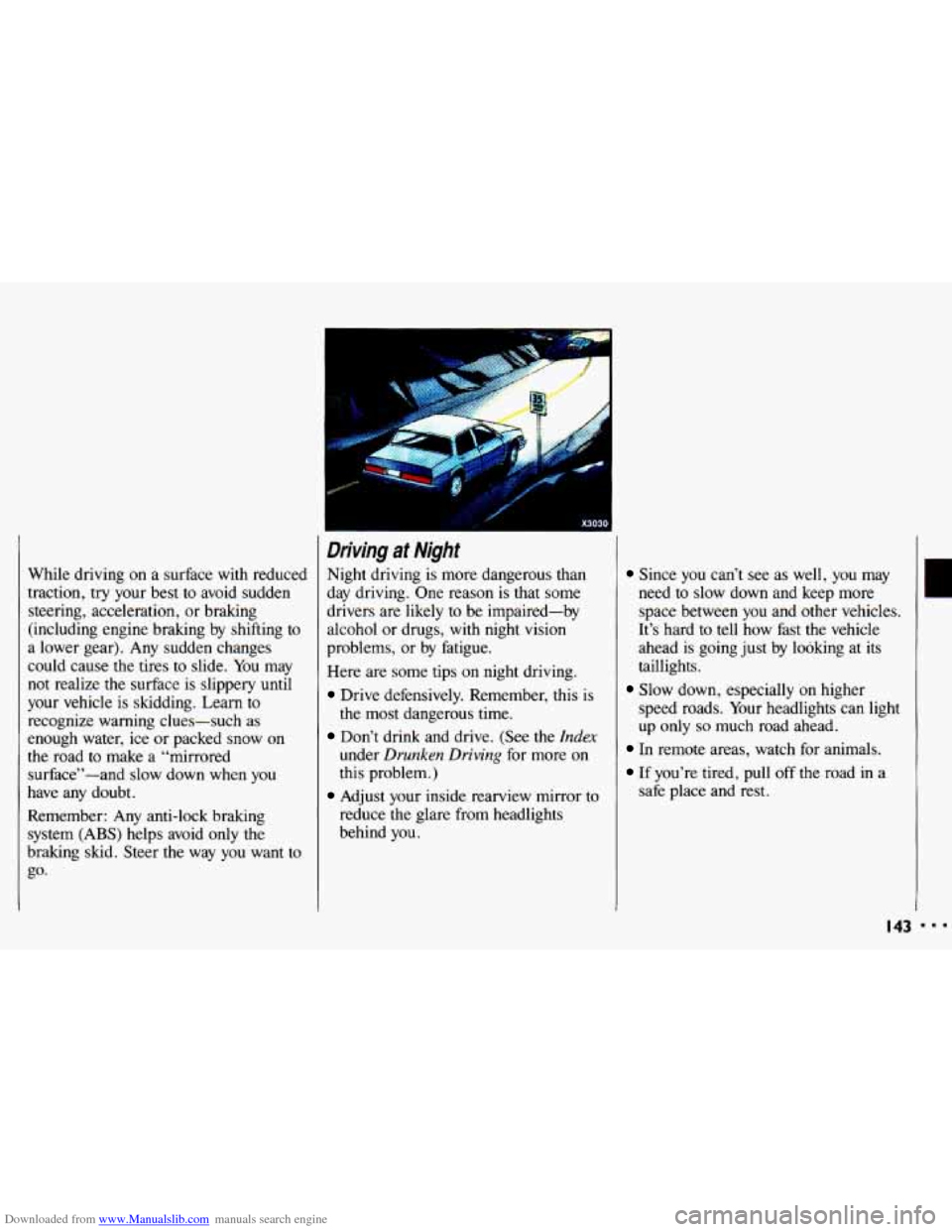
Driving at Night
Night driving is more dangerous than
day driving. One reason is that some
drivers are likely to be impaired-by
alcohol or drugs, with night vision
problems, or by fatigue.
Here are some tips on night driving.
Drive defensively. Remember, this is
the most dangerous time.
Don’t drink and drive. (See the index
under Drunken Driving for more on
this problem.)
Adjust your inside rearview mirror to
reduce the glare from headlights
behind you.
Since you can’t see as well, you may
need
to slow down and keep more
space between you and other vehicles.
It’s hard to
tell how fast the vehicle
ahead is going just by looking at its
taillights.
speed roads. Your headlights can light
up only
so much road ahead.
Slow down, especially on higher
In remote areas, watch for animals.
If you’re tired, pull off the road in a
safe place and rest.
I43
r
I..
Page 155 of 308
Downloaded from www.Manualslib.com manuals search engine On the Road
Unless you are the only driver, it is
good to share the driving
task with
others. Limit turns behind the wheel
to
about 100 miles (160 km) or two hours
at a sitting. Then, either change drivers
or stop for some refreshment like coffee,
tea or soft drinks and some limbering
up. But do stop and move around. Eat
lightly along the way. Heavier meals
tend to make some people sleepy.
On two-lane highways or undivided
multilane highways that do
not have
controlled access, you’ll want
to watch
for some situations not usually found on
freeways. Examples are: stop signs and
signals, shopping centers with direct
access to the highway, no passing zones
and school zones, vehicles turning left
and right off the road, pedestrians,
cyclists, parked vehicles, and even
animals.
Highway Hypnosis
Is there actually such a condition as
“highway hypnosis”?
Or is it just plain
falling asleep at the wheel? Call it
highway hypnosis, lack
of awareness, or
whatever.
There is something about an easy stretch
of road with the same scenery, along
with the hum
of the tires on the road,
the drone
of the engine, and the rush of
the wind against the vehicle that can
make you sleepy. Don’t let it happen to
you! If it does, your vehicle can leave
the road
in less than a second, and you
could crash and be injured.
What can
you do about highway
hypnosis? First, be aware that it can
happen.
Then here are some tips:
Make sure your vehicle is well
ventilated, with a comfortably cool
interior.
Keep your eyes moving. Scan the road
ahead and to the sides. Check your
rearview mirrors frequently and your
instruments from time to time. This
can help you avoid a fixed stare.
Wear good sunglasses in bright light.
Glare can cause drowsiness. But don’t
wear sunglasses at night. They will
drastically reduce your overall vision
at the very time you need
all the
seeing power you have.
If you get sleepy, pull off the road into
a rest, service, or parking area and
take a nap, get some exercise, or both.
For safety, treat drowsiness on the
highway as an emergency.
As in any driving situation, keep pace
with traffic and allow adequate
following distances.
L
Page 191 of 308
Downloaded from www.Manualslib.com manuals search engine Ll X5076
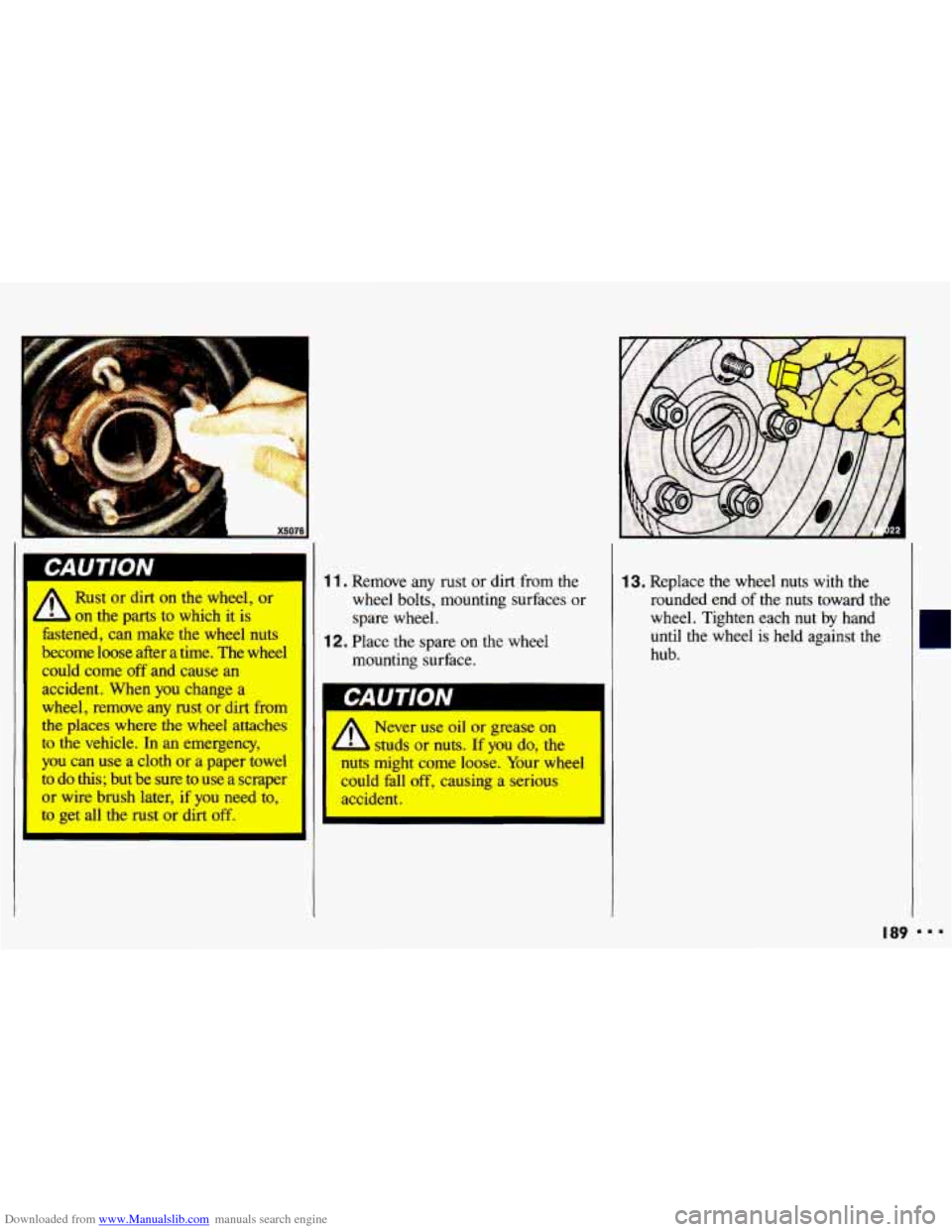
Rust or dirt on the wheel, or
on the parts to which it is
fastened, can make the wheel nuts
become loose after a time. The wheel
could come off and cause an
accident. When
you change a
wheel, remove any rust
or dirt from
the places where the wheel attaches
to the vehicle. In an emergency,
you can use a cloth
or a paper towel
to do this; but be sure to use a scraper
or wire brush later, if you need to,
to get all the rust or dirt off.
1 1. Remove any rust or dirt from the
wheel bolts, mounting surfaces or
spare wheel.
mounting surface.
1 2. Place the spare on the wheel
~ CAUTION
13. Replace the wheel nuts with the
rounded end of the nuts toward the
wheel. Tighten each nut by hand
until
the wheel is held against the
hub.
A
Never use oil or grease on
studs or nuts. If
you do, the
nuts might come loose. Your wheel
could fall off, causing a serious
accident.
I89
Page 210 of 308
Downloaded from www.Manualslib.com manuals search engine Service & Appearance Care
When to Change Engine Oil
See if any one of these is true for you:
Most trips are less than 4 miles (6 km).
It’s below freezing outside and most
trips are less than 10 miles
(16 km).
The engine is at low speed most of the
time (as in door-to-door delivery,
or in
stop-and-go traffic).
Most trips are through dusty places.
If any one
of these is true for your
vehicle, then you need to change your
oil and filter every 3,000 miles
(5 OOO km) or 3 months-whichever
comes first.
If none of them is true, change the oil
every
7,500 miles (12 500 km) or 12
months-whichever comes first. Change
the filter at the first oil change and at
every other oil change after that.
208
Engine Block Heater
An engine block heater can be a big
help if you have to park outside in very
cold weather,
0°F (-18°C) or colder. If
your vehicle has this option, see the
index under Engine Block Heater.
What to Do with Used Oil
CAUTION
A
Used engine oil contains
things that have caused skin
cancer in laboratory animals. Don’t
let used
oil stay on your skin for
very long. Clean your skin and
nails with soap and water, or a
good hand cleaner. Wash or
properly throw away clothing or
rags containing used engine oil.
Page 213 of 308
Downloaded from www.Manualslib.com manuals search engine Automaric Transaxle Fluid
When to Check and Change:
A good time to check your automatic
transaxle fluid level is when the engine
oil is changed. Refer to the Maintenance
Schedule to determine when to change
your fluid. See the
Index under
Scheduled Maintenance Services.
How to Check:
Because this operation can be a little
difficult, you may choose to have this
done at a Chevrolet dealership Service
Department.
If you do it yourself, be sure to follow
all the instructions here, or you could
get a false reading on the dipstick.
Too much or too little fluid can
damage
your transaxle. Too much
can mean that some of the fluid
could come out and fall
on hot
engine parts, starting a fire. Be
sure to get an accurate reading
if
you check your transaxle fluid. Wait
at least 30 minutes before checking
the transaxle fluid level if you have been
driving:
When outside temperatures are above
At high speed for quite a while.
In heavy traffic-especially in hot
To get the right reading, the fluid should
be at normal operating temperature,
which is 180°F to 200°F (82°C to
93" C).
Get the vehicle warmed up by driving
about 15 miles (24
km) when outside
temperatures are above
50°F (10OC). If
it's colder than 50" F (10" C), you may
have to drive longer.
90°F (32°C).
weather.
21 I
Page 215 of 308
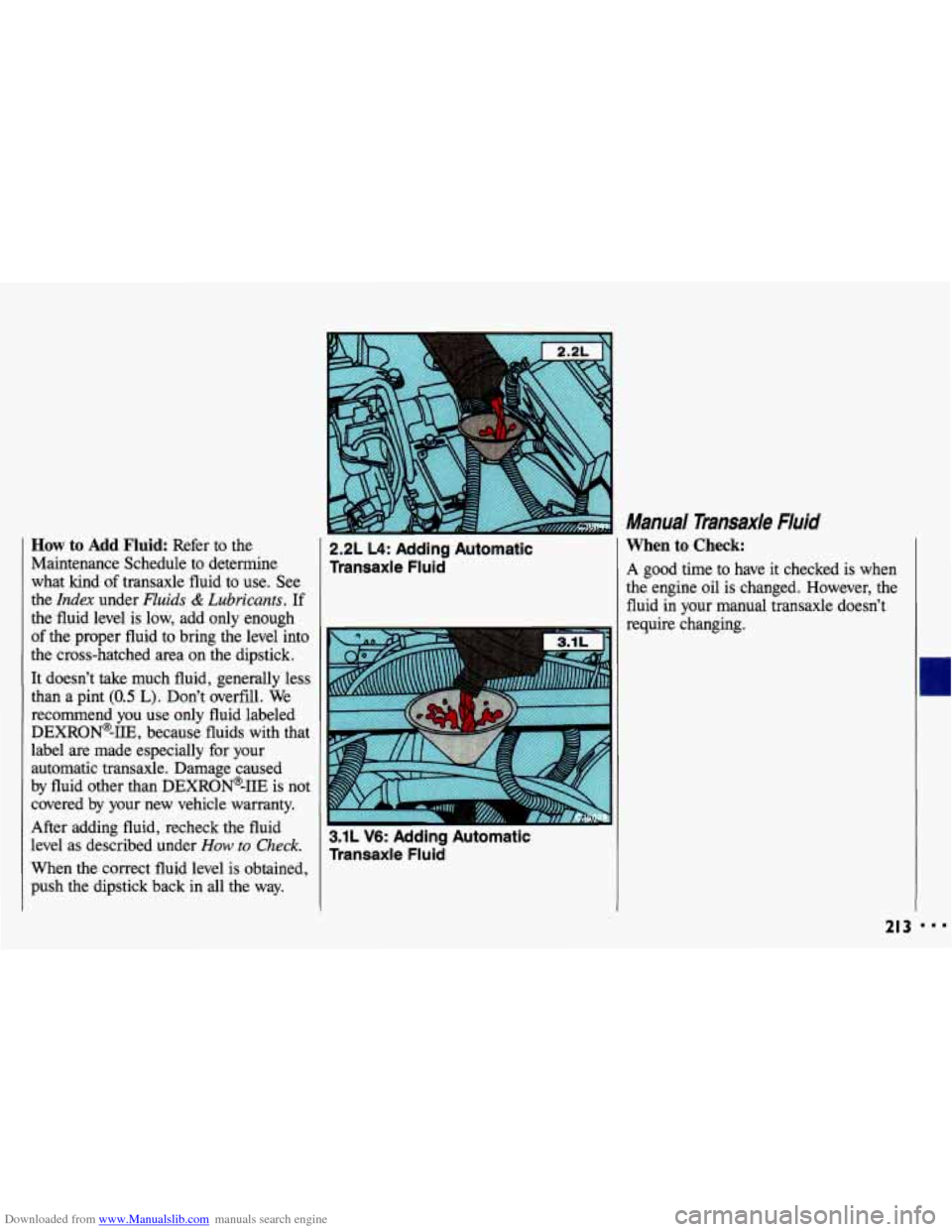
Downloaded from www.Manualslib.com manuals search engine How to Add Fluid: Refer to the
Maintenance Schedule to determine
what kind of transaxle fluid to use. See
the
Index under Fluids & Lubricants. If
the fluid level is low, add only enough
of the proper fluid to bring the level into
the cross-hatched area on the dipstick.
It doesn't take much fluid, generally less
than a pint
(0.5 L). Don't overfill. We
recommend you use only fluid labeled
DEXRON@-IIE, because fluids with that
label are made especially for your
automatic transaxle. Damage caused
by fluid other than DEXRON@-IIE is not
covered by your new vehicle warranty.
After adding fluid, recheck the fluid
level as described under
How to Check.
When the correct fluid level is obtained,
push the dipstick back in all the way.
2.2L L4: Adding Automatic
Transaxle Fluid
3.1L V6: Adding Automatic
Transaxle Fluid
Manual Transaxle Fluid
When to Check:
A good time to have it checked is when
the engine oil is changed. However, the
fluid in your manual transaxle doesn't
require changing.
213
Page 225 of 308
Downloaded from www.Manualslib.com manuals search engine genuine GM replacement parts. If you
don’t, your brakes may no longer work
properly. For example, if someone puts
in brake linings that are wrong for your
vehicle, the balance between your front
and rear brakes can change, for the
worse. The braking performance you’ve
come to expect can change
in many
other ways
if someone puts in the wrong
replacement brake parts.
Battery
Every new Chevrolet has a Delco
Freedom@ battery.
You never have to
add water to one
of these. When it’s
time for a new battery, we recommend a
Delco Freedom@ battery. Get one that
has the catalog number shown on the
original battery’s label.
Jump Starting
For jump starting instructions, see the
Index under Jump Starting.
Vehicle Storage
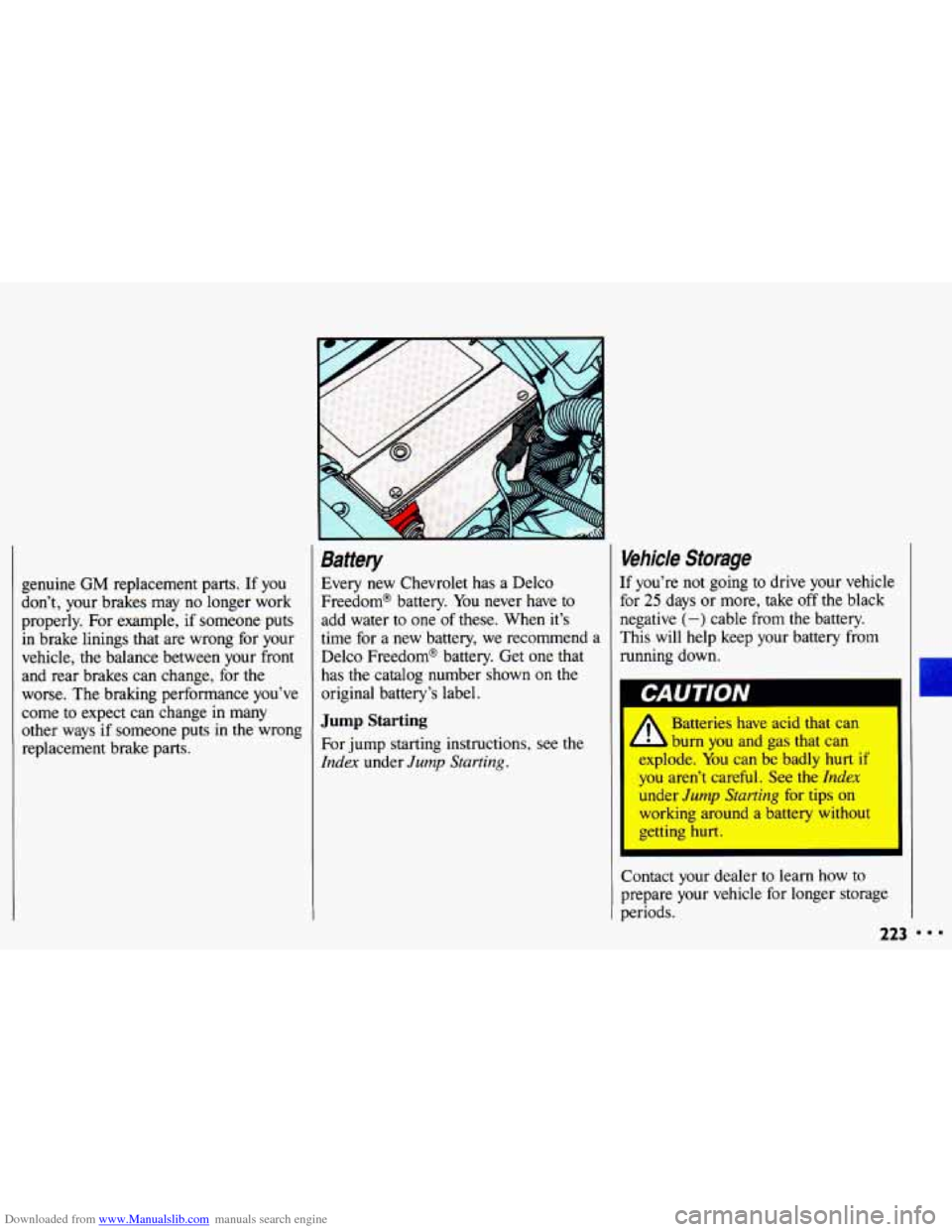
If you’re not going to drive your vehicle
for
25 days or more, take off the black
negative
(-) cable from the battery.
This will help keep your battery from
running down.
I
I A Batteries have acid that can
L burn you and gas that can
explode.
You can be badly hurt if
you aren’t careful. See the Index
under Jump Starting for tips on
working around a battery without
getting hurt.
Contact your dealer to learn how to
prepare your vehicle for longer storage
periods.
223 DDD
Page 233 of 308
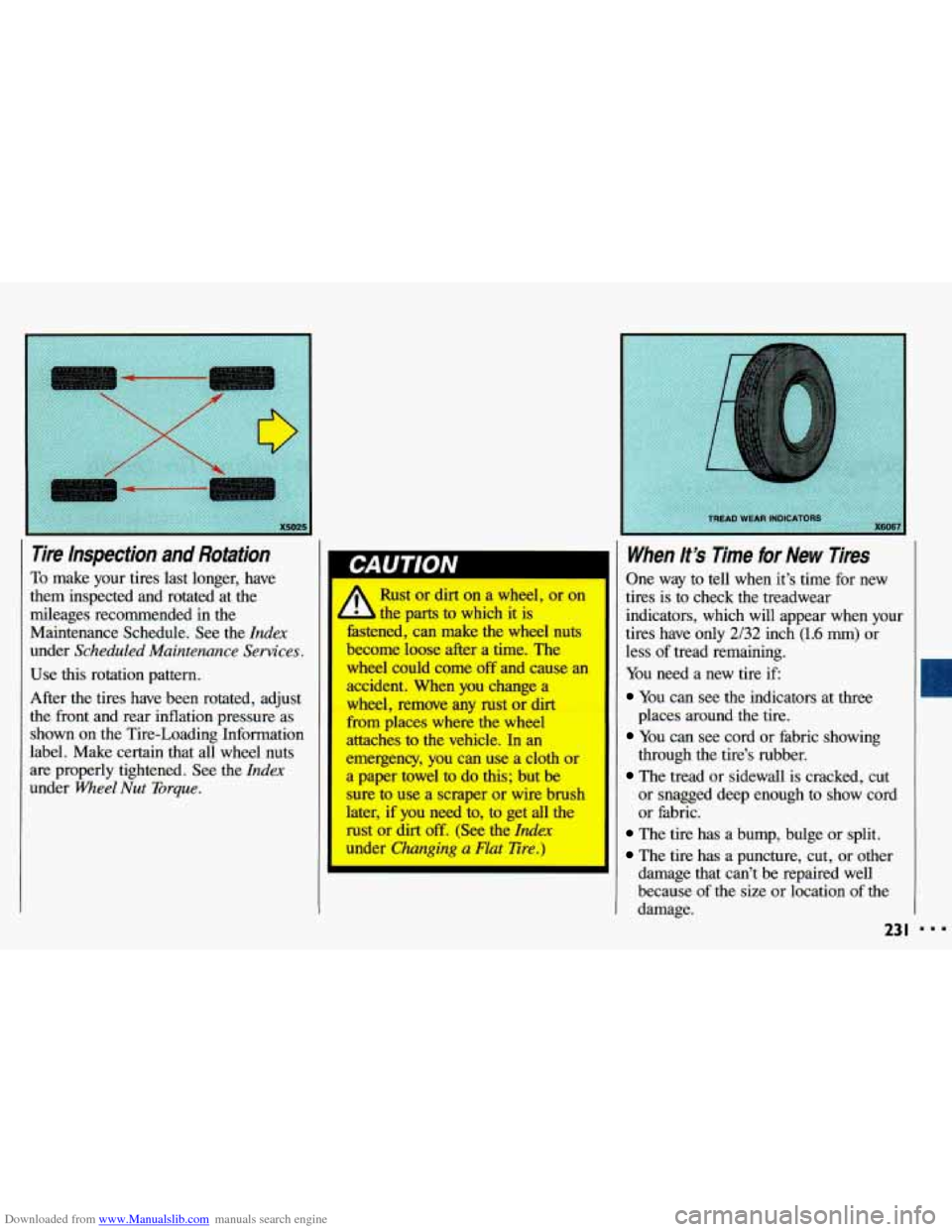
Downloaded from www.Manualslib.com manuals search engine Tire hspection and Rotation I
Use this rotation pattern.
After the tires have been rotated, adjust
the front and rear inflation pressure as
shown on the Tire-Loading Information
label. Make certain that all wheel nuts
are properly tightened. See the Index
under Wheel Nut Torque.
To make your tires last longer, have
them inspected and rotated at the
mileages recommended in the
Maintenance Schedule. See the
Index
under Scheduled Maintenance Services.
u I I’ -
Rust or dirt on a wheel, or on
; parts to which it is
fastened, can make the wheel nuts
become loose after a time. The
wheel could come off and cause an
accident. When you change a
wheel, remove any rust or dirt
from
places where the wheel
attaches to the vehicle. In an
emergency, you can use a cloth or
a paper towel to do this; but be
sure to use a scraper or wire brush
later, if you need to, to get all the
rust or dirt
off. (See the Index
under Changing a Flat Tire.)
When lt’s Time for New Tires
One way to tell when it’s time for new
tires
is to check the treadwear
indicators, which will appear when your
tires have
only 2/32 inch (1.6 mm) or
less of tread remaining.
You need a new tire if
You can see the indicators at three
You can see cord or fabric showing
The tread or sidewall is cracked, cut
places around the tire.
through the tire’s rubber.
or
snagged deep enough to show cord
or fabric.
The tire has a bump, bulge or split.
The tire has a puncture, cut, or other
damage that can’t be repaired well
because
of the size or location of the
damage.
23 I
Page 295 of 308

Downloaded from www.Manualslib.com manuals search engine I TOTAL MATERIAL NOTE: Dealers and Companies please provide dealer or company name, an\
d
also the name of the person to whose attention the shipment should be sent. Order payable to For purchases outside U.S.A. please write to the above address for quotation. add 4% sales tax Helm, Inc. (USA funds only - do not Handling Charge $3.50
send cash.) $6.50
0 Check or Money ~i~hi~~ purchasers ,. I.
,.
Handlina US. Funds)
Canadian Postage/
(ATTENTION) 0 Mastercard GRAND TOTAL
0 VISA
Account
Number: ml
~xpiration m m address is different from your Date molyr: shipping address shown.
(CUSTOMER SIGNATURE)
Check here if your billing
DAYTIME TELEPHONE
NO. CODE
:Prices are subject to change without notice and without incurring Obligation. NOTE: All listed prices are quoted in U.S. funds. Canadian residentsare to make checks payable in U.S. funds
Orders for Individual product service Pubfications cannot be filled without the and are to indude $6.50 for additional postage and handling. Requests for InanUalS print\
ed in French should
L.! ' may be found in the psp Index, Your be directed 10 Canadian General Motors dealerships.
ch additionat psp costs $2.00, PkaS8 allow adOqUat0 time for pOSml SOlVlCe. ., ,. . rl I.
,. .,