cooling CHEVROLET CAVALIER 1993 1.G User Guide
[x] Cancel search | Manufacturer: CHEVROLET, Model Year: 1993, Model line: CAVALIER, Model: CHEVROLET CAVALIER 1993 1.GPages: 308, PDF Size: 15.62 MB
Page 182 of 308
Downloaded from www.Manualslib.com manuals search engine Problems on the Road
Engine Overheating (CONE)
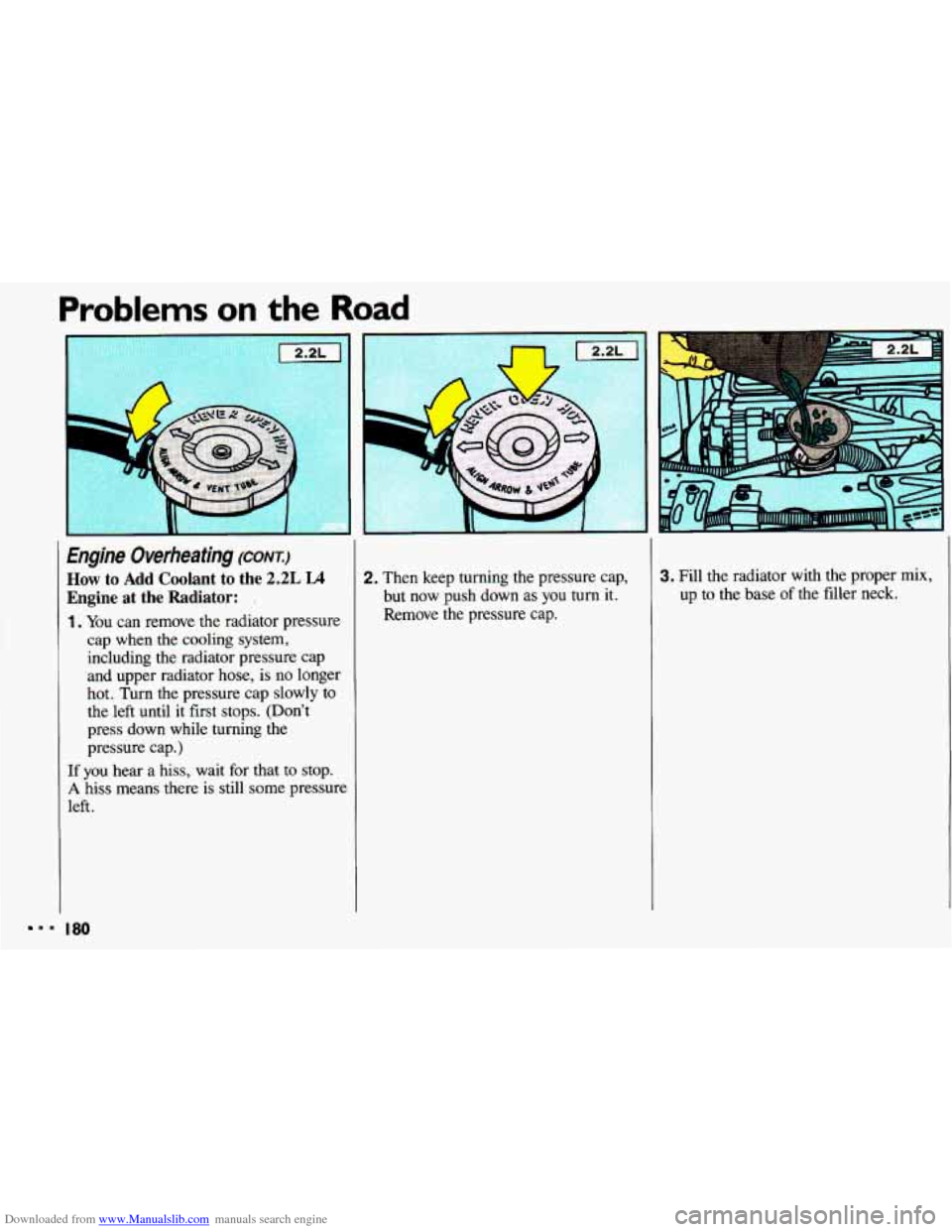
How to Add Coolant to the 2.2L LA
Engine at the Radiator: .
1. You can remove the radiator pressure
cap when
the cooling system,
including the radiator pressure cap
and upper radiator hose, is no longer
hot. Turn the pressure cap slowly to
the left until it first stops. (Don’t
press down while turning the
pressure cap.)
If you hear a hiss, wait for that to stop.
A hiss means there is still some pressure
left.
2. Then keep turning the pressure cap, 3. Fill the radiator with the proper mix,
but now push down as
you turn it. up to the base of the filler neck.
Remove the pressure cap.
== 180
Page 184 of 308
Downloaded from www.Manualslib.com manuals search engine Problems on the Road
Engine Overheating (CONT)
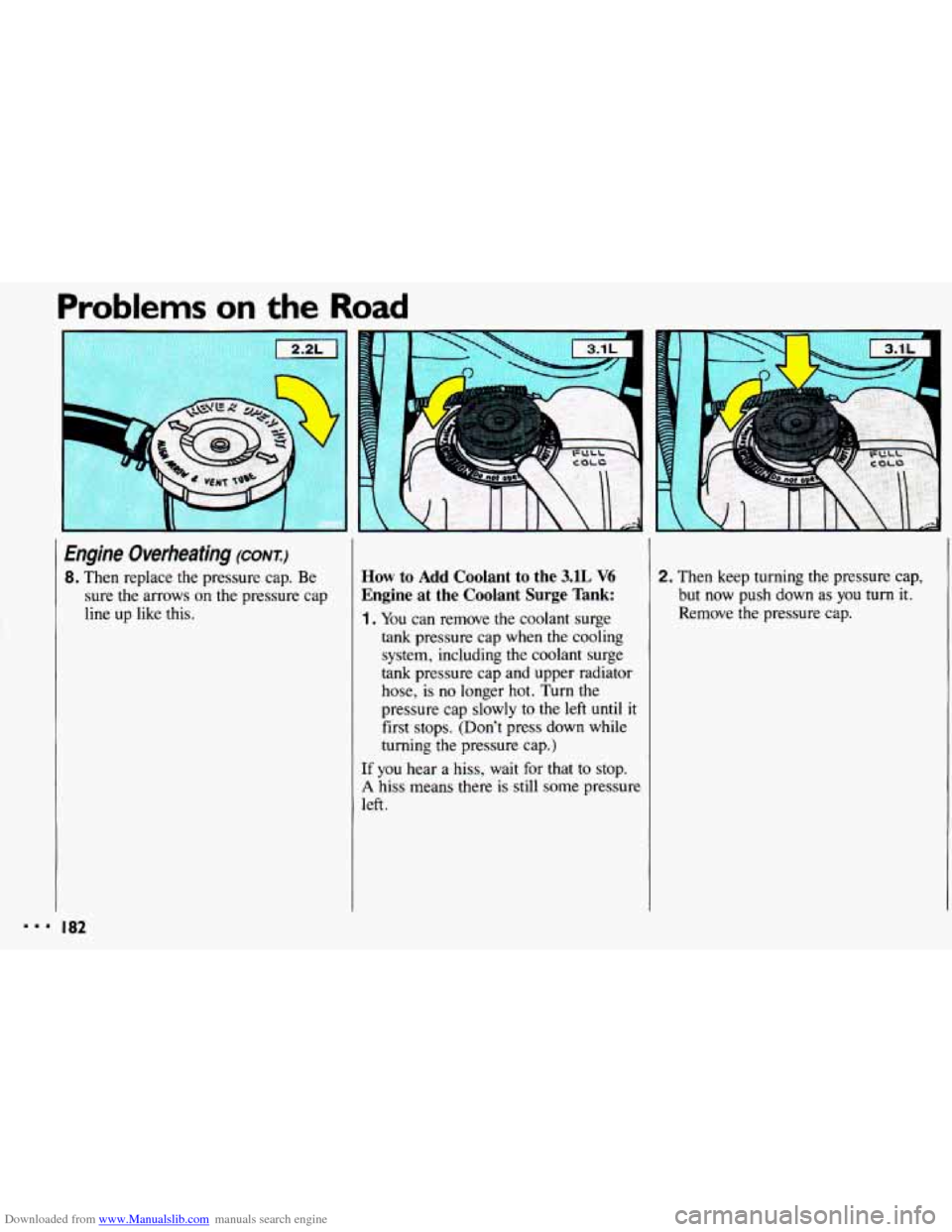
8. Then replace the pressure cap. Be
sure the arrows
on the pressure cap
line up like this.
How to Add Coolant to the 3.lL V6
Engine at the Coolant Surge Tank:
1. You can remove the coolant surge
tank pressure cap when the cooling
system, including the coolant surge
tank pressure cap and upper radiator
hose, is
no longer hot. Turn the
pressure cap slowly
to the left until it
first stops. (Don’t press down while
turning the pressure cap.)
If you hear a hiss, wait for that to stop.
A hiss means there is still some pressure
left.
2. Then keep turning the pressure cap,
but now push down
as you turn it.
Remove the pressure cap.
Page 218 of 308
Downloaded from www.Manualslib.com manuals search engine 888
Service rance Care
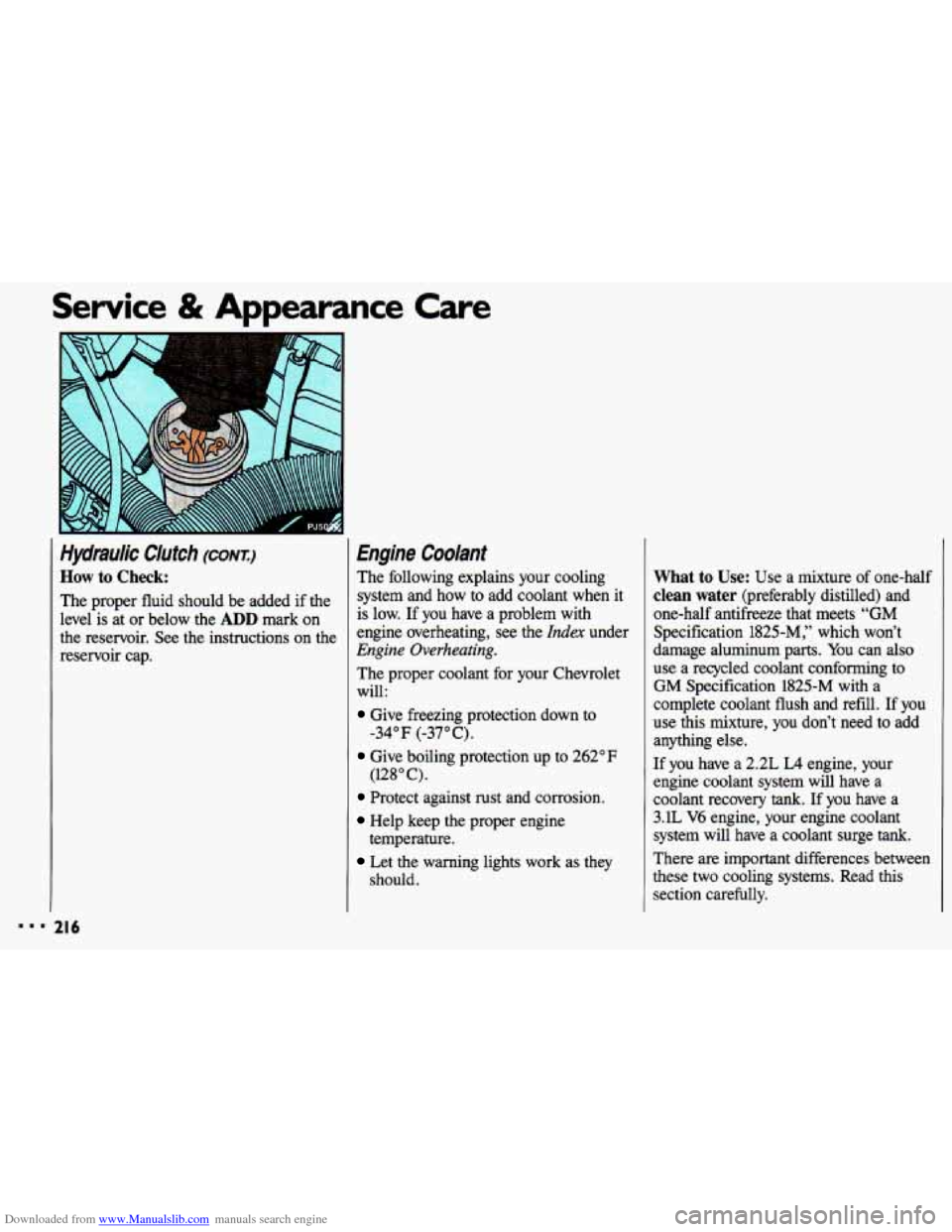
Hydraulic Clutch (CONTJ
How to Check:
The proper fluid should be added if the
level is at or below the
ADD mark on
the reservoir.
See the instructions on the
reservoir cap.
216
Engine Coolant
The following explains your cooling
system and how to add coolant when it
is low. If you have a problem with
engine overheating,
see the Index under
Engine Overheating.
The proper coolant for your Chevrolet
will:
Give freezing protection down to
Give boiling protection up to 262°F
Protect against rust and corrosion.
Help keep the proper engine
Let the warning lights work as they
-34" F (-37" C).
(128" C).
temperature.
should.
What to Use: Use a mixture of one-half
clean water (preferably distilled) and
one-half antifreeze that meets "GM
Specification 1825-M," which won't
damage aluminum parts.
You can also
use a recycled coolant conforming to
GM Specification 1825-M with a
complete coolant flush and refill.
If you
use this mixture, you don't need to add
anything else.
If you have a 2.2L LA engine, your
engine coolant system will have a
coolant recovery
tank. If you have a
3.1L V6 engine, your engine coolant
system will have a coolant surge
tank.
There are important differences between
these two cooling systems. Read this section carefully.
Page 219 of 308
Downloaded from www.Manualslib.com manuals search engine L Adding only plain water to - your cooling system can be
dangerous. Plain water,
or some
other liquid like alcohol, can boil
before the proper coolant
mix will.
Your vehicle's coolant warning
system
is set for the proper coolant
mix. With plain water or the
wrong mix, your engine could get
too hot but
you wouldn't get the
overheat warning. Your engine
could catch
fire and you or others
could be burned. Use a
50150 mix
of clean water and a proper
antifreeze.
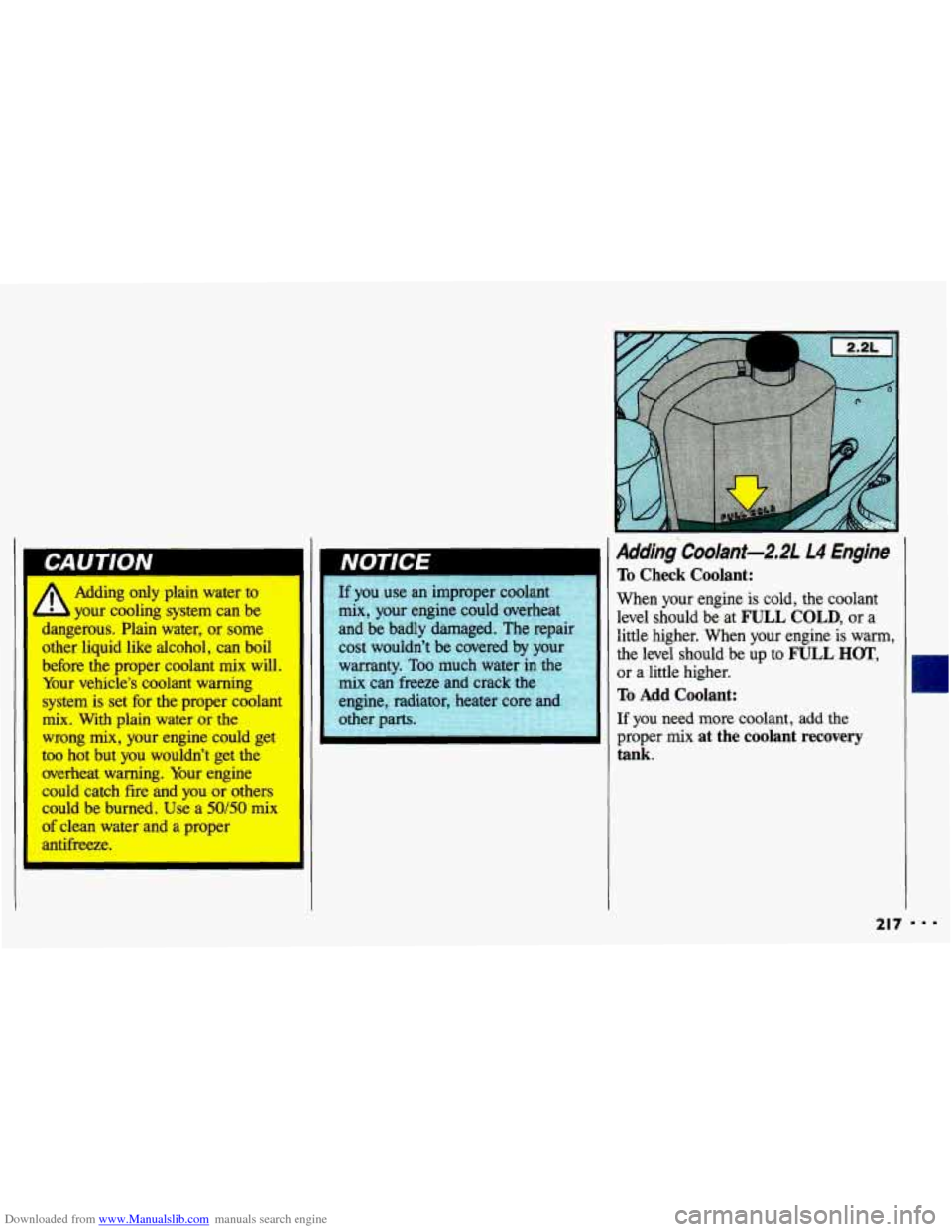
Adding Coolant-2,21 L4 Engine
To Check Coolant:
When your engine
is cold, the coolant
level should be at
FULL COLD, or a
little higher. When your engine
is warm,
the level should be up to
mJLL HOT,
or a little higher.
To Add Coolant:
If you need more coolant, add the
proper
mix at the coolant recovery
tank.
Page 237 of 308
Downloaded from www.Manualslib.com manuals search engine A
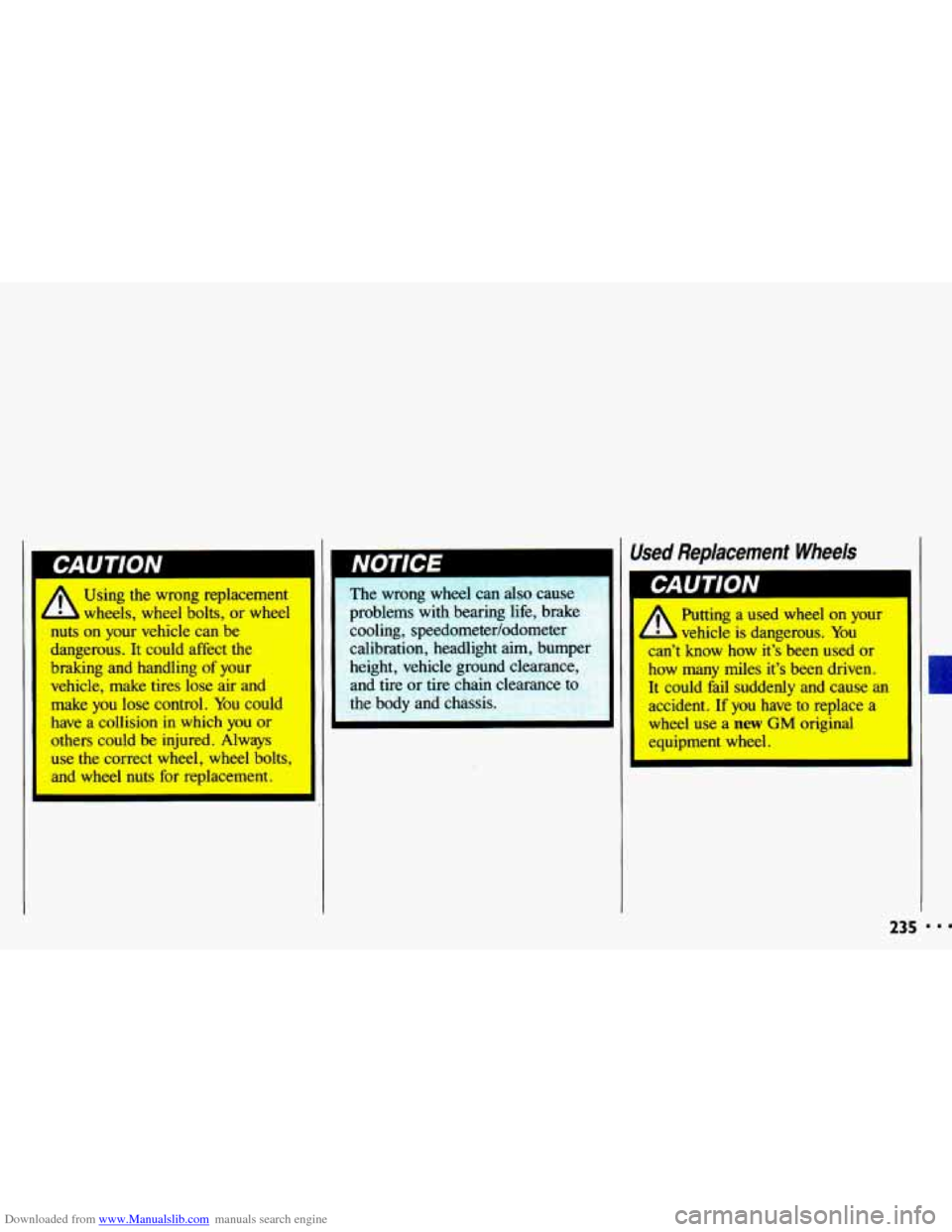
Using the wrong replacement
wheels, wheel
bolts, or wheel
nuts on your vehicle can be
dangerous. It could affect the braking
and handling of your
vehicle, make tires lose air and
make you lose control. You could
have a collision
in which you or
others .could be injured. Always
use the correct wheel, wheel bolts,
and wheel
nuts for replacement.
z -.
. ::?T?W wrong wheel can also cause
problems with bearing life, bra‘
cooling, speedometedodometer
calibration, headlight aim,
bumper
height, vehicle ground clearance,
.. and tire or tire chain clearance +*
the body adchassis.
Used Replacement Wheels
Putting a used wheel on your
4 vehicle is dangerous. You
can’t know how it’s been
used or
how many miles it’s been driven.
It could fail suddenly and cause an
accident. If you have to replace a
wheel use a new GM original
equipment wheel.
235
c
Page 252 of 308
Downloaded from www.Manualslib.com manuals search engine Service & Appearance Care
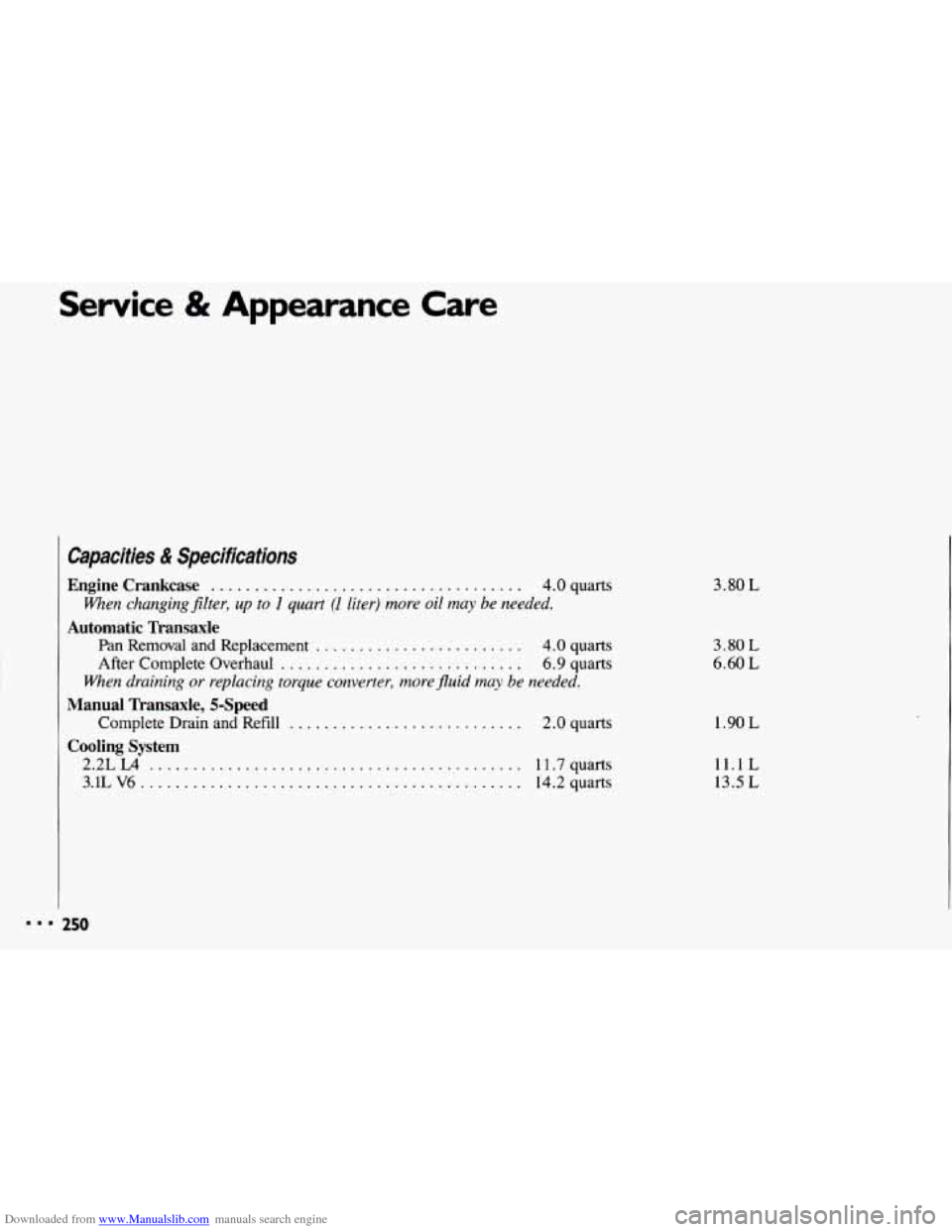
Capacities & Specifications
Engine Crankcase .................................... 4.0 quarts
When changing Jilter, up to I quart (I liter) more oil may be needed.
Automatic Transaxle
Pan Removal and Replacement ........................ 4.0 quarts
After Complete Overhaul
............................ 6.9 quarts
When draining or replacing torque converter, more fluid may be needed.
Manual Transaxle, 5-Speed
Cooling System
Complete Drain and Refill ........................... 2.0 quarts
2.2LL4
........................................... 11.7quarts
3.1LV6............................................ 14.2quarts 3.80
L
3.80 L
6.60 L
1.90 L
11.1 L
13.5 L
. . 250
Page 271 of 308
Downloaded from www.Manualslib.com manuals search engine ITEM
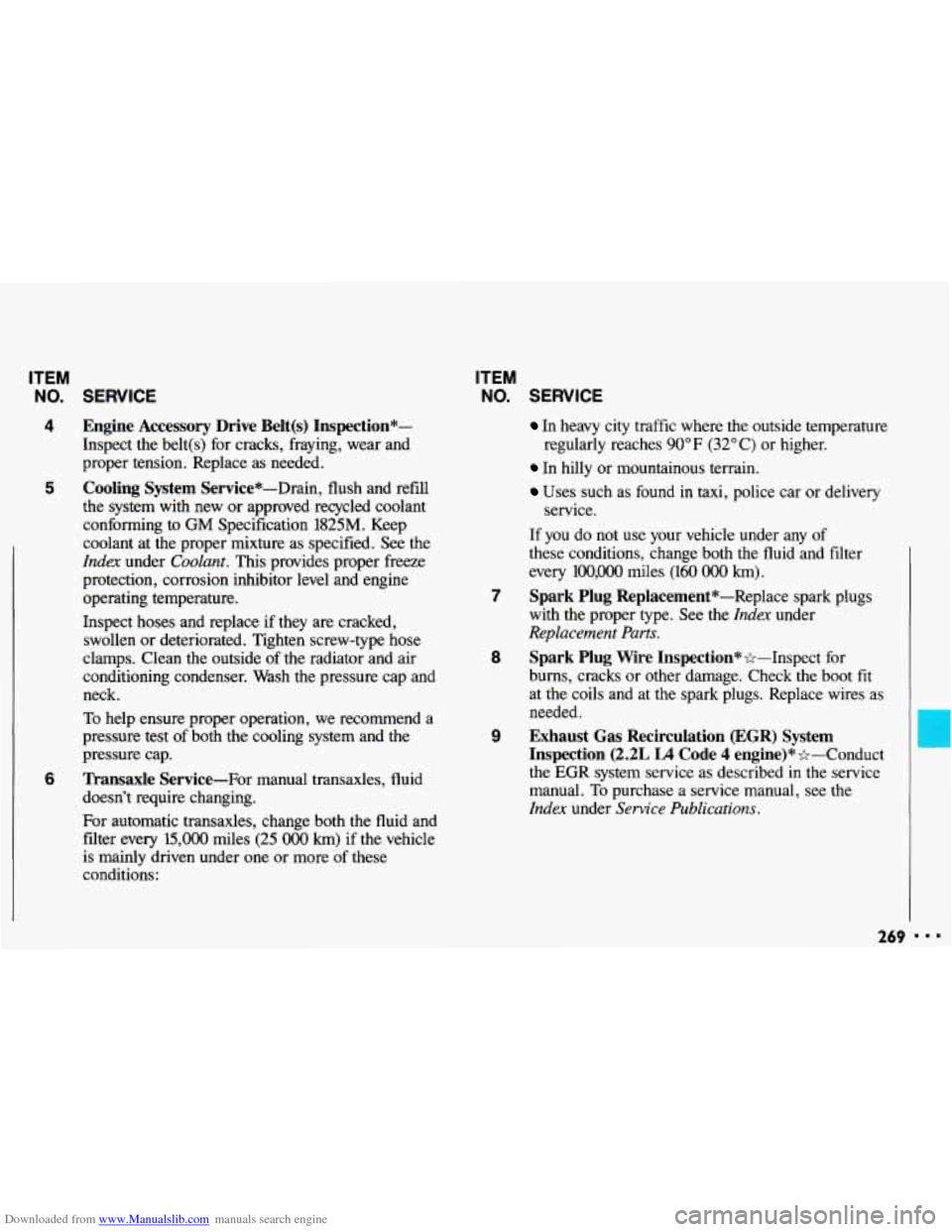
NO. SERVICE ITEM NO. SERVICE
4
5
Engine
Accessory Drive Belt(s) Inspection*-
Inspect the belt(s) for cracks, fraying, wear and
proper tension. Replace as needed.
Cooling System Service*-Drain, flush and refill
the system with
new or approved recycled coolant
conforming to
GM Specification 1825M. Keep
coolant at the proper mixture as specified. See the
Index under Coolant. This provides proper freeze
protection, corrosion inhibitor level and engine
operating temperature.
Inspect hoses and replace if they are cracked,
swollen or deteriorated. Tighten screw-type hose
clamps. Clean the outside of the radiator and air
conditioning condenser. Wash
the pressure cap and
neck.
To help ensure proper operation, we recommend a
pressure test of both the cooling system and the
pressure cap.
6
7
8
9
Transaxle Service-For manual transaxles, fluid
doesn't require changing.
For automatic transaxles, change both the fluid and
filter every
15,000 miles (25 000 km) if the vehicle
is mainly driven under one or more of these
conditions:
In heavy city traffic where the outside temperature
In hilly or mountainous terrain.
Uses such as found in taxi, police car or delivery
regularly reaches
90" F (32" C) or higher.
service.
If you do not use your vehicle under any of
these conditions, change both the fluid and filter
every 100,000 miles (160
0oO km).
Spark Plug Replacement*-Replace spark plugs
with the proper type. See
the Index under
Replacement Parts.
Spark Plug Wire Inspection* *-Inspect for
burns, cracks or other damage. Check the boot
fit
at the coils and at the spark plugs. Replace wires as
needed.
Exhaust Gas Recirculation (EGR) System
Inspection
(2.2L L4 Code 4 engine)" *-Conduct
the
EGR system service as described in the service
manual. To purchase a service manual
, see the
Index under Service Publications.