key CHEVROLET CAVALIER 1993 1.G User Guide
[x] Cancel search | Manufacturer: CHEVROLET, Model Year: 1993, Model line: CAVALIER, Model: CHEVROLET CAVALIER 1993 1.GPages: 308, PDF Size: 15.62 MB
Page 58 of 308
Downloaded from www.Manualslib.com manuals search engine Features & Contr
Key Release Button (CONT.)
On manual transaxle vehicles,
- udng the key ta Lock will
lock the shMg column and result
in a loss of ability to steer the
vehicle. This could cause a
collision, If you need to tum the
engine off while the vehicle is
moving, turn the key only to Off.
Don’t press the key release button
while the vehicle is mcwing.
If your key seems stuck in Lock
and you can’t turn it, be sure it is
all the way in.
If it is, then turn tl
steering wheel left and right while
you
turn the key hard. But turn the
key only with your hand. Using a
tool to force it could break the
key
or the ignition switch. If none
this works,
t 1 yc vehicle needs
service.
Starting Your Engine
Engines start differently. The 8th digit of
your Vehicle Identification Number
(VIN) shows the code letter or number
for your engine. You will find the
VIN
at the top left of your instrument panel.
(See the Index under &hick
Ident@cation Number. ) Follow the
proper steps to start the engine.
56
Page 59 of 308
Downloaded from www.Manualslib.com manuals search engine Automatic Transaxle
1. Move your shift lever to P (Park) or
N (Neutral). Your engine won’t start
in any other position-that’s a safety
feature. To restart when you’re
already moving, use
N (Neutral)
only.
,1 I^
~‘::, Don’t try to sl,~ to P (Park) if
your Chevrolet is moving. If
yo
do, you could damage ;
’’, transaxle. Shift to P (Park) only
when your vehicle
is stopped. _x,, ,I ~wl
Manual Transaxle
1. Shift your gear selector to N (Neutral)
and hold the clutch pedal to the
floor
while starting the engine. Your
vehicle won’t
start if the clutch pedal
is not all the way down-that’s a
safety feature.
Both Transaxles
2. Don’t push the accelerator pedal before starting your engine. In some other vehicles you might need to do
this, but because
of your vehicle’s
computer systems, you don’t.
3. Turn your ignition key to Start.
When the engine starts, let go of the
key. The idle speed will
go down as
your engine gets warm.
Holding your key in
Start for
longer than 15 seconds at a til
will cause your battery to be
drained much sooner. And the excessive heat can damage your
starter motor.
Page 60 of 308
Downloaded from www.Manualslib.com manuals search engine Features & Controls
60th Transaxles (CONI)
4. If your engine won’t start (or starts
but then stops), it could be flooded
with too much gasoline.
Try pushing
your accelerator pedal all the way to
the floor and holding it there as you
hold the key
in Start for about three
seconds. If the vehicle starts briefly
but then stops again, do the same
thing, but this time keep the pedal
down for five or six seconds. This
clears the extra gasoline from the
engine. Your
engine is designed to work
with the electronics in your
vehicle. If you add electrical parts
or accessories, you could change
the way the fuel injection system
operates. Before adding electrical
equipment, check with your dealer.
If you don’t, your engine might not
perform properly.
If you ever have to have your
vehicle towed, see the part
of this
manual that tells how
to do it
without damaging your vehicle.
See the
Index under Towing Your
Chevrolet.
kiving Through Deep Standing
Vater
IA!
If you drive too quickly through
deep puddles
or standing water,
water can come in through your
engine’s air intake and badly
damage your engine.
If you can’t
avoid deep puddles or standing
Page 63 of 308
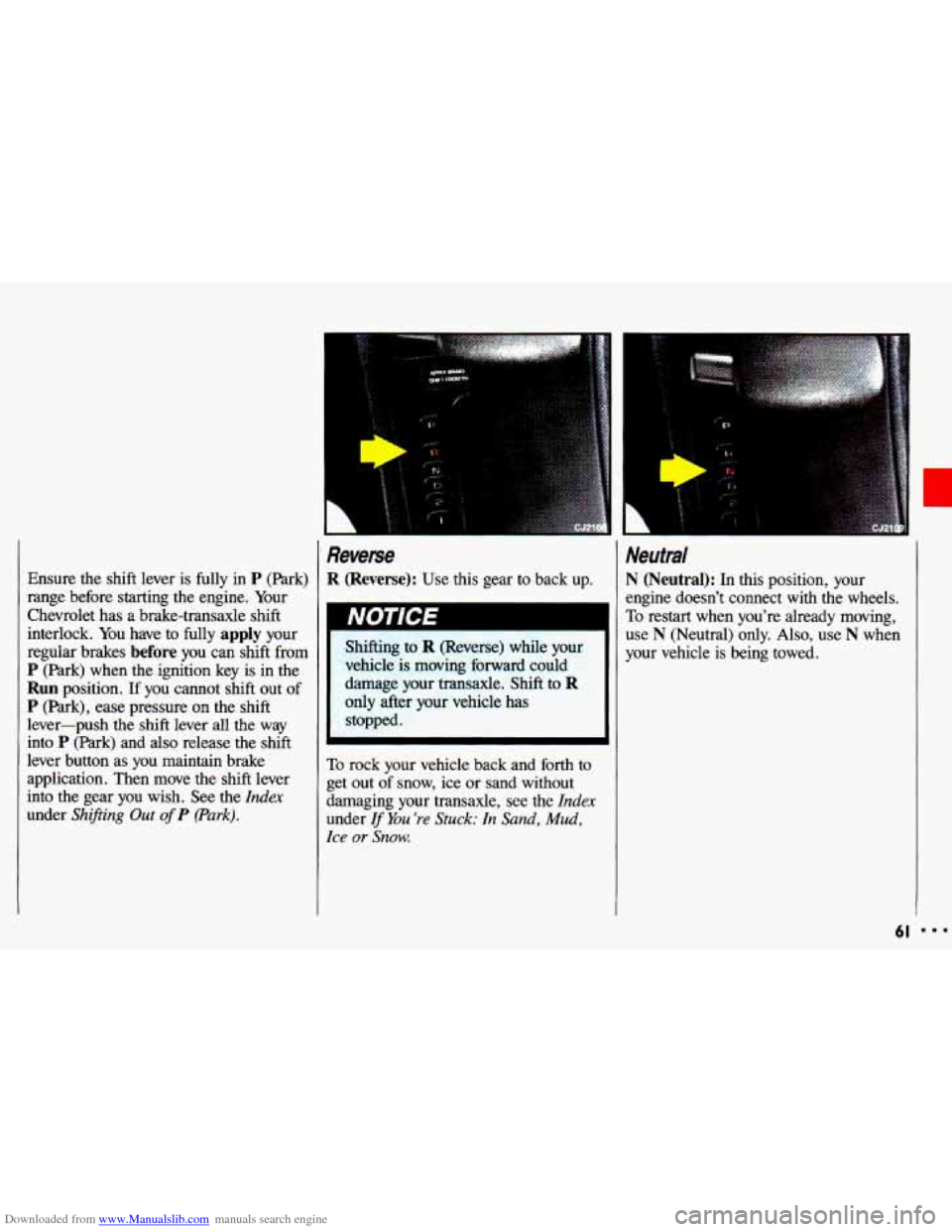
Downloaded from www.Manualslib.com manuals search engine Ensure the shift lever is fully in P (Park)
range before starting the engine. Your
Chevrolet has a brake-transaxle shift
interlock. You have to fully
apply your
regular brakes
before you can shift fiom
P (Park) when the ignition key is in the
Run position. If you cannot shift out of
P (Park), ease pressure on the shift
lever-push the shift lever
all the way
into
P (Park) and also release the shift
lever button as you maintain brake
application. Then move the shift lever
into
the gear you wish. See the Index
under Shifting Out of P (Park),
U
Reverse
R (Reverse): Use this gear to back up.
Shifting to
R (Reverse) while your
vehicle
is moving forward could
damage your transaxle. Shift
to R
only after your vehicle has
Stopped-
Neutmi
N (Neutral): In this position, your
engine doesn’t connect with the wheels.
To restart when you’re already moving,
use
N (Neutral) only. Also, use N when
your vehicle
is being towed.
To rock your vehicle back and forth to
get out of snow, ice or sand without
damaging your transaxle, see the
Index
under If You ’re Stuck: In Sand, Mud,
Ice or Snow.
61
Page 70 of 308
Downloaded from www.Manualslib.com manuals search engine Features & Controls
Shifting Into P (Park) (CONTI
1. Hold the brake pedal down with your right foot and set the parking brake.
A
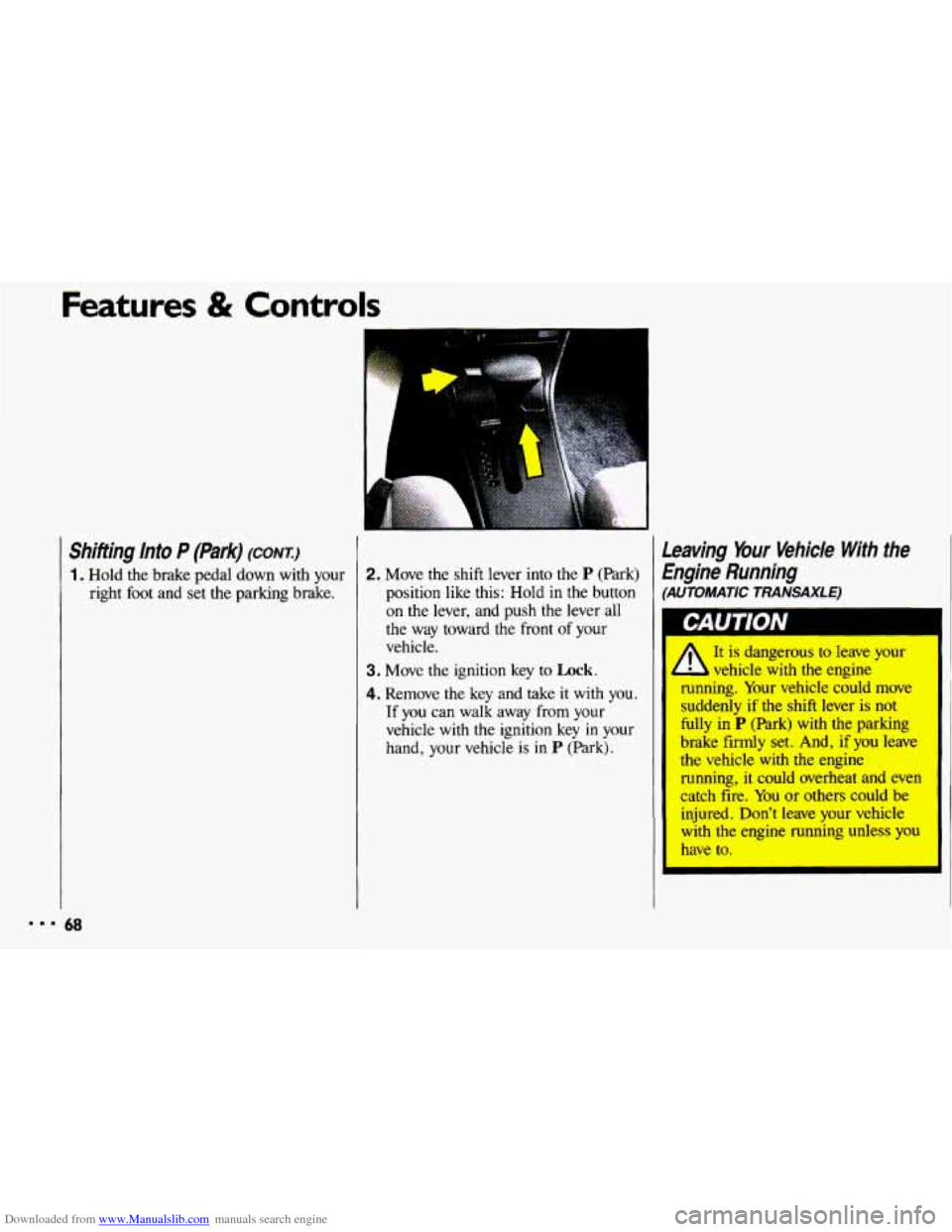
2. Move the shift lever into the P (Park)
position like this: Hold in the button on the lever, and push the lever all
the way toward the front of your
vehicle.
3. Move the ignition key to Lock.
4. Remove the key and take it with you.
If you can walk away
from your
vehicle with the ignition key
in your
hand, your vehicle is in
P (Park).
Leaving Your Vehicle With the
Engine Running
(AUTOMATIC TRANSAXLE)
It is dangerous to leave your
running. Your vehicle could move
suddenly
if the shift lever is not
fully in
P (Park) with the parking
brake
firmly set. And, if you leave
the vehicle
with the engine
running, it could overheat and even
catch fire. You
or others could be
injured. Don't leave your vehicle
with the engine running unless you
have to.
I I L vehicle with the engine
Page 71 of 308
Downloaded from www.Manualslib.com manuals search engine If you have to leave your vehicle with
the engine running, be sure your vehicle is in
P (Park) and your parking brake is
firmly set before you leave it. After
you’ve moved the shift lever into the
P (Park) position, hold the regular brake
pedal down. Then, see if you can move
the shift lever away from
P (Park)
without first pushing the button.
If you can, it means that the shift lever
wasn’t fully locked into
P (Park).
Shifting Out of P (Park)
(AUTOMATIC TRANSAXLE)
Your Chevrolet has a brake-transaxle
shift interlock. You have to fully
apply
your regular brakes before you can shift
from
P (Park) when the ignition is in the
Run position. See the Index under
Automatic Transu.de. If you cannot shift
out
of P (Park), ease pressure on the
shift lever-push the shift lever all
the
way into P (Park) and also release the
shift lever button on floor shift console
models as you maintain brake
application. Then move the shift lever
into the gear
you wish. (Press the shift
lever button before moving the shift lever on floor shift console models.) If you ever hold the brake pedal
down
but still can’t shift out of
P (Park), try
this:
1. Turn the key to Off.
2. Apply and hold the brake until the
3. Shift to N (Neutral).
4. Start the vehicle and then shift to the
drive gear you want.
5. Have the vehicle fixed as soon as you
can. end
of Step 4.
69
Page 98 of 308
Downloaded from www.Manualslib.com manuals search engine Features & Controls
Warning Lights,
Gages and Indicators
This section describes the warning lights
and gages that may be on your vehicle.
The pictures will help
you locate them.
Warning lights and gages can signal that something is wrong before it becomes
serious enough
to cause an expensive
repair or replacement. Paying attention
to your warning lights and gages could also save you or others from injury.
Warning lights
go on when there may be
or is a problem
with one of your
vehicle’s functions.
As you will see in
the details on the next few pages, some
warning lights come on briefly when
you turn the ignition key just to let you
know they’re working. If you are
familiar with this section, you should
not be alarmed when this happens. Gages can indicate when there
may be
or is a problem with one
of your
vehicle’s functions. Often gages
and
warning lights work together to let you
know when there’s a problem with your
vehicle.
When one of the warning lights comes
on and stays on when you are driving,
or when one
of the gages shows there
may be a problem, check the section
that tells you what to do about it. Please
follow the manual’s advice. Waiting to
do repairs can be costly-and even
dangerous.
So please get to know your
warning lights and gages. They’re a big
help.
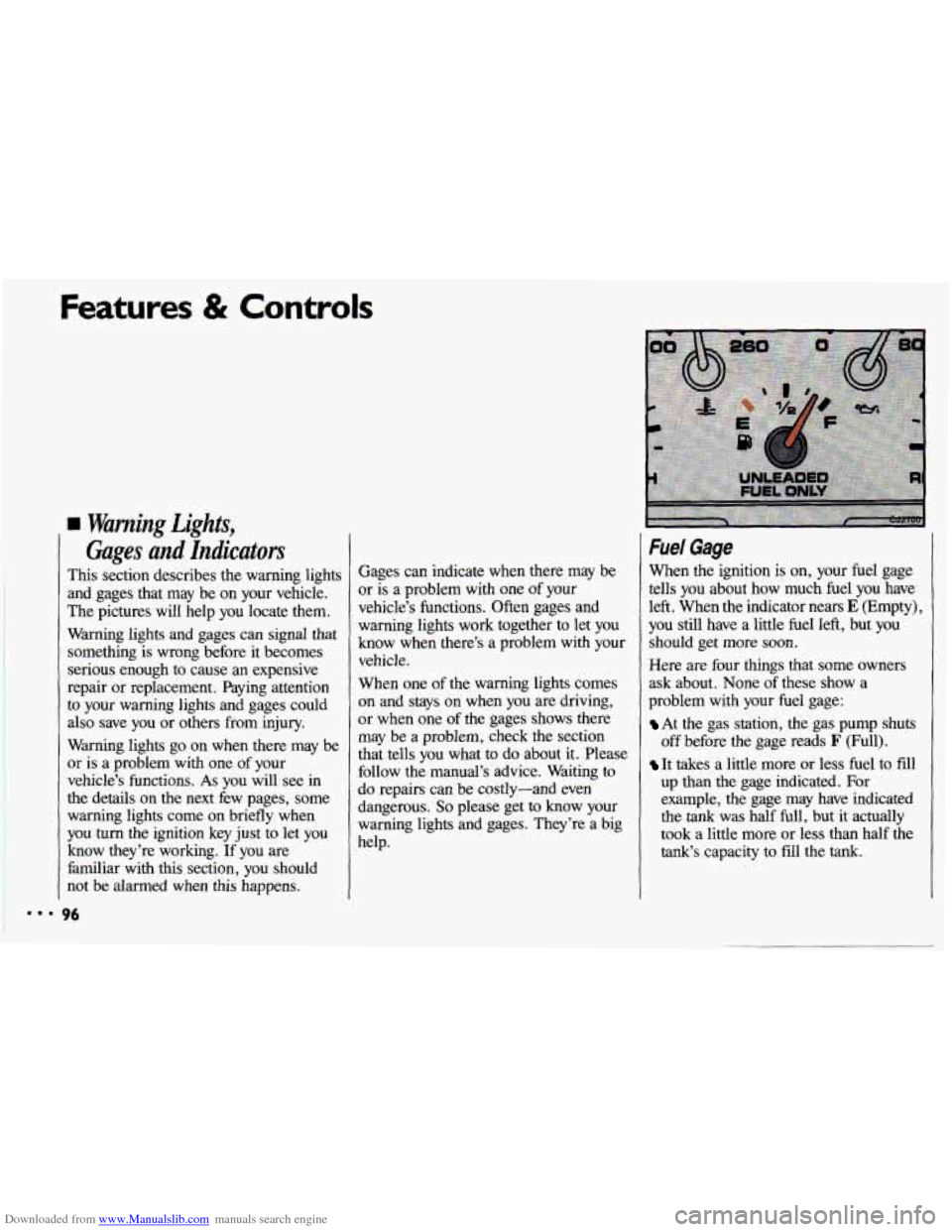
Fuel Gage
When the ignition is on, your fuel gage
tells
you about how much fuel you have
left. When the indicator nears
E (Empty),
you still have a little fuel left, but you
should get more soon.
Here are four things that some owners
ask about. None
of these show a
problem with your fuel gage:
At the gas station, the gas pump shuts
off before the gage reads
F (Full).
It takes a little more or less fuel to fdl
up than the gage indicated. For
example, the gage may have indicated
the
tank was half full, but it actually
took a little more or less than half the
tank‘s capacity to fill the tank.
Page 103 of 308
Downloaded from www.Manualslib.com manuals search engine Anti-Lock Brake System Warning
Light
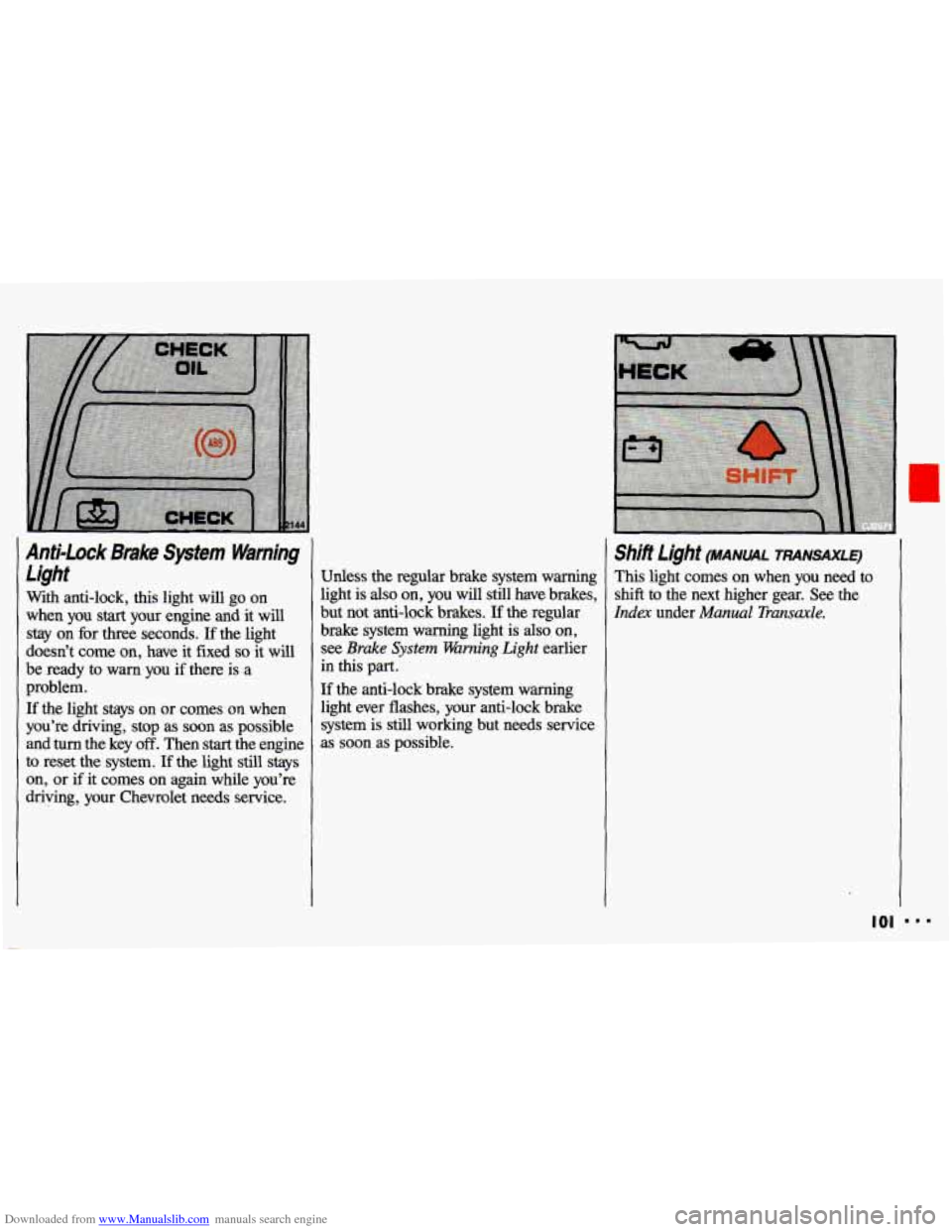
With anti-lock, this light will go on
when you
start your engine and it will
stay on for three seconds.
If the light
doesn’t come on, have it fixed
so it will
be ready to warn you if there is a
problem.
If the light stays on or comes on when
you’re driving, stop as soon as possible
and turn the key
off. Then start the engine
to reset the system.
If the light still stays
on, or if it comes on again while you’re
driving, your Chevrolet
needs service.
Shift light (MANUAL TRANSAXLE)
Unless the regular brake system warning
brake system warning light is
also on,
Index under Manual Transale. but not anti-lock brakes. If the regular shift to the next higher gear. See
the
light is
also on, you will still have brakes, This
light comes on when you need to
in this part.
see Brake System Warning Light earlier
If the anti-lock brake system warning
light ever flashes, your anti-lock brake
system is still working but needs service
as soon as possible.
IO1
Page 131 of 308
Downloaded from www.Manualslib.com manuals search engine Drunken Driving
Death and injury associated with
drinking and driving
is a national
tragedy. It’s the number one contributor
to the highway death toll, claiming
thousands of victims every year.
Alcohol takes
away three things that
anyone needs to drive a vehicle:
Judgment
Muscular Coordination
Vision
Police records
show that half of all
motor vehicle-related deaths involve alcohol-a driver, a passenger or
someone else, such as
a pedestrian, had
been drinking. In most cases, these
deaths are
the result of someone who
was drinking and driving. Over 25,000
motor vehicle-related deaths occur each
year because
of alcohol, and thousands
of people are injured. Just
how much alcohol
is too much if a
person plans to drive? Ideally, no one
should
drink alcohol and then drive. But
if one does, then what’s “too much”? It
can be a lot
less than many might think.
Although it depends on each person and
situation, here is
some general
information
on the problem,
The Blood Alcohol Content
(BAC) of
someone who is drinking depends upon
four
things:
How much alcohol is in the drink.
The drinker’s body weight.
The amount of food that is consumed
before and during
drinking.
The length of time it has taken the
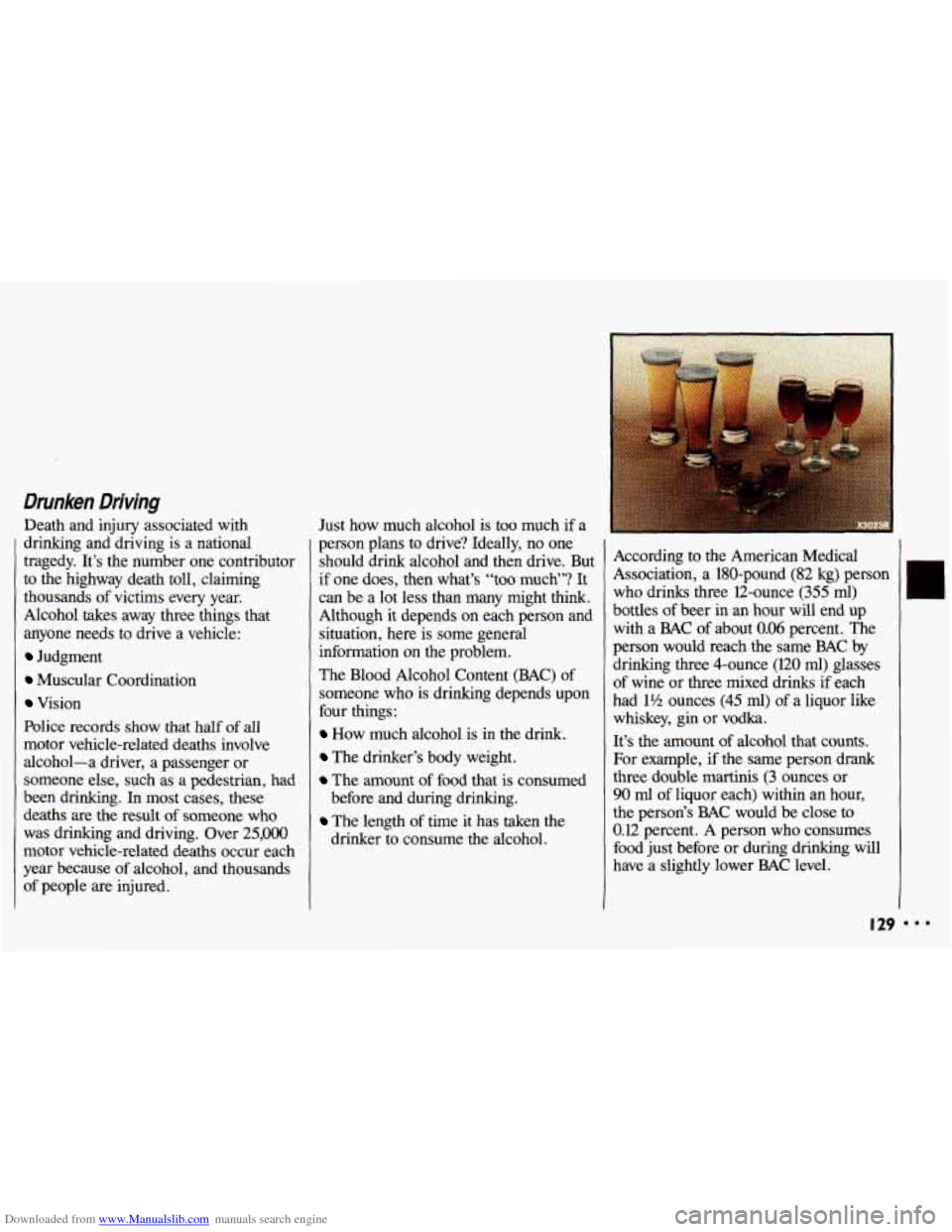
drinker to consume the alcohol. According to
the American Medical
Association,
a 180-pound (82 kg) person
who drinks three E-ounce
(355 ml)
bottles of beer in an hour will end up
with a BAC of about 0.06 percent. The
person would reach the same BAC by
drinking three 4-ounce (120 ml) glasses
of wine or three mixed drinks if each
had
1% ounces (45 ml) of a liquor like
whiskey, gin or vodka.
It’s the amount of alcohol that counts,
For example, if the same person drank
three double martinis (3 ounces or
90 ml of liquor each) within an hour,
the person’s
BAC would be close to
0.12 percent. A person who consumes
food just before or during drinking will
have
a slightly lower BAC level.
I29 I..
Page 166 of 308
Downloaded from www.Manualslib.com manuals search engine Problems on the Road
-<.'
I X600!
Hazard Warning Flashers
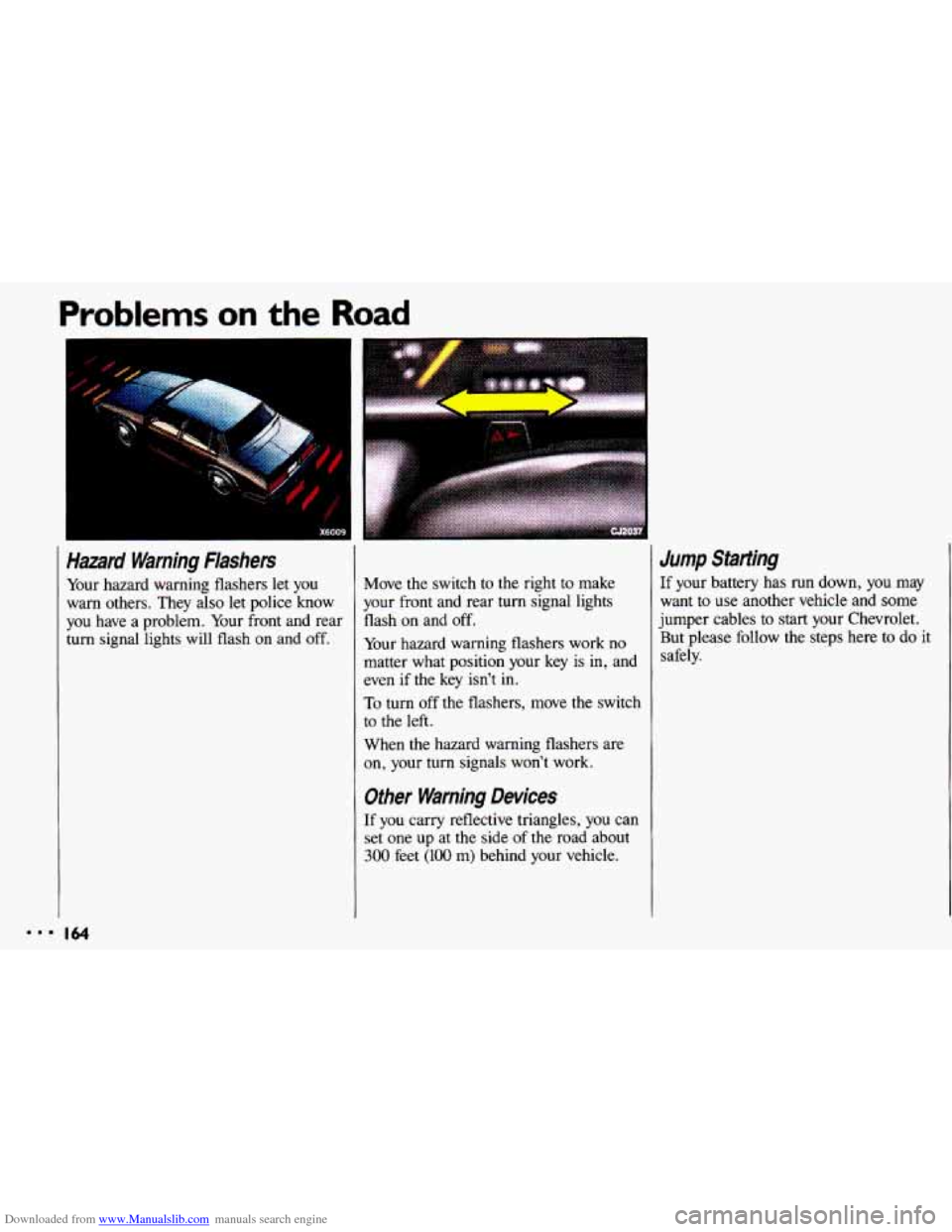
Your hazard warning flashers let you
warn others. They also let police know
you have a problem. Your front and rear
turn signal lights will flash on and off. Move
the switch to the right to make
your front and rear turn signal lights
flash on and off.
Your hazard warning flashers
work no
matter what position your key
is in, and
even if the key isn't in.
To turn off the flashers, move the switch
to the left.
When the hazard warning flashers are
on, your turn signals won't work.
Other Warning Devices
If you carry reflective triangles, you can
set one up at the side of the road about
300 feet (100 m) behind your vehicle.
Jump Starling
If your battery has run down, you may
want to use another vehicle and some
jumper cables
to start your Chevrolet.
But please follow the steps here to do it
safely.