lights CHEVROLET CAVALIER 1993 1.G User Guide
[x] Cancel search | Manufacturer: CHEVROLET, Model Year: 1993, Model line: CAVALIER, Model: CHEVROLET CAVALIER 1993 1.GPages: 308, PDF Size: 15.62 MB
Page 83 of 308
Downloaded from www.Manualslib.com manuals search engine ?;. I
I ..q
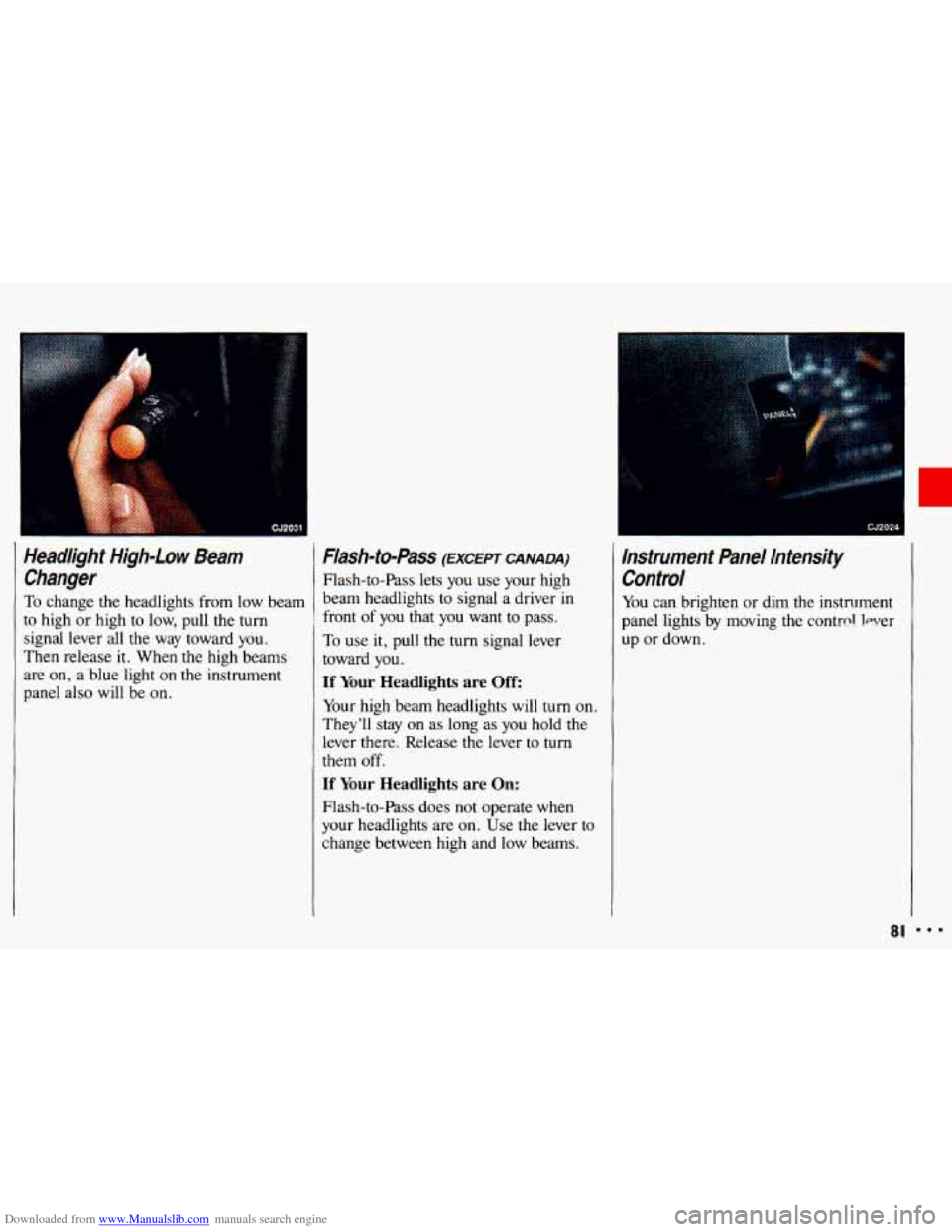
Headlight High-Low Beam Changer
To change the headlights from low beam
to high or high to low, pull the
turn
signal lever all the way toward you.
Then release it. When the high beams
are
on, a blue light on the instrument
panel also
will be on.
Flash-to-Pass (EXCEPT CANADA)
Flash-to-Pass lets you use your high
beam headlights
to signal a driver in
front of you that you want to pass.
To use it, pull the turn signal lever
toward you.
If Your Headlights are Off:
Your high beam headlights will turn on.
They'll
stay on as long as you hold the
lever there. Release the lever to turn
them
off.
If Your Headlights are On:
Flash-to-Pass does not operate when
your headlights are on. Use the lever to
change between high and low beams.
I
Instrument Panel Intensity Control
You can brighten or dim the instrument
panel lights
by moving the control. lever
up or down.
81
Page 84 of 308
Downloaded from www.Manualslib.com manuals search engine Features & Controls
...
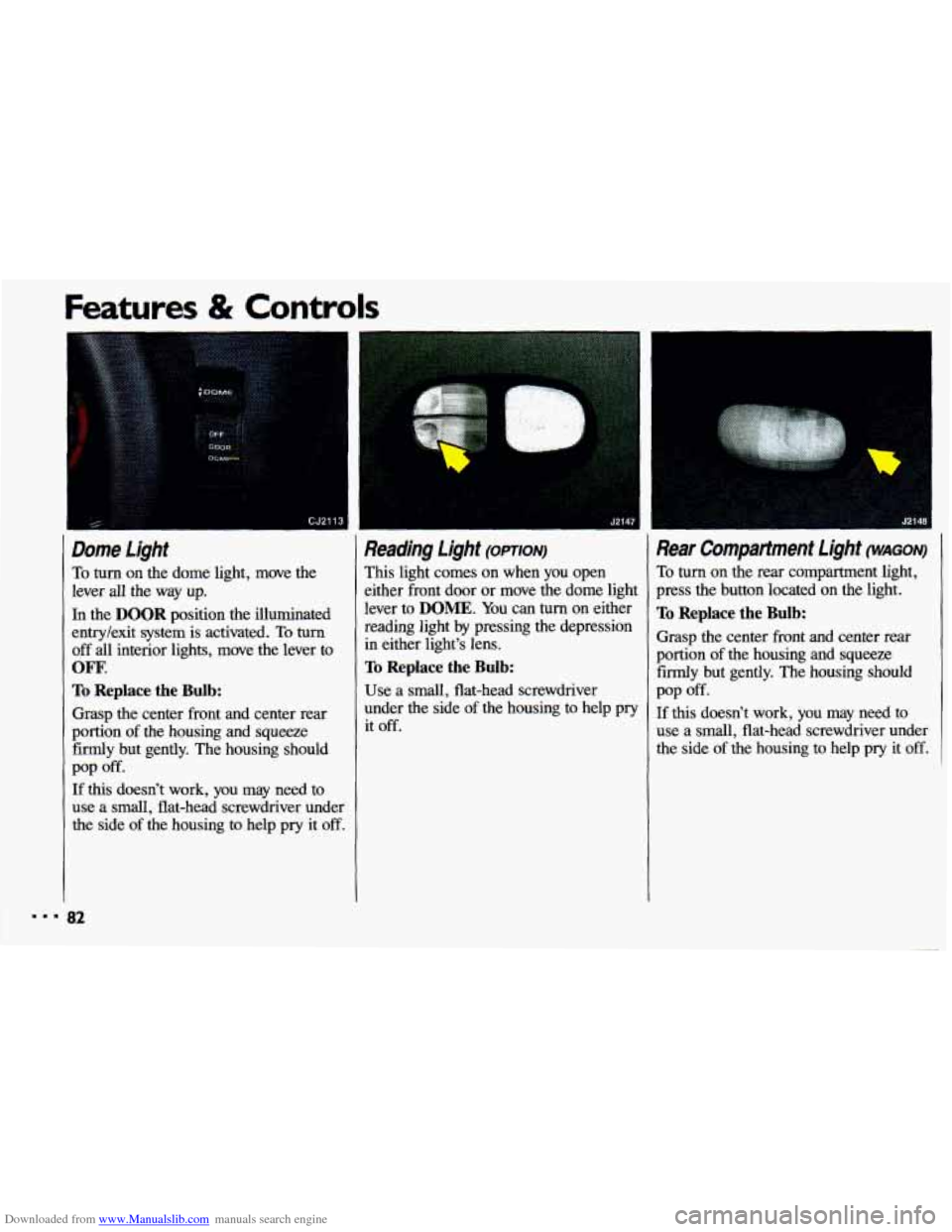
Dome Light
To turn on the dome light, move the
lever all the way up.
In the DOOR position the illuminated
entry/exit system is activated.
To turn
off all interior lights, move the lever to
OFF.
To Replace the Bulb:
Grasp the center front and center rear
portion
of the housing and squeeze
firmly but gently. The housing should
If this doesn’t work, you may need to
use a small, flat-head screwdriver under
the side
of the housing to help pry it off.
pop off.
B2
Reading Light (OPTION)
This light comes on when you open
either front door or move the dome lighl
lever to
DOME. You can turn on either
reading light
by pressing the depression
in either light’s lens.
To Replace the Bulb:
Use a small, flat-head screwdriver
under the side
of the housing to help pr]
it
off.
Rear Compartment Light (WAGON)
To turn on the rear compartment light,
press the button located
on the light.
To Replace the Bulb:
Grasp the center front and center rear
portion
of the housing and squeeze
firmly but gently. The housing should
If this doesn’t work, you may need to
use a small, flat-head screwdriver under
the side of the housing to help pry it
off.
pop off.
Page 87 of 308
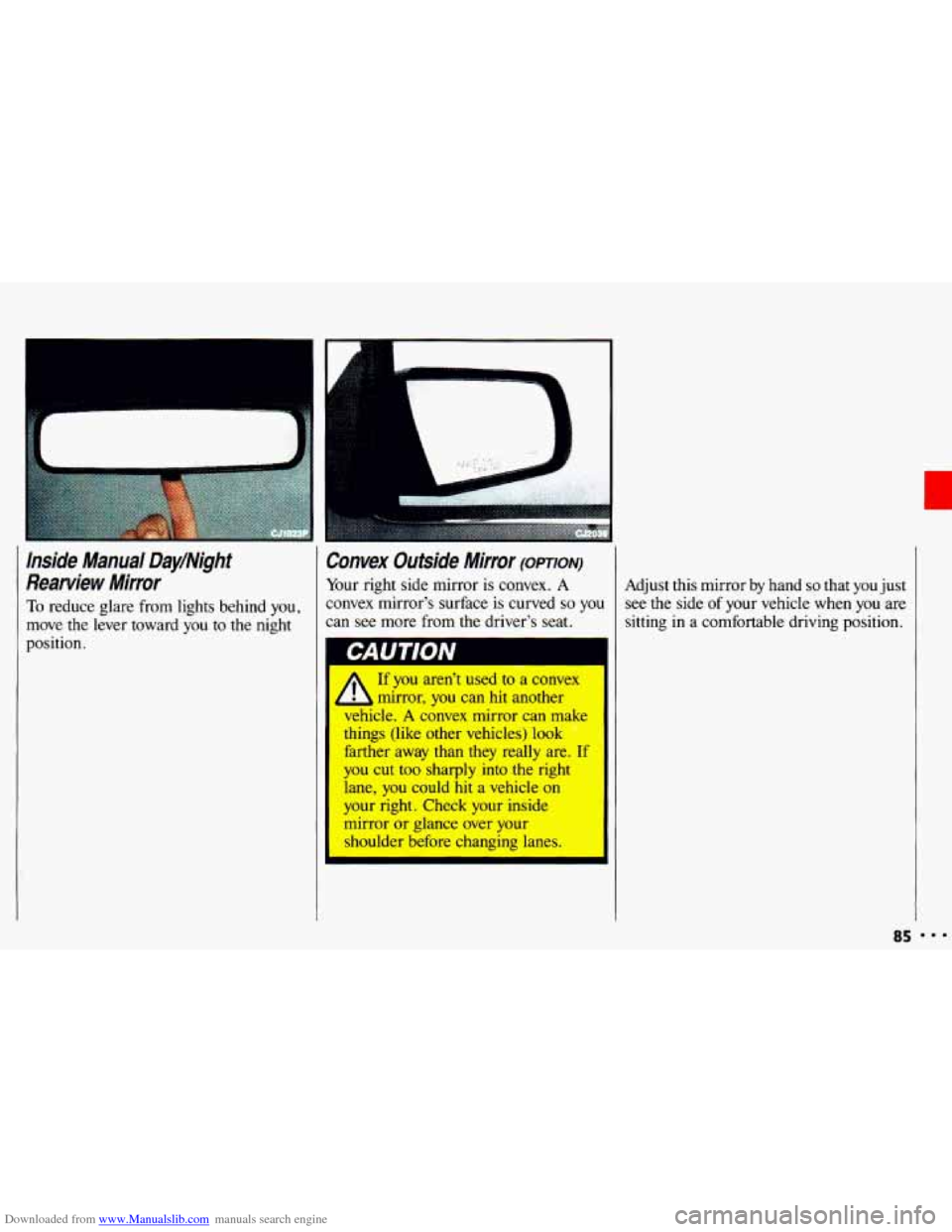
Downloaded from www.Manualslib.com manuals search engine Inside Manual DayINight
Rearview Mirror
To reduce glare from lights behind you,
move
the lever toward you to the night
position.
Convex Outsjde Mirror (OPTION)
Your right side mirror is convex. A
convex mirror’s surface is curved
so you
can see more from the driver’s seat.
I CAUTioN
I
If you aren’t used to a convex
mirror, you can hit another
vehicle.
A convex mirror can make
things (like other vehicles) look
farther away than they really are. If
you cut too sharply into the right
lane, you could
hit a vehicle on
your right. Check your inside
mirror or glance over your
shoulder before changing lanes. Adjust
this mirror
by hand so that you just
see the side
of your vehicle when you are
sitting
in a comfortable driving position.
85
Page 96 of 308
Downloaded from www.Manualslib.com manuals search engine Features & Controls
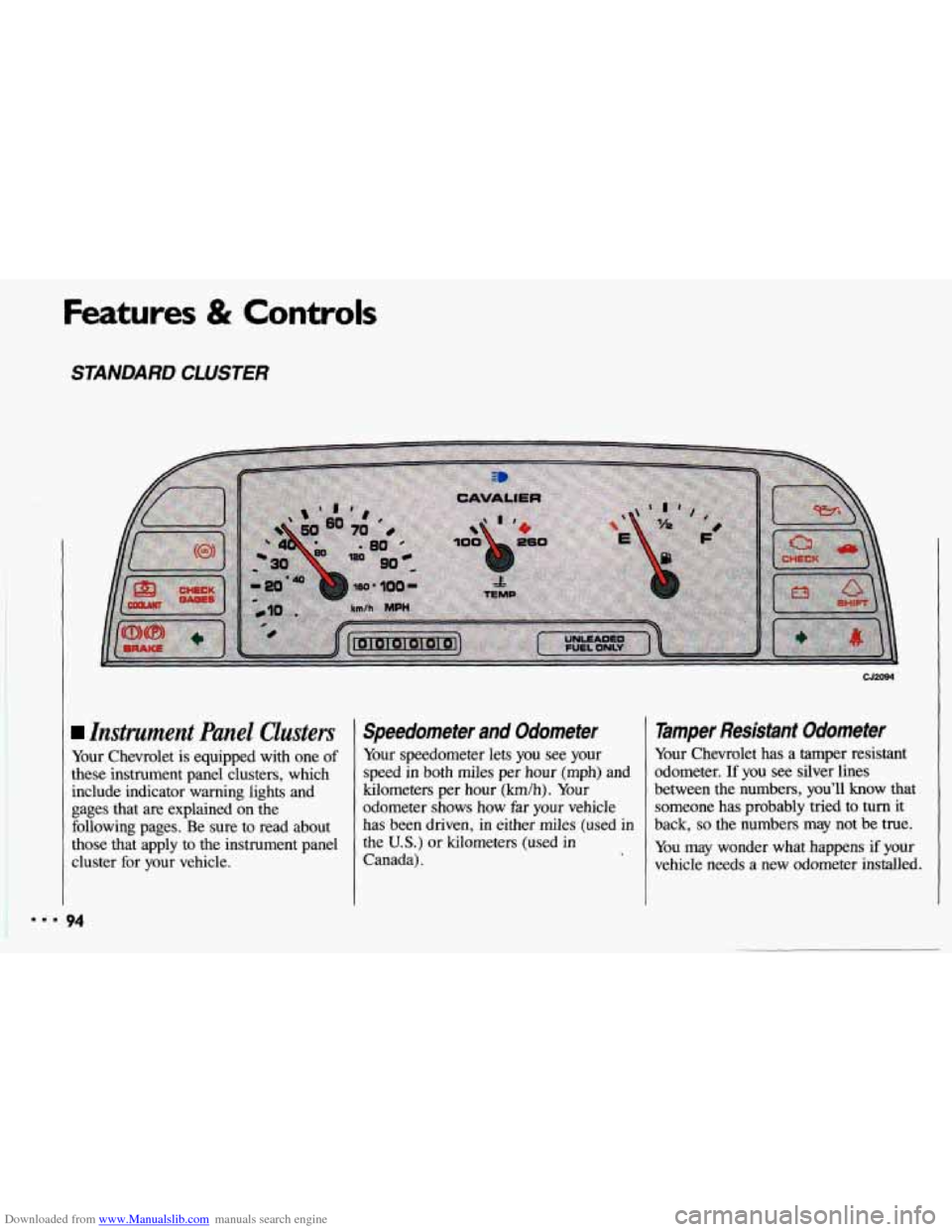
STANDARD CLUSTER
Instrument Panel Clusters
Your Chevrolet is equipped with one of
these instrument panel clusters, which
include indicator warning lights and
gages that are explained on the
following pages. Be sure to read about
those that apply to the instrument panel
cluster for your vehicle.
Speedometer and Odometer
Your speedometer lets you see your
speed in both miles per hour (mph) and
kilometers per hour (km/h). Your
odometer shows how far your vehicle
has been driven, in either miles (used in
the
U.S.) or kilometers (used in
Canada).
Tamper Resistant Odometer
Your Chevrolet has a tamper resistant
odometer. If
you see silver lines
between the numbers, you’ll
know that
someone has probably tried to
turn it
back,
so the numbers may not be true.
You may wonder what happens if your
vehicle needs a new odometer installed.
=.* 94
Page 98 of 308
Downloaded from www.Manualslib.com manuals search engine Features & Controls
Warning Lights,
Gages and Indicators
This section describes the warning lights
and gages that may be on your vehicle.
The pictures will help
you locate them.
Warning lights and gages can signal that something is wrong before it becomes
serious enough
to cause an expensive
repair or replacement. Paying attention
to your warning lights and gages could also save you or others from injury.
Warning lights
go on when there may be
or is a problem
with one of your
vehicle’s functions.
As you will see in
the details on the next few pages, some
warning lights come on briefly when
you turn the ignition key just to let you
know they’re working. If you are
familiar with this section, you should
not be alarmed when this happens. Gages can indicate when there
may be
or is a problem with one
of your
vehicle’s functions. Often gages
and
warning lights work together to let you
know when there’s a problem with your
vehicle.
When one of the warning lights comes
on and stays on when you are driving,
or when one
of the gages shows there
may be a problem, check the section
that tells you what to do about it. Please
follow the manual’s advice. Waiting to
do repairs can be costly-and even
dangerous.
So please get to know your
warning lights and gages. They’re a big
help.
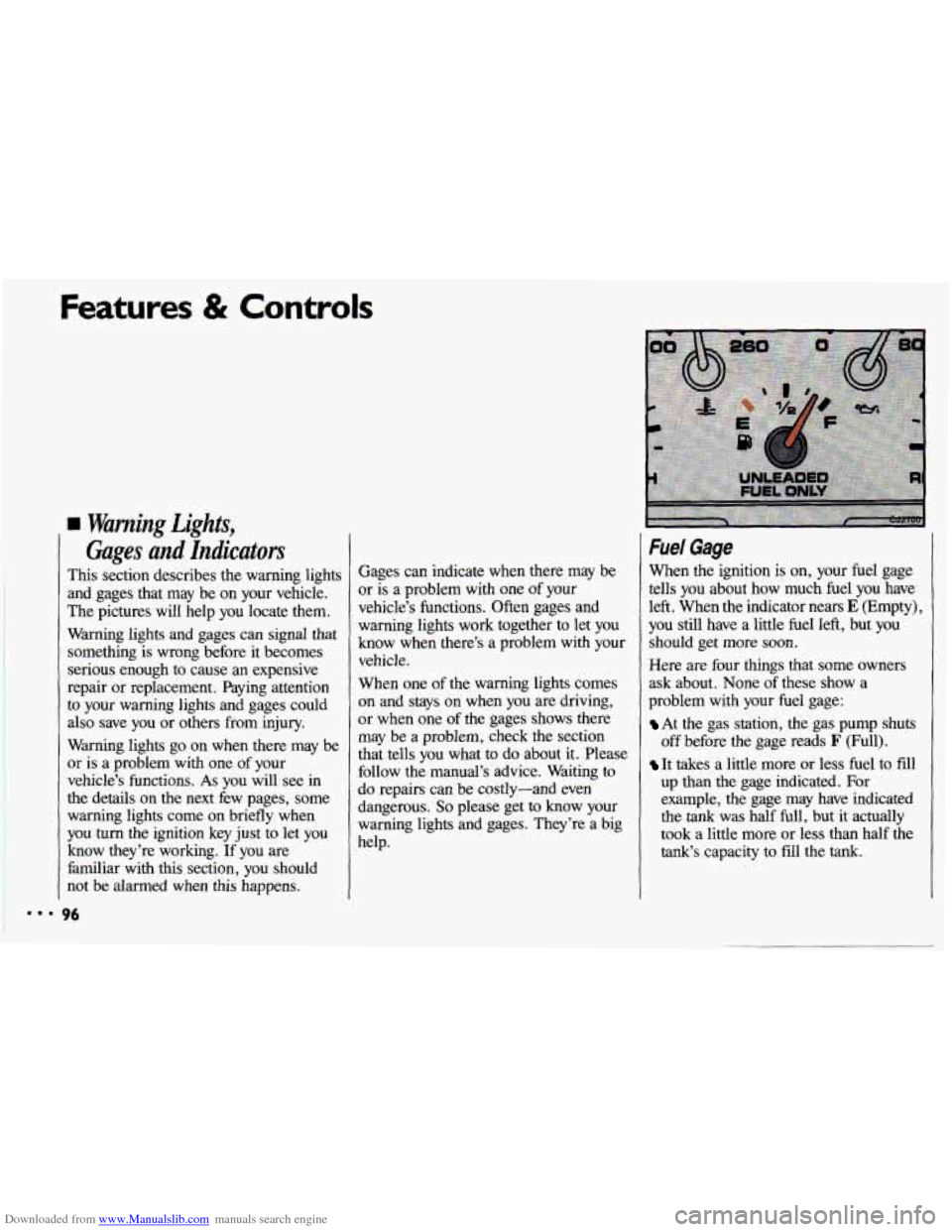
Fuel Gage
When the ignition is on, your fuel gage
tells
you about how much fuel you have
left. When the indicator nears
E (Empty),
you still have a little fuel left, but you
should get more soon.
Here are four things that some owners
ask about. None
of these show a
problem with your fuel gage:
At the gas station, the gas pump shuts
off before the gage reads
F (Full).
It takes a little more or less fuel to fdl
up than the gage indicated. For
example, the gage may have indicated
the
tank was half full, but it actually
took a little more or less than half the
tank‘s capacity to fill the tank.
Page 128 of 308
Downloaded from www.Manualslib.com manuals search engine Your Driving and the Road
881
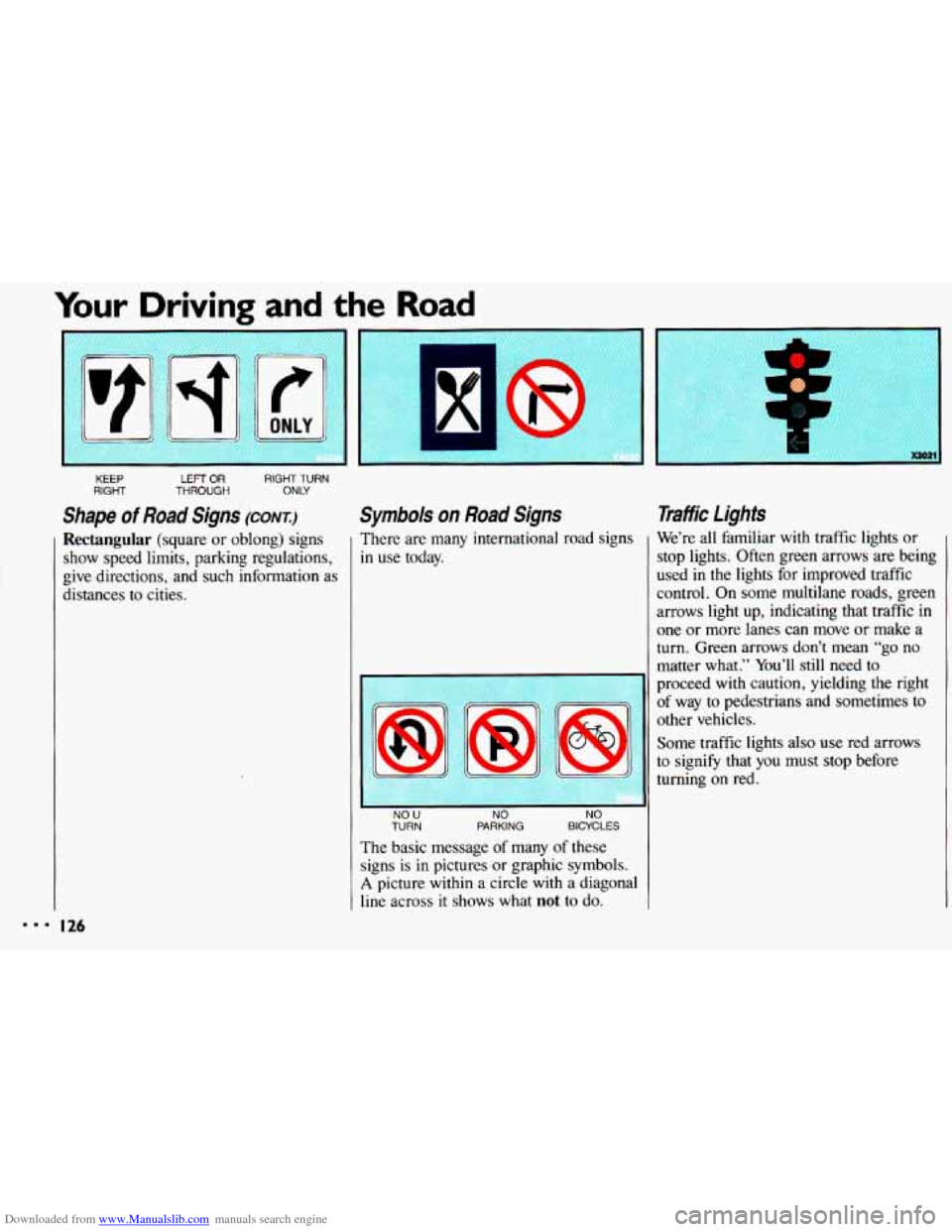
KEEP LEFT OR muHT TURN
RIGHT THROUGH ONLY
Shape of Road Signs (CONI)
Rectangular (square or oblong) signs
show speed limits, parking regulations,
give directions, and such information as
distances
to cities.
I26
1
Symbols on Road Signs
There are many international road signs
in use today.
NO U NO NO
TURN PARKING BICYCLES
The
basic message of many of these
signs
is in pictures or graphic symbols.
A picture within a circle with a diagonal
line across it shows what not to do.
L
Traffic 1 ights
We’re all familiar with traffic lights or
stop lights. Often green arrows are being
used
in the lights for improved traffic
control. On some multilane roads, green
arrows light up, indicating that traffic
in
one or more lanes can move or make a
turn. Green arrows don’t mean
“go no
matter what.’’ You’ll still need to
proceed
with caution, yielding the right
of way to pedestrians and sometimes to
other vehicles.
Some traffic lights also use red arrows
to signify that
y~u must.stop before
turning
on red.
Page 129 of 308
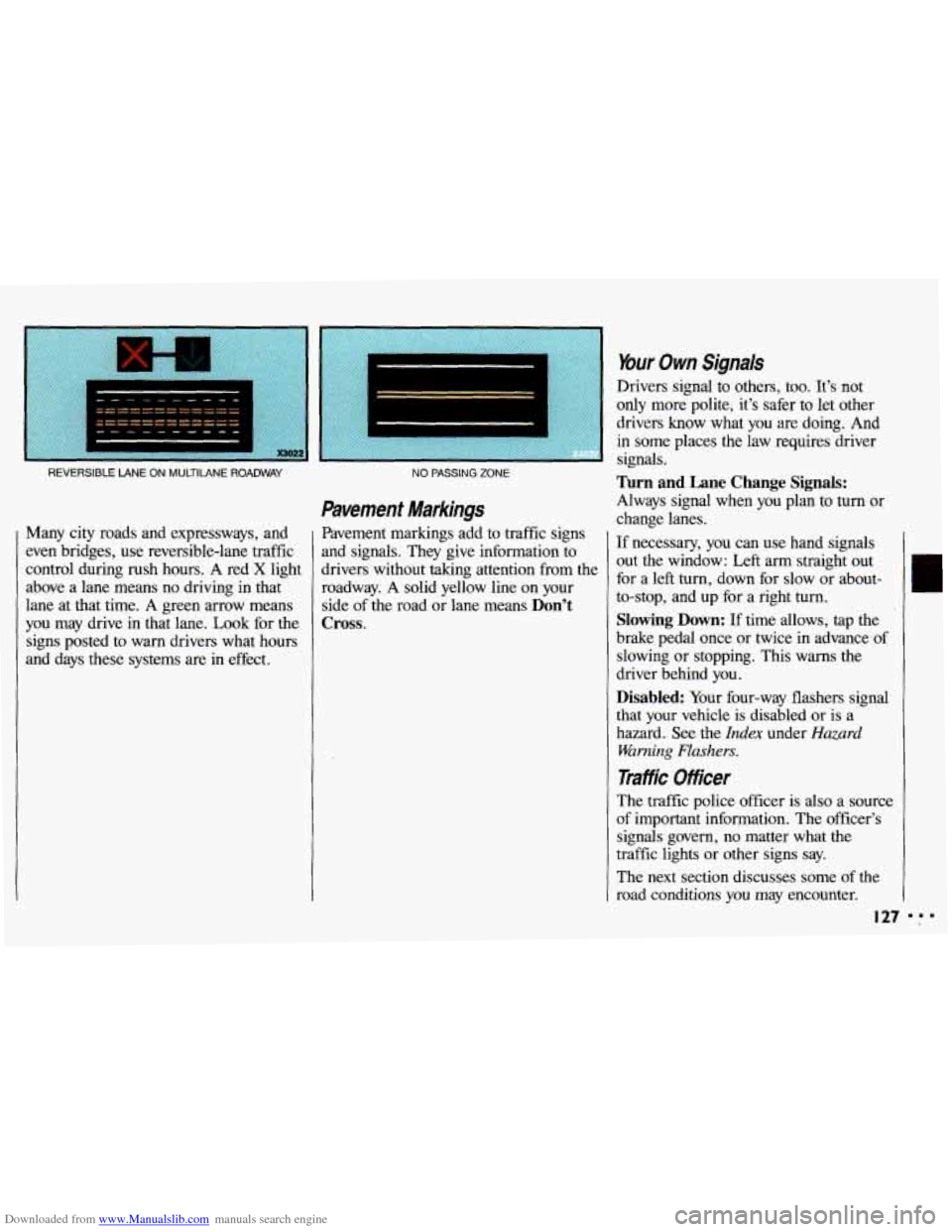
Downloaded from www.Manualslib.com manuals search engine REVERSIBLE LANE ON MULTILANE ROADWAY
Many city roads and expressways, and
even bridges, use reversible-lane traffic
control during rush hours. A red
X light
above
a lane means no driving in that
lane at that time. A green arrow means
you may drive in that lane.
Look for the
signs posted
to warn drivers what hours
and days these systems are in effect.
NO PASSING ZONE
Pavement Markings
Pavement markings add to traffic signs
and signals. They give information to
drivers without taking attention from the roadway.
A solid yellow line on your
side
of the road or lane means Don’t
Cross.
Mur Own Signals
Drivers signal to others, too. It’s not
only more polite, it’s safer
to let other
drivers
know what you are doing. And
in some places the law requires driver
signals.
Turn and Lane Change Signals:
Always signal when you plan to turn or
change lanes.
If necessary,
you can use hand signals
out the window: Left arm straight out for a left
turn, down for slow or about-
to-stop, and up for a right
turn.
Slowing Down: If time allows, tap the
brake pedal once or twice in advance of
slowing or stopping. This warns the
driver behind you.
Disabled: Your four-way flashers signal
that your vehicle is disabled or is a
hazard. See the
Index under Hazard
Warning Flashers.
Traffic Officer
The traffic police officer is also a source
of important information. The officer’s
signals govern, no matter what the
traffic lights or other signs say.
The next section discusses some
of the
road conditions
you may encounter.
I27
Page 140 of 308
Downloaded from www.Manualslib.com manuals search engine ..I
Your Driving and the Road
Steering Tips-Driving on Curves
It’s important to take curves at a
reasonable speed.
A lot of the “driver lost control”
accidents mentioned on the news happen
on curves. Here’s why:
Experienced driver or beginner, each of
us is subject to the same laws of physics
when driving on curves. The traction of
the tires against the road surface makes
it possible for the vehicle to change its
path when you turn the front wheels.
If
there’s no traction, inertia will keep the
vehicle going in the same direction. If
you’ve ever tried to steer a vehicle on
wet ice, you’ll understand this.
The traction
you can get in a curve
depends on the condition
of your tires
and the road surface, the angle at which
the curve is banked, and youT speed.
I38
While you’re in a curve, speed is the
one factor you can control.
Suppose you’re steering through
a sharp
curve. Then you suddenly accelerate.
Those two control systems-steering
and acceleration-can overwhelm those
places where the tires meet
the road and
make
you lose control.
What should you do if this ever
happens? Let up
on the accelerator
pedal, steer the vehicle the way
you
want it to go, and slow down.
Speed limit signs near curves warn lhat
you should adjust your speed.
Of
course, the posted speeds are based on
good weather and road conditions.
Under less favorable conditions you’ll
want to go slower. If
you need to reduce your speed
as you
approach a curve, do it before you enter
the curve, while your front wheels are
straight ahead.
Try
to adjust your speed so you can
“drive” through the curve. Maintain a
reasonable, steady speed. Wait to
accelerate until
you are out of the curve,
and then accelerate gently into the
straightaway.
When
you drive into a curve at night,
it’s harder
to see the road ahead of you
because
it bends away from the straight
beams
of your lights. This is one good
reason
to drive slower.
Page 143 of 308
Downloaded from www.Manualslib.com manuals search engine If you suspect that the driver of the
vehicle
you want to pass isn’t aware of
your presence, tap the horn a couple
of times before passing.
Do not get too close to the vehicle you
want
to pass while you’re awaiting an
opportunity. For one thing, following
too closely reduces your area
of
vision, especially if you’re following a
larger vehicle. Also, you won’t have
adequate space if the vehicle ahead suddenly slows or stops. Keep back a
reasonable distance.
When it looks like a chance to pass is
coming up, start to accelerate but stay
in the right lane and don’t get too
close. Time your move
so you will be
increasing
speed as the time comes to
move into the other lane.
If the way is
clear to pass, you will have a “running
start” that more than makes up for the
distance you would lose by dropping
back. And
if something happens to
cause you
to cance1,your pass, you
need only slow down and drop back
again and wait for another opportunity.
slow vehicle, wait your turn. But take
care that someone isn’t trying
to pass
you as you pull out to pass the slow
vehicle. Remember to glance over
your shoulder and check the blind
spot.
Check your mirrors, glance over your
shoulder, and
start your left lane
change signal before moving out of the
right lane to pass. When you are far
enough ahead of the passed vehicle to
see its front in your inside mirror,
activate your right lane change signal
If other cars are lined up to pass a and
move back into the right lane.
(Remember that your right outside
mirror is convex. The vehicle you just
passed may
seem to be further away
from you than it really
is.)
Try not to pass more than one vehicle
at a time on two-lane roads.
Reconsider before passing the next
vehicle.
vehicle too rapidly. Even though the
brake lights are not flashing, it may be
slowing down or starting to
turn.
If you’re being passed, make it easy
for the following driver to get ahead of
you. Perhaps you can ease a
little to
the right.
Don’t overtake a slowly moving
I41
Page 145 of 308
Downloaded from www.Manualslib.com manuals search engine While driving on a surface with reduced
traction,
try your best to avoid sudden
steering, acceleration, or braking
(including engine braking by shifting
to
a lower gear). Any sudden changes
could cause the tires
to slide. You may
not realize
the surface is slippery until
your vehicle is skidding. Learn to
recognize warning clues-such as
enough water, ice or packed snow on
the road
to make a “mirrored
surface”-and slow down when you
have any doubt.
Remember: Any anti-lock braking
system (ABS) helps avoid only the
braking skid. Steer
the way you want to
go.
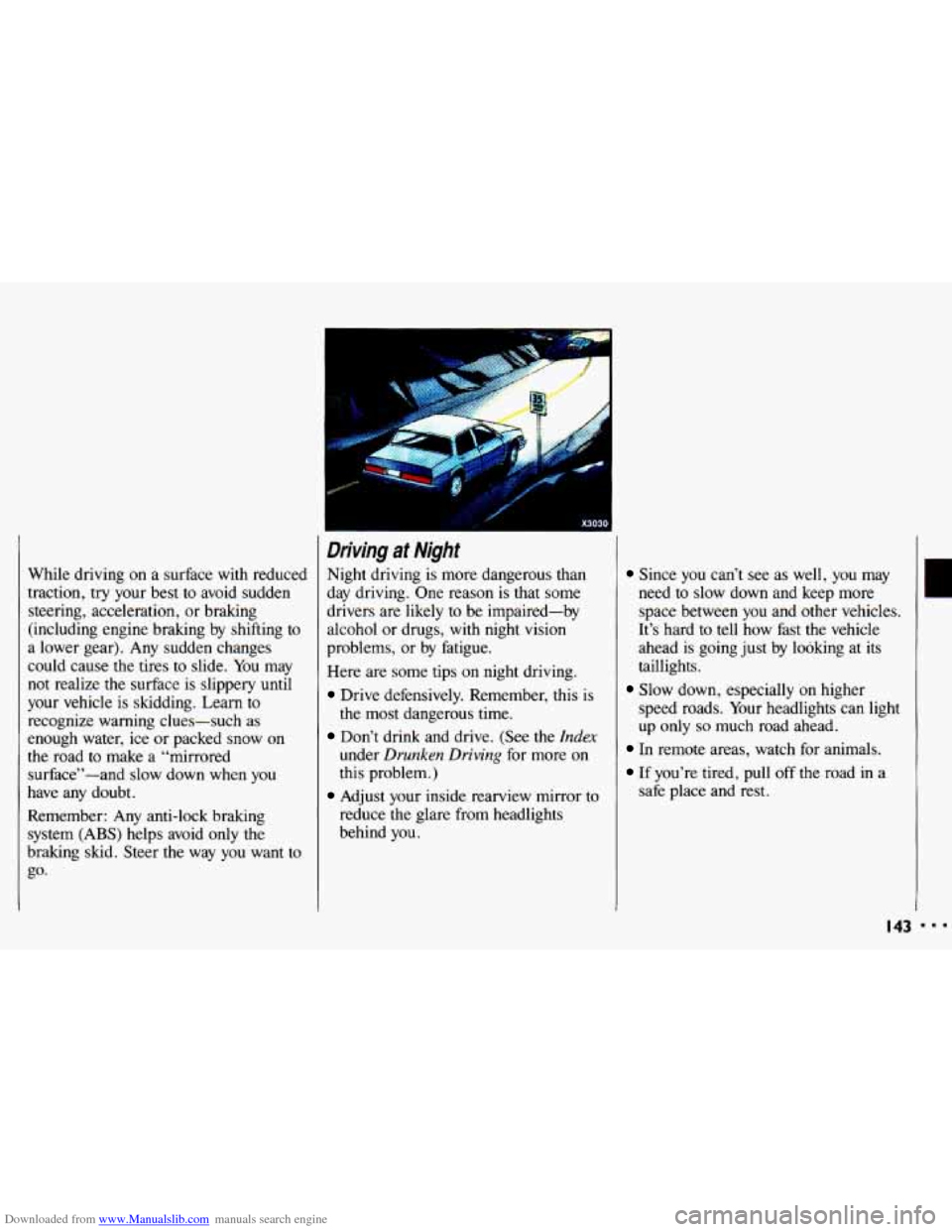
Driving at Night
Night driving is more dangerous than
day driving. One reason is that some
drivers are likely to be impaired-by
alcohol or drugs, with night vision
problems, or by fatigue.
Here are some tips on night driving.
Drive defensively. Remember, this is
the most dangerous time.
Don’t drink and drive. (See the index
under Drunken Driving for more on
this problem.)
Adjust your inside rearview mirror to
reduce the glare from headlights
behind you.
Since you can’t see as well, you may
need
to slow down and keep more
space between you and other vehicles.
It’s hard to
tell how fast the vehicle
ahead is going just by looking at its
taillights.
speed roads. Your headlights can light
up only
so much road ahead.
Slow down, especially on higher
In remote areas, watch for animals.
If you’re tired, pull off the road in a
safe place and rest.
I43
r
I..