mirror CHEVROLET CAVALIER 1993 1.G Owners Manual
[x] Cancel search | Manufacturer: CHEVROLET, Model Year: 1993, Model line: CAVALIER, Model: CHEVROLET CAVALIER 1993 1.GPages: 308, PDF Size: 15.62 MB
Page 49 of 308
Downloaded from www.Manualslib.com manuals search engine ..
.; . I
Here you can learn about the
many standard and optional features
on your Chevrolet. and information
on starting. shifting and braking
.
Also explained are the instrument
panel and the warning systems that
tell you
if everything is working
properly-and what to
do if you have
a problem
.
Part 2
Features & Controls
Keys ............................................................ 48
Locks ........................................................... 49
GloveBox ....................................................... 53
Ignition ......................................................... 55
StartingYourEngine ............................................... 56
Engine Block Heater ............................................... 59
Shifting the Transaxle
.............................................. 60
ParkingBrake .................................................... 66
ShiftingintoPark .................................................. 67
Windows
........................................................ 71
Turn SignaVHeadlight Beam Lever
................................... -73
Cruisecontrol
.................................................... 74
Headlights
....................................................... 78
Interior Lights
.................................................... 81
Windshield Wipers
................................................ 83
Windshield Washer
................................................ 84
Mirrors
......................................................... 85
Ashtrays and Lighter
............................................... 87
Sunroof ......................................................... 88
Instrumentpanel .................................................. 93
Warning Lights, Gages and Indicators
.................................. 96
47
c
...
Page 87 of 308
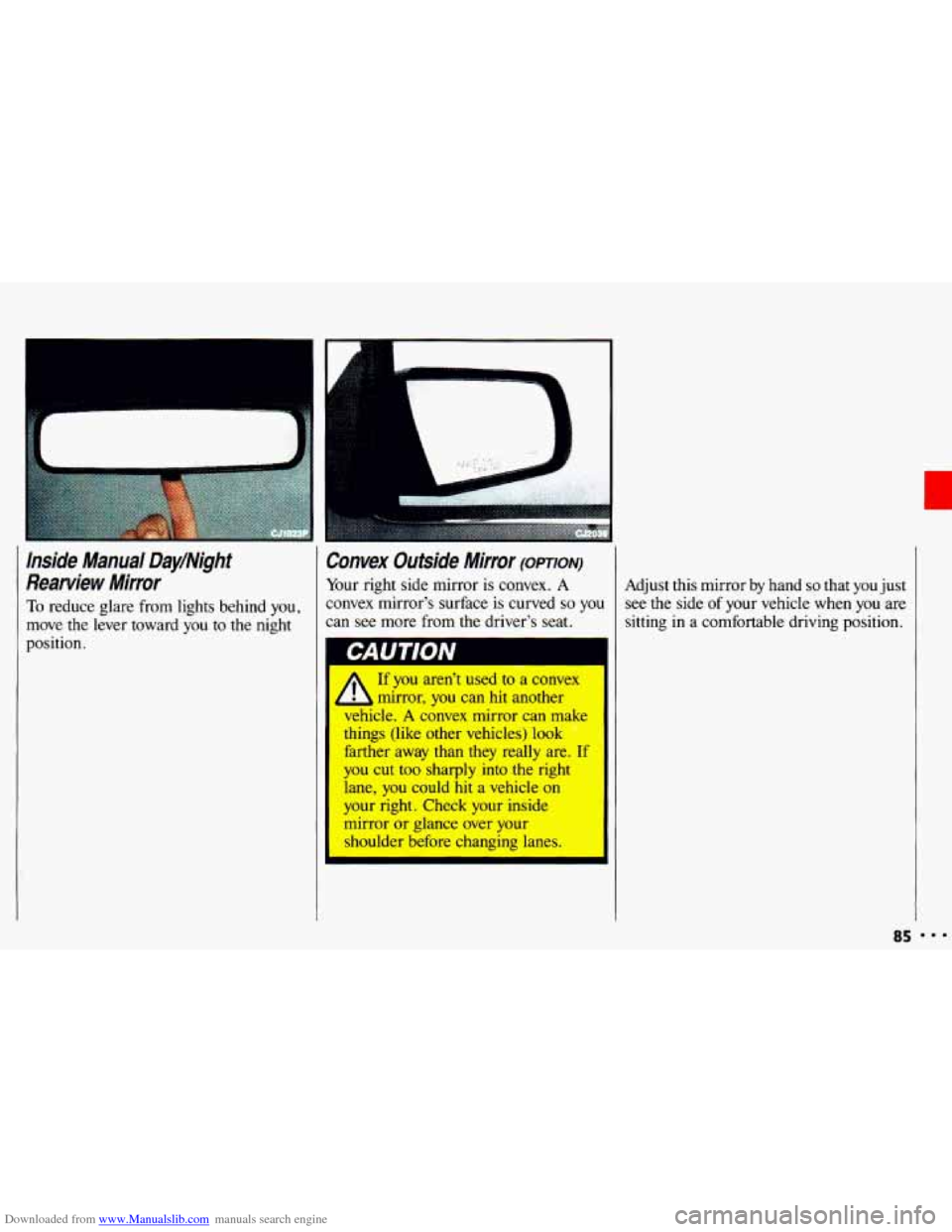
Downloaded from www.Manualslib.com manuals search engine Inside Manual DayINight
Rearview Mirror
To reduce glare from lights behind you,
move
the lever toward you to the night
position.
Convex Outsjde Mirror (OPTION)
Your right side mirror is convex. A
convex mirror’s surface is curved
so you
can see more from the driver’s seat.
I CAUTioN
I
If you aren’t used to a convex
mirror, you can hit another
vehicle.
A convex mirror can make
things (like other vehicles) look
farther away than they really are. If
you cut too sharply into the right
lane, you could
hit a vehicle on
your right. Check your inside
mirror or glance over your
shoulder before changing lanes. Adjust
this mirror
by hand so that you just
see the side
of your vehicle when you are
sitting
in a comfortable driving position.
85
Page 88 of 308
Downloaded from www.Manualslib.com manuals search engine Features & Controls
il
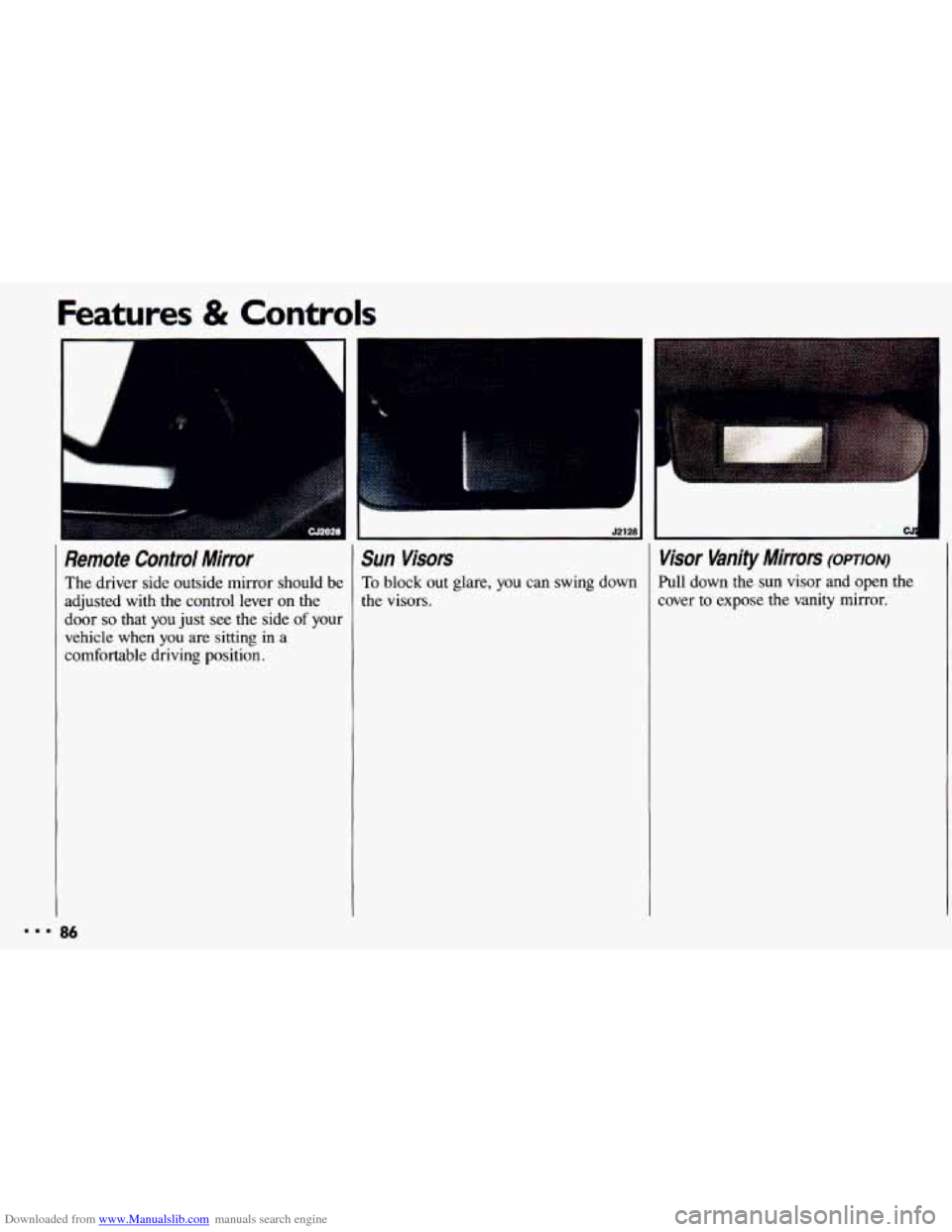
Remote Contra/ Mirror Sun Visors
The driver side outside mirror should be To block out glare, you can swing down
adjusted
with the control lever on the the visors.
door
so that you just see the side of your
vehicle
when you are sitting in a
comfortable driving position.
Visor Vanity Mirrors (opTIoN)
Pull down the sun visor and open the
cover to expose the vanity mirror.
Page 143 of 308
Downloaded from www.Manualslib.com manuals search engine If you suspect that the driver of the
vehicle
you want to pass isn’t aware of
your presence, tap the horn a couple
of times before passing.
Do not get too close to the vehicle you
want
to pass while you’re awaiting an
opportunity. For one thing, following
too closely reduces your area
of
vision, especially if you’re following a
larger vehicle. Also, you won’t have
adequate space if the vehicle ahead suddenly slows or stops. Keep back a
reasonable distance.
When it looks like a chance to pass is
coming up, start to accelerate but stay
in the right lane and don’t get too
close. Time your move
so you will be
increasing
speed as the time comes to
move into the other lane.
If the way is
clear to pass, you will have a “running
start” that more than makes up for the
distance you would lose by dropping
back. And
if something happens to
cause you
to cance1,your pass, you
need only slow down and drop back
again and wait for another opportunity.
slow vehicle, wait your turn. But take
care that someone isn’t trying
to pass
you as you pull out to pass the slow
vehicle. Remember to glance over
your shoulder and check the blind
spot.
Check your mirrors, glance over your
shoulder, and
start your left lane
change signal before moving out of the
right lane to pass. When you are far
enough ahead of the passed vehicle to
see its front in your inside mirror,
activate your right lane change signal
If other cars are lined up to pass a and
move back into the right lane.
(Remember that your right outside
mirror is convex. The vehicle you just
passed may
seem to be further away
from you than it really
is.)
Try not to pass more than one vehicle
at a time on two-lane roads.
Reconsider before passing the next
vehicle.
vehicle too rapidly. Even though the
brake lights are not flashing, it may be
slowing down or starting to
turn.
If you’re being passed, make it easy
for the following driver to get ahead of
you. Perhaps you can ease a
little to
the right.
Don’t overtake a slowly moving
I41
Page 145 of 308
Downloaded from www.Manualslib.com manuals search engine While driving on a surface with reduced
traction,
try your best to avoid sudden
steering, acceleration, or braking
(including engine braking by shifting
to
a lower gear). Any sudden changes
could cause the tires
to slide. You may
not realize
the surface is slippery until
your vehicle is skidding. Learn to
recognize warning clues-such as
enough water, ice or packed snow on
the road
to make a “mirrored
surface”-and slow down when you
have any doubt.
Remember: Any anti-lock braking
system (ABS) helps avoid only the
braking skid. Steer
the way you want to
go.
Driving at Night
Night driving is more dangerous than
day driving. One reason is that some
drivers are likely to be impaired-by
alcohol or drugs, with night vision
problems, or by fatigue.
Here are some tips on night driving.
Drive defensively. Remember, this is
the most dangerous time.
Don’t drink and drive. (See the index
under Drunken Driving for more on
this problem.)
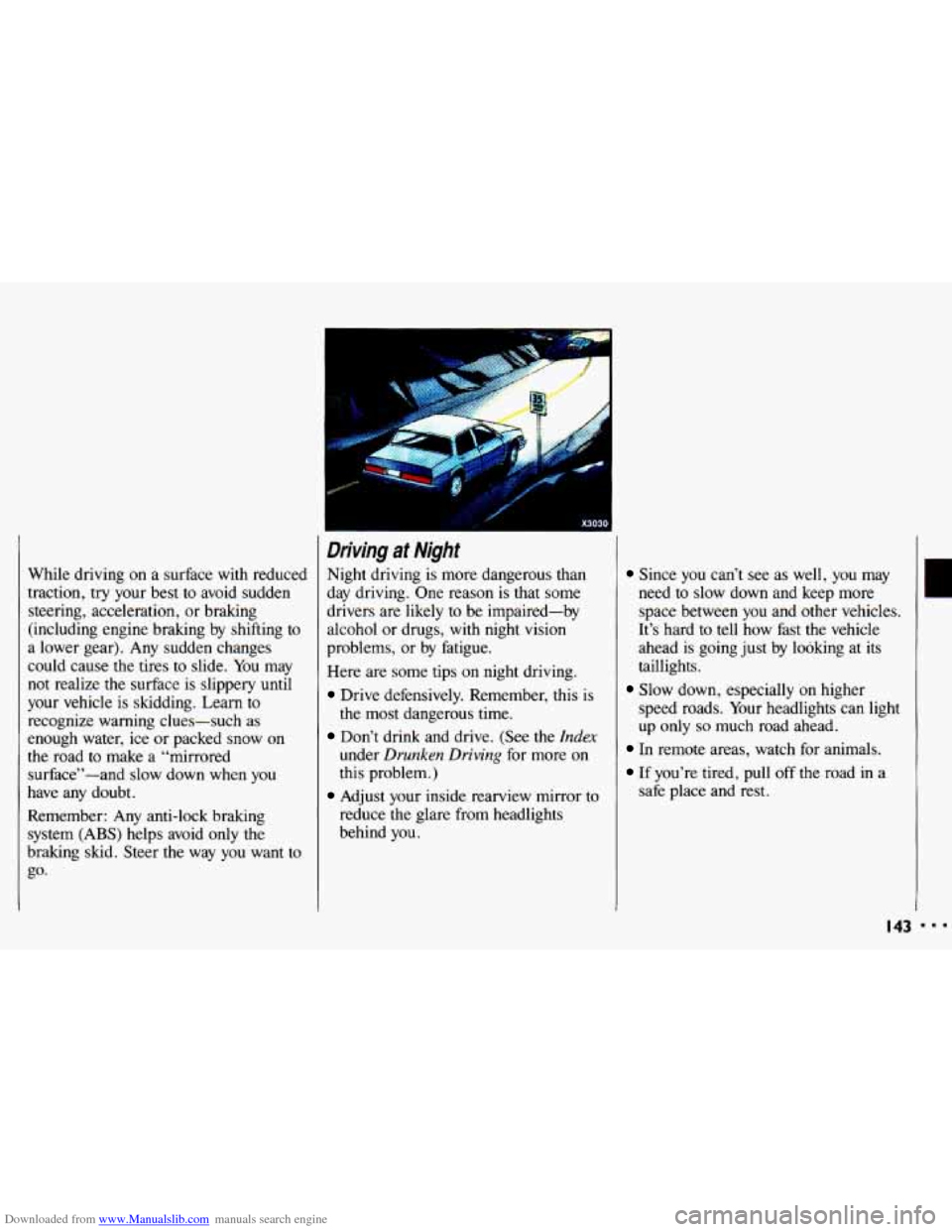
Adjust your inside rearview mirror to
reduce the glare from headlights
behind you.
Since you can’t see as well, you may
need
to slow down and keep more
space between you and other vehicles.
It’s hard to
tell how fast the vehicle
ahead is going just by looking at its
taillights.
speed roads. Your headlights can light
up only
so much road ahead.
Slow down, especially on higher
In remote areas, watch for animals.
If you’re tired, pull off the road in a
safe place and rest.
I43
r
I..
Page 146 of 308
Downloaded from www.Manualslib.com manuals search engine Your Driving and the Road
‘I
Night Wsion
No one can see as well at night as in the
daytime. But as we get older these
differences increase. A SO-year-old
driver
may require at least twice as
much light to see the same thing at night
as a 20-year-old.
What you do in the daytime can
also
affect your night vision. For example, if
you spend the day in bright sunshine you
are wise to wear sunglasses. Your eyes
will have less trouble adjusting to night.
But if you’re driving, don’t wear
sunglasses at night. They may cut down
on glare from headlights, but they
also
make a lot of things invisible that should
remain visible-such as parked cars,
obstacles, pedestrians, or even trains
blocking railway crossings. You may
want to
put on your sunglasses after you
have pulled into a brightly-lighted
service or refreshment area. Eyes
I44
shielded from that glare may adjust
more quickly to darkness back on the
road. But be sure to remove your
sunglasses before you leave the service
area.
You can be temporarily blinded by
approaching lights. It can take a second
or two, or even several seconds, for your
eyes to readjust to the dark. When you
are faced with severe glare (as from a
driver who doesn’t lower the high
beams, or a vehicle with misaimed
headlights), slow down a little. Avoid
staring directly into the approaching
lights. If there is a line of opposing
traffic, make occasional glances over the line of headlights to make certain that
one
of the vehicles isn’t starting to move
into your lane. Once you are past the
bright lights, give your eyes time to readjust before resuming speed.
High Beams
If the vehicle approaching you has its
high beams on, signal by flicking yours
to high and then back to low beam. This is the usual signal to lower the headlight
beams.
If the other driver still doesn’t
lower the beams, resist the temptation to
put your high beams on.
This only
makes two half-blinded drivers.
On a freeway, use your high beams only
in remote areas where you won’t impair
approaching drivers.
In some places,
like cities, using high beams is illegal.
When you follow another vehicle on a
freeway or highway, use low beams.
True, most vehicles now have day-night
mirrors that enable the driver to reduce
glare. But outside mirrors are not of this
type and high beams from behind can
bother the driver ahead.
Page 152 of 308
Downloaded from www.Manualslib.com manuals search engine Your Driving and the Road
Freeway Driving
Mile for mile, freeways (also called
thruways, parkways, expressways,
turnpikes, or superhighways) are the
safest of all roads. But they have their
own special rules.
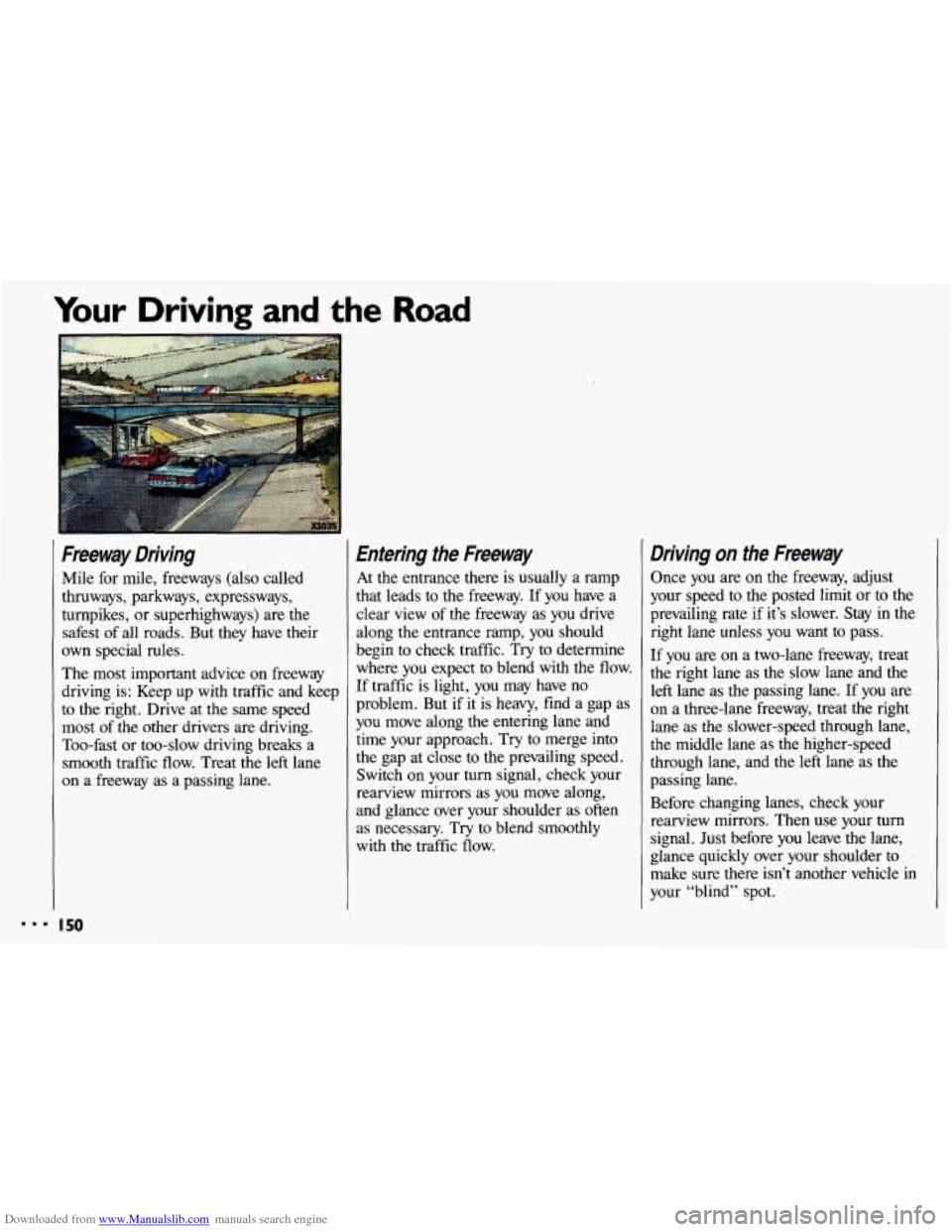
The most important advice on freeway
driving is: Keep up with traffic and keep
to the right. Drive at the same speed
most
of the other drivers are driving.
Too-fast or too-slow driving breaks a
smooth traffic flow. Treat the left lane
on a freeway as a passing lane.
Entering the Freeway
At the entrance there is usually a ramp
that leads to the freeway. If you have a
clear view
of the freeway as you drive
along the entrance ramp, you should
begin
to check traffic. Try to determine
where you expect to blend with the flow.
If traffic is light, you may have no
problem. But if it is heavy, find a gap as
you move along the entering lane and
time your approach.
Try to merge into
the gap at close to the prevailing speed.
Switch on your
turn signal, check your
rearview mirrors as you move along,
and glance over your shoulder as often
as necessary. Try to blend smoothly
with the traffic flow.
Driving on fhe Freeway
Once you are on the freeway, adjust
your speed to the posted limit or to the
prevailing rate
if it’s slower. Stay in the
right lane unless you want to pass.
If you are on a two-lane freeway, treat
the right lane as the slow lane and the
left lane as the passing lane. If you are
on a three-lane freeway, treat the right
lane as the slower-speed through lane,
the middle lane as the higher-speed
through lane, and
the left lane as the
passing lane.
Before changing lanes, check your
rearview mirrors. Then use your
turn
signal. Just before you leave the lane,
glance quickly over your shoulder to
make sure there isn’t another vehicle in
your “blind” spot.
... I 50
Page 155 of 308
Downloaded from www.Manualslib.com manuals search engine On the Road
Unless you are the only driver, it is
good to share the driving
task with
others. Limit turns behind the wheel
to
about 100 miles (160 km) or two hours
at a sitting. Then, either change drivers
or stop for some refreshment like coffee,
tea or soft drinks and some limbering
up. But do stop and move around. Eat
lightly along the way. Heavier meals
tend to make some people sleepy.
On two-lane highways or undivided
multilane highways that do
not have
controlled access, you’ll want
to watch
for some situations not usually found on
freeways. Examples are: stop signs and
signals, shopping centers with direct
access to the highway, no passing zones
and school zones, vehicles turning left
and right off the road, pedestrians,
cyclists, parked vehicles, and even
animals.
Highway Hypnosis
Is there actually such a condition as
“highway hypnosis”?
Or is it just plain
falling asleep at the wheel? Call it
highway hypnosis, lack
of awareness, or
whatever.
There is something about an easy stretch
of road with the same scenery, along
with the hum
of the tires on the road,
the drone
of the engine, and the rush of
the wind against the vehicle that can
make you sleepy. Don’t let it happen to
you! If it does, your vehicle can leave
the road
in less than a second, and you
could crash and be injured.
What can
you do about highway
hypnosis? First, be aware that it can
happen.
Then here are some tips:
Make sure your vehicle is well
ventilated, with a comfortably cool
interior.
Keep your eyes moving. Scan the road
ahead and to the sides. Check your
rearview mirrors frequently and your
instruments from time to time. This
can help you avoid a fixed stare.
Wear good sunglasses in bright light.
Glare can cause drowsiness. But don’t
wear sunglasses at night. They will
drastically reduce your overall vision
at the very time you need
all the
seeing power you have.
If you get sleepy, pull off the road into
a rest, service, or parking area and
take a nap, get some exercise, or both.
For safety, treat drowsiness on the
highway as an emergency.
As in any driving situation, keep pace
with traffic and allow adequate
following distances.
L
Page 298 of 308
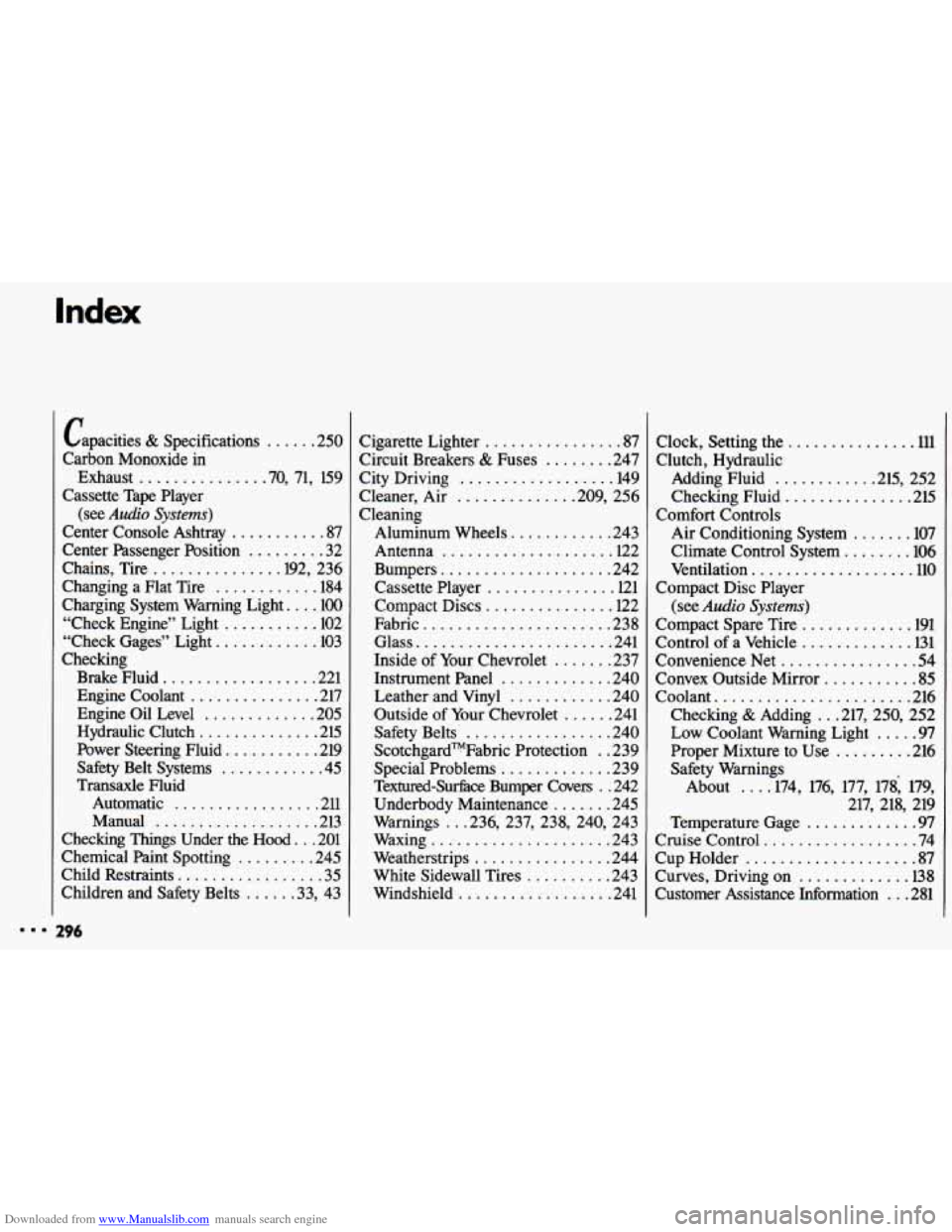
Downloaded from www.Manualslib.com manuals search engine Capacities & Specifications ...... 250
Carbon Monoxide in
Cassette Tape Player
Center Console Ashtray
........... 87
Center Passenger Position
......... 32
Chains. Tire
.............. .192. 236
Exhaust
.............. .70.
71. 159
(see
Audio Systems)
Changing a Flat Tire ............ 184
Charging System Warning Light
... -100
“Check Engine” Light
........... 102
“Check Gages” Light
............ 103
Checking Brake Fluid
.................. 221
Engine
Oil Level ............. 205
Hydraulic Clutch
.............. 215
Safety Belt Systems
............ 45
Transaxle Fluid
Automatic
................. 211
Manual
................... 213
Chemical Paint Spotting
......... 245
Child Restraints
................. 35
Children and Safety Belts
..... .33. 43
196
Engine Coolant ............... 217
Power Steering Fluid
........... 219
Checking Things Under the
Hood ... 201 Cigarette Lighter
................ 87
Circuit Breakers
8z Fuses ........ 247
Cleaner. Air
............. .209. 256
Cleaning Aluminum Wheels
............ 243
Antenna
.................... 122
Bumpers
.................... 242
Cassette Player
............... 121
Compact Discs
............... 122
Fabric
...................... 238
Glass
....................... 241
Inside of Your Chevrolet
....... 237
Instrument Panel
............. 240
Leather and Vinyl
............ 240
Outside
of Your Chevrolet ...... 241
Safety Belts
................. 240
ScotchgardTMFabric Protection
. . 239
Special Problems
............. 239
Textured-Surhce Bumper Coven
. . 242
Underbody Maintenance
....... 245
Warnings
.. .236. 237. 238. 240. 243
Waxing
..................... 243
Weatherstrips
................ 244
White Sidewall Tires
.......... 243
Windshield
.................. 241
City
Driving
.................. 149 Clock.
Setting the
............... 111
Clutch. Hydraulic
Adding Fluid
........... .215. 252
Checking Fluid
.............. -215
Air Conditioning System
....... 107
Climate Control System
........ 106
Ventilation
................... 110
Compact Disc Player
(see
Audio Systems)
Compact Spare Tire ............. 191
Control of a Vehicle
............. 131
Convenience Net
................ 54
Convex Outside Mirror ........... 85
Coolant ....................... 216
Checking
& Adding .. .217. 250. 252
Low Coolant Warning Light ..... 97
Proper Mixture to Use
......... 216
Safety Warnings About
... .174. 176. 177. 1781 179. 217. 218. 219
Temperature Gage
............. 97
Cruise Control .................. 74
Cup Holder
.................... 87
Curves. Driving on
............. 138
Customer Assistance Information
... 281
Comfort Controls
Page 301 of 308
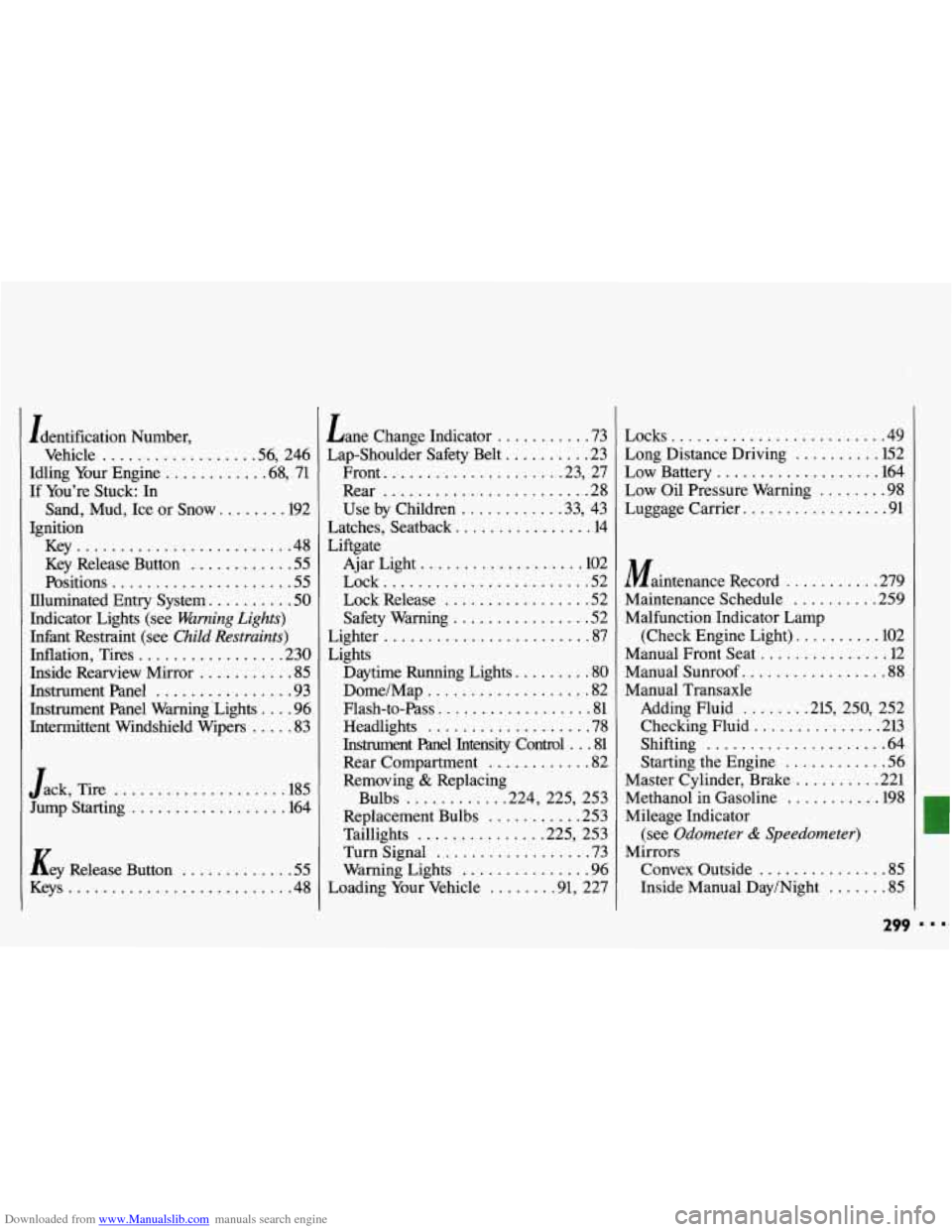
Downloaded from www.Manualslib.com manuals search engine Identification Number.
Vehicle
................. .56. 246
Idling Your Engine
........... .68. 71
Sand. Mud. Ice or Snow
........ 192
If You're Stuck: In
Ignition
Key
......................... 48
Key Release Button ............ 55
Positions
..................... 55
Illuminated Entry System
.......... 50
Indicator Lights (see
Warning Lights)
Infant Restraint (see Child Restraints)
Inflation. Tires ................. 230
Inside Rearview Mirror
........... 85
Instrument Panel ................ 93
Instrument Panel Wming'Lights
.... 96
Intermittent Windshield Wipers
..... 83
.................... J ack. Tire 185
Jump Starting
.................. 164
Key Release Button
............. 55
Keys .......................... 48 Lane
Change Indicator
........... 73
Lap-Shoulder Safety Belt
.......... 23
Front
..................... 23. 27
Rear
........................ 28
Use by Children ........... .33. 43
Latches. Seatback
................ 14
Liftgate Ajar Light
................... 102
Lock
........................ 52
Lock Release
................. 52
Safety Warning
................ 52
Lighter
........................ 87
Dome/Map
................... 82
Headlights
................... 78
Lights
Daytime Running Lights
......... 80
Flash-to-Pass .................. 81
Instrument Panel Intensity Control
... 81
Rear Compartment
............ 82
Removing
& Replacing
Bulbs
........... .224, 225, 253
Replacement Bulbs
........... 253
Taillights
.............. .225. 253
Turn Signal
.................. 73
Warning Lights
............... 96
Loading Your Vehicle
....... .91. 227 Locks
......................... 49
Long Distance Driving
.......... 152
Low Oil Pressure Warning
........ 98
Luggage Carrier
................. 91
Low Battery
................... 164
Maintenance Record
........... 279
Maintenance Schedule
.......... 259
Malfunction Indicator Lamp
(Check Engine Light)
.......... 102
Manual Front Seat
............... 12
Manual Sunroof
................. 88
Manual Transaxle
Adding Fluid
....... .215. 250, 252
Shifting
..................... 64
Master Cylinder. Brake
.......... 221
Methanol in Gasoline
........... 198
Mileage Indicator
Mirrors Checking
Fluid
............... 213
Starting the Engine
............ 56
(see
Odometer & Speedometer)
Convex Outside ............... 85
Inside Manual Day/Night ....... 85
299 m ..