key CHEVROLET CAVALIER 1994 1.G User Guide
[x] Cancel search | Manufacturer: CHEVROLET, Model Year: 1994, Model line: CAVALIER, Model: CHEVROLET CAVALIER 1994 1.GPages: 243, PDF Size: 15.06 MB
Page 52 of 243
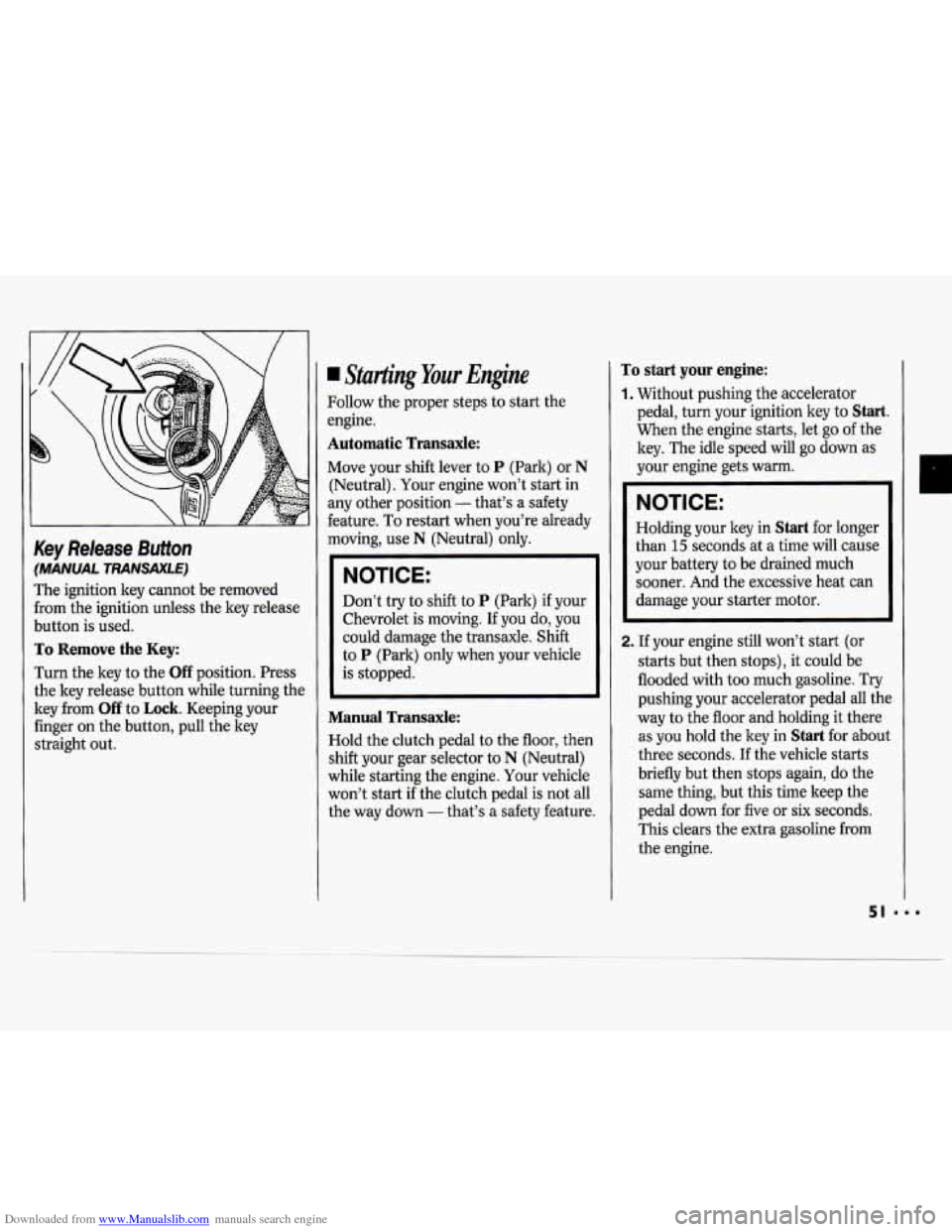
Downloaded from www.Manualslib.com manuals search engine Key Release Button
(MANUAL TRANSAXLE)
The ignition key cannot be removed
from the ignition unless the key release
button is used.
To Remove the Key:
Turn the key to the Off position. Press
the key release button while turning the
key from
Off to Lock. Keeping your
finger
on the button, pull the key
straight out.
Starting Your Engine
Follow the proper steps to start the
engine.
Automatic Transaxle:
Move your shift lever to P (Park) or N
(Neutral). Your engine won’t start in
any other position
- that’s a safety
feature.
To restart when you’re already
moving, use
N (Neutral) only.
NOTICE:
Don’t try to shift to P (Park) if your
Chevrolet is moving. If you do, you
could damage the transaxle.
Shift
to P (Park) only when your vehicle
is stopped.
Manual Transaxle:
Hold the clutch pedal to the floor, then
shift your gear selector to
N (Neutral)
while starting the engine. Your vehicle
won’t start if the clutch pedal is not all
the way down
- that’s a safety feature.
To start your engine:
1. Without pushing the accelerator
pedal, turn your ignition key to
Start.
When the engine starts, let go of the
key. The idle speed will go down as
your engine gets warm.
NOTICE:
Holding your key in Start for longer
than
15 seconds at a time will cause
your battery to be drained much
sooner. And the excessive heat can
damage your starter motor.
2. If your engine still won’t start (or
starts but then stops), it could be
flooded with too much gasoline. Try
pushing your accelerator pedal all the
way to the floor and holding it there
as you hold the key in
Start for about
three seconds.
If the vehicle starts
briefly but then stops again, do the
same thing, but this time keep the
pedal down for five or
six seconds.
This clears the extra gasoline from
the engine.
n
Page 60 of 243
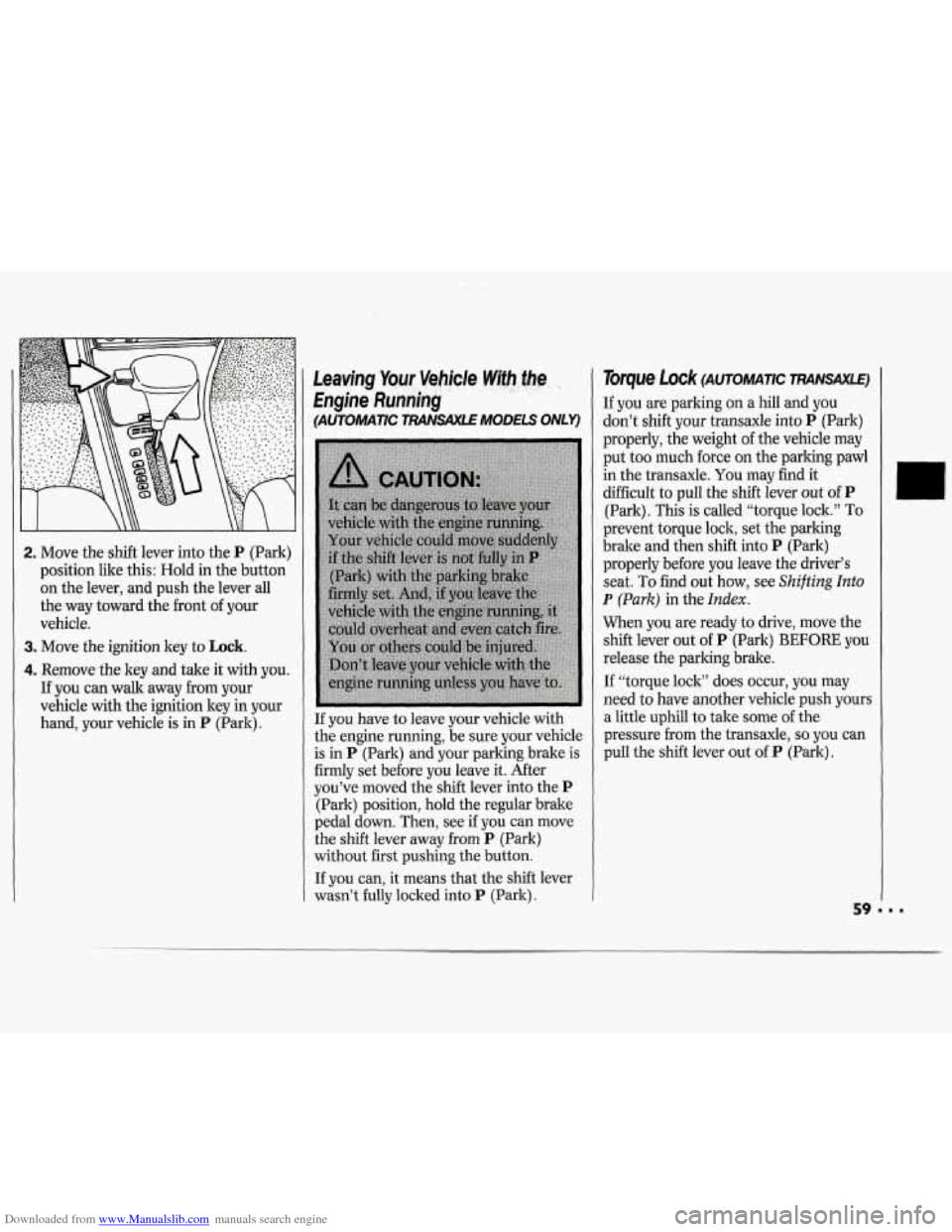
Downloaded from www.Manualslib.com manuals search engine 2. Move the shift lever into the P (Park)
position like this: Hold in the button
on the lever, and push the lever all
the way toward the front of your
vehicle.
3. Move the ignition key to Lock.
4. Remove the key and take it with you.
If you can walk away from your
vehicle with the ignition key
in your
hand, your vehicle is in
P (Park).
Leaving Yqur. Vebjcle W@h:,.the .-‘j! ., . , , :. . .
Engine Runriing ’ ’ ,. .
(AUTOllrlATIC TRANSAXLE MODELS ONLY)
If you have to leave your vehicle with
the engine running, be sure your vehicle
is in
P (Park) and your parking brake is
firmly set before you leave it. After
you’ve moved the shift lever into the
P
(Park) position, hold the regular brake
pedal down. Then, see if you can move
the shift lever away from
P (Park)
without first pushing the button.
If you can, it means that the shift lever
wasn’t fully locked into
P (Park).
Torque Lock (AUTOMATIC RWVSAXLE)
If you are parking on a hill and you
don’t shift your transaxle into
P (Park)
properly, the weight of the vehicle may
put too much force on the parking pawl
in the transaxle. You may find it
difficult to pull the shift lever out
of P
(Park). This is called “torque lock.” To
prevent torque lock, set the parking
brake and then shift into
P (Park)
properly before you leave the driver’s
seat.
To find out how, see Shifting Into
P (Park) in the Index.
When you are ready to drive, move the
shift lever out
of P (Park) BEFORE you
release the parking brake.
If “torque lock” does occur, you may
need to have another vehicle push yours
a little uphill to take some of the
pressure from the transaxle,
so you can
pull the shift lever out of
P (Park).
Page 61 of 243
Downloaded from www.Manualslib.com manuals search engine Features & Controls
Shifting Out of P (Park)
(AUTOMATIC TRANSAXLE)
Your Cheyrolet has a brake-transaxle
shift interlock. You have
to fully apply
your regular brakes before you can shift
from P (Park) when the ignition is in
the
Run position. See the Index under
Automatic Transaxb. If you cannot
shift out of P (Park), ease pressure on
the shift lever-push the shift lever all
the way into
P (Park) and also release
the shift lever button on floor shift
console models as you maintain brake
application. Then move the shift lever
into the gear you wish. (Press the
shift
lever button before moving the shift
lever on floor shift console models.)
If you ever hold the brake pedal down but
still can’t shift out
of P (Park), try this:
1. Turn the key to OFF.
2. Apply and hold the brake until the
3. Shift to
N (Neutral).
4. Start the vehicle and then shift to the
drive gear you want.
5. Have the vehicle fixed as soon as you
end
of Step 4.
Can.
Parking Your Vehicle
(MANUAL
TRANSAXLE)
Before you get out of your vehicle, put
your manual transaxle in
R (Reverse) .
and firmly apply the parking brake.
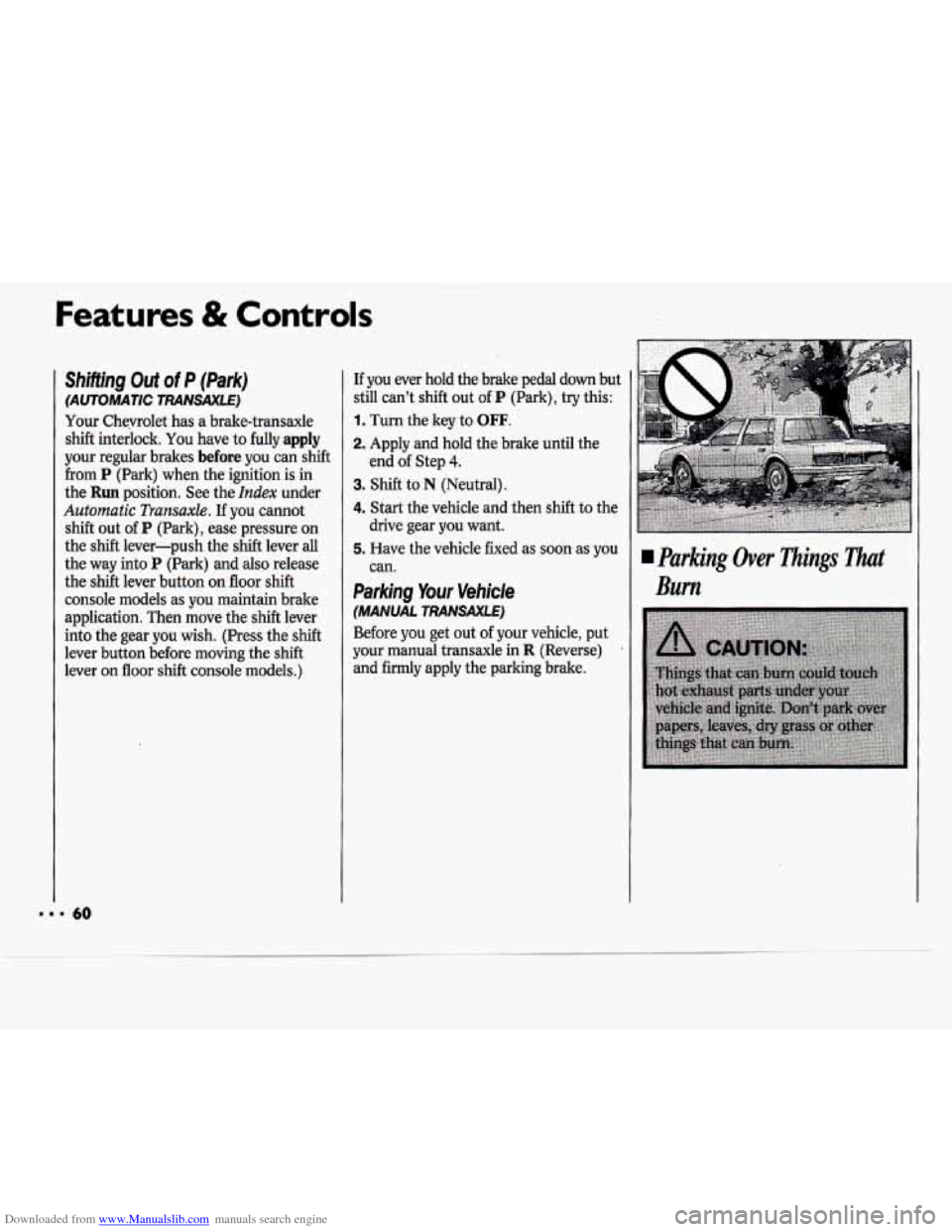
Parking Over Things That
Burn
Page 85 of 243
Downloaded from www.Manualslib.com manuals search engine Features & Controls
Warning Lights, Gages and
Indicators
This section describes the warning
lights and gages that may be on your
vehicle. The pictures will help you
locate them.
Warning lights and gages can signal that
something is wrong before it becomes
serious enough to cause an expensive
repair
or replacement. Paying attention
to your warning lights and gages could
also save you or others from injury.
Warning lights go on when there may
be or is a problem with one of your
vehicle’s functions.
As you will see in
the details
on the next few pages, some
warning lights come on briefly when
you turn the ignition key just to let you
lmow they’re working.
If you are familiar
with this section, you should
not be alarmed when this happens.
Gages can indicate when there may be
or is a problem with one of your
vehicle’s functions. Often gages and
warning lights work together to let
you
know when there’s a problem with your
vehicle.
When one of the warning lights comes
on and stays on when you are driving,
or when one of the gages shows there
may be a problem, check the section
that tells you what to do about it. Please
follow the manual’s advice. Waiting to
do repairs can be costly
- and even
dangerous.
So please get to know your
warning lights and gages. They’re a big
help.
260 0
E
93 ’&
fi
FUEL ONLY
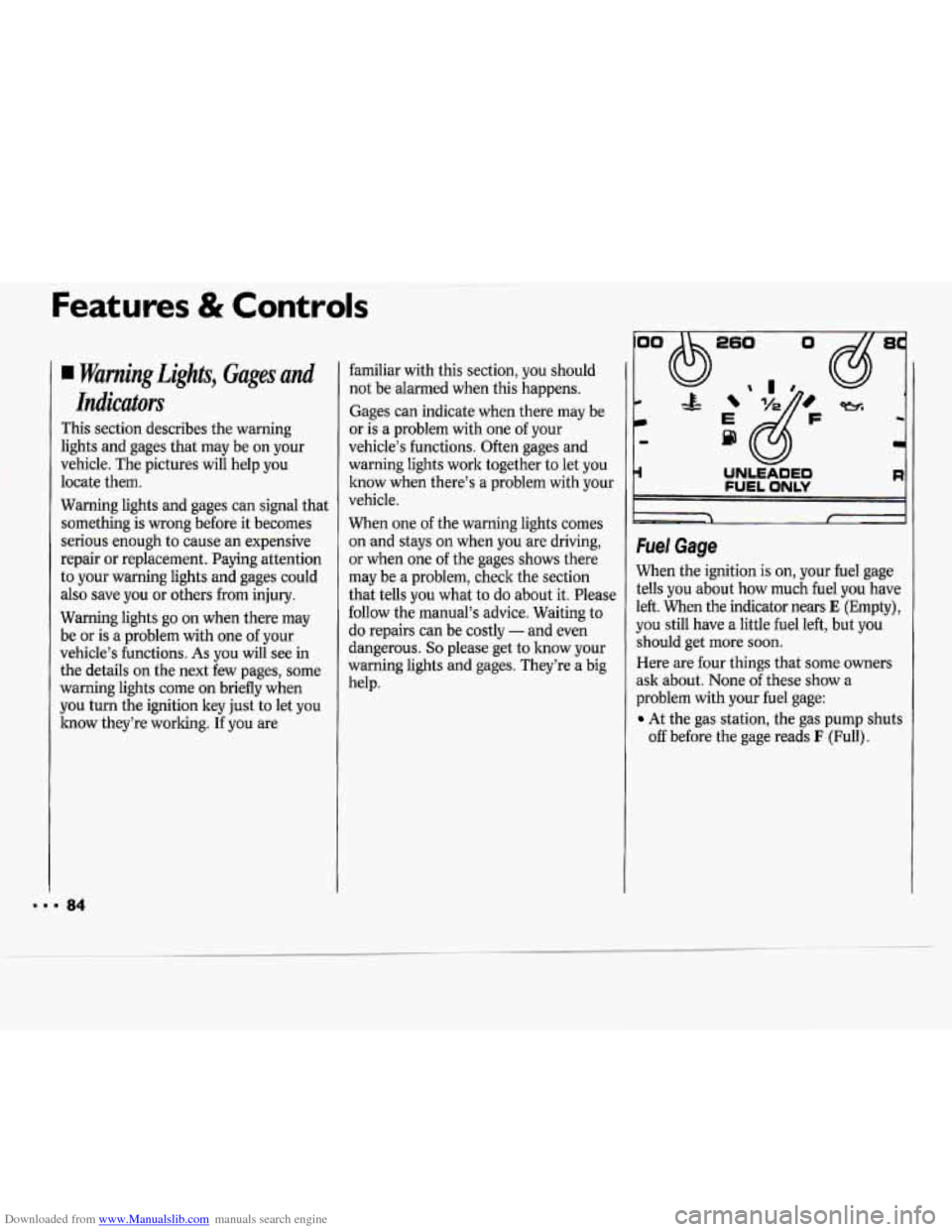
Fuel Gage
When the ignition is on, your fuel gage
tells you about how much fuel you have
left. When the indicator nears
E (Empty),
you still have a little fuel left, but you
should get more soon.
Here are four things that some owners
ask about. None of these show a
problem with your fuel gage:
At the gas station, the gas pump shuts
off before the gage reads I: (Full).
8
-4
Page 110 of 243
Downloaded from www.Manualslib.com manuals search engine According to the American Medical
Association, a 180-pound (82 kg)
person who drinks three 12-ounce
(355 ml) bottles of beer in an hour will
end up with a BAC
of about 0.06
percent. The person would reach the
same BAC by drinking three 4-ounce
(120 ml) glasses of wine or three mixed
drinks
if each had 1 H ounces (45 ml) of
a liquor like whiskey, gin or vodka.
It’s the amount
of alcohol that counts.
For example, if the same person drank
three double martinis
(3 ounces or 90
ml of liquor each) within an hour, the
person’s BAC would
be close to 0.12
percent. A person who consumes food
just before or during drinking will have
a slightly lower BAC level.
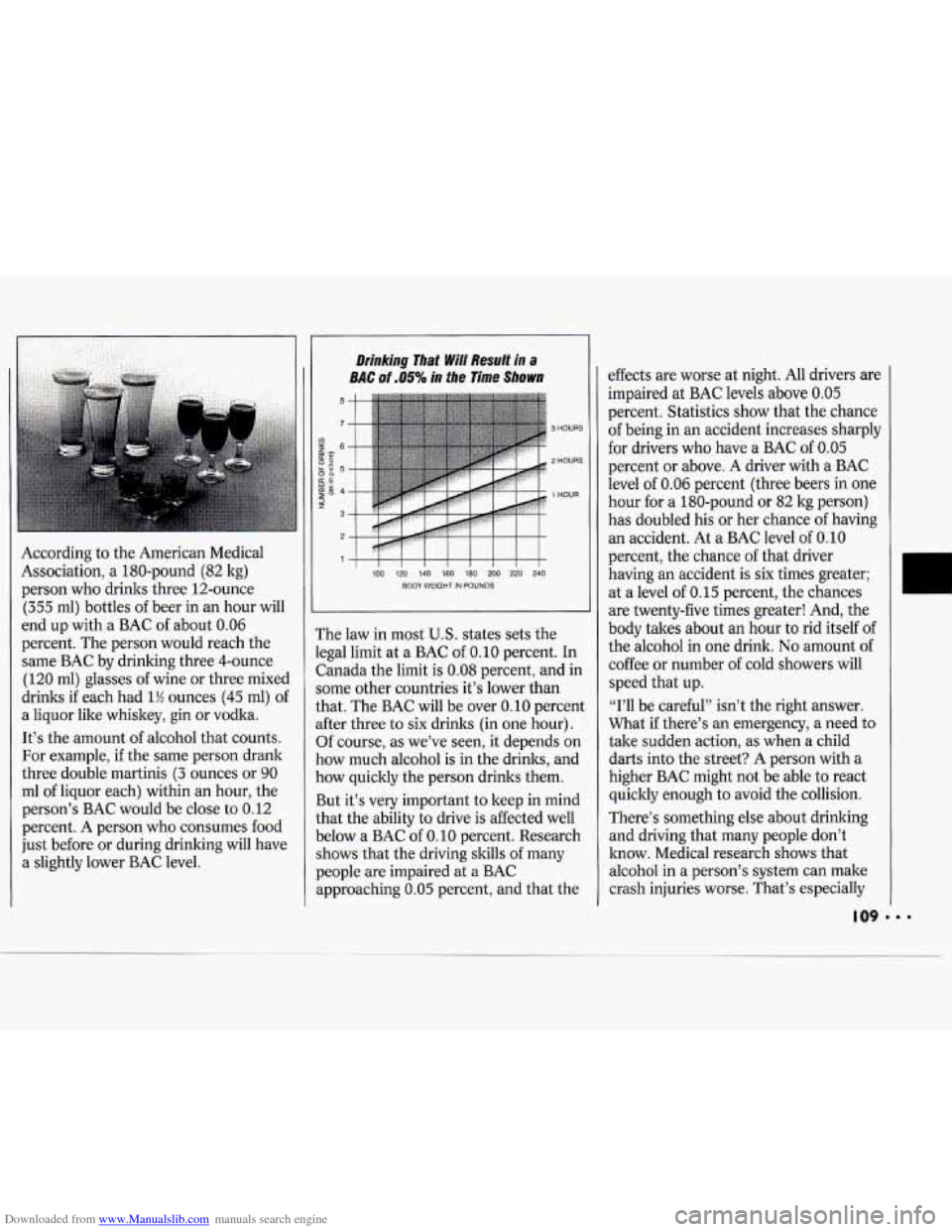
Drinking That WIN Resuit in a
BAC of -05% in the Time Shown
3 HOURS
2 HOURS
1 HOUR
100 120 140 160 180 200 220 240 BOQY WEIGHT IN POUNDS
rhe law in most U.S. states sets the
legal limit at a BAC of
0.10 percent. In
Canada the limit is
0.08 percent, and in
some other countries it’s lower than
that. The BAC will be over
0.10 percent
after three to six drinks (in one hour).
Of course, as we’ve seen,
it depends on
how much alcohol is in the drinks, and
how quickly the person drinks them.
But it’s very important to keep in mind
that the ability to drive is affected well
below
a BAC of 0.10 percent. Research
shows that the driving skills of many
people are impaired at a BAC
approaching
0.05 percent, and that the effects
are worse at night. All drivers are
impaired
at BAC levels above 0.05
percent. Statistics show that the chance
of being in an accident increases sharply
for drivers who have a BAC
of 0.05
percent or above. A driver with a BAC
level
of 0.06 percent (three beers in one
hour for a 180-pound or 82 kg person)
has doubled his or her chance
of having
an accident. At a BAC level of 0.10
percent, the chance of that driver
having an accident is six times greater;
at a level of 0.15 percent, the chances
are twenty-five times greater! And, the
body takes about an hour to rid itself
of
the alcohol in one drink. No amount of
coffee or number
of cold showers will
speed that up.
“I’ll be careful” isn’t the right answer.
What
if there’s an emergency, a need to
take sudden action, as when a child
darts into the street? A person with
a
higher BAC might not be able to react
quickly enough to avoid the collision.
There’s something else about drinking
and driving that many people don’t
know. Medical research shows that
alcohol in a person’s system can make
crash injuries worse. That’s especially
Page 126 of 243
Downloaded from www.Manualslib.com manuals search engine Run your engine only as long as you
must. This saves fuel. When you run the
engine, malte it go a little faster than
just idle. That is, push the accelerator
slightly. This uses less fuel for the heat
that you get and it keeps the battery
charged.
You will need a well-charged
battery to restart the vehicle, and
possibly
for signaling later on with your
headlights. Let the heater run for
awhile.
Then, shut the engine
off and close the
window almost all the way to preserve
the heat. Start the engine again and
repeat this only when you feel really
uncomfortable
from the cold. But do it
as little as possible. Preserve the fuel as
long as
you can. To help keep warm,
you can get out
of the vehicle and do
some fairly vigorous exercises every half
hour or so until help comes.
~~
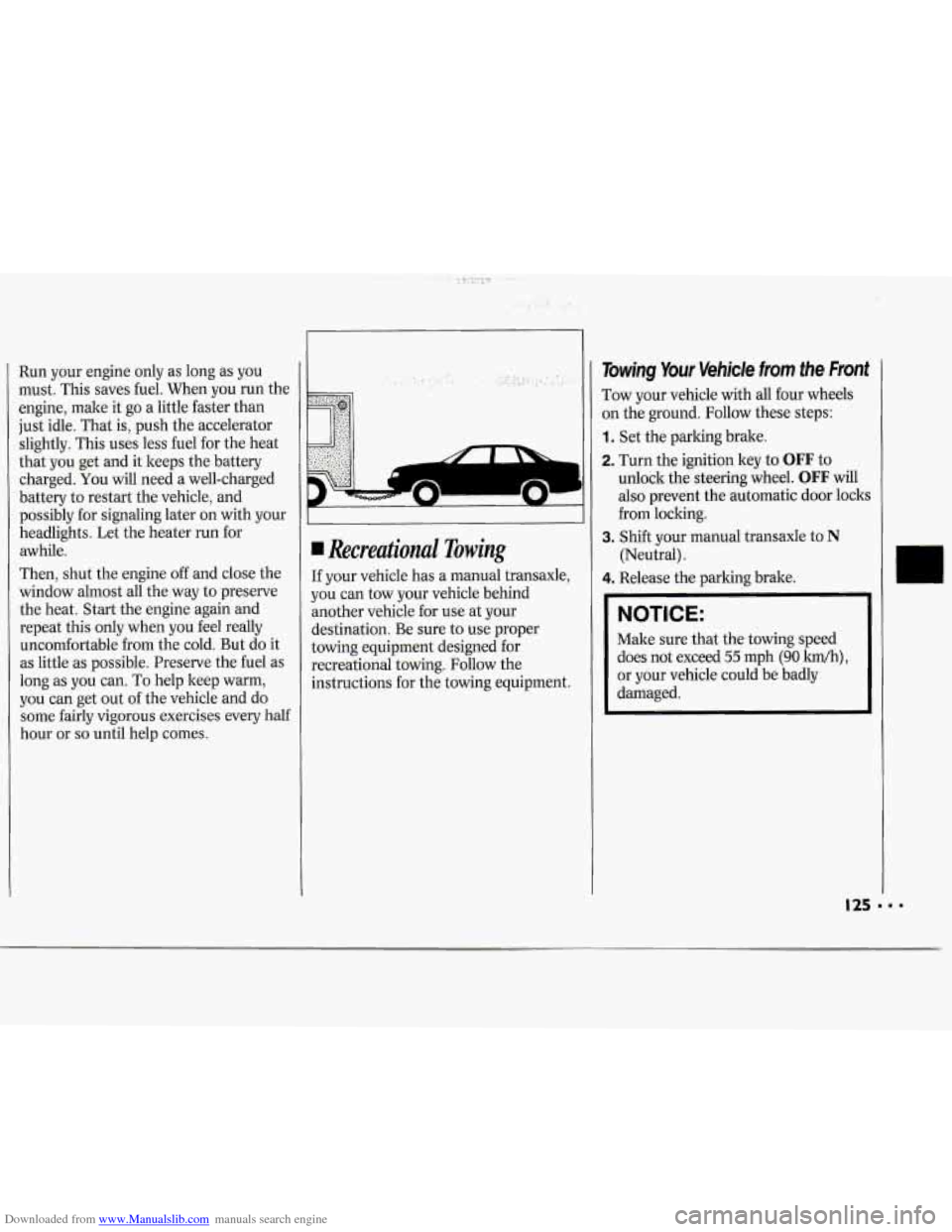
Recreational Towing
If your vehicle has a manual transaxle,
you can tow your vehicle behind
another vehicle for use at your
destination. Be sure
to use proper
towing equipment designed for
recreational towing. Follow the
instructions for the towing equipment.
Towing Your Vehicle from the Front
Tow your vehicle with all four wheels
on the ground. Follow these steps:
1. Set the parking brake.
2. Turn the ignition key to OFF to
unlock the steering wheel.
OFF will
also prevent the automatic door locks
from locking.
(Neutral).
3.
Shift your manual transaxle to
N
4. Release the parking brake.
NOTICE:
Make sure that the towing speed
does not exceed
55 mph (90 lm),
or your vehicle could be badly
damaged.
Page 129 of 243
Downloaded from www.Manualslib.com manuals search engine Problems on the Road
Hazard Warning Flashers
Your hazard warning flashers let you
warn others. They also let police know
you have a problem. Your front and rear
turn signal lights will flash on and
off.
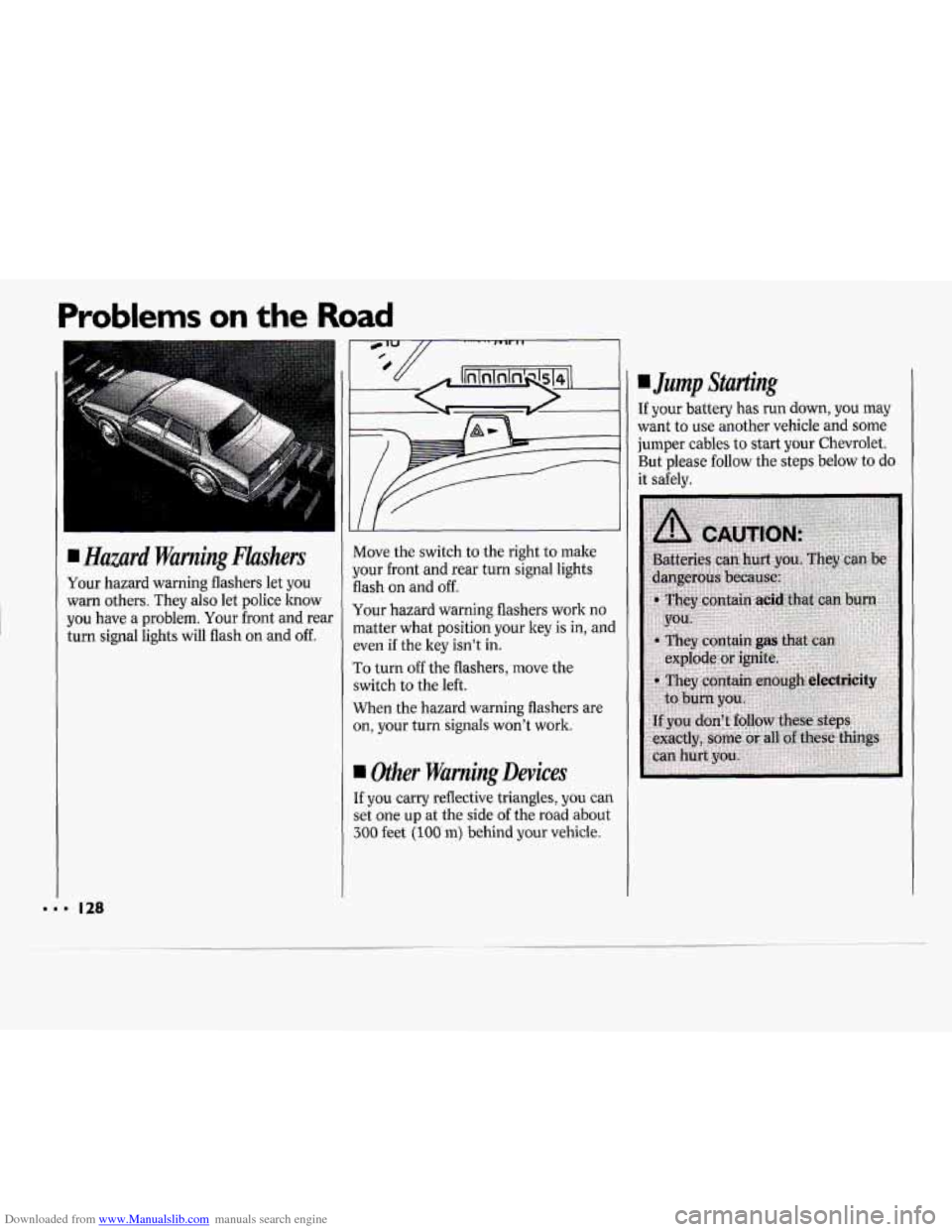
Move the switch to the right to male
your front and rear turn signal lights
flash on and
off.
Your hazard warning flashers work no
matter what position your key
is in, and
even if the key isn’t
in.
To turn off the flashers, move the
switch to the left.
When the hazard warning flashers are
on, your turn signals won’t work.
Other Warning Devices
If you carry reflective triangles, you can
set one
up at the side of the road about
300 feet (100 m) behind your vehicle.
Jump Starting
If your battery has run down, you may
want to use another vehicle and some
jumper cables to start your Chevrolet.
But please follow the steps below to do
it safely.
Page 134 of 243
Downloaded from www.Manualslib.com manuals search engine When your vehicle is being towed, have
the ignition key
off. The steering wheel
should be clamped in a straight-ahead
position, with a clamping device
designed for towing service.
Do not use
the vehicle’s steering column lock for
this. The transaxle should be in
N
(Neutral) and the parking brake
released.
Don’t have your vehicle towed
on the
front wheels, unless you must. If the
vehicle must be towed
on the front wheels,
don’t
go more than 35 mph (56 kdh)
or farther than
50 miles (80 lun) or your
transaxle will be damaged.
If these
limits must be exceeded, then the front
wheels have to be supported on a dolly.
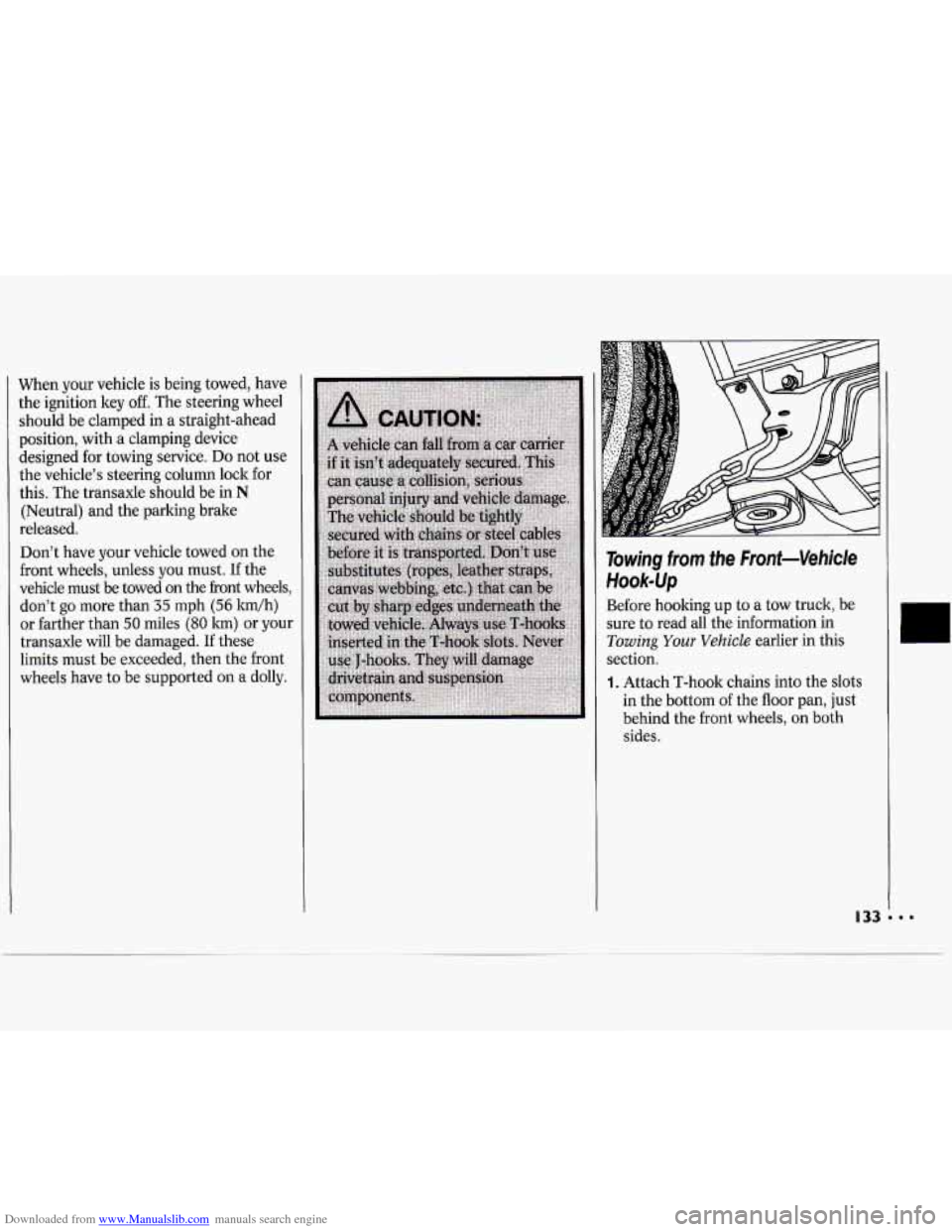
Towing from the Front-Vehicle
Hookup
Before hooking up to a tow truck, be
sure to read all the information in
Towing Your Vehicle earlier in this
section.
1. Attach T-hook chains into the slots
in the bottom
of the floor pan, just
behind the front wheels, on both
sides.
Page 215 of 243
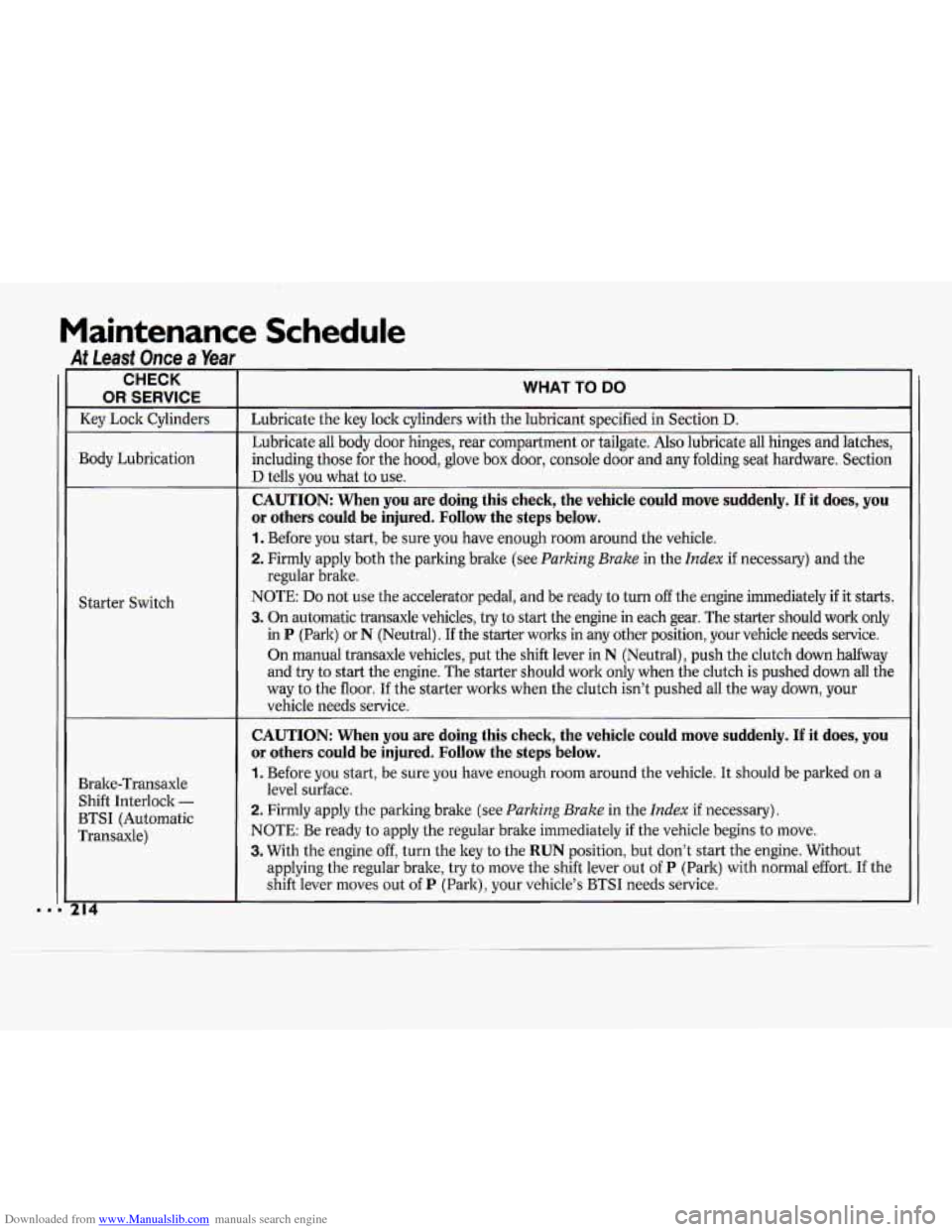
Downloaded from www.Manualslib.com manuals search engine Maintenance Schedule
At Leasf Once a Year
CHECK
-
-
-
OR SERVICE
Key Lock Cylinders
Body Lubrication
Starter Switch
Bralte-Transaxle Shift Interlock
-
BTSI (Automatic
Transaxle)
- z A
WHAT TO DO
Lubricate the key lock cylinders with the lubricant specified in Section D.
Lubricate all body door hinges, rear compartment or tailgate. Also lubricate all hinges and latches,
including those for the hood, glove box door, console
door and any folding seat hardware. Section
D tells vou what to use.
CAUTION: When you are doing this check, the vehicle could move suddenly. If it does, you
or others could be injured. Follow the steps below.
1. Before you start, be sure you have enough room around the vehicle.
2. Firmly apply both the parking brake (see Parking Brake in the Index if necessary) and the
NOTE:
Do not use the accelerator pedal, and be ready to turn off the engine immediately if it starts.
3. On automatic transaxle vehicles, try to start the engine in each gear. The starter should work only
in
P (Park) or N (Neutral). If the starter worlts in any other position, your vehicle needs servic\
e.
On manual transaxle vehicles, put the shift lever in
N (Neutral), push the clutch down halfway
and try to start the engine. The starter should work only when the clutch is pushed down all the
way to the floor.
If the starter worlts when the clutch isn’t pushed all the way down, your
vehicle needs service. regular
brake.
CAUTION: When you are doing this check, the vehicle could move\
suddenly. If it does, you
or others could be injured. Follow the steps below.
1. Before you start, be sure you have enough room around the vehicle. It should be parked on a
2. Firmly apply the parking brake (see Parking Brake in the Index if necessary),
NOTE: Be ready to apply the regular brake immediately if the vehicle begins to move.
3. With the engine off, turn the key to the RUN position, but don’t start the engine. Without
level surface.
applying the regular brake, try to move the shift lever out of
P (Park) with normal effort. If the
shift lever moves out of
P (Park), your vehicle’s BTSI needs service.
Page 216 of 243
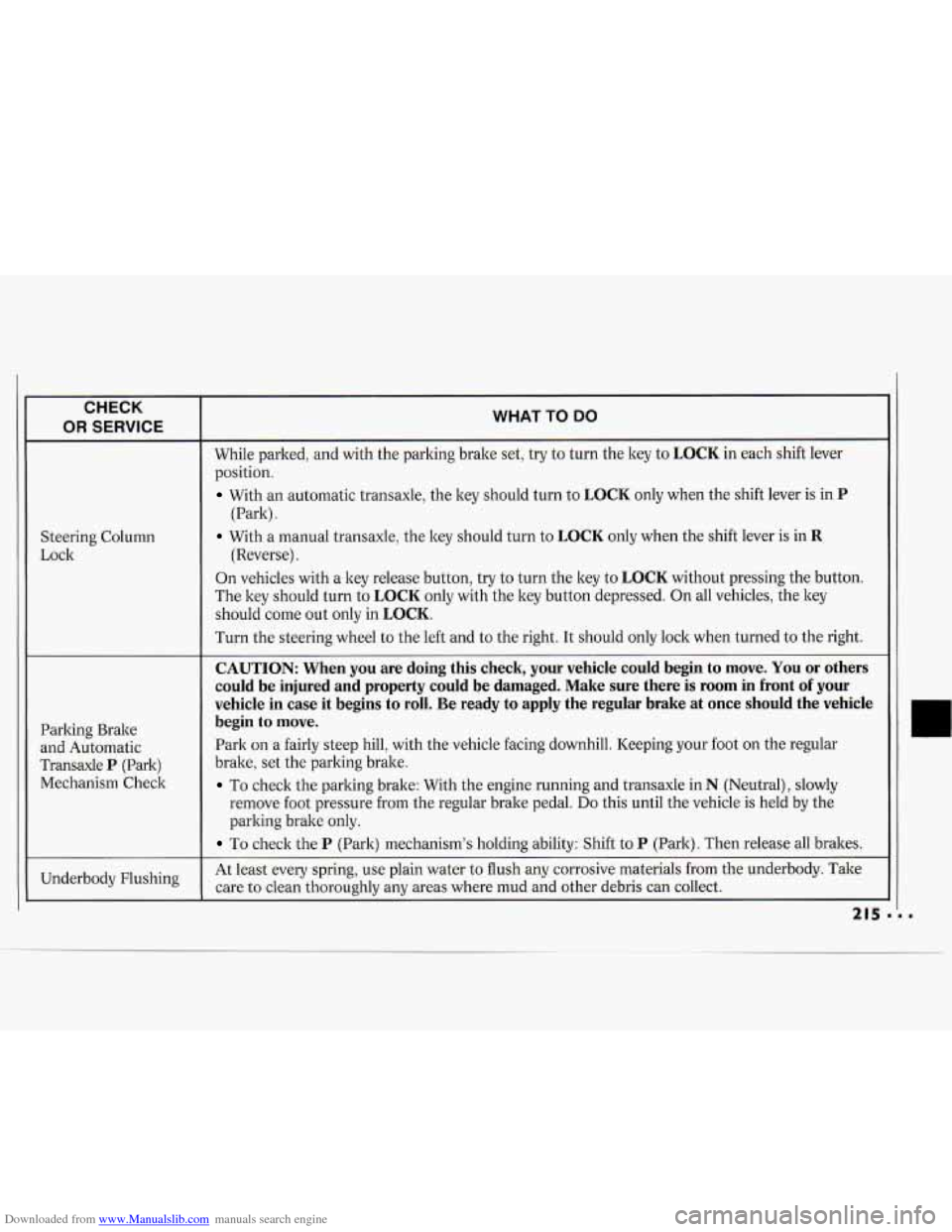
Downloaded from www.Manualslib.com manuals search engine CHECK
I OR SERVICE
Steering Column
Lock
Parking Brake
and Automatic
Transaxle
P (Park)
Mechanism Check
WHAT TO DO
While parked, and with the parking brake set, try to turn the key to LOCK in each shift lever
position.
With an automatic transaxle, the key should turn to LOCK only when the shift lever is in P
(Park) .
With a manual transaxle, the key should turn to LOCK only when the shift lever is in R
(Reverse).
On vehicles with a key release button, try to turn the key to
LOCK without pressing the button.
The key should turn to
LOCK only with the key button depressed. On all vehicles, the key
should come out only in
LOCK.
Turn the steering wheel to the left and to the right. It should only lock when turned to the right.
~~ ~~ ~
CAUTION: When you are doing this check, your vehicle could begin to move. You or others
could be injured and property could be damaged. Make sure ther\
e is room in front
of your
vehicle in case
it begins to roll. Be ready to apply the regular brake at once should the vehicle
begin to move.
Park on a fairly steep hill, with the vehicle facing downhill. Keeping your foot on the regular
brake, set the parking brake.
To check the parking brake: With the engine running and transaxle in N (Neutral), slowly
remove foot pressure from the regular brake pedal.
Do this until the vehicle is held by the
parking brake only.
To check the P (Park) mechanism’s holding ability: Shift to P (Park). Then release all brakes.
At least every spring, use plain water to flush any corrosive materials from the underbody. Take
care
to clean thoroughly any areas where mud and other debris can collect.