tow CHEVROLET CAVALIER 1994 1.G Owner's Manual
[x] Cancel search | Manufacturer: CHEVROLET, Model Year: 1994, Model line: CAVALIER, Model: CHEVROLET CAVALIER 1994 1.GPages: 243, PDF Size: 15.06 MB
Page 147 of 243
Downloaded from www.Manualslib.com manuals search engine Problems on the Road
If a front tire fails, the flat tire will
create a drag that pulls the vehicle
toward that side. Take your foot off the
accelerator pedal and grip the steering
wheel firmly. Steer to maintain lane
position, then gently brake to
a stop
well out
of the traffic lane.
A rear blowout, particularly on a curve,
acts much like a skid and may require
the same correction you’d use in a skid.
In any rear blowout, remove your foot
from the accelerator pedal. Get the
vehicle under control by steering the
way
you want the vehicle to go. It may
be very bumpy and noisy, but you can
still steer. Gently brake to a stop, well
off the road if possible.
If a tire goes flat, the next section shows
how to use your jacking equipment to
change a flat tire safely.
Changing a Flat Tire
If a tire goes flat, avoid further tire and
wheel damage by driving slowly to a
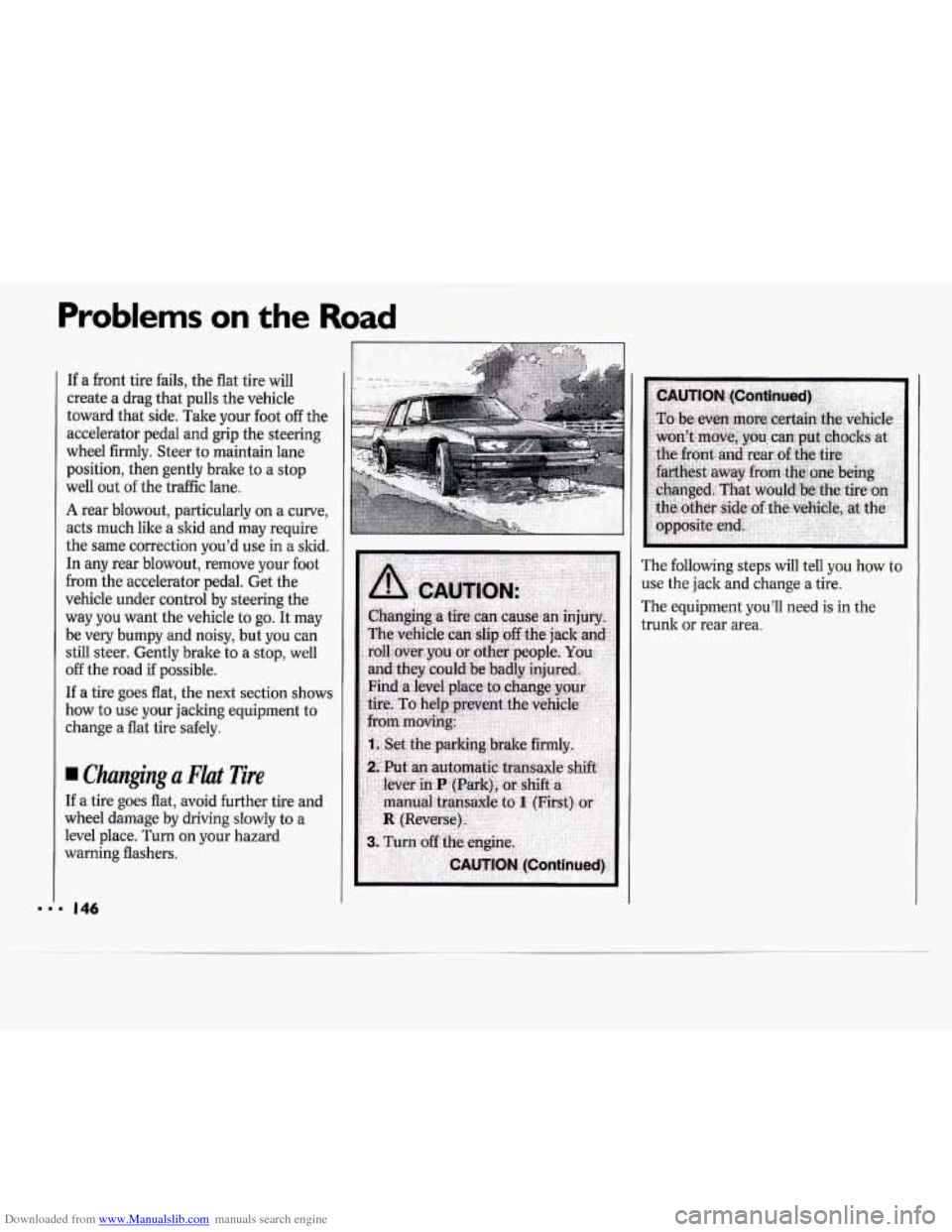
level place. Turn on your hazard
warning flashers. The
following steps will tell you how to
use the jack and change a tire.
The equipment you’ll need
is in the
trunk
or rear area.
Page 151 of 243
Downloaded from www.Manualslib.com manuals search engine Problems on the Road
J
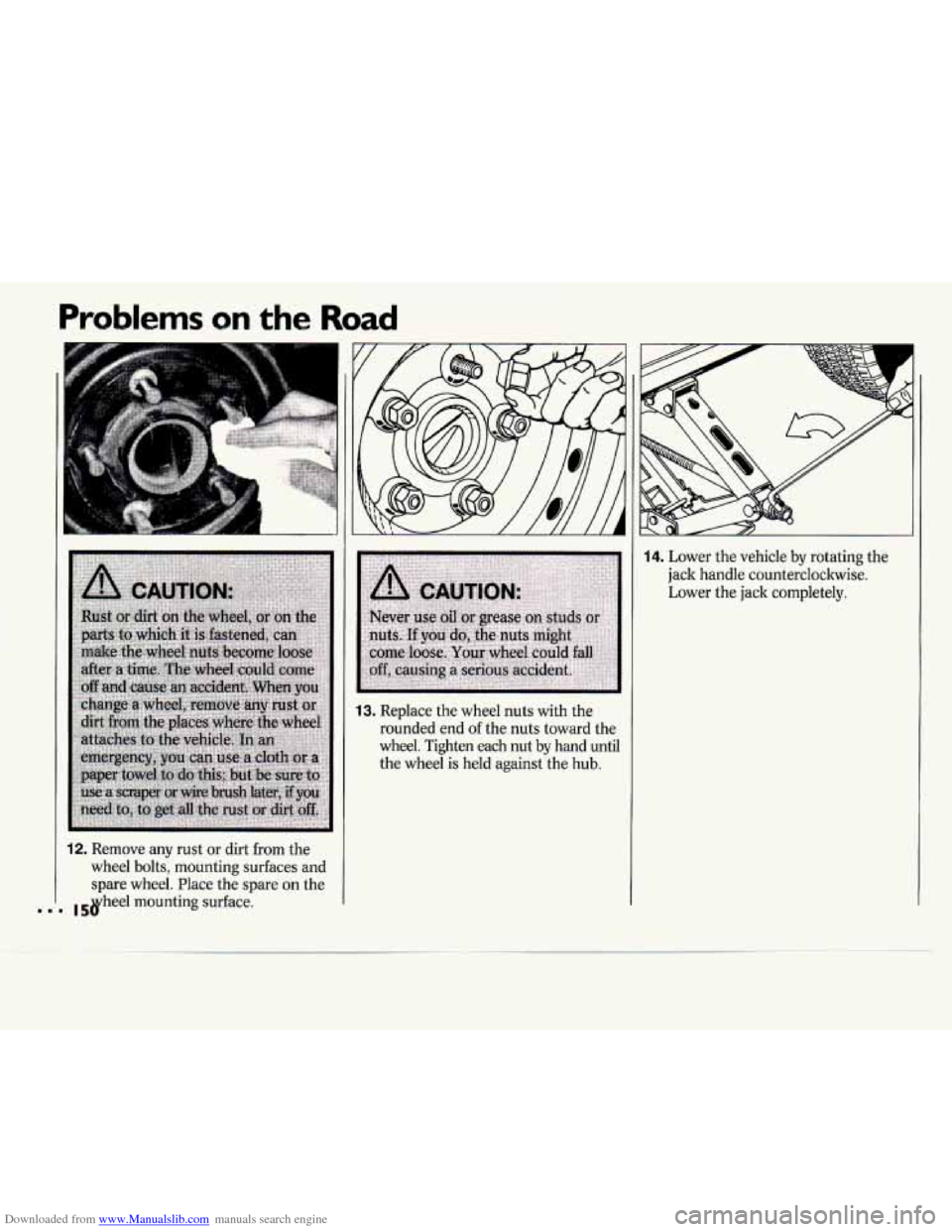
12. Remove any rust or dirt from the
wheel bolts, mounting surfaces and
spare wheel. Place the spare
on the
mounting surface.
F
13. Replace the wheel nuts with the
rounded end of the nuts toward the
wheel. Tighten each nut by hand until
the wheel
is held against the hub.
14. Lower the vehicle by rotating the
jack handle counterclockwise.
Lower the jack completely.
Page 153 of 243
Downloaded from www.Manualslib.com manuals search engine Problems on the Road
Don’t use your compact spare on some
other vehicle.
And don’t mix
your compact spare or
wheel with other wheels or tires. They
won’t fit. Keep your spare and its wheel
together.
NOTICE:
Tire chains won’t fit your compact
spare. Using them will damage your
vehicle and destroy the chains too.
Don’t use tire chains on your
compact spare.
If You’re Stuck: In Sand,
Mud, Ice or Snow
What you don’t want to do when your
vehicle is stuck is to spin your wheels.
The method known as “rocking” can
help you get out when you’re stuck, but
you must use caution.
NOTICE:
Spinning your wheels can destroy
parts of your vehicle as well as the
tires.
If you spin the wheels too fast
while shifting your transaxle back
and forth, you can destroy your
transaxle.
Rocking your vehicle to get it out:
First, turn your steering wheel left and
right. That will clear the area around
your front wheels. Then shift back and
forth between
R (Reverse) and a
fonGard gear (or with a manual
transaxle, between First or Second gear
and Reverse), spinning the wheels as
little as possible. Release the accelerator
pedal while you shift, and press lightly
on the accelerator pedal when the
transaxle is in gear.
If that doesn’t get
you out after a few tries, you may need
to be towed out. If
you do need to be
towed out, see
Towing Your Vehicle in
the
Index.
Page 163 of 243
Downloaded from www.Manualslib.com manuals search engine Service & Appearance Care
Engine Oil
If the oil warning light on the
instrument panel comes on, it means
you need to check your engine oil level
right away. For more information, see
Engine Oil Warning Light in the Index.
You should check your engine oil level
regularly; this is an added reminder.
It’s a good idea to check your engine oil
every time you get fuel. In order to get
an accurate reading, the oil must be
warm and the vehicle must be on level
ground.
Turn
off the engine and give the oil a
few minutes to drain back into the oil
pan. If you don’t, the oil dipstick might
not show the actual level.
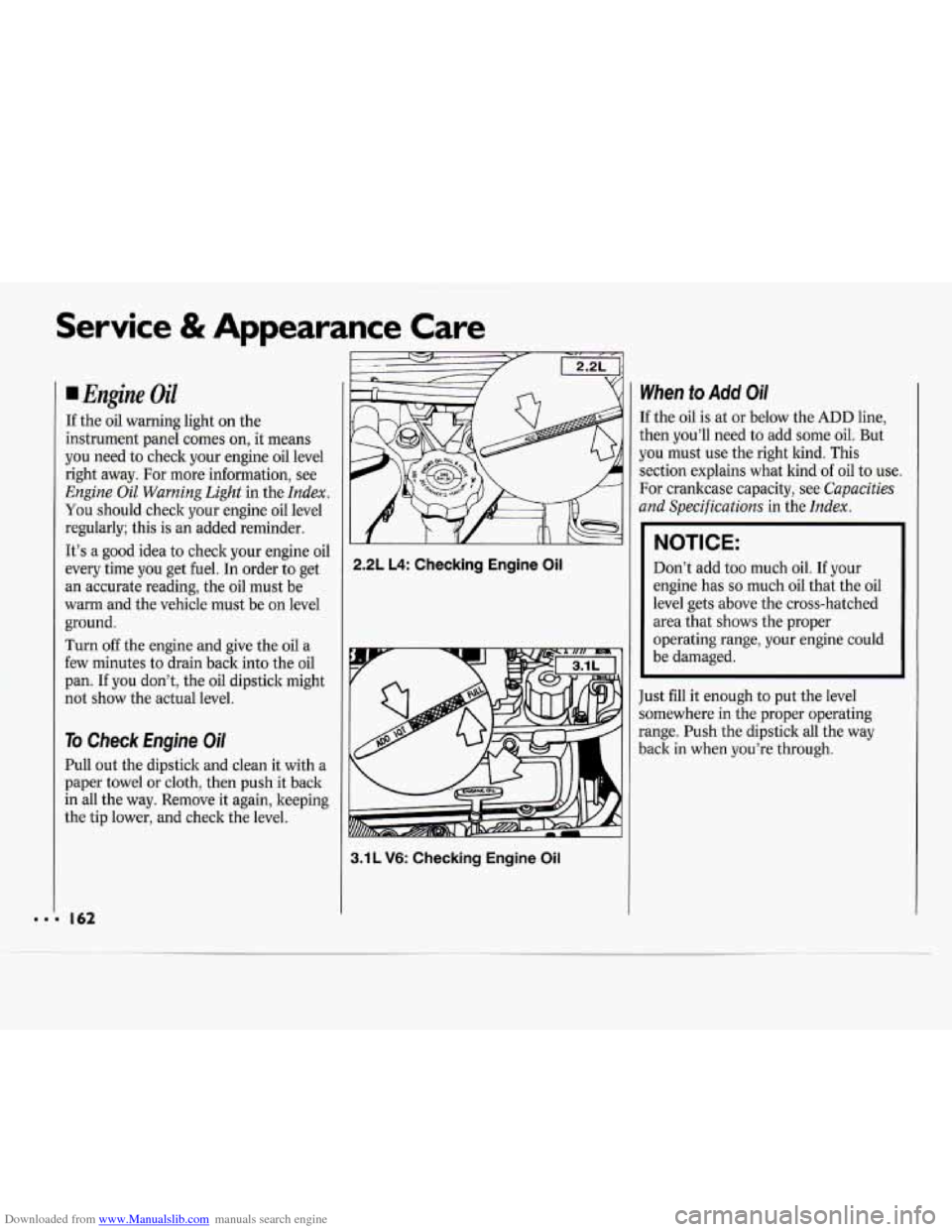
To Check Engine Oil
Pull out the dipstick and clean it with a
paper towel or cloth, then push it back
in all the way. Remove it again, keeping
the tip lower, and check the level.
2.2L L4: Checking Engine Oil
3.1 L V6: Checking Engine Oil
When to Add Oi/
If the oil is at or below the ADD line,
then you’ll need to add some oil. But
you must use the right kind. This
section explains what kind of oil to use.
For crankcase capacity, see
Capacities
and Specifications
in the Index.
NOTICE:
Don’t add too much oil. If your
engine has
so much oil that the oil
level gets above the cross-hatched
area that shows the proper
operating range, your engine could
be damaged.
Just
fill it enough to put the level
somewhere in the proper operating
range. Push the dipstick all the way
back in when you’re through.
Page 168 of 243
Downloaded from www.Manualslib.com manuals search engine I Automatic Transaxle Fluid
1 When to Check and Change
A good time to check your automatic
transaxle fluid level is when the engine
oil is changed. Refer to the Maintenance
Schedule to determine when to change
your fluid. See
Scheduled Maintenance
Services
in the Index.
How to Check
Because this operation can be a little
difficult, you may choose to have this
done at your Chevrolet dealership
Service Department.
If you do it yourself, be sure to follow
all the instructions here, or
you could
get a false reading on the dipstick.
NOTICE:
~. , ,'
Too much or too little fluid can
damage your transaxle.
Too much can
mean that some of the fluid could
come out and fall on hot engine parts
or exhaust system, starting a fire.
Be sure to get an accurate reading
if
you check your transaxle fluid.
Wait at least
30 minutes before
checking the transaxle fluid level
if you
have been driving:
When outside temperatures are above
At high speed for quite a while.
In heavy traffic - especially in hot
To get the right reading, the fluid
should be at normal operating
temperature, which is 180°F to 200°F
(82°C to 93°C).
Get the vehicle warmed up by driving
about 15 miles (24 lun) when outside
temperatures are above
50°F (10.C). If
it's colder than 50°F (lOOC), you may
have to drive longer.
90°F
(32°C).
weather.
To check the fluid level
Park your vehicle on a level place.
With the parking brake applied, place
With your foot on the brake pedal,
the
shift lever in
P (Park).
move the shift lever through each gear
range, pausing for about three
seconds in each range. Then, position
the shift lever in
P (Park).
Let the engine run at idle for three to
five minutes.
Then, without shutting off the engine,
follow these steps:
1. Pull out the dipstick and wipe it with
2. Push it back in all the way, wait three
a clean rag or
paper towel.
seconds and then pull it back out
again.
3. Check both sides of the dipstick, and
read the lower level. The fluid level
must be in the cross-hatched area.
4. If the fluid level is in the acceptable
range, push the dipstick back in all
the way.
Page 170 of 243
Downloaded from www.Manualslib.com manuals search engine Manual Transaxle Fluid
When to Check
A good time to have it checked is when
the engine oil is changed. However, the
fluid in your manual transaxle doesn't
require changing.
How to Check
Because this operation can be a little
difficult, you may choose to have this
done at a Chevrolet dealership Service
Department.
If you do it yourself, be sure to follow
all the instructions here, or you could
get a false reading on the dipstick.
NOTICE:
Too much or too little fluid can
damage your transaxle.
Too much
can mean that some of the fluid
could come out and fall on hot'
engine parts or exhaust system,
starting a fire. Be sure to get an
accurate reading if you check your
transaxle fluid. Check
the fluid level only when your
engine is off, the vehicle is parked on a
level place and the transaxle is cool
enough for you to rest your fingers on
the transaxle case.
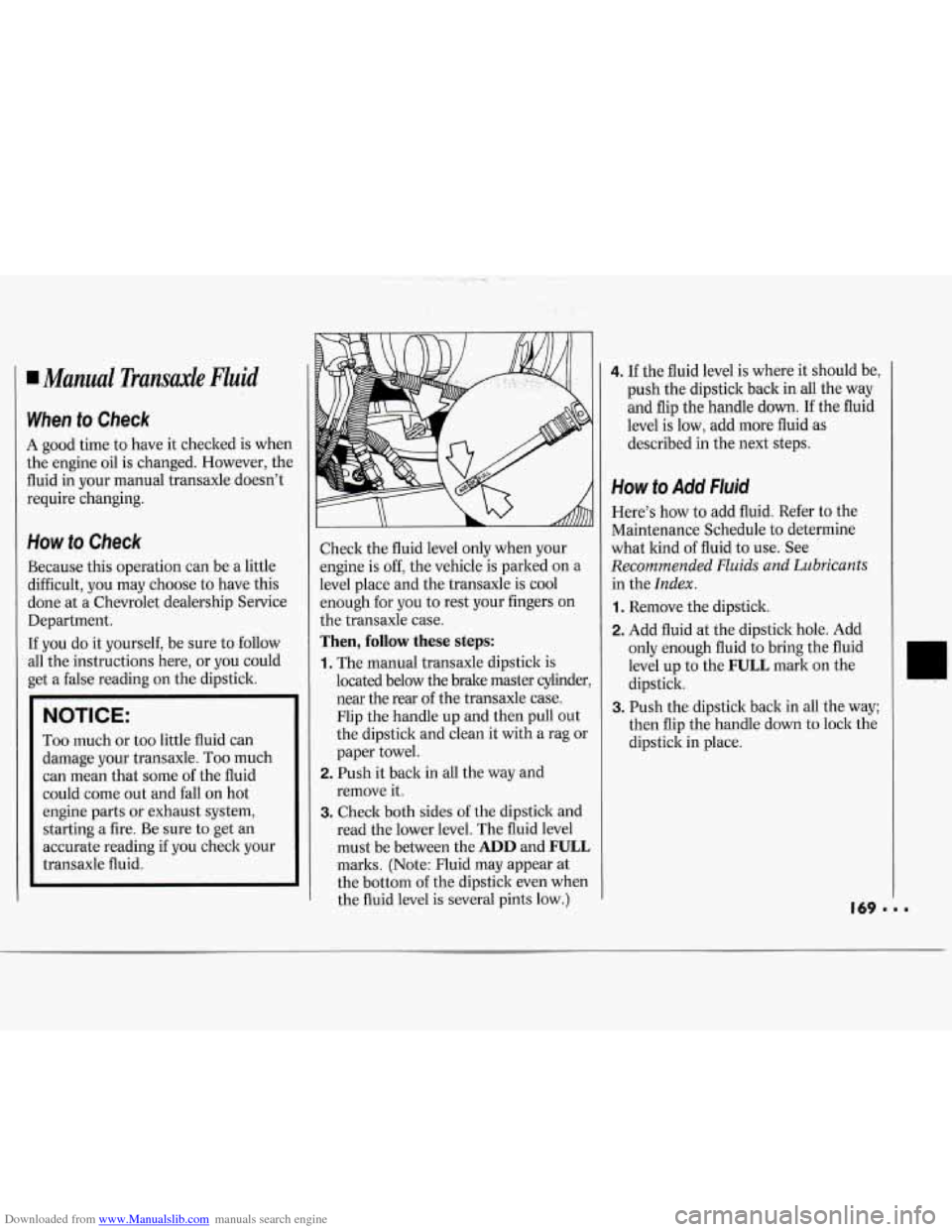
Then, follow these steps:
1. The manual transaxle dipstick is
located below the brake master cylinder
near the rear of the transaxle case.
Flip the handle up and then pull out
the dipstick and clean it with a rag or
paper towel.
2. Push it back in all the way and
remove it.
3. Check both sides of the dipstick and
read the lower level. The fluid level
must be between the
ADD and FULL
marks. (Note: Fluid may appear at
the bottom of the dipstick even when
the fluid level is several pints low.)
4. If the fluid level is where it should be,
push the dipstick back in all the way
and flip the handle down.
If the fluid
level is low, add more fluid as
described in the next steps.
How to Add Fluid
Here's how to add fluid. Refer to the
Maintenance Schedule to determine
what kind of fluid to use. See
Recommended Fluids and Lubricants
in the Index.
1. Remove the dipstick.
2. Add fluid at the dipstick hole. Add
only enough fluid to bring the fluid
level up to the
FULL mark on the
dipstick.
3. Push the dipstick back in all the way;
then flip the handle down
to lock the
dipstick in place.
Page 189 of 243
Downloaded from www.Manualslib.com manuals search engine Service & Appearance Care
Never use these to clean your vehicle:
Gasoline
Benzene
Naphtha
Carbon Tetrachloride
Acetone
Paint Thinner
Turpentine
Lacquer Thinner
Nail Polish Remover
They can all be hazardous
- some
more than others
- and they can all
damage your vehicle, too.
NOTICE:
Don’t use any of these unless this
manual says
you can. In many uses,
these will damage your vehicle:
Alcohol
Laundry Soap
Bleach
Reducing Agents
Cleaning the Inside of Your
Chevrolet
Use a vacuum cleaner often to get rid of
dust and loose dirt. Wipe vinyl or
leather with
a clean, damp cloth.
Your Chevrolet dealer has two GM
cleaners, a solvent-type spot lifter and a
foam-type powdered cleaner. They will
clean normal spots and stains very well.
Do not use them on vinyl or leather.
Here are some cleaning tips:
Always read the instructions on the
cleaner label.
Clean up stains as soon as you can -
before they set.
Use a clean cloth or sponge, and
change to a clean area often.
A soft
brush may be used
if stains are
stubborn.
ventilated area only. If you use them,
don’t saturate the stained area.
If a ring forms after spot cleaning,
clean the entire area immediately or it
will set.
Use solvent-type cleaners in a well-
Using Foam-Type Cleaner on
Fabric
Vacuum and brush the area to remove
Always clean a whole trim panel or
any
loose dirt.
section. Mask surrounding trim along
stitch or welt lines.
,
Mix Multi-Purpose Powdered Cleaner
following the directions on the
container label.
Use suds only and apply with a clean
Don’t saturate the material.
Don’t rub it roughly.
As soon as you’ve cleaned the section,
use a sponge to remove the suds.
Rinse the section with a clean, wet
sponge.
Wipe off what’s left with a slightly
damp paper towel or cloth.
Then dry it immediately with a blow
dryer or a heat lamp.
sponge.
Page 190 of 243
Downloaded from www.Manualslib.com manuals search engine NOTICE:
Be careful with a hair dryer or heat
lamp. You could scorch the fabric.
Wipe with a clean cloth.
Using Solvent-Type Cleaner on
Fabric
First, see if you have to use solvent-type
cleaner at all. Some spots and stains
will clean off better with just water and
mild soap.
If you need to use a solvent:
Gently scrape excess soil from the
trim material with a clean, dull knife
or scraper. Use very little cleaner,
light pressure and clean cloths
(preferably cheesecloth). Cleaning
should start at the outside of the
stain, “feathering” toward the center.
Keep changing to a clean section of
the cloth.
When you clean a stain from fabric,
immediately dry the area with an air
hose, hair dryer, or heat lamp to help
prevent a cleaning ring. (See the
previous NOTICE.)
Fabric hotection
Your Chevrolet has upholstery that has
been treated with Scotchgard’” Fabric
Protector, a 3M product. ScotchgardTM
protects fabrics by repelling oil and
water, which are the carriers of most
stains. Even with this protection, you
still need to clean your upholstery often
to keep it looking new.
Further information on cleaning is
available by calling 1-800-433-3296 (in
Minnesota, 1-800-642-6167).
Special Cleaning Problems
Greasy or Oily Stains
Such as grease, oil, butter, margarine,
shoe polish, coffee with cream, chewing
gum, cosmetic creams, vegetable oils,
wax crayon, tar and asphalt.
Carefully scrape off excess stain.
Follow the solvent-type instructions
Shoe polish, wax crayon, tar and
described earlier.
asphalt will stain if left on a vehicle
seat fabric. They should be removed
as soon as possible. Be careful,
because the cleaner will dissolve them
and may cause them to spread.
Non-Greasy Stains
Such as catsup, coffee (black), egg,
fruit,
fruit juice, milk, soft drinks, wine,
vomit, urine and blood.
Carefully scrape off excess stain, then
sponge the soiled area with cool
water.
If a stain remains, follow the foam-
type instructions described earlier.
If an odor lingers after cleaning vomit
or urine, treat the area with a
.
waterhaking soda solution: 1
teaspoon (5 ml) of baking soda to 1
cup (250 ml) of lukewarm water.
If needed, clean lightly with solvent-
type cleaner.
Combination Stains
Such as candy, ice cream, mayonnaise,
chili sauce and unknown stains.
Carefully scrape off excess stain, then
clean with cool water and allow to
dry-
If a stain remains, clean it with
solvent-type cleaner.
189 I
Page 191 of 243
Downloaded from www.Manualslib.com manuals search engine Service & Appearance Care
190
Cleaning Vinyl
Use warm water and a clean cloth.
Rub with a clean, damp cloth to
remove dirt.
You may have to do it
more than once.
polish will stain if you don’t get them
off quickly. Use a clean cloth and a
solvent-type vinyl cleaner.
Things like tar, asphalt and shoe
Cleaning the Top of the
Instrument Panel
Use only mild soap and water to clean
the top surfaces of the instrument
panel. Sprays containing silicones or
waxes may cause annoying reflections
in the windshield and even make it
difficult to see through the windshield
under certain conditions.
1 Ckaning the Cupholder
If beverages get spilled on your
cupholder, it may become difficult to
operate. The slider mechanism can
become clogged with pop, coffee, etc.
To clean and return the cupholder to normal
operation, simply spray
a water-
based cleaner (such as Glass Plus@ or
Windex@) on the tracks of the slider
mechanism, and then slide the
cupholder in and out until normal
operation
is regained. Hold a paper
towel under the cupholder to catch any
excess cleaner which could drip on your
carpet or seats.
Care of Safety Belts
Keep belts clean and dry.
Glass
Glass should be cleaned often. GM
Glass Cleaner
(GM Part No. 1050427)
or a liquid household glass cleaner will
remove normal tobacco smoke and dust
films.
Don’t use abrasive cleaners on glass,
because they may cause scratches.
Avoid placing decals
on the inside rear
window, since they may have to be
scraped
off later. If abrasive cleaners are
used on the inside of the rear window,
an electric defogger element may be
damaged. Any temporary license should
not be attached across the defogger grid.
I Cleaning the Outside of the
Windshield and Wiper
Blades
If the windshield is not clear after using
the windshield washer, or if the wiper
blade chatters when running, wax or
other material may be on the blade
or
windshield.
Page 192 of 243
Downloaded from www.Manualslib.com manuals search engine Clean the outside of the windshield
with GM Windshield Cleaner, Bon-Ami
Powder@ (GM Part
No. 1050011). The
windshield is clean
if beads do not form
when you rinse it with water.
Clean the blade by wiping vigorously
with a cloth soaked in full strength
windshield washer solvent. Then rinse
the blade with water.
Wiper blades should be checked on a
regular basis and replaced when worn.
Cleuning tbe Outside of Your
Chevrolet
The paint finish on your vehicle
provides beauty, depth of color, gloss
retention and durability.
Washing Your Vehicle
The best way to preserve your vehicle’s
finish is to keep it clean by washing it
often with lukewarm or cold water.
Don’t wash your vehicle in the direct
rays
of the sun. Don’t use strong soaps
or chemical detergents. Use liquid hand,
dish or car washing (mild detergent) soaps. Don’t
usecleaning
8 @o&-that
contain acid
or abrasives. 31 cleaning
agents should be flushed promptly and
not allowed to dry on the surface, or
they could stain.
Dry the finish with a
soft, clean chamois or a 100% cotton
towel to avoid surface scratches and
water spotting.
High pressure car washes may cause
water to enter your vehicle.
Finish Care
Occasional waxing or mild polishing of
your Chevrolet may be necessary to
remove residue from the paint finish.
You can get GM approved cleaning
products from your dealer.
Your Chevrolet has a ‘Lbasecoat/clearcoat”
paint finish. The clearcoat gives more
depth and gloss to the colored basecoat.
Always use waxes and polishes that are
non-abrasive and made for a
basecoat/clearcoat paint finish.
NOTICE:
Machine compounding or
aggressive polishing on a
basecoat/clearcoat. paint finish may
dull the finish or leave swirl marks.
Rxtured-Surjace Bumper
Covers
WL AND RS MODELS)
Cleaning with a brush, a soft terry cloth
or a commercial car wash is
recommended for normal dirt. Never
use a wire brush or abrasives.
Avoid applying wax or polish to the
textured-surface bumper covers.
To
remove wax, a commercially available
wax solvent should be used. Tar and Oil
Remover (GM Part
No.1050172) is also
recommended. It’s also recommended
for cleaning difficult
soils like road tar
and oil.
Also recommended are solvent-
type fabric cleaners such as GM
Part
No. 1050214.
191 ...