brake CHEVROLET CAVALIER 1994 1.G Service Manual
[x] Cancel search | Manufacturer: CHEVROLET, Model Year: 1994, Model line: CAVALIER, Model: CHEVROLET CAVALIER 1994 1.GPages: 243, PDF Size: 15.06 MB
Page 176 of 243
Downloaded from www.Manualslib.com manuals search engine Use new brake fluid from a sealed container only, and always clean the
brake fluid reservoir cap before
removing it.
I
NOTICE:
DOT-5 silicone brake fluid can
Don’t let someone put in the
damage your vehicle. Don’t
use it.
wrong kind of fluid. For example,
just
a few drops of mineral-based
oil, such as engine
oil, in your
brake system can damage brake system parts
so badly that they’ll
have to be replaced.
Brake fluid can damage paint, so
be careful not to spill brake fluid
on your vehicle. If you do, wash it
OF immediately. See Appearance
Cave
in the Index.
II
Brake Wear
Your Chevrolet has front disc brakes
and rear drum brakes.
Disc brake pads have built-in wear
indicators that make a high-pitched warning sound when
~ the
b&e..p@dsa .ve,
worn and new‘
pads are needed: .The ‘
sound may come and go or be heard all
the time your vehicle is moving (except
when you are pushing on the brake
pedal firmly).
NOTICE:
Continuing to drive with worn-out
brake pads could result in costly
brake repair.
Some driving conditions or climates
may cause
a brake squeal when the
brakes are first applied or lightly
applied. This does not mean something
is wrong with your brakes. Your
rear drum brakes don’t have wear
indicators, but if you ever hear a rear
brake rubbing noise, have the rear brake
linings inspected.
Also, the rear brake
drums should be removed and
inspected each time the tires are
removed for rotation or changing. When
you have the front brakes replaced,
have the rear brakes inspected, too.
Brake linings should always be replaced
as complete axle sets.
Brake Pedal Travel
See your dealer if the brake pedal does
not return to normal height, or if there
is
a rapid increase in pedal travel. This
could be a sign of brake trouble.
Brake Adjustment
Every time you make a moderate brake
stop, your disc brakes adjust for wear. If
you rarely make a moderate or heavier stop, then your brakes might not adjust
correctly.
If you drive in that way, then
- very carefully - make a few
moderate brake stops about every
1,000
miles (1600 lun), so your brakes will
adjust properly.
Page 177 of 243
Downloaded from www.Manualslib.com manuals search engine Service & Appearance Care
If your brake pedal goes down farther
than normal, your rear drum brakes
may need adjustment. Adjust them by
backing up and firmly applying the
brakes a few times.
Replacing Brake System Pa&
The braking system on a modern
vehicle is complex. Its many parts ha
to be
of top quality and work well we
together
if the vehicle is to have really
good braking. Vehicles we design and
test have top-quality GM brake parts in
them, as your Chevrolet does when it is
new. When you replace parts
of your
braking system
- for example, when
your brake linings wear down and you
have to have new ones put in
- be sure
you get new genuine
GM replacement
parts. If
you don’t, your brakes may no
longer work properly. For example, if
someone puts in brake linings th,at are
wrong for your vehicle, the balance
between your front and rear brakes can
change, for the worse. The braking
performance you’ve come to expect can
change in many other ways
if someone
puts in the wrong replacement brake
parts.
Battery
Every new Chevrolet has a Delco
Freedom* battery.
You never have to
add water to one of these. When it’s
time for a new battery, we recommend a
Delco Freedom* battery. Get one that
has the catalog number shown on the
original battery’s label.
Vehicle Storage
If you’re not going to drive your vehicle
for
25 days or more, take off the black,
negative
(-) cable from the battery. This
will help keep your battery
from
running down. Contact
your dealer to learn how to
prepare your vehicle for longer storage
periods.
Halogen Bulbs
Page 187 of 243
Downloaded from www.Manualslib.com manuals search engine Service & Appearance Care
Wheel Alignment and Tire Balance
The wheels on your vehicle were
aligned and balanced carefully at the
factory
to give you the longest tire life
and best overall performance.
In most cases, you will not need to have
your wheels aligned again. However, if
you notice unusual tire wear or your
vehicle pulling one way or the other, the
alignment may need
to be reset. If you
notice your vehicle vibrating when
driving on
a smooth road, your wheels
may need to be rebalanced.
Wheel Replacement
Replace any wheel that is bent, cracked
or badly rusted.
If wheel nuts keep
coming loose, the wheel, wheel bolts,
and wheel nuts should be replaced.
If
the wheel leaks air, replace it (except
some aluminum wheels, which can
sometimes be repaired). See your
Chevrolet dealer if any
of these
conditions exist.
Your dealer will know the kind of wheel
you need.
Each new wheel should have the same
load carrying capacity, diameter, width,
offset, and be mounted the same way as
the one it replaces.
If you need to replace any of your
wheels, wheel bolts, or wheel nuts,
replace them only with new
GM
original equipment parts. This way, you
will be sure
to have the right wheel,
wheel bolts, and wheel nuts for your
Chevrolet model.
I NOTICE:
The wrong wheel can also cause
problems with bearing life, brake
cooling, speedometer/odometer
calibration, headlight aim, bumper
height, vehicle ground clearance,
and tire or tire chain clearance to
the body and chassis.
Page 197 of 243
Downloaded from www.Manualslib.com manuals search engine Service & Appearance Care
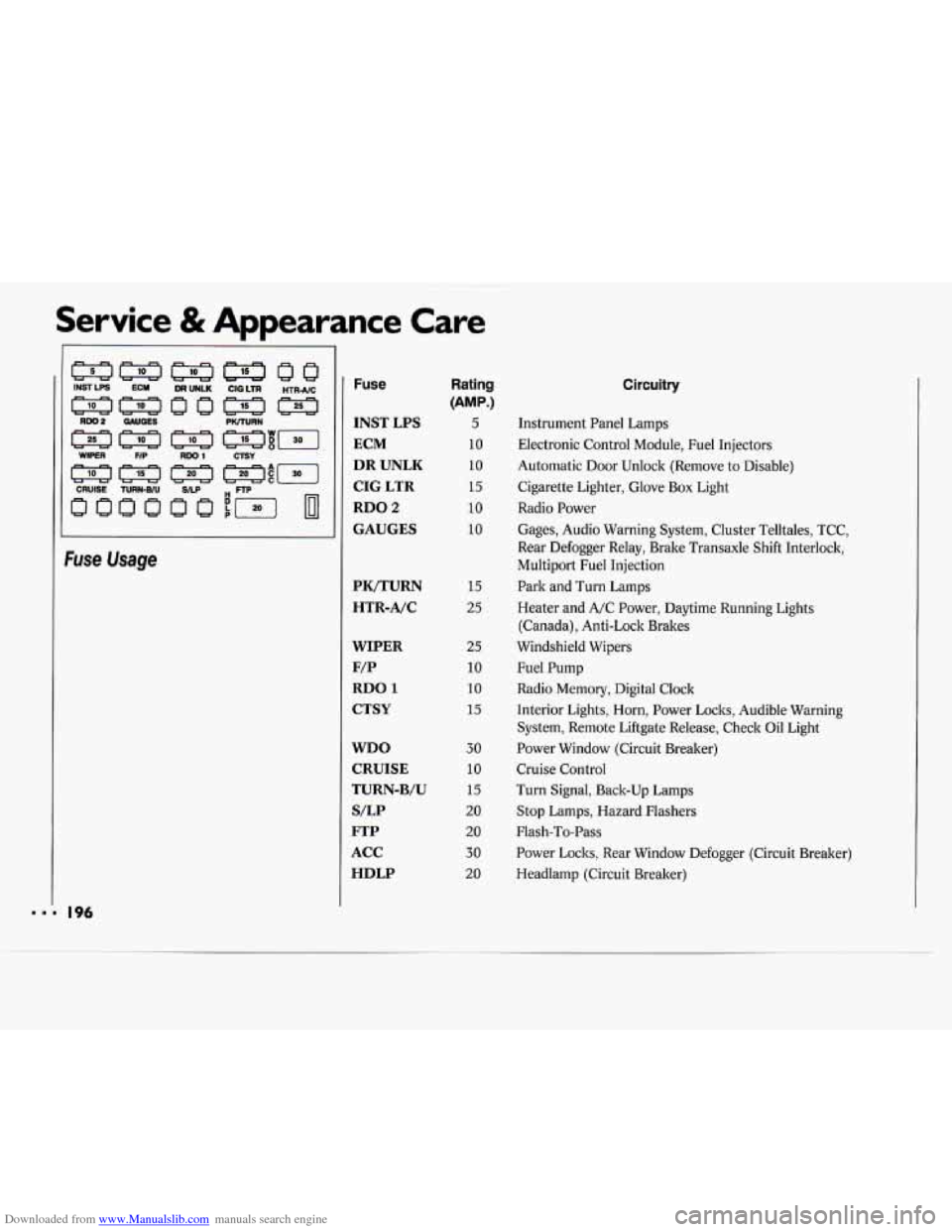
Vse Usage 1
196
Fuse
INST LPS
ECM
DR UNLK
CIG LTR
RDO 2
GAUGES
PIUTURN
HTR-A/C
WIPER
F/P
RDO
1
CTSY
WDO CRUISE
TURN-B/U S/LP
FTP
ACC HDLP
Rating
(AMP.)
5
10
10
15
10
10
15
25
25
10
10
15
30
10
15
20
20
30
20
Circuitry
Instrument Panel Lamps
Electronic Control Module, Fuel Injectors
Automatic Door Unlock (Remove to Disable)
Cigarette Lighter, Glove Box Light
Radio Power
Gages, Audio Warning System, Cluster Telltales, TCC,
Rear Defogger Relay, Brake Transaxle Shift Interlock,
Multiport Fuel Injection
Park and Turn Lamps
Heater and A/C Power, Daytime Running Lights
(Canada), Anti-Lock Brakes
Windshield Wipers
Fuel Pump Radio Memory, Digital Clock
Interior Lights, Horn, Power Locks, Audible Warning
System, Remote Liftgate Release, Check Oil Light
Power Window (Circuit Breaker)
Cruise Control
Turn Signal, Back-Up Lamps
Stop Lamps, Hazard Flashers
Flash-To-Pass
Power Locks, Rear Window Defogger (Circuit Breaker)
Headlamp (Circuit Breaker)
Page 200 of 243
Downloaded from www.Manualslib.com manuals search engine ,
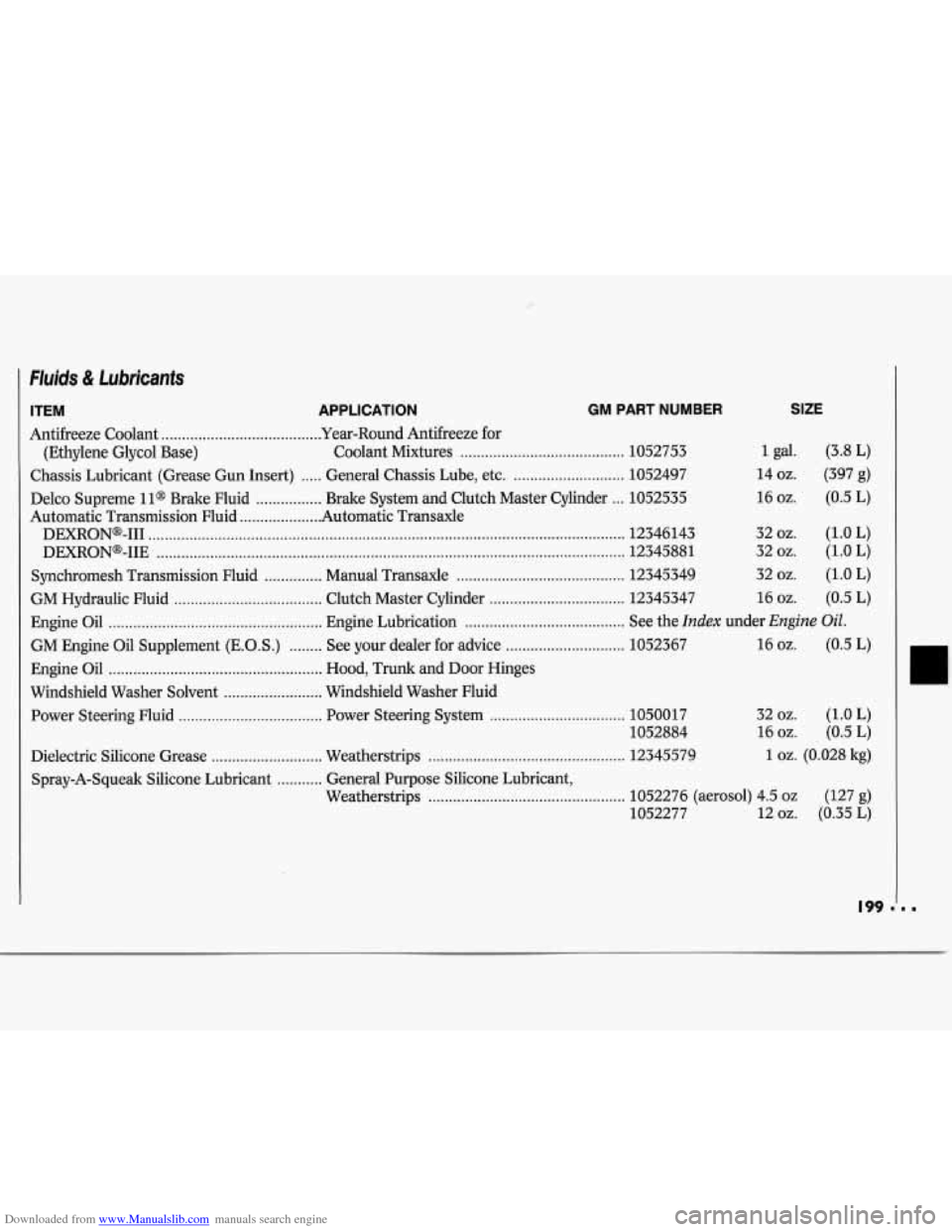
Fluids & Lubricants
ITEM APPLICATION GM PART NUMBER
Antifreeze Coolant ...................................... .Year-Round Antifreeze for
(Ethylene Glycol Base) Coolant Mixtures
........................................ 1052753
Chassis Lubricant (Grease Gun Insert)
..... General Chassis Lube, etc. ........................... 1052497
Delco Supreme
1 l@ Brake Fluid ................ Brake System and Clutch Master Cylinder ... 1052535
Automatic Transmission Fluid
.................... Automatic Transaxle
DEXRON@-I11
........................................................................\
............................................ 12346143
DEXRONa-IIE
........................................................................\
.......................................... 12345881
Synchromesh Transmission Fluid
.............. Manual Transaxle ......................................... 12345349
GM Hydraulic Fluid
.................................... Clutch Master Cylinder ................................. 12345347
SIZE
1 gal.
14 oz.
16 oz.
32 oz.
32 oz.
32 oz.
16 oz. (3.8 L)
(397
8)
(0.5 L)
(1.0
L)
(1.0 L)
(1.0 L)
(0.5 L)
Engine Oil
.................................................... Engine Lubrication ....................................... See the Index under Engine Oil.
GM Engine Oil Supplement (E.O.S.) ........ See your dealer for advice ............................. 1052367 16 oz. (0.5 L)
Engine Oil
.................................................... Hood, Trunk and Door Hinges
Windshield Washer Solvent
........................ Windshield Washer Fluid
Power Steering Fluid
................................... Power Steering System ................................. 1050017 32 oz. (1 .O L)
1052884 16 oz.
(0.5 L)
Dielectric Silicone Grease
........................... Weatherstrips ................................................ 12345579 1 oz. (0.028 kg)
Spray-A-Squeak Silicone Lubricant
........... General Purpose Silicone Lubricant,
Weatherstrips
................................................ 1052276 (aerosol) 4.5 oz (127 g)
1052277 12 02. (0.35 L)
I
Page 202 of 243
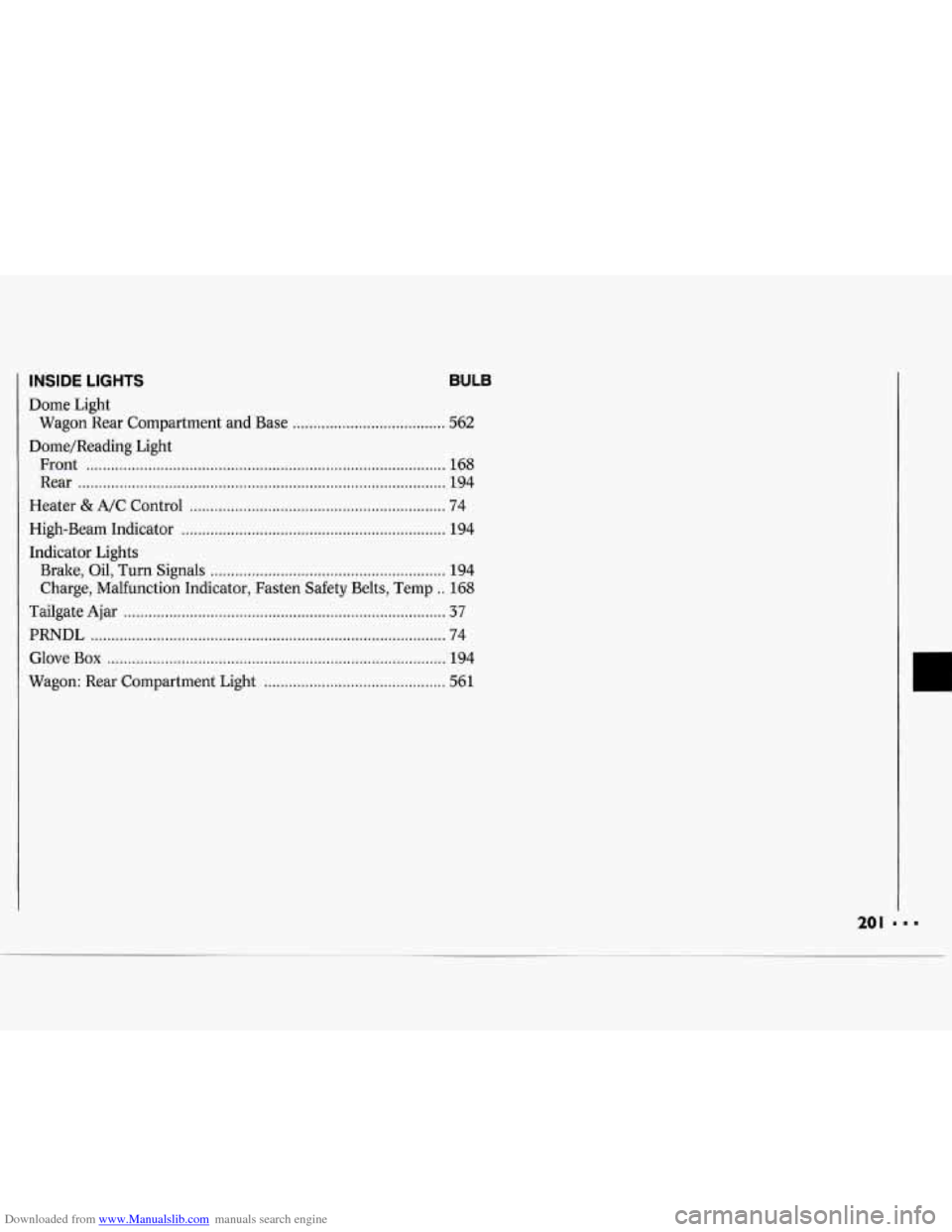
Downloaded from www.Manualslib.com manuals search engine BULB INSIDE LIGHTS
Dome Light
Dome/Reading Light Wagon Rear
Compartment and Base
..................................... 562
Front
........................................................................\
............... 168
Rear ........................................................................\
................. 194
Heater
& A/C Control .............................................................. 74
High-Beam Indicator
................................................................ 194
Indicator Lights
Brake.
Oil. Turn Signals ......................................................... 194
Charge. Malfunction Indicator. Fasten Safety Belts. Temp
.. 168
Tailgate Ajar ........................................................................\
...... 37
PRNDL ........................................................................\
.............. 74
Glove
Box ........................................................................\
.......... 194
Wagon: Rear Compartment Light
............................................ 561
Page 215 of 243
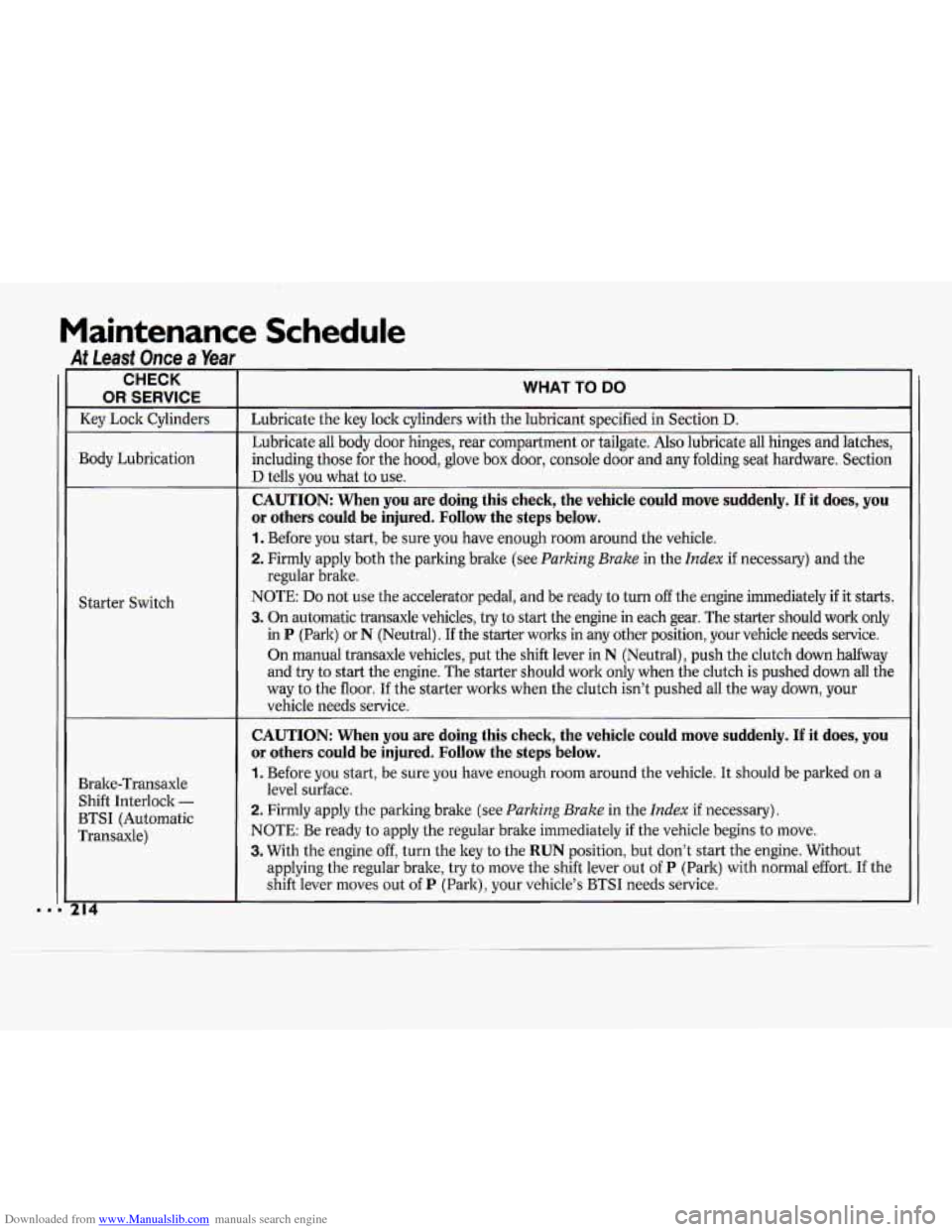
Downloaded from www.Manualslib.com manuals search engine Maintenance Schedule
At Leasf Once a Year
CHECK
-
-
-
OR SERVICE
Key Lock Cylinders
Body Lubrication
Starter Switch
Bralte-Transaxle Shift Interlock
-
BTSI (Automatic
Transaxle)
- z A
WHAT TO DO
Lubricate the key lock cylinders with the lubricant specified in Section D.
Lubricate all body door hinges, rear compartment or tailgate. Also lubricate all hinges and latches,
including those for the hood, glove box door, console
door and any folding seat hardware. Section
D tells vou what to use.
CAUTION: When you are doing this check, the vehicle could move suddenly. If it does, you
or others could be injured. Follow the steps below.
1. Before you start, be sure you have enough room around the vehicle.
2. Firmly apply both the parking brake (see Parking Brake in the Index if necessary) and the
NOTE:
Do not use the accelerator pedal, and be ready to turn off the engine immediately if it starts.
3. On automatic transaxle vehicles, try to start the engine in each gear. The starter should work only
in
P (Park) or N (Neutral). If the starter worlts in any other position, your vehicle needs servic\
e.
On manual transaxle vehicles, put the shift lever in
N (Neutral), push the clutch down halfway
and try to start the engine. The starter should work only when the clutch is pushed down all the
way to the floor.
If the starter worlts when the clutch isn’t pushed all the way down, your
vehicle needs service. regular
brake.
CAUTION: When you are doing this check, the vehicle could move\
suddenly. If it does, you
or others could be injured. Follow the steps below.
1. Before you start, be sure you have enough room around the vehicle. It should be parked on a
2. Firmly apply the parking brake (see Parking Brake in the Index if necessary),
NOTE: Be ready to apply the regular brake immediately if the vehicle begins to move.
3. With the engine off, turn the key to the RUN position, but don’t start the engine. Without
level surface.
applying the regular brake, try to move the shift lever out of
P (Park) with normal effort. If the
shift lever moves out of
P (Park), your vehicle’s BTSI needs service.
Page 216 of 243
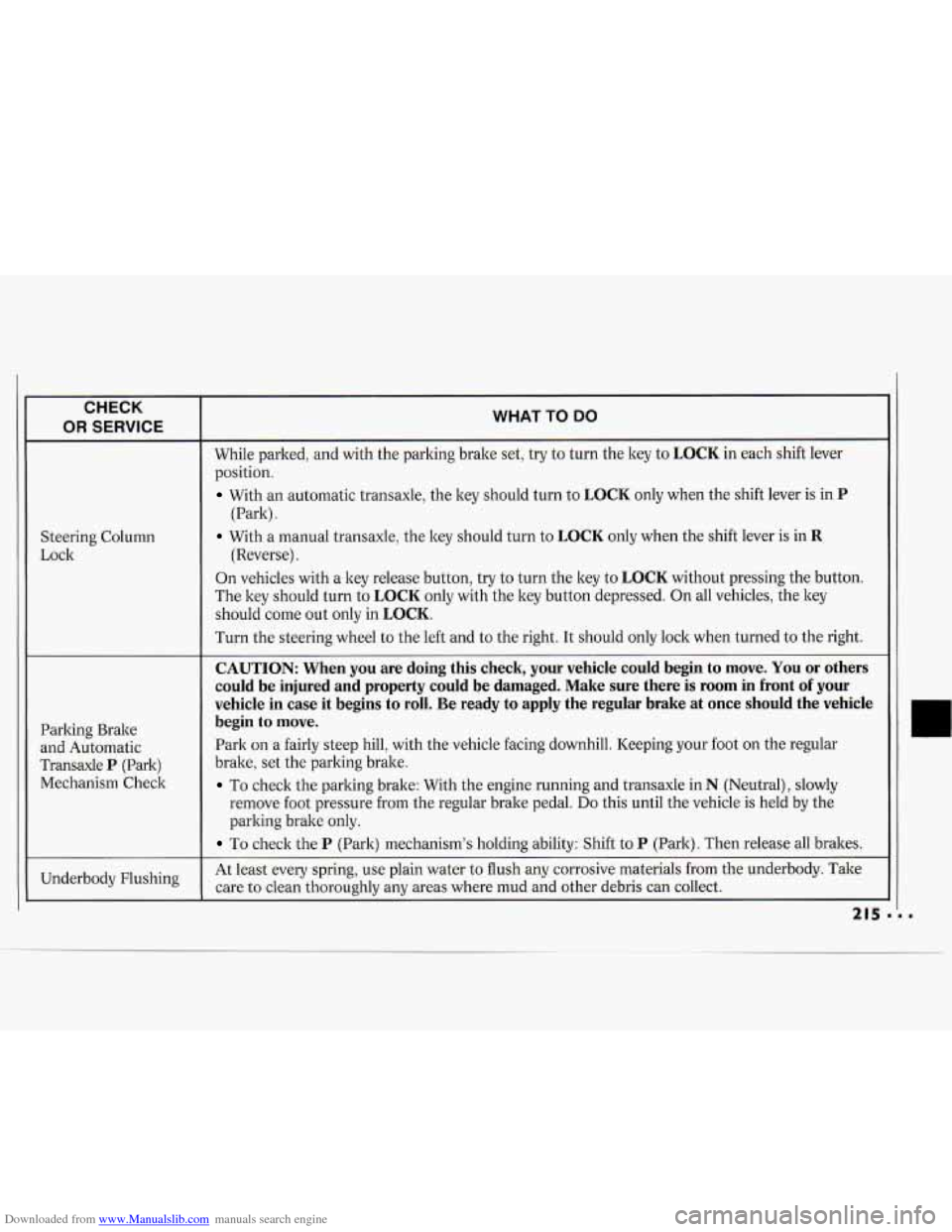
Downloaded from www.Manualslib.com manuals search engine CHECK
I OR SERVICE
Steering Column
Lock
Parking Brake
and Automatic
Transaxle
P (Park)
Mechanism Check
WHAT TO DO
While parked, and with the parking brake set, try to turn the key to LOCK in each shift lever
position.
With an automatic transaxle, the key should turn to LOCK only when the shift lever is in P
(Park) .
With a manual transaxle, the key should turn to LOCK only when the shift lever is in R
(Reverse).
On vehicles with a key release button, try to turn the key to
LOCK without pressing the button.
The key should turn to
LOCK only with the key button depressed. On all vehicles, the key
should come out only in
LOCK.
Turn the steering wheel to the left and to the right. It should only lock when turned to the right.
~~ ~~ ~
CAUTION: When you are doing this check, your vehicle could begin to move. You or others
could be injured and property could be damaged. Make sure ther\
e is room in front
of your
vehicle in case
it begins to roll. Be ready to apply the regular brake at once should the vehicle
begin to move.
Park on a fairly steep hill, with the vehicle facing downhill. Keeping your foot on the regular
brake, set the parking brake.
To check the parking brake: With the engine running and transaxle in N (Neutral), slowly
remove foot pressure from the regular brake pedal.
Do this until the vehicle is held by the
parking brake only.
To check the P (Park) mechanism’s holding ability: Shift to P (Park). Then release all brakes.
At least every spring, use plain water to flush any corrosive materials from the underbody. Take
care
to clean thoroughly any areas where mud and other debris can collect.
Page 217 of 243
Downloaded from www.Manualslib.com manuals search engine Maintenance Schedule
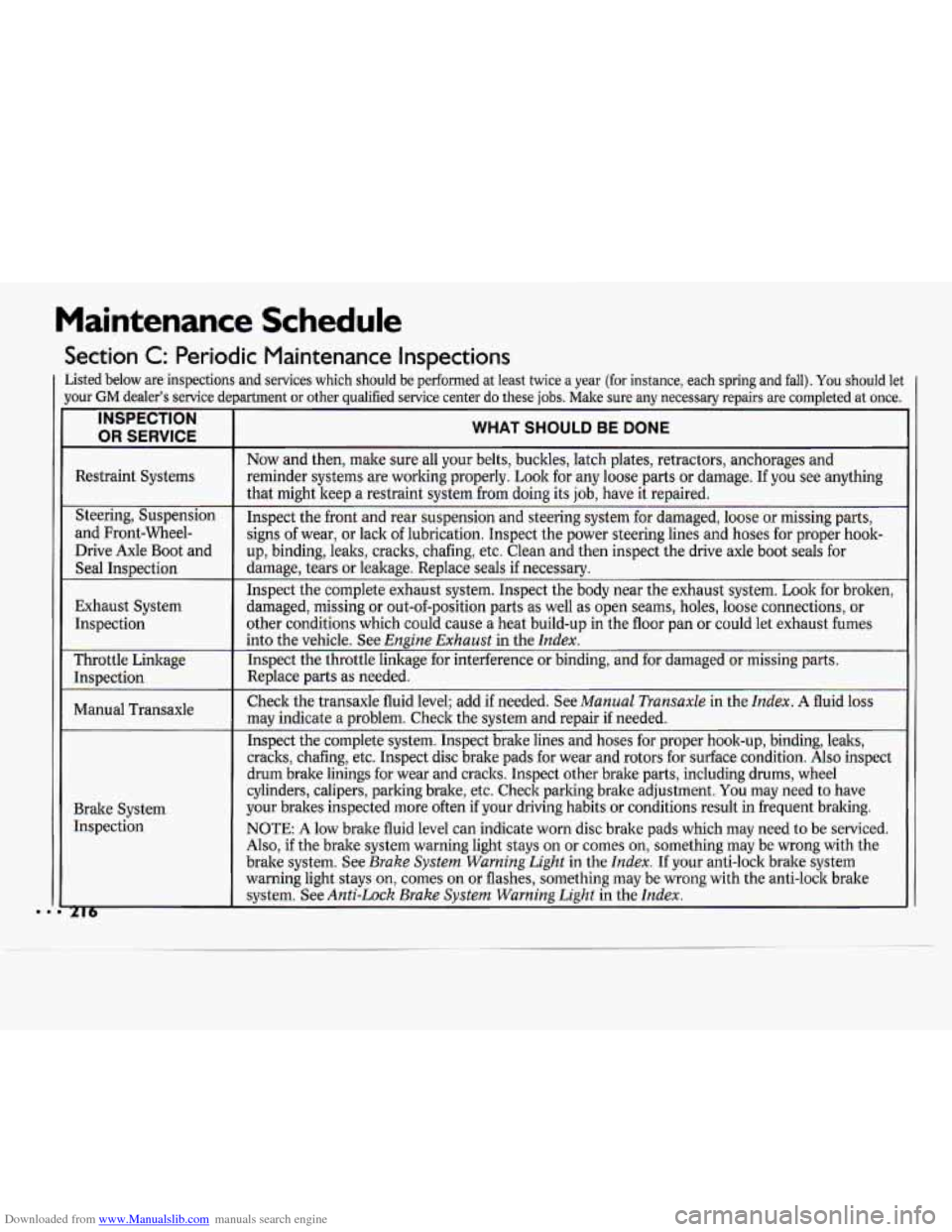
Section C: Periodic Maintenance Inspections
Listed below are inspections and services which should be performed at least twice a year (for instance, each spring and fall). You should let
Jour
GM dealer’s service department or other qualified service center \
do these jobs. Make sure any necessary repairs are completed at once.
INSPECTION
OR SERVICE
Restraint Systems
Steering, Suspension
and Front-Wheel-
Drive Axle Boot and
Seal InsDection
Exhaust System Inspection
Throttle Linkage Inspection
Manual Transaxle
Brake System Inspection
216
WHAT SHOULD BE DONE
Now and then, make sure all your belts, bucltles, latch plates, retractors, anchorages and
reminder systems are worlting properly. Look for any loose parts or damage. If you see anything
that might keep a restraint system from doing its job, have it repaired.
Inspect the front and rear suspension and steering system for damaged, loose or \
missing parts,
signs of wear, or lack
of lubrication. Inspect the power steering lines and hoses for proper hook-
up, binding, leaks, cracks, chafing, etc. Clean and then inspect the drive axle boot seals for
damage, tears or leakage. Replace seals if necessary.
~ ~~~~~~
Inspect the complete exhaust system. Inspect the body near the exhaust system. Look for broken,
damaged, missing or out-of-position parts as well as open seams, holes, loose connections, or
other conditions which could cause a heat build-up in the floor pan or could let exhaust fumes
into the vehicle. See
Engine Exhaust in the Index.
Inspect the throttle linkage for interference or binding, and for damaged or missing parts.
Replace parts as needed.
.-
Check the transaxle fluid level; add if needed. See Manual Transaxle in the Index. A fluid loss
may indicate a problem. Check the system and repair if needed.
Inspect the complete system. Inspect brake lines and hoses for proper hook-\
up, binding, leaks,
cracks, chafing, etc. Inspect disc brake pads for wear and rot\
ors for surface condition. Also inspect
drum brake linings for wear and cracks. Inspect other brake parts, including drums, wheel
cylinders, calipers, parking brake, etc. Check parking brake adj\
ustment. You may need to have
your brakes inspected more often if your driving habits or conditions result in frequent braking.
NOTE: A low brake fluid level can indicate worn disc brake pads which \
may need to be serviced.
Also, if the brake system warning light stays on or comes
on, something may be wrong with the
brake system. See
Brake System Warning Light in the Index. If your anti-lock brake system
warning light stays on, comes on or flashes, something may be wrong with the anti-lock brake
system. See
Anti-Lock Brake System Warning Light in the Index.
11
.
Page 218 of 243
Downloaded from www.Manualslib.com manuals search engine Maintenance Schedule
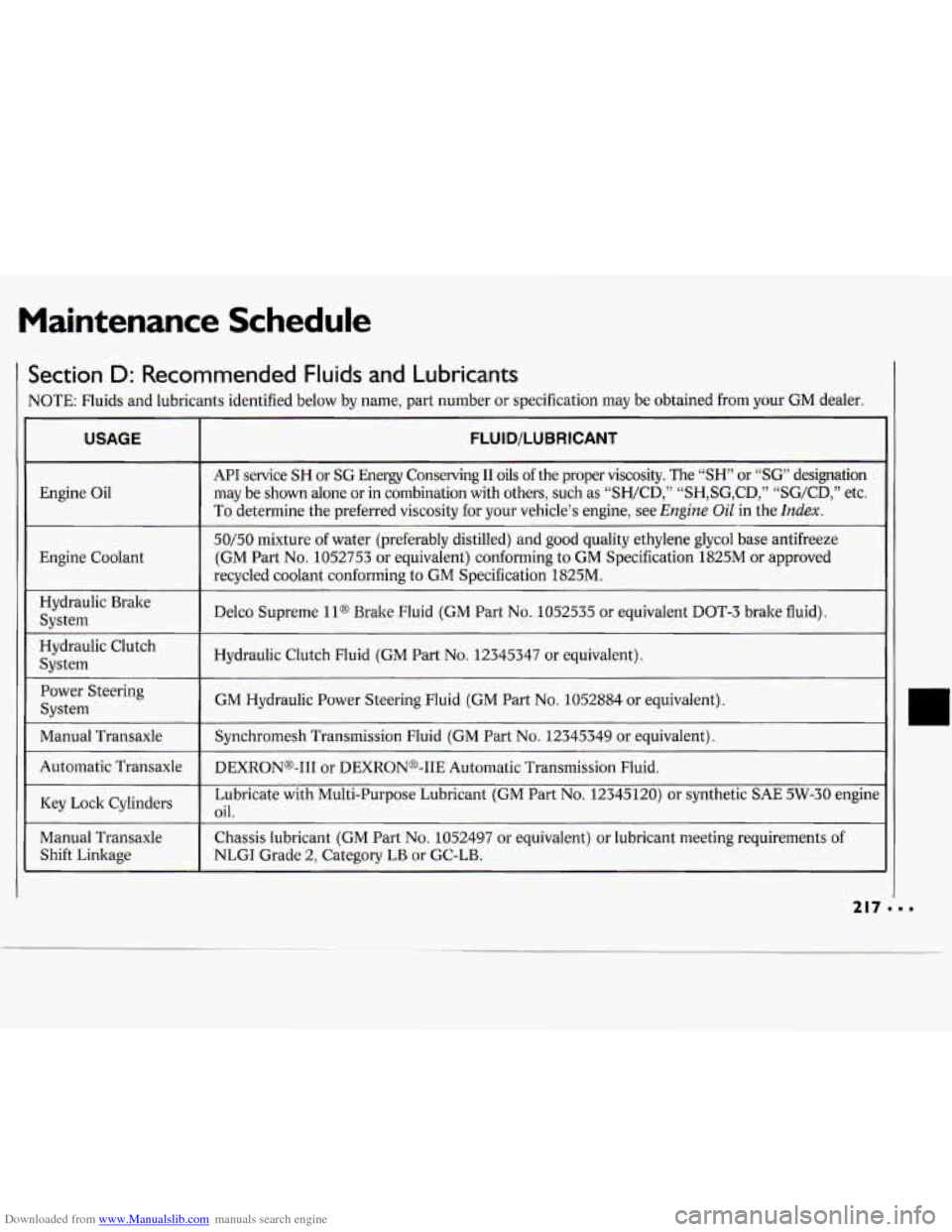
Section D: Recommended Fluids and Lubricants
VOTE: Fluids and lubricants identified below by name, part number or specification may be obtained from your GM dealer. ~~ ~
USAGE
Engine Oil
Engine Coolant Hydraulic Brake
System
~~~~ ~
Hydraulic Clutch
System
Power Steering
System
Manual Transaxle
Automatic Transaxle
Key Lock Cylinders
Manual Transaxle Shift Linkage
FLUID/LUBRICANT
API service SH or SG Energy Conserving I1 oils of the proper viscosity. The “SH” or “SG” designation
may be shown alone or in combination with others, such as “SH/CD,” “SH,SG,CD,” “SG/CD,” etc.
To determine the preferred viscosity for your vehicle’s engine, see Engine Oil in the Index.
50/50 mixture of water (preferably distilled) and good quality ethylene glycol base antifreeze
(GM Part
No. 1052753 or equivalent) conforming to GM Specification 1825M or approved
recycled coolant conforming to
GM Specification 1825M.
Delco Supreme
110 Brake Fluid (GM Part No. 1052535 or equivalent DOT-3 brake fluid).
Hydraulic Clutch Fluid (GM Part No. 12345347 or equivalent).
GM Hydraulic Power Steering Fluid (GM Part
No. 1052884 or equivalent).
~ ~~~
Synchromesh Transmission Fluid (GM Part No. 12345349 or equivalent).
DEXRONo-I11 or DEXRONs-IIE Automatic Transmission Fluid.
Lubricate with Multi-Purpose Lubricant (GM Part No. 12345120) or synthetic
SAE 5W-30 engine
oil.
Chassis lubricant (GM Part No, 1052497 or equivalent) or lubricant meeting requirements of
NLGI Grade 2, Category LB or GC-LB.