key CHEVROLET CAVALIER 1995 3.G Owner's Manual
[x] Cancel search | Manufacturer: CHEVROLET, Model Year: 1995, Model line: CAVALIER, Model: CHEVROLET CAVALIER 1995 3.GPages: 340, PDF Size: 17.09 MB
Page 126 of 340
Downloaded from www.Manualslib.com manuals search engine These following conditions also may cause the CHECK
ENGINE light to come
on:
0
0
Low Fuel/Out of Fuel: As the vehicle starts to run
out of fuel, the CHECK ENGINE light may come on
as a result of an engine misfire. Filling your fuel tank
should correct this condition. Make sure to install
the
gas cap fully. It will require a few driving trips to
turn the light off.
Poor Quality Fuel: Be sure to fuel your vehicle with
quality fuel. Your engine may
not run efficiently on
poor fuel. Poor fuel may cause stalling, hesitation or
misfire. These conditions may
go away when the
engine
is warmed-up. However, poor quality fuel
may cause the
CHECK ENGINE light to come on.
Have a dealer check the vehicle. If no problems are
found, you may want
to change to another brand of
fuel.
Driving Through Standing Water: Driving your
vehicle through puddles
of deep standing water may
result in
a temporary misfire condition. This
condition will usually correct itself shortly after
the
electrical system dries out. it will require a few
driving trips
to turn the light off.
Passlock Warning Light
THEFT
SYSTEM
This light will come on
when you turn the key
towards the
START
position. The light will stay
on until the vehicle starts.
If the light flashes, the Passlock system has entered a
tamper mode.
If the vehicle fails to start, see “Passlock”
in the Index.
If
the light comes on continuously while driving and
stays
on, there may be a problem with the Passlock
system. Your vehicle will not be protected
by Passlock,
and
you should see your dealer.
2-70
Page 142 of 340
Downloaded from www.Manualslib.com manuals search engine Drunken Driving
Death and injury associated with drinking and driving is
a national tragedy. It’s the number one contributor to the
highway death toll, claiming thousands of victims every
year.
Alcohol affects four things that anyone needs to drive a
vehicle:
0 Judgment
0 Muscular Coordination
0 Vision
0 Attentiveness
Police records show that almost
half of all motor
vehicle-related deaths involve alcohol. In most cases,
these deaths are the result
of someone who was drinking
and driving. In recent years, some 18,000 annual motor
vehicle-related deaths have been associated with the use
of alcohol, with more
than 300,000 people injured.
Many adults
-- by some estimates, nearly half the adult
population
-- choose never to drink alcohol, so they
never drive after drinking. For persons under 21, it’s
against the law in every
U.S. state to drink alcohol.
There are good medical, psychological and
developmental reasons for these laws. The
obvious way
to solve this highway safety problem
is for people never to drink alcohol and then drive. But
what
if people do? How much is “too much” if the
driver plans to drive? It’s a lot less than many might
think. Although it depends on each person and situation,
here is some general information on the problem.
The Blood Alcohol Concentration (BAC)
of someone
who is drinking depends upon four things:
0 How much alcohol consumed
0 The drinker’s body weight
0 The amount of food that is consumed before and
during drinking
consume the alcohol
The length of time it has taken the drinker to
According
to the American Medical Association, a
180-pound
(82 kg) person who drinks three 12-ounce
(355 ml) bottles of beer in an hour will end up with a
BAC
of about 0.06 percent. The person would reach the
same BAC by drinking three 4-ounce (120 ml) glasses
of wine or three mixed drinks if each had 1-1/2 ounces
(45 ml) of a liquor like whiskey, gin or vodka.
4-2 -
Page 166 of 340
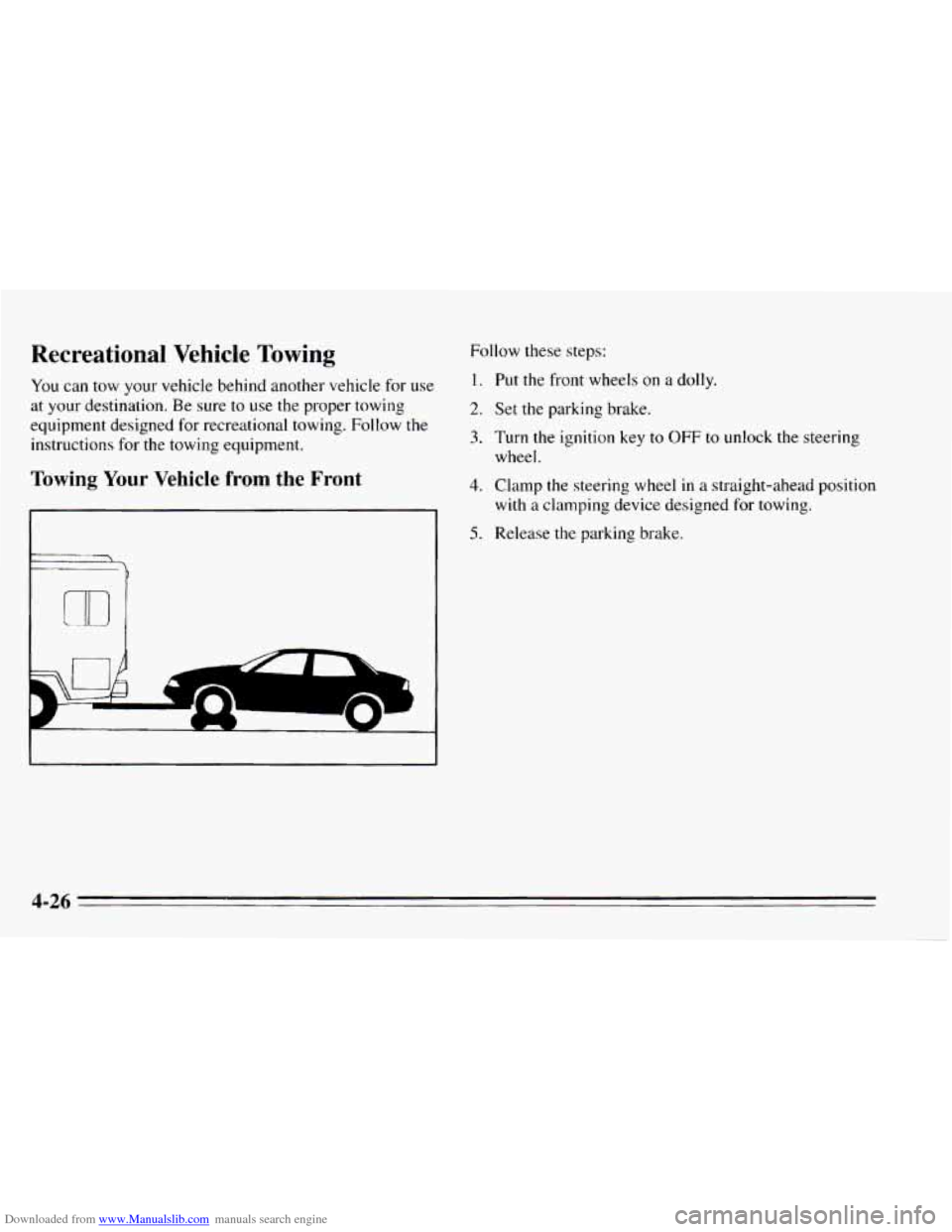
Downloaded from www.Manualslib.com manuals search engine Recreational Vehicle Towing
You can tow your vehicle behind another vehicle for use
at your destination.
Be sure to use the proper towing
equipment designed for recreational towing. Follow
the
instructions for the towing equipment.
Towing Your Vehicle from the Front
P
Follow these steps:
1. Put the front wheels on a dolly.
2. Set the parking brake.
3. Turn the ignition key to OFF to unlock the steering
4. Clamp the steering wheel in a straight-ahead position
5. Release the parking brake.
wheel.
with
a clamping device
designed for towing.
4-26
-
Page 167 of 340
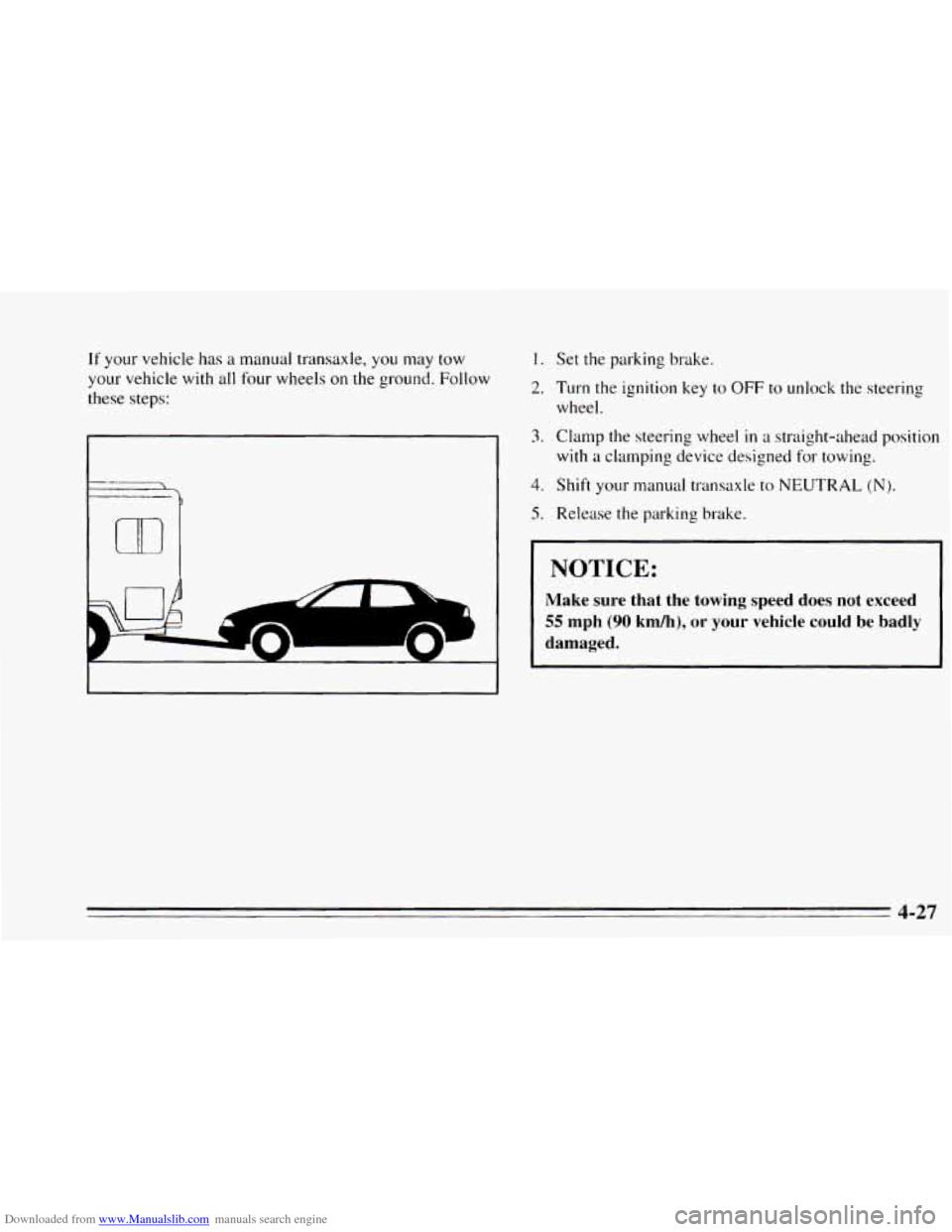
Downloaded from www.Manualslib.com manuals search engine If your vehicle has a manual transaxle, you may tow
your vehicle with
all four wheels on the ground. Follow
these steps:
1.
2.
3.
4.
5.
Set the parking brake.
Turn the ignition key
to OFF to unlock the steering
wheel.
Clamp the steering wheel
in a straight-ahead position
with a clamping device designed for towing.
Shift
your manual transaxle to NEUTRAL (N).
Release the parking brake.
I NOTICE:
Make sure that the towing speed does not exceed
55 mph (90 kh), or your vehicle could be badly
damaged.
4-27
Page 177 of 340
Downloaded from www.Manualslib.com manuals search engine 0 Section 5 Problems on the Road
Here you’ll find what to do about some problems that
can occur on the road.
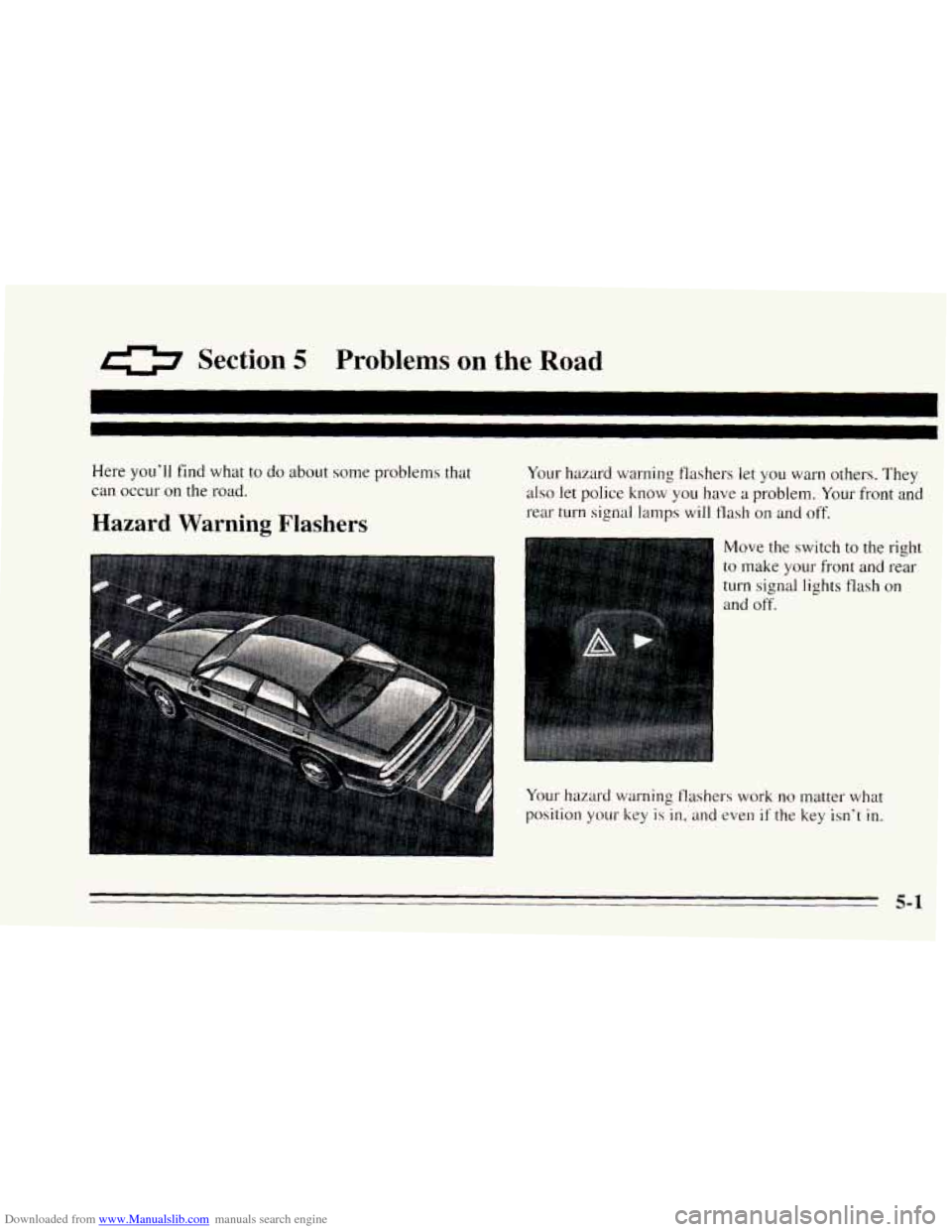
Hazard Warning Flashers
Your hazard warning flashers let you warn others. They
also let police know you have a problem. Your front and
rear turn signal lamps will flash on and off.
Move the switch to the right
to make your front and rear
turn signal lights flash on
and off.
Your hazard warning flashers work
no matter what
position your
key is in, and even if the key isn’t in.
5-1
Page 184 of 340
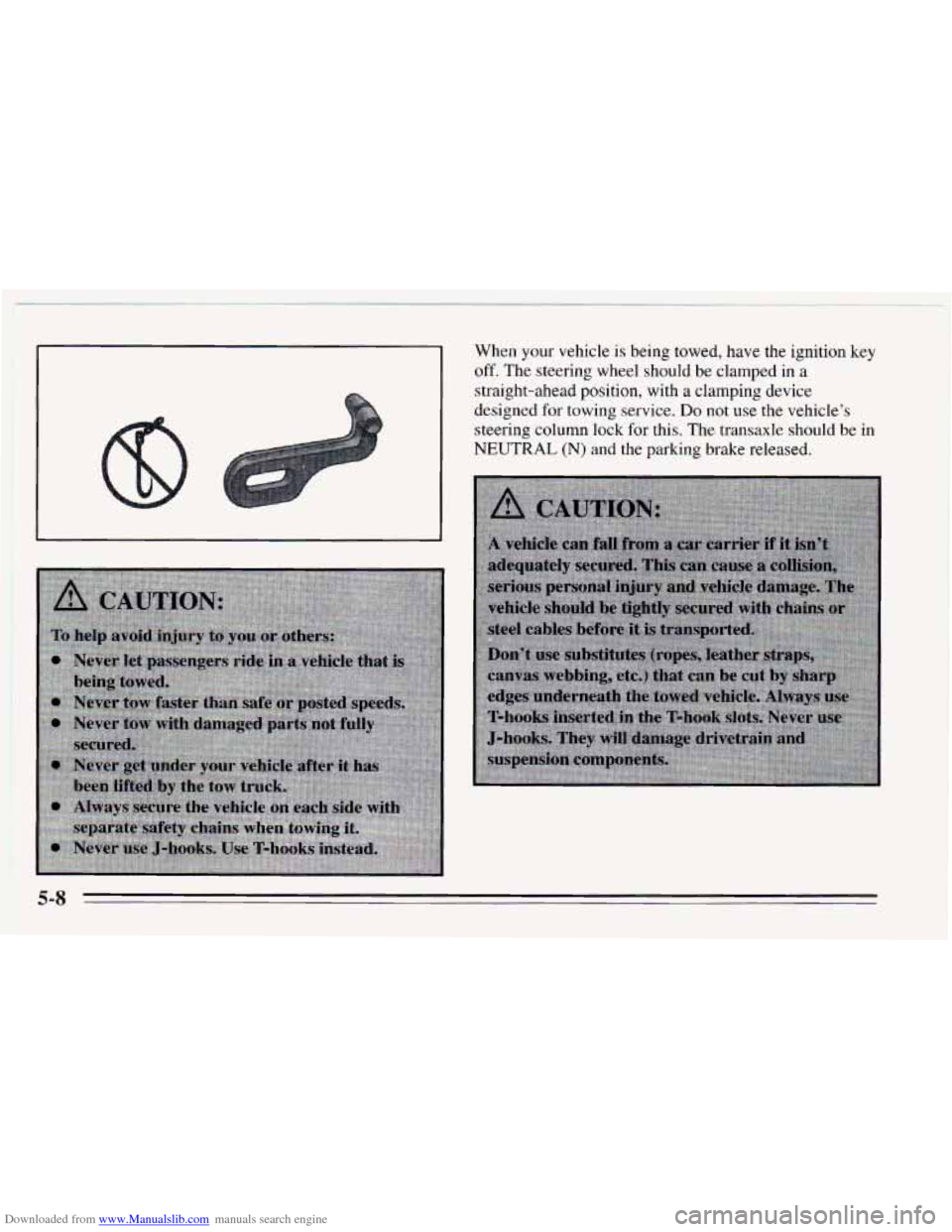
Downloaded from www.Manualslib.com manuals search engine When your vehicle is being towed, have the ignition key
off, The steering wheel should be clamped in a
straight-ahead position, with a clamping device
designed for towing service.
Do not use the vehicle’s
steering column lock
for this. The transaxle should be in
NEUTRAL (N) and the
parking brake released.
5-8
Page 301 of 340
Downloaded from www.Manualslib.com manuals search engine At Least Once a Year
Key Lock Cylinders
Lubricate the key lock cylinders with the lubricant
specified
in Part D.
Body Lubrication
Lubricate all body door and rear compartment hinges.
Also lubricate all hinges and latches, including those for
the hood, glove box door, console door and any folding
seat hardware. Part
D tells you what to use. More
frequent lubrication may be required when exposed
to a
corrosive envlronment.
Starter Switch
1. Before you start, be sure you have enough room
around the vehicle.
2. Firmly apply both the parking brake (see “Parking
Brake”
in the Index if necessary) and the regular
brake.
NOTE:
Do not use the accelerator pedal, and be
ready
to turn off the engine immediately if it starts.
3. On automatic transaxle vehicles, try to start the
engine
in each gear. The starter should work only in
PARK (P) or NEUTRAL (N). If the starter works in
any other position, your vehicle needs service.
On manual transaxle vehicles, put the shift lever in
NEUTRAL
(N), push the clutch down halfway and
try to start the engine.
The starter should work only
when the clutch is pushed down all the way
to the
floor. If the starter works when the clutch isn’t
pushed
all the way down, your vehicle needs service.
7-39
Page 302 of 340
Downloaded from www.Manualslib.com manuals search engine Brake-Transaxle Shift Interlock -- BTSI (Automatic
Transaxle)
1.
2.
3.
Before you start, be sure you have enough room
around the vehicle. It should be parked
on a level
surface.
Firmly apply the parking brake (see “Parking Brake”
in the Index
if necessary).
NOTE: Be ready to apply the regular brake
immediately
if the vehicle begins to move.
With the engine off, turn the key to the RUN
position, but don’t start the engine. Without applying
the regular brake, try
to move the shift lever out of
PARK (P) with normal effort, If the shift lever
moves
out of PARK (P), your vehicle’s BTSI needs
service.
Steering Column Lock
While parked, and with the parking brake set, try to turn
the key to
LOCK in each shift lever position.
0 With an automatic transaxle, the key should turn to
LOCK only when the shift lever
is in PARK (P).
With a manual transaxle, the key should turn to
LOCK only when the shift lever is in
REVERSE
(R).
On vehicles with a key release button, try to turn the key
to LOCK without pressing the button. The key should
turn to
LOCK only with the key button depressed.
On all vehicles, the
key should come out only in LOCK.
Turn the steering wheel to
the left and to the right. It
should only lock when turned
to the right.
7-40
Page 305 of 340
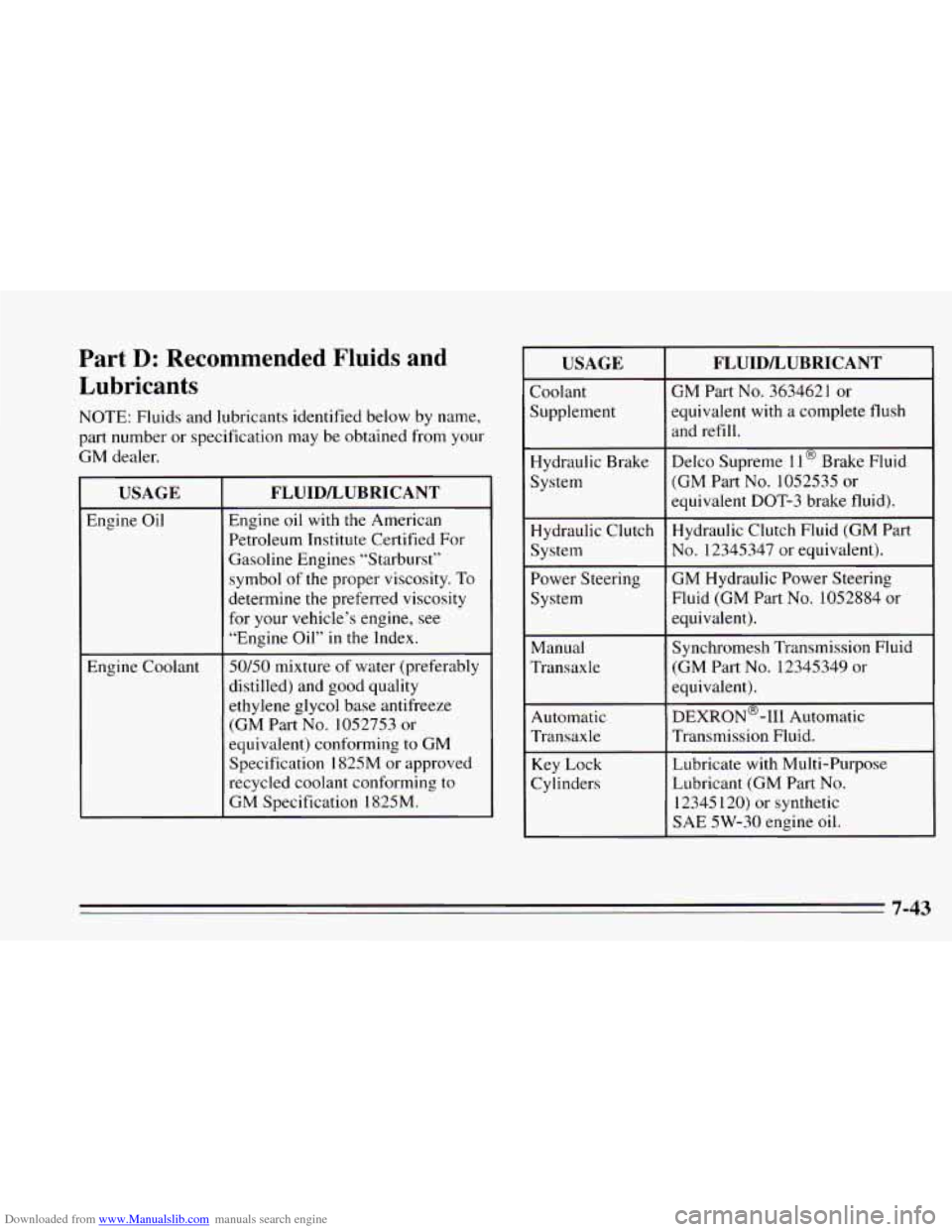
Downloaded from www.Manualslib.com manuals search engine Part D: Recommended Fluids and
Lubricants
NOTE: Fluids and lubricants identified below by name,
part number or specification may be obtained from your
GM dealer.
USAGE
Engine Oil
Engine Coolant
FLUIDLUBRICANT
Engine oil with the American
Petroleum Institute Certified For
Gasoline Engines “Starburst”
symbol
of the proper viscosity. To
determine
the preferred viscosity
for your vehicle’s engine, see
“Engine Oil”
in the Index.
50/50 mixture of water (preferably
distilled) and good quality
ethylene glycol base antifreeze
(GM Part No. 1052753 or
equivalent) conforming
to GM
Specification 1825M or approved
recycled coolant conforming to
GM Specification
1825M.
USAGE FLUIDLUBRICANT
Coolant
Supplement GM Part No. 3634621 or
(GM Part No. 1052535 or
System Delco Supreme
11 @ Brake
Fluid
Hydraulic Brake equivalent
with
a complete flush
Hydraulic Clutch Hydraulic Clutch Fluid (GM
Part
System No. 12345347 or equivalent).
Power Steering
GM Hydraulic Power Steering
System Fluid
(GM Part No. 1052884 or
equivalent). and refill.
~~
equivalent DOT-3 brake fluid).
Manual (GM Part
No. 12345349 or
Transaxle Synchromesh
Transmission Fluid
DEXRON@-111 Automatic
Automatic
Transaxle Transmission Fluid.
Key Lock Lubricate with Multi-Purpose
Cylinders Lubricant
(GM Part
No.
12345 120) or synthetic
SAE
5W-30 engine oil.
equivalent).
7-43
Page 314 of 340
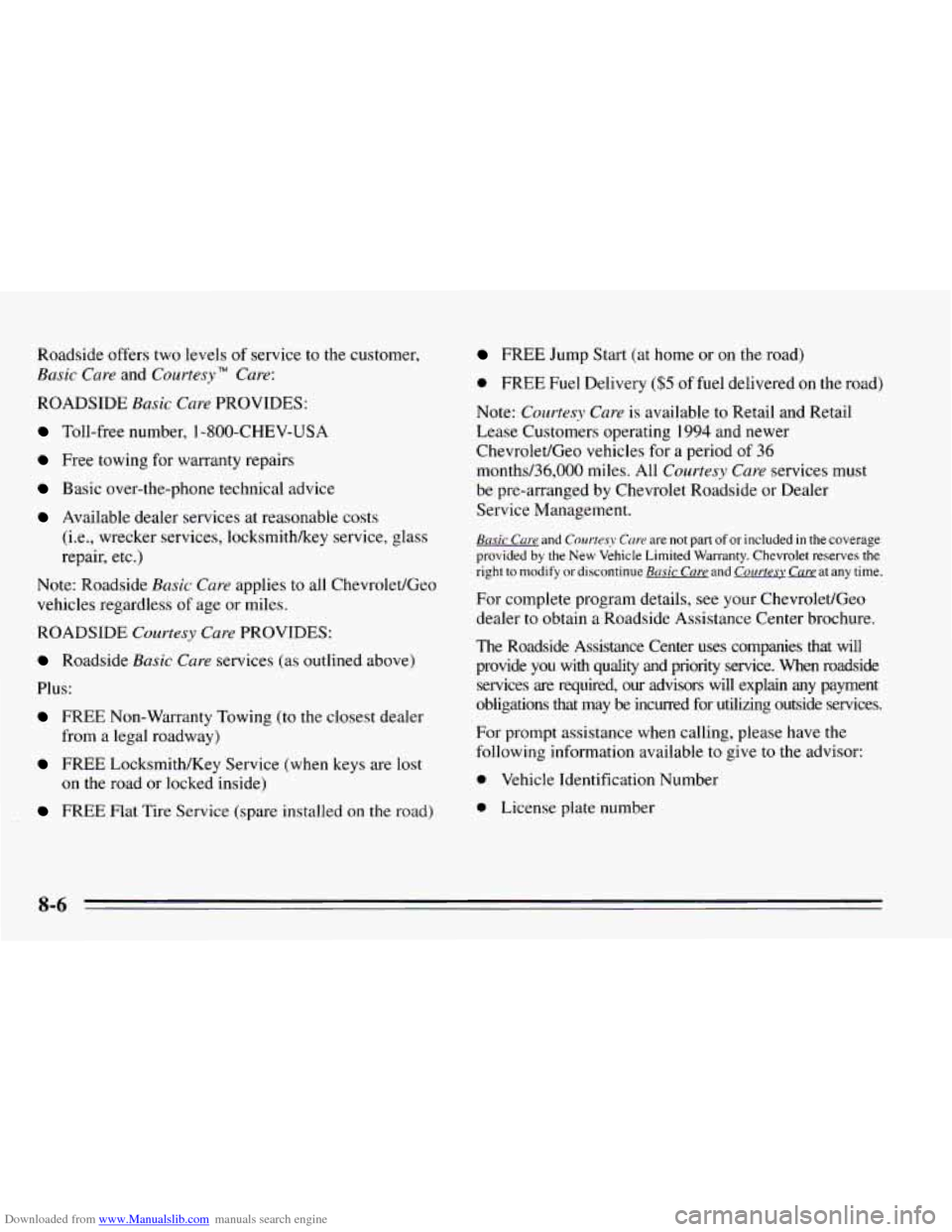
Downloaded from www.Manualslib.com manuals search engine Roadside offers two levels of service to the customer,
Basic Care and Cuurtesy '" Care:
ROADSIDE Basic Care PROVIDES:
Toll-free number, 1 -800-CHEV-USA
Free towing for warranty repairs
Basic over-the-phone technical advice
Available dealer services at reasonable costs
(i.e., wrecker services, locksmith/key service, glass
repair, etc.)
Note: Roadside
Basic Care applies to all Chevrolet/Geo
vehicles regardless
of age or miles.
ROADSIDE
Courtesy Care PROVIDES:
Roadside Basic Care services (as outlined above)
Plus:
FREE Non-Warranty Towing (to the closest dealer
from a legal roadway)
on the road or locked inside)
FREE Locksmith/Key Service (when keys are lost
FREE Flat Tire Service (spare installed on the road)
FREE Jump Start (at home or on the road)
0 FREE Fuel Delivery ($5 of fuel delivered on the road)
Note:
Courtesy Cure is available to Retail and Retail
Lease Customers operating
1994 and newer
Chevrolet/Geo vehicles for
a period of 36
months/36,000 miles. All
Courtesy Care services must
be pre-arranged by Chevrolet Roadside or Dealer
Service Management.
Basic Cure and Courtes!: Cm-e are not part of or included in the coverage
provided by the New Vehicle Limited Warranty. Chevrolet reserves the
right
to modify or discontinue Basic Care and Courtesy at any time.
For complete program details, see your Chevrolet/Geo
dealer to obtain a Roadside Assistance Center brochure.
The Roadside Assistance Center uses companies that will provide you with quality and priority service. When roadside
services are required,
our advisors will explain any payment
obligations that may
be incurred for utilizing outside services.
For prompt assistance when calling, please have
the
following information available to give to the advisor:
0 Vehicle Identification Number
0 License plate number
8-6