belt CHEVROLET CAVALIER 1995 3.G Service Manual
[x] Cancel search | Manufacturer: CHEVROLET, Model Year: 1995, Model line: CAVALIER, Model: CHEVROLET CAVALIER 1995 3.GPages: 340, PDF Size: 17.09 MB
Page 141 of 340
Downloaded from www.Manualslib.com manuals search engine 0 Section 4 Your Driving and the Road
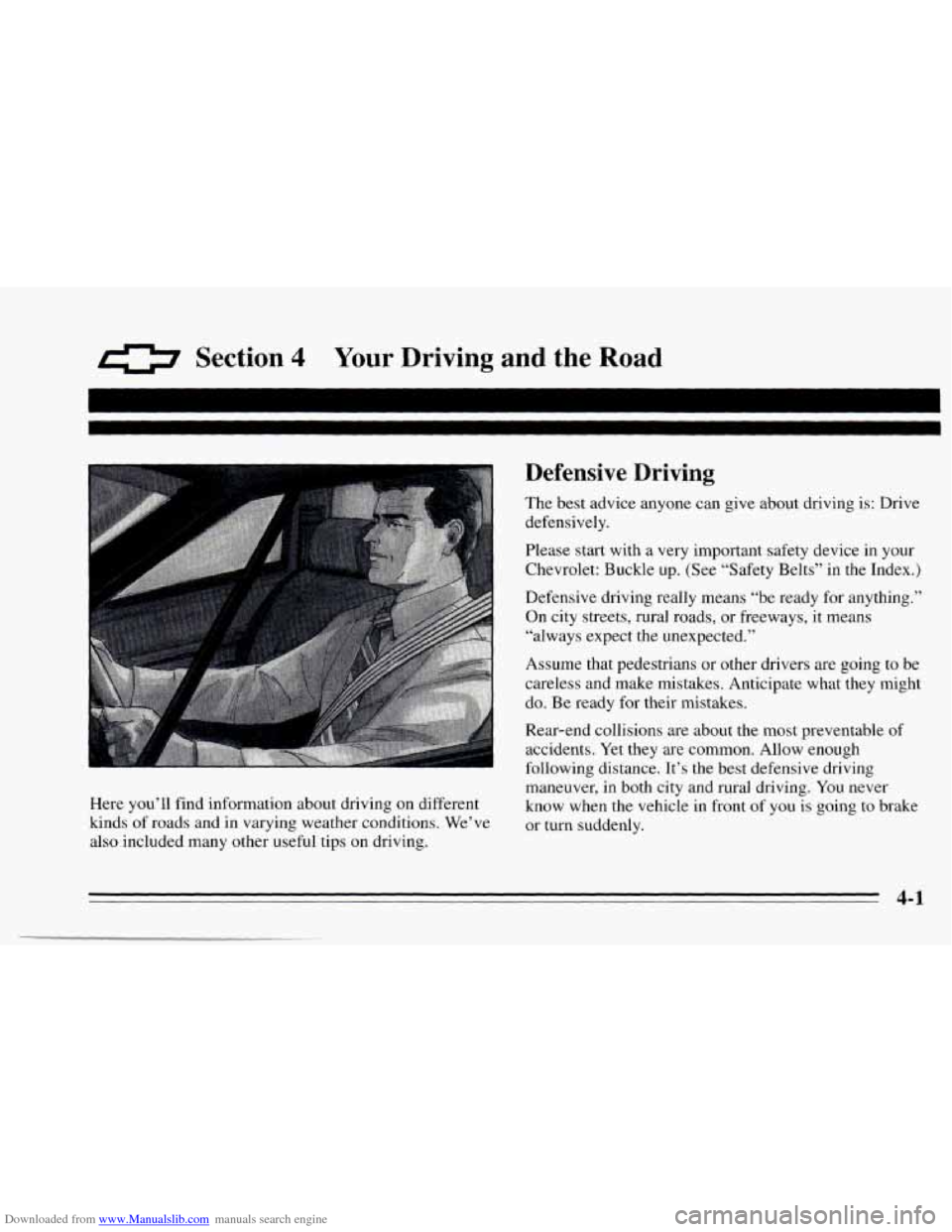
Defensive Driving
Here you’ll find information about driving on different
kinds
of roads and in varying weather conditions. We’ve
also included many other useful tips on driving. The
best advice anyone can give about driving is: Drive
defensively.
Please start with a very important safety device in your
Chevrolet: Buckle up. (See “Safety Belts” in
the Index.)
Defensive driving really means “be ready for anything.”
On city streets, rural roads, or freeways, it means
“always expect the unexpected.”
Assume that pedestrians
or other drivers are going to be
careless and make mistakes. Anticipate what they might
do. Be ready for their mistakes.
Rear-end collisions are about the most preventable of
accidents. Yet they are common. Allow enough
following distance. It’s the best defensive driving
maneuver, in both city and rural driving.
You never
know when the vehicle in front
of you is going to brake
or turn suddenly.
4-1
Page 149 of 340
Downloaded from www.Manualslib.com manuals search engine Speed limit signs near curves warn that you should
adjust
your speed. Of course, the posted speeds are
based on good weather and road conditions. Under less
favorable conditions you’ll want
to go slower.
If you need to reduce your speed as you approach a
curve, do
it before you enter the curve, while your front
wheels are straight ahead.
Try to adjust your speed
so you can “drive” through the
curve. Maintain a reasonable, steady speed. Wait to
accelerate until you are out of the curve, and then
accelerate gently
into the straightaway.
Steering in Emergencies
There are times when steering can be more effective than
braking. For example, you come over
a hill and find a
truck stopped
in your lane, or a car suddenly pulls out
from nowhere, or a child darts out from between parked
cars and stops right
in front of you. You can avoid these
problems by braking
-- if you can stop in time. But
sometimes
you can’t; there isn’t room. That’s the time for
evasive action
-- steering around the problem.
Your Chevrolet can perform very well
in emergencies
like these. First apply your brakes. (See “Braking
in
Emergencies” earlier in this section.) It is better to
remove
as much speed as you can from a possible collision. Then
steer around the problem,
to the left or
right depending on the space available.
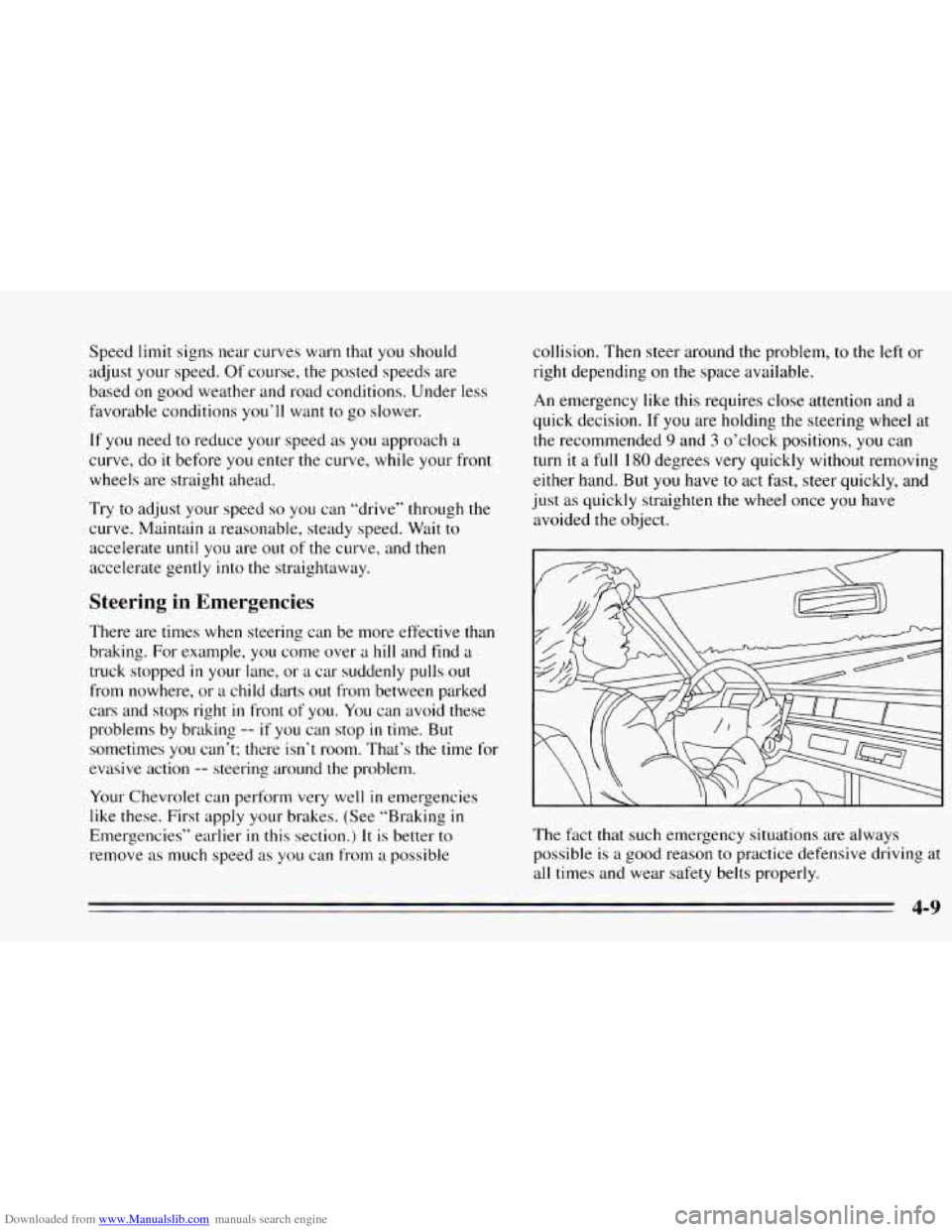
An emergency like this requires close attention and a
quick decision. If
you are holding the steering wheel at
the recommended
9 and 3 o’clock positions, you can
turn it
a full 180 degrees very quickly without removing
either hand. But
you have to act fast, steer quickly, and
just as quickly straighten the wheel once
you have
avoided the object.
The
fxt that such emergency situations are always
possible
is a good reason to practice defensive driving at
all times and wear safety belts properly.
4-9
Page 176 of 340
Downloaded from www.Manualslib.com manuals search engine When You Are Ready to Leave After
Parking
on a Hill
1. Apply your regular brakes and hold the pedal down
while
you:
Start your engine;
Shift into a gear; and
Release the parking brake.
2. Let up on the brake pedal.
3. Drive slowly until the trailer is clear of the chocks.
4. Stop and have someone pick up and store the chocks.
Maintenance When Trailer Towing
Your vehicle will need service more often when you’re
pulling a trailer. See the Maintenance Schedule for more on
this. Things that are especially important in trailer
operation are automatic transaxle fluid (don’t overfill),
engine oil, belt, cooling system, and brake adjustment.
Each
of these is covered in this manual, and the Index
will help you find them quickly. If you’re trailering,
it’s
a good idea to review these sections before you start
your trip.
Check periodically
to see that all hitch nuts and bolts are
tight.
Towing A Trailer
Do not tow a trailer with a Cavalier if your vehicle is:
a convertible model.
equipped with a 2.2L (Code 4) engine.
equipped with a manual transaxle or a three
speed automatic transaxle.
Your Cavalier is neither designed nor intended to tow a
trailer.
4-36
Page 241 of 340
Downloaded from www.Manualslib.com manuals search engine Buying New Tires
To find out what kind and size of tires you need, look at
the Tire-Loading Information label.
The tires installed on your vehicle when it was new had
a Tire Performance Criteria Specification (TPC Spec)
number on each tire’s sidewall. When you get new tires,
get ones with that same
TPC Spec number. That way,
your vehicle will continue to have tires that are designed
to give proper endurance, handling, speed rating,
traction, ride and other things during normal service on
your vehicle. If your tires have an all-season tread
design, the TPC number will be followed by an
“MS”
(for mud and snow).
If you ever replace your tires with those not having a
TPC Spec number, make sure they are the same size,
load range, speed rating and construction type (bias,
bias-belted
or radial) as your original tires.
6-37
Page 249 of 340
Downloaded from www.Manualslib.com manuals search engine Cleaning the Top of the Instrument Panel
Use only mild soap and water to clean the top surfaces
of the instrument panel. Sprays containing silicones or
waxes may cause annoying reflections
in the windshield
and even make
it difficult to see through the windshield
under certain conditions.
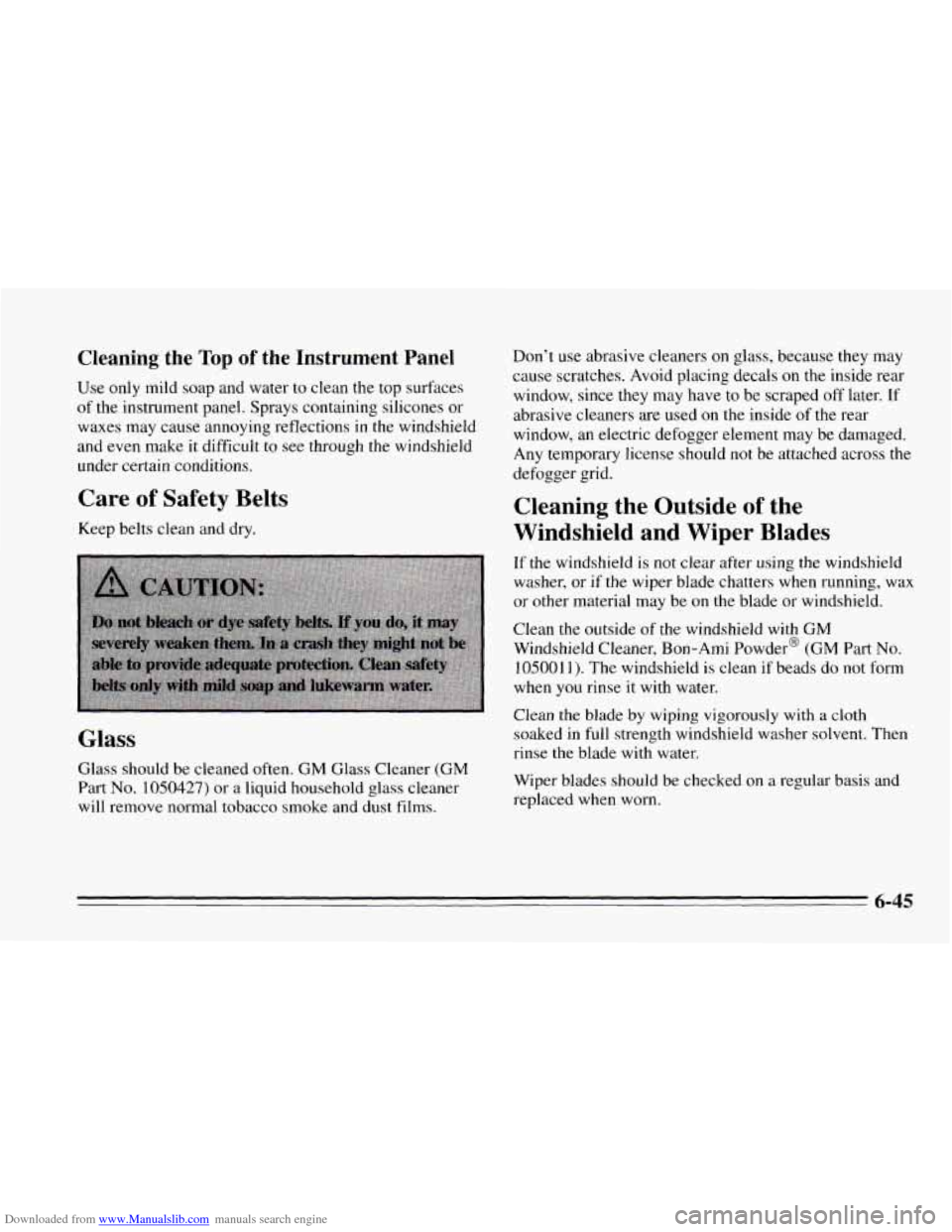
Care of Safety Belts
Keep belts clean and dry.
Glass
Glass should be cleaned often. GM Glass Cleaner (GM
Part
No. 1050427) or a liquid household glass cleaner
will remove normal tobacco smoke and dust films. Don’t use
abrasive cleaners on glass, because they may
cause scratches. Avoid placing decals on the inside rear
window, since they may have
to be scraped off later. If
abrasive cleaners are used on the inside
of the rear
window, an electric defogger element may be damaged.
Any temporary license should
not be attached across the
defogger grid.
Cleaning the Outside of the
Windshield and Wiper Blades
If the windshield is not clear after using the windshield
washer, or if
the wiper blade chatters when running, wax
or other material may be on the blade or windshield.
Clean the outside
of the windshield with GM
Windshield Cleaner, Bon-Ami Powder@ (GM Part
No.
105001 1). The windshield is clean if beads do not form
when you rinse it with water.
Clean the blade
by wiping vigorously with a cloth
soaked in
full strength windshield washer solvent. Then
rinse the blade with water.
Wiper blades should be checked on a regular basis and
replaced when worn.
6-45
Page 266 of 340
Downloaded from www.Manualslib.com manuals search engine Maintenance Schedule
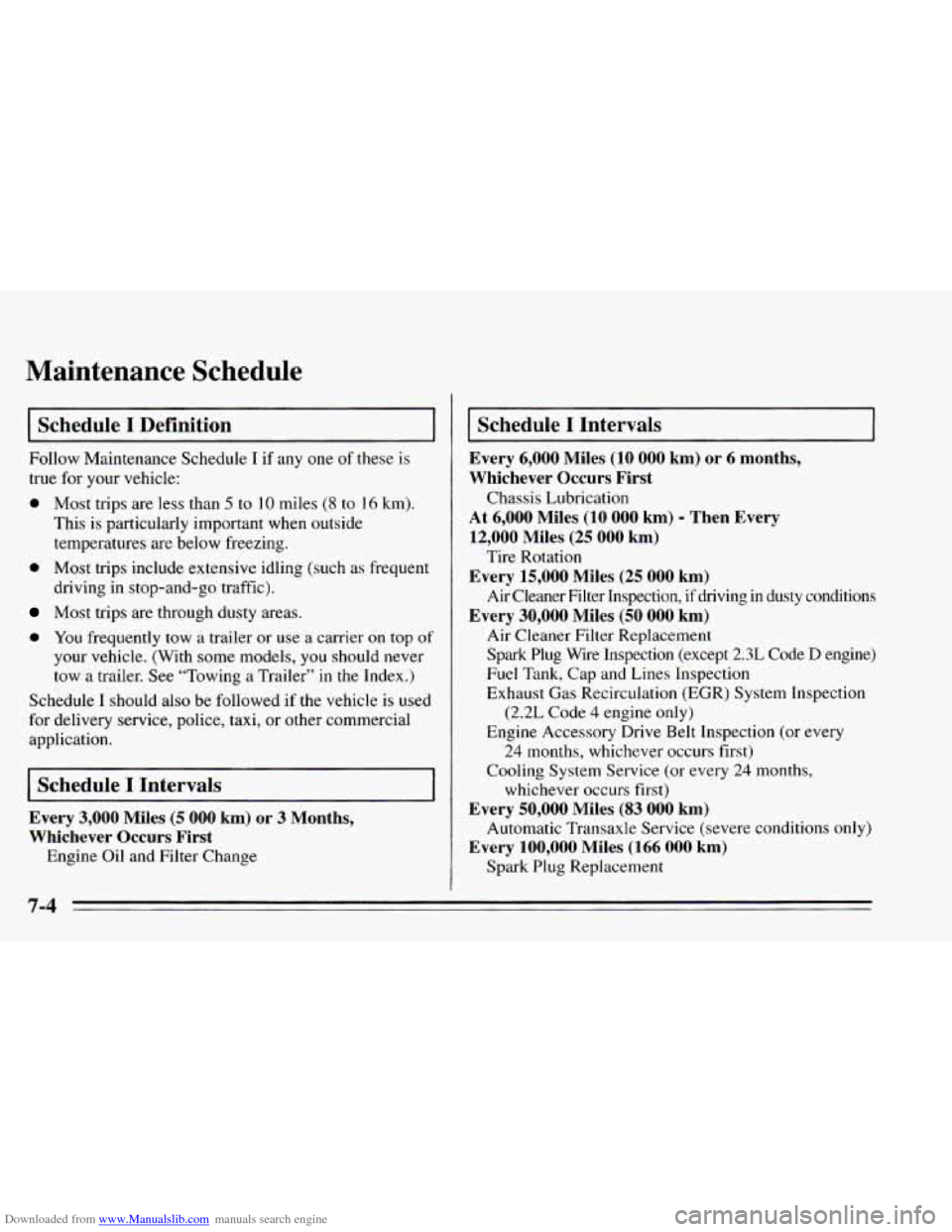
Schedule I Definition
Follow Maintenance Schedule I if any one of these is
true for your vehicle:
0 Most trips are less than 5 to 10 miles (8 to 16 km).
This
is particularly important when outside
temperatures are below freezing.
0 Most trips include extensive idling (such as frequent
driving in stop-and-go traffic).
Most trips are through dusty areas.
0 You frequently tow a trailer or use a carrier on top of
your vehicle. (With some models, you should never
tow a trailer. See “Towing a Trailer”
in the Index.)
Schedule
I should also be followed if the vehicle is used
for delivery service, police, taxi, or other commercial
application.
Schedule I Intervals
Every 3,000 Miles (5 000’km) or 3 Months,
Whichever Occurs First
Engine Oil and Filter Change
Schedule I Intervals
Every 6,000 Miles (10 000 km) or 6 months,
Whichever Occurs First
Chassis Lubrication
At 6,000 Miles (10 000 km) - Then Every
12,000 Miles (25 000 km)
Tire Rotation
Every 15,000 Miles (25 000 km)
Air Cleaner Filter Inspection, if driving in dusty conditions
Every 30,000 Miles (50 000 km)
Air Cleaner Filter Replacement
Spark Plug Wire Inspection (except 2.3L Code D engine)
Fuel Tank, Cap and Lines Inspection
Exhaust Gas Recirculation (EGR) System Inspection
Engine Accessory Drive Belt Inspection (or every
Cooling System Service (or every 24 months,
(2.2L Code 4 engine only)
24 months, whichever occurs first)
whichever occurs first)
Every 50,000 Miles (83 000 km)
Every
100,000 Miles (166 000 km)
Automatic Transaxle Service (severe conditions only)
Spark Plug Replacement
7-4
Page 267 of 340
Downloaded from www.Manualslib.com manuals search engine Maintenance Schedule
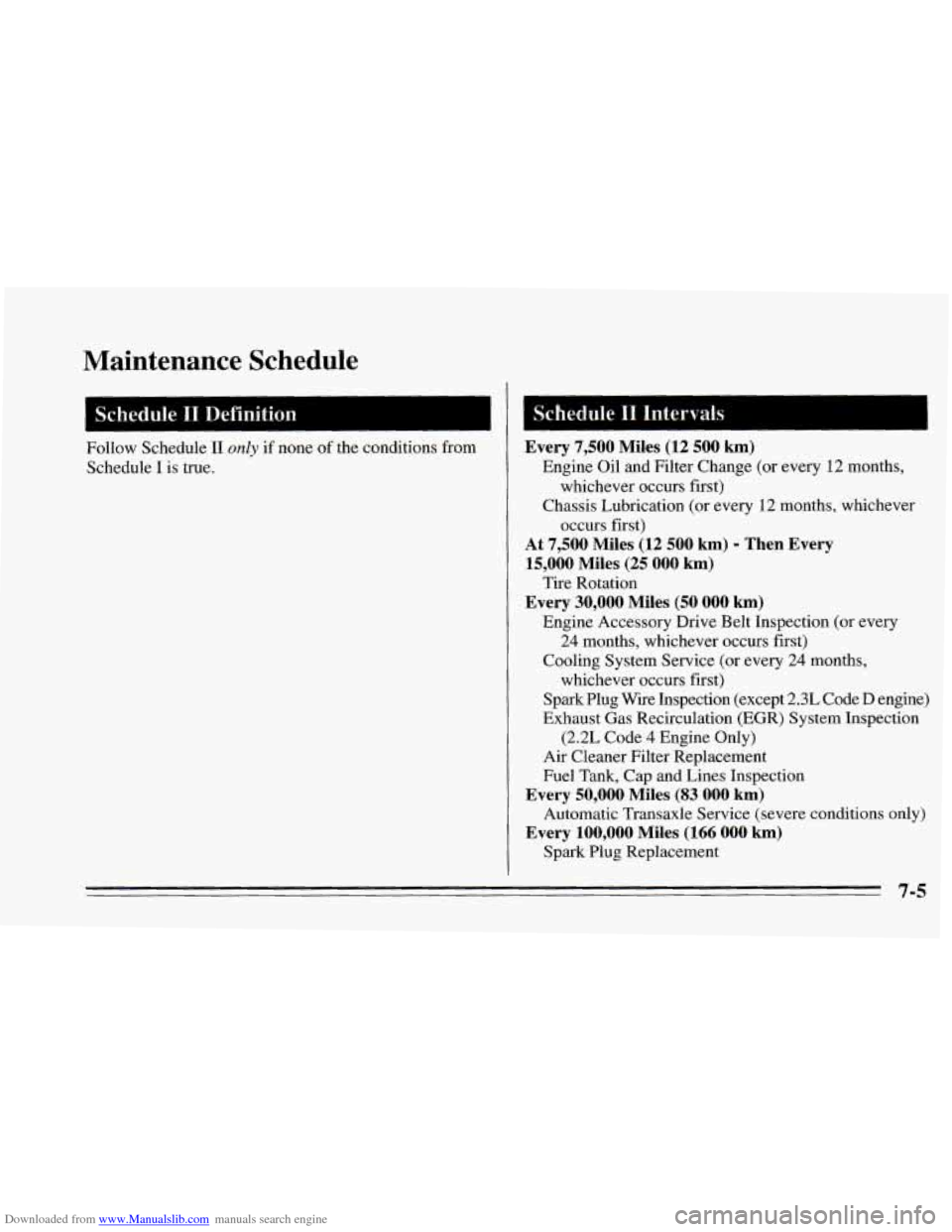
Follow Schedule I1 only if none of the conditions from
Schedule
I is true.
Every 7,500 Miles (12 500 km)
whichever occurs first)
occurs first)
Engine
Oil and Filter Change (or every 12 months,
Chassis Lubrication (or
every 12 months, whichever
At 7,500 Miles (12 500 km) - Then Every
15,000 Miles (25 000 km)
Every
30,000 Miles (50 000 km)
Tire Rotation
Engine Accessory Drive Belt Inspection
(or every
Cooling System Service
(or every 24 months,
Spark Plug Wire Inspection (except 2.3L Code
D engine)
Exhaust Gas Recirculation
(EGR) System Inspection
(2.2L Code 4 Engine Only)
Air Cleaner Filter Replacement
Fuel Tank, Cap and Lines Inspection
Every 50,000 Miles (83 000 km)
Automatic Transaxle Service (severe conditions only)
Every 100,000 Miles (166 000 km)
Spark Plug Replacement
24 months,
whichever occurs first)
whichever occurs first)
Page 273 of 340
Downloaded from www.Manualslib.com manuals search engine Maintenance Schedule I
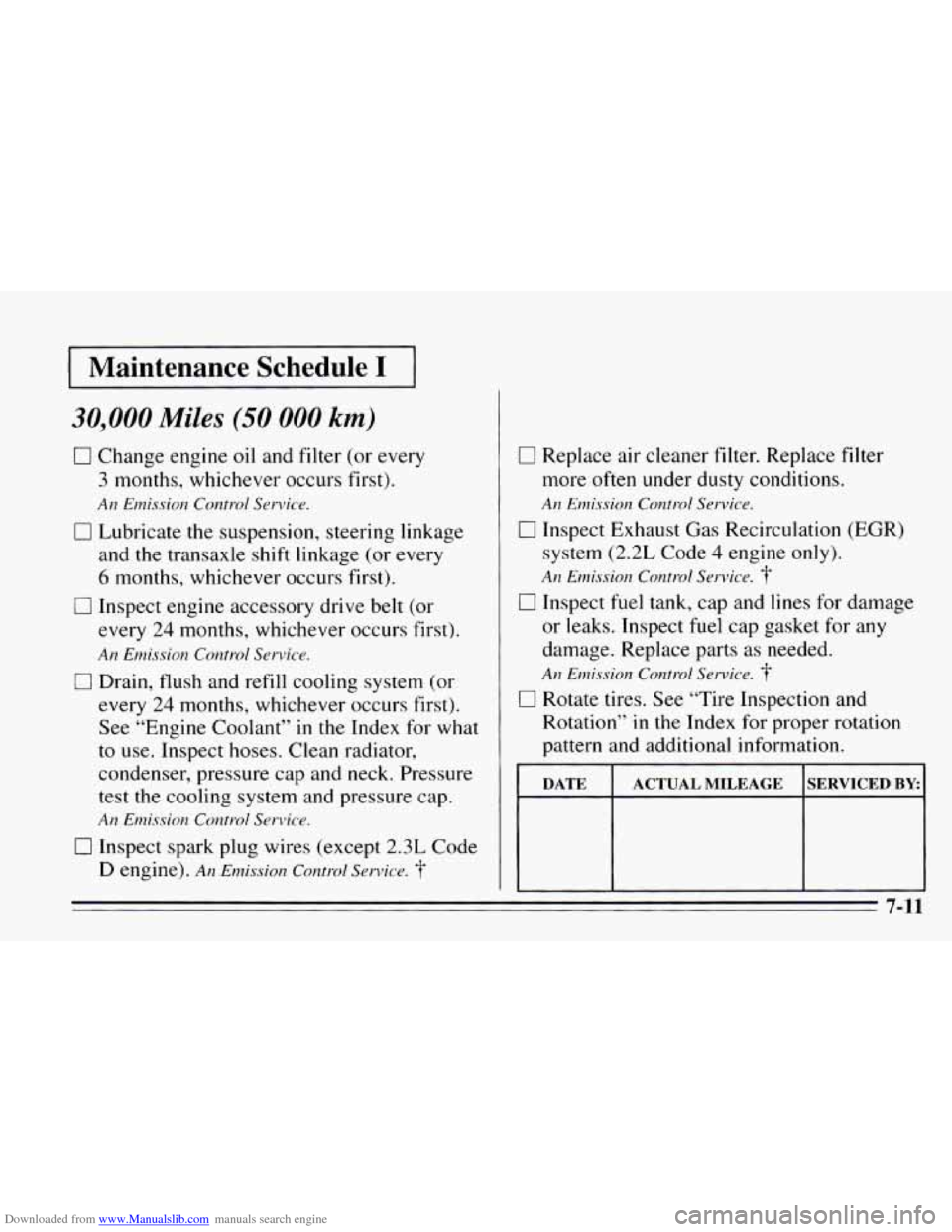
30,000 Miles (50 000 km)
0 Change engine oil and filter (or every
3 months, whichever occurs first).
An Emission Control Service.
0 Lubricate the suspension, steering linkage
and
the transaxle shift linkage (or every
6 months, whichever occurs first).
[7 Inspect engine accessory drive belt (or
every
24 months, whichever occurs first).
0 Drain, flush and refill cooling system (or
every 24 months, whichever occurs first).
See “Engine Coolant”
in the Index for what
to use. Inspect hoses. Clean radiator,
condenser, pressure cap and neck. Pressure
test the cooling system and pressure cap.
0 Inspect spark plug wires (except 2.3L Code
An Emission Control Service.
An Ernission Control Service.
D engine). An Emission Control Service.
0 Replace air cleaner filter. Replace filter
more often under dusty conditions.
An Emission Control Service.
0 Inspect Exhaust Gas Recirculation (EGR)
system (2.2L Code
4 engine only).
An Emission Control Servicu. -t-
0 Inspect fuel tank, cap and lines for damage
or leaks. Inspect fuel cap gasket for any
damage. Replace parts as needed.
0 Rotate tires. See “Tire Inspection and
Rotation”
in the Index for proper rotation
pattern and additional information.
An Emission Control Service.
DATE SERVICED BY ACTUAL MILEAGE
7-11
Page 279 of 340
Downloaded from www.Manualslib.com manuals search engine I Maintenance Schedule I 1
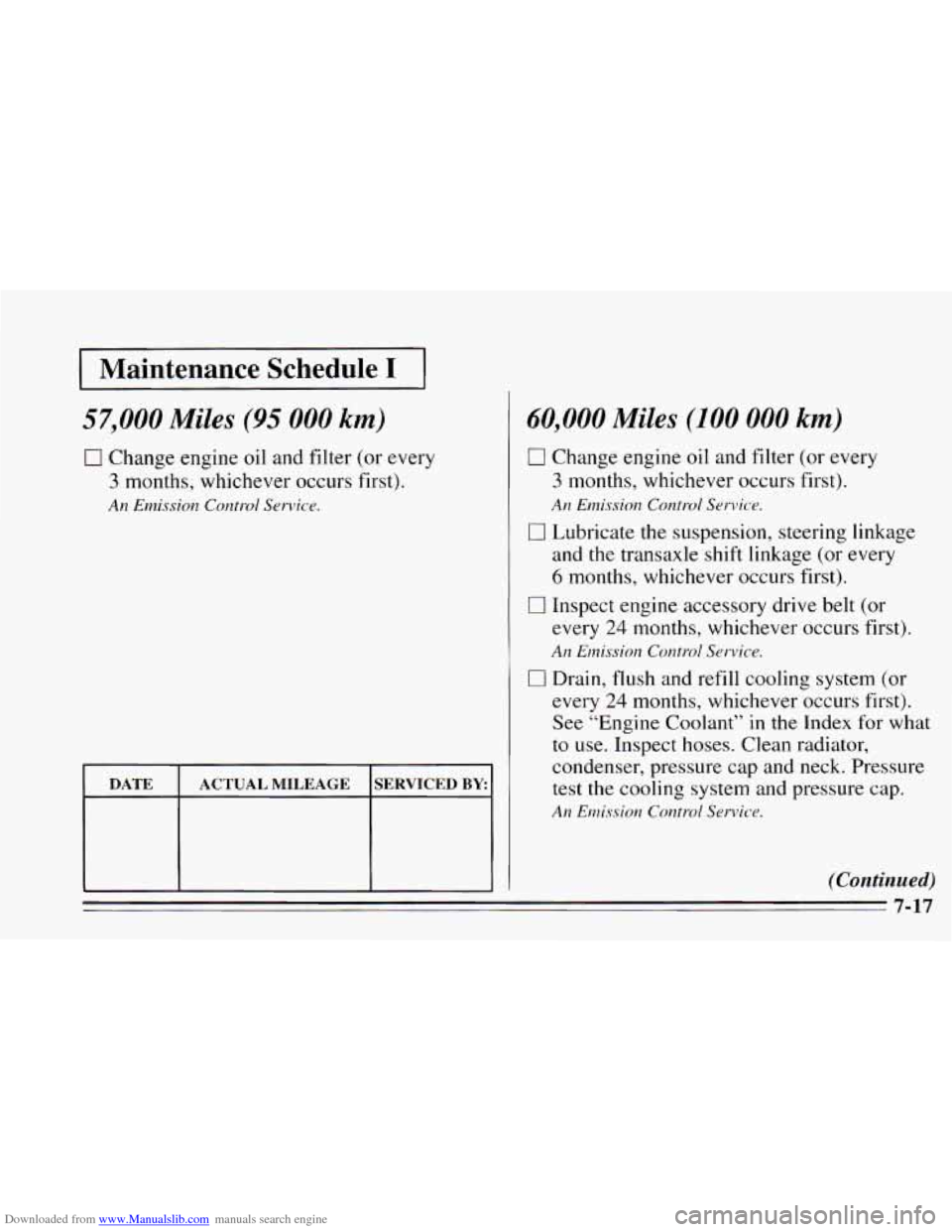
57,000 Miles (95 000 km)
0 Change engine oil and filter (or every
3 months, whichever occurs first).
An Emission Control Service.
I DATE ACTUAL MILEAGE SERVICED BY
60,000 Miles (100 000 km)
0 Change engine oil and filter (or every
3 months, whichever occurs first).
An Emission Control Service.
0 Lubricate the suspension, steering linkage
and
the transaxle shift linkage (or every
6 months, whichever occurs first).
0 Inspect engine accessory drive belt (or
every
24 months, whichever occurs first).
0 Drain, flush and refill cooling system (or
every
24 months, whichever occurs first).
See “Engine Coolant”
in the Index for what
to use. Inspect hoses. Clean radiator,
condenser, pressure cap and neck. Pressure
test the cooling system and pressure cap.
An Emissiorr Control Service.
An E~nission Control Service.
(Continued)
7-17
Page 285 of 340
Downloaded from www.Manualslib.com manuals search engine Maintenance Schedule I
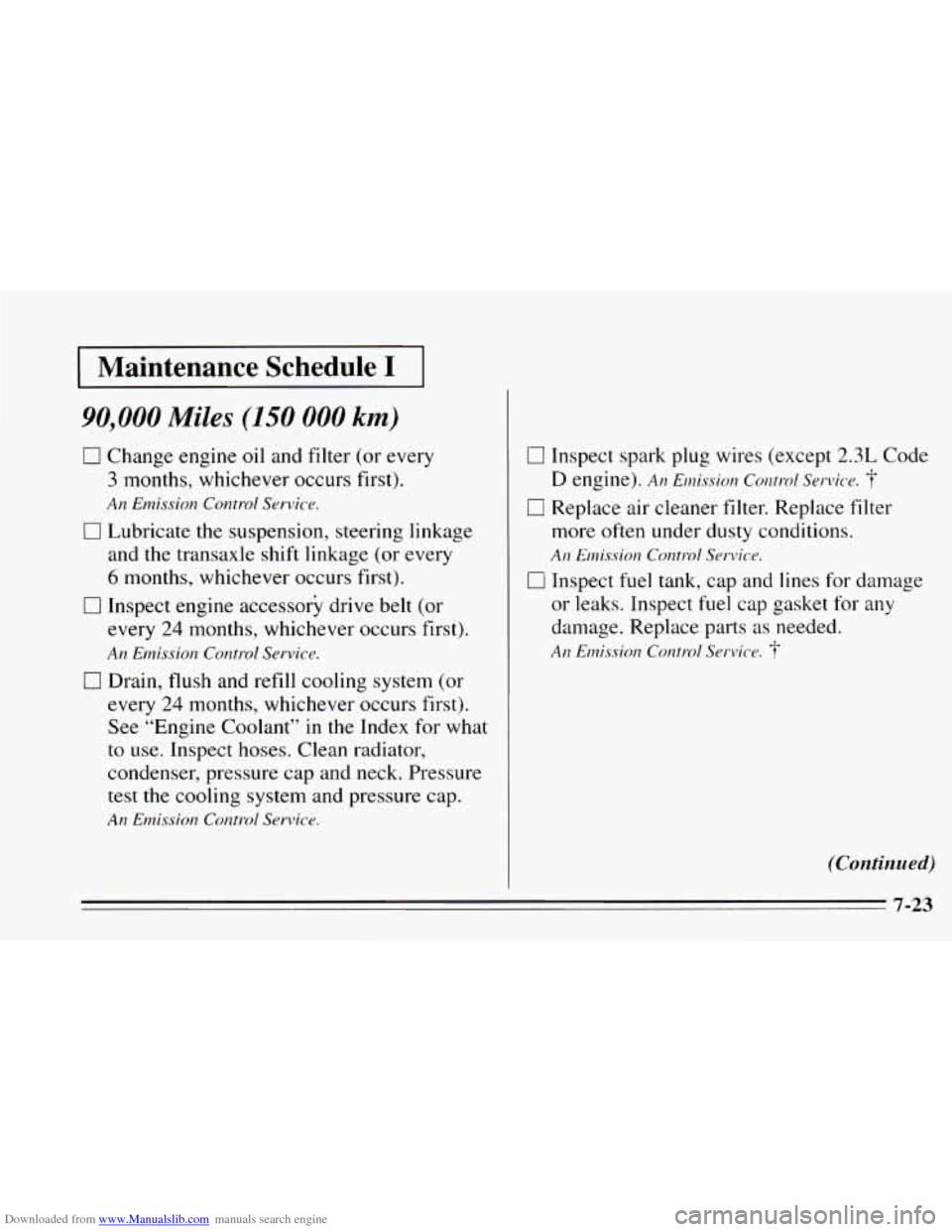
90,000 Miles (150 000 km)
0 Change engine oil and filter (or every
3 months, whichever occurs first).
An Emission Control Service.
0 Lubricate the suspension, steering linkage
and the transaxle shift linkage (or every
6 months, whichever occurs first).
every
24 months, whichever occurs first).
An Enzission Control Service.
0 Drain, flush and refill cooling system (or
every
24 months, whichever occurs first).
See “Engine Coolant’’ in the Index for what
to use. Inspect hoses. Clean radiator,
condenser, pressure cap and neck. Pressure
test the cooling system and pressure cap.
An Emission Control Service.
0 Inspect engine accessory drive belt (or
0 Inspect spark plug wires (except 2.3L Code
D engine). An Emissiou Control Setvice.
0 Replace air cleaner filter. Replace filter
more often under dusty conditions.
An Emission Control Ser\?ice.
0 Inspect fuel tank, cap and lines for damage
or leaks. Inspect fuel cap gasket for any
damage. Replace parts
as needed.
An Emissiorz Control Serviw.
7-23