service schedule CHEVROLET CAVALIER 1995 3.G Owners Manual
[x] Cancel search | Manufacturer: CHEVROLET, Model Year: 1995, Model line: CAVALIER, Model: CHEVROLET CAVALIER 1995 3.GPages: 340, PDF Size: 17.09 MB
Page 3 of 340
Downloaded from www.Manualslib.com manuals search engine 0 TI-? 1995 Chevrolet Cavalier Owner’s Manual
I
Seats and Restraint Systems .............................................................
This section tells you how to use your seats and safety belts properly. It also explains the “SRS”
(Air Bag) System.
This section explains how to start and operate your Chevrolet.
This section tells you how to adjust the ventilation and comfort controls and how to operate your
sound system.
YourDrivingandtheRoad ..............................................................
Here you’ll find helpful information and tips about the road and how to drive under different conditions.
ProblemsontheRoad ..................................................................
This section tells you what to do if you have a problem while driving, such as a flat tire or engine
overheating, etc.
ServiceandAppearanceCare ............................................................
Here the manual tells you how to keep your Chevrolet running properly and looking good.
Maintenanceschedule ..................................................................
This section tells you when to perform vehicle maintenance and what fluids and lubricants to use.
Customer Assistance Information ........................................................
This section tells you how to contact Chevrolet for assistance and how to get service publications. It also
gives
you information on “Reporting Safety Defects” on page 8-4.
Here’s an alphabetical listing of almost every subject in this manual. You can use it to quickly find
something
you want to read.
FeaturesandControls ..................................................................
Comfort Controls and Audio Systems .....................................................
Index ........................................................................\
........
1-1
2-1
3-1
4- 1
5- 1
6-1
7-1
8-1
9- 1
i
Page 176 of 340
Downloaded from www.Manualslib.com manuals search engine When You Are Ready to Leave After
Parking
on a Hill
1. Apply your regular brakes and hold the pedal down
while
you:
Start your engine;
Shift into a gear; and
Release the parking brake.
2. Let up on the brake pedal.
3. Drive slowly until the trailer is clear of the chocks.
4. Stop and have someone pick up and store the chocks.
Maintenance When Trailer Towing
Your vehicle will need service more often when you’re
pulling a trailer. See the Maintenance Schedule for more on
this. Things that are especially important in trailer
operation are automatic transaxle fluid (don’t overfill),
engine oil, belt, cooling system, and brake adjustment.
Each
of these is covered in this manual, and the Index
will help you find them quickly. If you’re trailering,
it’s
a good idea to review these sections before you start
your trip.
Check periodically
to see that all hitch nuts and bolts are
tight.
Towing A Trailer
Do not tow a trailer with a Cavalier if your vehicle is:
a convertible model.
equipped with a 2.2L (Code 4) engine.
equipped with a manual transaxle or a three
speed automatic transaxle.
Your Cavalier is neither designed nor intended to tow a
trailer.
4-36
Page 219 of 340
Downloaded from www.Manualslib.com manuals search engine Air Cleaner
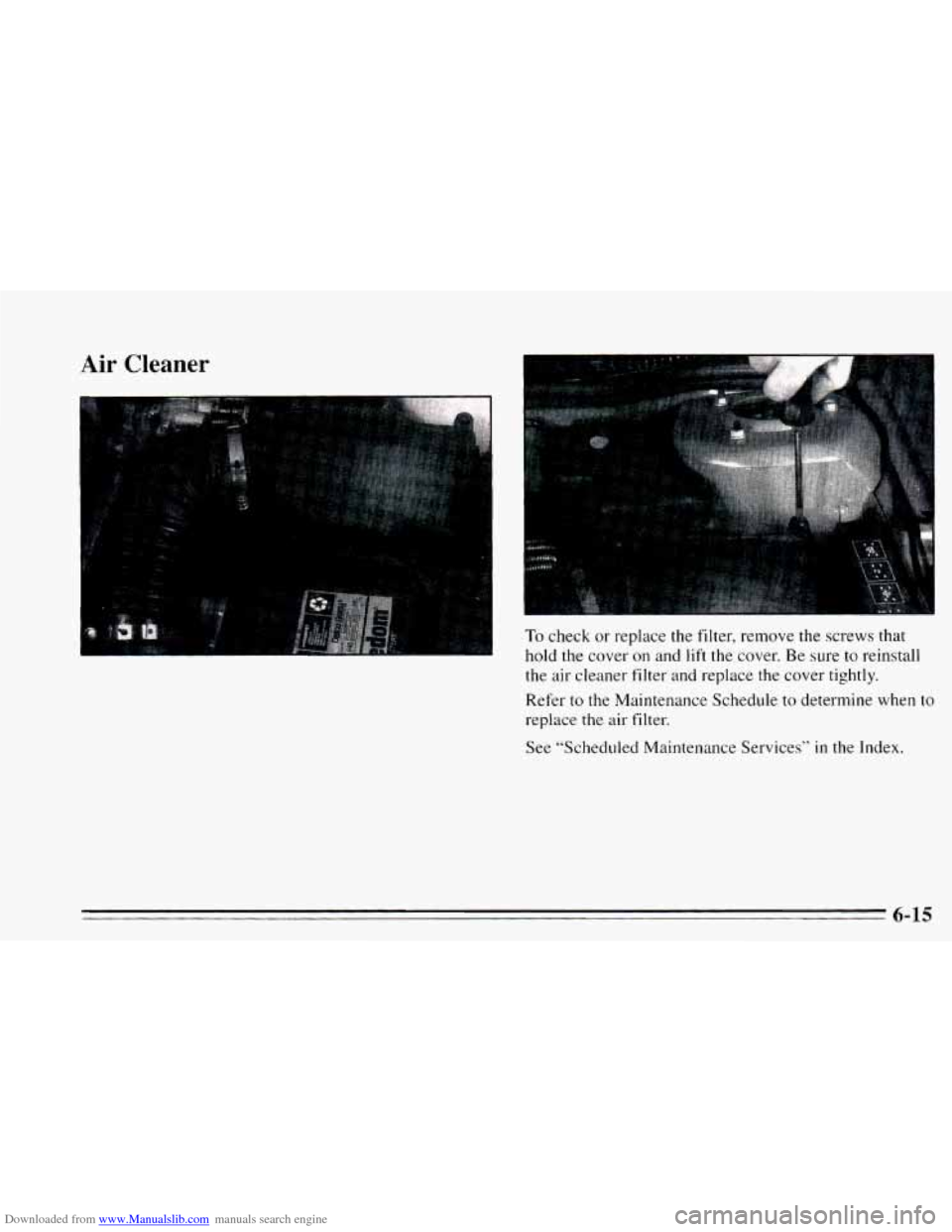
To check or replace the filter, remove the screws that
hold the cover on and lift the cover. Be sure to reinstall
the air cleaner filter and replace
the cover tightly.
Refer
to the Maintenance Schedule to determine when to
replace the air filter.
See “Scheduled Maintenance Services”
in the Index.
6-15
Page 220 of 340
Downloaded from www.Manualslib.com manuals search engine I NOTICE:
If the air cleaner is off, a backfire can cause a
damaging engine fire. And, dirt can easily get
into your engine, which
will damage it. Always
have the air cleaner in place when you’re driving.
Automatic Transaxle Fluid
(Except
2.3L Code D Engine)
When to Check and Change
A good time to check your automatic transaxle fluid
level is when the engine oil is changed. Refer to
the
Maintenance Schedule to determine when to change
your fluid. See “Scheduled Maintenance Services” in the
Index.
How to Check
Because this operation can be a little difficult, you may
choose
to have this done at your Chevrolet dealer
Service Department.
If
you do it yourself, be sure to follow all the
instructions here, or
you could get a false reading on the
dipstick.
6-16
Page 225 of 340
Downloaded from www.Manualslib.com manuals search engine When to Check and What to Use
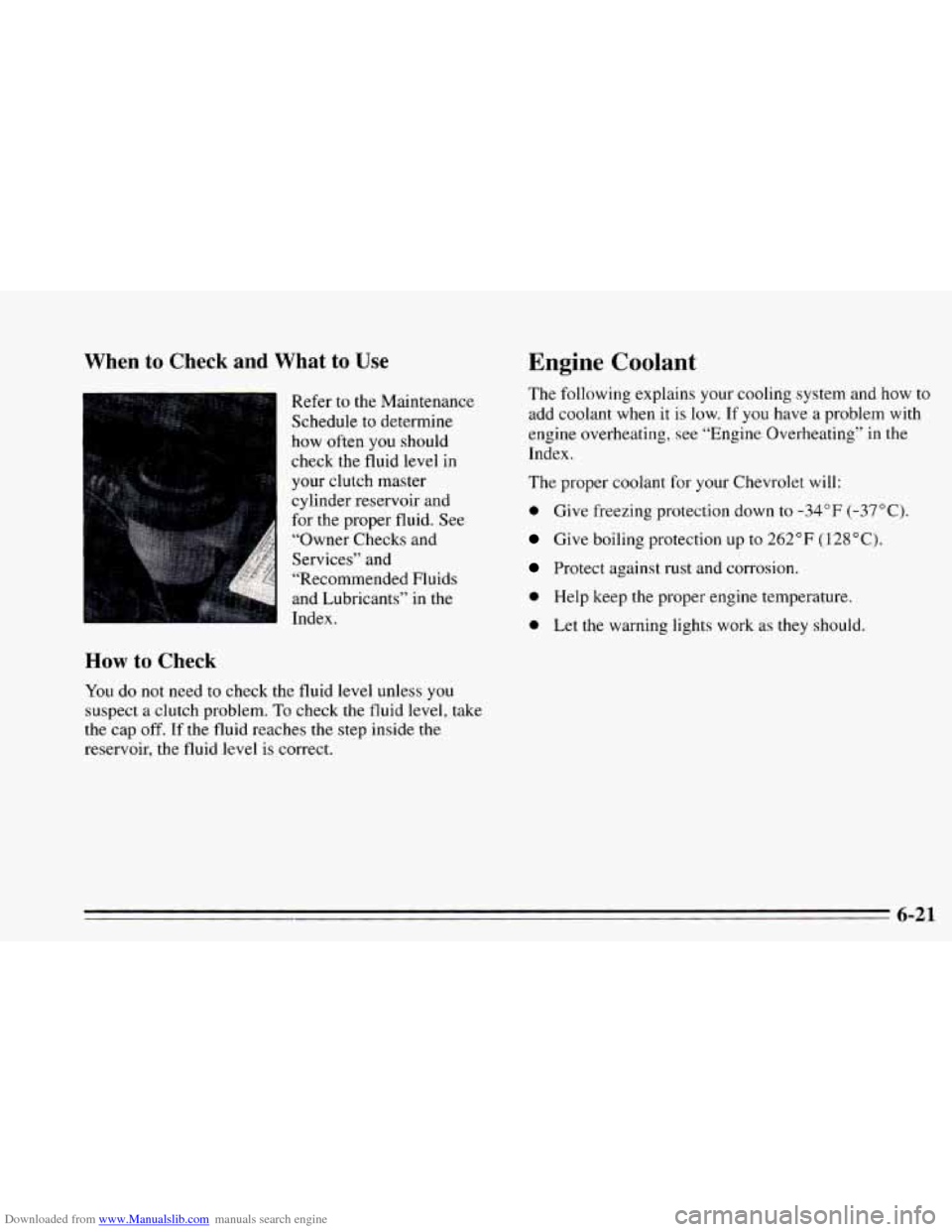
Refer to the Maintenance
Schedule to determine
how often you should
check the fluid level in
your clutch master
cylinder reservoir and
for the proper fluid. See
“Owner Checks and
Services” and
“Recommended Fluids
and Lubricants” in the
Index.
How to Check
You do not need to check the fluid level unless you
suspect a clutch problem. To check the fluid level, take
the cap
off. If the fluid reaches the step inside the
reservoir, the fluid level
is correct.
Engine Coolant
The following explains your cooling system and how to
add coolant when it is low.
If you have a problem with
engine overheating, see “Engine Overheating” in the
Index.
The proper
coolant for your Chevrolet will:
0 Give freezing protection down to -34°F (-37°C).
Give boiling protection up to 262°F (128°C).
Protect against rust and corrosion.
0 Help keep the proper engine temperature.
0 Let the warning lights work as they should.
6-21
Page 239 of 340
Downloaded from www.Manualslib.com manuals search engine Tire Inspection and Rotation
Tires should be inspected every 6,000 to 8,000 miles
(10 000 to 13 000 km) for any signs of unusual wear. If
unusual wear is present, rotate your tires as soon
as
possible and check wheel alignment. Also check for
damaged tires or wheels. See “When It’s Time for New
Tires” and “Wheel Replacement” later in this section for
more information.
The purpose of regular rotation is to achieve more
uniform wear for all tires on the vehicle. The first
rotation is the most important. See “Scheduled
Maintenance Services” in the Index for scheduled
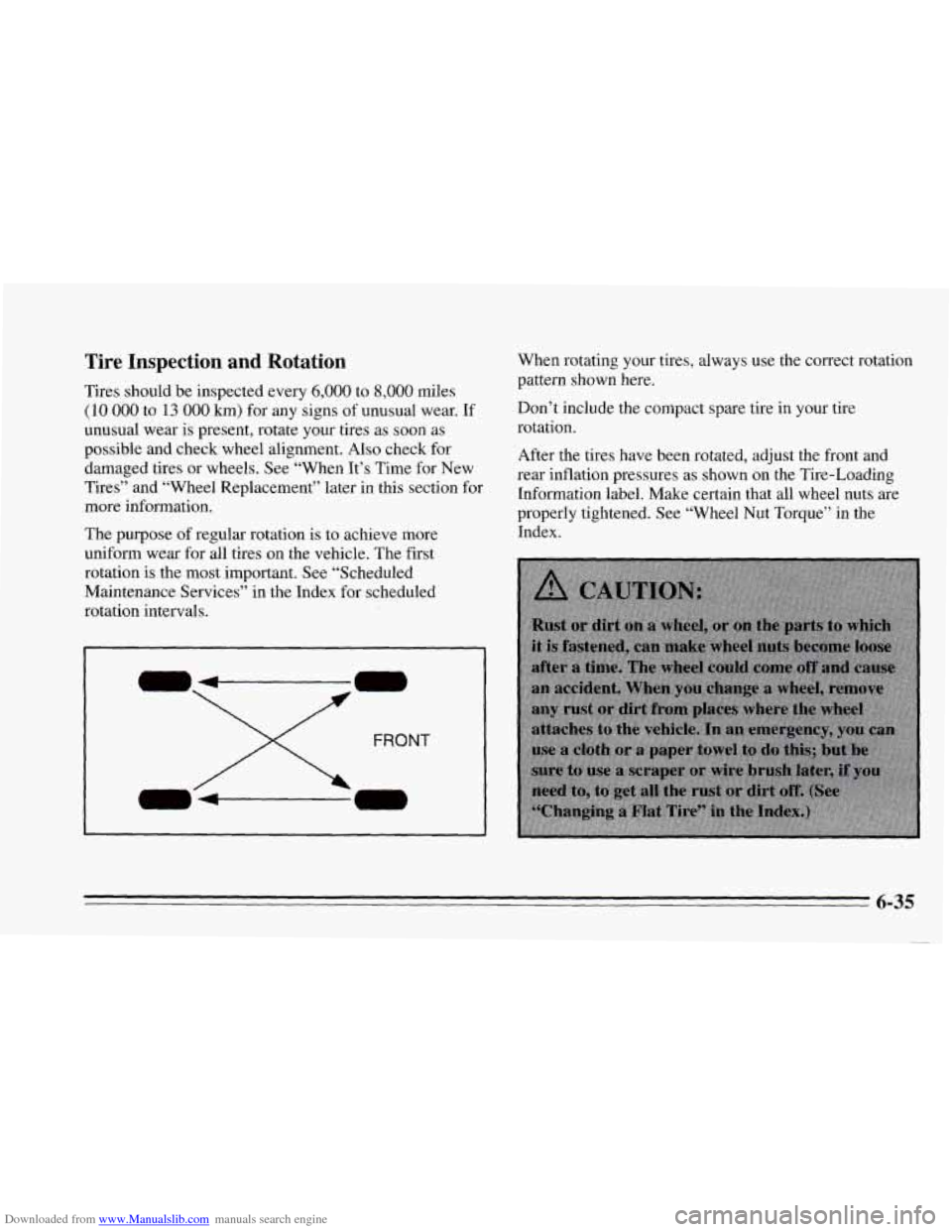
rotation intervals. When
rotating your tires, always use the correct rotation
pattern shown here.
Don’t include the compact spare tire in your tire
rotation.
After the tires have been rotated, adjust the front and
rear inflation pressures as shown on the Tire-Loading
Information label. Make certain that all wheel nuts are
properly tightened. See “Wheel Nut Torque” in the
Index.
FRONT
6-35
Page 263 of 340
Downloaded from www.Manualslib.com manuals search engine a Section 7 Maintenance Schedule
I
LE
IMPORTANT:
KEEP ENGINE OIL
AT THE PROPER
!VEL AND CHANGE
RECOMMENDED AS
This section covers the maintenance required for your
Chevrolet. Your vehicle needs these services
to retain its
safety, dependability and emission control performance.
Introduction
Your Vehicle and the Environment
Proper vehicle maintenance not only helps to keep your
vehicle
in good working condition, but also helps the
environment.
All recommended maintenance procedures
are important. Improper vehicle maintenance or the
removal
of important components can significantly
affect the quality of the air we breathe. Improper fluid
levels or even the wrong tire inflation can increase the
level of emissions from your vehicle.
To help protect our
environment, and to help keep your vehicle in good
condition, please maintain your vehicle properly.
7-1
Page 264 of 340
Downloaded from www.Manualslib.com manuals search engine How This Section is Organized
The remainder of this section is divided into five parts:
“Part A: Scheduled Maintenance Services’’ shows
what
to have done and how often. Some of these
services can be complex,
so unless you are technically
qualified and have the necessary equipment,
you should
let your dealer’s service department or another qualified
service center do these jobs.
If you are skilled enough to do some work
on your
vehicle,
you will probably want to get the service
information
GM publishes. See “Service Publications”
in
the Index.
“Part B: Owner Checks and Services” tells you what
should be checked whenever you stop for fuel. It also
explains what you can easily
do to help keep your
vehicle
in good condition.
“Part C: Periodic Maintenance Inspections’’ explains
important inspections that your Chevrolet dealer’s
service department or another qualified service center
should perform.
“Part D: Recommended Fluids and Lubricants” lists
some products
GM recommends to help keep your
vehicle properly maintained. These products,
or their
equivalents, should be used whether
you do the work
yourself or have
it done.
“Part E: Maintenance Record” provides a place for
you
to record the maintenance performed on your
vehicle. Whenever any maintenance is performed, be
sure to write
it down in this part. This will help you
determine when your next maintenance should be done.
In addition,
it is a good idea to keep your maintenance
receipts. They may be needed
to qualify your vehicle for
warranty repairs.
7-2
Page 265 of 340
Downloaded from www.Manualslib.com manuals search engine Part A: Scheduled Maintenance
Services
Using Your Maintenance Schedule
We at General Motors want to help you keep your
vehicle
in good working condition. But we don’t know
exactly how
you’ll drive it. You may drive very short
distances
only a few times a week. Or you may drive
long distances all
the time in very hot, dusty weather.
You may
use your vehicle in making deliveries. Or you
may drive
it to work, to do errands or in many other
ways.
Because
of all the different ways people use their GM
vehicles, maintenance needs vary.
You may even need
more frequent checks and replacements than you’ll find
in the schedules in this section. So please read this
section and note how
you drive. If you have any
questions
on how to keep your vehicle in good
condition, see your Chevrolet dealer.
This part tells you the maintenance services
you should
have done and when you should schedule them.
If you
go to your dealer for
your service needs, you’ll know
that GM-trained and supported service people
will
perform the work using genuine GM parts.
The proper fluids and lubricants to use are listed in Part
D. Make sure whoever services your vehicle uses these.
All parts should be replaced and all necessary repairs
done before
you or anyone else drives the vehicle.
These schedules are for vehicles that:
0 carry passengers and cargo within recommended
limits. You will find these limits on your vehicle’s
Tire-Loading Information label. See “Loading Your
Vehicle”
in the Index.
are driven on reasonable road surfaces within legal
driving limits.
use the recommended unleaded fuel. See “Fuel” in
the Index.
Selecting the Right Schedule
First you’ll need to decide which of the two schedules is
right for your vehicle. Here’s how to decide which
schedule
to follow:
7-3
Page 266 of 340
Downloaded from www.Manualslib.com manuals search engine Maintenance Schedule
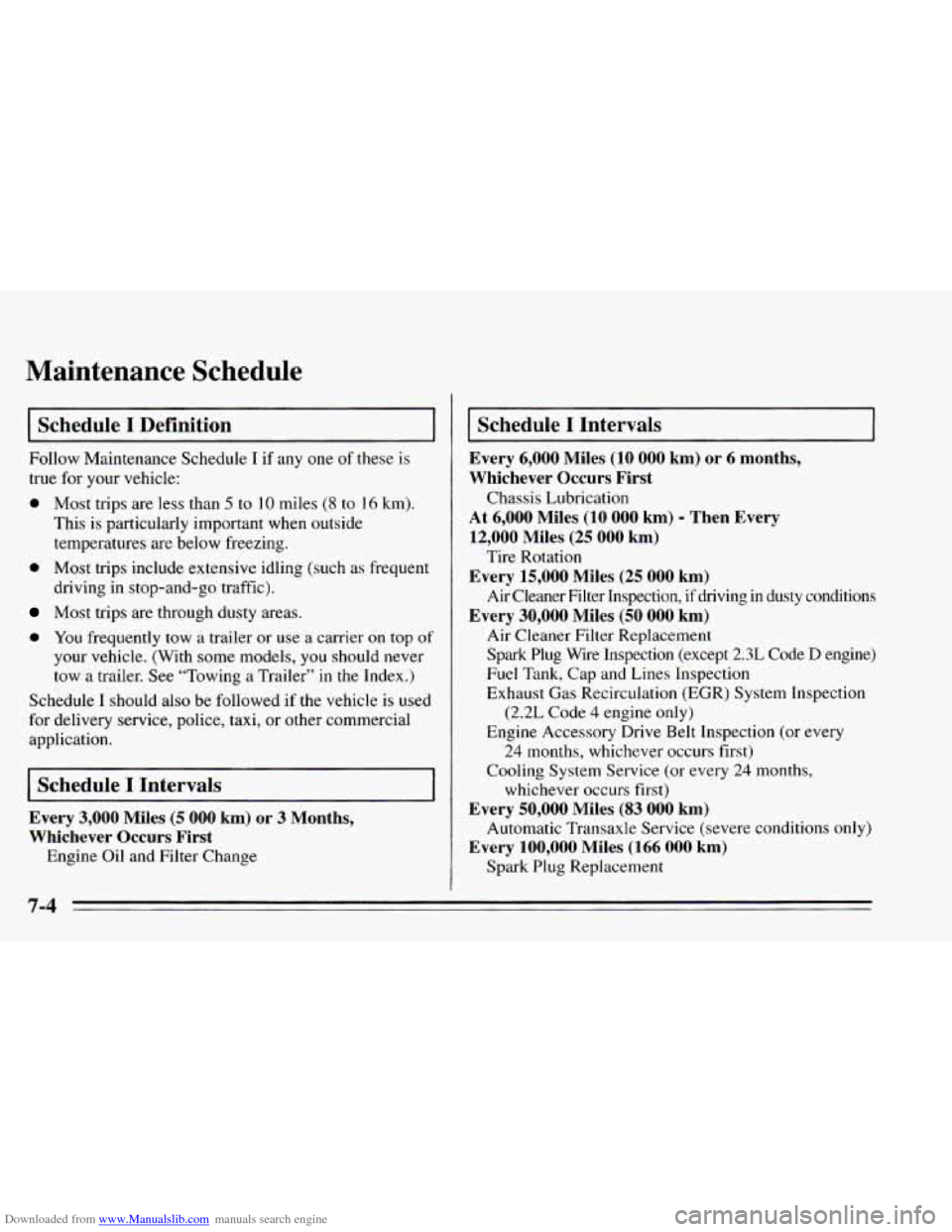
Schedule I Definition
Follow Maintenance Schedule I if any one of these is
true for your vehicle:
0 Most trips are less than 5 to 10 miles (8 to 16 km).
This
is particularly important when outside
temperatures are below freezing.
0 Most trips include extensive idling (such as frequent
driving in stop-and-go traffic).
Most trips are through dusty areas.
0 You frequently tow a trailer or use a carrier on top of
your vehicle. (With some models, you should never
tow a trailer. See “Towing a Trailer”
in the Index.)
Schedule
I should also be followed if the vehicle is used
for delivery service, police, taxi, or other commercial
application.
Schedule I Intervals
Every 3,000 Miles (5 000’km) or 3 Months,
Whichever Occurs First
Engine Oil and Filter Change
Schedule I Intervals
Every 6,000 Miles (10 000 km) or 6 months,
Whichever Occurs First
Chassis Lubrication
At 6,000 Miles (10 000 km) - Then Every
12,000 Miles (25 000 km)
Tire Rotation
Every 15,000 Miles (25 000 km)
Air Cleaner Filter Inspection, if driving in dusty conditions
Every 30,000 Miles (50 000 km)
Air Cleaner Filter Replacement
Spark Plug Wire Inspection (except 2.3L Code D engine)
Fuel Tank, Cap and Lines Inspection
Exhaust Gas Recirculation (EGR) System Inspection
Engine Accessory Drive Belt Inspection (or every
Cooling System Service (or every 24 months,
(2.2L Code 4 engine only)
24 months, whichever occurs first)
whichever occurs first)
Every 50,000 Miles (83 000 km)
Every
100,000 Miles (166 000 km)
Automatic Transaxle Service (severe conditions only)
Spark Plug Replacement
7-4