check engine CHEVROLET CAVALIER 1996 3.G Workshop Manual
[x] Cancel search | Manufacturer: CHEVROLET, Model Year: 1996, Model line: CAVALIER, Model: CHEVROLET CAVALIER 1996 3.GPages: 372, PDF Size: 19.73 MB
Page 257 of 372
Downloaded from www.Manualslib.com manuals search engine How to Add Fluid
Refer to the Maintenance Schedule to determine what
kind of transaxle fluid to use. See “Recommended
Fluids and Lubricants” in the Index.
If the fluid level is low, add only enough of the proper
fluid to bring the level into the cross-hatched area on
the dipstick.
1. Pull out the dipstick.
2. Using a long-neck funnel, add enough fluid at the
dipstick hole to bring it to the proper level.
It doesn’t take much fluid, generally less than a pint
(OSL). Don’t overfill. We recommend you use only fluid
labeled DEXRON@-111, because fluid with that
label is made especially for your automatic transaxle.
Damage caused by fluid other than DEXRON@-I11 is
not covered by
your new vehicle warranty.
0 After adding fluid, recheck the fluid level as
described under “How to Check.”
When the correct fluid level is obtained, push the
dipstick back in all the way.
Automatic Transaxle Fluid
(2.4L Code T Engine Only)
If you have the optional 2.4L Code T engine (see
“Engine Identification” in the Index) and
an automatic
transaxle, it is not necessary to check the transaxle fluid
level.
A transaxle fluid leak is the only reason for fluid
loss.
If a leak occurs, take the vehicle to your Chevrolet
dealer Service Department and have it repaired
as soon
as possible. You may also have your fluid level checked
by your dealer or service center when you have your
oil changed.
Manual Transaxle Fluid
When to Check
A good time to have it checked is when the engine oil is
changed. However, the fluid in your manual transaxle
doesn’t require changing.
6-19
Page 258 of 372
Downloaded from www.Manualslib.com manuals search engine How to Check
Because this operation can be a little difficult, you may
choose to have this done at your Chevrolet dealership Service Department.
If you do it yourself, be sure to follow all the instructions here, or you could get
a false reading on
the dipstick.
NOTICE:
Too much or too little fluid can damage your
transaxle.
Too much can mean that some of the
fluid could come
out and fall on hot engine parts
or exhaust system parts, starting a fire. Be sure to
get an accurate reading if you check your
transaxle fluid.
Check the fluid level only when your engine is off, the
vehicle is parked on a level place and the transaxle
is
cool enough for you to rest your fingers on the
transaxle case. Then, follow these steps:
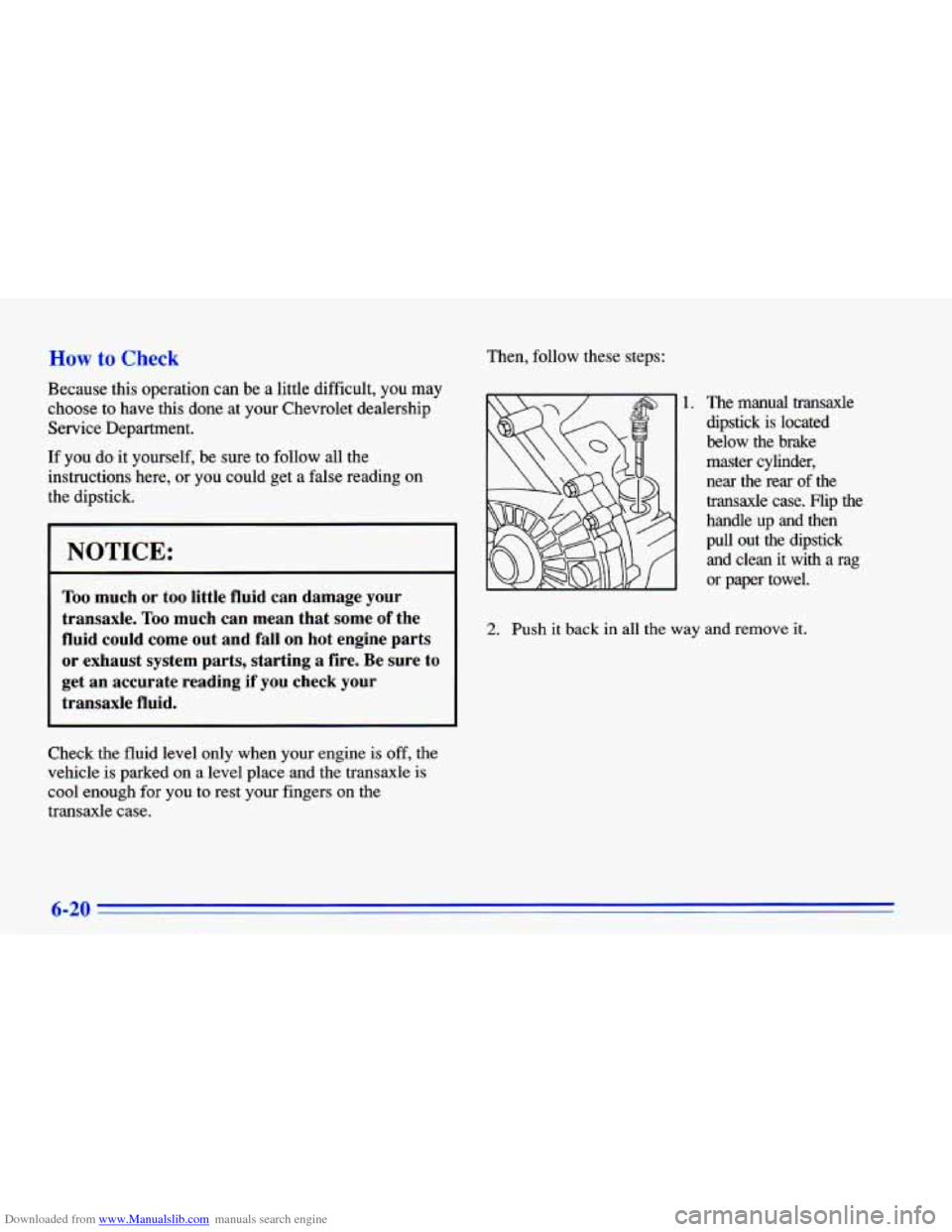
1. The manual transaxle
dipstick
is located
below the brake
master cylinder,
near the
rear of the
transaxle case. Flip the
handle
up and then
pull
out the dipstick
and clean it with a rag
or paper towel.
2. Push it back in all the way and remove it.
6-20
Page 259 of 372
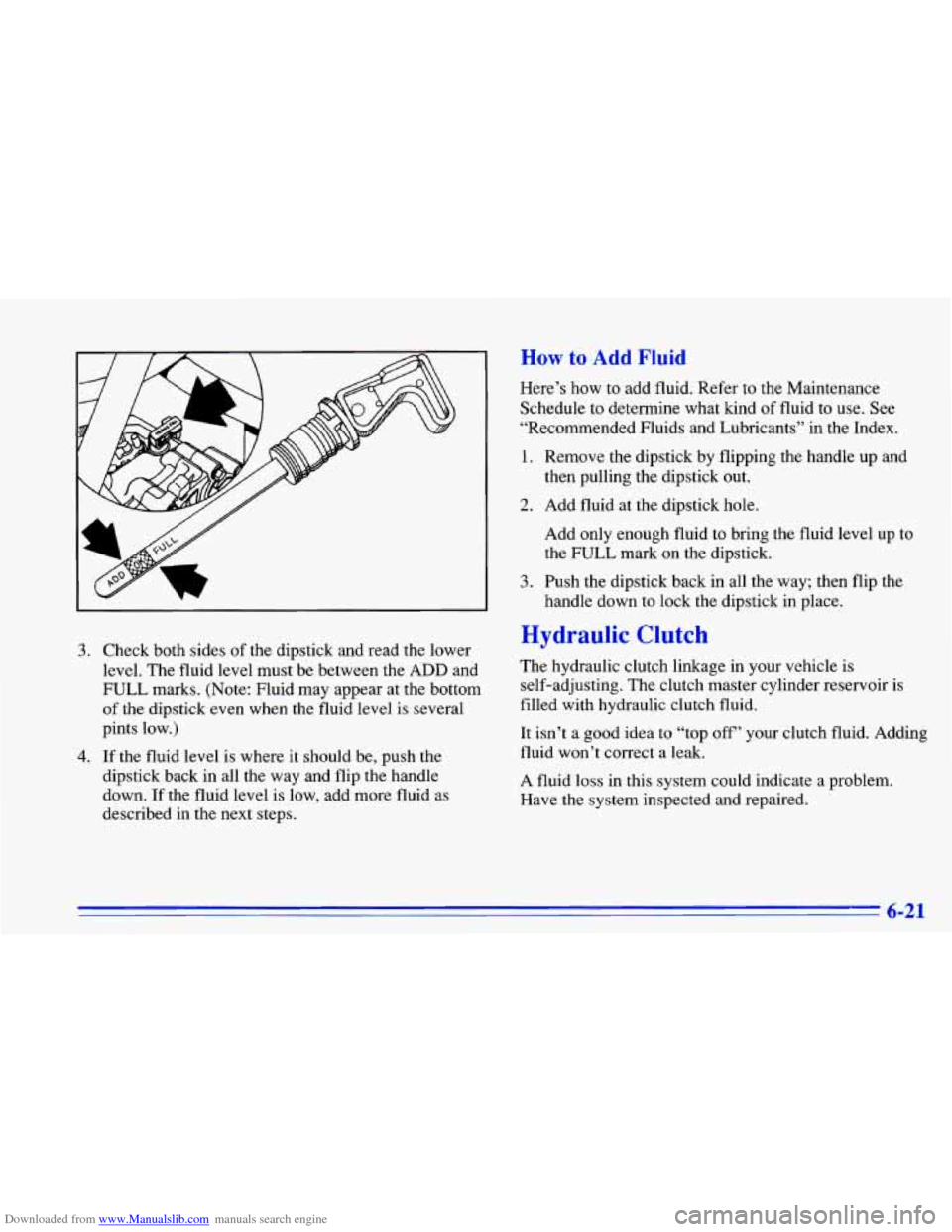
Downloaded from www.Manualslib.com manuals search engine 3. Check both sides of the dipstick and read the lower
level. The fluid level must be between the
ADD and
FULL marks. (Note: Fluid may appear at the bottom
of the dipstick even when the fluid level is several
pints low.)
4. If the fluid level is where it should be, push the
dipstick back in all the way and flip the handle
down. If the fluid level
is low, add more fluid as
described in the next steps.
How to Add Fluid
Here’s how to add fluid. Refer to the Maintenance
Schedule to determine what kind of fluid
to use. See
“Recommended Fluids and Lubricants” in the Index.
1. Remove the dipstick by flipping the handle up and
then pulling the dipstick
out.
2. Add fluid at the dipstick hole.
Add only enough fluid to bring the fluid level up to
the
FULL mark on the dipstick.
handle down to lock the dipstick in place.
3. Push the dipstick back in all the way; then flip the
Hydraulic Clutch
The hydraulic clutch linkage in your vehicle is
self-adjusting. The clutch master cylinder reservoir is
filled with hydraulic clutch fluid.
It isn’t a good idea
to “top off’ your clutch fluid. Adding
fluid won’t correct a leak.
A fluid loss in this system could indicate a problem.
Have the system inspected and repaired.
6-21
Page 260 of 372
Downloaded from www.Manualslib.com manuals search engine When to Check and What to Use
Refer to the Maintenance Schedule to determine how
often you should check the fluid level in your clutch
master cylinder reservoir and for the proper fluid. See
“Owner Checks and Services” and “Recommended
Fluids and Lubricants” in the Index.
How to Check
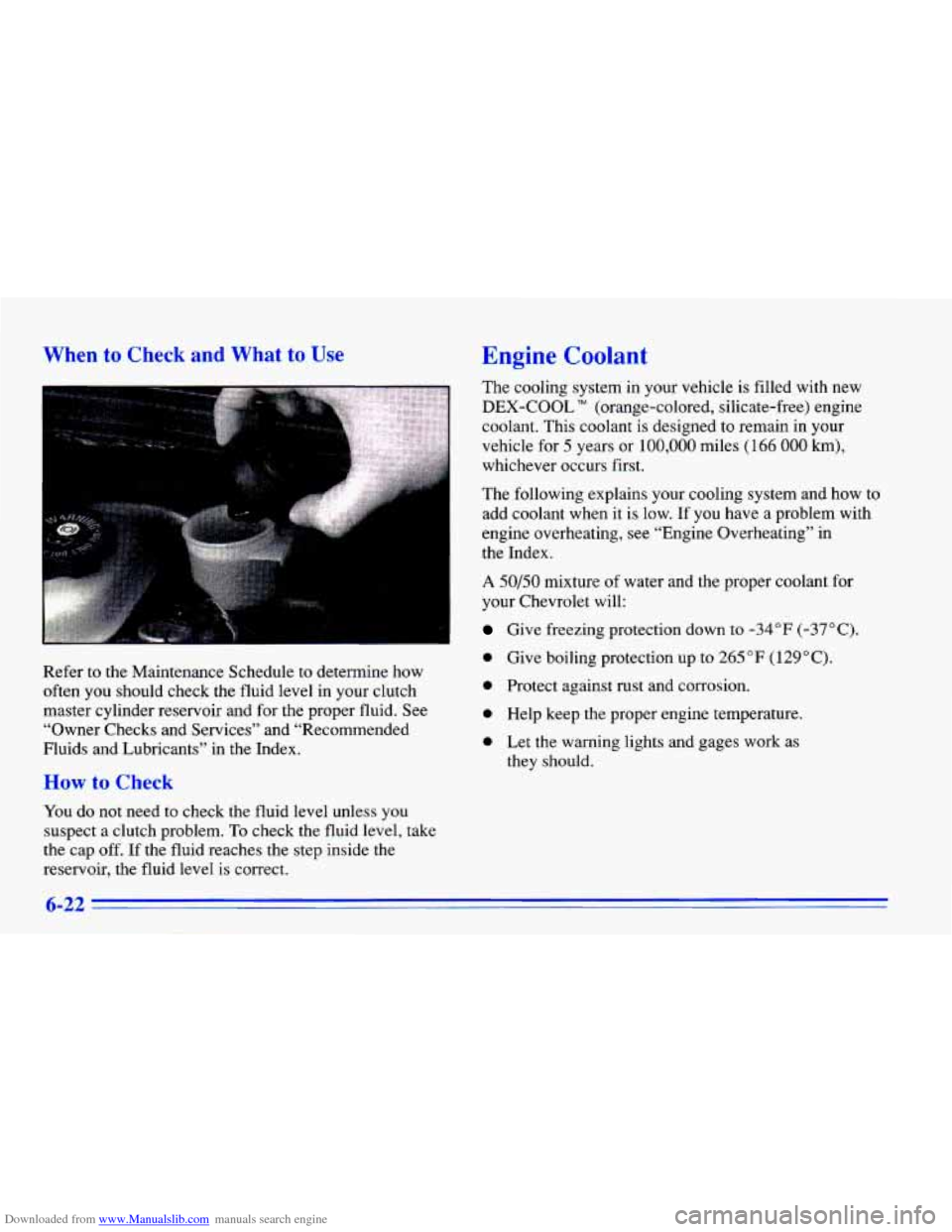
You do not need to check the fluid level unless you
suspect a clutch problem. To check the fluid level, take
the cap off.
If the fluid reaches the step inside the
reservoir, the fluid level
is correct.
Engine Coolant
The cooling system in your vehicle is filled with new
DEX-COOL TM (orange-colored, silicate-free) engine
coolant. This coolant is designed to remain in your
vehicle for
5 years or 100,000 miles ( 166 000 km),
whichever occurs first.
The following explains your cooling system and how to
add coolant when it is low. If you have a problem with
engine overheating, see “Engine Overheating” in
the Index.
A 50/50 mixture of water and the proper coolant for
your Chevrolet will:
Give freezing protection down to -34°F (-37OC).
e Give boiling protection up to 265 “F (129°C).
0 Protect against rust and corrosion.
e Help keep the proper engine temperature.
e Let the warning lights and gages work as
they should.
6-22
Page 262 of 372
Downloaded from www.Manualslib.com manuals search engine NOTICE:
If you use an improper coolant mix, your engine
could overheat and be badly damaged. The
repair cost wouldn't
be covered by your
warranty.
Too much water in the mix can freeze
and crack the engine, radiator, heater core and
other parts.
If you have to add coolant more than four times a year,
have your dealer check your cooling system.
NOTICE:
If you use the proper coolant, you don't have to
add extra inhibitors or additives which claim to
improve the system. These can be harmful.
I
Checking Coolant
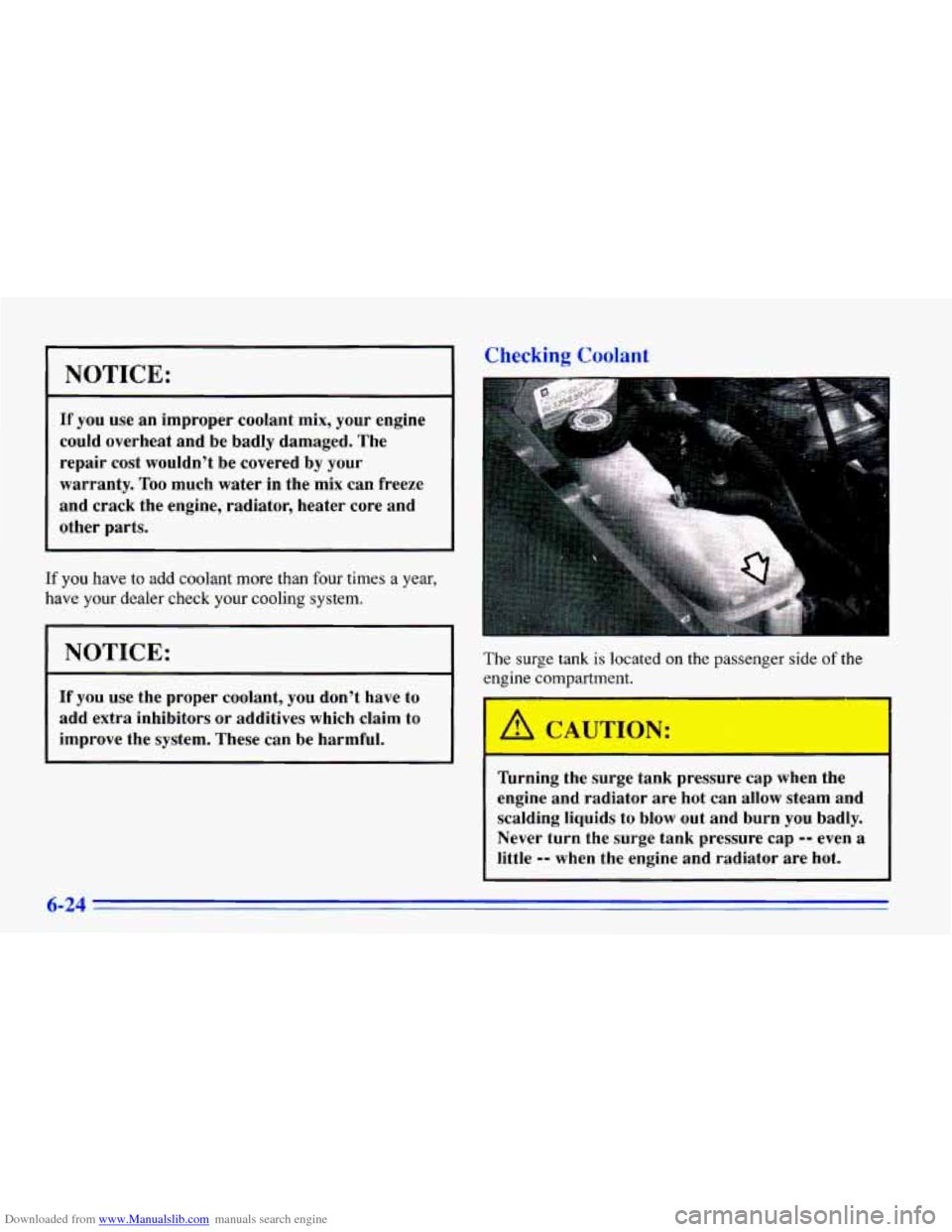
The surge tank is located on the passenger side of the
engine compartment.
"urning the surge tank pressure cap when the
engine and radiator are hot can allow steam and
scalding liquids to blow out and burn you badly.
Never turn the surge tank pressure cap
-- even a
little -- when the engine and radiator are hot.
6-24
Page 264 of 372
Downloaded from www.Manualslib.com manuals search engine Thermostat
Engine coolant temperature is controlled by a thermostat
in the engine coolant system. The thermostat stops the
flow of coolant through the radiator until the coolant
reaches
a preset temperature.
When you replace your thermostat, an
AC’ thermostat
is recommended.
Power Steering Fluid
When to Check Power Steering Fluid
It is not necessary to regularly check power steering
fluid unless you suspect there
is a leak in the system or
you hear an unusual noise.
A fluid loss in this system
could indicate a problem. Have the system inspected
and repaired.
How To Check Power Steering Fluid
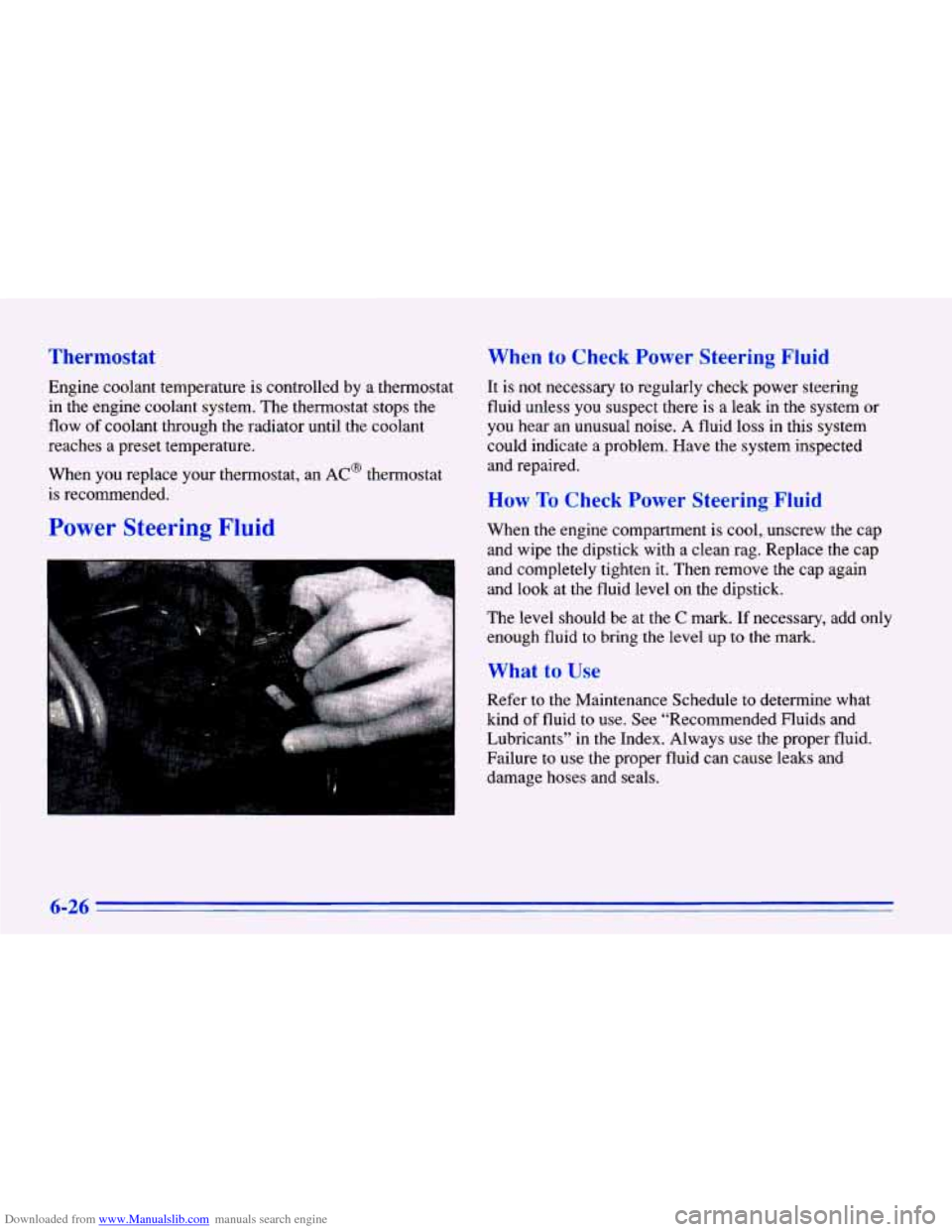
When the engine compartment is cool, unscrew the cap
and wipe the dipstick with a clean rag. Replace the cap
and completely tighten it. Then remove the cap again
and look at the fluid level on the dipstick.
The level should be at the
C mark. If necessary, add only
enough fluid
to bring the level up to the mark.
What to Use
Refer to the Maintenance Schedule to determine what
kind
of fluid to use. See “Recommended Fluids and
Lubricants” in the Index. Always use the proper fluid.
Failure
to use the proper fluid can cause leaks and
damage hoses and seals.
6-26
Page 274 of 372
Downloaded from www.Manualslib.com manuals search engine Tires
We don’t make tires. Your new Chevrolet comes with
high-quality tires made
by a leading tire manufacturer. If
you ever have questions about your tire warranty and
where to obtain service, see your Chevrolet Warranty
booklet for details.
Poorly maintained and improperly used tires
are dangerous.
0 Overloadingyour tires can cause
overheating as
a result of too much friction.
You could have an air-out and
a serious
accident, See “Loading Your Vehicle” in
the Index.
CAUTION: (Continued)
-
L
0 Underinflated tires pose the same danger as
overloaded tires. The resulting accident
could. cause serious injury. Check all tires
frequently to maintain the recommended
pressure. Tire pressure should be checked
when your tires are cold.
cut, punctured or broken by
a sudden
impact
-- such as when you hit a pothole.
Keep tires at the recommended pressure.
0 Worn, old tires can cause accidents. If your
tread is badly worn, or if your tires have
been damaged, replace them.
0 Overinflated tires are more likely to be
6-36
Page 275 of 372
Downloaded from www.Manualslib.com manuals search engine Inflation -- Tire Pressure
The Tire-Loading Information label which is on the rear
edge
of the driver’s door shows the correct inflation
pressures for your tires when they’re cold. “Cold”
means your
vehicle has been sitting for at least three
hours or driven no more than
1 mile (1.6 km).
NOTICE:
Don’t let anyone tell you that underinflation or
overinflation is
all right. It’s not. If your tires
don’t have enough air (underinflation), you can
get the following:
Too much flexing
Too much heat
Tire overloading
Bad wear
Bad handling
Bad fuel economy.
NOTICE: (Continued) NOTICE:
(Continued)
If your tires have too much air (overinflation),
you can get the following:
Unusual wear
Bad handling
Rough ride
Needless damage from road hazards.
When to Check
Check your tires once a month or more.
Don’t forget your compact spare tire.
It should be at
60 psi (420 Pa).
How to Check
Use a good quality pocket-type gage to check tire
pressure. You can’t tell
if your tires are properly inflated
simply by looking at them. Radial tires may look
properly inflated even when they’re underinflated.
Be sure
to put the valve caps back on the valve stems.
They help prevent leaks by keeping out dirt and
moisture.
6-37
Page 276 of 372
Downloaded from www.Manualslib.com manuals search engine Tire Inspection and Rotation
1 Tires should be inspected every 6,000 to 8,000 miles
(10 000 to 13 000 km) for any signs of unusual wear.
If unusual wear is present, rotate your tires as soon as
possible and check wheel alignment. Also check for
damaged tires or wheels. See “When It’s Time for New
Tires” and “Wheel Replacement” later in this section for
more information.
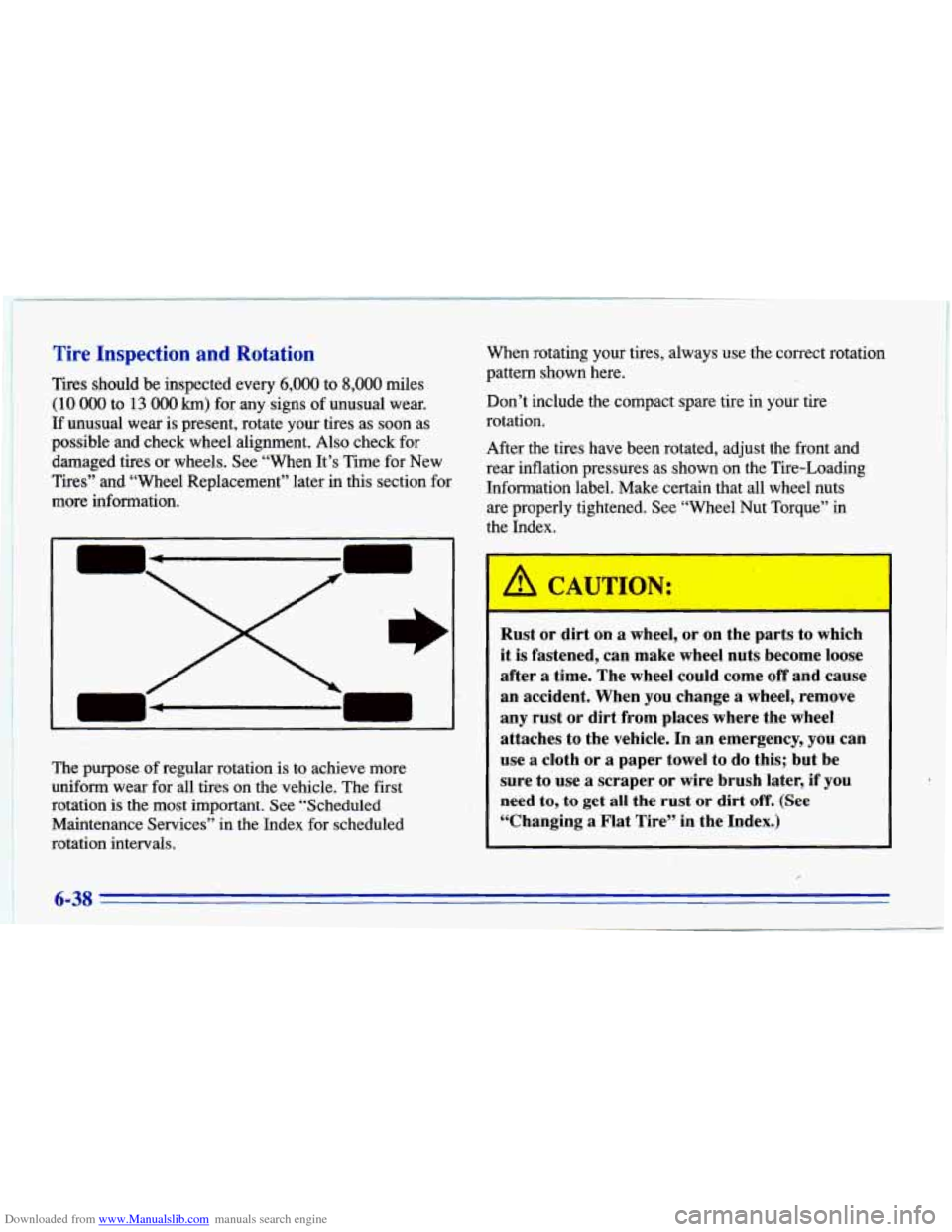
The purpose of regular rotation is to achieve more
uniform wear for all tires on the vehicle. The first
rotation is the most important. See “Scheduled
Maintenance Services” in the Index for scheduled
rotation intervals. When rotating your tires, always use the Correct rotation
pattern shown here.
Don’t include the compact spare tire
in your tire
rotation.
After the tires have been rotated, adjust the front and
rear inflation pressures as shown on the Tire-Loading
Information label. Make certain that all wheel nuts are properly tightened. See “Wheel Nut Torque” in
the Index.
A CAUTION:
Rust or dirt on a wheel, or on the parts to which
it is fastened, can make wheel nuts become loose
after
a time. The wheel could come off and cause
an accident. When you change
a wheel, remove
any rust or dirt from places where the wheel
attaches to the vehicle. In an emergency, you can
use a cloth or a paper towel to do this; but be
sure to use
a scraper or wire brush later, if you
need to, to get all the rust or dirt
off. (See
“Changing
a Flat Tire” in the Index.)
,
6-38
Page 277 of 372
Downloaded from www.Manualslib.com manuals search engine When It’s Time for New Tires
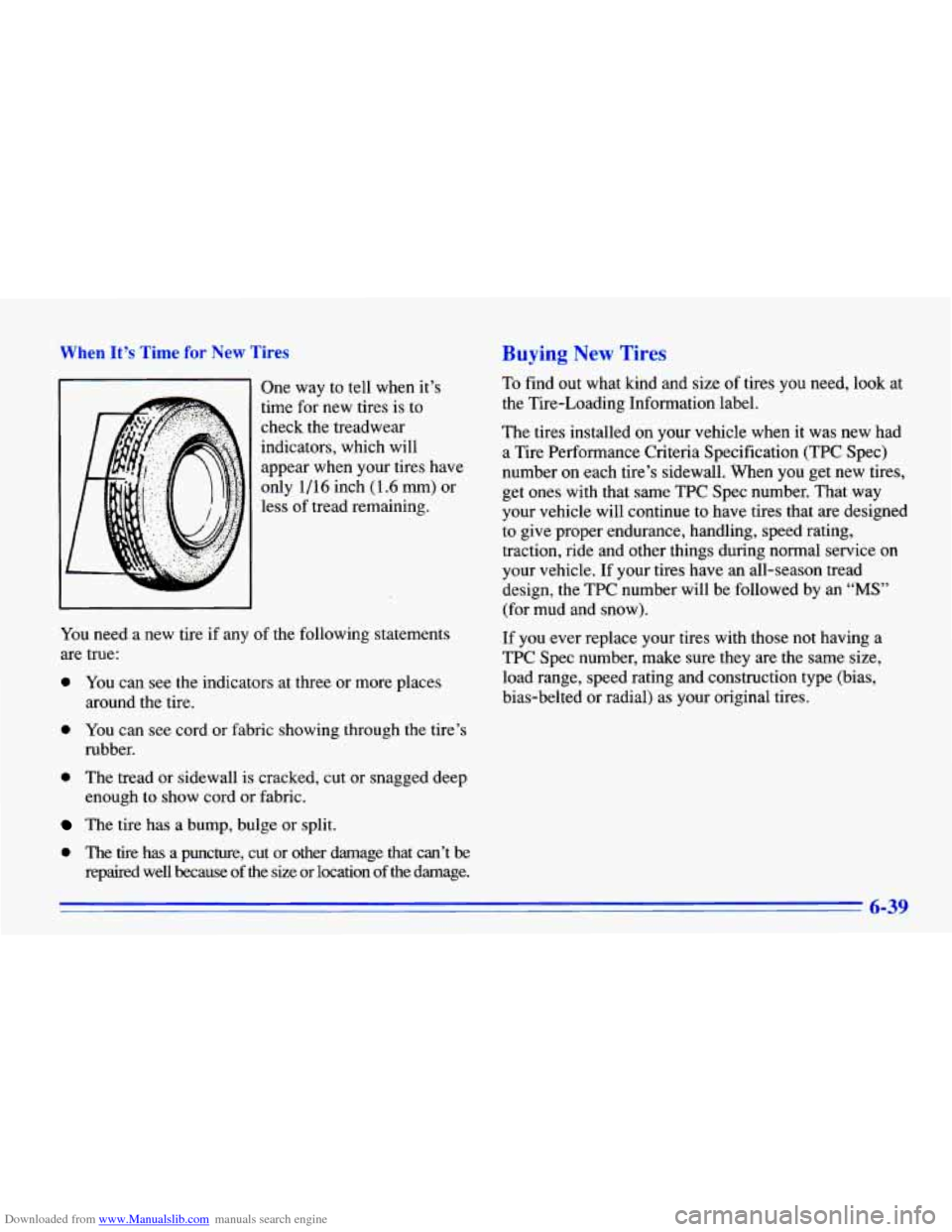
One way to tell when it’s
time for new tires is to
check the treadwear
indicators, which will
appear when your tires have
only
1/16 inch (1.6 mm) or
less of tread remaining.
Buying New Tires
To find out what kind and size of tires you need, look at
the Tire-Loading Information label.
The tires installed on your vehicle when it was new had
a Tire Performance Criteria Specification (TPC Spec)
number on each tire’s sidewall. When you get new tires,
get ones with that same TPC Spec number. That way
your vehicle will continue to have tires that are designed
to give proper endurance, handling, speed rating,
traction, ride and other things during normal service on
your vehicle. If your tires have an all-season tread
design, the TPC number will be followed by an
“MS”
(for mud and snow).
If you ever replace your tires with those not having a
TPC Spec number, make sure they are the same size,
load range, speed rating and construction type (bias,
bias-belted or radial) as your original tires.
You
need a new tire if any of the following statements
are true:
0 You can see the indicators at three or more places
0 You can see cord or fabric showing through the tire’s
around the tire.
rubber.
0 The tread or sidewall is cracked, cut or snagged deep
enough to show cord or fabric.
The tire has a bump, bulge or split.
0 The tire has a puncture, cut or other damage that can’t be
repaired well because of the size or location of the damage.
6-39