power steering CHEVROLET CAVALIER 1996 3.G Owners Manual
[x] Cancel search | Manufacturer: CHEVROLET, Model Year: 1996, Model line: CAVALIER, Model: CHEVROLET CAVALIER 1996 3.GPages: 372, PDF Size: 19.73 MB
Page 68 of 372
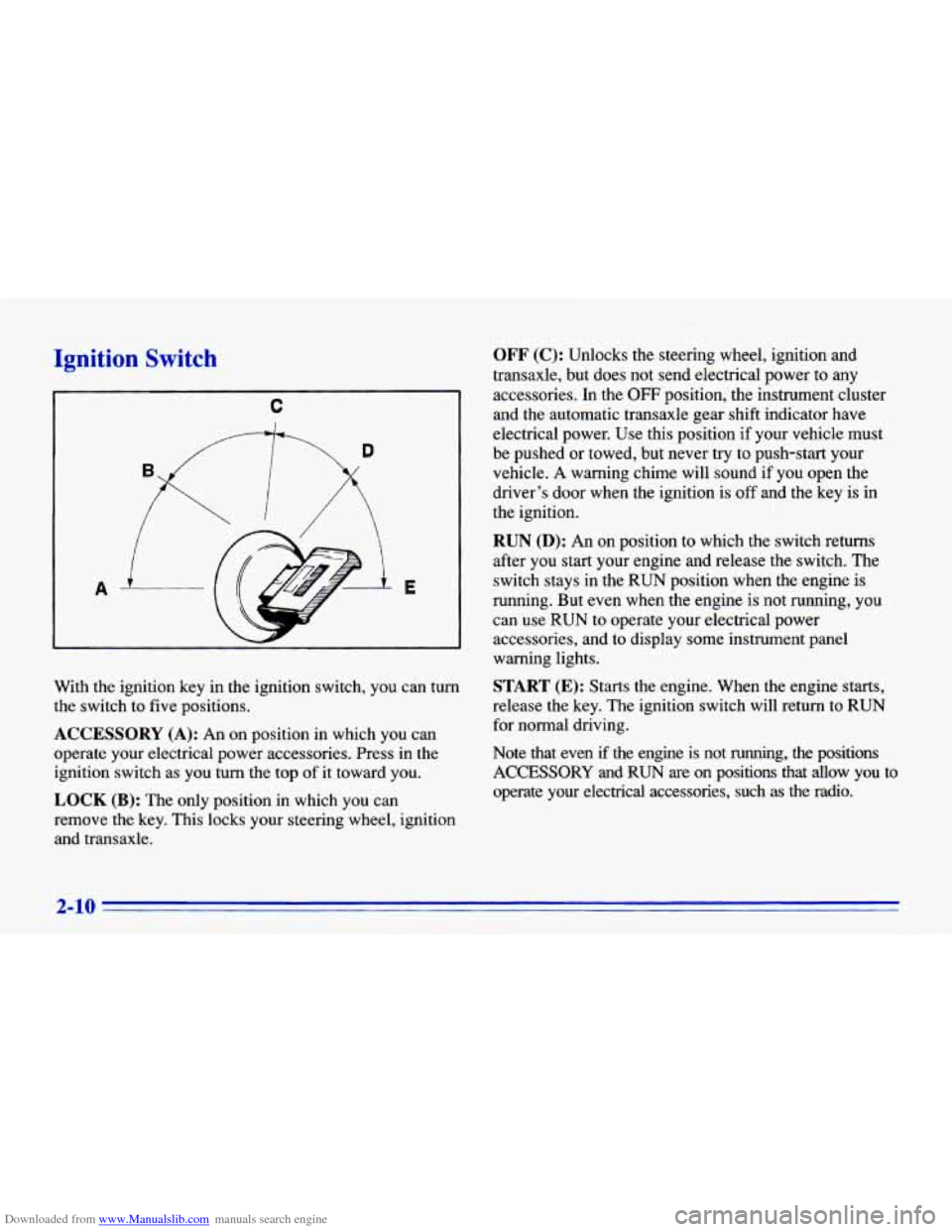
Downloaded from www.Manualslib.com manuals search engine Ignition Switch
A E
With the ignition key in the ignition switch, you can turn
the switch to five positions.
ACCESSORY (A): An on position in which you can
operate your electrical power accessories. Press in the
ignition switch as you turn the top of it toward you.
LOCK (B): The only position in which you can
remove the key. This locks your steering wheel, ignition
and transaxle.
OFF (C): Unlocks the steering wheel, ignition and
transaxle, but does not send electrical power to any
accessories.
In the OFF position, the instrument cluster
and the automatic transaxle gear shift indicator have
electrical power. Use this position if your vehicle must
be pushed or towed, but never try to push-start your
vehicle.
A warning chime will sound if you open the
driver’s door when the ignition is
off and the key is in
the ignition.
RUN (D): An on position to which the switch returns
after you start your engine and release the switch. The
switch stays in the RUN position when the engine is
running. But even when the engine is not running, you can use RUN to operate your electrical power
accessories, and to display some instrument panel
warning lights.
START (E): Starts the engine. When the engine starts,
release the key. The ignition switch will return to RUN
for normal driving.
Note that even if the engine is not running, the positions
ACCESSORY and RUN are on positions that allow you to
operate your electrical accessories, such
as the radio.
2-10
Page 87 of 372
Downloaded from www.Manualslib.com manuals search engine Windows
On a vehicle with manual windows, use the window
crank to open and close each window.
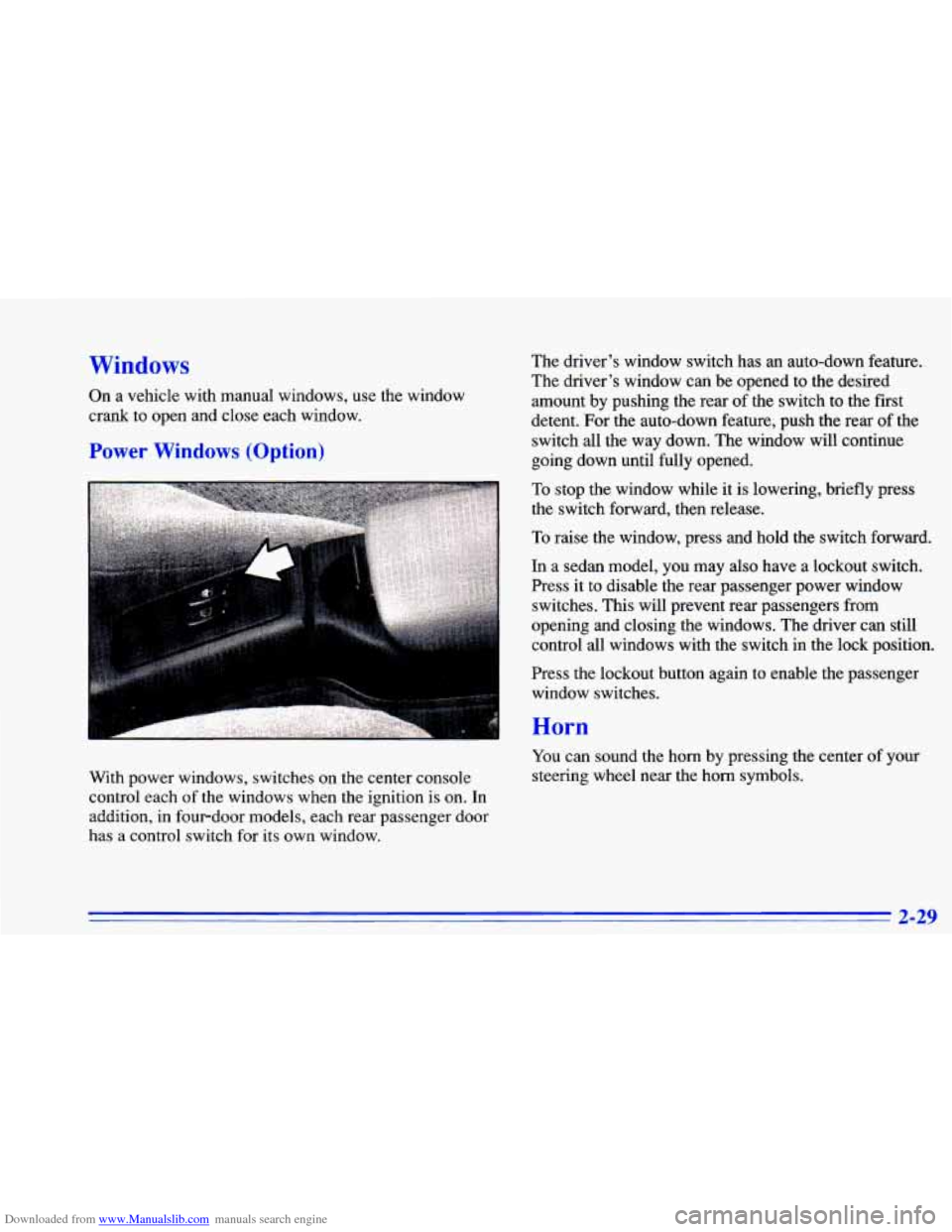
Power Windows (Option)
The driver’s window switch has an auto-down feature.
The driver’s window can be opened to the desired
amount by pushing the rear of the switch to the first
detent. For the auto-down feature, push the rear of the
switch all the way down. The window will continue
going down until fully opened.
To stop the window while it is lowering, briefly press
the switch forward, then release.
To raise the window, press and hold the switch forward.
In a sedan model, you may also have a lockout switch.
Press
it to disable the rear passenger power window
switches. This will prevent rear passengers from
opening and closing the windows. The driver can still
control all windows with the switch in the lock position.
rress the lockout button again to enable the passenger
window switches.
With power windows, switches on the center console
control each
of the windows when the ignition is on. In
addition, in fourdoor models, each rear passenger door
has a control switch for its own window.
Horn
You can sound the horn by pressing the center of your
steering wheel near the horn symbols.
2-29
Page 171 of 372
Downloaded from www.Manualslib.com manuals search engine ETS
OFF
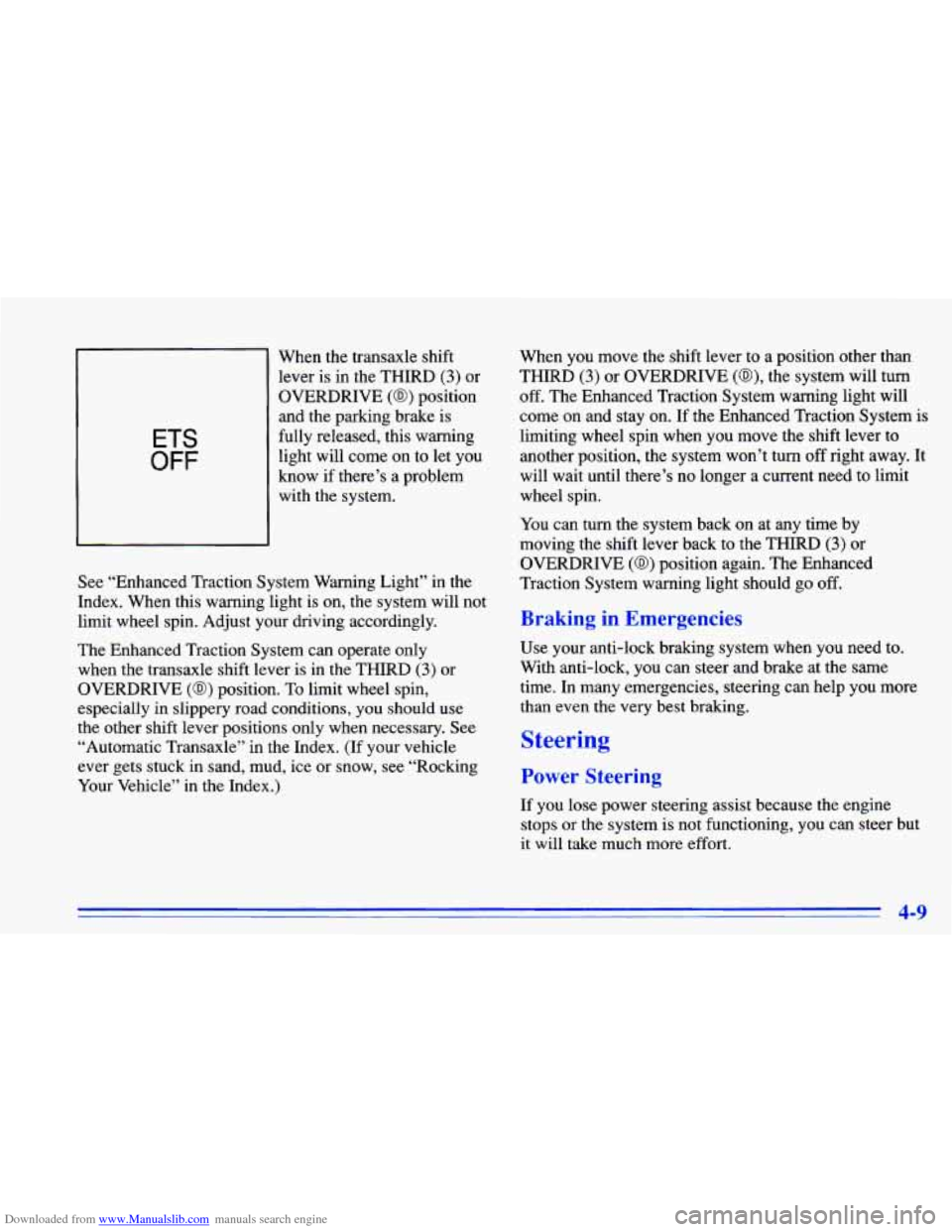
When the transaxle shift
lever
is in the THIRD (3) or
OVERDRIVE
(Q) position
and the parking brake is
fully released, this warning
light will come on to let you
know if there’s a problem
with the system.
See “Enhanced Traction System Warning Light” in the
Index. When this warning light is on, the system will not
limit wheel spin. Adjust your driving accordingly.
The Enhanced Traction System can operate only
when the transaxle shift lever is in the THIRD
(3) or
OVERDRIVE
(a) position. To limit wheel spin,
especially in slippery road conditions, you should use
the other shift lever positions only when necessary.
See
“Automatic Transaxle” in the Index. (If your vehicle
ever gets stuck in sand, mud, ice or snow, see “Rocking
Your Vehicle” in the Index.) When you move the shift lever
to a position other than
THIRD
(3) or OVERDRIVE (@), the system will turn
off. The Enhanced Traction System warning light will
come on and stay on. If the Enhanced Traction System is
limiting wheel spin when you move the shift lever to
another position, the system won’t turn off right away. It
will wait until there’s no longer a current need to limit
wheel spin.
You can turn the system back on at any time by
moving the shift lever back to the THIRD
(3) or
OVERDRIVE
(@) position again. The Enhanced
Traction System warning light should go off.
Braking in Emergencies
Use your anti-lock braking system when you need to.
With anti-lock, you can steer and brake at the same
time. In many emergencies, steering can help you more
than even the very best braking.
Steering
Power Steering
If you lose power steering assist because the engine
stops or the system is not functioning, you can steer but
it will take much more effort.
4-9
Page 246 of 372
Downloaded from www.Manualslib.com manuals search engine 2.2L Engine (Code 4)
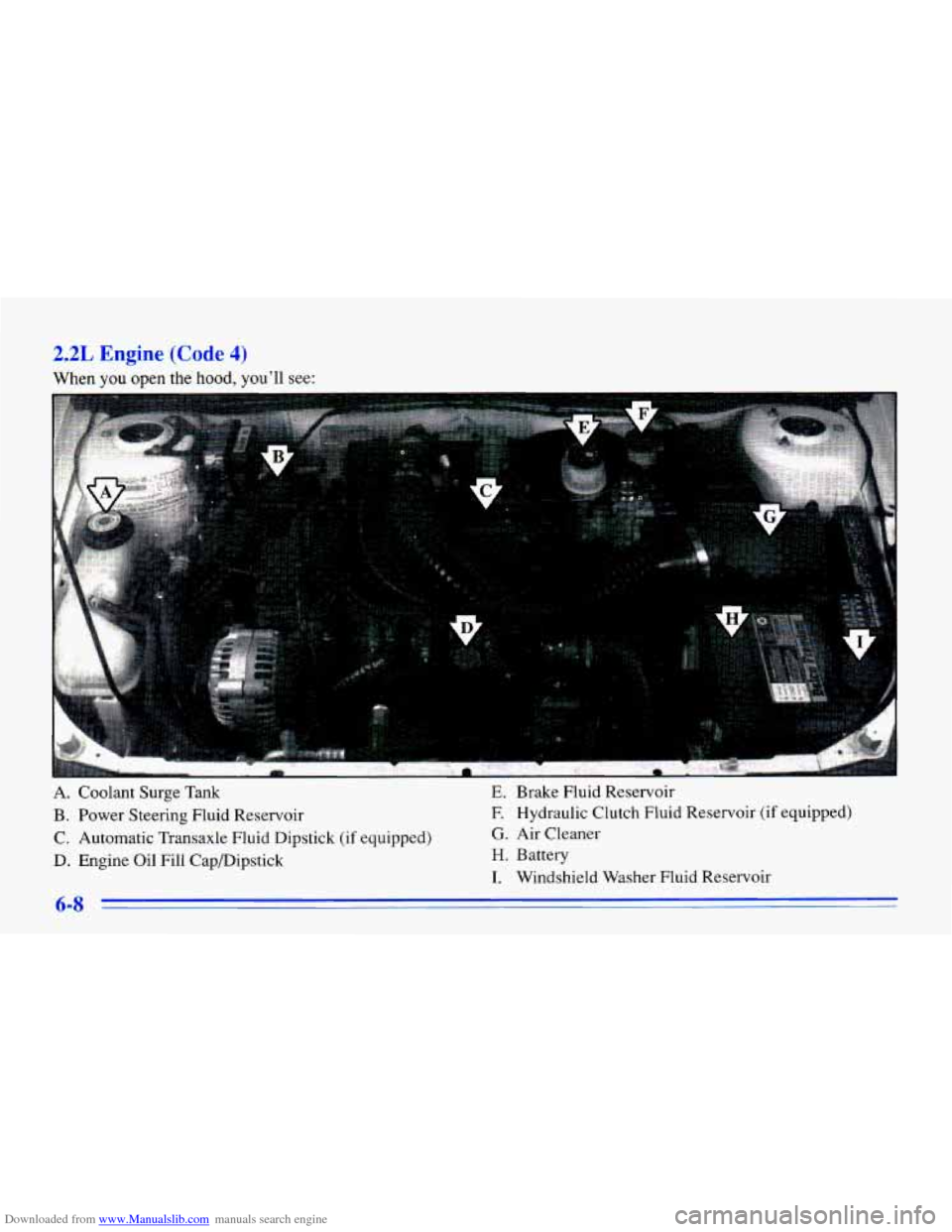
When you open the hood, you’ll see:
A. Coolant Surge Tank E. Brake Fluid Reservoir
B. Power Steering Fluid Reservoir F.
Hydraulic Clutch Fluid Reservoir (if equipped)
C. Automatic Transaxle Fluid Dipstick (if equipped)
G. Air Cleaner
D. Engine Oil Fill CapDipstick H. Battery
I. Windshield Washer Fluid Reservoir
Page 247 of 372
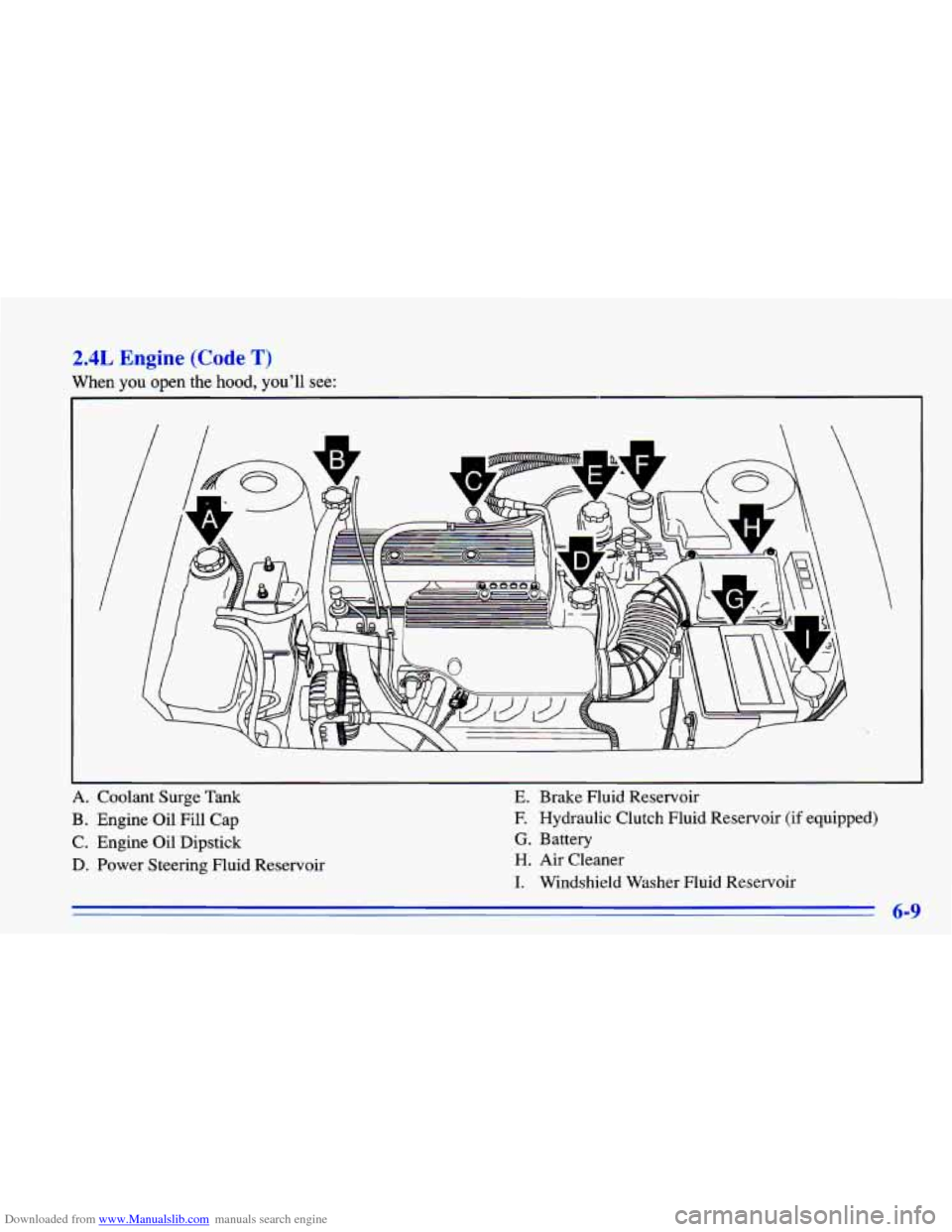
Downloaded from www.Manualslib.com manuals search engine 2.4L Engine (Code T)
When you open the hood, you’ll see:
I
A. Coolant Surge Tank
B. Engine Oil Fill Cap
C. Engine Oil Dipstick
D. Power Steering Fluid Reservoir
E. Brake Fluid Reservoir
E Hydraulic Clutch Fluid Reservoir (if equipped)
G. Battery
H. Air Cleaner
I. Windshield Washer Fluid Reservoir
6-9
Page 264 of 372
Downloaded from www.Manualslib.com manuals search engine Thermostat
Engine coolant temperature is controlled by a thermostat
in the engine coolant system. The thermostat stops the
flow of coolant through the radiator until the coolant
reaches
a preset temperature.
When you replace your thermostat, an
AC’ thermostat
is recommended.
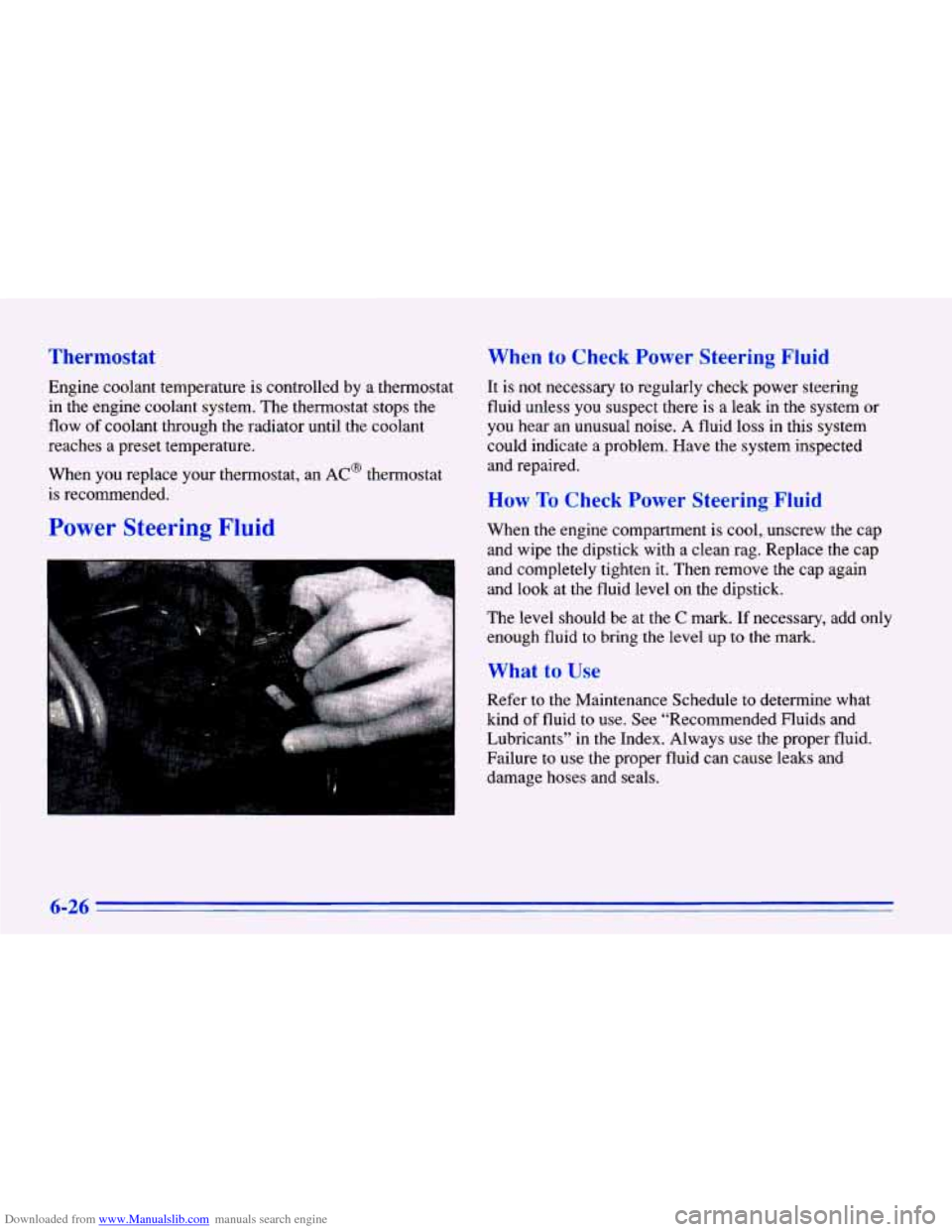
Power Steering Fluid
When to Check Power Steering Fluid
It is not necessary to regularly check power steering
fluid unless you suspect there
is a leak in the system or
you hear an unusual noise.
A fluid loss in this system
could indicate a problem. Have the system inspected
and repaired.
How To Check Power Steering Fluid
When the engine compartment is cool, unscrew the cap
and wipe the dipstick with a clean rag. Replace the cap
and completely tighten it. Then remove the cap again
and look at the fluid level on the dipstick.
The level should be at the
C mark. If necessary, add only
enough fluid
to bring the level up to the mark.
What to Use
Refer to the Maintenance Schedule to determine what
kind
of fluid to use. See “Recommended Fluids and
Lubricants” in the Index. Always use the proper fluid.
Failure
to use the proper fluid can cause leaks and
damage hoses and seals.
6-26
Page 294 of 372
Downloaded from www.Manualslib.com manuals search engine Engine Compartment Fuse Block
J
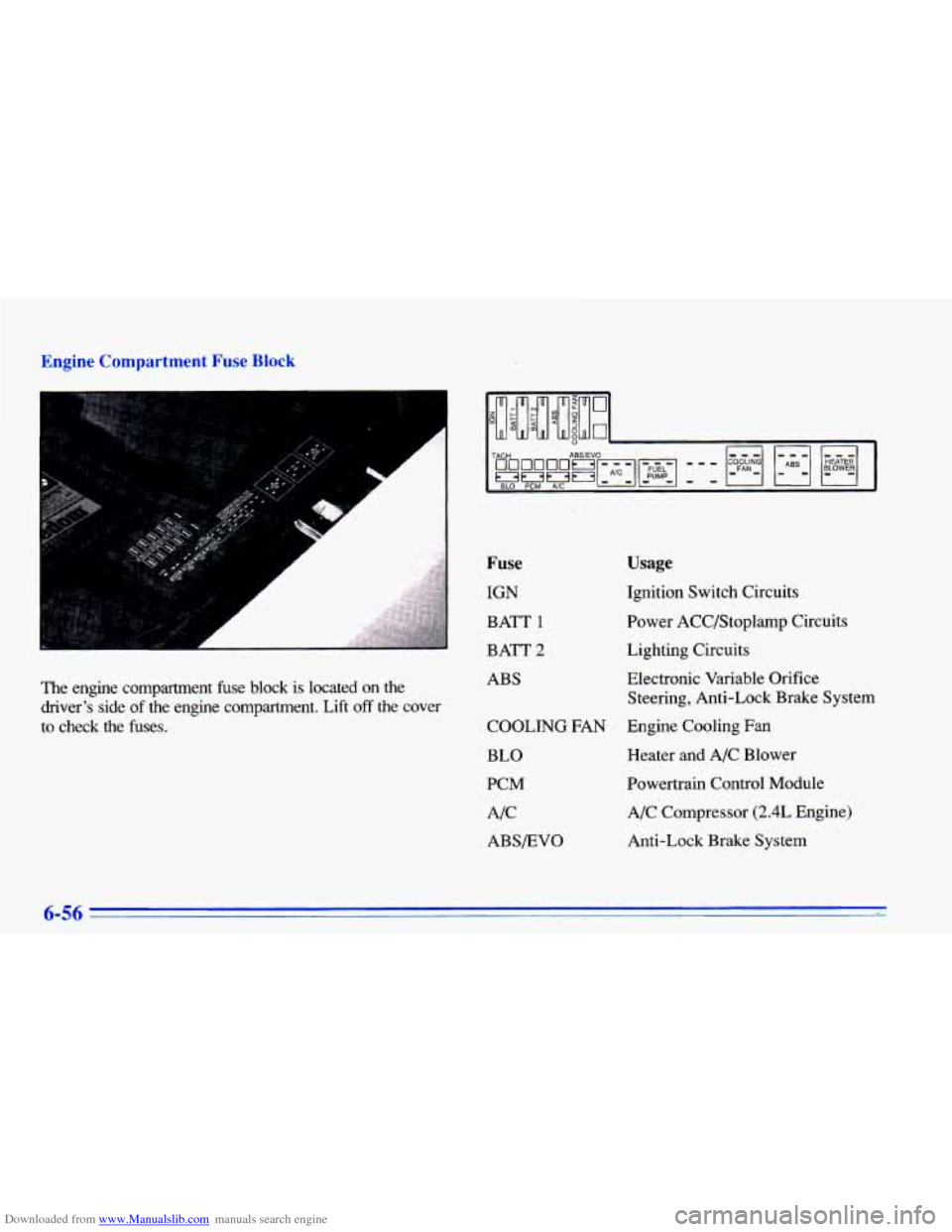
The engine compartment fuse block is located on the
driver’s side of the engine compartment. Lift off the cover
to check the fuses.
Fuse
IGN
BATT
1
BATT 2
ABS
Usage
Ignition Switch Circuits
Power ACC/Stoplamp Circuits Lighting Circuits
Electronic Variable Orifice
Steering, Anti-Lock Brake System
COOLING
FAN Engine Cooling Fan
BLO Heater and A/C Blower
PCM Powertrain Control Module
A/C A/C Compressor
(2.4L Engine)
ABS/EVO Anti-Lock Brake System
6-56
Page 340 of 372
Downloaded from www.Manualslib.com manuals search engine Part C: Periodic Maintenance
Inspections
Listed below are inspections and services which should be
performed at least twice a year (for instance, each spring
and
fall). You should let your GM dealer’s service
department or other qualified service center do these jobs.
Make sure any necessary repairs are completed at once.
Proper procedures to perform these services may be
found
in a Chevrolet service manual. See “Service and
Owner Publications” in the Index.
Steering, Suspension and Front-Wheel-Drive
Axle
Boot and Seal Inspection
Inspect the front and rear suspension and steering system
for damaged, loose or missing parts, signs
of wear, or lack
of lubrication. Inspect the power steering lines and hoses
for proper hook-up, binding, leaks, cracks, chafing, etc.
Clean and then inspect the drive axle boot seals for
damage, tears or leakage. Replace seals
if necessary.
Exhaust System Inspection
Inspect the complete exhaust system. Inspect the body near
the exhaust system. Look for broken, damaged, missing or
out-of-position
parts as well as open seams, holes, loose
connections, or other conditions
which could cause a heat build-up in the floor pan or could let exhaust fumes into
the vehicle, See “Engine Exhaust”
in the Index.
Radiator and Heater Hose Inspection
Inspect the hoses and have them replaced if they are
cracked, swollen or deteriorated. Inspect all pipes,
fittings and clamps; replace as needed.
Throttle Linkage Inspection
Inspect the throttle linkage for interference or binding,
and for damage or missing parts. Replace parts as
needed. Replace any cables that have high effort or
excessive wear.
Do not lubricate accelerator and cruise
control cables.
Brake System Inspection
Inspect the complete system. Inspect brake lines and
hoses for proper hookup, binding, leaks, cracks, chafing, etc. Inspect disc brake pads for wear and rotors for
surface condition.
Also inspect drum brake linings for
wear and cracks. Inspect other brake parts, including
drums, wheel cylinders, calipers, parking brake, etc.
Check parking brake adjustment. You may need to have
your brakes inspected more often if your driving habits
or conditions result
in frequent braking.
7-42
Page 341 of 372
Downloaded from www.Manualslib.com manuals search engine Part D: Recommended Fluids and
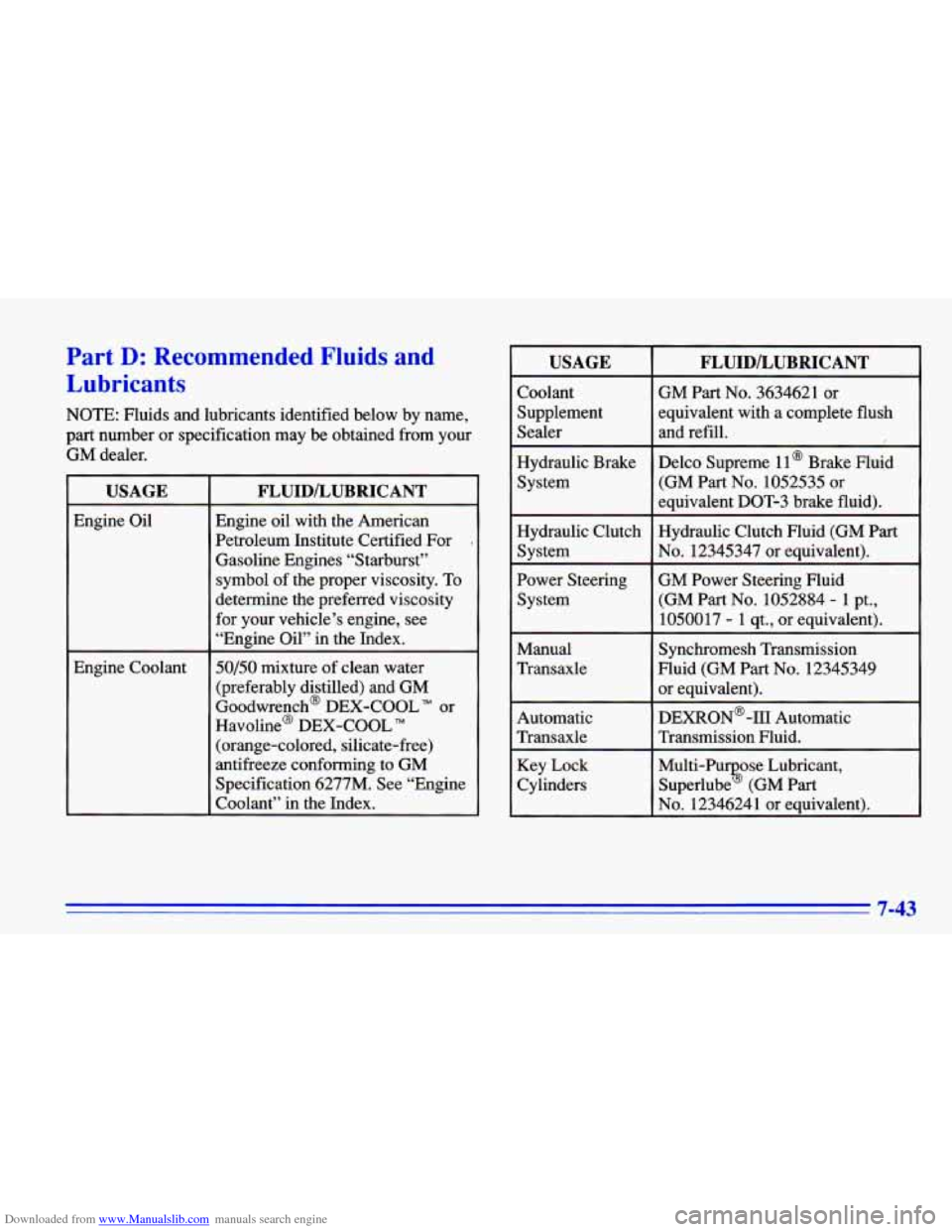
Lubricants
NOTE: Fluids and lubricants identified below by name,
part number or specification may be obtained from your
SM dealer.
USAGE
Engine Oil
Engine Coolant
FLUID/LUBRICANT
Engine oil with the American
Petroleum Institute Certified For
Gasoline Engines “Starburst” symbol of the proper viscosity.
To
determine the preferred viscosity
for your vehicle’s engine, see
“Engine Oil” in the Index.
50/50 mixture of clean water
(preferably distilled) and GM
Goodwrench@ DEX-COOL
TM or
Havoline@ DEX-COOL TM
(orange-colored, silicate-free)
antifreeze conforming to GM
Specification 6277M. See “Engine
Coolant’’ in the Index.
USAGE
Coolant
Supplement
Sealer
Hydraulic Brake
System
Hydraulic Clutch System
Power Steering System
Manual
Transaxle
Automatic
Transaxle
Key Lock
Cylinders
FLUIDlLUBRICANT
GM Part No. 3634621 or
equivalent with a complete flush
and refill.
Delco Supreme
ll@ Brake Fluid
(GM
Part No. 1052535 or
equivalent DOT-3 brake fluid).
Hydraulic Clutch Fluid (GM Part
No. 12345347 or equivalent).
GM Power Steering Fluid
1050017
- 1 qt., or equivalent).
Synchromesh Transmission
Fluid (GM Part
No. 12345349
or equivalent).
DEXRON@ -111 Automatic
Transmission Fluid.
Multi-Pu ose Lubricant,
Superlube
% (GM Part
No. 1234624 1 or equivalent).
(GM Part
NO. 1052884 - 1
Pt.,
Page 365 of 372
Downloaded from www.Manualslib.com manuals search engine Oil Pressure Warning .......................... 2-73
Passlock Warning
........................... 2-75
Safety Belt Reminder
...................... 1.6. 2.65
Loading Your Vehicle
........................... 4-31
Cylinders
................................... 7-39
Door
........................................ 2-3
PowerDoor
.................................. 2-4
Rear Door Security
............................. 2-4
Steering Column Lock Check
................... 7-40
Tr~nk
....................................... 2-7
Low Coolant Warning Light
...................... 2-70
Lowering the Convertible Top Manually
............. 2-57
Lowering Your Convertible Top
................... 2-49
Lubricants and Fluids
............................ 7-43
Lubrication Service. Body
........................ 7-39
Up-Shift
.................................... 2-75
Locks
......................................... 2-3
Key Lock Cylinder Service
..................... 7-39
Maintenance. Normal Replacement
parts ........... 6-60
Maintenance Record ............................ 7-45
Maintenance Schedule
............................ 7- 1
Long Tripmighway Definition ................... 7-5
Long Tripmighway Intervals
..................... 7-5
Owner Checks and Services
..................... 7-38
Periodic Maintenance Inspections
................ 7-42
Recommended Fluids and Lubricants
............. 7-43 Scheduled Maintenance Services
.................. 7-3
Short Trip/City Definition
....................... 7-4
Short Trip/City Intervals
........................ 7-4
Maintenance. Underbody
......................... 6-50
Maintenance When Trailer Towing
................. 4-40
Malfunction Indicator Lamp
...................... 2-71
Manual Front Seat
............................... 1 . 1
Manual Lumbar Support .......................... 1-2
Manual Remote Control Mirror
.................... 2-44
Manual Transaxle
............................... 2-12
Check
...................................... 7-39
Fluid
....................................... 6-19
Shifting
..................................... 2-20
Starting Your Engine
.......................... 2-12
Methanol
...................................... 6-2
Mirrors
....................................... 2-44
Convex Outside
.............................. 2-45
Inside Daymight Rearview
..................... 2-43
Manual Remote Control
........................ 2-44
Power Remote Control
......................... 2-44
MountainRoads
................................ 4-23
Multifunction Lever
............................. 2-30
Neutral. Automatic Transaxle
.................... 2-17
Neutral. Manual Transaxle
........................ 2-21
New Vehicle “Break-In”
.......................... 2-9
Nightvision
................................... 4-16
9- /