washer fluid CHEVROLET CAVALIER 1996 3.G Owners Manual
[x] Cancel search | Manufacturer: CHEVROLET, Model Year: 1996, Model line: CAVALIER, Model: CHEVROLET CAVALIER 1996 3.GPages: 372, PDF Size: 19.73 MB
Page 92 of 372
Downloaded from www.Manualslib.com manuals search engine Windshield Washer Driving without washer fluid is dangerous. A bad mud
splash can block your
vision. You could collide with
another vehicle. Check your washer fluid often.
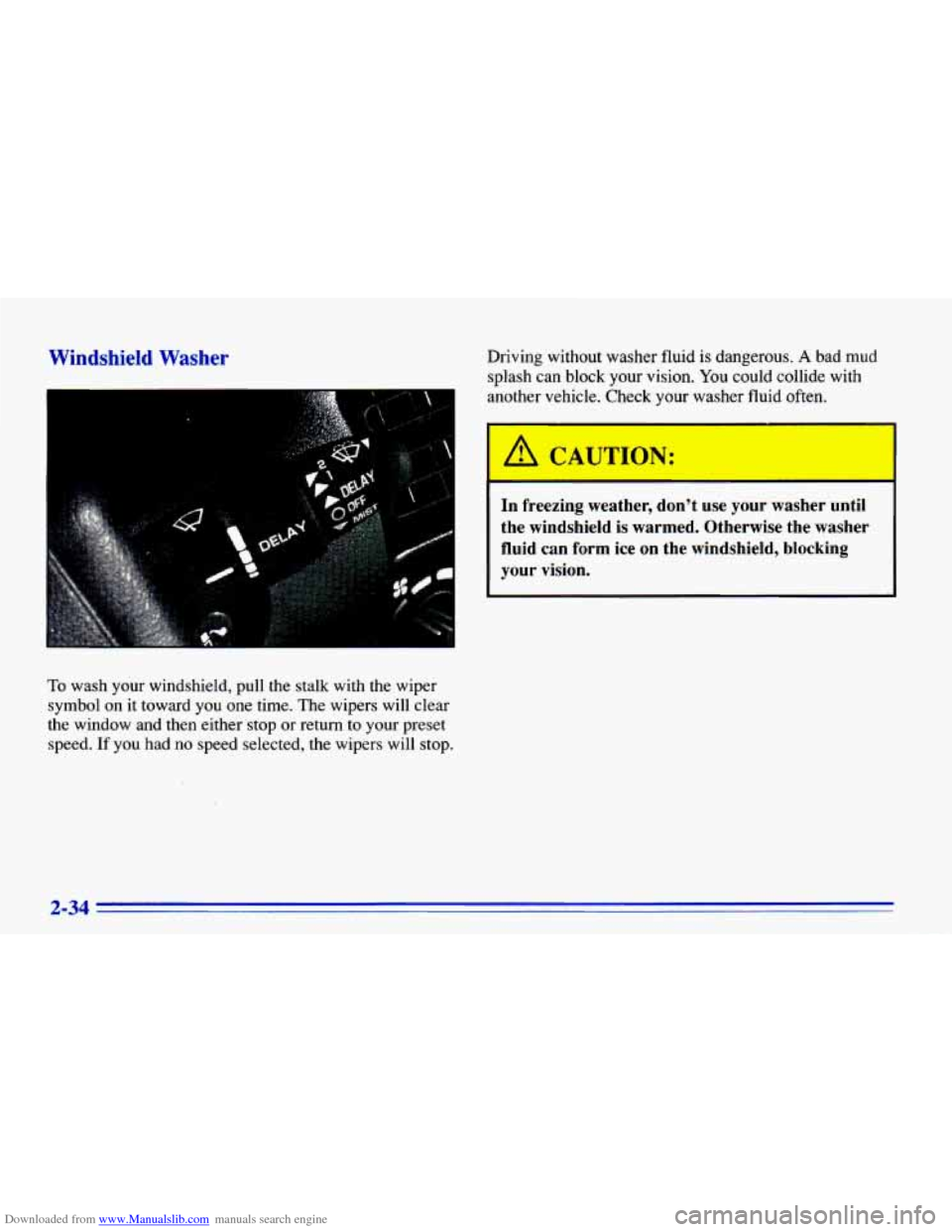
To wash your windshield, pull the stalk with the wiper
symbol on it toward you one time. The wipers will clear
the window and then either
stop or return to your preset
speed.
If you had no speed selected, the wipers will stop.
I
I A CAUTION:
In freezing weather, don’t use your washer until
the windshield is warmed. Otherwise the washer
fluid can form ice on the windshield, blocking
your vision.
2-34
Page 179 of 372
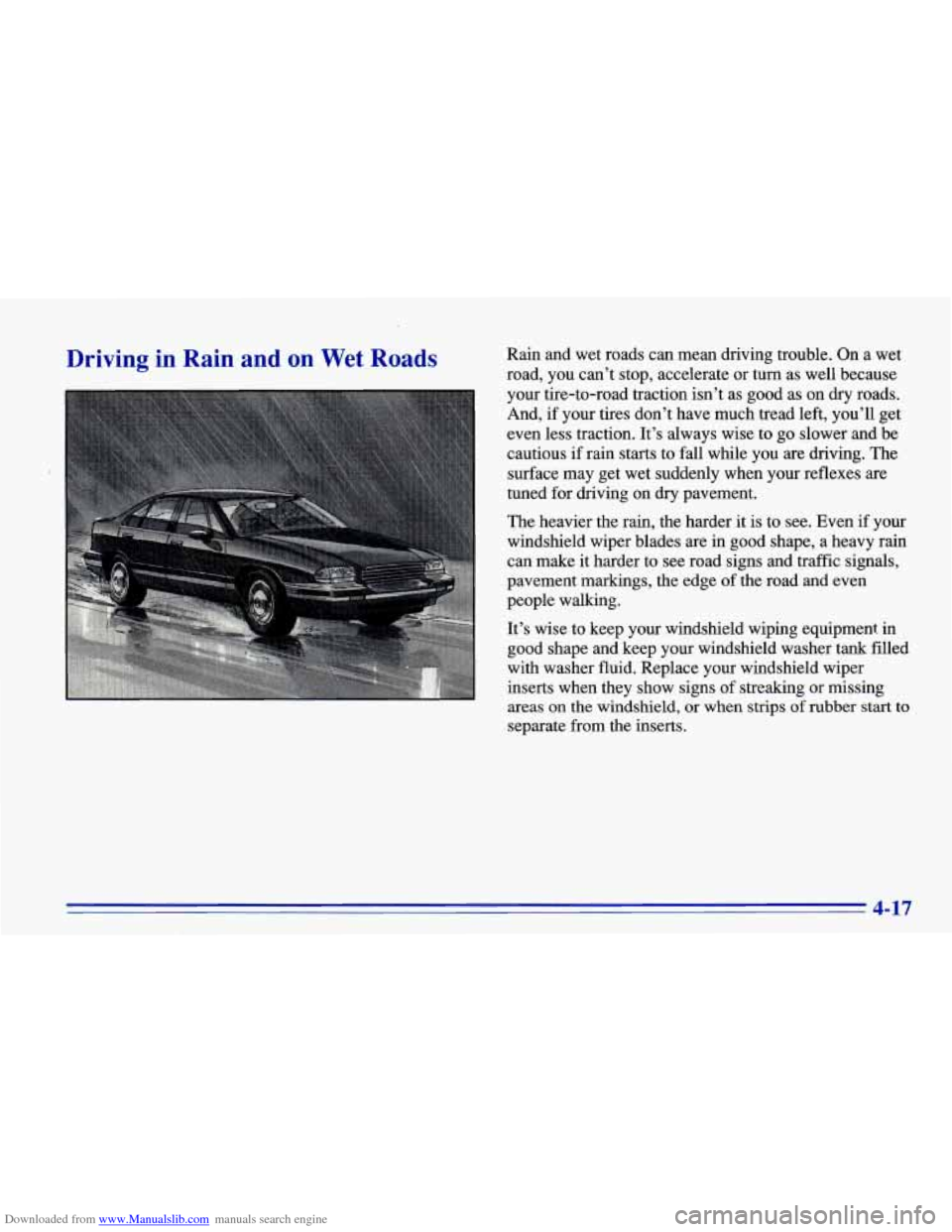
Downloaded from www.Manualslib.com manuals search engine Driving in Rain and on Wet Roads Rain and wet roads can mean driving trouble. On a wet
road, you can’t stop, accelerate or
turn as well because
your tire-to-road traction isn’t as good as on
dry roads.
And,
if your tires don’t have much tread left, you’ll get
even less traction. It’s always wise to go slower and be
cautious if rain starts
to fall while you are driving. The
surface may get wet suddenly when your reflexes are
tuned for driving on dry pavement.
The heavier the rain, the harder it is to see. Even
if your
windshield wiper blades are in good shape, a heavy rain
can make it harder to see road signs and traffic signals,
pavement markings, the edge of the road and even
people walking.
It’s wise to keep your windshield wiping equipment
in
good shape and keep your windshield washer tank filled
with washer fluid. Replace your windshield wiper
inserts when they show signs of streaking or missing
areas
on the windshield, or when strips of rubber start to
separate from the inserts.
4-17
Page 184 of 372
Downloaded from www.Manualslib.com manuals search engine The exit speed is usually posted.
Reduce your speed according to your speedometer, not
to your sense of motion. After driving for any distance
at higher speeds, you may tend to think you are going
slower than you actually are.
Before Leaving on a Long Trip
Make sure you’re ready. Try to be well rested. If you
must start when you’re not fresh
-- such as after a day’s
work
-- don’t plan to make too many miles that first part
of the journey. Wear comfortable clothing and shoes you
can easily drive in.
Is your vehicle ready for a long trip?
If you keep it
serviced and maintained, it’s ready to
go. If it needs
service, have
it done before starting out. Of course,
you’ll find experienced and
able service experts in
Chevrolet dealerships all across North America. They’ll
be ready and willing to help if you need it. Here
are some things you can check before a trip:
0
0
0
0
0
0
0
Windshield Washer Fluid: Is the reservoir full?
Are all windows clean inside and outside?
Wiper Blades: Are they in good shape?
Fuel, Engine Oil, Other Fluids: Have you checked
all levels?
Lamps: Are they all working? Are the lenses clean?
Tires: They are vitally important to a safe,
trouble-free trip. Is the tread good enough for
long-distance driving? Are the tires all inflated to the
recommended pressure?
Weather Forecasts: What’s the weather outlook
along your route? Should you delay your trip a short
time to avoid a major storm system?
Maps: Do you have up-to-date maps?
4-22
Page 187 of 372
Downloaded from www.Manualslib.com manuals search engine Winter Driving
Here are some tim for winter driving:
Have your uevrolet in good shape for winter.
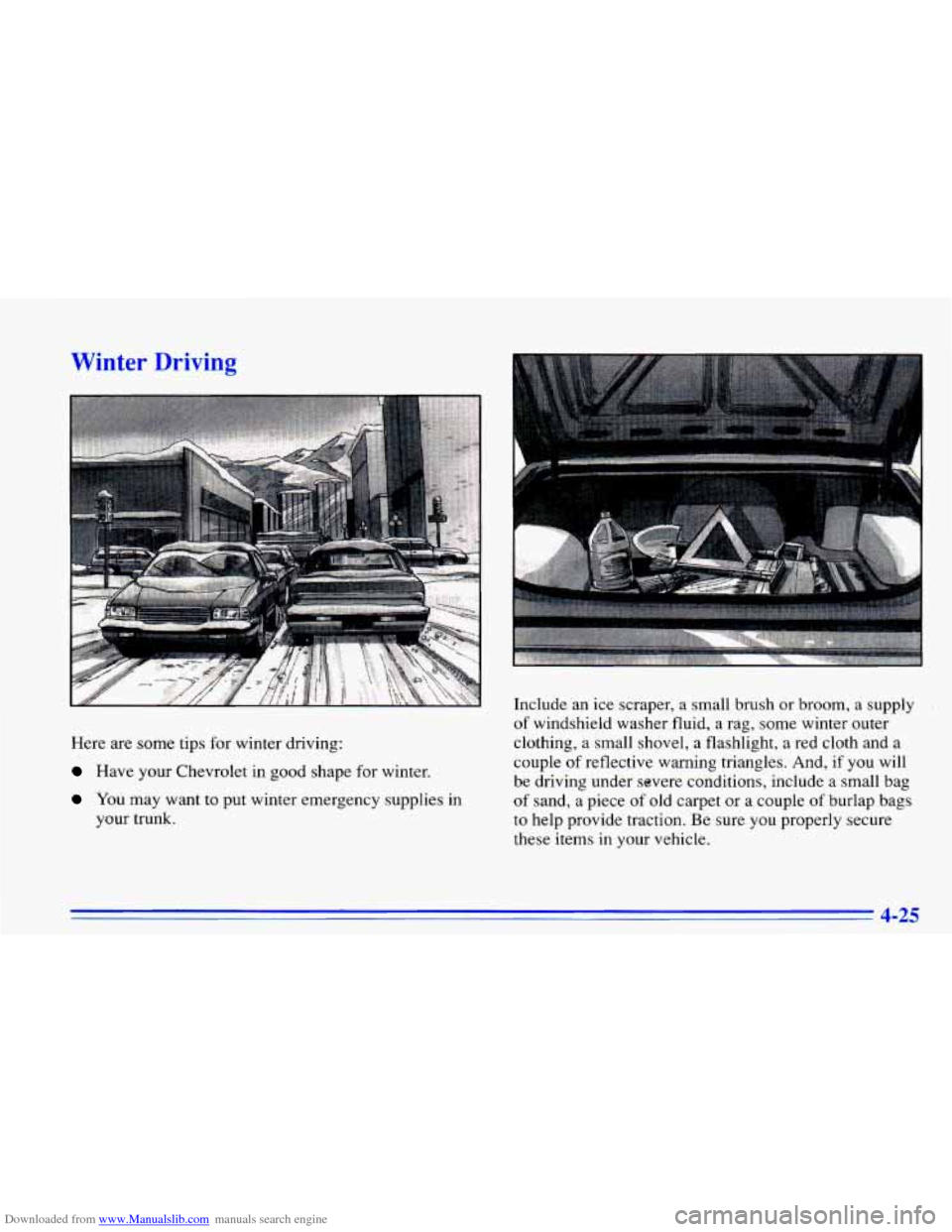
You may want to put winter emergency supplies in
your
trunk.
... .
Include an ice scraper, a small brush or broom, a supply
of windshield washer fluid, a rag, some winter outer
clothing, a small shovel, a flashlight, a red cloth and a
couple
of reflective warning triangles. And, if you will
be driving under severe conditions, include a small bag
of sand, a piece of old carpet or a couple of burlap bags
to help provide traction. Be sure
you properly secure
these items
in your vehicle.
4-25
Page 244 of 372
Downloaded from www.Manualslib.com manuals search engine Checking Things Under the Hood Hood Release
1
An electric fan under the hood can start up and
injure
you even when the engine is not running.
Keep hands, clothing and tools away from
any
underhood electric fan.
A CAUTION:
- -
Things that burn can get on hot engine parts and
start
a fire. These include liquids like gasoline,
oil, coolant, brake fluid, windshield washer and
other fluids, and plastic or rubber. You or others
could be burned. Be careful not to drop or spill
things that will burn onto
a hot engine.
The following sections tell
you how to check fluids,
lubricants
and important parts underhood.
1
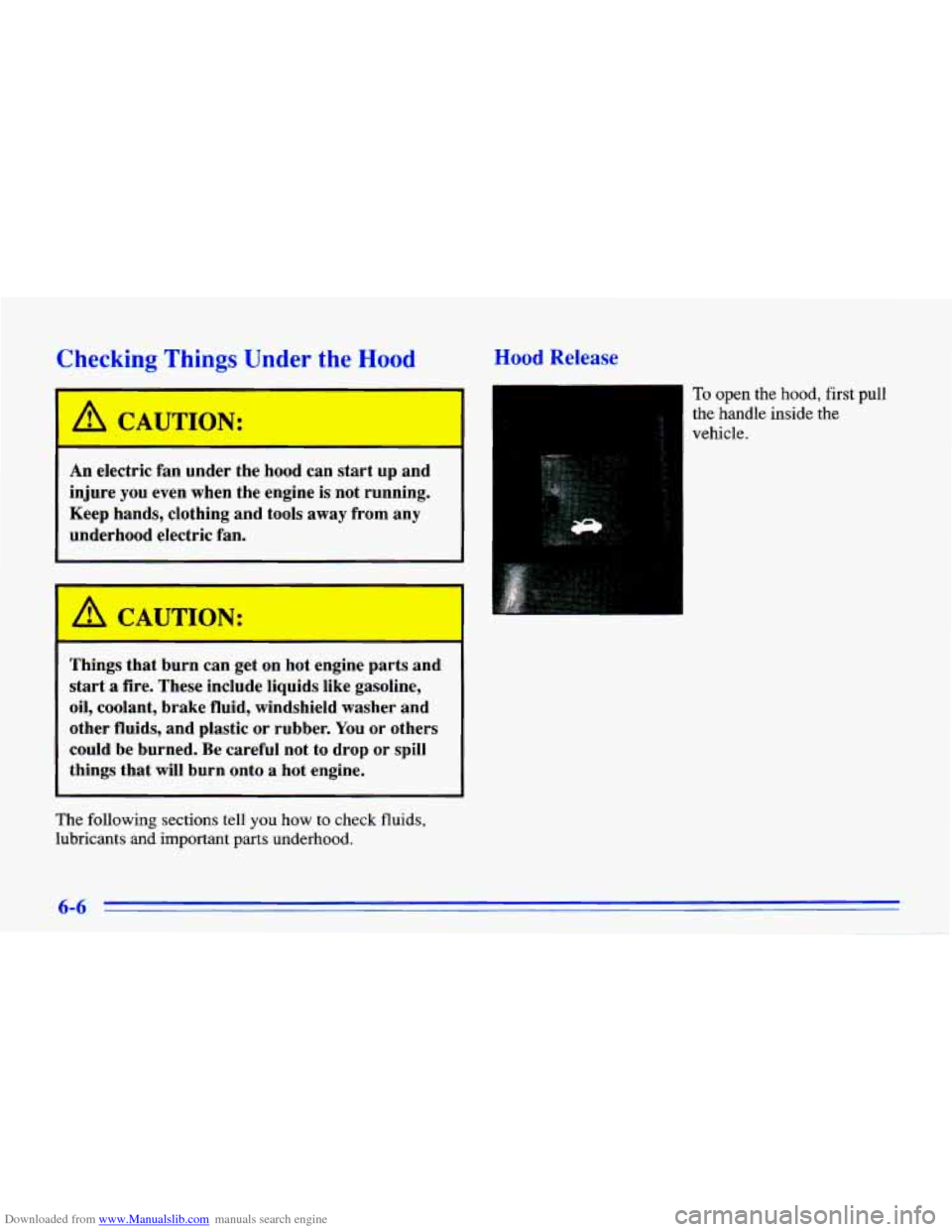
To open the hood, first pull
the handle inside the
vehicle.
6-6
Page 246 of 372
Downloaded from www.Manualslib.com manuals search engine 2.2L Engine (Code 4)
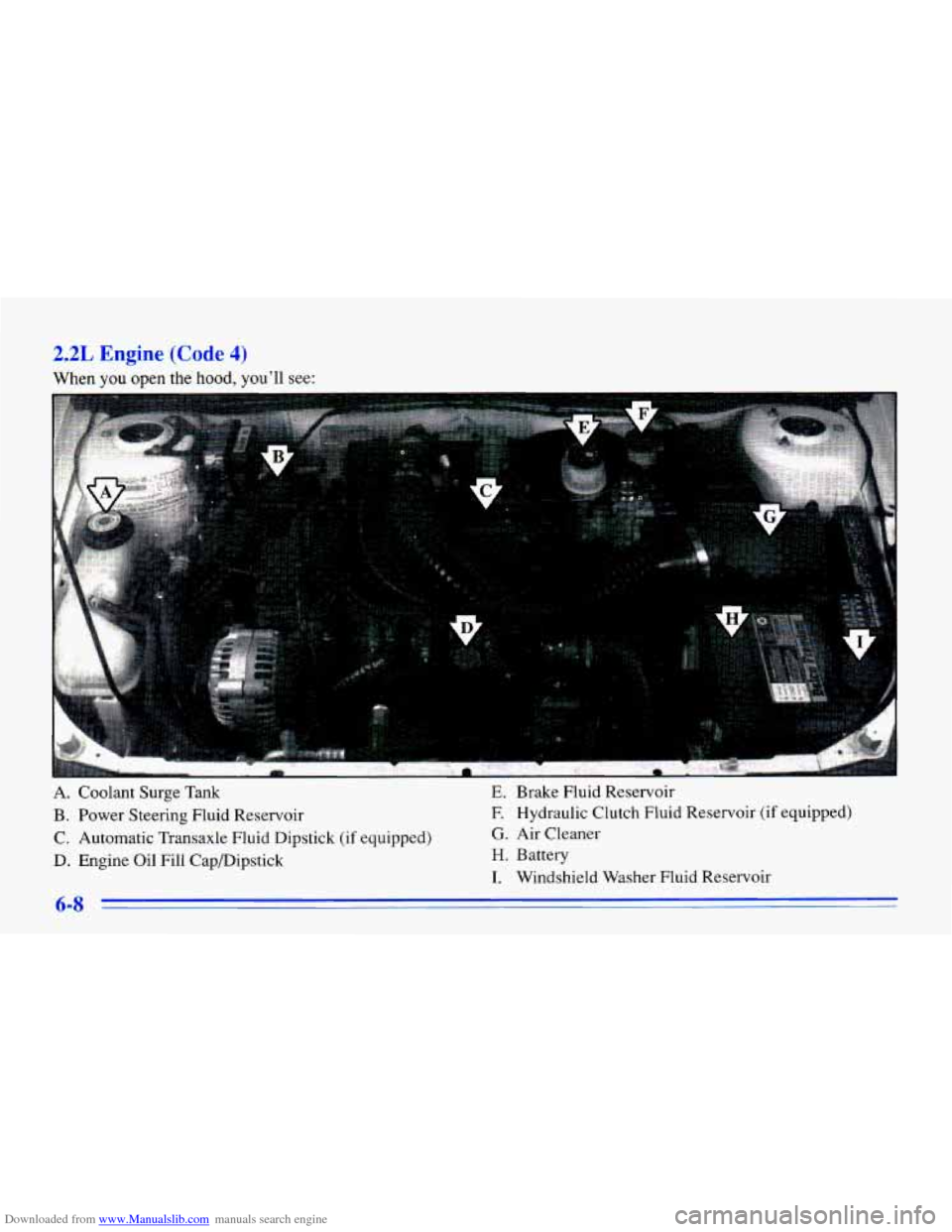
When you open the hood, you’ll see:
A. Coolant Surge Tank E. Brake Fluid Reservoir
B. Power Steering Fluid Reservoir F.
Hydraulic Clutch Fluid Reservoir (if equipped)
C. Automatic Transaxle Fluid Dipstick (if equipped)
G. Air Cleaner
D. Engine Oil Fill CapDipstick H. Battery
I. Windshield Washer Fluid Reservoir
Page 247 of 372
Downloaded from www.Manualslib.com manuals search engine 2.4L Engine (Code T)
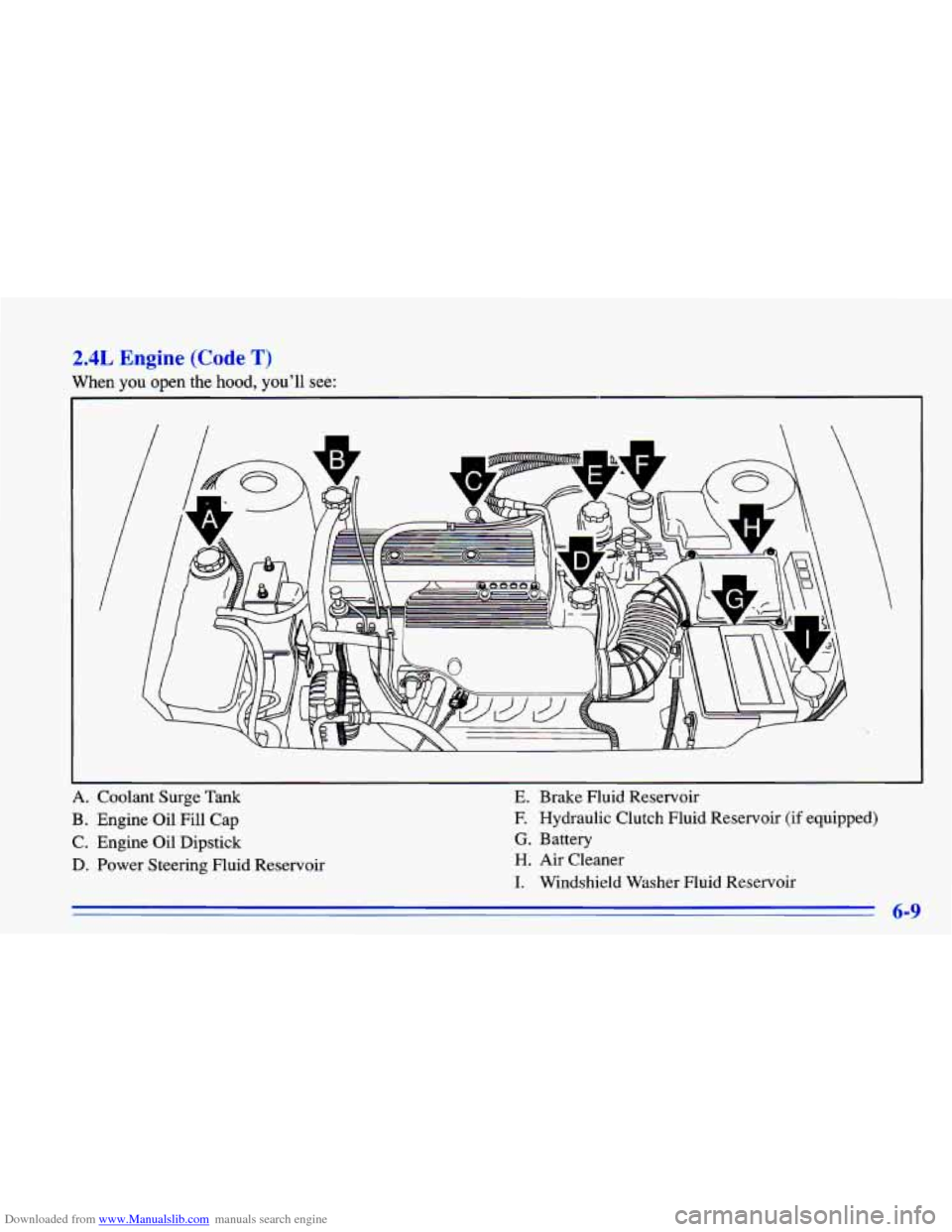
When you open the hood, you’ll see:
I
A. Coolant Surge Tank
B. Engine Oil Fill Cap
C. Engine Oil Dipstick
D. Power Steering Fluid Reservoir
E. Brake Fluid Reservoir
E Hydraulic Clutch Fluid Reservoir (if equipped)
G. Battery
H. Air Cleaner
I. Windshield Washer Fluid Reservoir
6-9
Page 265 of 372
Downloaded from www.Manualslib.com manuals search engine Windshield Washer Fluid
What to Use
When you need windshield washer fluid, be sure to read
the manufacturer’s instructions before use. If you will be
operating your vehicle
in an area where the temperature
may fall below freezing, use
a fluid that has sufficient
protection against freezing.
Adding Washer Fluid
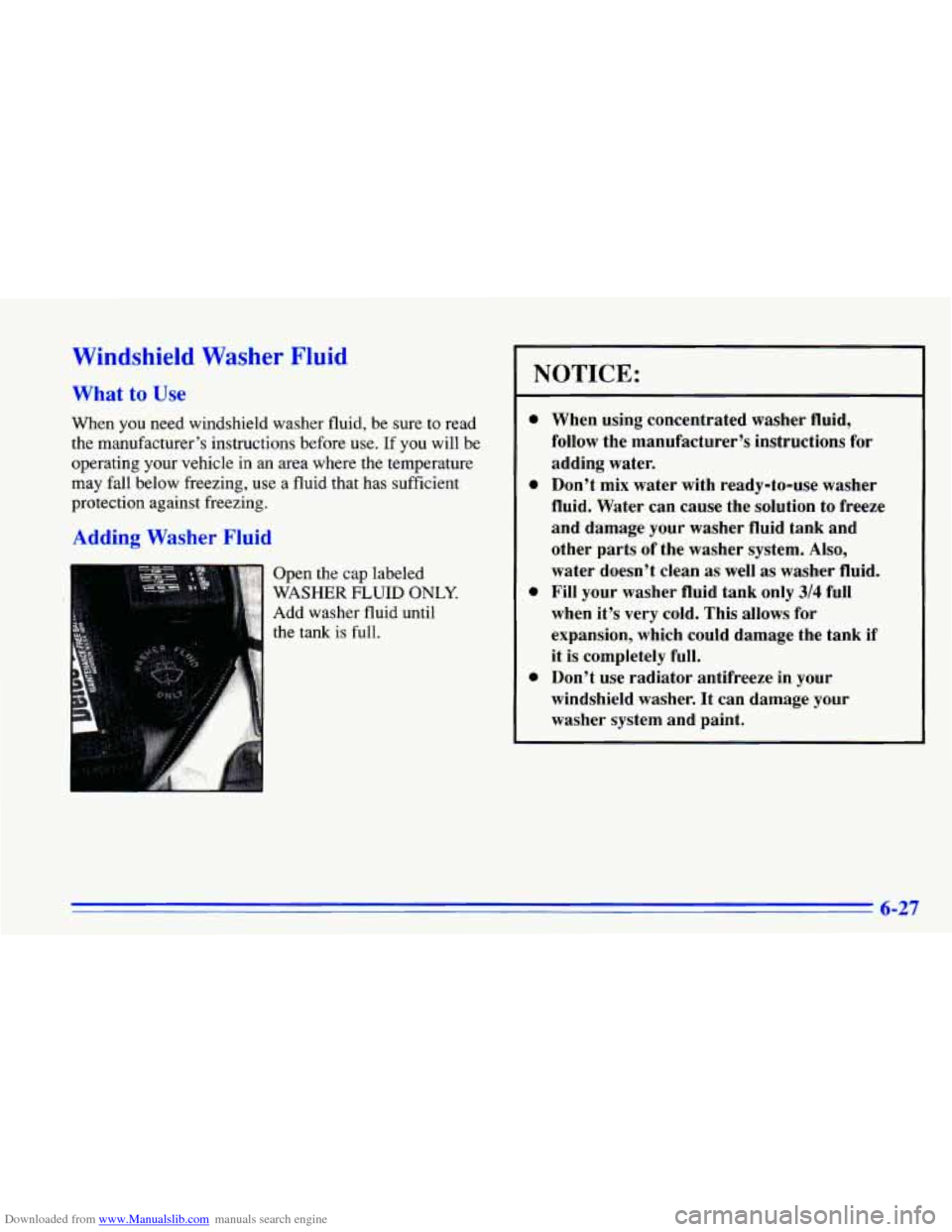
Open the cap labeled
Add washer fluid until
the tank is
full.
WASHER FLUID ONLY.
NOTICE:
0
0
0
0
When using concentrated washer fluid,
follow the manufacturer’s instructions for
adding water.
Don’t mix water with ready-to-use washer
fluid. Water can cause the solution to freeze
and damage your washer fluid tank and
other parts of the washer system. Also,
water doesn’t clean
as well as washer fluid.
Fill your washer fluid tank only
3/4 full
when
it’s very cold. This allows for
expansion, which could damage the tank if
it
is completely full.
Don’t use radiator antifreeze in your
windshield washer.
It can damage your
washer system and paint.
6-27
Page 285 of 372
Downloaded from www.Manualslib.com manuals search engine Glass
Glass should be cleaned often. GM Glass Cleaner (GM
Part No. 1050427) or a liquid household glass cleaner
will remove normal tobacco smoke and dust films.
Don’t use abrasive cleaners on glass, because they may
cause scratches. Avoid placing decals on the inside rear
window, since they may have
to be scraped off later. If
abrasive cleaners are used
on the inside of the rear
window, an electric defogger element may be damaged.
Any temporary license should not be attached across the
defogger grid.
Cleaning the Outside of the
Windshield
and Wiper Blades
If the windshield is not clear after using the windshield
washer, or if the wiper blade chatters when running, wax
or other material may be on the blade or windshield.
Clean the outside of the windshield with
GM
Windshield Cleaner, Bon-Ami Powder@ (GM Part
No. 105001 1). The windshield is clean if beads do not
form when you rinse it with water.
Clean the blade by wiping vigorously with a cloth
soaked in full-strength windshield washer solvent. Then
rinse the blade with water. Wiper
blades should be checked on a regular basis and
replaced when worn.
Weatherstrips
Silicone grease on weatherstrips will make them last
longer, seal better, and not stick
or squeak. Apply
silicone grease with a clean cloth at least every six
months. During very cold, damp weather more frequent
application may be required. (See “Recommended
Fluids and Lubricants” in the Index.)
Cleaning the Outside of Your
Chevrolet
The paint finish on your vehicle provides beauty, depth
of color, gloss retention and durability.
Washing Your Vehicle
The best way to preserve your vehicle’s finish is to keep
it clean by washing it often with lukewarm or cold water.
Don’t wash your vehicle in the direct rays of the
sun.
Don’t use strong soaps or chemical detergents. Use
liquid hand, dish or car washing (mild detergent) soaps.
Don’t use cleaning agents that are petroleum based, or
that contain acid or abrasives. All cleaning agents
should be flushed promptly
and not allowed to dry on
the surface, or they could stain.
Dry the finish with a
6-47
Page 336 of 372
Downloaded from www.Manualslib.com manuals search engine Part B: Owner Checks and Services
Listed below are owner checks and services which
should be performed at the intervals specified to help
ensure the safety, dependability and emission control
perfoJmance of your vehicle.
Be sure any necessary repairs are completed at once.
Whenever any fluids or lubricants are added to your vehicle,
make sure they are the proper ones, as shown in
Part D.
At Each Fuel Fill
It is important for you or a service station attendant to
pe$orrn these underhood checks at each fuel fill.
Engine Oil Level Check
Check the engine oil level and add the proper oil if necessary.
See ‘Engine Oil”
in the Index for further details.
Engine Coolant Level Check
Check the engine coolant level and add the proper
coolant mix if necessary. See “Engine Coolant” in the
Index for further details.
Windshield Washer Fluid Level Check
Check the windshield washer fluid level in the
windshield washer tank and add the proper fluid if necessary.
See “Windshield Washer Fluid” in the Index
for further details.
At Least Once a Month
Tire Inflation Check
Make sure tires are inflated to the correct pressures. See
“Tires” in the Index for further details.
Cassette Deck Service
Clean cassette deck. Cleaning should be done every
50 hours of tape play. See “Audio Systems” in the
Index for further details.
At Least Twice a Year
Restraint System Check
Make sure the safety belt reminder light and all your
belts, buckles, latch plates, retractors and anchorages are
working properly. Look for any other loose or damaged
safety belt system parts.
If you see anything that might
keep a safety belt system from doing its job, have it
repaired. Have any torn or frayed safety belts replaced.
Also look for any opened or broken air bag covers, and
have them repaired or replaced. (The
air bag system
does not need regular maintenance.)
7-38