warning CHEVROLET CAVALIER 1997 3.G User Guide
[x] Cancel search | Manufacturer: CHEVROLET, Model Year: 1997, Model line: CAVALIER, Model: CHEVROLET CAVALIER 1997 3.GPages: 388, PDF Size: 20 MB
Page 127 of 388
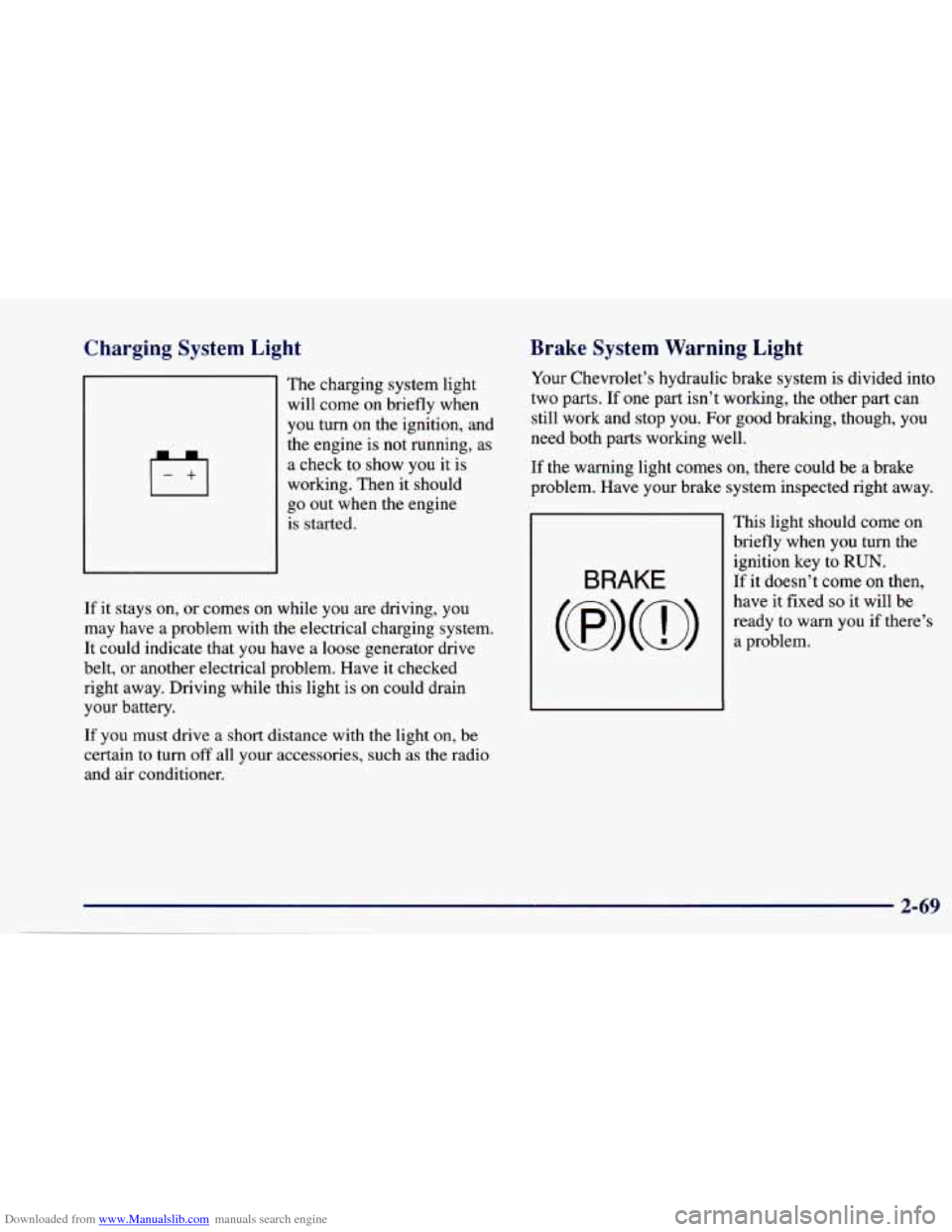
Downloaded from www.Manualslib.com manuals search engine Charging System Light
The charging system light
will come on briefly when
you turn on the ignition, and
the engine is not running, as
a check to show you it is
working. Then
it should
go out when the engine
is started.
If it stays on, or comes on while you are driving, you
may have a problem with the electrical charging system.
It could indicate that you have a loose generator drive
belt, or another electrical problem. Have
it checked
right away. Driving while this light is on could drain
your battery.
If you must drive a short distance with the light on, be
certain to turn
off all your accessories, such as the radio
and air conditioner.
Brake System Warning Light
Your Chevrolet’s hydraulic brake system is divided into
two parts.
If one part isn’t working, the other part can
still work and stop you. For good braking, though, you
need both parts working well.
If the warning light comes on, there could be a brake
problem. Have your brake system inspected right away.
BRAKE
This light should come on
briefly when you turn the
ignition key to
RUN.
If it doesn’t come on then,
have it fixed
so it will be
ready to warn you if there’s
a problem.
2-69
Page 128 of 388
Downloaded from www.Manualslib.com manuals search engine If the light comes on while you are driving, pull off the
road and stop carefully.
You may notice that the pedal is
harder to push. Or, the pedal may go closer to the floor.
It may take longer to stop. If the light is still on, have the
vehicle towed for service. (See “Towing Your Vehicle’’
il he
- *)
Your brake system may not be working propc--y
if the brake system warning light
is on. Driving
with the brake system warning light on can lead
to an accident.
If the light is still on after you’ve
pulled
off the road and stopped carefully, have
the vehicle towed for service.
When the ignition is on, the brake system warning light
will also
come on when you set your parking brake. The
light will stay on if your parking brake doesn’t release
fully. If it stays on after your parking brake is fully
released, it means you have
a brake problem.
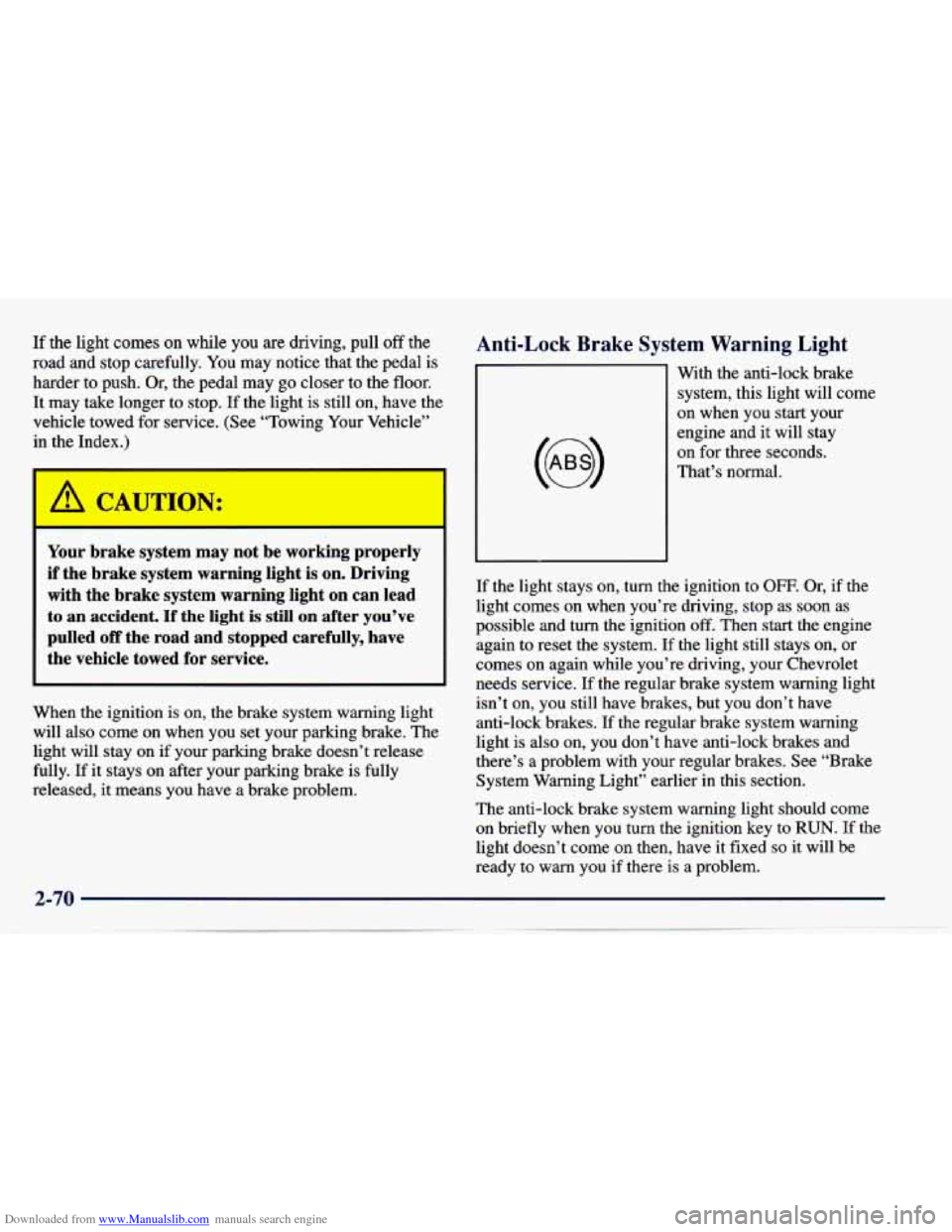
Anti-Lock Brake System Warning Light
With the anti-lock brake
system, this light will come
on when you start your
engine and it will stay
on for three seconds.
That’s normal.
If the light stays on, turn the ignition to OFF. Or, if the
light comes on when you’re driving, stop as soon as
possible and turn the ignition
off. Then start the engine
again to reset the system.
If the light still stays on, or
comes on again while you’re driving, your Chevrolet
needs service. If the regular brake system warning light
isn’t on, you still have brakes, but you don’t have
anti-lock brakes.
If the regular brake system warning
light is also on, you don’t have anti-lock brakes and
there’s
a problem with your regular brakes. See “Brake
System Warning Light” earlier in this section.
The anti-lock brake system warning light should come
on briefly when
you turn the ignition key to RUN. If the
light doesn’t come on then, have it fixed
so it will be
ready to warn you if there is a problem.
2-70
Page 129 of 388
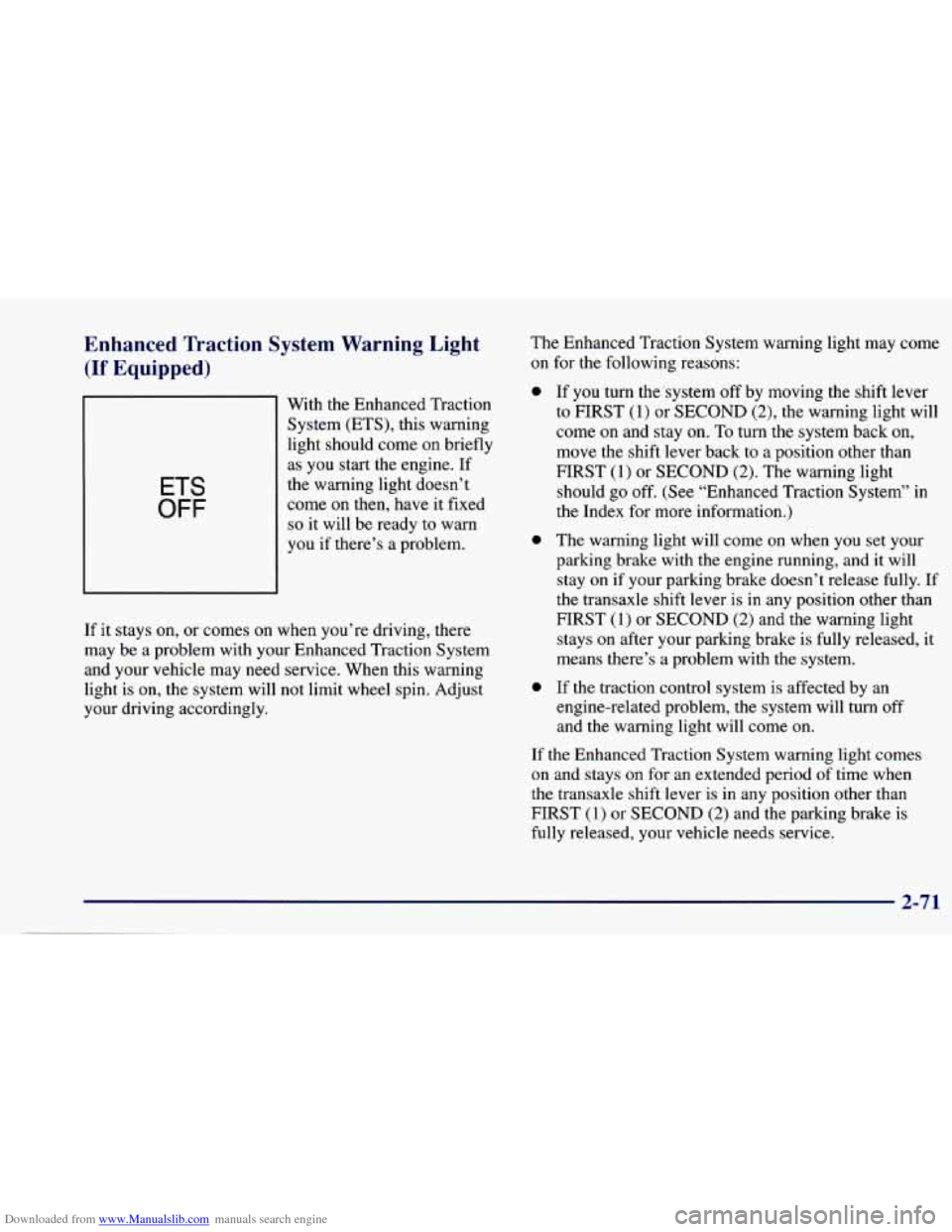
Downloaded from www.Manualslib.com manuals search engine Enhanced Traction System Warning Light
(If Equipped)
ETS
OFF
With the Enhanced Traction System (ETS), this warning
light should come on briefly
as you start the engine. If
the warning light doesn’t
come on then, have it fixed
so it will be ready to warn
you
if there’s a problem.
If it stays on, or comes on when you’re driving, there
may be a problem with your Enhanced Traction System
and your vehicle may need service. When this warning
light is on, the system will
not limit wheel spin. Adjust
your driving accordingly. The
Enhanced Traction System warning light may come
on for the following reasons:
a
0
0
If you turn the ‘system off by moving the shift lever
to FIRST (1) or SECOND (2), the warning light will
come on and stay on.
To turn the system back on,
move the shift lever back to a position other than
FIRST
(1) or SECOND (2). The warning light
should go off. (See “Enhanced Traction System” in
the Index for more information.)
The warning light will come on when you set your
parking brake with the engine running, and it will
stay on if your parking brake doesn’t release fully. If
the transaxle shift lever is in any position other than
FIRST (1) or SECOND
(2) and the warning light
stays on after your parking brake is fully released,
it
means there’s a problem with the system.
If the traction control system is affected by an engine-related problem,
the system will turn off
and the warning light will come on.
If the Enhanced Traction System warning light comes
on and stays
on for an extended period of time when
the transaxle shift lever is in any position other than
FIRST (1) or SECOND (2) and the parking brake is
fully released, your vehicle needs service.
2-71
Page 131 of 388
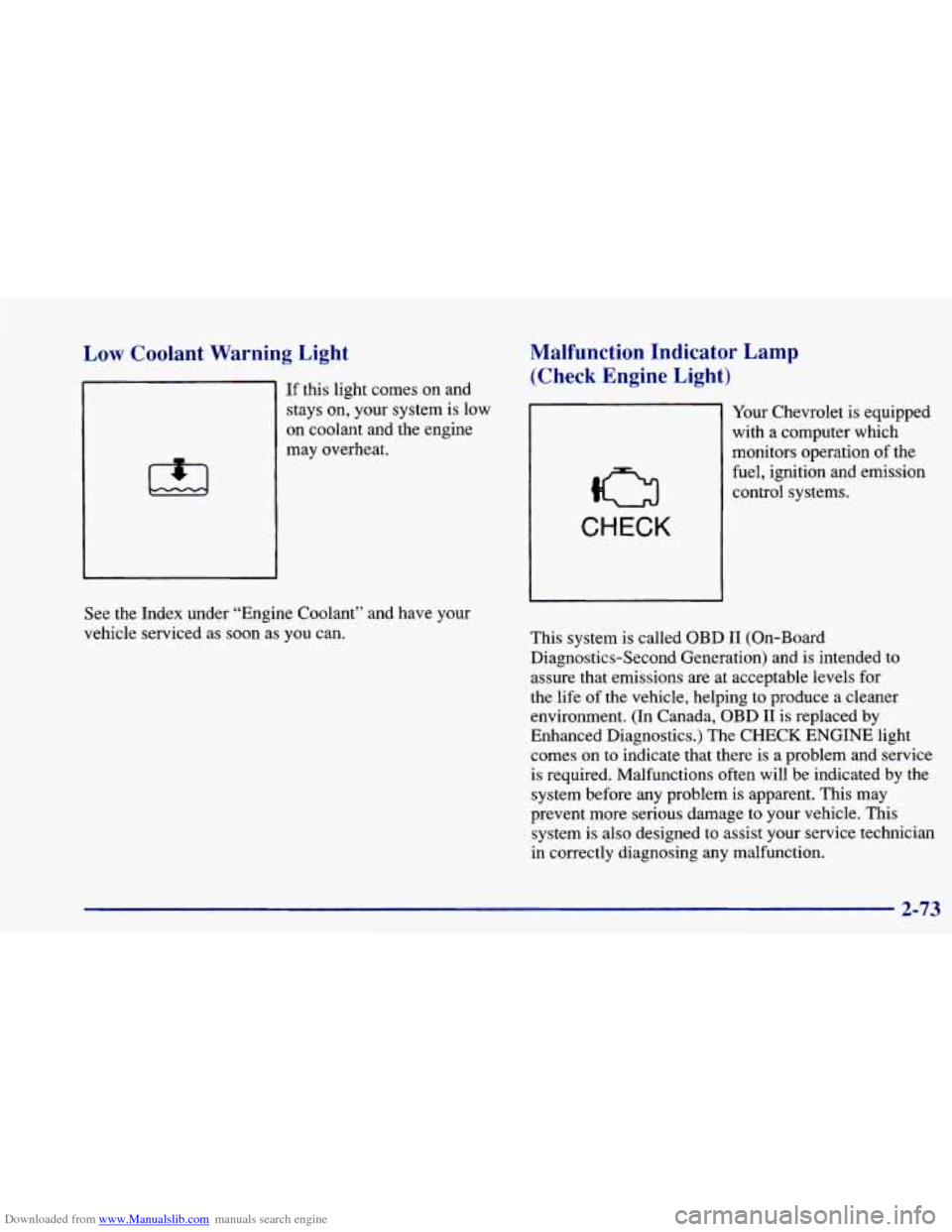
Downloaded from www.Manualslib.com manuals search engine Low Coolant Warning Light
If this light comes on and
stays on, your system is low
on coolant and the engine
may overheat.
Malfunction Indicator Lamp
(Check Engine Light)
CHECK
Your Chevrolet is equipped
with a computer which
monitors operation of the
fuel, ignition
and emission
control systems.
See the Index under “Engine Coolant’’ and have your
vehicle serviced as soon as
you can.
This system is called OBD I1 (On-Board
Diagnostics-Second Generation) and is intended to
assure that emissions are at acceptable levels for
the life of
the vehicle, helping to produce a cleaner
environment. (In Canada,
OBD I1 is replaced by
Enhanced Diagnostics.) The CHECK ENGINE light
comes on to indicate that there
is a problem and service
is required, Malfunctions often will be indicated by the
system before any problem is apparent. This may
prevent more serious damage to your vehicle. This
system is also designed to assist your service technician
in correctly diagnosing any malfunction.
2-73
Page 134 of 388
Downloaded from www.Manualslib.com manuals search engine Oil Pressure Warning Light
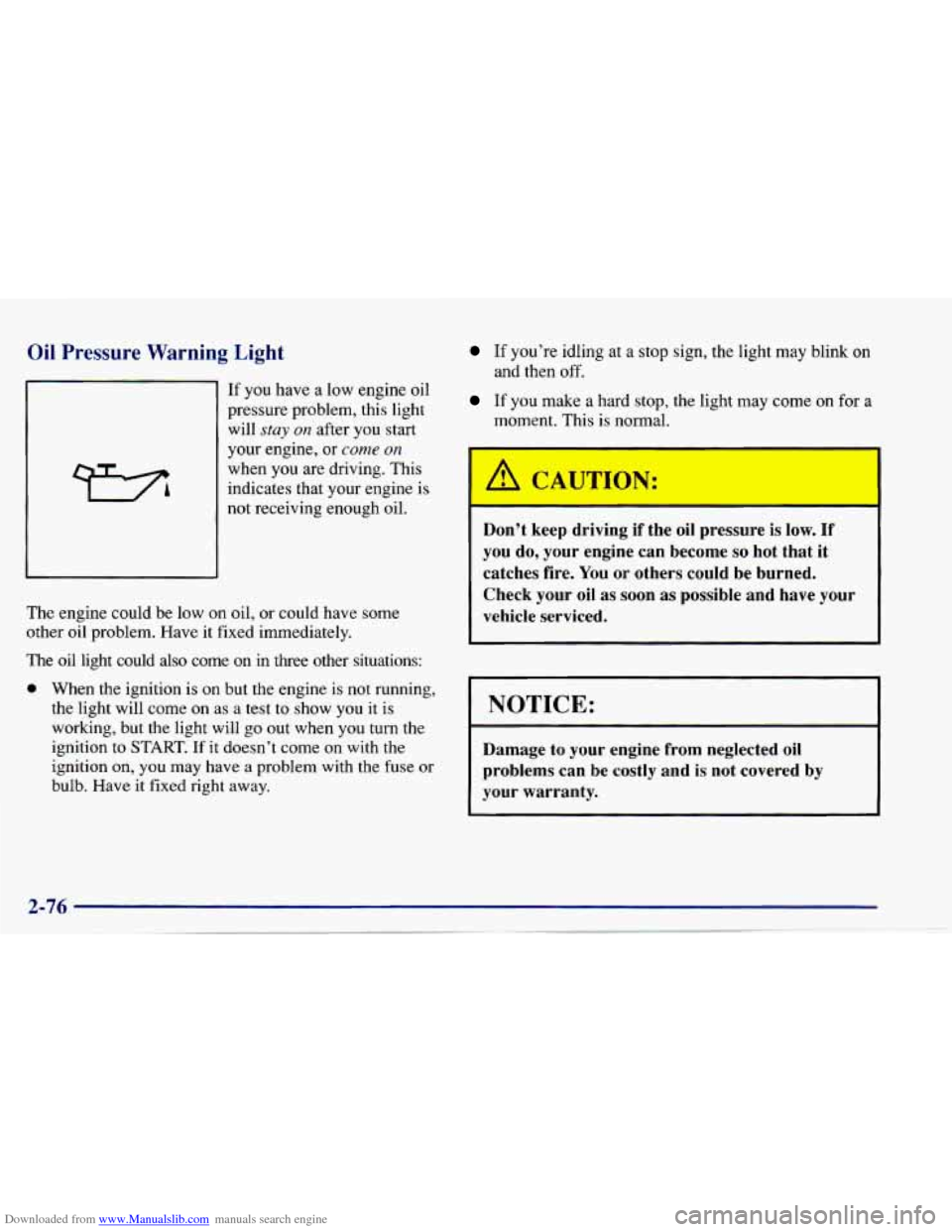
If you have a low engine oil
pressure problem, this light
will
stay on after you start
your engine, or
conze 012
when you are driving. This
indicates that your engine is
not receiving enough oil.
The engine could be low on oil, or could have some
other oil problem. Have it fixed immediately.
The oil light could also come on in three other situations:
0 When the ignition is on but the engine is not running,
the light
will come on as a test to show you it is
working, but the light will
go out when you turn the
ignition to START. If it doesn’t come on with the
ignition
on, you may have a problem with the fuse or
bulb. Have it fixed right away.
If you’re idling at a stop sign, the light may blink on
If you make a hard stop, the light may come on for a
and then
off.
moment. This is normal.
Don’t keep driving if the oil pressure is low.
If
you do, your engine can become so hot that it
catches fire. You or others could
be burned.
Check your oil
as soon as possible and have your
vehicle serviced.
I NOTICE:
Damage to your engine from neglected oil
problems can be costly and
is not covered by
your warranty.
Page 135 of 388
Downloaded from www.Manualslib.com manuals search engine Passlock Warning Light
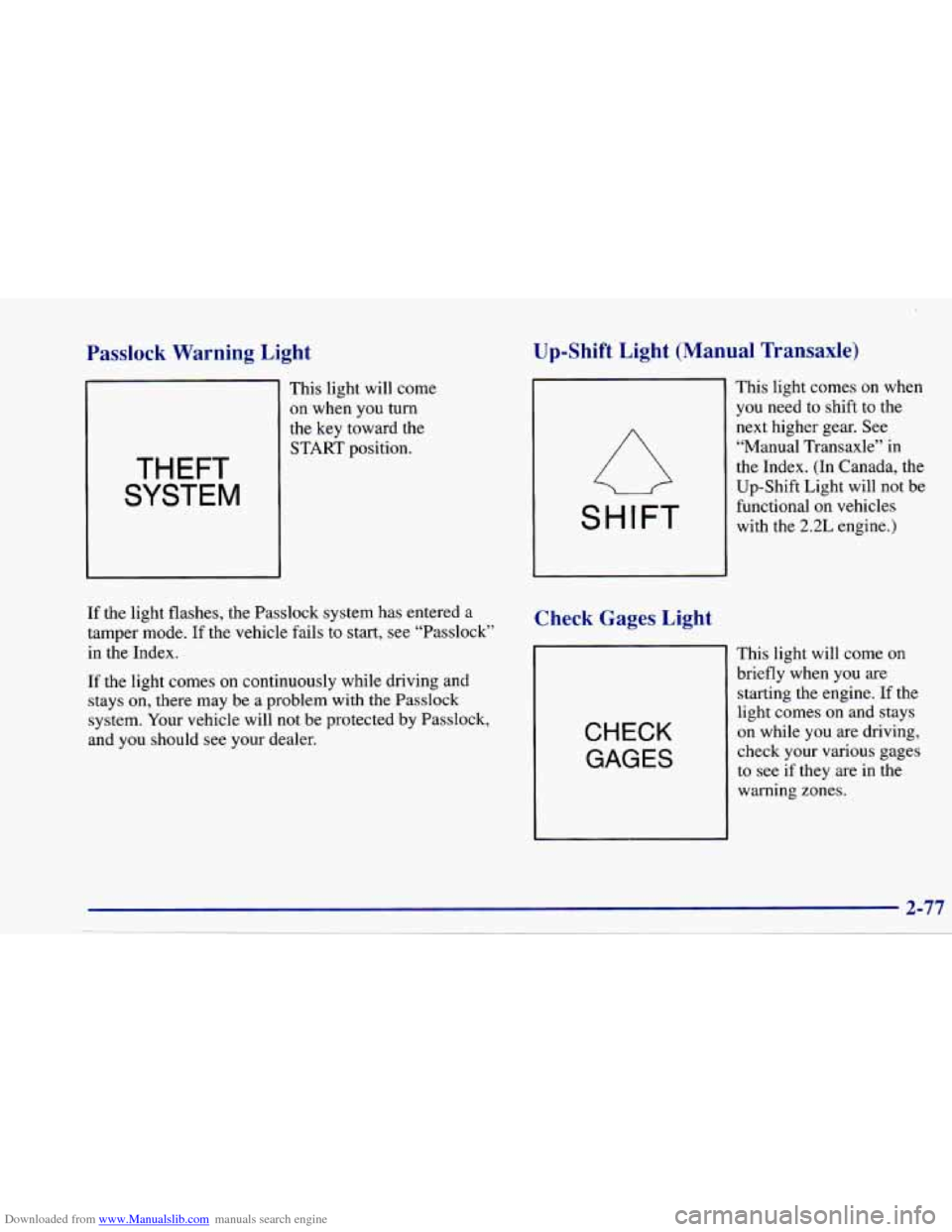
THEFT
SYSTEM
This light will come
on when you turn
the key toward the START position.
If the light flashes, the Passlock system has entered a
tamper mode. If the vehicle fails to start, see “Passlock”
in the Index.
If the light comes
on continuously while driving and
stays on, there may be a problem with the Passlock
system. Your vehicle will not be protected by Passlock,
and you should see your dealer.
Up-Shift Light (Manual Transaxle)
SHIFT
Check Gages Light
CHECK
GAGES
I I
This light comes on when
you need to shift to the
next higher gear. See
“Manual Transaxle” in
the Index. (In Canada, the
Up-Shift Light will not be
functional on vehicles
with the
2.2L engine.)
This light will come
on
briefly when you are
starting the engine. If the
light comes on and stays
on while you are driving,
check your various gages
to
see if they are in the
warning zones.
2-77
Page 169 of 388
Downloaded from www.Manualslib.com manuals search engine Avoid needless heavy braking. Some people drive in
spurts
-- heavy acceleration followed by heavy
braking
-- rather than keeping pace with traffic. This is a
mistake. Your brakes may not have time to cool between
hard stops. Your brakes will wear out much faster if you
do a lot of heavy braking. If you keep pace with the
traffic and allow realistic following distances, you will
eliminate a lot
of unnecessary braking. That means
better braking and longer brake life.
If your engine ever stops while you’re driving, brake
normally but don’t pump your brakes. If you do, the
pedal may get harder to push down.
If your engine
stops, you will still have some power brake assist. But
you will use it when you brake. Once the power assist is
used up, it may take longer to stop and the brake pedal
will be harder to push.
Anti-Lock Brakes
Your vehicle has anti-lock brakes (ABS). ABS is an
advanced electronic braking system that will help
prevent a braking skid.
When you start your engine,
or when you begin to drive
away, your anti-lock brake system will check itself.
You
may hear a momentary motor or clicking noise while
this test is going on, and you may even notice that your
brake pedal moves
a little. This is normal.
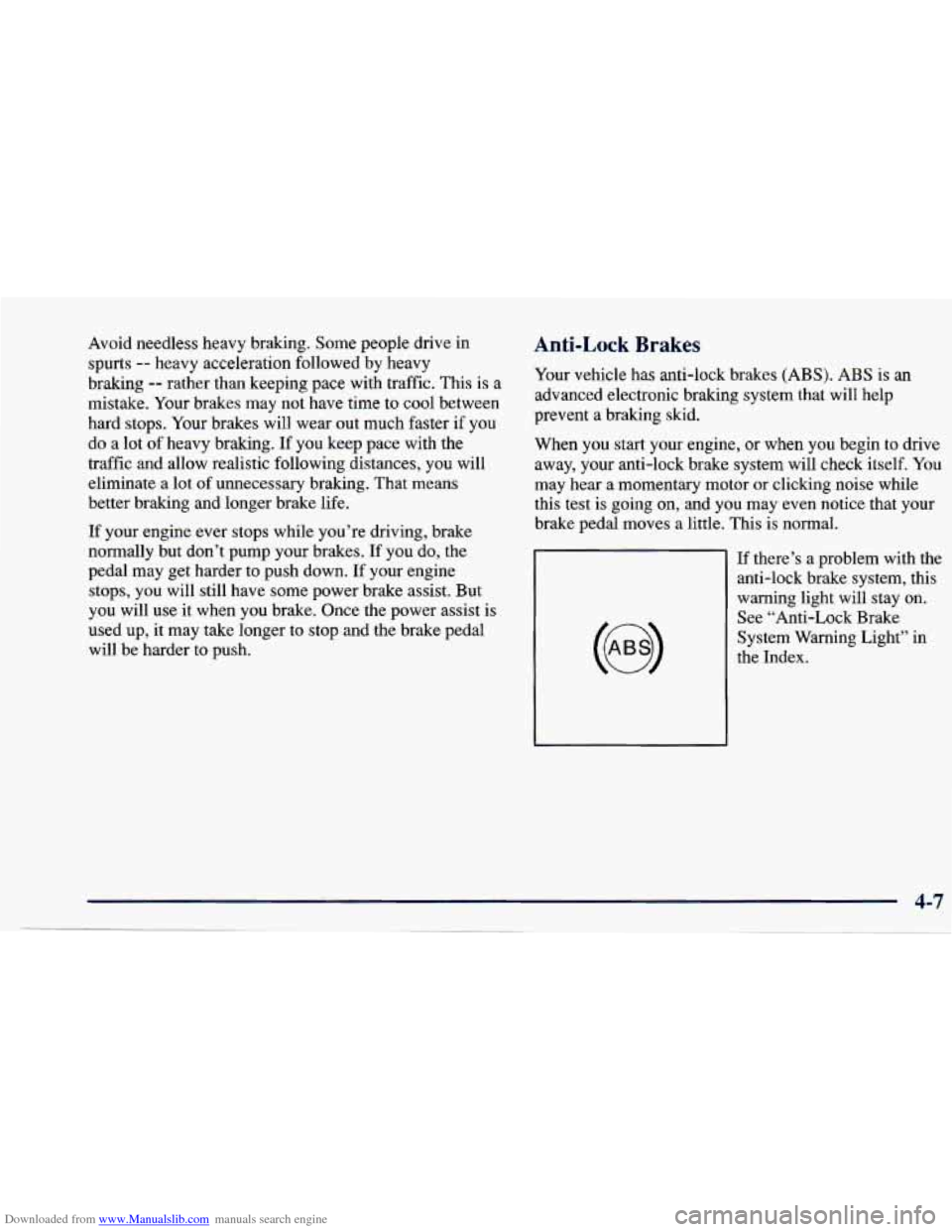
If there’s
a problem with the
anti-lock brake system, this
warning light will stay on. See “Anti-Lock Brake
System Warning Light’’ in
the Index.
Page 171 of 388
Downloaded from www.Manualslib.com manuals search engine Remember: Anti-lock doesn’t change the time you need
to get your foot up to the brake pedal or always decrease
stopping distance. If you get too close to the vehicle in
front
of you, you won’t have time to apply your brakes
if that vehicle suddenly slows or stops. Always leave
enough room up ahead to stop, even though you have
anti-lock brakes.
Using Anti-Lock
Don’t pump the brakes. Just hold the brake pedal down
and let anti-lock work for you. You may feel the system
working, or you may notice some noise, but
this is normal.
Enhanced Traction System (If Equipped)
If your vehicle has the optional four-speed automatic
transaxle, it also has an Enhanced Traction System
(ETS) that limits wheel spin. This is especially useful
in slippery road conditions. The system operates only
when the transaxle shift lever is in
the REVERSE (R),
THIRD (3) or OVERDRIVE (a) position and the
system senses that one
or both of the front wheels are
spinning or beginning to lose traction. When this
happens, the system reduces engine power and may also
upshift the transaxle to limit wheel spin.
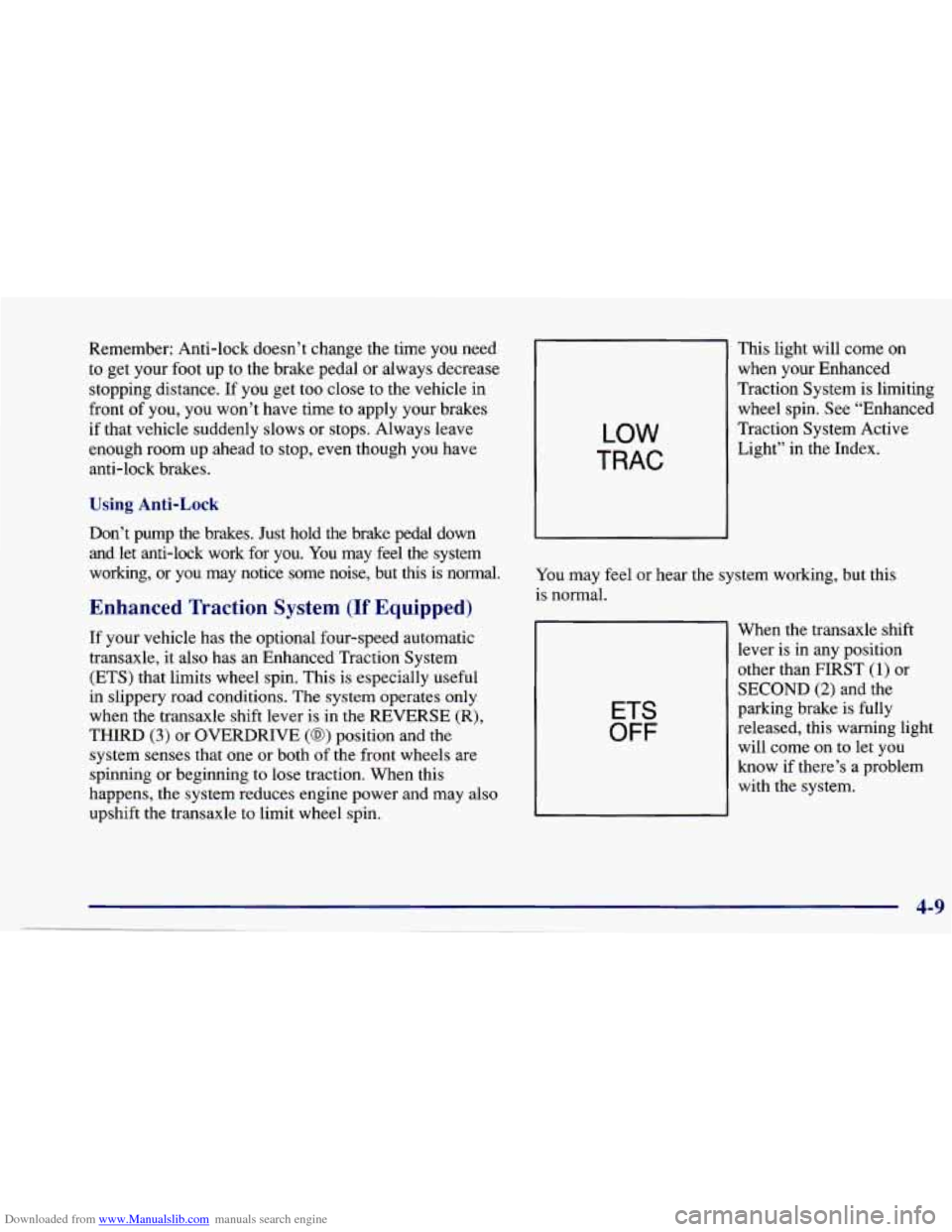
LOW
TRAC
This light will come on
when your Enhanced
Traction System is limiting
wheel spin. See “Enhanced
Traction System Active Light” in the Index.
You may feel or hear the system working, but this
is normal.
ETS
OFF
When the transaxle shift
lever is in any position
other than
FIRST (1) or
SECOND (2) and the
parking brake is fully
released, this warning light will come on to let you
know if there’s a problem
with the system.
Page 172 of 388
Downloaded from www.Manualslib.com manuals search engine See “Enhanced Traction System Warning Light” in the
Index. When this warning light is on, the system will not
limit wheel spin. Adjust your driving accordingly.
The Enhanced Traction System can operate when
the transaxle shift lever is in any position other than
FIRST (1) or SECOND (2). To limit wheel spin,
especially
in slippery road conditions, you should use
the other shift lever positions only when necessary. See
“Automatic Transaxle” in the Index.
(If your vehicle
ever gets stuck in sand, mud, ice or snow, see “Rocking
Your Vehicle” in the Index.)
When you move the shift lever to FIRST
(1) or
SECOND (2), the system will turn off. The Enhanced
Traction System warning light will come on and stay on.
If the Enhanced Traction System is limiting wheel spin
when you move the shift lever to another position, the
system won’t turn off right away.
It will wait until
there’s no longer
a current need to limit wheel spin.
You can turn the system back on at any time by moving
the shift lever to any position other than FIRST
(1) or
SECOND (2). The Enhanced Traction System warning
light should
go off.
Braking in Emergencies
With anti-lock, you can steer and brake at the same
time. In many emergencies, steering can help you more
than even the very best braking.
Steering
Power Steering
If you lose power steering assist because the engine
stops or the system is not functioning, you
can steer but
it will take much more effort.
Steering Tips
Driving on Curves
It’s important to take curves at a reasonable speed.
A lot of the “driver lost control” accidents mentioned on
the news happen on curves. Here’s why:
Experienced driver or beginner, each of
us is subject to
the same laws of physics when driving on curves. The
traction of the tires against the road surface makes it
possible for the vehicle to change its path when you turn
the front wheels.
If there’s no traction, inertia will keep
the vehicle going in the same direction. If you’ve ever
tried to steer a vehicle on wet ice, you’ll understand this.
Page 177 of 388
Downloaded from www.Manualslib.com manuals search engine A cornering skid is best handled by easing your foot off
the accelerator pedal.
If you have the Enhanced Traction System, remember:
It helps avoid only the acceleration skid.
If you do not have the Enhanced Traction System, or if
the transaxle shift lever is not in the OVERDRIVE
(@)
position, then an acceleration skid is also best handled
by easing your foot off the accelerator pedal.
If your vehicle starts to slide, ease your foot off the
accelerator pedal and quickly steer the way you want the
vehicle to go. If you start steering quickly enough, your
vehicle may straighten out. Always be ready for a
second skid if it occurs.
Of course, traction is reduced when water, snow, ice,
gravel or other material is on the road. For safety, you’ll
want to slow down and adjust your driving to these
conditions.
It is important to slow down on slippery
surfaces because stopping distance will be longer and
vehicle control more limited. While
driving on a surface with reduced traction,
try
your best to avoid sudden steering, acceleration or
braking (including engine braking by shifting to a lower
gear). Any sudden changes could cause the tires to slide.
You may not realize the surface is slippery until your
vehicle is skidding. Learn to recognize warning
clues
-- such as enough water, ice or packed snow on
the road to make a “mirrored surface”
-- and slow
down when you have any doubt.
Remember: Any anti-lock brake system
(ABS) helps
avoid only the braking skid.