light CHEVROLET CAVALIER 1997 3.G Workshop Manual
[x] Cancel search | Manufacturer: CHEVROLET, Model Year: 1997, Model line: CAVALIER, Model: CHEVROLET CAVALIER 1997 3.GPages: 388, PDF Size: 20 MB
Page 188 of 388
Downloaded from www.Manualslib.com manuals search engine Winter Driving
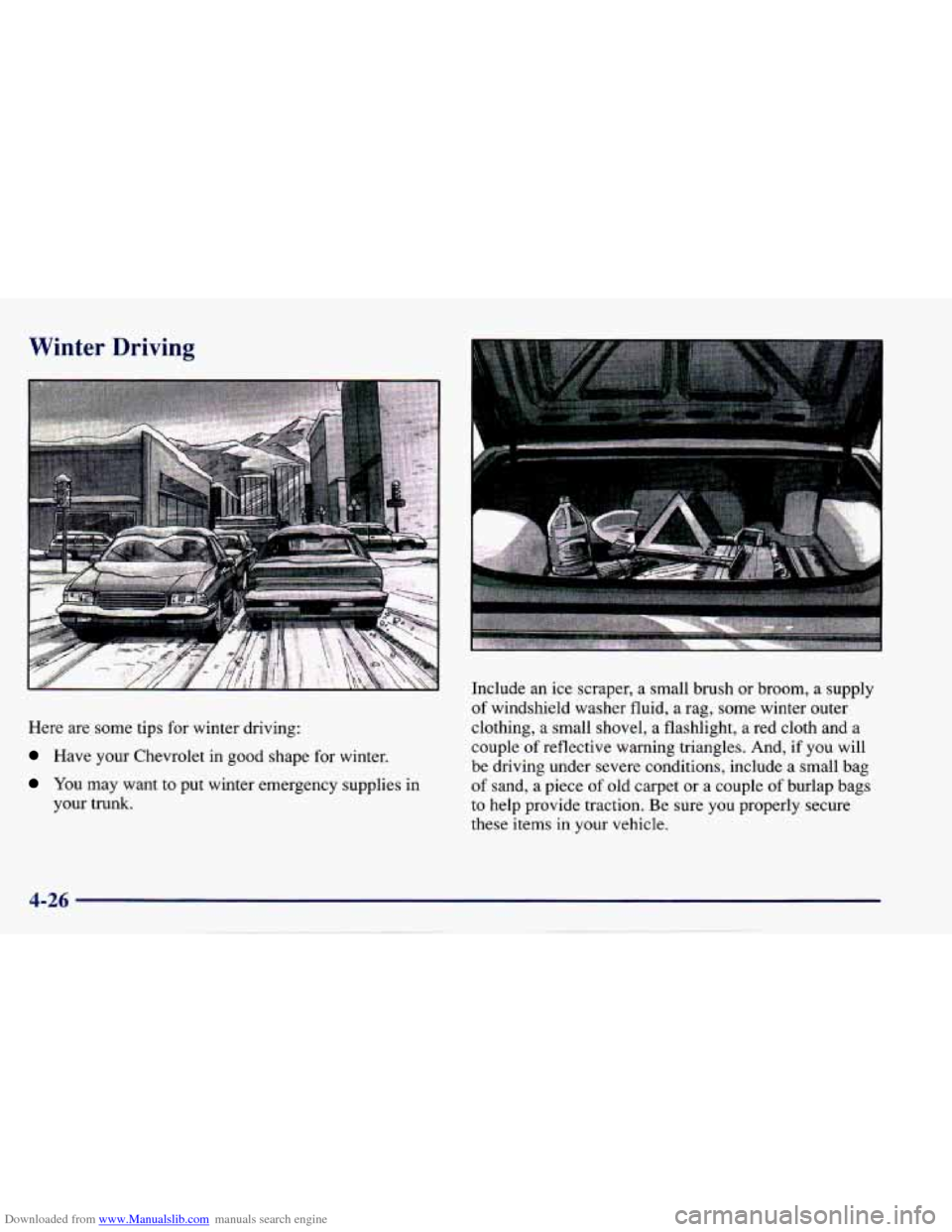
Here are Some tips for winter driving:
Havk y6i-n Chevrolet in good shape for winter.
You may want to put winter emergency supplies in
your trunk. Include an
ice scraper, a small brush or broom, a supply
of windshield washer fluid, a rag, some winter outer
clothing, a small shovel, a flashlight, a red cloth and a
couple of reflective warning triangles. And, if you will
be driving under severe conditions, include a small bag
of sand, a piece of old carpet or a couple of burlap bags
to help provide traction. Be sure you properly secure
these items in your vehicle.
4-26
Page 192 of 388
Downloaded from www.Manualslib.com manuals search engine A CAUTIl- N:
Snow can trap exhaust gases under your vehicle.
This can cause deadly
CO (carbon monoxide) gas
to get inside.
CO could overcome you and kill
you. You can’t see it or smell it, so you might not
know it is in your vehicle. Clear away snow from
around the base
of your vehicle, especially any
that is blocking your exhaust pipe. And check
around again from time to time to be sure snow
doesn’t collect there.
Open
a window just a little on the side of the
vehicle that’s away from the wind. This will help
keep
CO out. Run your
engine only as long as
you must. This saves
fuel. When you run the engine, make it go
a little faster
than just idle. That is, push the accelerator slightly. This
uses less fuel for the heat that you get and
it keeps the
battery charged. You will need a well-charged battery to
restart the vehicle, and possibly for signaling later on
with
your headlamps. Let the heater run for awhile.
Then,
shut the engine off and close the window almost
all the way to preserve the heat. Start the engine again
and repeat this only when you feel really uncomfortable
from the cold. But do it
as little as possible. Preserve the
fuel
as long as you can. To help keep warm, you can get
out of the vehicle and
do some fairly vigorous exercises
every half hour or
so until help comes.
Page 197 of 388
Downloaded from www.Manualslib.com manuals search engine /! CAUTION:
Things you put inside your vehicle can strike
and injure people in
a sudden stop or turn,
or in
a crash.
Put things in the trunk or rear area of your
vehicle. In
a trunk, put them as far forward
as you can. Try to spread the weight evenly.
If you have fold-down rear seats, you’ll
find four anchors on the back wall
of your
trunk.
You can use these anchors to tie
down lighter loads. They’re not strong
enough
for heavy things, however, so put
them
as far forward as you can in the trunk
or rear area.
CAUTION: (Continued) CAUTION: (Continued)
e Never stack heavier things, like suitcases,
inside the vehicle
so that some of them are
above the tops of the seats.
a Don’t leave an unsecured child restraint in
your vehicle.
When you carry something inside the
vehicle, secure it whenever you can.
Don’t leave a seat folded down unless you
need to.
Page 210 of 388
Downloaded from www.Manualslib.com manuals search engine 2. Get the vehicles close enough so the jumper cables
can reach, but be sure the vehicles aren’t touching
each other.
If they are, it could cause a ground
connection
you don’t want. You wouldn’t be able to
start your Chevrolet, and the bad grounding could
damage the electrical systems.
To avoid the possibility of the vehicles rolling, set
the parking brake firmly on both vehicles involved
in the jump start procedure. Put an automatic
transaxle in
PARK (P) or a manual transaxle in
NEUTRAL (N) before setting the parking brake.
3. Turn off the ignition on both vehicles. Unplug
unnecessary accessories plugged into the cigarette
lighter.
Turn off all lamps that aren’t needed as well
as radios.
This will avoid sparks and help save both
batteries. In addition,
it could save your radio.
NOTICE:
If you leave your radio on, it could be badly
damaged. The repairs wouldn’t be covered by
your warranty.
4. Open the hoods and locate the batteries.
An electric fan can start up even when the engine
is not running and can injure you. Keep hands,
clothing and tools away from any underhood
electric fan.
Page 211 of 388
Downloaded from www.Manualslib.com manuals search engine 5. Find the positive (+) and negative (-) terminals on
each battery.
Using a match near a battery can cause battery
gas to explode. People have been hurt doing this,
and some have been blinded. Use
a flashlight if
you need more light.
Be sure the battery has enough water. You don’t
need
to add water to the Delco Freedom@ battery
installed
in every new GM vehicle. But if a battery
has fiiier caps, be
sure the right amount of fluid is
there. If it is low, add water to take care of that
first.
If you don’t, explosive gas could be present.
Battery fluid contains acid that can burn you.
Don’t get it on you.
If you accidentally get it in
your eyes or on your skin, flush the place with
water and get medical help immediately.
6. Check that the jumper cables don’t have loose or
missing insulation.
If they do, you could get a shock.
The vehicles could be damaged, too.
Before you connect the cables, here are some basic
things you should know. Positive
(+) will go to
positive
(+) and negative (-) will go to negative (-)
or a metal engine part. Don’t connect positive (+) to
negative
(-) or you’ll get a short that would damage
the battery and maybe other
parts, too.
Fans or other moving engine parts can injure you
badly. Keep your hands away from moving parts
once
the engine is running.
Page 220 of 388
Downloaded from www.Manualslib.com manuals search engine Engine Overh - -rting
YOU will find a coolant temperature gage and a low coolant
warning light on your Chevrolet’s instrument panel.
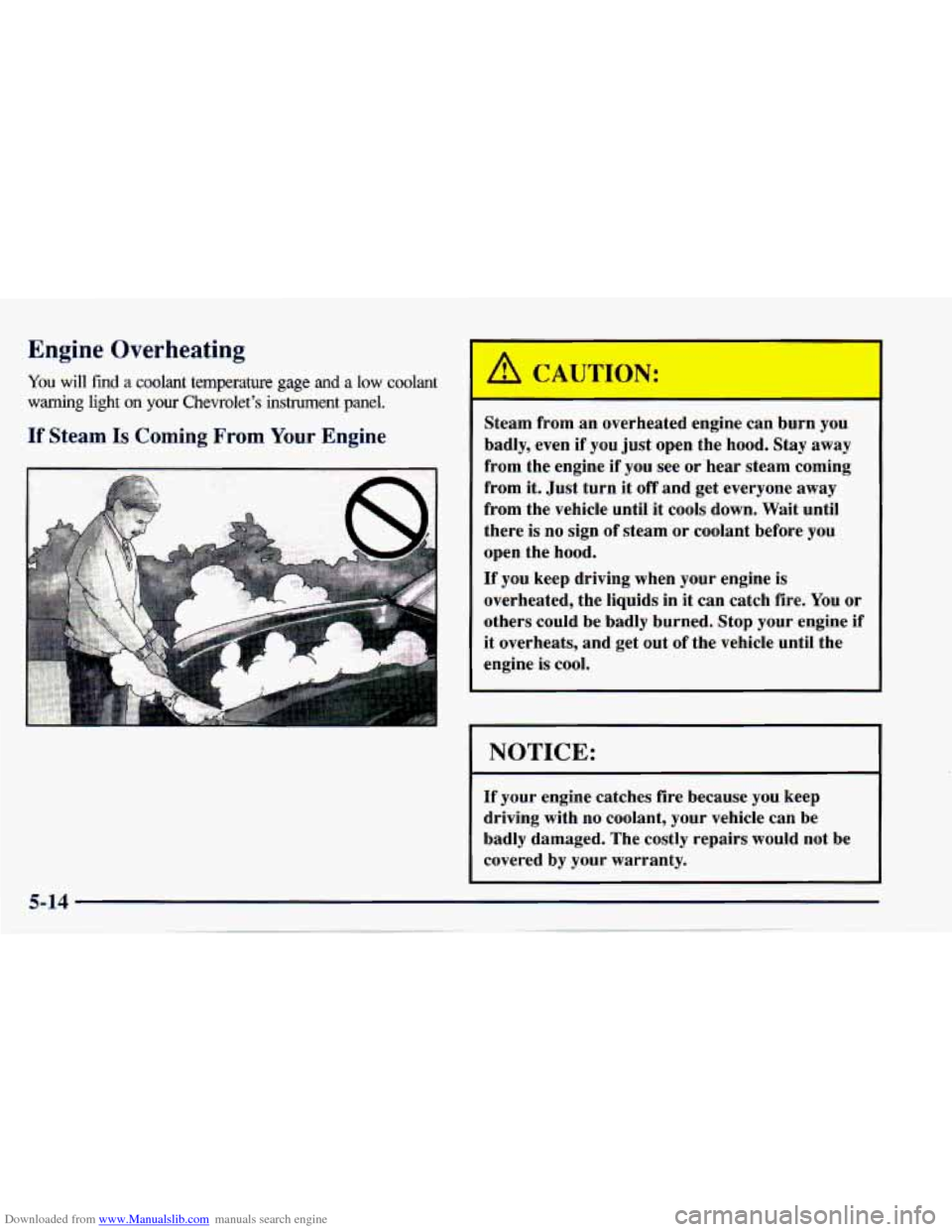
If Steam Is Coming From Your Engine
Steam from an overheated engine can burn you
badly, even
if you just open the hood. Stay away
from the engine if you see or hear steam coming
from it, Just turn it
off and get everyone away
from the vehicle until it cools down. Wait until
there is no sign of steam or coolant before you
open the hood.
If you keep driving when your engine is
overheated, the liquids in it can catch fire. You or
others could be
badly burned. Stop your engine if
it overheats, and get out of the vehicle until the
engine
is cool.
I NOTICE:
If your engine catches fire because you keep
driving with no coolant, your vehicle can be
badly damaged. The costly repairs would not be
covered
by your warranty.
Page 241 of 388
Downloaded from www.Manualslib.com manuals search engine If You’re Stuck: In Sand, Mud,
Ice or Snow
What you don’t want to do when your vehicle is stuck is
to spin your wheels too fast. The method known as
“rocking” can help you get
out when you’re stuck, but
you must use caution.
If you let your tires spin at high speed, they can
explode, and you or others could be injured.
And, the transaxle or other parts of the vehicle
can overheat. That could cause an engine
compartment fire or other damage. When you’re
stuck, spin the wheels
as little as possible. Don’t
spin the wheels above
35 mph (55 km/h) as shown
on the speedometer.
I NOTICE:
Spinning your wheels can destroy parts of your
vehicle as well as the tires.
If you spin the wheels
too fast while shifting your transaxle back and
forth, you can destroy your transaxle.
For information about using tire chains on your vehicle,
see “Tire Chains” in the Index.
Rocking Your Vehicle To Get It Out
First, turn your steering wheel left and right. That will
clear the area around your front wheels. Then shift back
and forth between REVERSE
(R) and a forward gear
(or with a manual transaxle, between FIRST
(1) or
SECOND
(2) and REVERSE (R)), spinning the wheels
as little as possible.
(If your vehicle has the Enhanced
Traction System, shift back and forth between
REVERSE (R) and FIRST
(1) or SECOND (2),
spinning the wheels as little as possible.) Release the
accelerator pedal while you shift, and press lightly on
the accelerator pedal when the transaxle is in gear. If
that doesn’t get you out after a few tries, you may need
to be towed out. If you do need to be towed out, see
“Towing Your Vehicle” in
the Index.
5-35
Page 249 of 388
Downloaded from www.Manualslib.com manuals search engine A CAUTION:
If you get gasoline on yourself and then
something ignites it, you could be badly burned.
Gasoline can spray out on
you if you open the
fuel filler cap too quickly. This spray can happen
if your tank is nearly full, and is more likely in
hot weather. Open the fuel filler cap slowly and
wait for any “hiss” noise to stop. Then unscrew
the cap all the way.
Be careful not to spill gasoline. Clean gasoline from
painted surfaces as soon as possible. See “Cleaning the
Outside
of Your Chevrolet” in the Index. When you put the
cap back on, turn
it to the right
(clockwise) until you hear a clicking sound.
Make sure
you fully install the cap. The diagnostic
system can
determine
if the fuel cap has been left off or improperly
installed. This would allow fuel to evaporate into the
atmosphere. See “Malfunction Indicator Lamp” in
the Index.
NOTICE:
If you need a new cap, be sure to get the right
type. Your dealer can get one for you. If you get
the wrong type, it may not fit properly. This may
cause your malfunction indicator lamp to light
and your
fuel tank and emissions system may be
damaged. See “Malfunction Indicator Lamp” in
the
Index.
6-7
, .. .. .
Page 267 of 388
Downloaded from www.Manualslib.com manuals search engine How to Check
You do not need to check the fluid level unless you
suspect
a clutch problem. To check the fluid level, take
the cap
off. If the fluid reaches the step inside the
reservoir, the fluid level
is correct.
Engine Coolant
The cooling system in your vehicle is filled
with DEX-COOL@ engine coolant. This coolant
is designed to remain in your vehicle for
5 years or
150,000 miles (240 000 km), whichever occurs first,
if you add only DEX-COOL@ extended life coolant.
The following explains your cooling system and how to add
coolant when it is low.
If you have a problem with engine
overheating, see “Engine Overheating”
in the Index.
A 50/50 mixture of water and DEX-COOL@ coolant will:
0 Give freezing protection down to -34°F (-37°C).
0 Give boiling protection up to 265 “F (129°C).
0 Protect against rust and corrosion.
0 Help keep the proper engine temperature.
Let the warning lights and gages work as
they should.
NOTICE:
I
When adding coolant, it is important that you
use only
DEX-COOL@ (silicate-free) coolant.
If coolant other than
DEX-COOL’ is added
to the system, premature engine, heater core or
radiator corrosion may result. In addition, the
engine coolant will require change sooner
-- at
30,000 miles (50 000 km) or 24 months, whichever
occurs
first. Damage caused by the use of coolant
other than
DEX-COOL@ is not covered by your
new vehicle warranty.
Page 269 of 388
Downloaded from www.Manualslib.com manuals search engine Checking Coolant
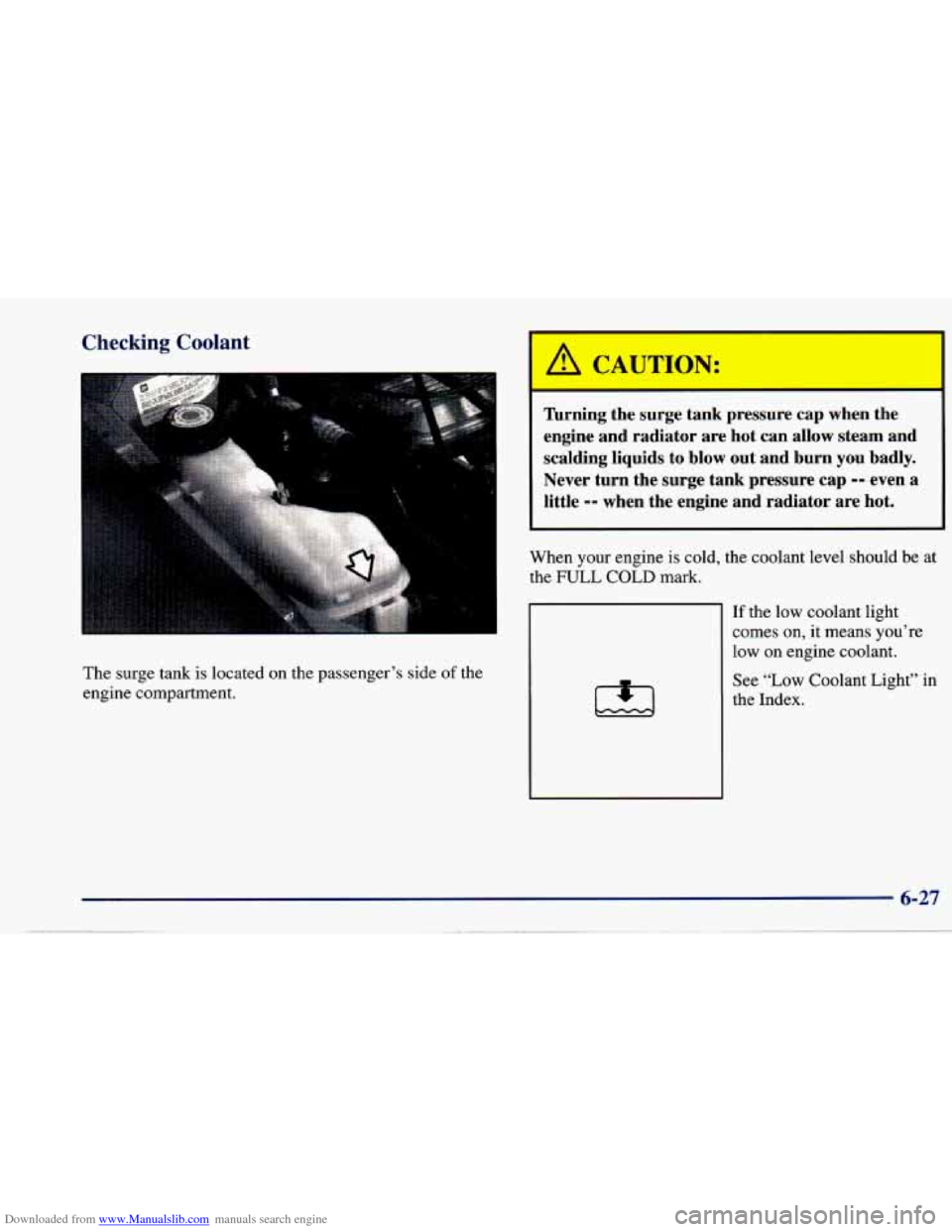
The surge tank is located on the passenger’s side of the
engine compartment.
’ A CAUTIO--:
firning the surge tank bl-ssure cap when the
engine and radiator are hot can allow steam and
scalding liquids to blow out and burn you badly.
Never turn the surge tank pressure cap
-- even a
little
-- when the engine and radiator are hot.
When your engine is cold, the coolant level should be at
the FULL COLD mark.
1
If the low coolant light
comes on,
it means you’re
low on engine coolant.