exhaust CHEVROLET CAVALIER 1997 3.G Owners Manual
[x] Cancel search | Manufacturer: CHEVROLET, Model Year: 1997, Model line: CAVALIER, Model: CHEVROLET CAVALIER 1997 3.GPages: 388, PDF Size: 20 MB
Page 59 of 388
Downloaded from www.Manualslib.com manuals search engine 0 Section 2 Features and Controls
2-2
2-4
2-6
2-10 2-10
2-1 1
2-12
2-12
2- 14
2-
17
2-18
2-23
2-26
2-27
2-29 2-30
2-30
2-3 1
2-32 2-33
2-4
1
2-44
2-46
2-48
2-5 1
2-5 1
2-62
2-67 Parking Over Things That
Bum
Engine Exhaust
Running Your Engine While You’re Parked
(Automatic Transaxle)
Windows
Turn Signalhlultifunction Lever
Exterior Lamps
Interior Lamps
Mirrors Storage Compartments
Sunroof
(If Equipped)
Convertible Top
(If Equipped)
The Instrument Panel
-- Your
Information System
Warning Lights, Gages and Indicators
Here
you can learn about the many standard and optional features on your Chevrolet, and information
on starting,
shifting and braking. Also explained are the instrument panel and the warning systems that tell you
if everything is
working properly
-- and what to do if you have a problem.
Keys
Door Locks
Keyless Entry System (If Equipped)
Trunk
Theft
Passlock
New Vehicle “Break-In”
Ignition Positions Starting Your Engine
Engine Coolant Heater
(If Equipped)
Automatic Transaxle Operation
Manual Transaxle Operation
Parking Brake
Shifting Into PARK (P) (Automatic
Transaxle Models Only)
Shifting Out
of PARK (P)
(Automatic Transaxle)
2-1
Page 68 of 388
Downloaded from www.Manualslib.com manuals search engine Trunk
It can be dangerous to drive with the trunk lid
open because carbon monoxide (CO) gas can
come into
your vehicle. You can’t see or smell
CO. It can cause unconsciousness and even death.
If you must drive with the trunk lid open or if
electrical wiring or other cable connections must
pass through the seal between the body and the
trunk
lid:
Make sure all windows are shut.
Turn the fan on your heating or cooling
system
to its highest speed with the setting
on any airflow selection except
MAX. That
will force outside air into your vehicle. See
“Comfort Controls”
in the Index.
instrument panel, open them all the way.
If you have air outlets on or under the
See “Engine Exhaust” in the Index.
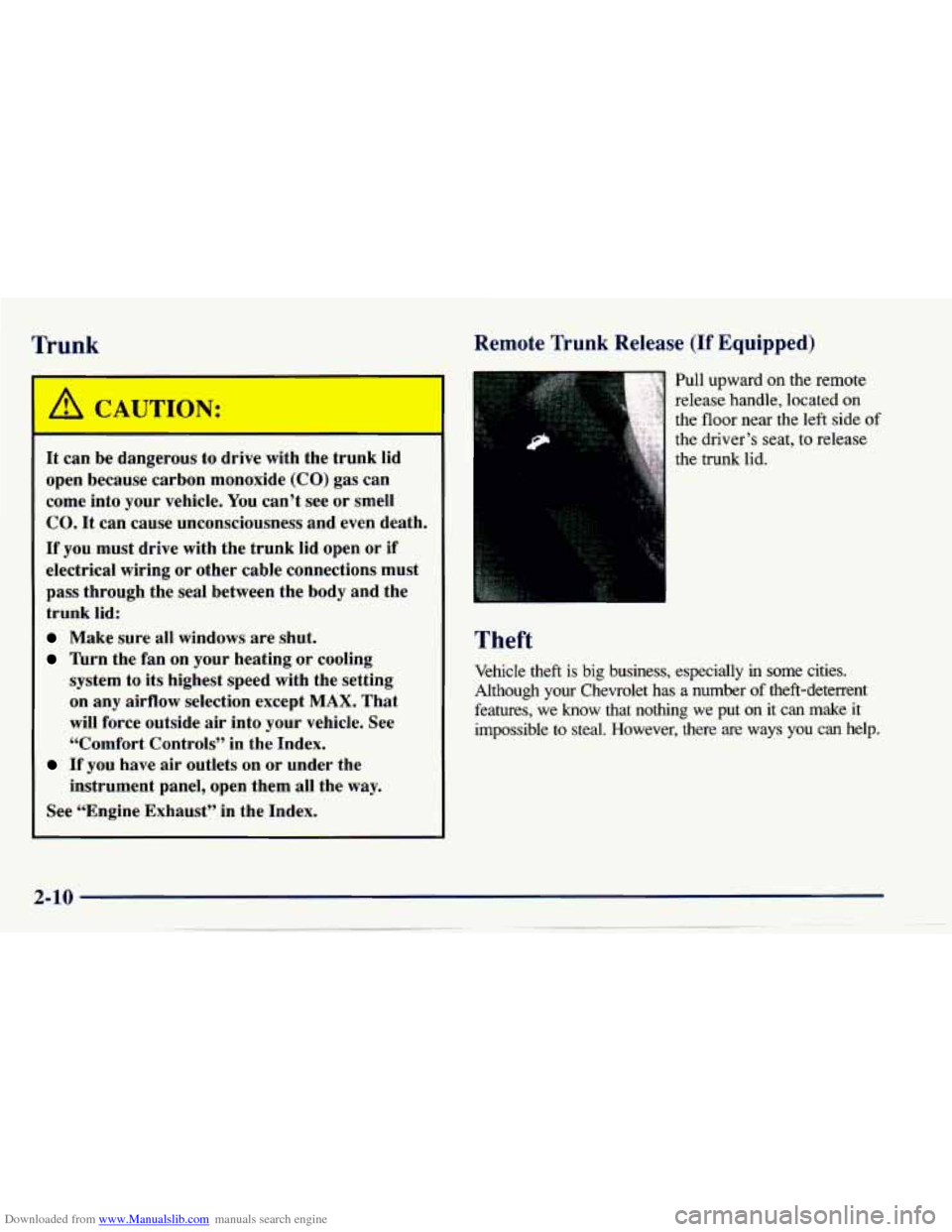
Remote Trunk Release (If Equipped)
Pull upward on the remote
release handle, located on
the floor near the
left side of
the driver’s seat, to release
the trunk lid.
Theft
Vehicle theft is big business, especially in some cities.
Although your Chevrolet has
a number of theft-deterrent
features, we
know that nothing we put on it can make it
impossible
to steal. However, there are ways you can help.
Page 88 of 388

Downloaded from www.Manualslib.com manuals search engine Engine Er9aust Parking Over Things That Burn
I --
'Lnmings that can burn could touch hot exhaust
parts under your vehicle and ignite. Don't park
over papers, leaves, dry grass or other things that
can burn. Engine exhaust can
kill.
It contains the gas
carbon monoxide
(CO), which you can't see or
smell. It can cause unconsciousness and death.
You might have exhaust coming in if:
Your exhaust system sounds strange
Your vehicle gets rusty underneath.
Your vehicle was damaged in a collision.
Your vehicle was damaged when driving over
high points on the road or over road debris.
0 Repairs weren't done correctly.
Your vehicle or exhaust system had been
If you ever suspect exhaust is coming into
your vehicle:
Drive it only with all the windows down to
Have your vehicle fixed immediately.
or
different.
modified improperly. blow
out any CO; and
Page 89 of 388

Downloaded from www.Manualslib.com manuals search engine Running Your Engine While You’re
Parked (Automatic Transaxle)
It’s better not to park with the engine running. But if you
ever have to, here
are some things to know.
/r CAUTION:
Idling the engine with the climate control
system
off could allow dangerous exhaust into
your vehicle (see the earlier Caution under
“Engine Exhaust”).
Also, idling in a closed-in place: can let deadly
carbon monoxide
(CO) into your vehicle even if
the fan switch is at the highest setting. One place
this can happen
is a garage. Exhaust -- with
CO
-- can come in easily. NEVER park in a
garage with the engine running.
Another closed-in place can be a blizzard.
(See “Blizzard” in the Index.)
A CAUTION:
t can be dangerous to get out of your vehicle if
the shift lever is not fully in PARK
(P) with the
parking brake firmly set. Your vehicle can roll.
Don’t leave your vehicle when the engine is
running unless you have to.
If you’ve left the
engine running, the vehicle can move suddenly.
You or others could be injured.
To be sure your
vehicle won’t move, even when you’re on fairly
level ground, always set your parking brake and
move the shift lever to
PARK (P).
Follow the proper steps to be sure your vehicle won’t
move.
See “Shifting Into PARK (P)” in the Index.
If you are parking on a hill and if you’re pulling a
trailer, also see “Towing
a Trailer’’ in the Index.
Page 192 of 388
Downloaded from www.Manualslib.com manuals search engine A CAUTIl- N:
Snow can trap exhaust gases under your vehicle.
This can cause deadly
CO (carbon monoxide) gas
to get inside.
CO could overcome you and kill
you. You can’t see it or smell it, so you might not
know it is in your vehicle. Clear away snow from
around the base
of your vehicle, especially any
that is blocking your exhaust pipe. And check
around again from time to time to be sure snow
doesn’t collect there.
Open
a window just a little on the side of the
vehicle that’s away from the wind. This will help
keep
CO out. Run your
engine only as long as
you must. This saves
fuel. When you run the engine, make it go
a little faster
than just idle. That is, push the accelerator slightly. This
uses less fuel for the heat that you get and
it keeps the
battery charged. You will need a well-charged battery to
restart the vehicle, and possibly for signaling later on
with
your headlamps. Let the heater run for awhile.
Then,
shut the engine off and close the window almost
all the way to preserve the heat. Start the engine again
and repeat this only when you feel really uncomfortable
from the cold. But do it
as little as possible. Preserve the
fuel
as long as you can. To help keep warm, you can get
out of the vehicle and
do some fairly vigorous exercises
every half hour or
so until help comes.
Page 201 of 388
Downloaded from www.Manualslib.com manuals search engine If you’re using a weight-carrying hitch, the trailer
tongue
(A) should weigh 10 percent of the total loaded
trailer weight
(B). If you have a weight-distributing
hitch, the trailer tongue
(A) should weigh 12 percent
of the total loaded trailer weight
(B).
After you’ve loaded your trailer, weigh the trailer and
then the tongue, separately, to see if the weights are
proper.
If they aren’t, you may be able to get them right
simply by moving some items around in the trailer.
Total Weight on Your Vehicle’s Tires
Be sure your vehicle’s tires are inflated to the upper
limit for cold tires. You’ll find these numbers on the
Tire-Loading Information Label at the rear edge
of the
driver’s door, or see “Loading Your Vehicle’’
in the Index.
Then
be sure you don’t go over the GVW limit for your
vehicle, including the weight of the trailer tongue.
Hitches
It’s important to have the correct hitch equipment.
Crosswinds, large trucks going by and rough roads are
a few reasons why you’ll need the right hitch. Here
are
some rules to follow:
0 The bumpers on your vehicle are not intended for
hitches.
Do not attach rental hitches or other
bumper-type hitches to them. Use only a
frame-mounted hitch that does not attach to
the bumper.
0 Will you have to make any holes in the body of your
vehicle when you install a trailer hitch? If you do,
then be sure to seal the holes later when you remove
the hitch. If you don’t seal them, deadly carbon
monoxide (CO) from your exhaust can get into your
vehicle (see “Carbon Monoxide” in the Index). Dirt and water can,
too.
Page 261 of 388
Downloaded from www.Manualslib.com manuals search engine Because this operation can be a little difficult, you may
choose to have this done
at your Chevrolet dealership
Service Department.
If you do it yourself, be sure to follow all the instructions
here, or you could get
a false reading on the dipstick.
NOTICE:
Too much or too little fluid can damage your
transaxle.
Too much can mean that some of the
fluid could come out and fall on hot engine parts
or exhaust system parts, starting a fire. Be sure to
get an accurate reading if
you check your
transaxle fluid.
Wait at least 30 minutes before checking the transaxle
fluid level if you have been driving:
0 When outside temperatures are above 90°F (32°C).
At high speed for quite a while.
In heavy traffic -- especially in hot weather.
0 While pulling a trailer.
To get the right reading, the fluid should be at normal
operating temperature, which is
180°F to 200" F
(82°C to 93°C).
Get the vehicle warmed up by driving about
15 miles
(24 km) when outside temperatures are above 50°F
(10°C). If it's colder than 50°F (lO"C), you may have
to drive longer.
Checking the Fluid Level
0
0
0
0
Park your vehicle on a level place. Keep the
engine running.
With the parking brake applied, place the shift lever
in
PARK (P).
With your foot on the brake pedal, move the shift
lever through each gear range, pausing for about
three seconds in each range. Then, position the shift
lever in
PARK (P).
Let the engine run at idle for three to five mhutes.
Page 264 of 388
Downloaded from www.Manualslib.com manuals search engine If you do not use your vehicle under any of these
conditions, the fluid and filter do not require changing.
NOTICE:
We recommend you use only fluid labeled
DEXRON@=III, because fluid with that label is
made especially for your automatic transaxle.
Damage
caused by fluid other than DEXRON-111
is not covered by your new vehicle warranty.
Manual Transaxle Fluid
When to Check
A good time to have it checked is when the engine oil is
changed.
However, the fluid in your manual transaxle
doesn't require changing.
How to Check
Because this operation can be a little difficult, you may
choose to have this done at your Chevrolet dealership
Service Department.
If you do it yourself, be sure to follow all the instructions
here, or
you could get a false reading on the dipstick.
I NOTICE:
1 Too much or too little fluid can damage your
transaxle.
Too much can mean that some of the
fluid could come out and fall on hot engine parts
or exhaust system parts, starting a fire. Be sure to
get an accurate reading if you check your
transaxle fluid.
Page 298 of 388
Downloaded from www.Manualslib.com manuals search engine Finish Damage
Any stone chips, fractures or deep scratches in the finish
should be repaired right away. Bare metal will corrode
quickly and may develop into a major repair expense.
Minor chips and scratches can be repaired with touch-up
materials available from your dealer or other service
outlets. Larger areas of finish damage can be corrected
in your dealer’s body and paint shop.
Underbody Maintenance
Chemicals used for ice and snow removal and dust
control can collect on the underbody. If these
are not
removed, accelerated corrosion (rust) can occur on
the underbody parts such as fuel lines, frame, floor
pan and exhaust system even though they have
corrosion protection.
At least every spring, flush these materials from the
underbody with plain water. Clean any areas where mud
and other debris can collect. Dirt packed in closed areas
of the frame should be loosened before being flushed.
Your dealer or
an underbody car washing system can do
this for you.
Chemic Paint Spotting
Some weather and atmospheric conditions can create
a chemical fallout. Airborne pollutants can fall upon and
attack painted surfaces on your vehicle. This damage
can take two forms: blotchy, ringlet-shaped
discolorations, and small irregular dark spots etched
into the paint surface.
Although no defect in the paint job causes this,
Chevrolet will repair, at no charge to the owner, the
surfaces of new vehicles damaged by this fallout
condition within
12 months or 12,000 miles (20 000 km)
of purchase, whichever occurs first.
6-56
Page 309 of 388
Downloaded from www.Manualslib.com manuals search engine 0 Section 7 Maintenance Schedule
This section covers the maintenance required for your Chevrolet. Your vehicle needs these services to retain its safety,
dependability and emission control performance.
7-2
7-2
7-3
7-4
7-4
7-4 7-4
1
7-4 1
7-4 1
7-42
7-43
Introduction Your Vehicle and the Environment
How This Section
is Organized
Part A: Scheduled Maintenance Services
Using Your Maintenance Schedule
Selecting the Right Schedule
Part B: Owner Checks and Services
At Each Fuel Fill
At Least Once
a Month
At Least Twice
a Year
At Least Once a Year
7-46
7-46
7-46
7-46
7-46
7-47
7-47
7-48
7-50 Part C: Periodic Maintenance Inspections
Steering, Suspension and Front Drive Axle
Boot and Seal Inspection
Exhaust System Inspection
Radiator and Heater Hose Inspection
Throttle Linkage Inspection
Brake System Inspection
CaliperKnuckle Maintenance Inspection
Part
D: Recommended Fluids and Lubricants
Part E: Maintenance Record