lights CHEVROLET CAVALIER 1997 3.G Owners Manual
[x] Cancel search | Manufacturer: CHEVROLET, Model Year: 1997, Model line: CAVALIER, Model: CHEVROLET CAVALIER 1997 3.GPages: 388, PDF Size: 20 MB
Page 10 of 388
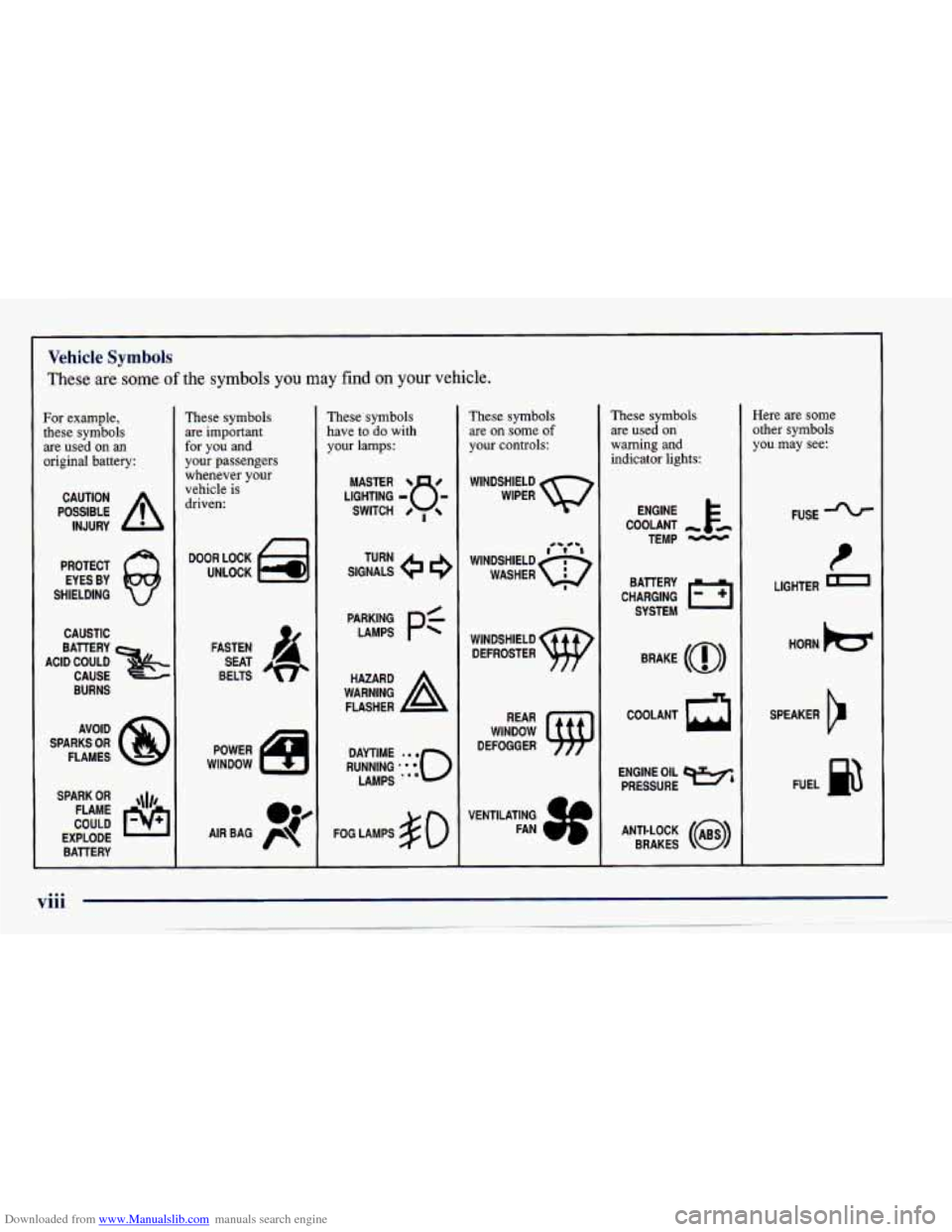
Downloaded from www.Manualslib.com manuals search engine Vehicle Symbols
These are some of the symbols you may find on your vehicle.
For example,
these symbols
are used on an
original battery:
POSSIBLE A
CAUTION
INJURY
PROTECT EYES
BY
SHIELDING Q
CAUSTIC
BURNS AVOID
SPARKS
OR
FLAMES
SPARK
OR ,\I/,
COULD FLAME
EXPLODE BATTERY
These symbols are important
for you
and
your passengers
whenever your
vehicle
is
driven:
n
UNLOCK la
FASTEN
SEAT
BELTS
POWER
WINDOW
0p
AIR BAG p
These symbols
have to do with
your lamps:
SIGNALS e
TURN
FOG LAMPS # 0
These symbols are
on some of
your controls:
WINDSHIELD
DEFROSTER
WINDOW
DEFOGGER
These symbols are used
on
warning and
indicator lights:
ENGINE k
COOLANT - th
TEMP -
CHARGING I-1
BATTERY
SYSTEM
'
BRAKE (a)
R
COOLANT
ENGINE OIL
e,
PRESSURE
ANTI-LOCK
(e)
BRAKES
Here are some
other symbols
you may see:
FUSE
t
LIGHTER
HORN
)a(
SPEAKER
b
FUEL p3
Page 59 of 388
Downloaded from www.Manualslib.com manuals search engine 0 Section 2 Features and Controls
2-2
2-4
2-6
2-10 2-10
2-1 1
2-12
2-12
2- 14
2-
17
2-18
2-23
2-26
2-27
2-29 2-30
2-30
2-3 1
2-32 2-33
2-4
1
2-44
2-46
2-48
2-5 1
2-5 1
2-62
2-67 Parking Over Things That
Bum
Engine Exhaust
Running Your Engine While You’re Parked
(Automatic Transaxle)
Windows
Turn Signalhlultifunction Lever
Exterior Lamps
Interior Lamps
Mirrors Storage Compartments
Sunroof
(If Equipped)
Convertible Top
(If Equipped)
The Instrument Panel
-- Your
Information System
Warning Lights, Gages and Indicators
Here
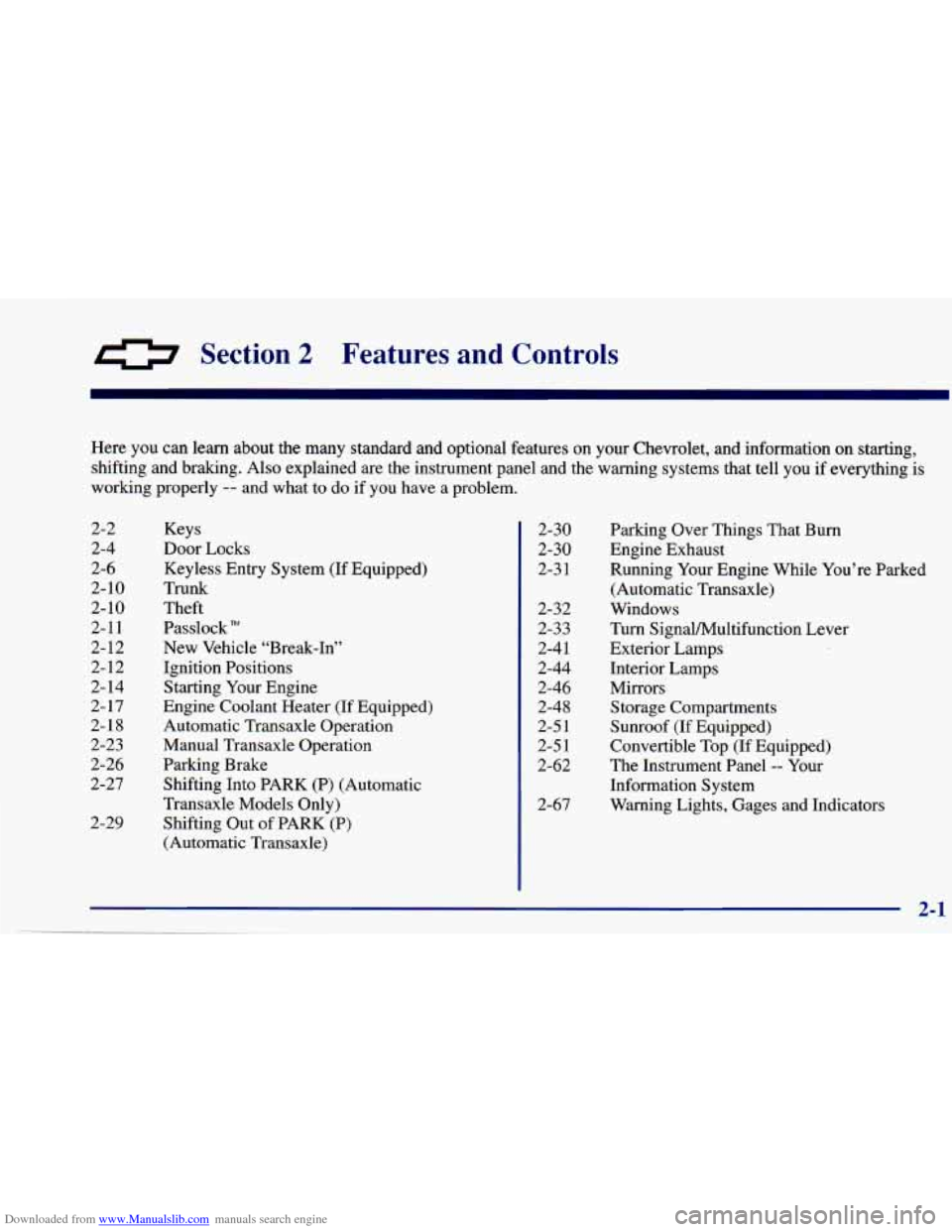
you can learn about the many standard and optional features on your Chevrolet, and information
on starting,
shifting and braking. Also explained are the instrument panel and the warning systems that tell you
if everything is
working properly
-- and what to do if you have a problem.
Keys
Door Locks
Keyless Entry System (If Equipped)
Trunk
Theft
Passlock
New Vehicle “Break-In”
Ignition Positions Starting Your Engine
Engine Coolant Heater
(If Equipped)
Automatic Transaxle Operation
Manual Transaxle Operation
Parking Brake
Shifting Into PARK (P) (Automatic
Transaxle Models Only)
Shifting Out
of PARK (P)
(Automatic Transaxle)
2-1
Page 64 of 388
Downloaded from www.Manualslib.com manuals search engine If you don’t cancel the security lock feature, adults or Keyless Entry Ss; __ (If Equipped)
older children who ride in the rear won’t be able to open
the rear door from the inside. You should
let adults and If your Chevrolet has this option, you can lock and
older children
know how to cancel the locks. unlock your doors or unlock your trunk from about
To cancel the rear door lock: keyless entry transmitter supplied with your vehicle.
3 feet (1 m) up to 30 feet (9 m) away using the remote
1.
2.
3.
Unlock the door from the inside and open the door
from the outside.
Use
a key to move the lock all the way down.
Do the same for the other rear door.
The rear door locks will now work normally.
Leaving Your Vehicle
If you are leaving the vehicle, open your door and
set the locks from the inside. Then get out and close
the door. In
addition, the system illuminates the interior lights for
a set period
of time. The remote Keyless Entry System
consists
of a receiver, which is located in the vehicle,
and two hand held transmitters.
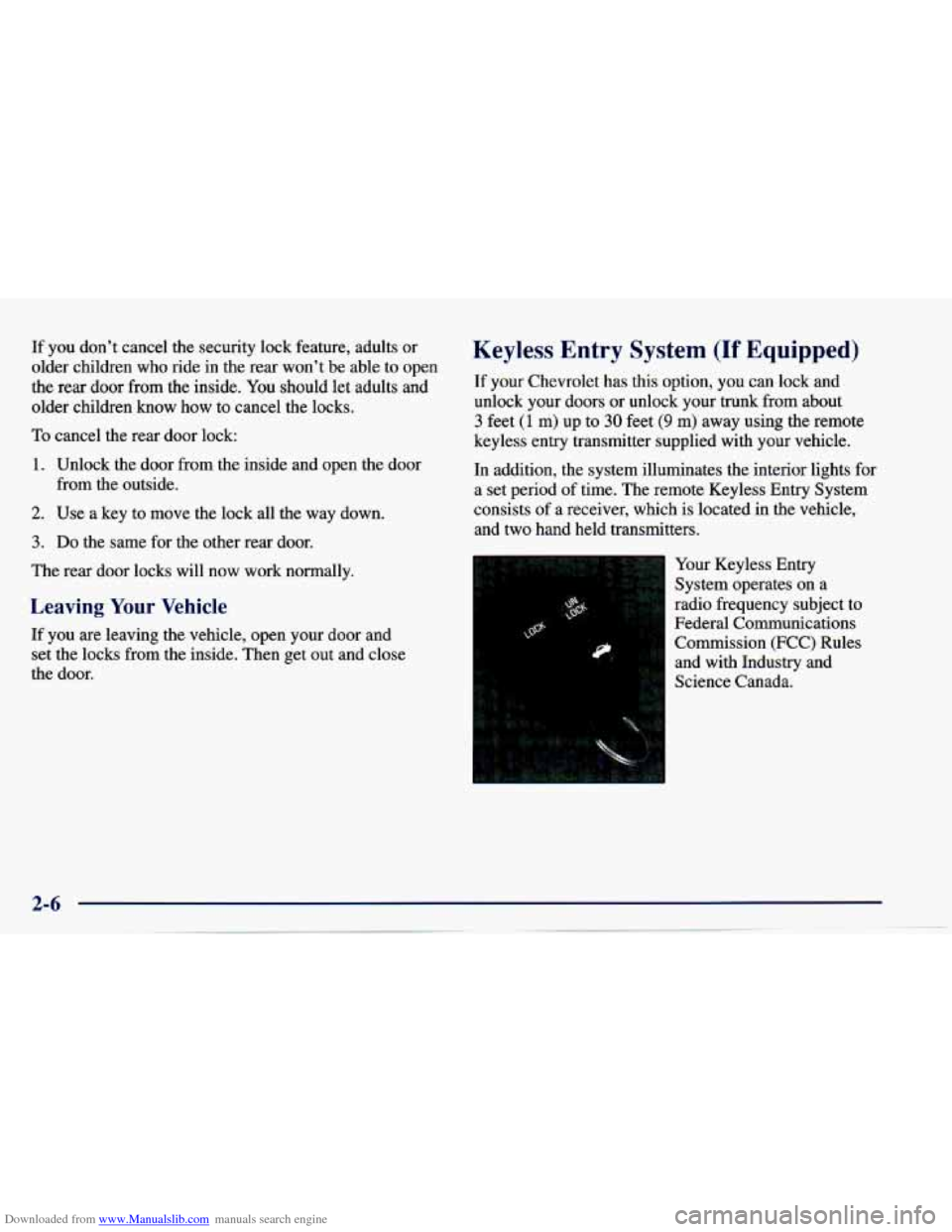
Your Keyless Entry
System operates on a
radio frequency subject to
Federal Communications
Commission (FCC) Rules and with Industry and
Science Canada.
Page 71 of 388
Downloaded from www.Manualslib.com manuals search engine OFF (C): This position unlocks the steering wheel,
ignition and transaxle, but does not send electrical
power to any accessories. In the
OFF position, the
instrument cluster and the automatic transaxle gear shift
indicator have electrical power. Use this position if your
vehicle must be pushed
or towed, but never try to
push-start your vehicle.
A warning chime will sound if
you open the driver’s door when the ignition is off and
the key
is in the ignition.
RUN (D): This is an on position to which the switch
returns after you start your engine and release the
switch. The switch stays in the RUN position when the
engine is running. But even when the engine is
not
running, you can use RUN to operate your electrical
power accessories, and to display some instrument panel
warning lights.
START
(E): This position starts the engine. When the
engine starts, release the
key. The ignition switch will
return to RUN for normal driving.
Note that even if the engine is not running, the positions
ACCESSORY and RUN are on positions that allow you
to operate your electrical accessories, such
as the radio. On manual transaxle
vehicles, turning the key to
LOCK will lock the steering column and result in
a loss of ability to steer the vehicle. This could
cause
a collision. If you need to turn the engine
off while the vehicle is moving, turn the key only
to
OFF. Don’t press the key release button while
the vehicle is moving.
NOTICE:
If your key seems stuck in LOCK and you can’t
turn it, be sure
you are using the correct key; if
so, is it all the way in? If it is, then turn the
steering wheel left and right while you turn the
key hard. But turn the key only with your hand.
Using
a tool to force it could break the key or the
ignition switch.
If none of this works, then your
~ vehicle needs service.
Page 100 of 388
Downloaded from www.Manualslib.com manuals search engine Parking Lamps
PC This position will turn on the following:
0 Parking Lamps
0 Sidemarker Lamps
0 Taillamps
0 Instrument Panel Lights
Headlamps
0: This position will turn on the following:
0 Headlamps
0 Parking Lamps
Sidemarker Lamps
Taillamps
0 Instrument Panel Lights
Turn the band clockwise all the way to turn the lamps off.
Lamps On Reminder
If you open the driver’s door with the ignition off and
the lamps on, you will hear a warning chime.
Daytime Running Lamps/Automatic
Light Control
Daytime Running Lamps (DRL) can make it easier for
others to
see the front of your vehicle during the day.
DRL can be helpful in many different driving
conditions, but they can be especially helpful in the
short periods after dawn and before sunset.
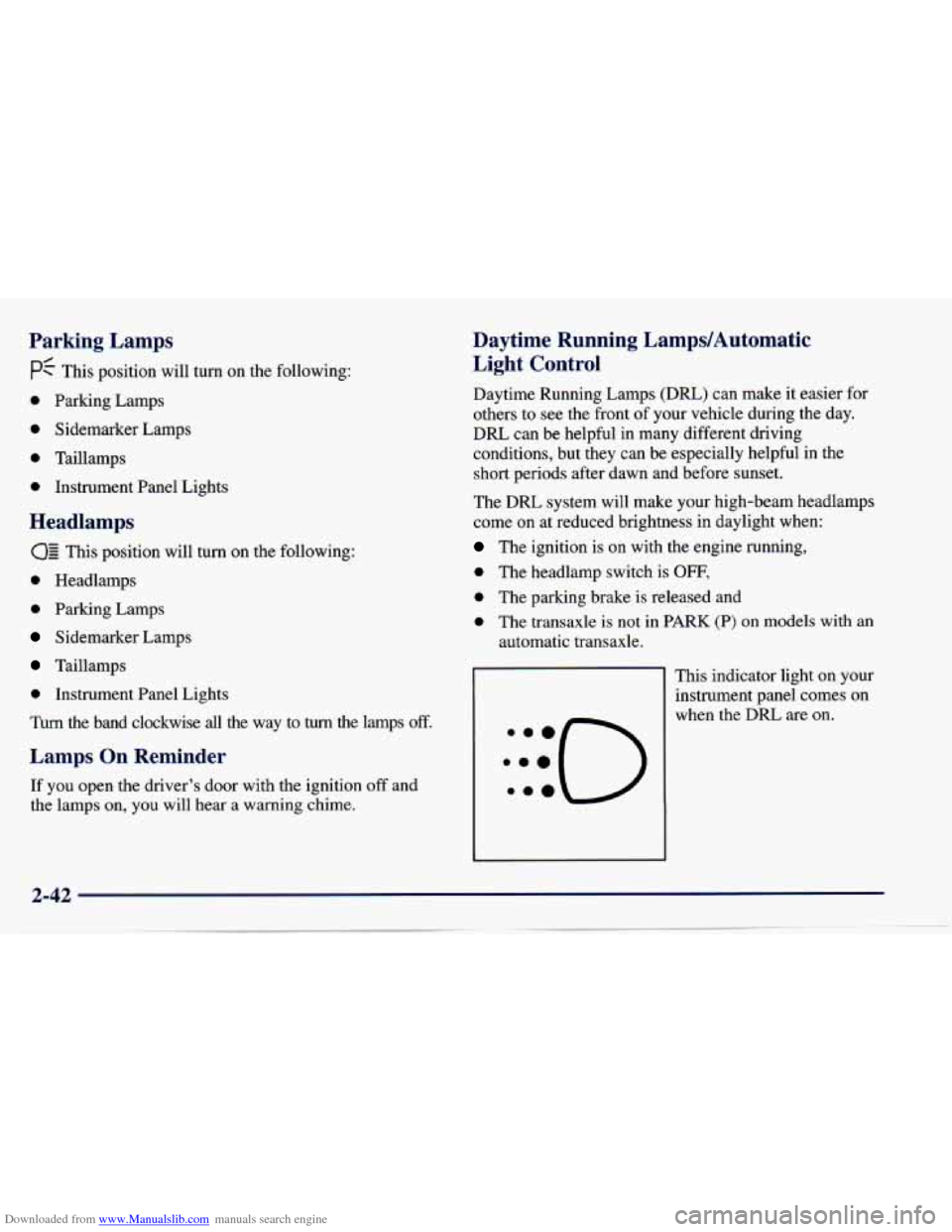
The DRL system will make your high-beam headlamps
come on at reduced brightness in daylight when:
The ignition is on with the engine running,
0 The headlamp switch is OFF,
0 The parking brake is released and
0 The transaxle is not in PARK (P) on models with an
automatic transaxle.
This indicator light on your
instrument panel comes on
when the DRL are on.
Page 102 of 388
Downloaded from www.Manualslib.com manuals search engine Interior Lamps
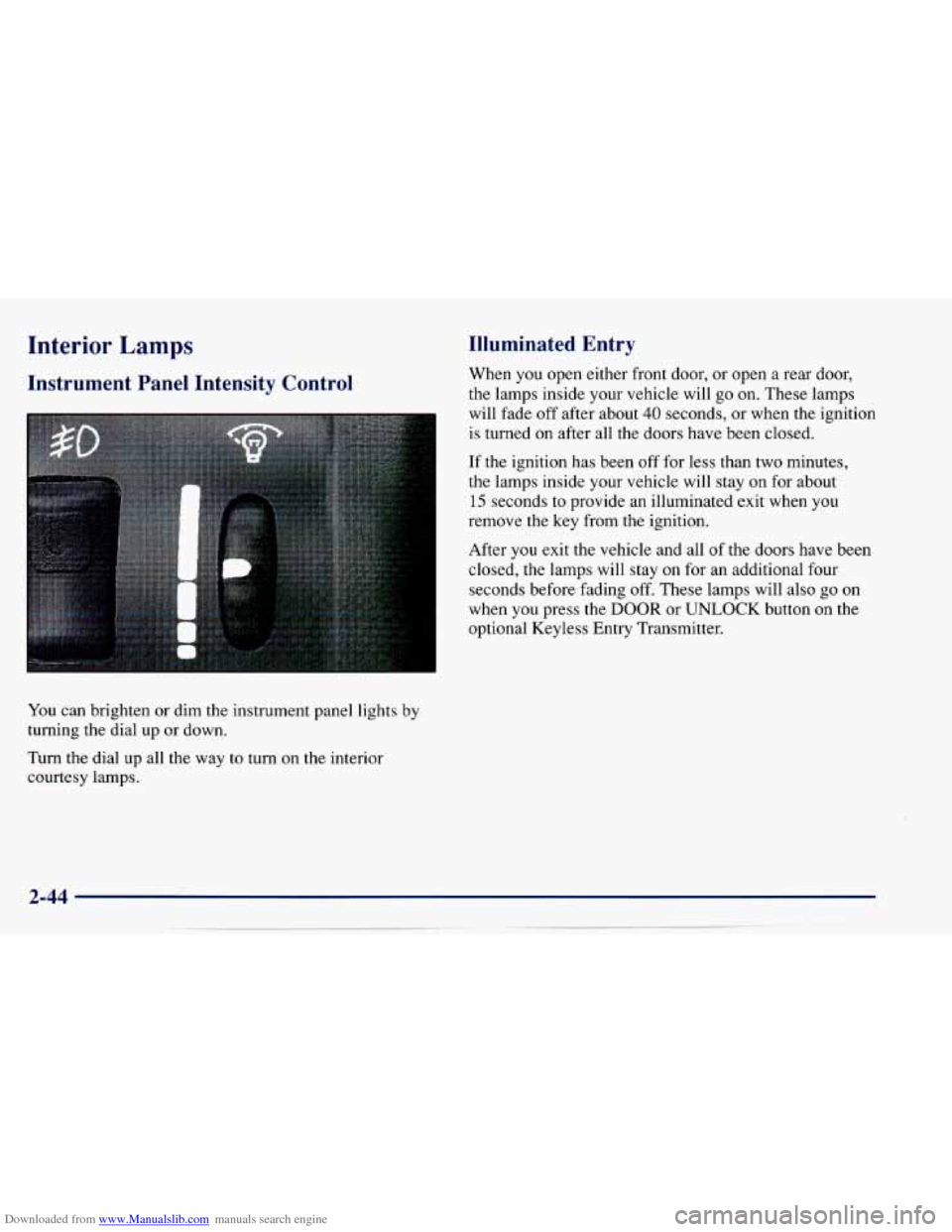
Instrument Panel Intensity Control
You can brighten or dim the instrument panel lights by
turning the dial up or down.
Turn the dial up all the way to turn on the interior
courtesy lamps.
Illuminated Entry
When you open either front door, or open a rear door,
the lamps inside your vehicle will
go on. These lamps
will fade off after about
40 seconds, or when the ignition
is turned on after all the doors have been closed.
If the ignition has been off for less than two minutes,
the lamps inside your vehicle will stay on for about
15 seconds to provide an illuminated exit when you
remove the key from the ignition.
After
you exit the vehicle and all of the doors have been
closed,
the lamps will stay on for an additional four
seconds before fading
off. These lamps will also go on
when you press the
DOOR or UNLOCK button on the
optional Keyless Entry Transmitter.
Page 122 of 388

Downloaded from www.Manualslib.com manuals search engine Instrument Panel Clusters
Your Chevrolet is equipped with one of these instrument panel clusters, which include indicator warning \
lights and
gages that are explained
on the following pages. Be sure to read about those that apply to the instrument panel cluster
for your vehicle.
Standard Cluster
Page 125 of 388
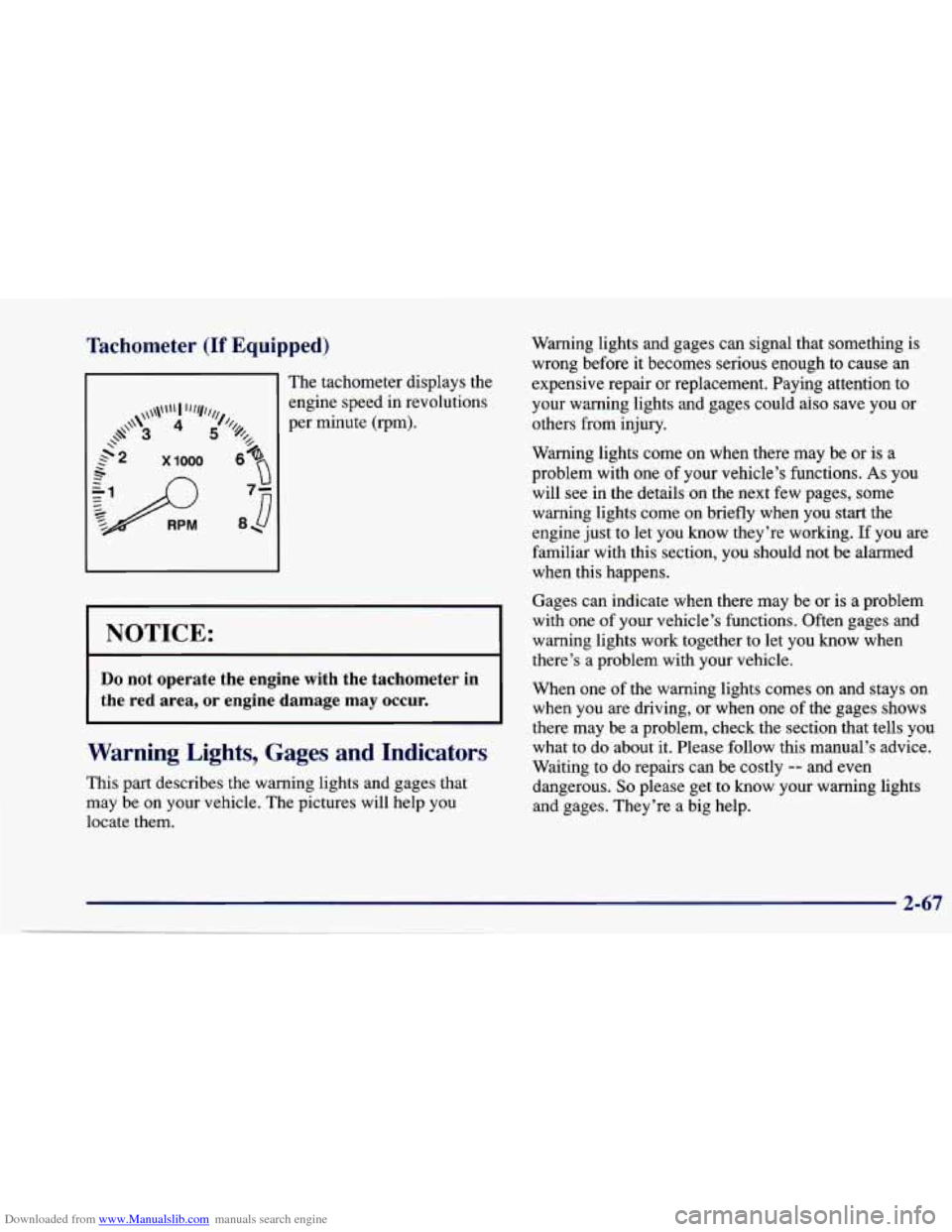
Downloaded from www.Manualslib.com manuals search engine Tachometer (If Equipped)
11 The tachometer displays the Warning lights and gages
can signal that something is
wrong before it becomes serious enough to cause an
expensive repair or replacement. Paying attention to
your warning lights and gages could ais0 save you or
others from injury.
Warning lights come on when there may be or is a
problem with one of your vehicle's functions.
As you
will see in the details on the next few pages, some
warning lights come on briefly when you start the
engine just to let you know they're working. If you are
familiar with this section, you should not be alarrned
when this happens.
Gages can indicate when there may be or is
a problem
with one of your vehicle's functions. Often gages and
warning lights work together to
let you know when
there's a problem with
your vehicle.
NOTICE:
-
I
Do not operate the engine with the tachometer in
the red area, or engine damage
may occur. I
When one of the warning lights comes on and stays on
when you are driving, or when one
of the gages shows I I there may be a problem, check the section that tells you
Warning Lights, Gages and Indicators
This part describes the warning lights and gages that
may be on your vehicle. The pictures will help
you
locate them. what to
do about
it. Please follow this manual's advice.
Waiting to do repairs can be costly
-- and even
dangerous. So please get to know your warning lights
and gages. They're a big help.
2-67
__
Page 179 of 388
Downloaded from www.Manualslib.com manuals search engine Night Vision
No one can see as well at night as in the daytime. But as
we get older these differences increase.
A 50-year-old
driver may require at least twice
as much light to see the
same thing at night as a 20-year-old.
What you
do in the daytime can also affect your night
vision. For example, if you spend the day in bright
sunshine you are wise to wear sunglasses. Your eyes will
have less trouble adjusting to night. But
if you’re
driving, don’t wear sunglasses at night. They may cut
down on glare from headlamps, but they also make a lot
of things invisible.
You can be temporarily blinded by approaching
headlamps. It can take a second
or two, or even several
seconds, for your eyes to readjust to the dark. When you
are faced with severe glare (as from a driver who
doesn’t lower the
high beams, or a vehicle with
misaimed headlamps), slow down
a little. Avoid staring
directly into the approaching headlamps. Keep your windshield and
all the glass on your vehicle
clean
-- inside and out. Glare at night is made much
worse by dirt
on the glass. Even the inside of the glass
can build up a film caused by dust. Dirty glass makes
lights dazzle and flash more than clean glass would,
making the pupils
of your eyes contract repeatedly.
Remember that your headlamps light up
far less of a
roadway when you are in
a turn or curve. Keep your
eyes moving; that way, it’s easier to pick out dimly
lighted objects. Just as your headlamps should be
checked regularly for proper aim,
so should your eyes
be examined regularly. Some drivers suffer from night
blindness
-- the inability to see in dim light -- and
aren’t even aware of it.
Page 267 of 388
Downloaded from www.Manualslib.com manuals search engine How to Check
You do not need to check the fluid level unless you
suspect
a clutch problem. To check the fluid level, take
the cap
off. If the fluid reaches the step inside the
reservoir, the fluid level
is correct.
Engine Coolant
The cooling system in your vehicle is filled
with DEX-COOL@ engine coolant. This coolant
is designed to remain in your vehicle for
5 years or
150,000 miles (240 000 km), whichever occurs first,
if you add only DEX-COOL@ extended life coolant.
The following explains your cooling system and how to add
coolant when it is low.
If you have a problem with engine
overheating, see “Engine Overheating”
in the Index.
A 50/50 mixture of water and DEX-COOL@ coolant will:
0 Give freezing protection down to -34°F (-37°C).
0 Give boiling protection up to 265 “F (129°C).
0 Protect against rust and corrosion.
0 Help keep the proper engine temperature.
Let the warning lights and gages work as
they should.
NOTICE:
I
When adding coolant, it is important that you
use only
DEX-COOL@ (silicate-free) coolant.
If coolant other than
DEX-COOL’ is added
to the system, premature engine, heater core or
radiator corrosion may result. In addition, the
engine coolant will require change sooner
-- at
30,000 miles (50 000 km) or 24 months, whichever
occurs
first. Damage caused by the use of coolant
other than
DEX-COOL@ is not covered by your
new vehicle warranty.