mirror CHEVROLET CAVALIER 1997 3.G Owners Manual
[x] Cancel search | Manufacturer: CHEVROLET, Model Year: 1997, Model line: CAVALIER, Model: CHEVROLET CAVALIER 1997 3.GPages: 388, PDF Size: 20 MB
Page 59 of 388
Downloaded from www.Manualslib.com manuals search engine 0 Section 2 Features and Controls
2-2
2-4
2-6
2-10 2-10
2-1 1
2-12
2-12
2- 14
2-
17
2-18
2-23
2-26
2-27
2-29 2-30
2-30
2-3 1
2-32 2-33
2-4
1
2-44
2-46
2-48
2-5 1
2-5 1
2-62
2-67 Parking Over Things That
Bum
Engine Exhaust
Running Your Engine While You’re Parked
(Automatic Transaxle)
Windows
Turn Signalhlultifunction Lever
Exterior Lamps
Interior Lamps
Mirrors Storage Compartments
Sunroof
(If Equipped)
Convertible Top
(If Equipped)
The Instrument Panel
-- Your
Information System
Warning Lights, Gages and Indicators
Here
you can learn about the many standard and optional features on your Chevrolet, and information
on starting,
shifting and braking. Also explained are the instrument panel and the warning systems that tell you
if everything is
working properly
-- and what to do if you have a problem.
Keys
Door Locks
Keyless Entry System (If Equipped)
Trunk
Theft
Passlock
New Vehicle “Break-In”
Ignition Positions Starting Your Engine
Engine Coolant Heater
(If Equipped)
Automatic Transaxle Operation
Manual Transaxle Operation
Parking Brake
Shifting Into PARK (P) (Automatic
Transaxle Models Only)
Shifting Out
of PARK (P)
(Automatic Transaxle)
2-1
Page 103 of 388
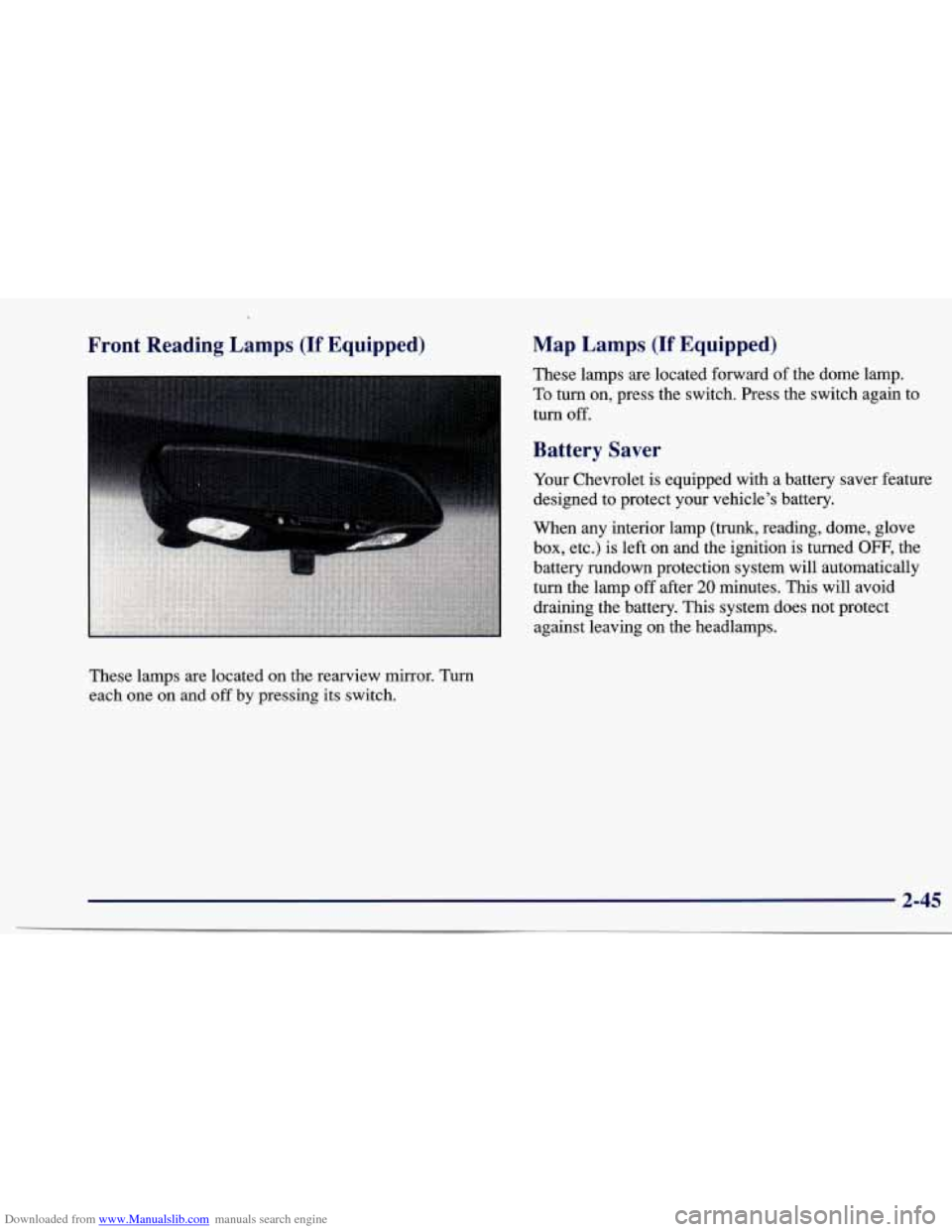
Downloaded from www.Manualslib.com manuals search engine Front Reading Lamps (If Equipped)
These lamps are located on the rearview mirror. Turn
each one on and off by pressing its switch.
Map Lamps (If Equipped)
These lamps are located forward of the dome lamp.
To turn on, press the switch. Press the switch again to
turn
off.
Battery Saver
Your Chevrolet is equipped with a battery saver feature
designed to protect your vehicle’s battery.
When any interior lamp (trunk, reading, dome, glove
box, etc.) is left on and the ignition is turned
OFF, the
battery rundown protection system will automatically
turn the lamp
off after 20 minutes. This will avoid
draining the battery. This system does not protect
against leaving on the headlamps.
2-45
Page 104 of 388
Downloaded from www.Manualslib.com manuals search engine To reactivate the interior lamps, either:
The ignition must be turned on,
The activated lamp switch must be turned off, then
A front door must be opened.
The battery rundown protection feature will also be
activated when any door
is left open.
If your vehicle is left with the ignition
off for over
24 days, the battery power to the clock and audio system
will turn off to reduce the battery drain. When the
ignition
is turned on again, battery power will be
resupplied. Under these conditions it will be necessary
to reset the clock and audio system settings. on,
OR
Mirrors
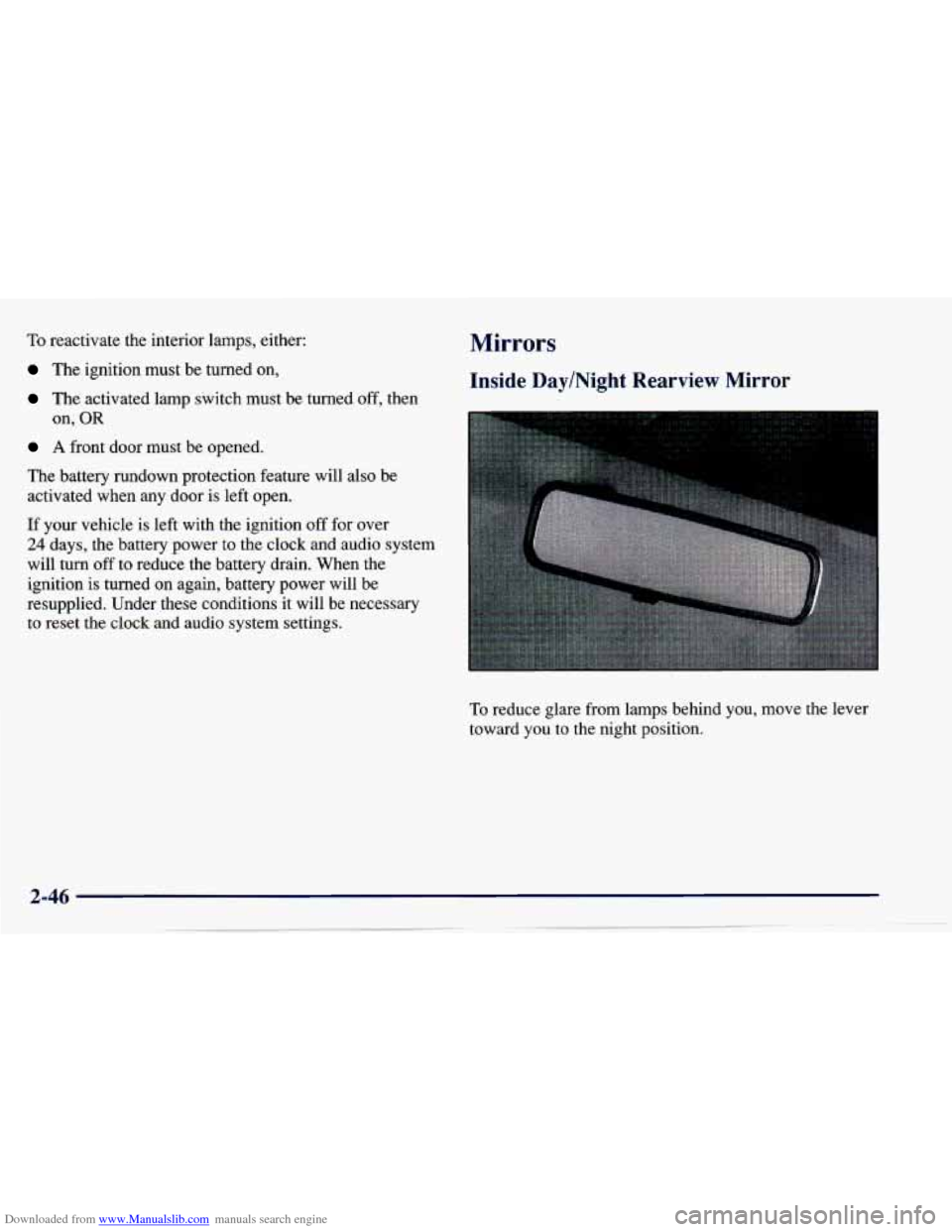
Inside Day/Night Rearview Mirror
To reduce glare from lamps behind you, move the lever
toward you to the night position.
Page 105 of 388
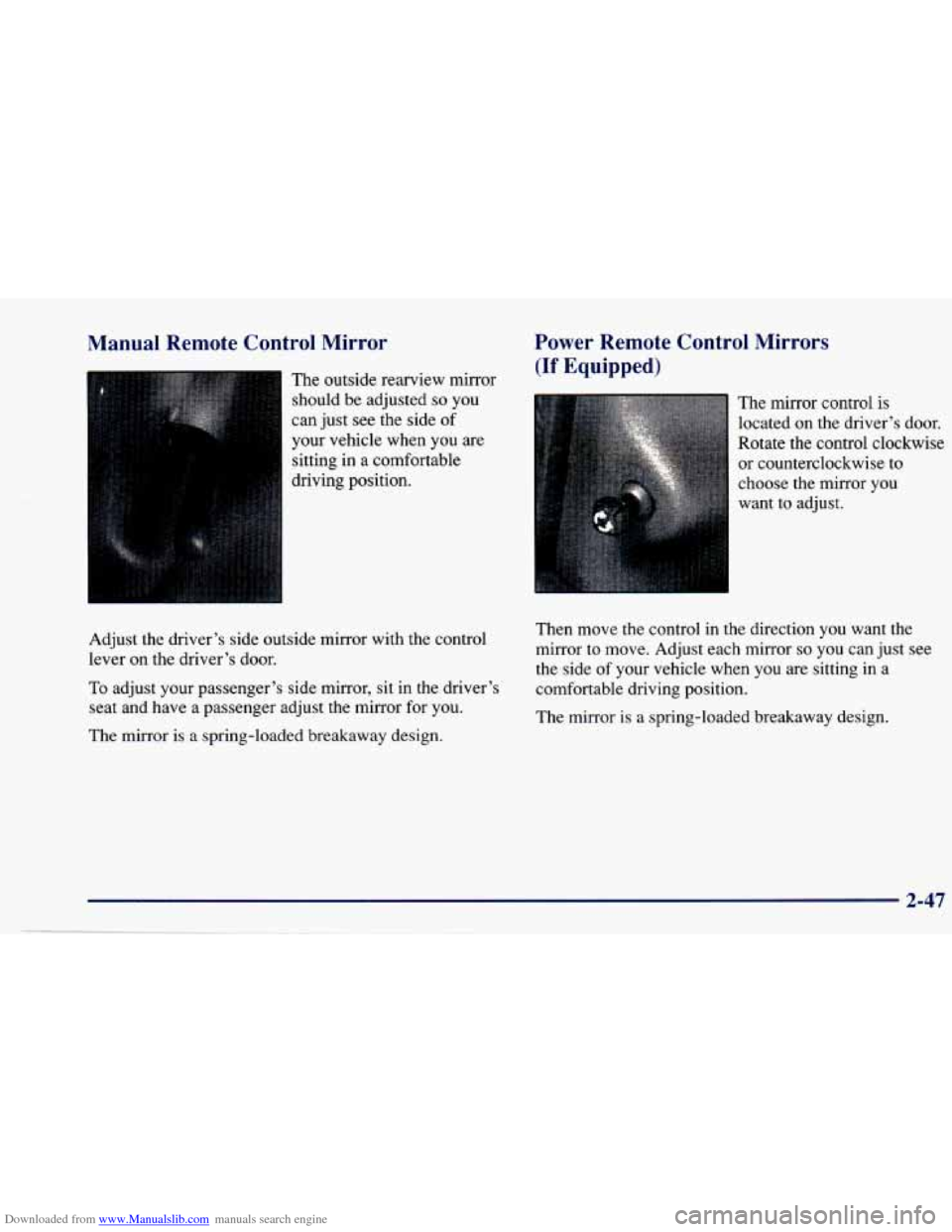
Downloaded from www.Manualslib.com manuals search engine Manual Remote Control Mirror
The outside rearview mirror
should be adjusted
so you
can just see the side of
your vehicle when you are
sitting in a comfortable
driving position.
Power Remote Control Mirrors
(If Equipped)
The mirror control is
located on the driver’s door.
Rotate the control clockwise
or counterclockwise to
choose the mirror you
want to adjust.
Adjust the driver’s side outside mirror with the control
lever on the driver’s door.
To adjust your passenger’s side mirror, sit in the driver’s
seat and have a passenger adjust the mirror for you.
The mirror is a spring-loaded breakaway design. Then move the control in the direction you want the
mirror
to move. Adjust each mirror
so you can just see
the side
of your vehicle when you are sitting in a
comfortable driving position.
The mirror is a spring-loaded breakaway design.
2-47
..
Page 106 of 388
Downloaded from www.Manualslib.com manuals search engine Convex Outside Mirror
Your passenger’s side mirror is convex. A convex
mirror’s surface is curved
so you can see more from the
driver’s seat.
Storage Compartments
Center Console Storage Area
A convex mirror can make things (like other
vehicles)
look farther away than they really are.
If you cut too sharply into the right lane, you
could hit
a vehicle on your right. Check your
inside mirror or glance over your shoulder before
changing lanes.
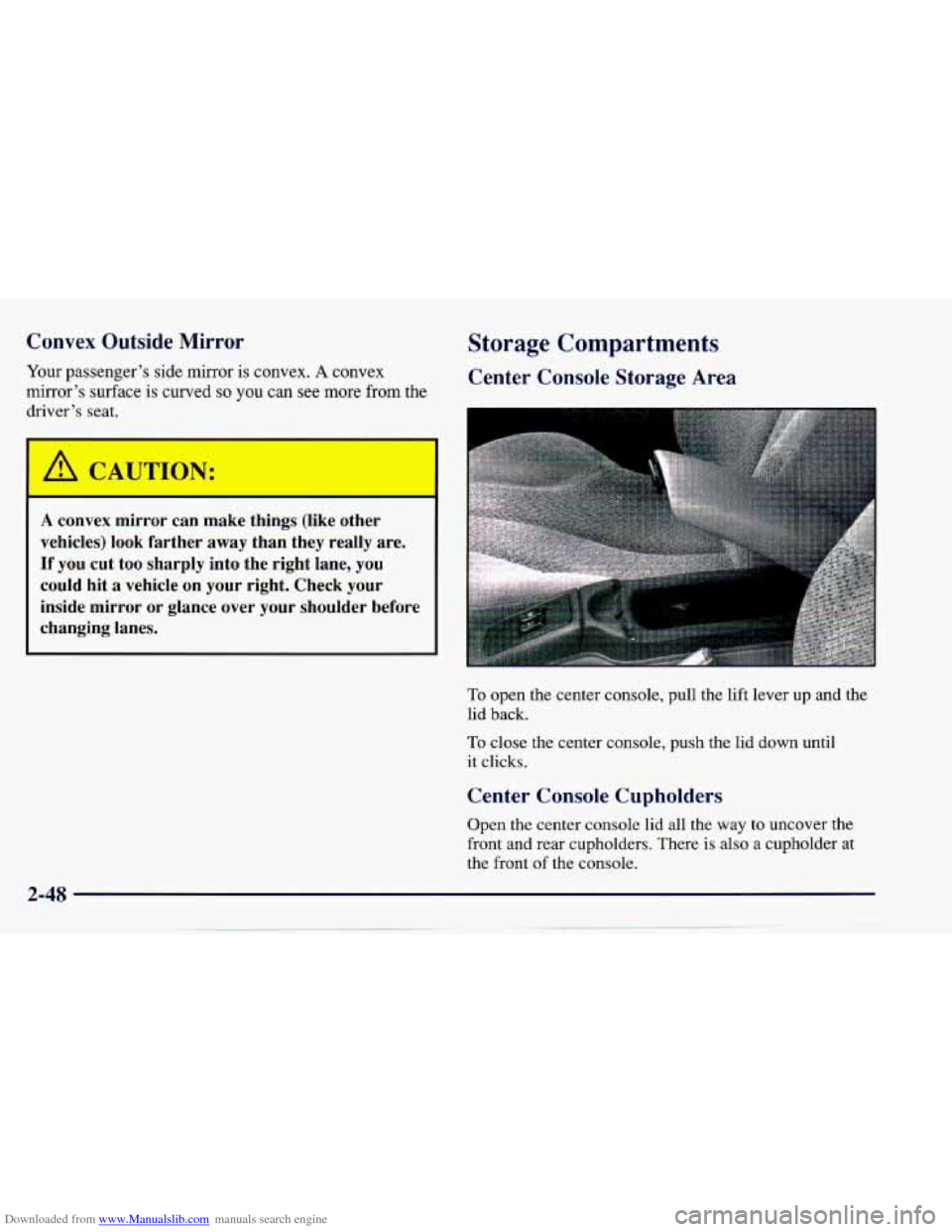
To open the center console, pull the lift lever up and the
lid back.
To close the center console, push the lid down until
it clicks.
Center Console Cupholders
Open the center console lid all the way to uncover the
front
and rear cupholders. There is also a cupholder at
the
front of the console.
Page 176 of 388
Downloaded from www.Manualslib.com manuals search engine Check your mirrors, glance over your shoulder, and
start your left lane change signal before moving out
of the right lane to pass. When you
are far enough
ahead of the passed vehicle to see its front in your
inside mirror, activate your right lane change signal
and move back into the right lane. (Remember that
your right outside mirror is convex. The vehicle you
just passed may seem
to be farther away from you
than it really is.)
Try not to pass more than one vehicle at a time on
two-lane roads. Reconsider before passing the
next vehicle.
0 Don’t overtake a slowly moving vehicle too rapidly.
Even though the brake lamps
are not flashing, it may
be slowing down or starting to turn.
following driver to get ahead of you. Perhaps you
can ease a little to the right.
If you’re being passed, make it easy for the
Loss of Control
Let’s review what driving experts say about what
happens when the three control systems (brakes, steering
and acceleration) don’t have enough friction where the
tires meet the road to do what the driver has asked.
In any emergency, don’t give up. Keep trying to steer and
constantly seek an escape route or area of less danger.
Skidding
In a skid, a driver can lose control of the vehicle.
Defensive drivers avoid most skids by taking reasonable
care suited to existing conditions, and by not
“overdriving” those conditions. But skids are always possible.
The three types of skids correspond
to your Chevrolet’s
three control systems. In the braking skid, your wheels aren’t rolling. In the steering or cornering skid, too
much speed or steering in a curve causes tires to slip and
lose cornering force. And in the acceleration skid,
too
much throttle causes the driving wheels to spin.
Page 177 of 388
Downloaded from www.Manualslib.com manuals search engine A cornering skid is best handled by easing your foot off
the accelerator pedal.
If you have the Enhanced Traction System, remember:
It helps avoid only the acceleration skid.
If you do not have the Enhanced Traction System, or if
the transaxle shift lever is not in the OVERDRIVE
(@)
position, then an acceleration skid is also best handled
by easing your foot off the accelerator pedal.
If your vehicle starts to slide, ease your foot off the
accelerator pedal and quickly steer the way you want the
vehicle to go. If you start steering quickly enough, your
vehicle may straighten out. Always be ready for a
second skid if it occurs.
Of course, traction is reduced when water, snow, ice,
gravel or other material is on the road. For safety, you’ll
want to slow down and adjust your driving to these
conditions.
It is important to slow down on slippery
surfaces because stopping distance will be longer and
vehicle control more limited. While
driving on a surface with reduced traction,
try
your best to avoid sudden steering, acceleration or
braking (including engine braking by shifting to a lower
gear). Any sudden changes could cause the tires to slide.
You may not realize the surface is slippery until your
vehicle is skidding. Learn to recognize warning
clues
-- such as enough water, ice or packed snow on
the road to make a “mirrored surface”
-- and slow
down when you have any doubt.
Remember: Any anti-lock brake system
(ABS) helps
avoid only the braking skid.
Page 178 of 388
Downloaded from www.Manualslib.com manuals search engine Driving at Night
4
.I .................. ” ..... ........ ...........
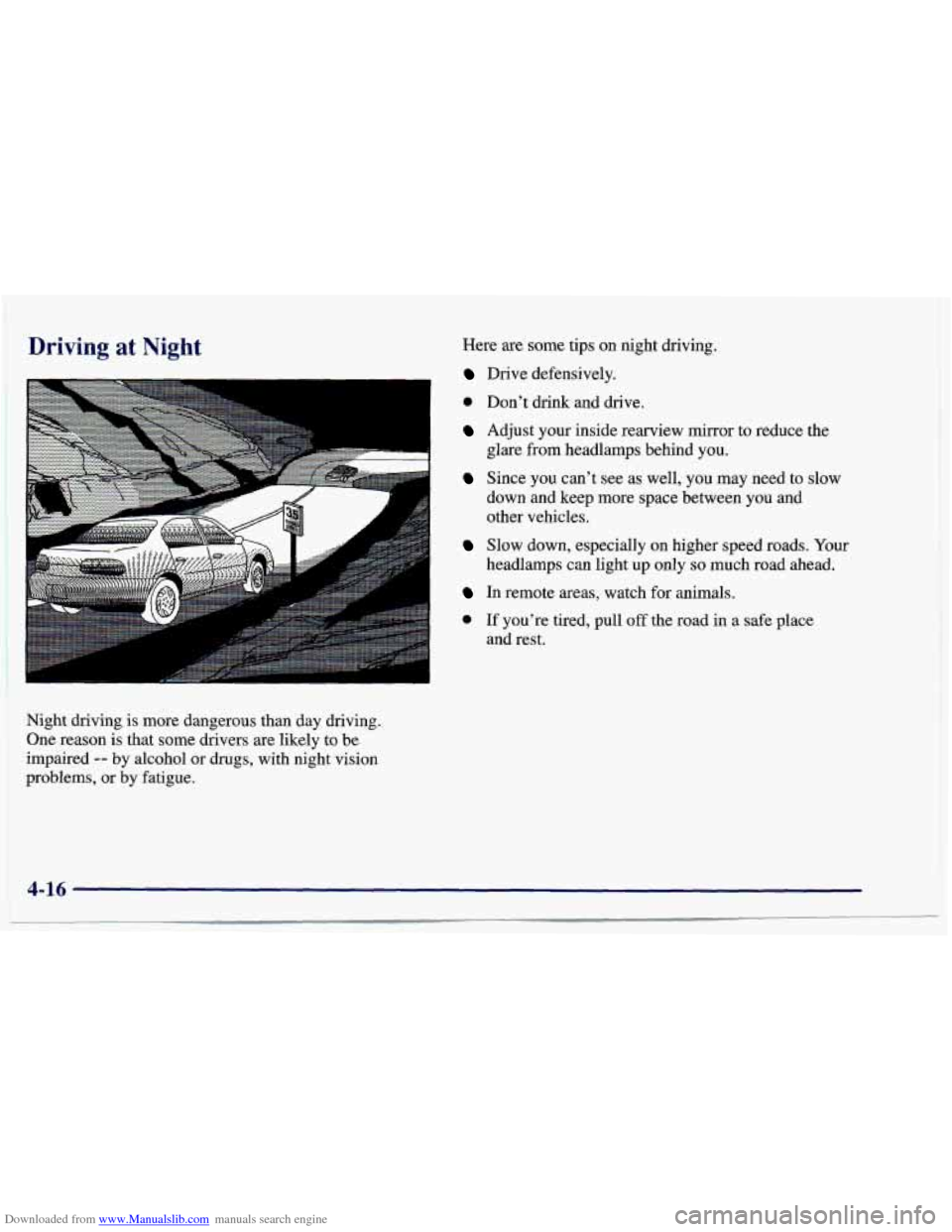
Here are some tips on night driving.
Drive defensively.
0 Don’t drink and drive.
Adjust your inside rearview mirror to reduce the
glare from headlamps behind you.
Since you can’t see as well, you may need to slow
“A
A down and keep more space between you and
other vehicles.
Slow down, especially on higher speed roads. Your
headlamps can light up only
so much road ahead.
In remote areas, watch for animals.
Night driving is more dangerous than day driving.
One reason is that some drivers
are likely to be
impaired
-- by alcohol or drugs, with night vision
problems,
or by fatigue.
0 If you’re tired, pull off the road in a safe place
and rest
.
4-15
Page 184 of 388
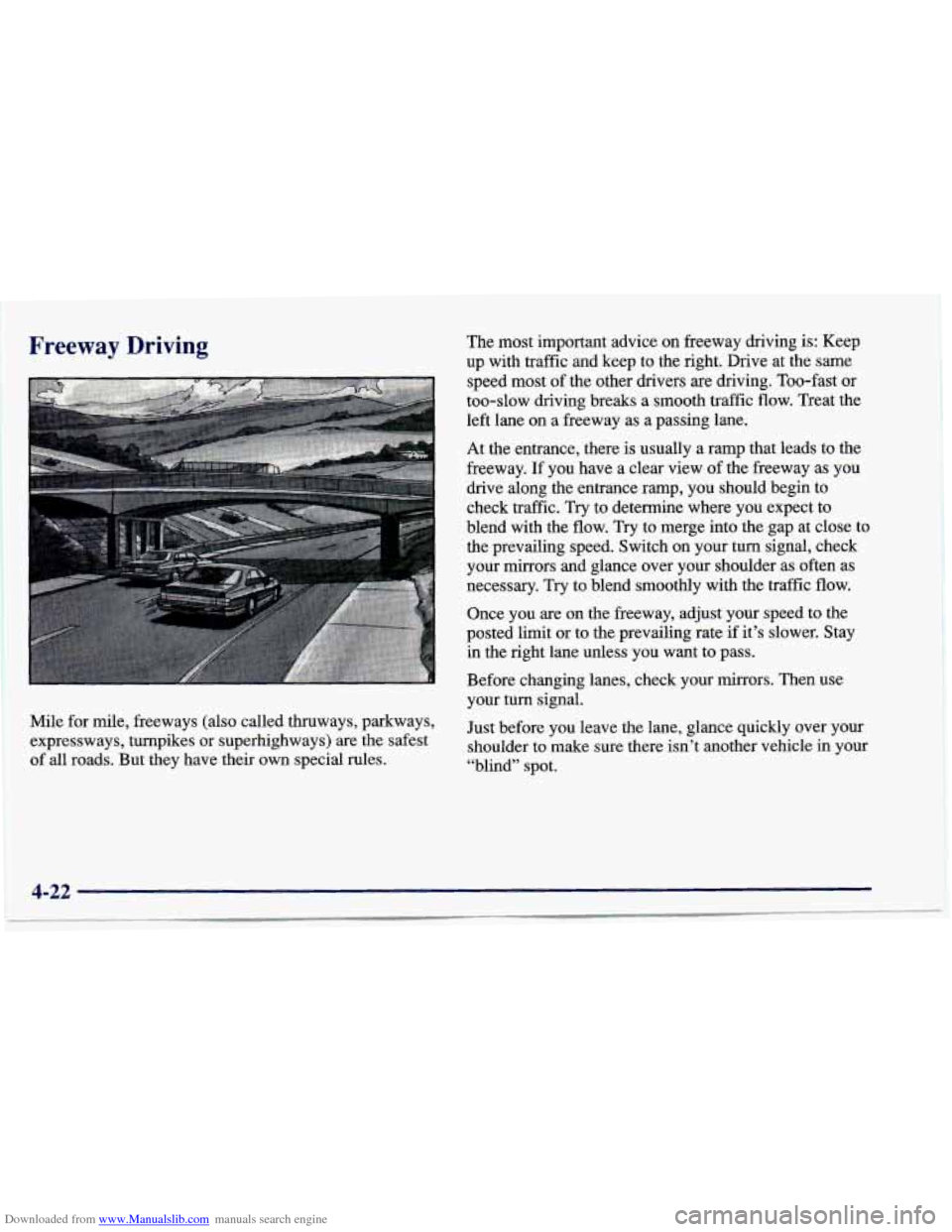
Downloaded from www.Manualslib.com manuals search engine Freeway Driving The most important advice on freeway driving is: Keep
up with traffic and keep
to the right. Drive at the same
speed most of the other drivers
are driving. Too-fast or
too-slow driving breaks a smooth traffic flow. Treat the
left lane on a freeway as
a passing lane.
At the entrance, there is usually a ramp that leads to the
freeway.
If you have a clear view of the freeway as you
drive along the entrance ramp, you should begin to check traffic. Try to determine where you expect to
blend with the flow. Try to merge into the gap at close to
the prevailing speed. Switch on your turn signal, check
your mirrors and glance over your shoulder as often as
necessary. Try to blend smoothly with the traffic flow.
Once you are on the freeway, adjust your speed to the
posted limit or to the prevailing rate if it’s slower. Stay
in the right lane unless you want to pass.
Before changing lanes, check your mirrors. Then
use
your turn signal.
for freeways thnxways7 parkways7 Just before you leave the lane, glance quickly over \
your
expressways7
Or are the safest shoulder to make sure there isn’t another vehicle in your
of all roads. But they have their own special rules. “blind” spot.
4-22
Page 186 of 388
Downloaded from www.Manualslib.com manuals search engine Highway Hypnosis
Is there actually such a condition as “highway hypnosis”?
Or is it just plain falling asleep at the wheel? Call it
highway hypnosis, lack of awareness, or whatever.
There
is something about an easy stretch of road with
the same scenery, along with the
hum of the tires on the
road, the drone
of the engine, and the rush of the wind
against the vehicle that can make you sleepy. Don’t let it
happen to you! If it does, your vehicle can leave the
road in
less than a second, and vou could crash and
be injured.
What can you
do about highway hypnosis? First, be
aware that it can happen.
Then here are some tips:
Make sure your vehicle is well ventilated, with a
comfortably cool interior.
Keep your eyes moving. Scan the road ahead and to
the sides. Check your rearview mirrors and your
instruments frequently.
If you get sleepy, pull off the road into a rest, service
or parking area and take a nap, get some exercise, or
both. For safety, treat drowsiness on the highway as
an emergencv.
Hill and Mountain Roads
Driving on steep hills or mountains is different from
driving in flat or rolling terrain.