radio CHEVROLET CAVALIER 1998 3.G Owner's Manual
[x] Cancel search | Manufacturer: CHEVROLET, Model Year: 1998, Model line: CAVALIER, Model: CHEVROLET CAVALIER 1998 3.GPages: 400, PDF Size: 20.74 MB
Page 175 of 400
Downloaded from www.Manualslib.com manuals search engine Unlocking the Theft-Deterrent Feature After a
Power
Loss
Enter your secret code as follows; pause no more than
15 seconds between steps:
1. LOC appears when the ignition is on.
2. Press MN and 000 will appear on the display.
3. Press MN again to make the last two digits agree
with your code.
with your code.
code matches the secret code you have written down.
The display will show
SEC, indicating the radio is
now operable and secure.
4. Press HR to make the first one or two digits agree
5. Press AM-FM after you have confirmed that the
If you enter the wrong code eight times,
INOP will
appear
on the display. You will have to wait an hour
with the ignition
on before you can try again. When you
try again, you will only have three chances to enter the
correct code before
INOP appears.
If you lose or forget your code, contact your dealer.
Disabling the Theft-Deterrent Feature
Enter your secret code as follows; pause no more than
15 seconds between steps:
1.
2.
3.
4.
5.
6.
7.
Turn the ignition to ACCESSORY or RUN.
Turn the radio off.
Press the 1 and 4 buttons together. Hold them down
until
SEC shows on the display.
Press
MN and 000 will appear on the display.
Press MN again to make the last two digits agree
with your code.
Press
HR to make the first one or two digits agree
with your code.
Press AM-FM after you have confirmed that the
code matches the secret code you have written down.
The display will show
---, indicating that the radio is
no longer secured.
If the code entered is incorrect, SEC will appear on the
display. The radio will remain secured until the correct
code
is entered.
When battery power is removed and later applied to a
secured radio, the radio won’t turn
on and LOC will
appear
on the display.
To unlock a secured radio, see “Unlocking the
Theft-Deterrent Feature After a Power
Loss’’ earlier
in this section.
3-21
Page 176 of 400
Downloaded from www.Manualslib.com manuals search engine Understanding Radio Reception
AM
The range for most AM stations is greater than for FM,
especially at night. The longer range, however, can
cause stations to interfere with each other.
AM can pick
up noise from things like storms and power lines. Try
reducing the treble to reduce this noise
if you ever get it.
FM Stereo
FM stereo will give you the best sound, but FM signals
will reach only about
10 to 40 miles (16 to 65 km). Tall
buildings or hills can interfere with
FM signals, causing
the sound to come and go.
Tips About Your Audio S m
Hearing damage from loud noise is almost undetectable
until it
is too late. Your hearing can adapt to higher
volumes of sound. Sound that seems normal
can be loud
and harmful to your hearing. Take precautions by
adjusting the volume control on your radio to a safe
sound level before your hearing adapts to it.
To help avoid hearing loss or damage:
Adjust the volume control to the lowest setting.
NOTICE:
Before you add any sound equipment to your
vehicle
-- like a tape player, CB radio, mobile
telephone or two-way radio
-- be sure you can
add what you want.
If you can, it’s very
important to do it properly. Added sound
equipment may interfere with the operation of
your vehicle’s engine, Delco Electronics radio or
other systems, and even damage them. Your
vehicle’s systems may interfere with the
operation of sound equipment that has been
added improperly.
So, before adding sound equipment, check with
your dealer and be sure to check Federal rules
covering mobile radio and telephone units.
Increase volume slowly until you hear comfortably
and clearly.
Page 177 of 400
Downloaded from www.Manualslib.com manuals search engine Care of Your Cassette Tape Player
A tape player that is not cleaned regularly can cause
reduced sound quality, ruined cassettes or a damaged
mechanism. Cassette tapes should be stored in their
cases away from contaminants, direct sunlight and
extreme heat.
If they aren’t, they may not operate
properly or may cause failure of the tape player.
Your tape player should be cleaned regularly after every
50 hours of use. Your radio may display CLN to indicate
that you have used your tape player for
50 hours without
resetting the tape clean timer. If this message appears on
the display, your cassette tape player needs to be
cleaned. It will still play tapes, but you should clean it as
soon as possible to prevent damage to your tapes and
player. If you notice a reduction in sound quality, try a
known good cassette to see if it is the tape or the tape
player at fault. If this other cassette has no improvement
in sound quality, clean the tape player.
The recommended cleaning method for your cassette
tape player is the use
of a scrubbing action,
non-abrasive cleaning cassette with pads which scrub
the tape head as the hubs of the cleaner cassette turn.
The recommended cleaning cassette is available through
your dealership
(GM Part No. 12344789).
When using a scrubbing action, non-abrasive cleaning
cassette, it is normal for the cassette to eject because
your unit is equipped with
a cut tape detection feature
and a cleaning cassette may appear as a broken tape. To
prevent the cleaning cassette from being ejected, use the
following steps.
If your vehicle
is equipped with the AM-FM Stereo with
Cassette Tape Player:
1. Turn the ignition to RUN or ACCESSORY.
2. Turn the radio on.
3. Insert the scrubbing action cleaning cassette.
4. Within five seconds, press and hold the REV and
FWD buttons at the same time for three seconds. The
tape symbol on the display will flash, showing that
the cut tape detection feature is
no longer active.
5. Eject the cleaning cassette after the manufacturer’s
recommended cleaning time.
If your vehicle is equipped with the
AM-FM Stereo with
Cassette Tape Player and Automatic Tone Control:
1. Turn the ignition to RUN or ACCESSORY.
2. Turn the radio off.
3-23
Page 178 of 400
Downloaded from www.Manualslib.com manuals search engine 3. Press and hold the TAPE AUX button for five
seconds. The tape symbol on the display will flash
for two seconds.
4. Insert the scrubbing action cleaning cassette.
5. Eject the cleaning cassette after the manufacturer’s
recommended cleaning time.
When the cleaning cassette has been ejected, the cut tape
detection feature is active again.
You may also choose a non-scrubbing action, wet-type
cleaner which uses a cassette with a fabric belt to clean
the tape head. This type of cleaning cassette will not
eject on its own.
A non-scrubbing action cleaner may
not clean
as thoroughly as the scrubbing type cleaner.
The use of a non-scrubbing action, dry-type cleaning
cassette
is not recommended.
After you clean the player, press and hold EJECT for
five seconds to reset the
CLN indicator. The radio will
display
--- to show the indicator was reset.
Cassettes are subject to wear and the sound quality
may degrade over time. Always make sure the cassette
tape is in good condition before you have your tape
player serviced.
Care of Your Compact Discs
Handle discs carefully. Store them in their original cases
or other protective cases and away from direct sunlight
and dust. If the surface of a disc is soiled, dampen a
clean, soft cloth in a mild, neutral detergent solution and
clean it, wiping from the center to the edge.
Be sure never
to touch the signal surface when handling
discs. Pick up discs by grasping the outer edges or the
edge of the hole and the outer edge.
Care of Your Compact Disc Player
The use of CD lens cleaner discs is not advised, due to
the risk of contaminating the lens of the CD optics with
lubricants internal to the CD mechanism.
Fixed Mast Antenna
The fixed mast antenna can withstand most car washes
without being damaged. If the mast should ever become
slightly bent, you can straighten it out by hand. If the
mast is badly bent, as it might be by vandals, you should
replace it.
Check every once in a while to be sure the mast is still
tightened to the fender.
3-24
Page 226 of 400
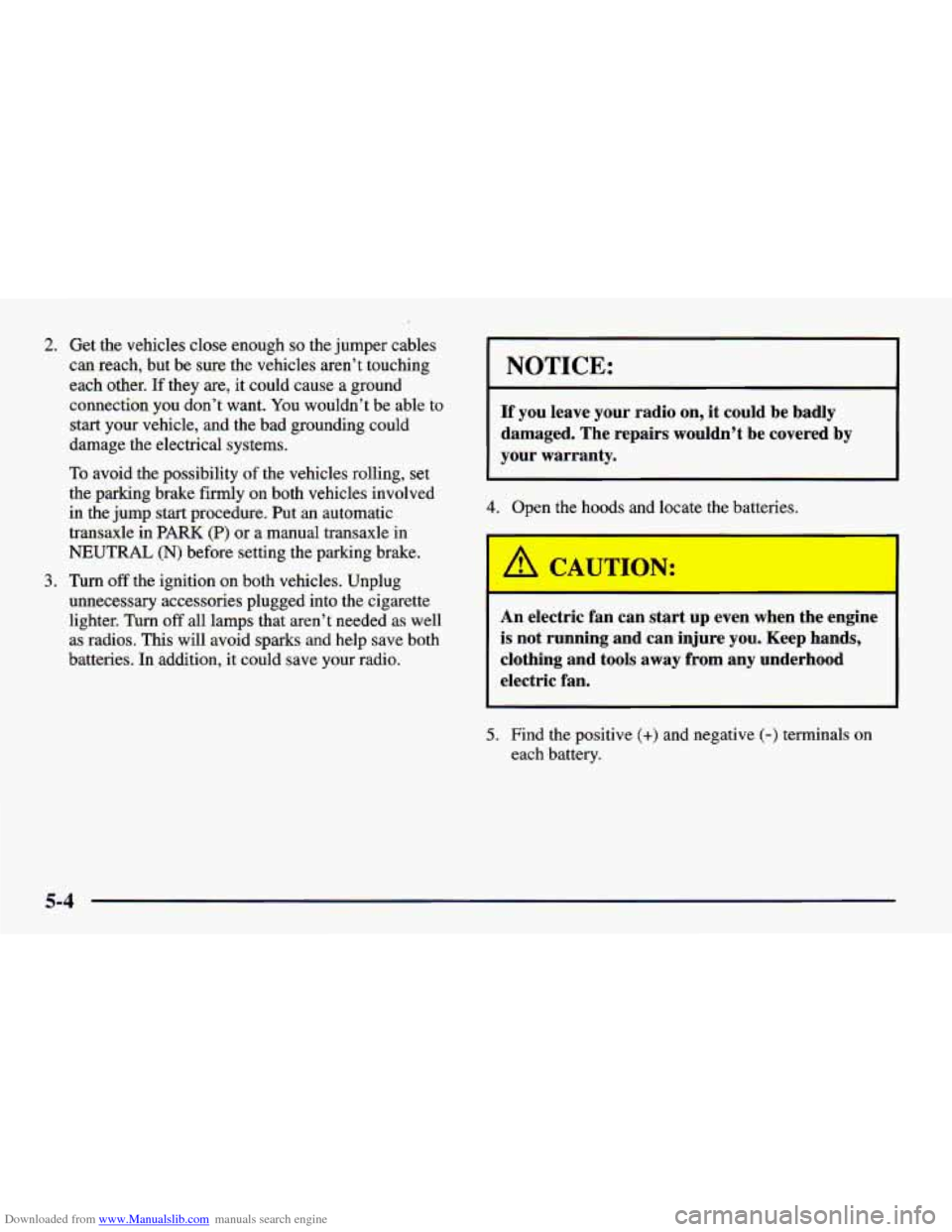
Downloaded from www.Manualslib.com manuals search engine 2. Get the vehicles close enough so the jumper cables
can reach, but be sure the vehicles aren’t touching
each other. If they are, it could cause a ground
connection
you don’t want. You wouldn’t be able to
start your vehicle, and the bad grounding could
damage the electrical systems.
To avoid the possibility
of the vehicles rolling, set
the parking brake firmly on both vehicles involved
in the jump start procedure. Put an automatic
transaxle in
PARK (P) or a manual transaxle in
NEUTRAL (N) before setting the parking brake.
unnecessary accessories plugged into the cigarette lighter. Turn
off all lamps that aren’t needed as well
as radios.
This will avoid sparks and help save both
batteries. In addition, it could save your radio.
3. Turn off the ignition on both vehicles. Unplug
I 1
NOTICE:
If you leave your radio on, it could be badly
damaged. The repairs wouldn’t be covered by
your warranty.
4. Open the hoods and locate the batteries.
I
An electric fan can start up even when me engine is not running and can injure you. Keep hands,
clothing and tools away from any underhood
electric fan.
5. Find the positive (+) and negative (-) terminals on
each battery.
5-4
Page 317 of 400
Downloaded from www.Manualslib.com manuals search engine Fuses and Circuit Breakers
The wiring circuits in your vehicle are protected from
short circuits by a combination of fuses, circuit breakers
and fusible thermal links. This greatly reduces the
chance of damage caused by electrical problems.
Look at the silver-colored band inside the fuse. If the
band is broken or melted, replace the fuse.
Be sure you
replace a bad fuse with a new one of the identical size
and rating.
If you ever have a problem on the road and don’t have a
spare fuse, you can borrow one that has the same
amperage. Just pick some feature of your vehicle that
you can get along without
-- like the radio or cigarette
lighter
-- and use its fuse if it is the correct amperage.
Replace it as soon
as you can.
There are two fuse blocks in your vehicle: the
instrument panel
fuse block and the engine compartment
fuse block.
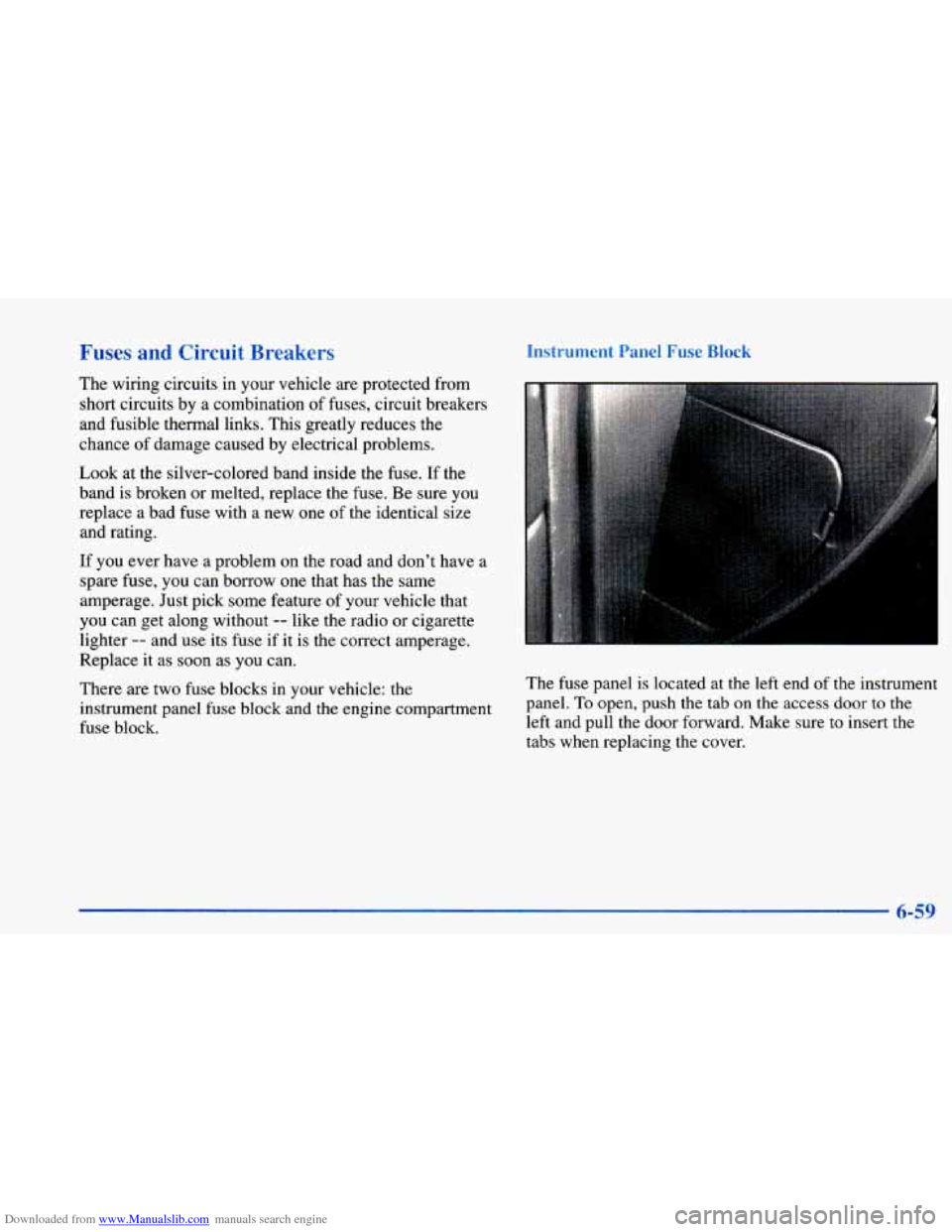
Instrument Panel Fuse Block
The fuse panel is located at the left end of the instrument
panel.
To open, push the tab on the access door to the
left and pull the door forward.
Make sure to insert the
tabs when replacing the cover.
6-59
Page 319 of 400
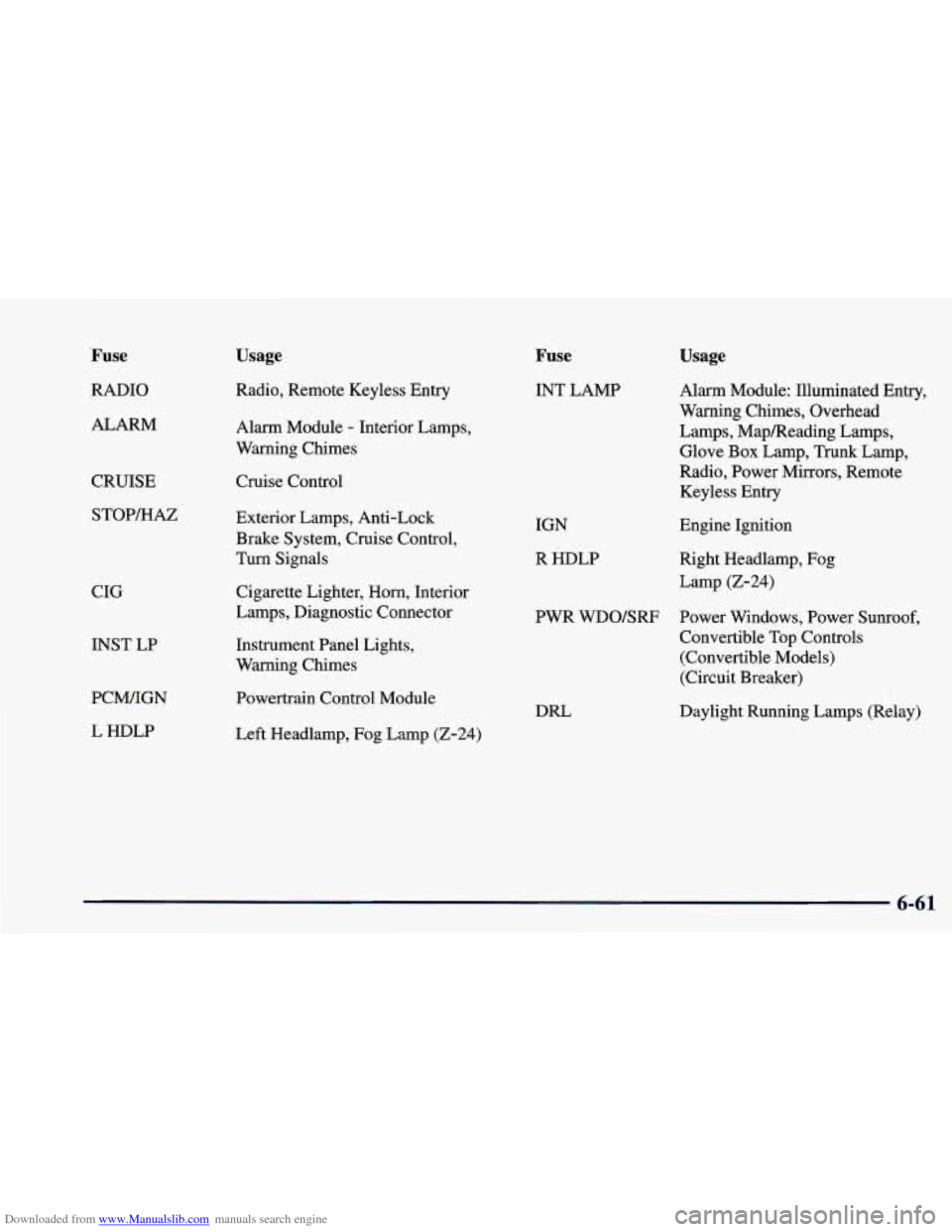
Downloaded from www.Manualslib.com manuals search engine Fuse
RADIO
ALARM CRUISE STOP/HAZ
CIG
INST LP
PCM/IGN
L HDLP
Usage
Radio, Remote Keyless Entry
Alarm Module
- Interior Lamps,
Warning Chimes
Cruise Control
Exterior Lamps, Anti-Lock
Brake System, Cruise Control,
Turn Signals Cigarette Lighter,
Horn, Interior
Lamps, Diagnostic Connector
Instrument Panel Lights,
Warning Chimes
Powertrain Control Module
Left Headlamp, Fog Lamp
(2-24)
Fuse
INT LAMP
IGN
R HDLP
Usage
Alarm Module: Illuminated Entry,
Warning Chimes, Overhead
Lamps, MapReading Lamps,
Glove Box Lamp, Trunk Lamp,
Radio, Power Mirrors, Remote Keyless
Entry
Engine Ignition
Right Headlamp, Fog
Lamp
(2-24)
PWR WDO/SRF Power Windows, Power Sunroof,
Convertible Top Controls
(Convertible Models)
(Circuit Breaker)
DRL Daylight Running Lamps (Relay)
6-61
Page 383 of 400
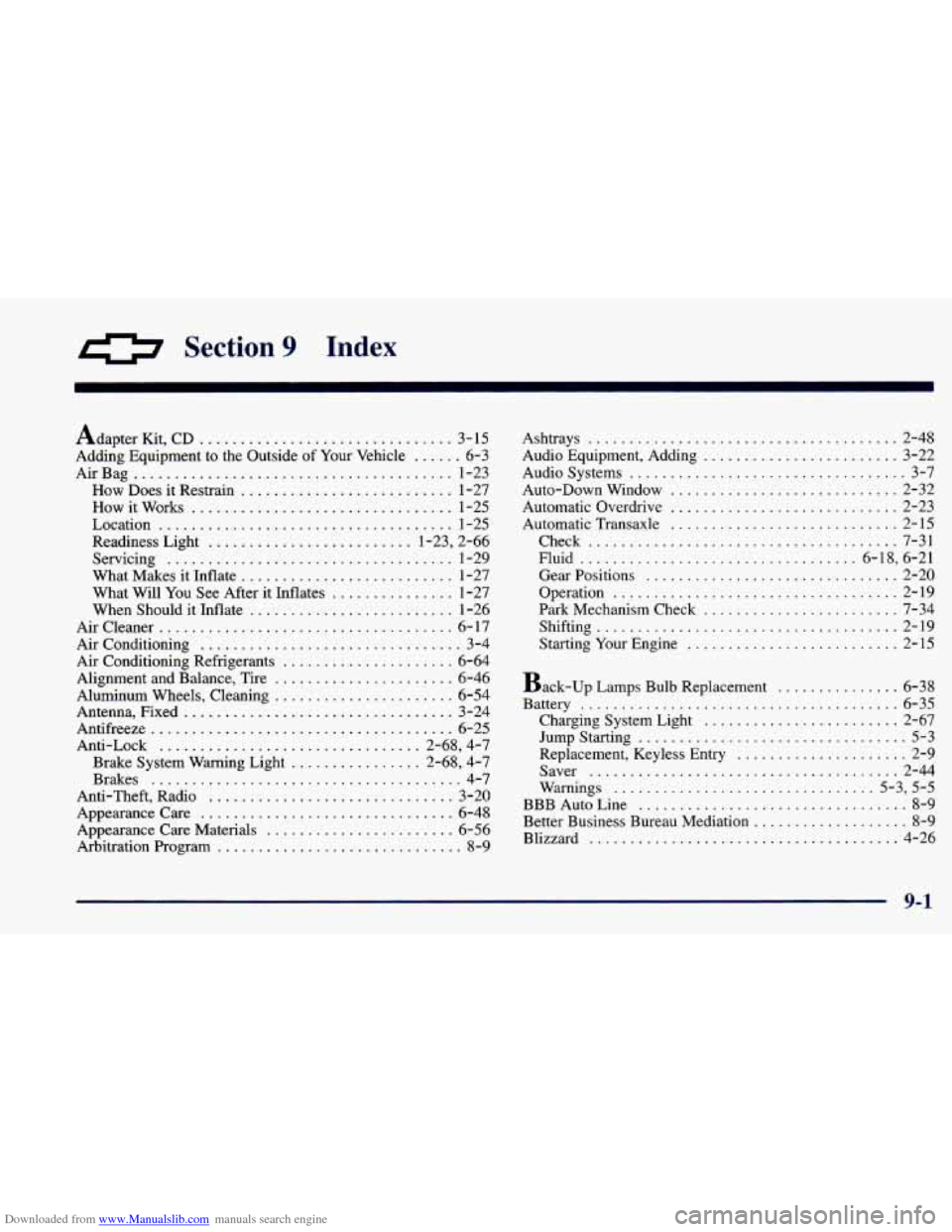
Downloaded from www.Manualslib.com manuals search engine 0 Section 9 Index
Adapter Kit. CD ............................... 3- 15
Adding Equipment to the Outside of Your Vehicle
...... 6-3
AirBag
....................................... 1-23
How Does it Restrain .......................... 1-27
How it Works ................................ 1-25
Location
.................................... 1-25
Readiness Light
......................... 1-23, 2-66
What Makes it Inflate
.......................... 1-27
What Will You See After it Inflates
............... 1-27
When Should it Inflate
......................... 1-26
Aircleaner
.................................... 6-17
Air Conditioning
................................ 3-4
Air Conditioning Refrigerants
..................... 6-64
Alignment and Balance, Tire
...................... 6-46
Aluminum Wheels, Cleaning
...................... 6-54
Antenna, Fixed
................................. 3-24
Antifreeze
..................................... 6-25
Anti-Lock
................................ 2-68, 4-7
Brake System Warning Light
................ 2-68, 4-7
Brakes
...................................... 4-7
Anti-Theft, Radio
.............................. 3-20
Appearancecare
............................... 6-48
Appearance Care Materials
....................... 6-56
Arbitration Program
.............................. 8-9
Servicing
................................... 1-29
Ashtrays
...................................... 2-48
Audio Systems
.................................. 3-7
Auto-Down Window
............................ 2-32
Automatic Overdrive
............................ 2-23
Automatic Transaxle
............................ 2-15
Check
...................................... 7-31
Fluid
.................................. 6-18, 6-21
Gear Positions
............................... 2-20
Operation
................................... 2-19
Park Mechanism Check
........................ 7-34
Shifting
..................................... 2-19
Starting Your Engine
.......................... 2-15
Audio Equipment. Adding
........................ 3-22
Back-up Lamps Bulb Replacement
............... 6-38
Battery
....................................... 6-35
Charging System Light
........................ 2-67
Jump Starting
................................. 5-3
Replacement. Keyless Entry
..................... 2-9
Saver
...................................... 2-44
Warnings
................................ 5-3, 5-5
BBB Auto Line ................................. 8-9
Better Business Bureau Mediation
................... 8-9
Blizzard
...................................... 4-26
9-1
Page 390 of 400
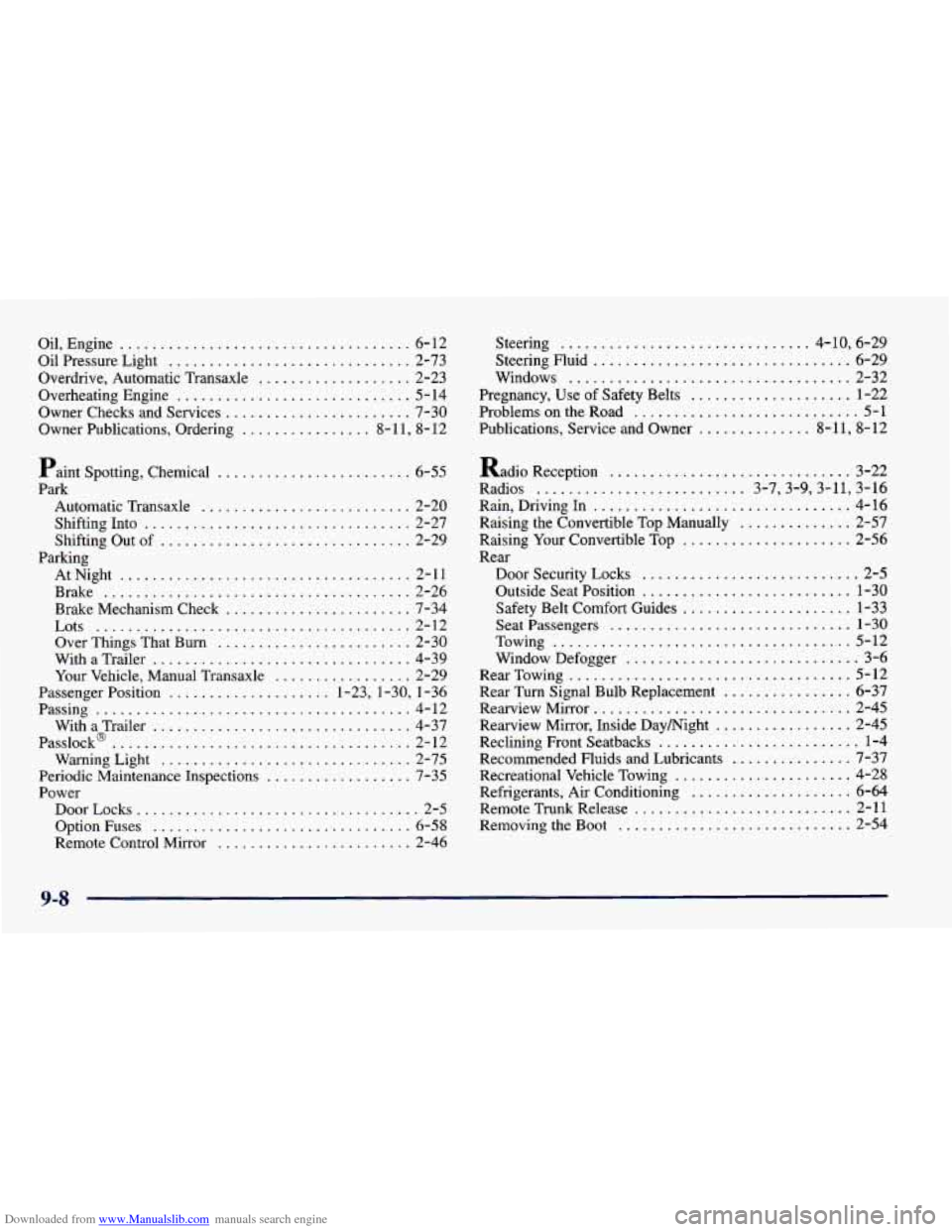
Downloaded from www.Manualslib.com manuals search engine Oil. Engine .................................... 6-12
Oil Pressure Light
.............................. 2-73
Overdrive, Automatic Transaxle
................... 2-23
Overheating Engine
............................. 5- 14
Owner Checks and Services ....................... 7-30
Owner Publications. Ordering
................ 8-1 1, 8-12
Paint Spotting. Chemical
........................ 6-55
Park
Automatic Transaxle
.......................... 2-20
Shifting Into
................................. 2-27
Shifting Out of
............................... 2-29
Parking AtNight
.................................... 2-11
Brake
...................................... 2-26
Brake Mechanism Check
....................... 7-34
Lots
....................................... 2- 12
Over Things That Burn
........................ 2-30
With a Trailer
................................ 4-39
Your Vehicle, Manual Transaxle
................. 2-29
Passenger Position
.................... 1-23, 1-30. 1-36
With
a Trailer ................................ 4-37
Passlock@
..................................... 2-12
Warning Light
............................... 2-75
Periodic Maintenance Inspections
.................. 7-35
Power
DoorLocks
................................... 2-5
Option Fuses ................................ 6-58
Remote Control Mirror ........................ 2-46
Passing
....................................... 4-12 Steering
............................... 4- 10. 6.29
Steering Fluid
................................ 6-29
Windows
................................... 2-32
Pregnancy, Use of Safety Belts
.................... 1-22
Problems on the Road
............................ 5-1
Publications, Service and Owner
.............. 8- 11, 8- 12
Radio Reception .............................. 3-22
Radios
.......................... 3.7.3.9.3.11. 3.16
Rain. Driving In ................................ 4-16
Raising the Convertible Top Manually
.............. 2-57
Raising Your Convertible Top
..................... 2-56
Rear Door Security Locks
........................... 2-5
Outside Seat Position
.......................... 1-30
Safety Belt Comfort Guides
..................... 1-33
Seatpassengers .............................. 1-30
Towing
..................................... 5-12
Window Defogger
............................. 3-6
RearTowing
................................... 5-12
Rear Turn Signal Bulb Replacement
................ 6-37
Rearview Mirror ................................ 2-45
Reclining Front Seatbacks
......................... 1-4
Recommended Fluids and Lubricants
............... 7-37
Recreational Vehicle Towing
...................... 4-28
Refrigerants. Air Conditioning
.................... 6-64
Remote Trunk Release
........................... 2-11
Removing the Boot
............................. 2-54
Rearview Mirror,
Inside Daymight
................. 2-45
9-8