lock CHEVROLET CAVALIER 1998 3.G Repair Manual
[x] Cancel search | Manufacturer: CHEVROLET, Model Year: 1998, Model line: CAVALIER, Model: CHEVROLET CAVALIER 1998 3.GPages: 400, PDF Size: 20.74 MB
Page 245 of 400
Downloaded from www.Manualslib.com manuals search engine If a Tire Goes Flat Changing a Flat Tire
It’s unusual for a tire to “blow out” while you’re driving,
especially if you maintain your tires properly. If air goes
out
of a tire, it’s much more likely to leak out slowly.
But if you should ever have a “blowout,” here are a few
tips about what to expect and what to do:
If a front tire fails, the flat tire will create a drag that
pulls the vehicle toward that side. Take your foot
off the
accelerator pedal and grip the steering wheel firmly. Steer to maintain lane position, and then gently brake to
a stop well out of the traffic lane.
A rear blowout, particularly on a curve, acts much like a
skid and may require the same correction you’d use in a
skid. In any rear blowout, remove your foot from the
accelerator pedal. Get the vehicle under control by
steering the way you want the vehicle to go.
It may be
very bumpy and noisy, but you can still steer. Gently
brake to a stop
-- well off the road if possible.
If a tire goes flat, the next part shows how to use your
jacking equipment to change a flat tire safely.
If a tire goes flat, avoid further tire and wheel damage
by driving slowly to a level place. Turn on your hazard w--+q- ‘?ashers.
I
Changing a tire can cause an injury. The vehicle
can slip
off the jack and roll over you or other
people. You and they could be badly injured.
Find
a level place to change your tire. To help
prevent the vehicle from moving:
1. Set the parking brake firmly.
2. Put an automatic transaxle shift lever in
PARK (P), or shift a manual transaxle to
FIRST (1) or REVERSE (R).
3. nrn off the engine.
To be even more certain the vehicle won’t move,
you can put blocks
at the front and rear of the
tire farthest away from the one being changed.
That would be the tire on the other side
of the
vehicle,
at the opposite end.
5-23
Page 264 of 400
Downloaded from www.Manualslib.com manuals search engine If you get gasoline on yourself and then
something ignites it, you could be badly burned.
Gasoline can spray out on you
if you open the
fuel filler cap too quickly.
This spray can happen
if your tank is nearly full, and is more likely in
hot weather. Open the fuel filler cap slowly and
wait for any “hiss” noise to stop. Then unscrew
the cap all the
way.
~~ ~ ~ ~~~~ ~ ~ ~~ ~~~~ ~~
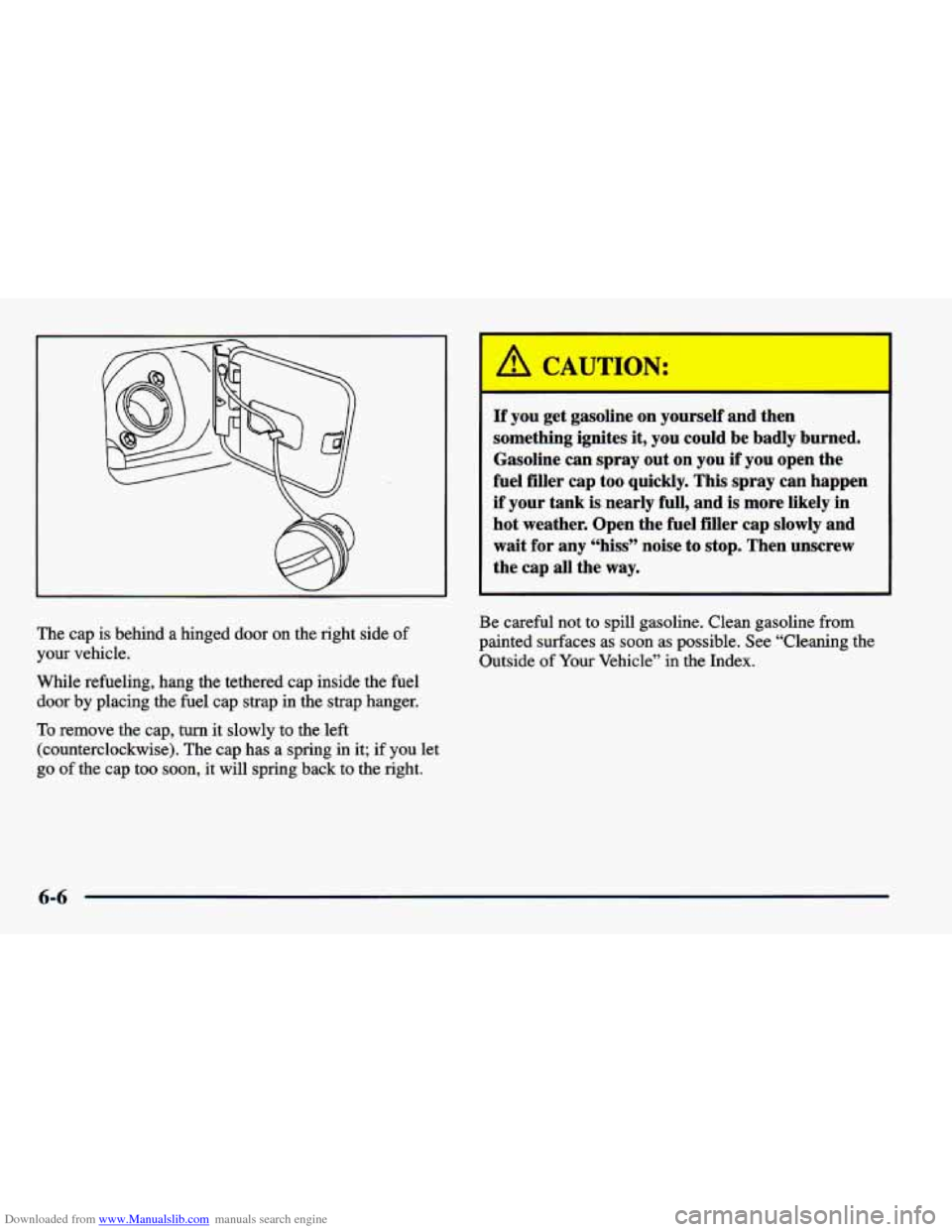
The cap is behind a hinged door on the right side of
your vehicle.
While refueling, hang the tethered cap inside the fuel door by placing the fuel cap strap in the strap hanger.
To remove the cap, turn it slowly to the left
(counterclockwise). The cap has a spring in it; if
you let
go
of the cap too soon, it will spring back to the right. Be
careful
not to spill gasoline. Clean gasoline from
painted surfaces as soon as possible. See “Cleaning the
Outside of Your Vehicle” in the Index.
6-6
Page 265 of 400
Downloaded from www.Manualslib.com manuals search engine When you put the cap back on, turn it to the right
(clockwise) until
you hear a clicking sound. Make sure
you fully install
the cap. The diagnostic system can
determine
if the he1 cap has been left off or improperly
installed.
This would allow fuel to evaporate into the
atmosphere.
See “Malfunction Indicator Lamp” in
the
Index.
NOTICE:
If you need a new cap, be sure to get the right
type. Your dealer can get one for you.
If you get
the wrong type, it may not
fit properly. This may
cause your malfunction indicator lamp to light
and your fuel
tank and emissions system may be
damaged. See “Malfunction Indicator Lamp” in
the Index.
Filling a Portable Fuel Container
Never fill a portable fuel container while it is in
your vehicle. Static electricity discharge from the
container can ignite the gasoline vapor.
You can
be badly burned and your vehicle damaged if this
occurs.
To help avoid injury to you and others:
Dispense gasoline only into approved
containers.
Do not fill a container while it is inside a
vehicle, in
a vehicle’s trunk, pickup bed or
on any surface other than the ground.
inside
of the fill opening before operating
the nozzle. Contact should be maintained
until the filling is complete.
Bring the fill nozzle in contact with the
Don’t smoke while pumping gasoline.
6-7
Page 282 of 400
Downloaded from www.Manualslib.com manuals search engine How to Add Fluid
Here’s how to add fluid. Refer to the Maintenance Schedule to determine what kind
of fluid to use. See
“Recommended Fluids and Lubricants” in the Index.
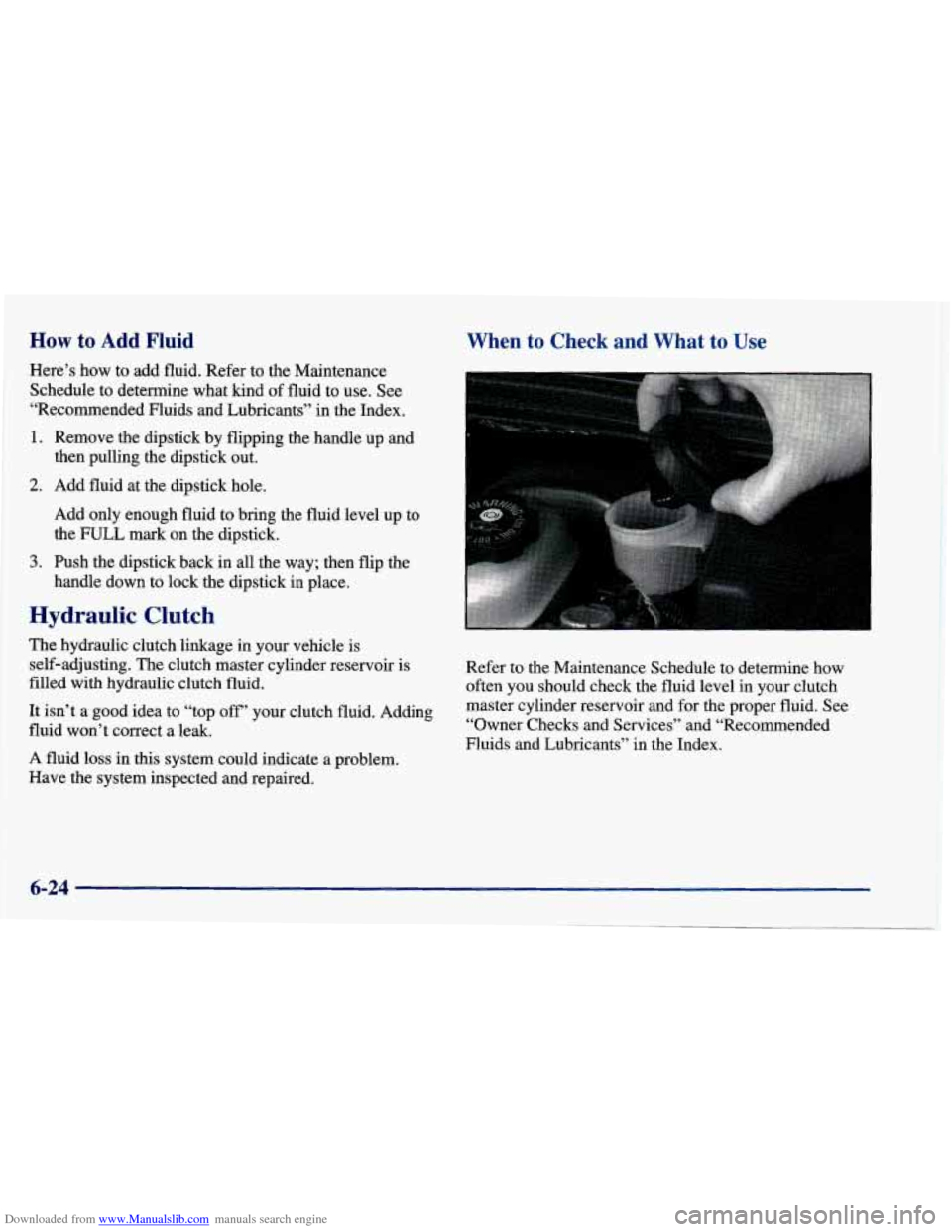
1. Remove the dipstick by flipping the handle up and
2. Add fluid at the dipstick hole. then pulling the dipstick out.
Add only enough fluid to bring the fluid level up to
the FULL mark on the dipstick.
handle down to lock the dipstick in place.
3. Push the dipstick back in all the way; then flip the
Hydraulic Clutch
The hydraulic clutch linkage in your vehicle is
self-adjusting. The clutch master cylinder reservoir is
filled with hydraulic clutch fluid.
It isn’t a good idea to “top off’ your clutch fluid. Adding
fluid won’t correct a leak.
A fluid loss in this system could indicate a problem.
Have the system inspected and repaired.
When to Check and What to Use
Refer to the Maintenance Schedule to determine how
often you should check the fluid level in your clutch
master cylinder reservoir and for the proper fluid. See
“Owner Checks and Services” and “Recommended
Fluids and Lubricants” in the Index.
6-24
Page 295 of 400
Downloaded from www.Manualslib.com manuals search engine 3. Disconnect the bulb base from me socket by lifting
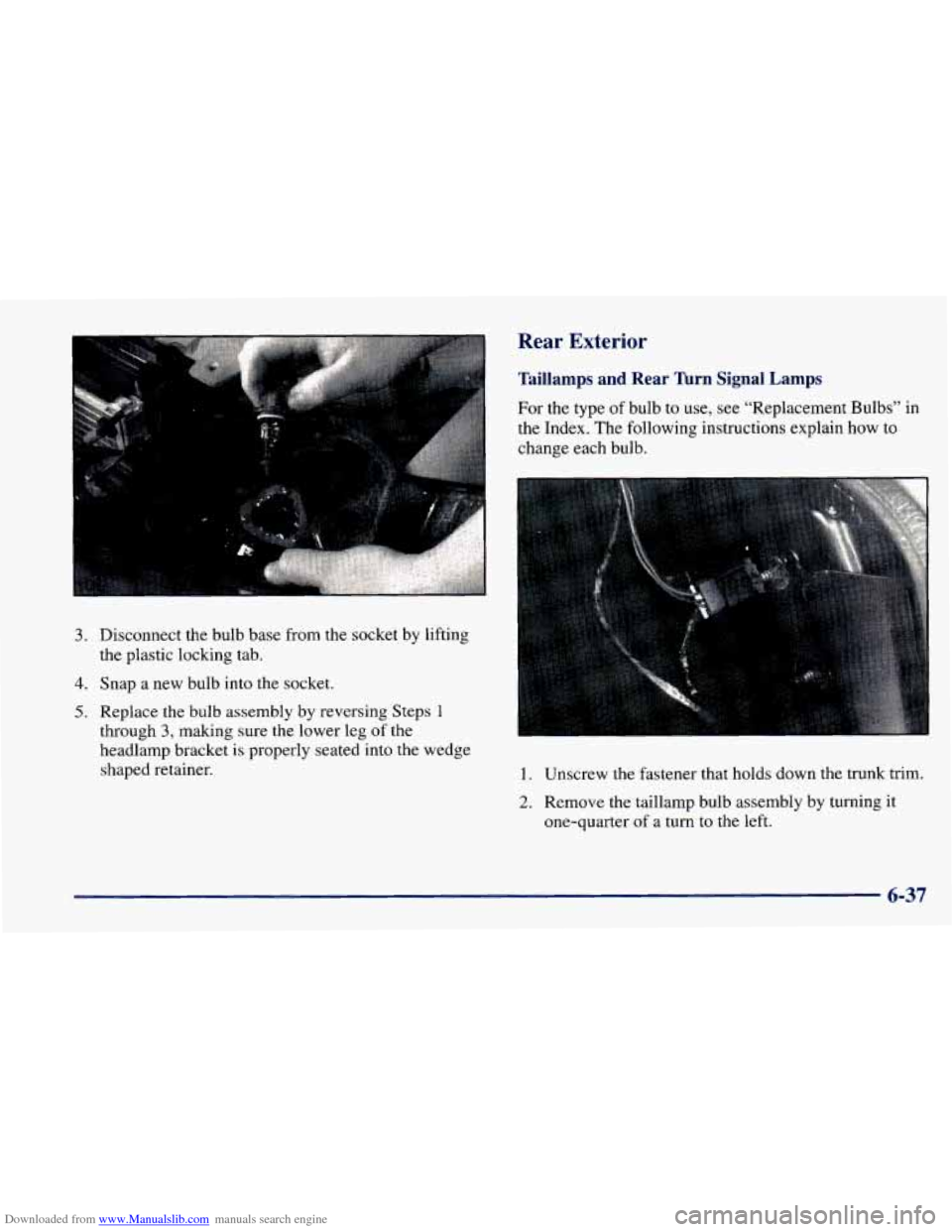
4. Snap a new bulb into the socket.
5. Replace the bulb assembly by reversing Steps 1
through 3, making sure the lower leg of the
headlamp bracket is properly seated into the wedge
shaped retainer.
the
plastic locking tab.
Rear Exterior
Taillamps and Rear Turn Signal Lamps
For the type of bulb to use, see “Replacement Bulbs” in
the Index. The following instructions explain
how to
change each bulb.
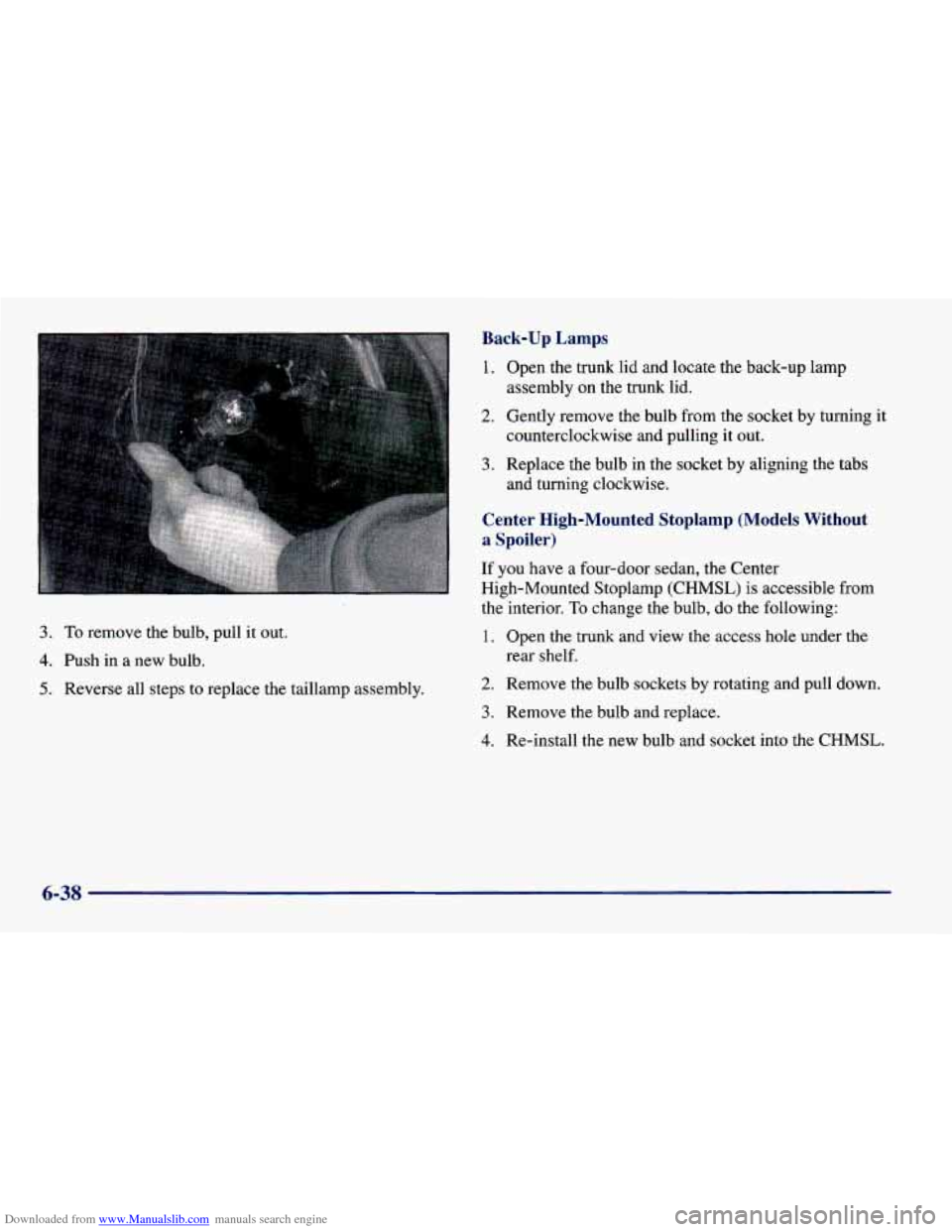
1. Unscrew the fastener that holds down the trunk trim.
2. Remove the taillamp bulb assembly by turning it
one-quarter of a turn to the left.
6-37
Page 296 of 400
Downloaded from www.Manualslib.com manuals search engine Back-up Lamps
1. Open the trunk lid and locate the back-up lamp
2. Gently remove the bulb from the socket by turning it
assembly on the trunk lid.
counterclockwise and pulling
it out.
3. To remove the bulb, pull it out.
4. Push in a new bulb.
5. Reverse all steps to replace the taillamp assembly.
3. Replace the bulb in the socket by aligning the tabs
and turning clockwise.
Center High-Mounted Stoplamp (Models Without
a Spoiler)
If you have a four-door sedan, the Center
High-Mounted Stoplamp (CHMSL)
is accessible from
the interior.
To change the bulb, do the following:
1. Open the trunk and view the access hole under the
2. Remove the bulb sockets by rotating and pull down.
rear shelf.
3. Remove the bulb and replace.
4. Re-install the new bulb and socket into the CHMSL.
6-38
Page 317 of 400
Downloaded from www.Manualslib.com manuals search engine Fuses and Circuit Breakers
The wiring circuits in your vehicle are protected from
short circuits by a combination of fuses, circuit breakers
and fusible thermal links. This greatly reduces the
chance of damage caused by electrical problems.
Look at the silver-colored band inside the fuse. If the
band is broken or melted, replace the fuse.
Be sure you
replace a bad fuse with a new one of the identical size
and rating.
If you ever have a problem on the road and don’t have a
spare fuse, you can borrow one that has the same
amperage. Just pick some feature of your vehicle that
you can get along without
-- like the radio or cigarette
lighter
-- and use its fuse if it is the correct amperage.
Replace it as soon
as you can.
There are two fuse blocks in your vehicle: the
instrument panel
fuse block and the engine compartment
fuse block.
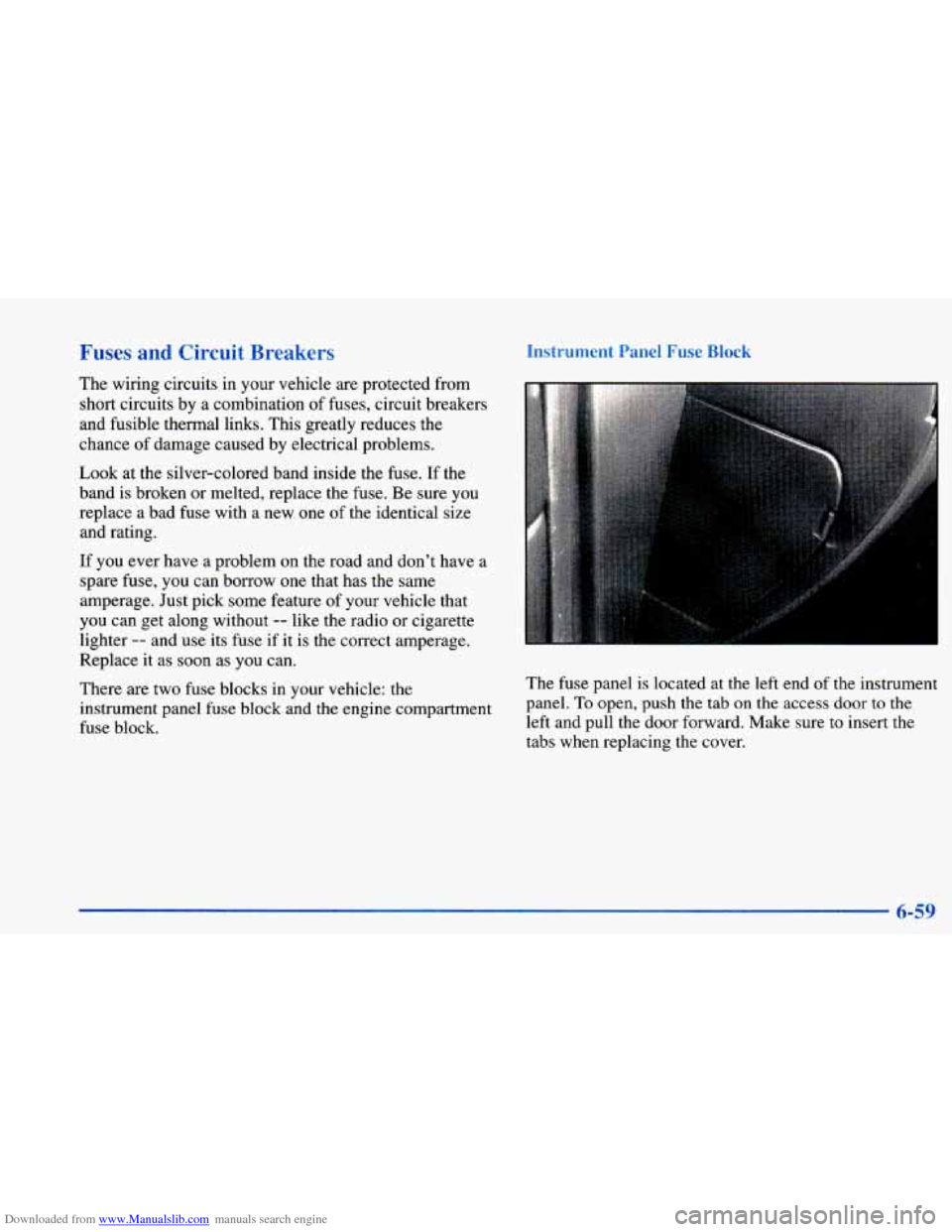
Instrument Panel Fuse Block
The fuse panel is located at the left end of the instrument
panel.
To open, push the tab on the access door to the
left and pull the door forward.
Make sure to insert the
tabs when replacing the cover.
6-59
Page 318 of 400
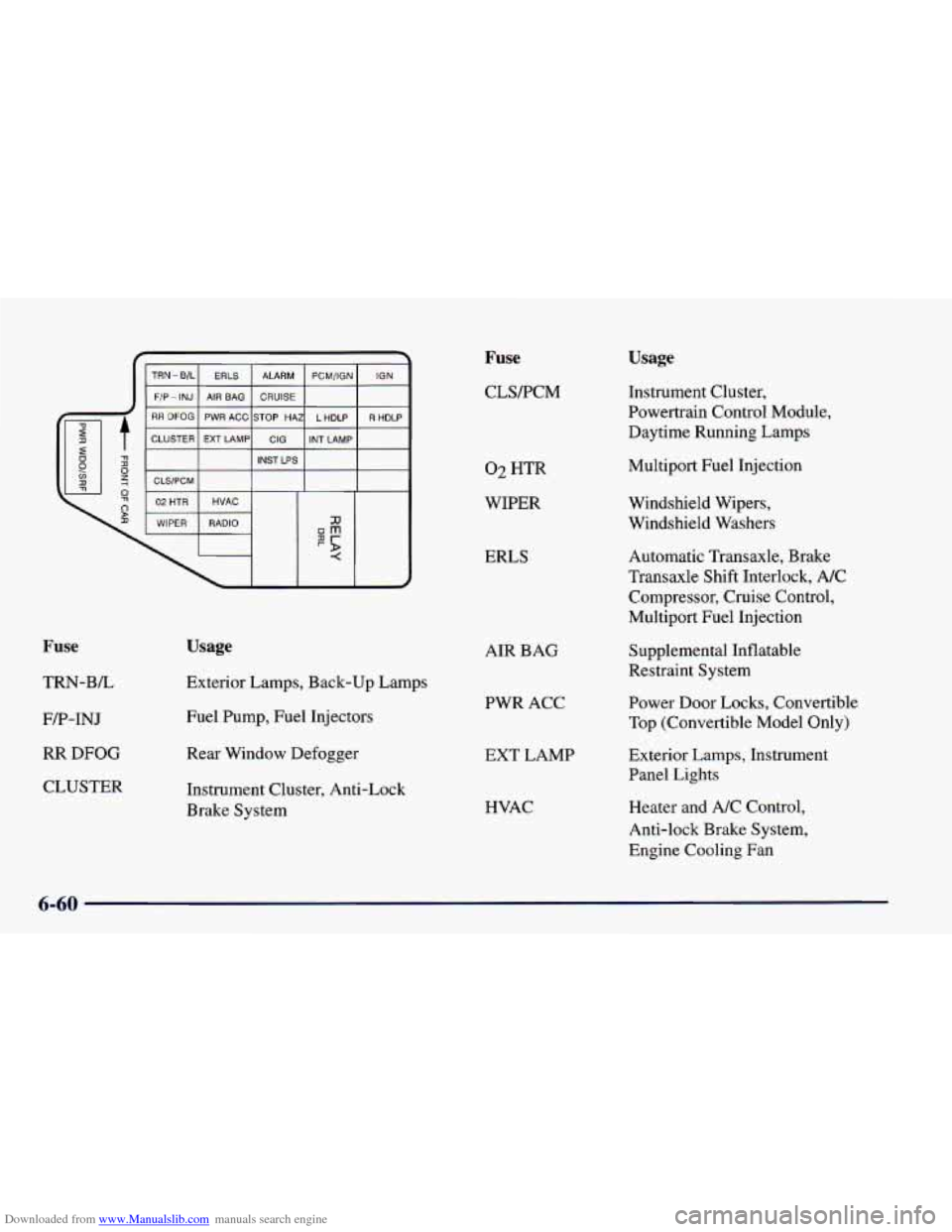
Downloaded from www.Manualslib.com manuals search engine Fuse
TRN-BL FA'-INJ
RR DFOG
CLUSTER
Usage
Exterior Lamps, Back-up Lamps
Fuel Pump, Fuel Injectors
Rear Window Defogger
Instrument Cluster, Anti-Lock
Brake System
Fuse
CLSRCM
02 HTR
WIPER
ERLS
AIR BAG
PWR ACC
EXT LAMP
HVAC
Usage
Instrument Cluster,
Powertrain Control Module,
Daytime Running Lamps
Multiport Fuel Injection
Windshield Wipers,
Windshield Washers Automatic Transaxle, Brake
Transaxle Shift Interlock, A/C
Compressor, Cruise Control,
Multiport Fuel Injection
Supplemental Inflatable
Restraint System
Power Door Locks, Convertible
Top (Convertible Model Only)
Exterior Lamps, Instrument
Panel Lights
Heater and A/C Control,
Anti-lock Brake System,
Engine Cooling Fan
6-60
Page 319 of 400
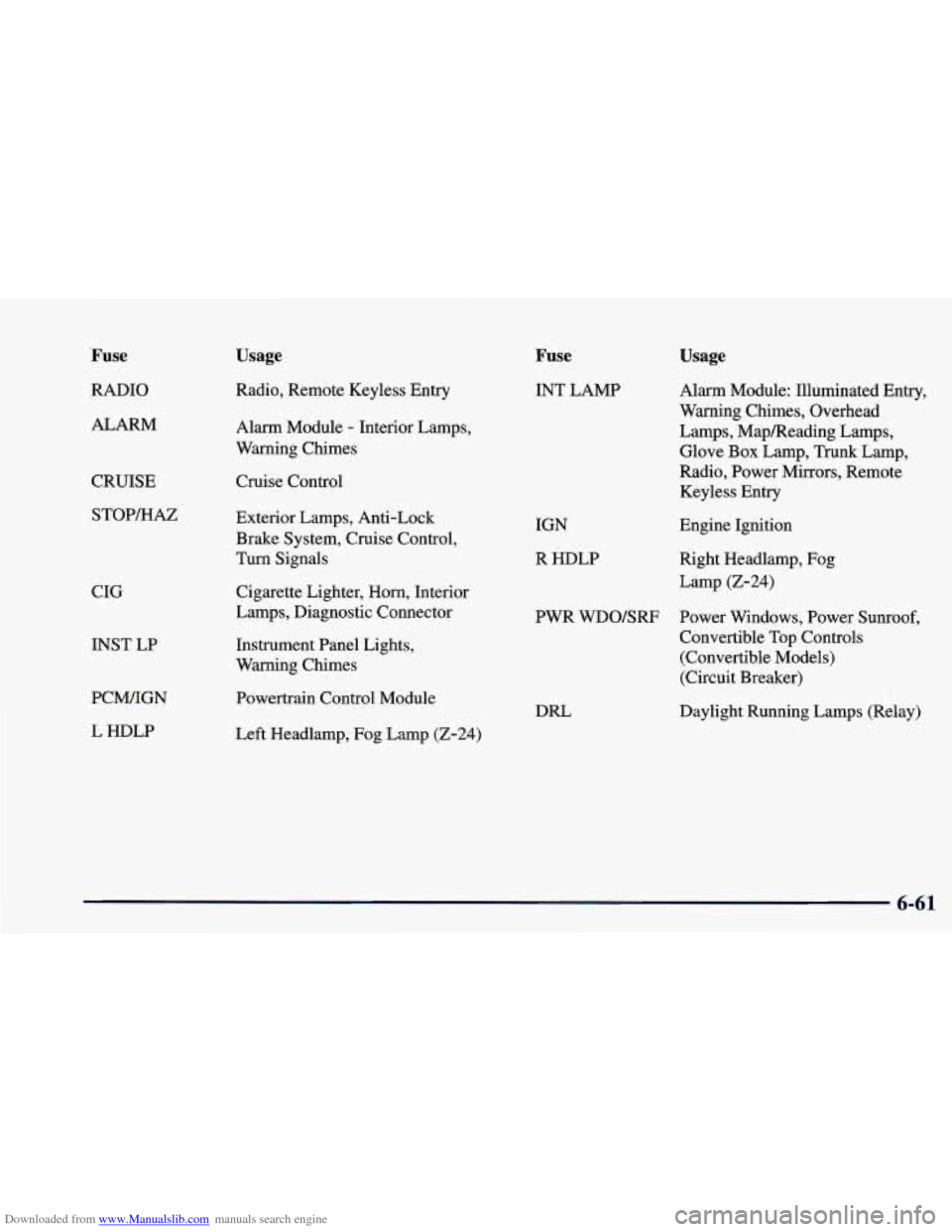
Downloaded from www.Manualslib.com manuals search engine Fuse
RADIO
ALARM CRUISE STOP/HAZ
CIG
INST LP
PCM/IGN
L HDLP
Usage
Radio, Remote Keyless Entry
Alarm Module
- Interior Lamps,
Warning Chimes
Cruise Control
Exterior Lamps, Anti-Lock
Brake System, Cruise Control,
Turn Signals Cigarette Lighter,
Horn, Interior
Lamps, Diagnostic Connector
Instrument Panel Lights,
Warning Chimes
Powertrain Control Module
Left Headlamp, Fog Lamp
(2-24)
Fuse
INT LAMP
IGN
R HDLP
Usage
Alarm Module: Illuminated Entry,
Warning Chimes, Overhead
Lamps, MapReading Lamps,
Glove Box Lamp, Trunk Lamp,
Radio, Power Mirrors, Remote Keyless
Entry
Engine Ignition
Right Headlamp, Fog
Lamp
(2-24)
PWR WDO/SRF Power Windows, Power Sunroof,
Convertible Top Controls
(Convertible Models)
(Circuit Breaker)
DRL Daylight Running Lamps (Relay)
6-61
Page 320 of 400
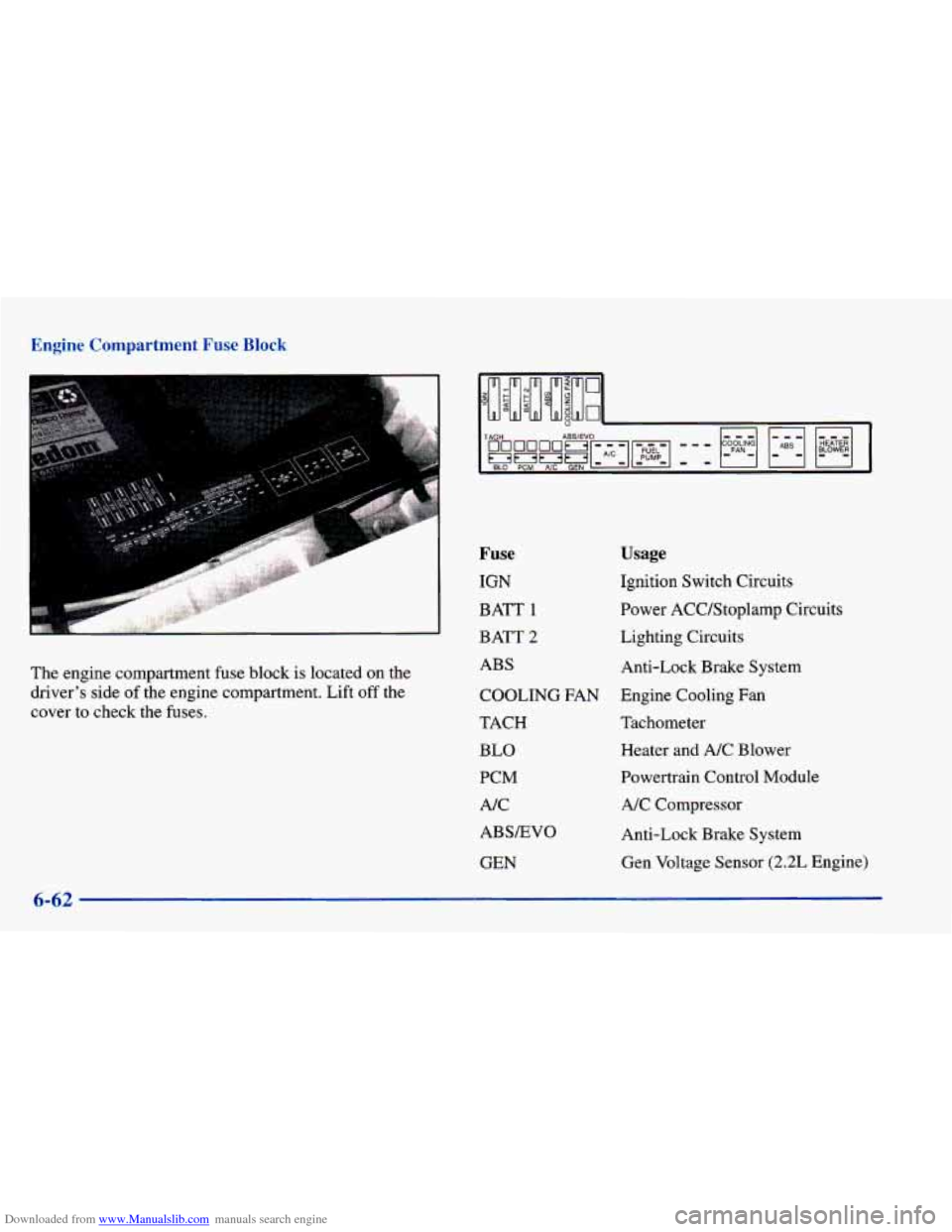
Downloaded from www.Manualslib.com manuals search engine Engine Compartment Fuse Block
The engine compartment fuse block is located on the
driver’s side
of the engine compartment. Lift off the
cover to check the fuses.
Fuse
IGN
BATT 1
BATT 2
ABS
COOLING FAN
TACH
BLO
PCM AIC
ABSEVO
GEN
Usage
Ignition Switch Circuits
Power ACC/Stoplamp Circuits
Lighting Circuits
Anti-Lock Brake System
Engine Cooling Fan
Tachometer
Heater and
A/C Blower
Powertrain Control Module
A/C Compressor
Anti-Lock Brake System
Gen Voltage Sensor (2.2L Engine)
6-62