clutch CHEVROLET CAVALIER 1998 3.G Owners Manual
[x] Cancel search | Manufacturer: CHEVROLET, Model Year: 1998, Model line: CAVALIER, Model: CHEVROLET CAVALIER 1998 3.GPages: 400, PDF Size: 20.74 MB
Page 91 of 400
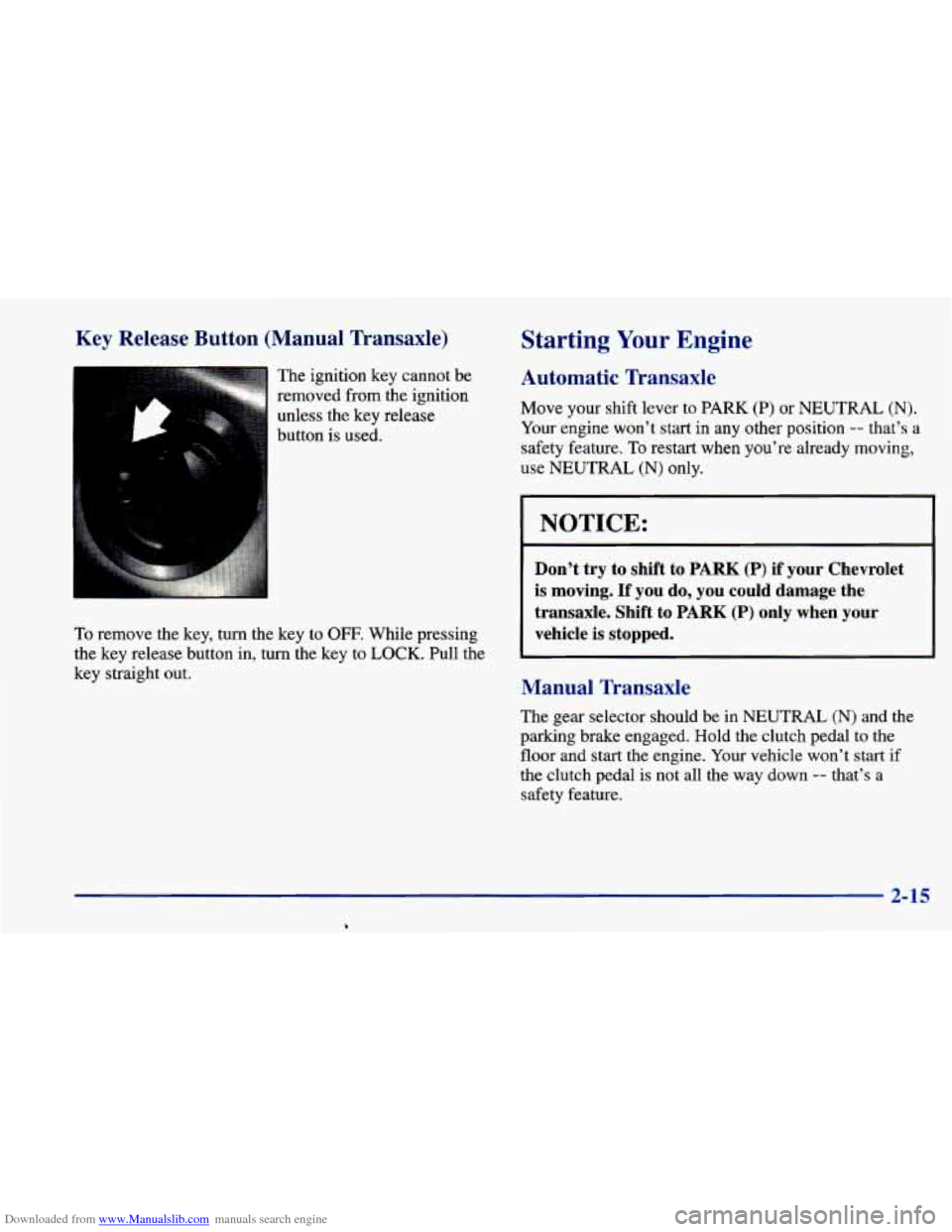
Downloaded from www.Manualslib.com manuals search engine Key Release Button (Manual Transaxle)
The ignition key cannot be
removed from the ignition
unless the key release
button
is used.
To remove the key, turn the key to
OFF. While pressing
the key release button in, turn the key to LOCK. Pull the
key straight out.
Starting Your Engine
Automatic Transaxle
Move your shift lever to PARK (P) or NEUTRAL (N).
Your engine won’t start in any other position
-- that’s a
safety feature. To restart when you’re already moving,
use NEUTRAL
(N) only.
NOTICE:
Don’t try to shift to PARK (P) if your Chevrolet
is moving.
If you do, you could damage the
transaxle. Shift to PARK
(P) only when your
vehicle is stopped.
I
Manual Transaxle
The gear selector should be in NEUTRAL (N) and the
parking brake engaged. Hold the clutch pedal
to the
floor and start the engine. Your vehicle won’t start if
the clutch pedal
is not all the way down -- that’s a
safety feature.
2-15
$
Page 101 of 400
Downloaded from www.Manualslib.com manuals search engine Here’s how to operate your transaxle:
FIRST (1): Press the clutch pedal and shift into
FIRST
(1). Then, slowly let up on the clutch pedal as
you press the accelerator pedal.
You can shift into FIRST
(1) when you’re going less
than
20 mph (32 km/h). If you’ve come to a complete
stop and it’s hard to shift into FIRST
(I), put the shift
lever in NEUTRAL
(N) and let up on the clutch. Press
the clutch pedal back down. Then shift into FIRST
(1).
SECOND (2): Press the clutch pedal as you let up on
the accelerator pedal and shift into SECOND
(2). Then,
slowly let up on the clutch pedal
as you press the
accelerator pedal.
THIRD (3), FOURTH (4) and FIFTH (5): Shift into
THIRD
(3), FOURTH (4) AND FIFTH (3, the same
way you do for
SECOND (2). Slowly let up on the
clutch pedal as you press the accelerator pedal.
To stop, let up on the accelerator pedal and press the
brake pedal. Just before the vehicle stops, press the
clutch pedal and the brake pedal, and shift to
NEUTRAL (N).
REVERSE (R): To back up, press down the clutch
pedal and shift into REVERSE
(R). Let up on the clutch
pedal slowly while pressing the accelerator pedal.
I I
NOTICE:
Shift to REVERSE (R) only after your vehicle is
stopped. Shifting to REVERSE
(R) while your
vehicle
is moving could damage your transaxle.
NEUTRAL (N):
Use this position when you start or
idle your engine. Also,
use REVERSE (R), along with
the parking brake,
for parking your vehicle.
Shift Speeds
If you skip more than one gear when you
downshift, you could lose control of your vehicle.
And you could injure yourself or others. Don’t
shift from FIFTH
(5) to SECOND (2) or
FOURTH
(4) to FIRST (1).
2-25
Page 112 of 400
Downloaded from www.Manualslib.com manuals search engine Windshield Washer
To wash your windshield, pull the stalk with the wiper
symbol on it toward you one time. When you release the
stalk, the washers will stop. The wipers continue wiping
for approximately three cycles and will either stop or
will resume the speed you were using before.
I
I ,A CAUTIGk
In freezing weather, don't use your washer until
the windshield is warmed. Otherwise the washer
fluid can form ice
on the windshield, blocking
your vision.
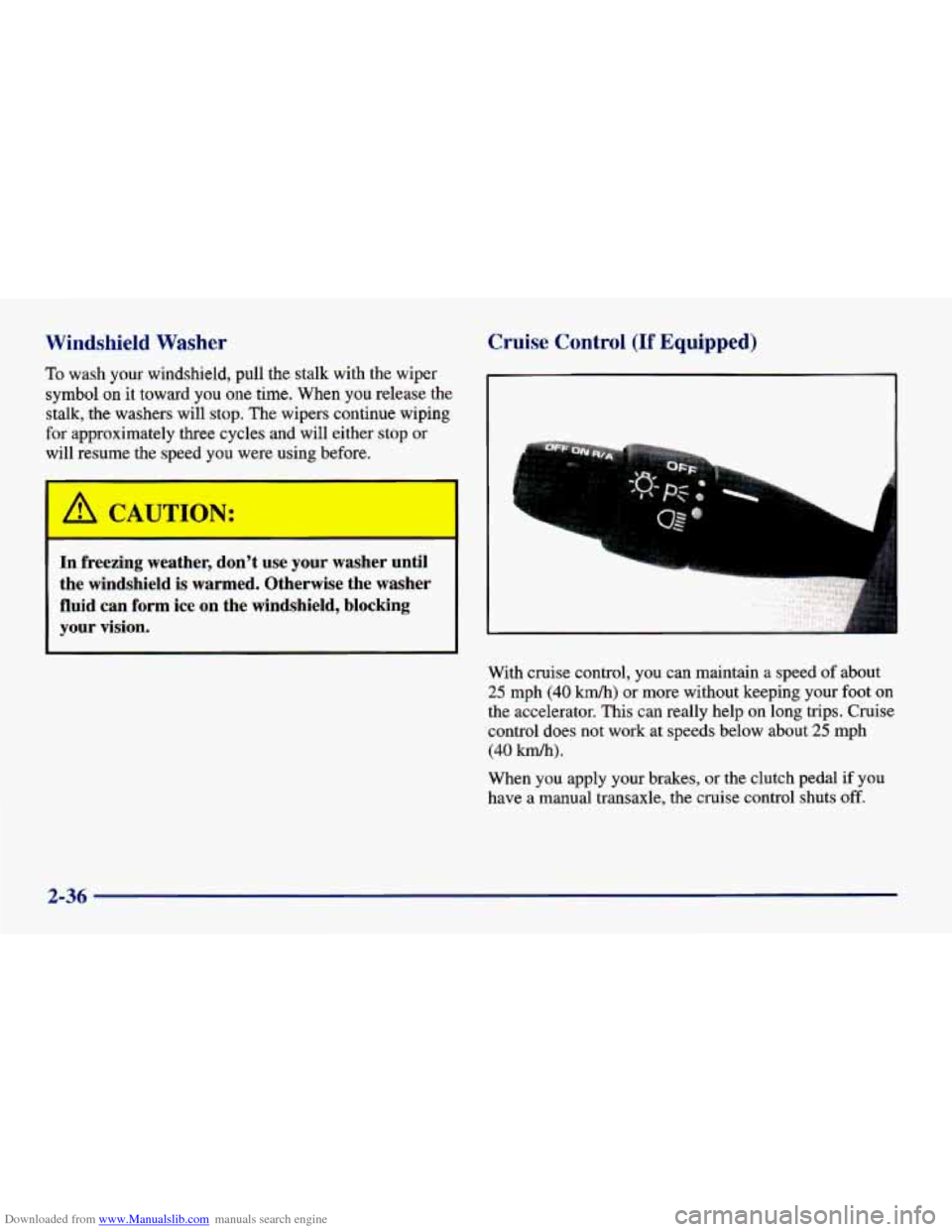
Cruise Control (If Equipped)
1
I I
With cruise control, you can maintain a speed of about
25 mph (40 kmk) or more without keeping your foot on
the accelerator. This can really help on long trips. Cruise
control does not work at speeds below about
25 mph
(40 Wh).
When you apply your brakes, or the clutch pedal if you
have a manual transaxle, the cruise control shuts off.
2-36
Page 114 of 400
Downloaded from www.Manualslib.com manuals search engine Resuming a Set Speed
Suppose you set your cruise control at a desired speed
and then you apply the brake or clutch pedal. This, of
course, shuts off the cruise control. But you don’t need
to reset it. Once you’re going about 25 mph
(40 km/h)
or more, you can move the cruise control switch from
ON to RIA for about a half second.
You’ll go right back up to your chosen speed and
stay there.
If you hold the switch at R/A longer than a half second,
the vehicle will keep going faster until you release the
switch or apply the brake or clutch pedal.
So unless you
want to
go faster, don’t hold the switch at WA.
Increasing Speed While Using Cruise Control
There are two ways to go to a higher speed:
0 Use the accelerator pedal to get to a higher speed.
Push the
SET button at the end of the lever, then
release the button and the accelerator pedal. You’ll
now cruise at the higher speed.
Hold it there until you get up to the speed you want,
and then release the switch. To increase your speed
in very small amounts, move the switch to
R/A for
less than a half a second and then release it. Each
time you do this, your vehicle will go about
1 mph
(1.6 km/h) faster.
Move the cruise control switch from ON to WA.
Reducing Speed While Using Cruise Control
There are two ways to reduce your speed while using
cruise control:
Push in the button at the end of the lever until you
reach the lower speed you want, then release it.
To slow down in very small amounts, push the
button for less than half a second. Each time you do
this, you’ll go about
1 mph (1.6 km/h) slower.
2-38
-
Page 115 of 400
Downloaded from www.Manualslib.com manuals search engine Passing Another Vehicle While Using Cruise Control
Use the accelerator pedal to increase your speed. When
you take your foot
off the pedal, your vehicle will slow
down to the cruise control speed you set earlier.
Using Cruise Control on Hills
How well your cruise control will work on hills depends
upon your speed, load and the steepness of the hills.
When going up steep hills, you may have to step on the
accelerator pedal to maintain your speed. When going
downhill, you may have to brake or shift to a lower gear
to keep your speed down.
Of course, applying the brake
or clutch pedal takes you out
of cruise control. Many
drivers find this too much trouble and don’t use cruise
control on steep hills.
Ending Cruise Control
There are several ways to turn off the cruise control:
Step lightly on the brake pedal, or push the clutch
Move the cruise switch to OFF.
pedal, if you have a manual transaxle, OR
Erasing Cruise Speed Memory
When you turn off the cruise control or the ignition,
your cruise control set speed memory is erased.
2-39
Page 259 of 400
Downloaded from www.Manualslib.com manuals search engine 0 Section 6 Service and Appearance Care
I
Here you will find information about the care of your vehicle. This section begins with service and fuel informa\
tion,
and then it shows how to check important fluid and lubricant levels. There is also technical information about your
vehicle, and a part devoted to its appearance care.
6-2
6-3
6-5
6-5
6-7
6- 8
6- 12
6- 17
6-18
6-2
1
6-22
6-24
6-25
6-28
6-28
6-29
Service
Fuel
Fuels in Foreign Countries
Filling Your
Tank
Filling a Portable Fuel Container
Checking Things Under the Hood
Engine Oil
Air Cleaner
Automatic Transaxle Fluid (Three-Speed
Only)
Automatic Transaxle Fluid (Four-Speed Only)
Manual Transaxle Fluid
Hydraulic Clutch
Engine Coolant Surge Tank Pressure Cap
Thermostat
Power Steering Fluid
6-30
6-3
1
6-35
6-35
6-40
6-48
6-49
6-5
1
6-52
6-53
6-57
6-58
6-63
6-63
6-64
6-64
Windshield Washer Fluid
Brakes
Battery
Bulb Replacement
Tires
Appearance Care
Cleaning the Inside of
Your Vehicle
Care
of Safety Belts
Cleaning the Outside
of Your Vehicle
Cleaning Your Convertible Top
Vehicle Identification Number
(VIN)
Electrical System
Replacement Bulbs
Capacities and Specifications
Air Conditioning Refrigerants
Normal Maintenance Replacement Parts
6-1
Page 268 of 400
Downloaded from www.Manualslib.com manuals search engine 2.2L Engine (Code 4)
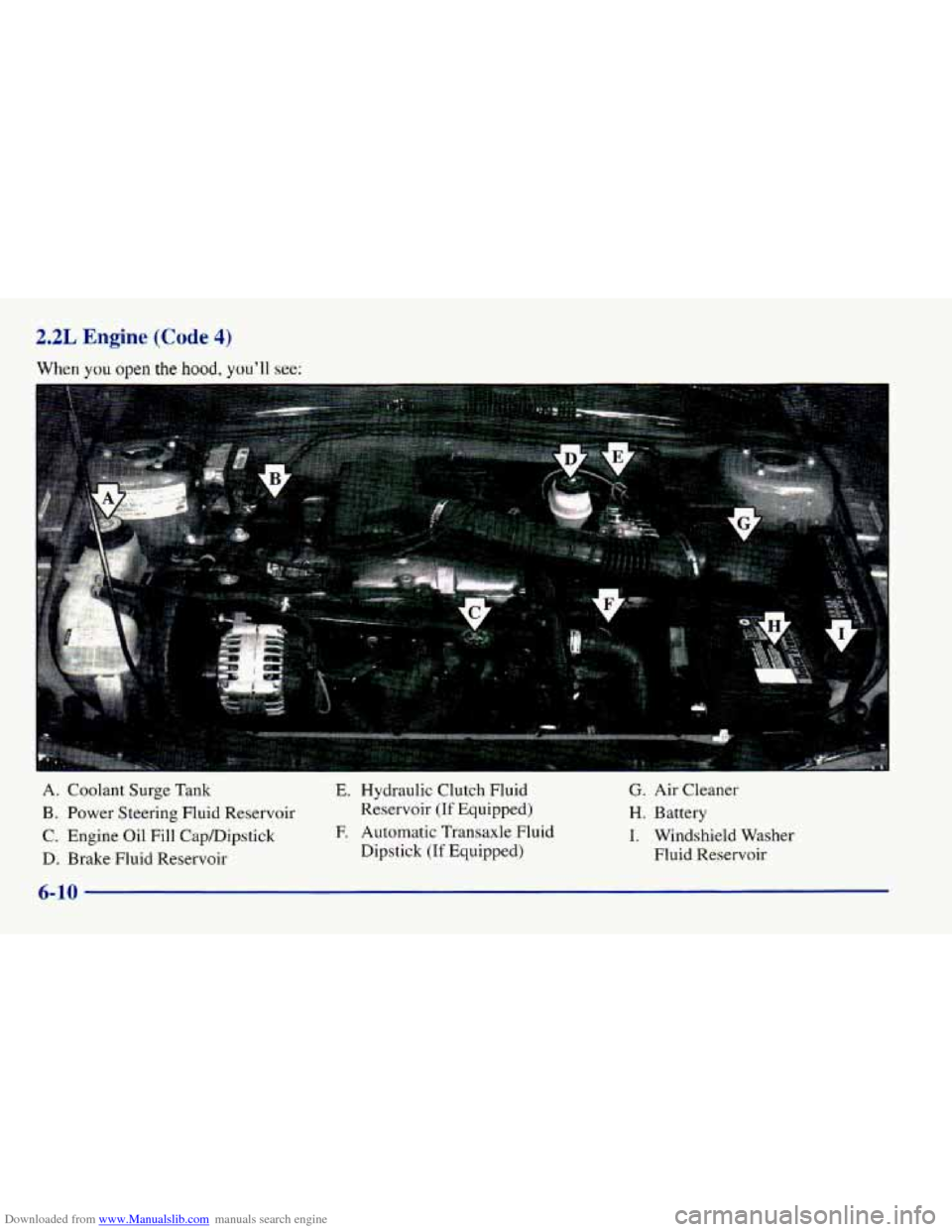
When you open the hood, you'll see:
A. Coolant Surge Tank
B. Power Steering Fluid Reservoir
C. Engine Oil Fill CapDipstick
D. Brake Fluid Reservoir
E. Hydraulic Clutch Fluid
Reservoir
(If Equipped)
F. Automatic Transaxle Fluid
Dipstick
(If Equipped)
G. Air Cleaner
H. Battery
1. Windshield Washer
Fluid Reservoir
6-10
Page 269 of 400
Downloaded from www.Manualslib.com manuals search engine 2.4L Engine (Code T)
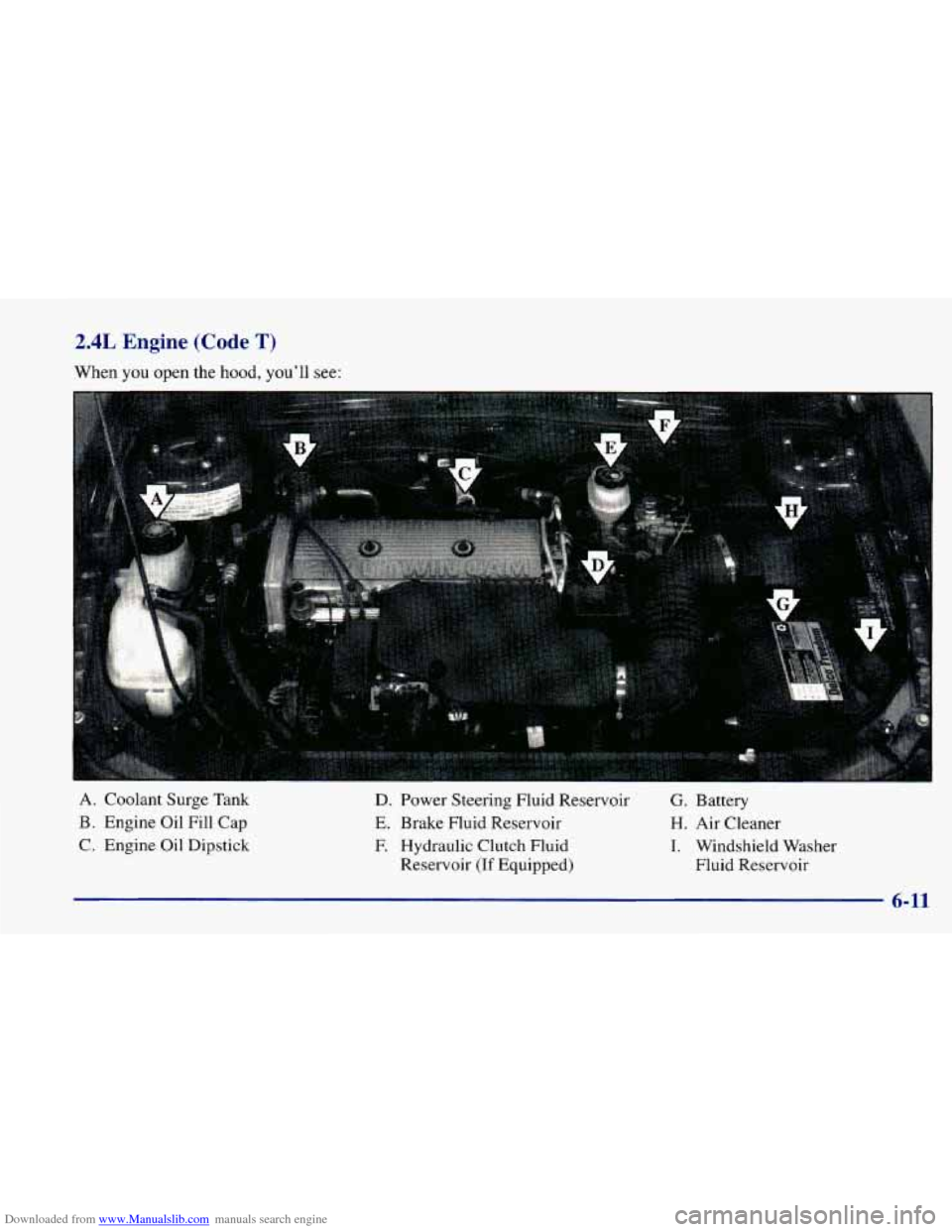
When you open the hood, you'll see:
A. Coolant Surge Tank
B. Engine Oil Fill Cap
C. Engine Oil Dipstick
D. Power Steering Fluid Reservoir
E. Brake Fluid Reservoir
F. Hydraulic Clutch Fluid
Reservoir
(If Equipped)
G. Battery
H. Air Cleaner
I. Windshield Washer
Fluid Reservoir
6-11
Page 282 of 400
Downloaded from www.Manualslib.com manuals search engine How to Add Fluid
Here’s how to add fluid. Refer to the Maintenance Schedule to determine what kind
of fluid to use. See
“Recommended Fluids and Lubricants” in the Index.
1. Remove the dipstick by flipping the handle up and
2. Add fluid at the dipstick hole. then pulling the dipstick out.
Add only enough fluid to bring the fluid level up to
the FULL mark on the dipstick.
handle down to lock the dipstick in place.
3. Push the dipstick back in all the way; then flip the
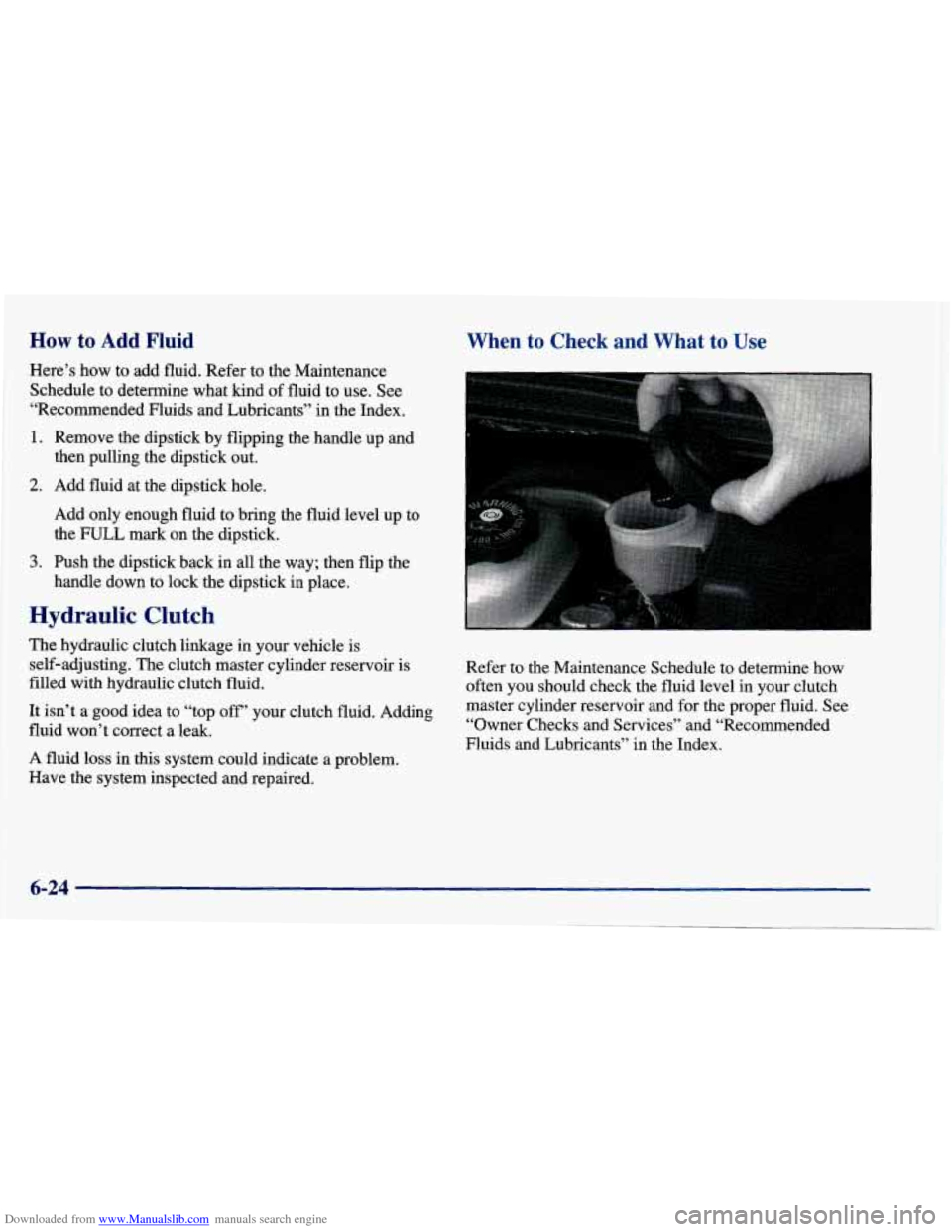
Hydraulic Clutch
The hydraulic clutch linkage in your vehicle is
self-adjusting. The clutch master cylinder reservoir is
filled with hydraulic clutch fluid.
It isn’t a good idea to “top off’ your clutch fluid. Adding
fluid won’t correct a leak.
A fluid loss in this system could indicate a problem.
Have the system inspected and repaired.
When to Check and What to Use
Refer to the Maintenance Schedule to determine how
often you should check the fluid level in your clutch
master cylinder reservoir and for the proper fluid. See
“Owner Checks and Services” and “Recommended
Fluids and Lubricants” in the Index.
6-24
Page 283 of 400
Downloaded from www.Manualslib.com manuals search engine How to Check
You do not need to check the fluid level unless you
suspect a clutch problem.
To check the fluid level, take
the cap
off. If the fluid reaches the step inside the
reservoir, the fluid level is correct.
Engine Coolant
The cooling s stem in your vehicle is filled with
DEX-COOL
8 engine coolant. This coolant is designed
to remain in your vehicle for
5 years or 150,000 miles
(240 000 km) whichever occurs first, if you add only
DEX-COOL’ extended life coolant.
The following explains your cooling system and how
to add coolant when it is low. If you have a problem
with engine overheating, see “Engine Overheating” in
the Index.
A 50/50 mixture of water and DEX-COOL@
coolant will:
Give freezing protection down to -34°F (-37°C).
Give boiling protection up to 265 “F (129°C).
Protect against rust and corrosion.
Help keep the proper engine temperature.
Let the warning lights and gages work as
they should.
NOTICE:
When adding coolant, it is important that you
use only
DEX-COOL@ (silicate-free) coolant.
If coolant other than DEX-COOL is added to
the system, premature engine, heater core or
radiator corrosion may result. In addition, the
engine coolant will require change sooner
-- at
30,000 miles (50 000 km) or 24 months,
whichever occurs first. Damage caused by the
use of coolant other than DEX-COOL@ is not
covered by your new vehicle warranty.
6-25