fuel cap CHEVROLET CAVALIER 1998 3.G Owners Manual
[x] Cancel search | Manufacturer: CHEVROLET, Model Year: 1998, Model line: CAVALIER, Model: CHEVROLET CAVALIER 1998 3.GPages: 400, PDF Size: 20.74 MB
Page 149 of 400
Downloaded from www.Manualslib.com manuals search engine If the Light Is On Steady
You may be able to correct the emission system
malfunction by considering the following:
Did you recently put fuel into your vehicle?
If
so, reinstall the fuel cap, making sure to fully install
the cap. The diagnostic system can determine if the fuel
cap has been left off or improperly installed.
A loose or
missing fuel cap will allow fuel to evaporate into the
atmosphere.
A few driving trips with the cap properly
installed should turn the light off.
Did you just drive through a deep puddle of water?
If
so, your electrical system may be wet. The condition
will usually be corrected when the electrical system
dries out.
A few driving trips should turn the light off. Have you recently changed brands
of fuel?
If
so, be sure to fuel your vehicle with quality fuel (see
“Fuel” in the Index). Poor fuel quality will cause your
engine not to run as efficiently as designed.
You may
notice this as stalling after start-up, stalling when you
put the vehicle into gear, misfiring, hesitation on
acceleration or stumbling
on acceleration. (These
conditions may go away once the engine is warmed up.)
This will be detected by the system and cause the light
to turn on.
If you experience one or more of these conditions,
change the fuel brand you use. It will require at least one
full tank of the proper fuel to turn the light off.
If none of the above steps have made the light turn off,
have your dealer or qualified service center check the
vehicle. Your dealer has the proper test equipment and
diagnostic tools to
fix any mechanical or electrical
problems that may have developed.
2-73
Page 152 of 400
Downloaded from www.Manualslib.com manuals search engine Check Gages Light
This light will come on
CHECK
GAGES
brieflywhen you are
starting the engine.
If the light comes on and stays on while you are driving,
check your various gages to see if they are in the
warning zones or if you
are low on fuel.
:age
Ir
E‘
’ ID
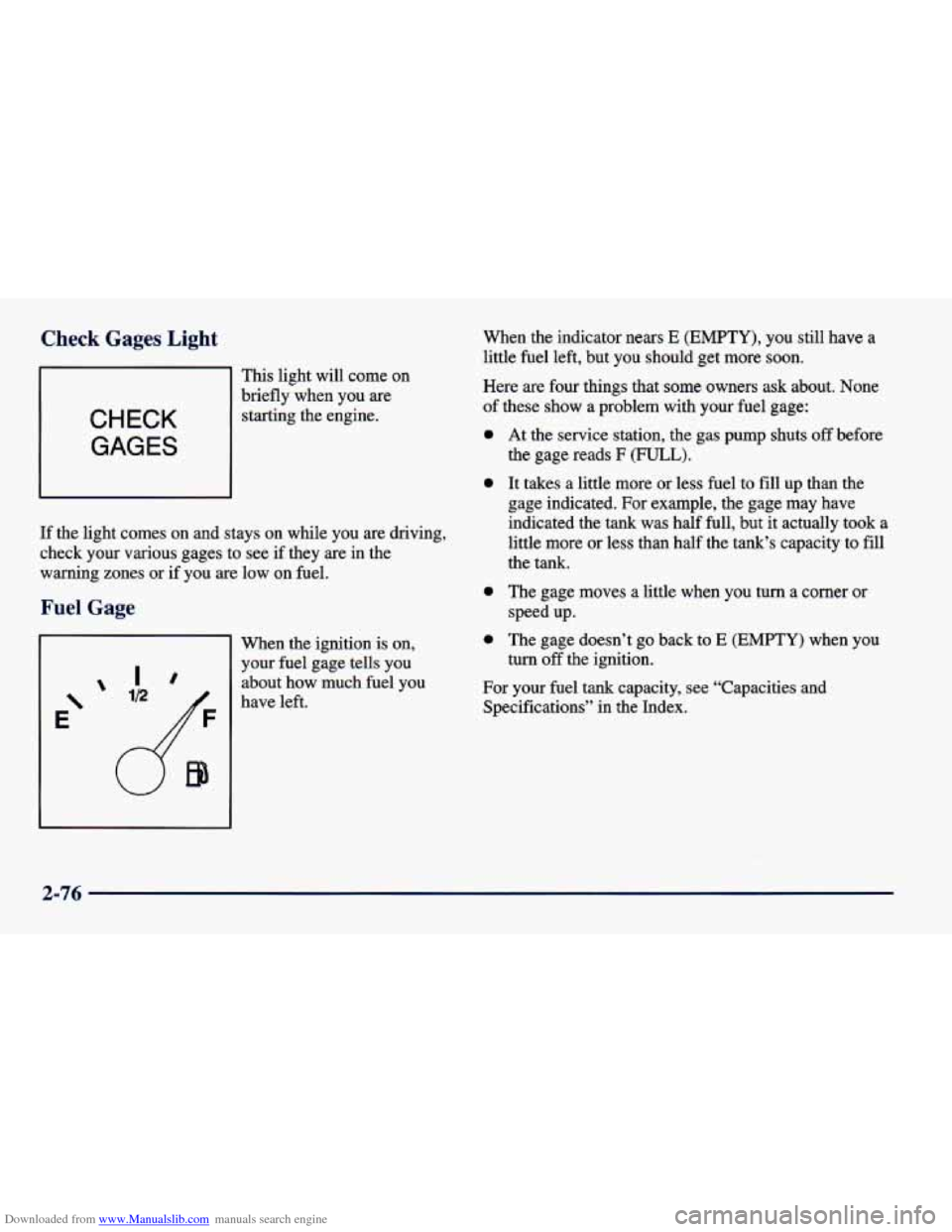
When the ignition is on,
your fuel gage tells you about how much fuel you
have left. When the indicator nears
E (EMPTY), you
still have a
little fuel left, but you should get more soon.
Here are four things that
some owners ask about. None
of these show a problem with your fuel gage:
0
0
0
0
At the service station, the gas pump shuts off before
the gage reads
F (FULL).
It takes a little more or less fuel to fill up than the
gage indicated.
For example, the gage may have
indicated the tank was half full, but it actually
took a
little more or less than half the tank’s capacity to
fill
the tank.
The gage moves a little when you turn a comer or
speed up.
The gage doesn’t go back to
E (EMPTY) when you
turn
off the ignition.
For your fuel tank capacity, see “Capacities and
Specifications” in the Index.
2-76
Page 158 of 400
Downloaded from www.Manualslib.com manuals search engine -0
/J VENT This setting brings in outside air and
directs it through the instrument panel.
+fl BI-LEVEL: This setting brings in outside air and
directs it two ways. Some air is directed through the
instrument panel outlets. Most of the air
is directed
through the floor ducts and a little to the defrost and side
window vents.
+# FLOOR: This setting sends most of the air
through the ducts near the floor. The rest comes out of
the defroster and side window vents.
+’ DEFOG: This setting allows half of the air to
go to the floor ducts and half to the defroster and side
window vents.
+e
e
we
DEFROST: This setting directs most of the air
through the defroster and side window vents. Some
of
the air goes to the floor ducts. The air conditioning
compressor will run automatically in
this setting when it
is needed to help dry the air in the vehicle.
Air Conditioning Compressor Button
Press the NC button to operate the air conditioner
compressor. The indicator light above the button will glow
when the air conditioning compressor is running.
You don’t have to press the button to run the compressor
in MAX or DEFROST.
Air Conditioning (If Equipped)
On very hot days, open the windows long enough
to let hot, inside air escape. This reduces the time it
takes for your vehicle to cool down, which should help
fuel economy.
For quick cool-down on very hot days, use
MAX with
the temperature knob all the way in the blue area. If this
setting is used for long periods of time, the air in your
vehicle may become too dry.
For normal cooling on hot days, use VENT with the
temperature knob
in the blue area and the A/C button
pushed in. The system will bring in outside air and
cool it.
On cool, but sunny days, the sun may warm your upper
body, but your lower body may not be warm enough.
You can use BI-LEVEL with the temperature knob in
the middle and the
NC button pushed in. The system
will bring in outside air and direct slightly warmer air to
your lower body. You may notice this temperature
difference more at
some times than others.
3-4
Page 211 of 400
Downloaded from www.Manualslib.com manuals search engine Loading Your Vehicle
TIRE-LOADING INFORMATION
OCCUPANTS VEHICLE
CAP. WT.
FRT. CTR. RR. TOTAL LBS. KG
MAX. LOADING & GVWR SAME AS VEHICLE
CAPACITY WEIGHT XXX COLD TIRE
TIRE SIZE SPEED PRESSURE
RTG PSI/KPa
FRT,
RR.
SPA.
IF TIRES ARE HOT, ADD 4PSIi28KPa
SEE OWNER‘S MANUAL FOR ADDITIONAL
INFORMATION
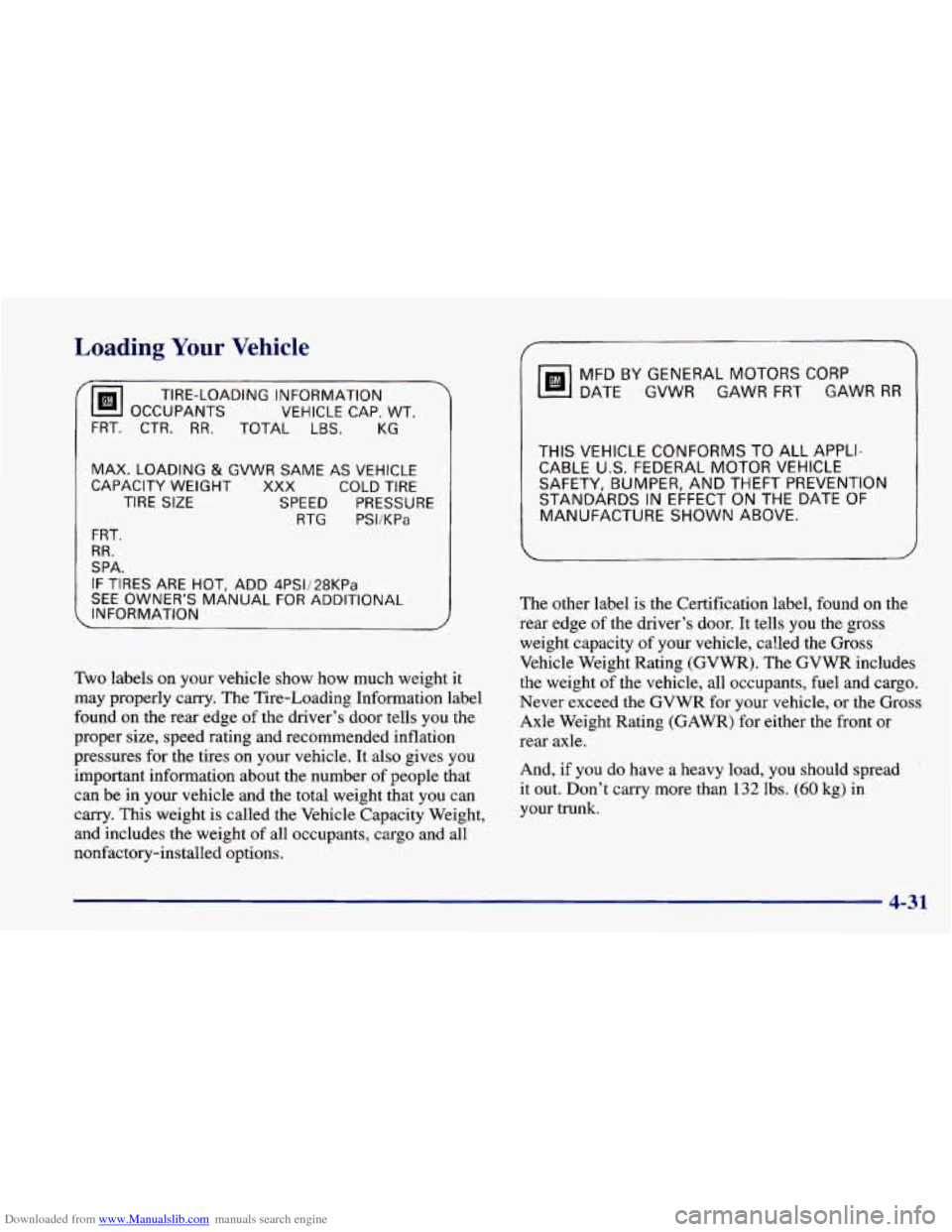
Two labels on your vehicle show how much weight it
may properly carry, The Tire-Loading Information label
found on the rear edge
of the driver’s door tells you the
proper size, speed rating and recommended inflation
pressures for the tires on your vehicle. It also gives you
important information about the number
of people that
can be in your vehicle and the total weight that you can
carry. This weight is called the Vehicle Capacity Weight,
and includes the weight of all occupants, cargo and
all
nonfactory-installed options.
MFDBYGENERALMOTORSCORP
DATE GVWR
GAWR FRT GAWR RR
THIS VEHICLE CONFORMS TO ALL APPLI-
CABLE
US. FEDERAL MOTOR VEHICLE
SAFETY, BUMPER, AND THEFT PREVENTION
STANDARDS
IN EFFECT ON THE DATE OF
MANUFACTURE SHOWN ABOVE.
The other label is the Certification label, found on the
rear edge of the driver’s door. It tells you the gross
weight capacity
of your vehicle, called the Gross
Vehicle Weight Rating
(GVWR). The GVWR includes
the weight of the vehicle, all occupants, fuel and cargo.
Never exceed the GVWR for your vehicle, or the Gross
Axle Weight Rating (GAWR) for either the front or
rear axle.
And,
if you do have a heavy load, you should spread
it out. Don’t carry more than
132 lbs. (60 kg) in
your trunk.
4-31
Page 213 of 400
Downloaded from www.Manualslib.com manuals search engine Towing a Trailer (Models with
2.4L Engine and 4-Speed
Automatic Transaxle)
I--
If you don’t use the correct equipment and drive
properly, you can lose control when you pull a
trailer. For example,
if the trailer is too heavy, the
brakes may not work well
-- or even at all. You
and your passengers could be seriously injured.
You may also damage your vehicle; the resulting
repairs would not be covered by your warranty.
Pull
a trailer only if you have followed all the
steps in this section. Ask your dealer for advice
and information about towing a trailer with
your vehicle.
Do not tow a trailer if your vehicle is equipped with a
2.2L (Code 4) engine. You also cannot tow a trailer if
your vehicle is equipped with a manual or a three-speed
automatic transaxle, or is a convertible model. Your
vehicle can tow a trailer if it is equipped with a
2.4L engine and 4 speed automatic transaxle and the
proper trailer towing equipment.
To identify what the
vehicle trailering capacity is for your vehicle, you
should read the information
in “Weight of the Trailer”
that appears later in this section. But trailering is
different than just driving your vehicle by itself.
Trailering means changes in handling, durability and
fuel economy. Successful, safe trailering takes correct
equipment, and
it has to be used properly.
That’s the reason for this part. In it
are many
time-tested, important trailering tips and safety rules.
Many of these are important for your safety and that of
your passengers.
So please read this section carefully
before you pull a trailer.
Load-pulling components such as the engine, transaxle,
wheel assemblies and tires are forced to work harder
against the drag of the added weight. The engine is
required to operate at relatively higher speeds and under
greater loads, generating extra heat. What’s more, the
trailer adds considerably to wind resistance, increasing
the pulling requirements.
4-33
Page 259 of 400
Downloaded from www.Manualslib.com manuals search engine 0 Section 6 Service and Appearance Care
I
Here you will find information about the care of your vehicle. This section begins with service and fuel informa\
tion,
and then it shows how to check important fluid and lubricant levels. There is also technical information about your
vehicle, and a part devoted to its appearance care.
6-2
6-3
6-5
6-5
6-7
6- 8
6- 12
6- 17
6-18
6-2
1
6-22
6-24
6-25
6-28
6-28
6-29
Service
Fuel
Fuels in Foreign Countries
Filling Your
Tank
Filling a Portable Fuel Container
Checking Things Under the Hood
Engine Oil
Air Cleaner
Automatic Transaxle Fluid (Three-Speed
Only)
Automatic Transaxle Fluid (Four-Speed Only)
Manual Transaxle Fluid
Hydraulic Clutch
Engine Coolant Surge Tank Pressure Cap
Thermostat
Power Steering Fluid
6-30
6-3
1
6-35
6-35
6-40
6-48
6-49
6-5
1
6-52
6-53
6-57
6-58
6-63
6-63
6-64
6-64
Windshield Washer Fluid
Brakes
Battery
Bulb Replacement
Tires
Appearance Care
Cleaning the Inside of
Your Vehicle
Care
of Safety Belts
Cleaning the Outside
of Your Vehicle
Cleaning Your Convertible Top
Vehicle Identification Number
(VIN)
Electrical System
Replacement Bulbs
Capacities and Specifications
Air Conditioning Refrigerants
Normal Maintenance Replacement Parts
6-1
Page 264 of 400
Downloaded from www.Manualslib.com manuals search engine If you get gasoline on yourself and then
something ignites it, you could be badly burned.
Gasoline can spray out on you
if you open the
fuel filler cap too quickly.
This spray can happen
if your tank is nearly full, and is more likely in
hot weather. Open the fuel filler cap slowly and
wait for any “hiss” noise to stop. Then unscrew
the cap all the
way.
~~ ~ ~ ~~~~ ~ ~ ~~ ~~~~ ~~
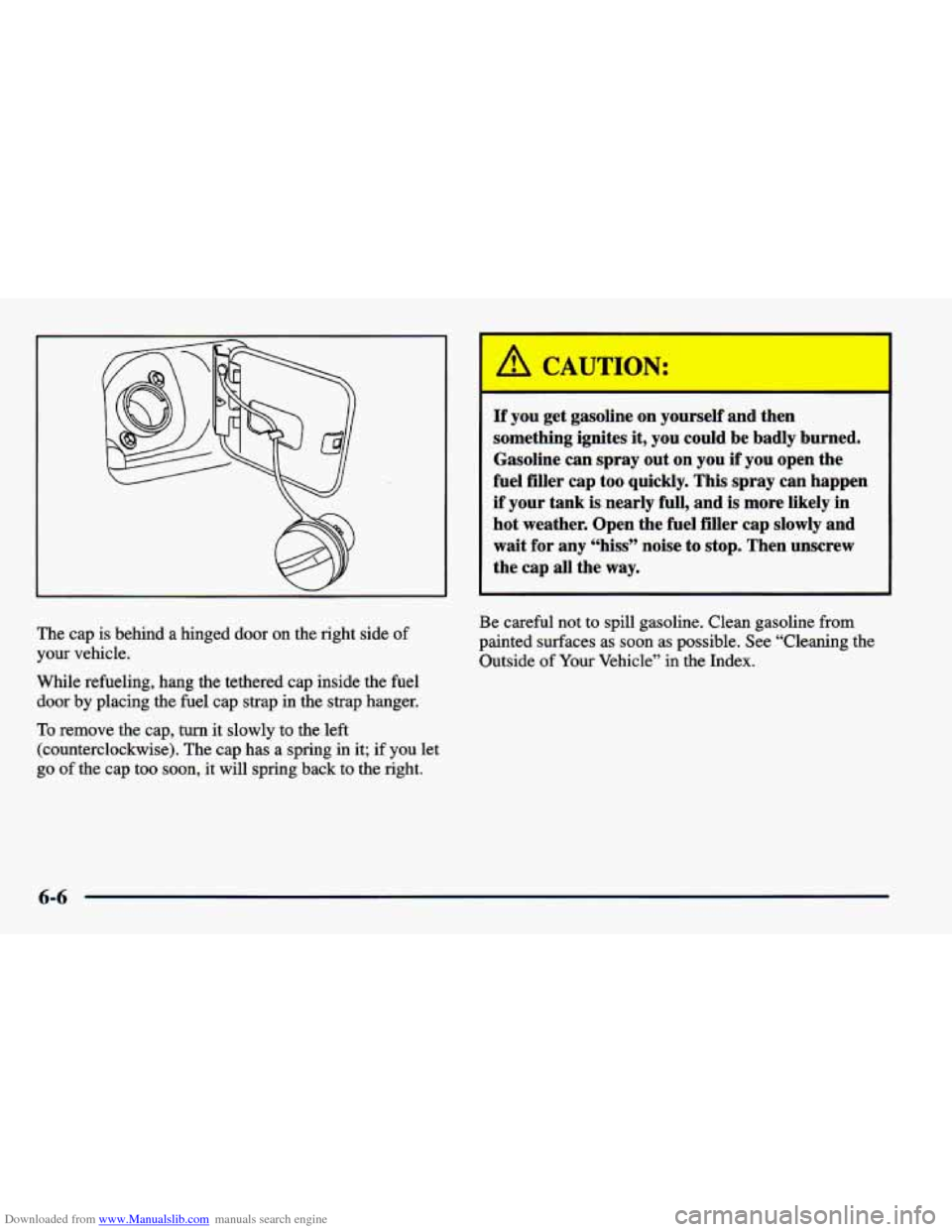
The cap is behind a hinged door on the right side of
your vehicle.
While refueling, hang the tethered cap inside the fuel door by placing the fuel cap strap in the strap hanger.
To remove the cap, turn it slowly to the left
(counterclockwise). The cap has a spring in it; if
you let
go
of the cap too soon, it will spring back to the right. Be
careful
not to spill gasoline. Clean gasoline from
painted surfaces as soon as possible. See “Cleaning the
Outside of Your Vehicle” in the Index.
6-6
Page 265 of 400
Downloaded from www.Manualslib.com manuals search engine When you put the cap back on, turn it to the right
(clockwise) until
you hear a clicking sound. Make sure
you fully install
the cap. The diagnostic system can
determine
if the he1 cap has been left off or improperly
installed.
This would allow fuel to evaporate into the
atmosphere.
See “Malfunction Indicator Lamp” in
the
Index.
NOTICE:
If you need a new cap, be sure to get the right
type. Your dealer can get one for you.
If you get
the wrong type, it may not
fit properly. This may
cause your malfunction indicator lamp to light
and your fuel
tank and emissions system may be
damaged. See “Malfunction Indicator Lamp” in
the Index.
Filling a Portable Fuel Container
Never fill a portable fuel container while it is in
your vehicle. Static electricity discharge from the
container can ignite the gasoline vapor.
You can
be badly burned and your vehicle damaged if this
occurs.
To help avoid injury to you and others:
Dispense gasoline only into approved
containers.
Do not fill a container while it is inside a
vehicle, in
a vehicle’s trunk, pickup bed or
on any surface other than the ground.
inside
of the fill opening before operating
the nozzle. Contact should be maintained
until the filling is complete.
Bring the fill nozzle in contact with the
Don’t smoke while pumping gasoline.
6-7
Page 322 of 400
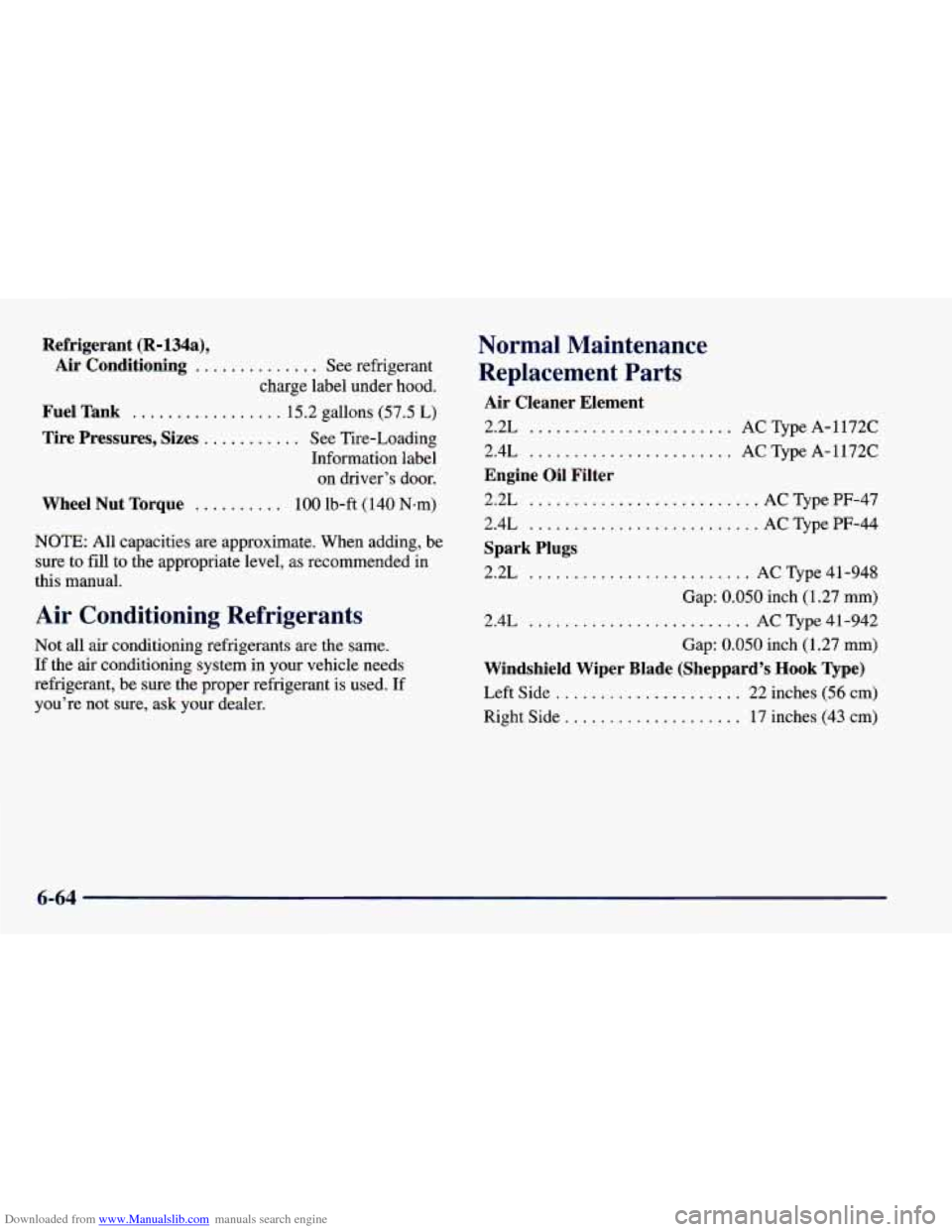
Downloaded from www.Manualslib.com manuals search engine Refrigerant (R=134a), Air Conditioning
.............. See refrigerant
charge label under hood.
Fuel Tank ................. 15.2 gallons (57.5 L)
Tire Pressures, Sizes ........... See Tire-Loading Information label on driver’s door.
Wheel Nut Torque .......... 100 lb-ft (140 Nmm)
NOTE: All capacities are approximate. When adding, be
sure to fill to the appropriate level, as recommended in
this manual.
Air Conditioning Refrigerants
Not all air conditioning refrigerants are the same.
If the air conditioning system in your vehicle needs
refrigerant, be sure the proper refrigerant is used. If
you’re not sure, ask your dealer.
Normal Maintenance
Replacement Parts
Air Cleaner Element
2.2L ....................... AC Type A- 11 72C
Engine Oil Filter
2.2L .......................... AC Type PF-47
2.4L
.......................... AC Type PF-44
Spark Plugs
2.2L ......................... AC Type 41-948
Gap:
0.050 inch (1.27 mm)
2.4L
......................... AC Type 4 1-942
Gap: 0.050 inch (1.27 mrn)
Windshield Wiper Blade (Sheppard’s Hook vpe)
Left Side ..................... 22 inches (56 cm)
Right Side.
................... 17 inches (43 cm)
2.4L
....................... AC Type A- 1172C
6-64
Page 331 of 400
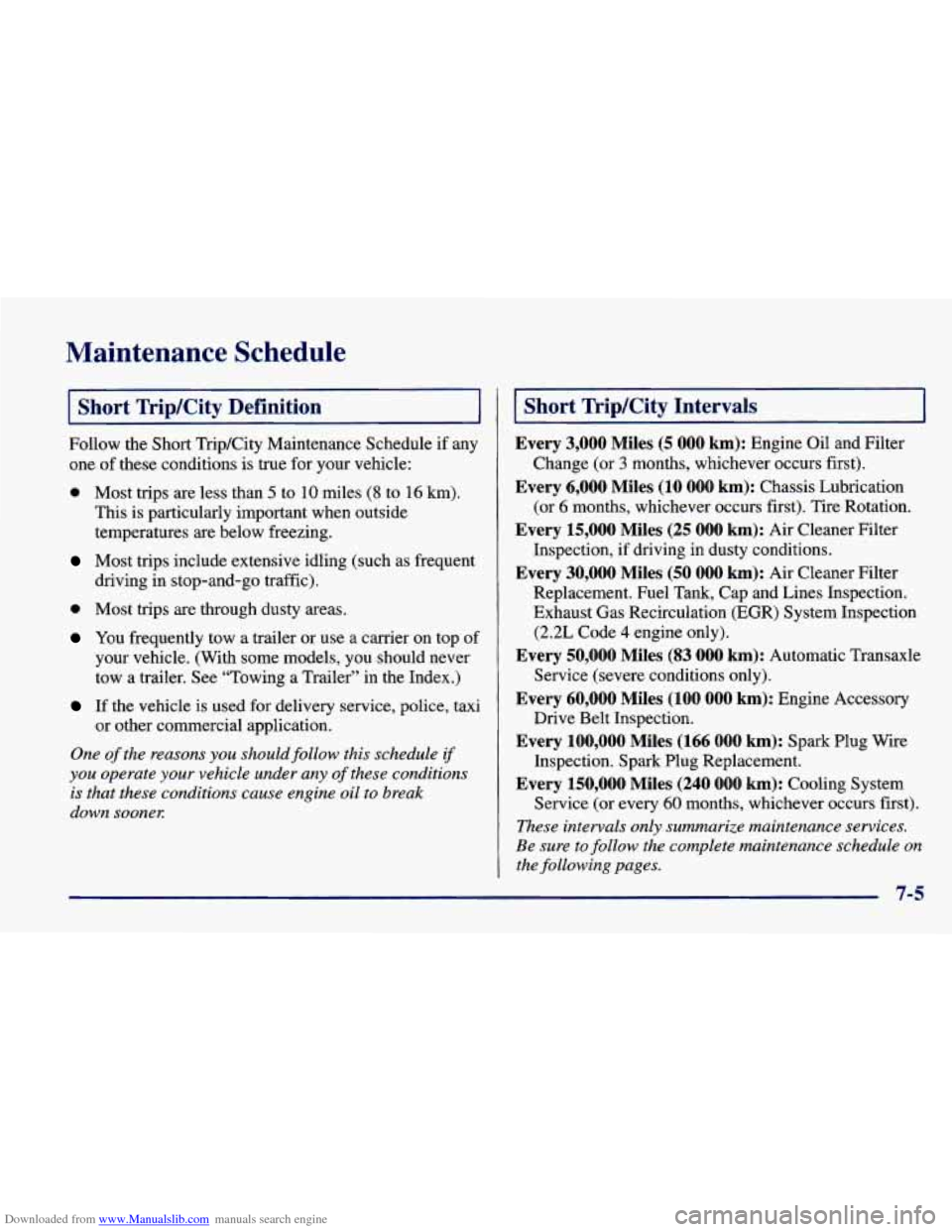
Downloaded from www.Manualslib.com manuals search engine Maintenance Schedule
-G/City Definition
Follow the Short TripKity Maintenance Schedule if any
one of these conditions is true for your vehicle:
0 Most trips are less than 5 to 10 miles (8 to 16 km).
This is particularly important when outside
temperatures are below freezing.
driving in stop-and-go traffic).
Most trips include extensive idling (such as frequent
0 Most trips are through dusty areas.
You frequently tow a trailer or use a carrier on top of
your vehicle. (With some models, you should never
tow a trailer. See “Towing a Trailer” in the Index.)
If the vehicle is used for delivery service, police, taxi
One of the reasons you should follow this schedule if
you operate your vehicle under any of these conditions
is that these conditions cause engine oil to break
down soonex
or other commercial application.
Short Trip/City Intervals
Every 3,000 Miles (5 000 km): Engine Oil and Filter
Every 6,000 Miles (10 000 km): Chassis Lubrication
Every 15,000 Miles (25 000 km): Air Cleaner Filter
Every 30,000 Miles (50 000 km): Air Cleaner Filter
Change (or
3 months, whichever occurs first).
(or
6 months, whichever occurs first). Tire Rotation.
Inspection, if driving in dusty conditions.
Replacement. Fuel Tank, Cap and Lines Inspection. Exhaust Gas Recirculation (EGR) System Inspection (2.2L Code
4 engine only).
Every 50,000 Miles (83 000 km): Automatic Transaxle
Service (severe conditions only).
Every 60,000 Miles (100 000 km): Engine Accessory
Drive Belt Inspection.
Every 100,000 Miles (166 000 km): Spark Plug Wire
Inspection. Spark Plug Replacement.
Every 150,000 Miles (240 000 km): Cooling System
Service (or every
60 months, whichever occurs first).
These intervals only summarize maintenance services.
Be sure to follow the complete maintenance schedule
on
the following pages.
7-5