warning light CHEVROLET CAVALIER 2003 3.G Owner's Manual
[x] Cancel search | Manufacturer: CHEVROLET, Model Year: 2003, Model line: CAVALIER, Model: CHEVROLET CAVALIER 2003 3.GPages: 364, PDF Size: 2.44 MB
Page 244 of 364
Engine Coolant
The cooling system in your vehicle is ®lled with
DEX-COOLžengine coolant. This coolant is designed
to remain in your vehicle for 5 years or 150,000 miles
(240 000 km), whichever occurs ®rst, if you add
only DEX-COOL
žextended life coolant.
The following explains your cooling system and how to
add coolant when it is low. If you have a problem
with engine overheating, see
Engine Overheating on
page 5-25.
A 50/50 mixture of clean, drinkable water and
DEX-COOL
žcoolant will:
·Give freezing protection down to-34ÉF (-37ÉC).
·Give boiling protection up to 265ÉF (129ÉC).
·Protect against rust and corrosion.
·Help keep the proper engine temperature.
·Let the warning lights and gages work as they
should.
Notice:When adding coolant, it is important that
you use only DEX-COOLž(silicate-free) coolant.
If coolant other than DEX-COOLžis added to
the system, premature engine, heater core or
radiator corrosion may result. In addition, the engine
coolant will require change sooner Ð at 30,000 miles
(50,000 km) or 24 months, whichever occurs ®rst.
Damage caused by the use of coolant other
than DEX-COOL
žis not covered by your new vehicle
warranty.
What to Use
Use a mixture of one-halfclean, drinkable waterand
one-half DEX-COOLžcoolant which won't damage
aluminum parts. If you use this coolant mixture,
you don't need to add anything else.
{CAUTION:
Adding only plain water to your cooling
system can be dangerous. Plain water, or
some other liquid such as alcohol, can boil
before the proper coolant mixture will.
CAUTION: (Continued)
5-22
Page 246 of 364
The vehicle must be on a level surface. When your
engine is cold, the coolant level should be at the FULL
COLD mark.
If the low coolant light
comes on and stays on, it
means you're low on
engine coolant. See
Low
Coolant Warning Light
on page 3-30
.
Adding Coolant
If you need more coolant, add the proper DEX-COOLž
coolant mixtureat the surge tank, but only when the
engine is cool. If the surge tank is empty, a special ®ll
procedure is necessary. See
Engine Overheating
on page 5-25for instructions on ªHow to Add Coolant to
the Coolant Surge Tank.º
{CAUTION:
You can be burned if you spill coolant on hot
engine parts. Coolant contains ethylene glycol,
and it will burn if the engine parts are hot
enough. Don't spill coolant on a hot engine.
When replacing the pressure cap, make sure it is
hand-tight.
Coolant Surge Tank Pressure Cap
Notice:Your pressure cap is a pressure-type
cap and must be tightly installed to prevent coolant
loss and possible engine damage from overheating.
See ªCapacities and Speci®cationsº for more
information.
5-24
Page 247 of 364
Engine Overheating
You will ®nd a coolant temperature gage and a low
coolant warning light on your vehicle's instrument panel.
See
Engine Coolant Temperature Gage on page 3-29andLow Coolant Warning Light on page 3-30.
If Steam Is Coming From Your Engine
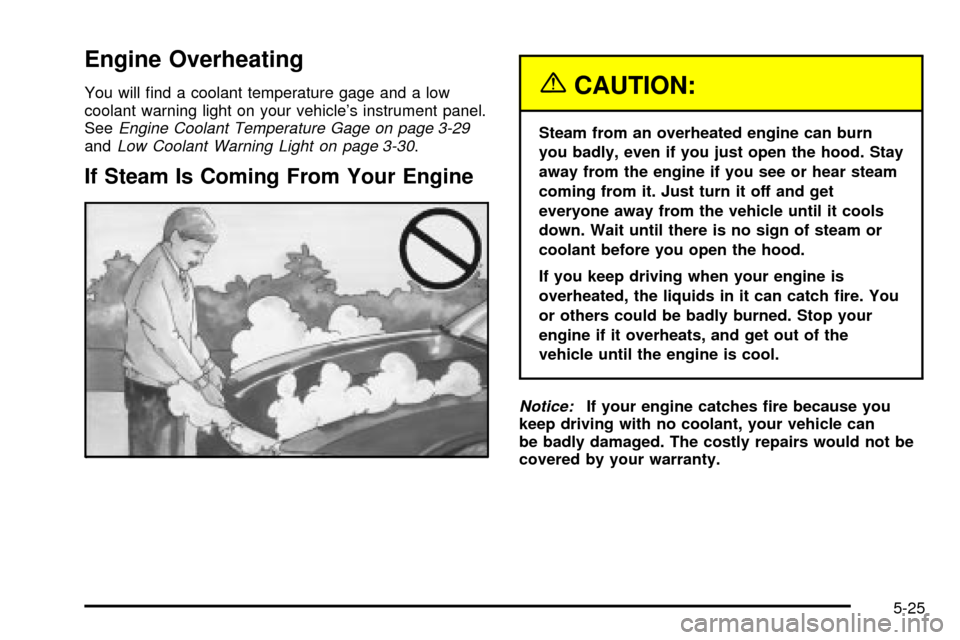
{CAUTION:
Steam from an overheated engine can burn
you badly, even if you just open the hood. Stay
away from the engine if you see or hear steam
coming from it. Just turn it off and get
everyone away from the vehicle until it cools
down. Wait until there is no sign of steam or
coolant before you open the hood.
If you keep driving when your engine is
overheated, the liquids in it can catch ®re. You
or others could be badly burned. Stop your
engine if it overheats, and get out of the
vehicle until the engine is cool.
Notice:If your engine catches ®re because you
keep driving with no coolant, your vehicle can
be badly damaged. The costly repairs would not be
covered by your warranty.
5-25
Page 248 of 364

If No Steam Is Coming From Your
Engine
An overheat warning, along with a low coolant light, can
indicate a serious problem. SeeLow Coolant Warning
Light on page 3-30.
If you get an engine overheat warning with no low
coolant light, but see or hear no steam, the problem may
not be too serious. Sometimes the engine can get a
little too hot when you:
·Climb a long hill on a hot day.
·Stop after high-speed driving.
·Idle for long periods in traffic.
·Tow a trailer.If you get the overheat warning with no sign of steam,
try this for a minute or so:
1. In heavy traffic, let the engine idle in NEUTRAL (N)
while stopped. If it is safe to do so, pull off the road,
shift to PARK (P) or NEUTRAL (N) and let the
engine idle.
2. Turn on your heater to full hot at the highest fan
speed and open the window as necessary.
If you no longer have the overheat warning, you can
drive. Just to be safe, drive slower for about 10 minutes.
If the warning doesn't come back on, you can drive
normally.
If the warning continues and you have not stopped, pull
over, stop, and park your vehicle right away.
If there's still no sign of steam, you can idle the engine
for three minutes while you're parked. If you still
have the warning,
turn off the engine and get everyone
out of the vehicleuntil it cools down.
You may decide not to lift the hood but to get service
help right away.
5-26
Page 257 of 364
Brakes
Brake Fluid
Your brake master cylinder reservoir is ®lled with DOT-3
brake ¯uid. SeeEngine Compartment Overview on
page 5-12for the location of the reservoir.
There are only two reasons why the brake ¯uid level in
the reservoir might go down. The ®rst is that the
brake ¯uid goes down to an acceptable level during
normal brake lining wear. When new linings are put in,
the ¯uid level goes back up. The other reason isthat ¯uid is leaking out of the brake system. If it is, you
should have your brake system ®xed, since a leak
means that sooner or later your brakes won't work well,
or won't work at all.
So, it isn't a good idea to ªtop offº your brake ¯uid.
Adding brake ¯uid won't correct a leak. If you add ¯uid
when your linings are worn, then you'll have too
much ¯uid when you get new brake linings. You should
add (or remove) brake ¯uid, as necessary, only when
work is done on the brake hydraulic system.
{CAUTION:
If you have too much brake ¯uid, it can spill on
the engine. The ¯uid will burn if the engine is
hot enough. You or others could be burned,
and your vehicle could be damaged. Add brake
¯uid only when work is done on the brake
hydraulic system.
When your brake ¯uid falls to a low level, your brake
warning light will come on. See
Brake System Warning
Light on page 3-26.
5-35
Page 259 of 364
Brake Wear
Your vehicle has front disc brakes and rear drum
brakes.
Disc brake pads have built-in wear indicators that make
a high-pitched warning sound when the brake pads
are worn and new pads are needed. The sound
may come and go or be heard all the time your vehicle
is moving (except when you are pushing on the
brake pedal ®rmly).
{CAUTION:
The brake wear warning sound means that
soon your brakes won't work well. That could
lead to an accident. When you hear the brake
wear warning sound, have your vehicle
serviced.
Notice:Continuing to drive with worn-out brake
pads could result in costly brake repair.Some driving conditions or climates may cause a brake
squeal when the brakes are ®rst applied or lightly
applied. This does not mean something is wrong with
your brakes.
See
Caliper/Knuckle MaintenanceInspection on
page 6-24.
Properly torqued wheel nuts are necessary to help
prevent brake pulsation. When tires are rotated, inspect
brake pads for wear and evenly tighten wheel nuts in
the proper sequence to GM torque speci®cations.
Your rear drum brakes don't have wear indicators, but if
you ever hear a rear brake rubbing noise, have the
rear brake linings inspected immediately. Also, the rear
brake drums should be removed and inspected each
time the tires are removed for rotation or changing.
When you have the front brake pads replaced, have the
rear brakes inspected, too.
Brake linings should always be replaced as complete
axle sets.
See
Brake System Inspection on page 6-24.
5-37
Page 278 of 364

Uniform Tire Quality Grading
Quality grades can be found where applicable on the
tire sidewall between tread shoulder and maximum
section width. For example:
Treadwear 200 Traction AA Temperature A
The following information relates to the system
developed by the United States National Highway
Traffic Safety Administration, which grades tires by
treadwear, traction and temperature performance. (This
applies only to vehicles sold in the United States.)
The grades are molded on the sidewalls of most
passenger car tires. The Uniform Tire Quality Grading
system does not apply to deep tread, winter-type
snow tires, space-saver or temporary use spare tires,
tires with nominal rim diameters of 10 to 12 inches
(25 to 30 cm), or to some limited-production tires.
While the tires available on General Motors passenger
cars and light trucks may vary with respect to these
grades, they must also conform to federal safety
requirements and additional General Motors Tire
Performance Criteria (TPC) standards.
Treadwear
The treadwear grade is a comparative rating based on
the wear rate of the tire when tested under controlled
conditions on a speci®ed government test course.
For example, a tire graded 150 would wear one and
a half (1.5) times as well on the government course as
a tire graded 100. The relative performance of tires
depends upon the actual conditions of their use,
however, and may depart signi®cantly from the norm
due to variations in driving habits, service practices and
differences in road characteristics and climate.
Traction ± AA, A, B, C
The traction grades, from highest to lowest, are AA, A,
B, and C. Those grades represent the tire's ability
to stop on wet pavement as measured under controlled
conditions on speci®ed government test surfaces of
asphalt and concrete. A tire marked C may have poor
traction performance. Warning: The traction grade
assigned to this tire is based on straight-ahead braking
traction tests, and does not include acceleration,
cornering, hydroplaning, or peak traction characteristics.
5-56
Page 349 of 364

A
Accessory Power Outlets.................................3-16
Adding Washer Fluid.......................................5-34
Additional Program Information........................... 7-9
Additives, Fuel................................................. 5-5
Add-On Electrical Equipment............................5-80
Adjusting the Speakers
(Balance/Fade)....................3-38, 3-42, 3-52, 3-66
Air Bag Systems.............................................1-49
How Does an Air Bag Restrain?....................1-56
Servicing Your Air Bag-Equipped Vehicle.........1-58
What Makes an Air Bag In¯ate?....................1-55
What Will You See After an Air
Bag In¯ates?...........................................1-56
When Should an Air Bag In¯ate?...................1-55
Where Are the Air Bags?..............................1-52
Air Bag .........................................................3-24
Readiness Light..........................................3-24
Air Cleaner/Filter, Engine.................................5-18
AM-FM Radio.................................................3-37
AM ...............................................................3-76
Antenna, Fixed Mast.......................................3-78
Antenna, XMŸ Satellite Radio Antenna System . . 3-79
Anti-lock Brake System (ABS)............................ 4-6
Anti-Lock Brake, System Warning Light..............3-27
Appearance Care............................................5-71
Care of Safety Belts....................................5-74
Chemical Paint Spotting...............................5-77
Cleaning the Inside of Your Vehicle................5-71Appearance Care (cont.)
Cleaning the Outside of Your Vehicle..............5-74
Finish Damage............................................5-77
Sheet Metal Damage...................................5-77
Underbody Maintenance...............................5-77
Vehicle Care/Appearance Materials................5-78
Weatherstrips..............................................5-74
Arming the System.........................................2-15
Ashtrays........................................................3-16
Audio System(s).............................................3-36
AM-FM Radio.............................................3-37
Care of Your Cassette Tape Player................3-77
Care of Your CD Player...............................3-78
Care of Your CDs........................................3-78
Chime Level Adjustment...............................3-79
Fixed Mast Antenna.....................................3-78
Personal Choice Radio Controls....................3-75
Radio with Cassette and CD.........................3-63
Radio with CD....................................3-39, 3-49
Setting the Time for Radios with Radio
Data Systems (RDS)................................3-36
Setting the Time for Radios without
Radio Data Systems (RDS).......................3-36
Theft-Deterrent Feature................................3-76
Understanding Radio Reception.....................3-76
XMŸ Satellite Radio Antenna System............3-79
Automatic Transaxle Inspection.........................6-20
Automatic Transaxle Shift Lock Control
System Check.............................................6-21
1
Page 350 of 364

Automatic Transaxle........................................2-19
Fluid..........................................................5-20
Operation...................................................2-22
B
Backing Up....................................................4-38
Battery Replacement......................................... 2-6
Battery Run-Down Protection............................3-15
Battery..........................................................5-39
Before Leaving on a Long Trip.........................4-21
Body Lubrication Service..................................6-20
Brake Fluid....................................................5-35
Brake Wear...................................................5-37
Brake............................................................2-26
Parking......................................................2-26
System Inspection.......................................6-24
System Warning Light..................................3-26
Brakes..........................................................5-35
Braking in Emergencies..................................... 4-8
Braking........................................................... 4-6
Break-In, New Vehicle.....................................2-17
Bulb Replacement...........................................5-45
Back-Up Lamps...........................................5-49
Front Turn Signal and Parking Lamps.............5-47
Halogen Bulbs............................................5-45
Headlamps.................................................5-45Bulb Replacement (cont.)
Replacement Bulbs......................................5-49
Taillamps and Turn Signal Lamps..................5-48
Buying New Tires...........................................5-55C
California Fuel.................................................. 5-5
Caliper/Knuckle MaintenanceInspection.............6-24
Canada ± Customer Assistance.......................... 7-4
Canadian Owners................................................ ii
Canadian Roadside Assistance........................... 7-7
Canceling the Rear Door Security Lock............... 2-9
Capacities and Speci®cations............................5-85
Carbon Monoxide...........4-24, 4-34, 4-40, 2-10, 2-30
Care of.........................................................5-74
Safety Belts................................................5-74
Your Cassette Tape Player............................3-77
Your CD Player...........................................3-78
Your CDs ...................................................3-78
Cassette Tape Messages.................................3-72
Cassette Tape Player Service...........................6-19
CD Adapter Kits.............................................3-73
Center Console Storage Area...........................2-35
Chains, Tires..................................................5-59
Charging System Light....................................3-25
Check Engine Light.........................................3-30
2
Page 351 of 364

Checking Coolant............................................5-23
Checking Engine Oil........................................5-14
Checking Things Under the Hood......................5-10
Checking Your Restraint Systems......................1-58
Check...........................................................3-30
Engine Light...............................................3-30
Gages Warning Light...................................3-34
Chemical Paint Spotting...................................5-77
Child Restraints..............................................1-35
Child Restraint Systems...............................1-35
Infants and Young Children...........................1-32
Lower Anchorages and Top Tethers for
Children (LATCH System)..........................1-41
Older Children.............................................1-29
Securing a Child Restraint Designed for
the LATCH System...................................1-43
Securing a Child Restraint in a Rear
Seat Position...........................................1-43
Securing a Child Restraint in the Right
Front Seat Position...................................1-46
Top Strap Anchor Location............................1-40
Top Strap...................................................1-39
Where to Put the Restraint...........................1-38
Chime Level Adjustment..................................3-79
Cigarette Lighter.............................................3-16
Cleaning Aluminum or Chrome-Plated Wheels.....5-76
Cleaning Exterior Lamps/Lenses.......................5-75
Cleaning Fabric/Carpet....................................5-71
Cleaning Glass Surfaces..................................5-73Cleaning Interior Plastic Components.................5-73
Cleaning the Top of the
Instrument Panel.........................................5-73
Cleaning Tires................................................5-77
Cleaning Vinyl................................................5-73
Cleaning Windshield and Wiper Blades..............5-76
Cleaning........................................................5-71
Inside of Your Vehicle..................................5-71
Outside of Your Vehicle................................5-74
Underbody Maintenance...............................5-77
Weatherstrips..............................................5-74
Climate Control System...................................3-17
Outlet Adjustment........................................3-20
Clutch, Hydraulic.............................................5-21
Compact Disc Messages.................3-48, 3-63, 3-75
Compact Spare Tire........................................5-70
Content Theft-Deferrent....................................2-15
Control of a Vehicle.......................................... 4-5
Convenience Net............................................2-36
Coolant.........................................................3-29
Engine Temperature Gage............................3-29
Heater, Engine............................................2-21
Low Warning Light.......................................3-30
Surge Tank Pressure Cap.............................5-24
Cooling System..............................................5-27
Cruise Control.................................................. 3-8
Cupholder(s)..................................................2-35
Current and Past Model Order Forms................7-11
3