belt CHEVROLET CAVALIER 2003 3.G Workshop Manual
[x] Cancel search | Manufacturer: CHEVROLET, Model Year: 2003, Model line: CAVALIER, Model: CHEVROLET CAVALIER 2003 3.GPages: 364, PDF Size: 2.44 MB
Page 222 of 364

When You Are Ready to Leave After
Parking on a Hill
1. Apply your regular brakes and hold the pedal down
while you:
·start your engine,
·shift into a gear, and
·release the parking brake.
2. Let up on the brake pedal.
3. Drive slowly until the trailer is clear of the chocks.
4. Stop and have someone pick up and store the
chocks.
Maintenance When Trailer Towing
Your vehicle will need service more often when you're
pulling a trailer. SeePart A: Scheduled Maintenance
Services on page 6-4for more on this. Things that are
especially important in trailer operation are automatic
transaxle ¯uid (don't over®ll), engine oil, drive belt,
cooling system and brake system.
Each of these is covered in this manual, and the Index
will help you ®nd them quickly. If you're trailering,
it's a good idea to review this information before you
start your trip.
Check periodically to see that all hitch nuts and bolts
are tight.
Engine Cooling When Trailer Towing
Your cooling system may temporarily overheat during
severe operating conditions. SeeEngine Overheating on
page 5-25.
Towing a Trailer (Manual Transaxle)
Do not tow a trailer if your vehicle is equipped with a
manual transaxle.
4-40
Page 224 of 364

Appearance Care............................................5-71
Cleaning the Inside of Your Vehicle.................5-71
Care of Safety Belts......................................5-74
Weatherstrips...............................................5-74
Cleaning the Outside of Your Vehicle..............5-74
Sheet Metal Damage.....................................5-77
Finish Damage.............................................5-77
Underbody Maintenance................................5-77
Chemical Paint Spotting.................................5-77
Vehicle Care/Appearance Materials..................5-78
Vehicle Identi®cation......................................5-79
Vehicle Identi®cation Number (VIN).................5-79
Service Parts Identi®cation Label.....................5-80Electrical System............................................5-80
Add-On Electrical Equipment..........................5-80
Headlamp Wiring..........................................5-81
Windshield Wiper Fuses................................5-81
Power Windows and Other Power Options.......5-81
Fuses and Circuit Breakers............................5-81
Capacities and Speci®cations..........................5-85
Normal Maintenance Replacement Parts..........5-86
Normal Maintenance Replacement Parts..........5-86
Section 5 Service and Appearance Care
5-2
Page 277 of 364
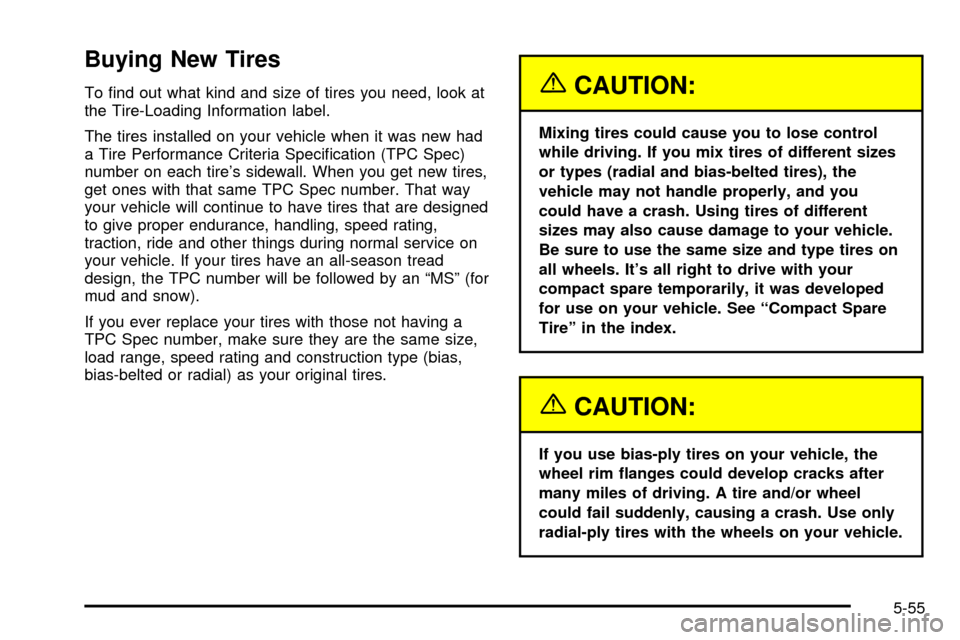
Buying New Tires
To ®nd out what kind and size of tires you need, look at
the Tire-Loading Information label.
The tires installed on your vehicle when it was new had
a Tire Performance Criteria Speci®cation (TPC Spec)
number on each tire's sidewall. When you get new tires,
get ones with that same TPC Spec number. That way
your vehicle will continue to have tires that are designed
to give proper endurance, handling, speed rating,
traction, ride and other things during normal service on
your vehicle. If your tires have an all-season tread
design, the TPC number will be followed by an ªMSº (for
mud and snow).
If you ever replace your tires with those not having a
TPC Spec number, make sure they are the same size,
load range, speed rating and construction type (bias,
bias-belted or radial) as your original tires.{CAUTION:
Mixing tires could cause you to lose control
while driving. If you mix tires of different sizes
or types (radial and bias-belted tires), the
vehicle may not handle properly, and you
could have a crash. Using tires of different
sizes may also cause damage to your vehicle.
Be sure to use the same size and type tires on
all wheels. It's all right to drive with your
compact spare temporarily, it was developed
for use on your vehicle. See ªCompact Spare
Tireº in the index.
{CAUTION:
If you use bias-ply tires on your vehicle, the
wheel rim ¯anges could develop cracks after
many miles of driving. A tire and/or wheel
could fail suddenly, causing a crash. Use only
radial-ply tires with the wheels on your vehicle.
5-55
Page 296 of 364
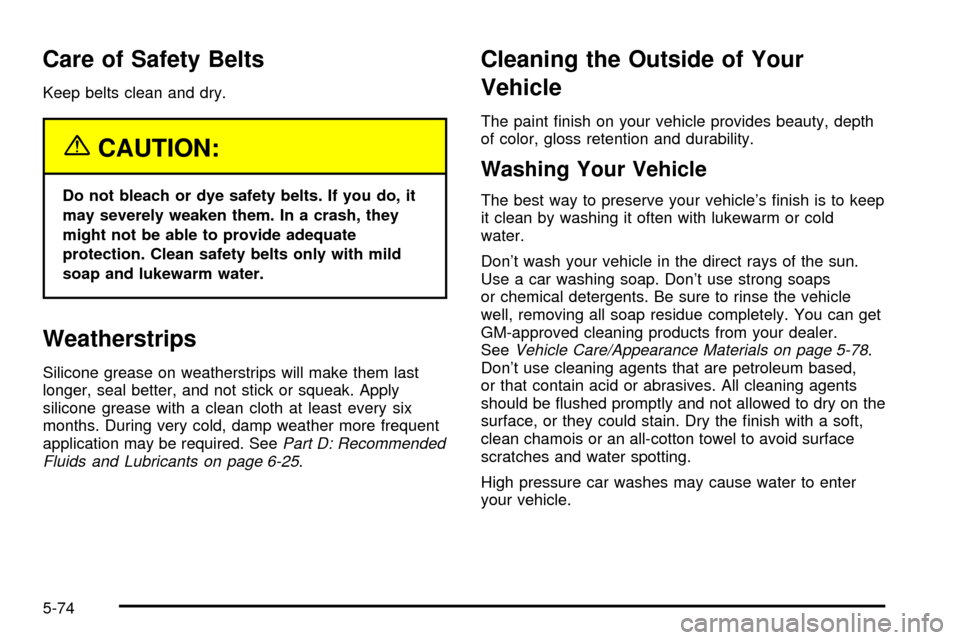
Care of Safety Belts
Keep belts clean and dry.
{CAUTION:
Do not bleach or dye safety belts. If you do, it
may severely weaken them. In a crash, they
might not be able to provide adequate
protection. Clean safety belts only with mild
soap and lukewarm water.
Weatherstrips
Silicone grease on weatherstrips will make them last
longer, seal better, and not stick or squeak. Apply
silicone grease with a clean cloth at least every six
months. During very cold, damp weather more frequent
application may be required. See
Part D: Recommended
Fluids and Lubricants on page 6-25.
Cleaning the Outside of Your
Vehicle
The paint ®nish on your vehicle provides beauty, depth
of color, gloss retention and durability.
Washing Your Vehicle
The best way to preserve your vehicle's ®nish is to keep
it clean by washing it often with lukewarm or cold
water.
Don't wash your vehicle in the direct rays of the sun.
Use a car washing soap. Don't use strong soaps
or chemical detergents. Be sure to rinse the vehicle
well, removing all soap residue completely. You can get
GM-approved cleaning products from your dealer.
See
Vehicle Care/Appearance Materials on page 5-78.
Don't use cleaning agents that are petroleum based,
or that contain acid or abrasives. All cleaning agents
should be ¯ushed promptly and not allowed to dry on the
surface, or they could stain. Dry the ®nish with a soft,
clean chamois or an all-cotton towel to avoid surface
scratches and water spotting.
High pressure car washes may cause water to enter
your vehicle.
5-74
Page 313 of 364

Selecting the Right Schedule
First you'll need to decide which of the two schedules is
right for your vehicle. Here's how to decide which
schedule to follow:
Short Trip/City De®nition
Follow the Short Trip/City Scheduled Maintenance if any
one of these conditions is true for your vehicle:
·Most trips are less than 5 miles (8 km). This is
particularly important when outside temperatures
are below freezing.
·Most trips include extensive idling, such as frequent
driving in stop-and-go traffic.
·You frequently tow a trailer or use a carrier on top
of your vehicle. With some models, you should
never tow a trailer. See
Towing a Trailer (Automatic
Transaxle) on page 4-34orTowing a Trailer
(Manual Transaxle) on page 4-40.
·If the vehicle is used for delivery service, police,
taxi or other commercial application.
One of the reasons you should follow this schedule if
you operate your vehicle under any of these conditions
is that these conditions cause engine oil to break
down sooner.
Short Trip/City Intervals
Every 3,000 Miles (5 000 km):Engine Oil and Filter
Change (or 3 months, whichever occurs ®rst).
Every 6,000 Miles (10 000 km):Chassis Lubrication (or
6 months, whichever occurs ®rst). Tire Rotation.
Every 15,000 Miles (25 000 km):Engine Air Cleaner
Filter Inspection.
Every 30,000 Miles (50 000 km):Engine Air Cleaner
Filter Replacement.
Every 50,000 Miles (83 000 km):Automatic Transaxle
Service (severe conditions only).
Every 100,000 Miles (166 000 km):Spark Plug Wire
Inspection. Spark Plug Replacement.
Every 150 000 Miles (240 000 km):Cooling System
Service (or every 60 months, whichever occurs
®rst). Engine Accessory Drive Belt Inspection.
These intervals only summarize maintenance services.
Be sure to follow the complete scheduled maintenance
on the following pages.
6-5
Page 314 of 364

Long Trip/Highway De®nition
Follow this scheduled maintenanceonlyif none of the
conditions from the Short Trip/City Scheduled
Maintenance are true. Do not use this schedule if the
vehicle is used for trailer towing, driven in a dusty area
or used off paved roads. Use the Short Trip/City
schedule for these conditions.
Driving a vehicle with a fully warmed engine under
highway conditions will cause engine oil to break down
slower.
Long Trip/Highway Intervals
Every 7,500 Miles (12 500 km):Engine Oil and Filter
Change (or every 12 months, whichever occurs
®rst). Chassis Lubrication (or 12 months, whichever
occurs ®rst). Tire Rotation.
Every 15,000 Miles (25 000 km):Engine Air Cleaner
Filter Inspection.
Every 30,000 Miles (50 000 km):Engine Air Cleaner
Filter Replacement.
Every 50,000 Miles (83 000 km):Automatic Transaxle
Service (severe conditions only).Every 100,000 Miles (166 000 km):Spark Plug Wire
Inspection. Spark Plug Replacement.
Every 150,000 Miles (240 000 km):Cooling System
Service (or every 60 months, whichever occurs
®rst). Engine Accessory Drive Belt Inspection.
These intervals only summarize maintenance services.
Be sure to follow the complete scheduled maintenance
on the following pages.
Short Trip/City Scheduled
Maintenance
The services shown in this schedule up to 100,000 miles
(166 000 km) should be repeated after 100,000 miles
(166 000 km) at the same intervals for the life of
this vehicle. The services shown at 150,000 miles
(240 000 km) should be repeated at the same interval
after 150,000 miles (240 000 km) for the life of this
vehicle.
See
Part B: Owner Checks and Services on page 6-19andPart C: Periodic MaintenanceInspections on
page 6-23.
6-6
Page 321 of 364

100,000 Miles (166 000 km)
qReplace spark plugs.An Emission Control Service.
qChange automatic transaxle ¯uid and ®lter if the
vehicle is mainly driven under one or more of
these conditions:
þ In heavy city traffic where the outside
temperature regularly reaches 90ÉF (32ÉC) or
higher.
þ In hilly or mountainous terrain.
þ When doing frequent trailer towing.
þ Uses such as found in taxi, police or delivery
service.
If you do not use your vehicle under any of these
conditions, the ¯uid and ®lter do not require changing.
Manual transaxle ¯uid doesn't require changing.
150,000 Miles (240 000 km)
qDrain, ¯ush and re®ll cooling system (or every
60 months since last service, whichever occurs ®rst).
See
Engine Coolant on page 5-22for what to use.
Inspect hoses. Clean radiator, condenser, pressure
cap and neck. Pressure test the cooling system
and pressure cap.
An Emission Control Service.
qInspect engine accessory drive belt.An Emission
Control Service.
6-13
Page 326 of 364

100,000 Miles (166 000 km)
qReplace spark plugs.An Emission Control Service.
qChange automatic transaxle ¯uid and ®lter if the
vehicle is mainly driven under one or more of
these conditions:
þ In heavy city traffic where the outside
temperature regularly reaches 90ÉF (32ÉC) or
higher.
þ In hilly or mountainous terrain.
þ When doing frequent trailer towing.
þ Uses such as found in taxi, police or delivery
service.
If you do not use your vehicle under any of these
conditions, the ¯uid and ®lter do not require changing.
Manual transaxle ¯uid doesn't require change.
150,000 Miles (240 000 km)
qDrain, ¯ush and re®ll cooling system (or every
60 months since last service, whichever occurs ®rst).
See
Engine Coolant on page 5-22for what to use.
Inspect hoses. Clean radiator, condenser, pressure
cap and neck. Pressure test the cooling system
and pressure cap.
An Emission Control Service.
qInspect engine accessory drive belt.An Emission
Control Service.
6-18
Page 327 of 364

Part B: Owner Checks and Services
Listed in this part are owner checks and services
which should be performed at the intervals speci®ed to
help ensure the safety, dependability and emission
control performance of your vehicle.
Be sure any necessary repairs are completed at once.
Whenever any ¯uids or lubricants are added to your
vehicle, make sure they are the proper ones, as shown
in Part D.
At Each Fuel Fill
It is important for you or a service station attendant to
perform these underhood checks at each fuel ®ll.
Engine Oil Level Check
Check the engine oil level and add the proper oil if
necessary. SeeEngine Oil on page 5-14for further
details.
Engine Coolant Level Check
Check the engine coolant level and add DEX-COOLž
coolant mixture if necessary. SeeEngine Coolant
on page 5-22for further details.
Windshield Washer Fluid Level Check
Check the windshield washer ¯uid level in the windshield
washer tank and add the proper ¯uid if necessary. See
Windshield Washer Fluid on page 5-34for further details.
At Least Once a Month
Tire In¯ation Check
Make sure tires are in¯ated to the correct pressures.
Don't forget to check your spare tire. SeeTires on
page 5-51for further details.
Cassette Tape Player Service
Clean cassette tape player. Cleaning should be done
every 50 hours of tape play. SeeAudio System(s)
on page 3-36for further details.
At Least Twice a Year
Restraint System Check
Make sure the safety belt reminder light and all your
belts, buckles, latch plates, retractors and anchorages
are working properly. Look for any other loose or
damaged safety belt system parts. If you see anything
that might keep a safety belt system from doing its
job, have it repaired. Have any torn or frayed safety belts
replaced.
Also look for any opened or broken air bag coverings,
and have them repaired or replaced. (The air bag
system does not need regular maintenance.)
6-19
Page 349 of 364

A
Accessory Power Outlets.................................3-16
Adding Washer Fluid.......................................5-34
Additional Program Information........................... 7-9
Additives, Fuel................................................. 5-5
Add-On Electrical Equipment............................5-80
Adjusting the Speakers
(Balance/Fade)....................3-38, 3-42, 3-52, 3-66
Air Bag Systems.............................................1-49
How Does an Air Bag Restrain?....................1-56
Servicing Your Air Bag-Equipped Vehicle.........1-58
What Makes an Air Bag In¯ate?....................1-55
What Will You See After an Air
Bag In¯ates?...........................................1-56
When Should an Air Bag In¯ate?...................1-55
Where Are the Air Bags?..............................1-52
Air Bag .........................................................3-24
Readiness Light..........................................3-24
Air Cleaner/Filter, Engine.................................5-18
AM-FM Radio.................................................3-37
AM ...............................................................3-76
Antenna, Fixed Mast.......................................3-78
Antenna, XMŸ Satellite Radio Antenna System . . 3-79
Anti-lock Brake System (ABS)............................ 4-6
Anti-Lock Brake, System Warning Light..............3-27
Appearance Care............................................5-71
Care of Safety Belts....................................5-74
Chemical Paint Spotting...............................5-77
Cleaning the Inside of Your Vehicle................5-71Appearance Care (cont.)
Cleaning the Outside of Your Vehicle..............5-74
Finish Damage............................................5-77
Sheet Metal Damage...................................5-77
Underbody Maintenance...............................5-77
Vehicle Care/Appearance Materials................5-78
Weatherstrips..............................................5-74
Arming the System.........................................2-15
Ashtrays........................................................3-16
Audio System(s).............................................3-36
AM-FM Radio.............................................3-37
Care of Your Cassette Tape Player................3-77
Care of Your CD Player...............................3-78
Care of Your CDs........................................3-78
Chime Level Adjustment...............................3-79
Fixed Mast Antenna.....................................3-78
Personal Choice Radio Controls....................3-75
Radio with Cassette and CD.........................3-63
Radio with CD....................................3-39, 3-49
Setting the Time for Radios with Radio
Data Systems (RDS)................................3-36
Setting the Time for Radios without
Radio Data Systems (RDS).......................3-36
Theft-Deterrent Feature................................3-76
Understanding Radio Reception.....................3-76
XMŸ Satellite Radio Antenna System............3-79
Automatic Transaxle Inspection.........................6-20
Automatic Transaxle Shift Lock Control
System Check.............................................6-21
1