service CHEVROLET CITATION 1980 1.G Owners Manual
[x] Cancel search | Manufacturer: CHEVROLET, Model Year: 1980, Model line: CITATION, Model: CHEVROLET CITATION 1980 1.GPages: 95, PDF Size: 21.48 MB
Page 3 of 95
Downloaded from www.Manualslib.com manuals search engine A WORD TO CITATION OWNERS
:;':'.'1'.;.-:,-, 32 ~ This manual has beet} prepared to acquaint vou-:withtheoperation and maintenance of your 1980 Citation, and to provide importa~t~afeJY infc?rmation. It is supplemented by a Maintenance Schedule and a Warranty Information folder. We urge you to read these three publications carefully. Follow the recommendations to help assure the most enjoyable, safe and troublefree operation of your vehicle.
While reading this manual, you will notice that specifications are given in both metric and customary measures. Where precise accuracy is not needed, some conversions
have been rounded to even numbers for your handy use.
When it comes to service, remember that your Chevrolet dealer knows your vehicle
best and is interested in your complete satisfaction.
Be
sure to discuss the GM Continuou's'Protection Plan with your dealer, if you haven't already done so. The Plan is an optional service contract which goes beyond the New Vehicle Limited Warranty and gives you added mechanical and electrical protection for a total of 36 months or 36,000 miles (60 000 kilometers in Canada), whichever comes first. In the U.S., the Plan is also available at extra cost for a total of 36 months or 50,000 miles, whichever comes first See your dealer for the full details. The Plan is available for up to 60 days after you take delivery of your new vehicle.
To help dealers handle your needs, Chevrolet has a number of Zone Offices throughout the country. If you have a problem that has not been handled to your satisfaction, follow the steps in "Owner Assistance," Section 6 of this manual.
We thank you for choosing a Chevrolet product, and want to assure you of our continuing interest in your motoring pleasure and satisfaction.
CHEVROLET MOTOR DIVISION
FOR CONTINUING SATISFACTION,
KEEP YOUR GM CAR ALL GM.
GENERAL
MOTORS PARTS ARE IDENTIFIED BY ONE OF THESE TRADEMARKS:
NOTE TO CANADIAN OWNERS:
If preferred, a French Owner's Manual can be obtained either from your Dealer or by writing to General Motors of Canada Limited, Technical Publications Department, Oshawa, Ontario L1J 5Z6.
Aux propriehaires canadiens
On peut se procurer un exemplaire de ce guide en francais aupres du concessionnaire ou du service des publications techniques, General Motors of Canada Limited, Oshawa, Ontario L 1J 5Z6.
Page 4 of 95
Downloaded from www.Manualslib.com manuals search engine 1980 CHEVROLET CITATION
OWNER'S
MANUAL
rHIS "lANUAL SHOULDSE CONSIDERED A PERMANENT PART OF THIS CAR. IT 3HOULD STAY WITH THE CAR WHEN SOLD. TO PROVIDE THE NEXT OWNER WITH "lPORTANT OPERATING. SAFETY. AND MAINTENANCE INFORMATION.
CHEVROLET MOTOR DIVISION
GENERAL MOTORS CORPORATION
DETROIT, MICHIGAN 48202
4lrinformatlon, illustrations and specifications in thisma'n 'ual are ' based on the latest t. )roduct information available at the time of printing. The right is rese rved to make ~hanges at any time without notice.
Co" cars sold in Canada , substitute the name General Motors of Canada Limited ",herever the name Chevro-'et Motor D;vision appears in this manual.
Table of Contents
Section
.1 Before Driving Your · Citation .... . ,-,
-__ 2 Starting and Operating .. . ..... 2-'
Steering Column Contr~!s 2-5
.
Floor Controls .. 2-13
Instrument Panel 2-15
Other Controls and Features . 2-26
3--'ln Case of Emergency . 3-1
4 Appearance Care .. ..... 4-'
:' 5 Service and Maintenance 5-'
6 Owner Assistance. 6-1
7 Specifications, service Manuals , Ind ex, Service Station Information .... ". _ .... , ................... 7~ 1
Page 8 of 95
Downloaded from www.Manualslib.com manuals search engine SEAT CONTROLS
ADJUSTMENT OF SEAT POSITION
Manually Operated Front Seats
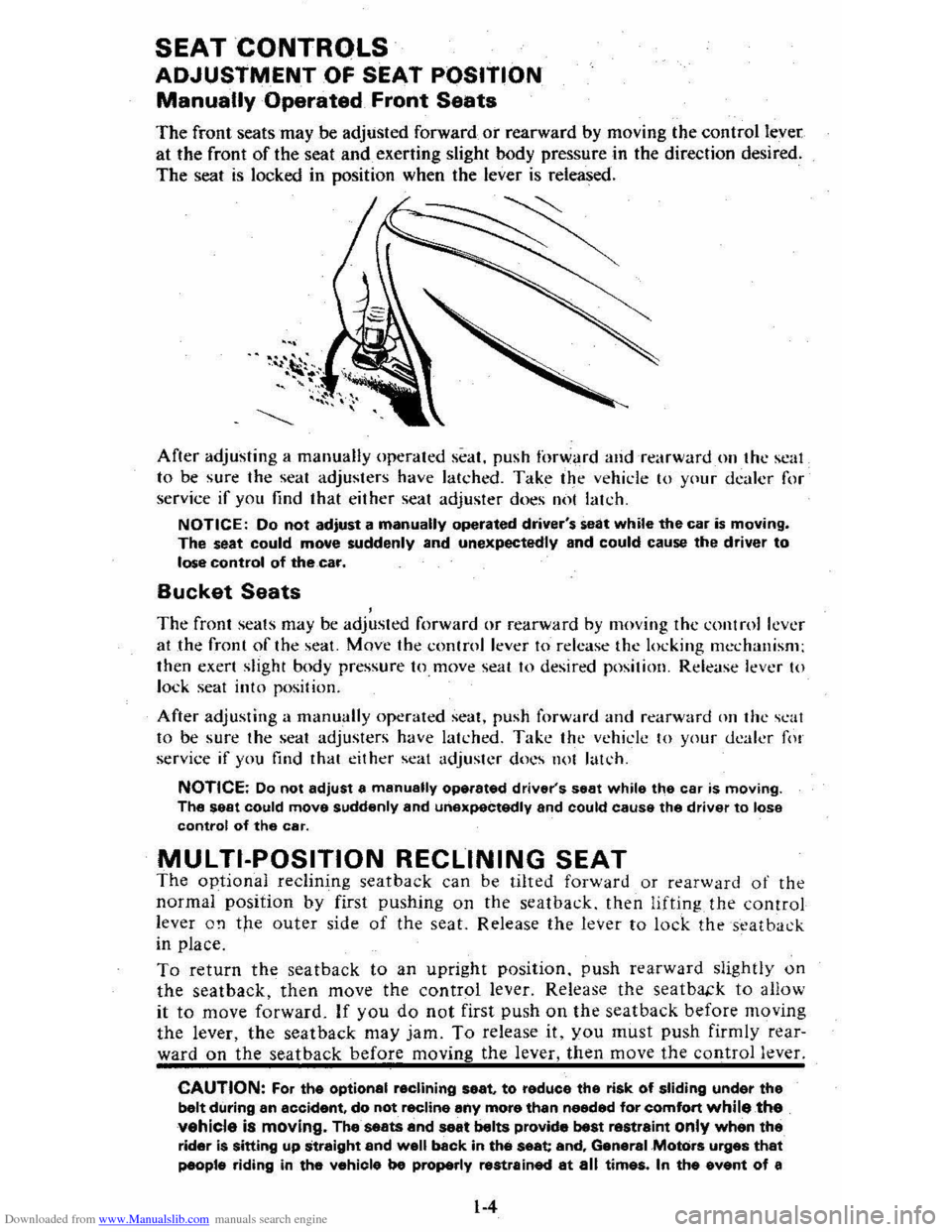
The front seats may be adjusted forward or rearward by moving the control lever
at the front of the seat and exerting slight body pressure in the direction desired.
The seat
is locked in position when the lever is released.
After adjusting a manually operated seat. push forward and rearwardon the scal
to be sure the seat adjusters have latched. Take the vehicle 10 Y(lur dealer for
service if you find that either seat adjuster does IIi)! lakh.
NOTICE: Do not adjust a manually operated driver's seat while the car is moving. The seat could move suddenly and unexpectedly and could cause the driver to lose control of thecaf.
Bucket Seats , The front seats may be adjusted forward or rearward by moving the control lever at the front of the seat. Move the control lever to release the locking mechanism;
then exert slight body pressure to. move seat to desired position. Release lever to lock seat into position.
After adjusting a manually operated seat. push forward and rearward Oil the scat to be sure the seat adjusters have latched. Take the vehicle to your dealer fo!
service if you find that either seat adjuster docs not latch.
NOTICE: Do not adjust a manually operated driver's seat while the car is moving. The seat could move suddenly and unexpectedly and could cause the driver to lose control of the car.
MULTI-POSITION RECLINING SEAT The optional reclining seat back can be tilted forward or rearward of the
normal position by first pushing on the seatback. then lifting the control
lever O!l the outer side of the seat. Release the lever to lock the seat back
in place.
To return the seatback to an upright position. push rearward slightly on
the seatback, then move the control lever. Release the seatba.:k to allow
it to move forward. If you do not first push on the seat back before moving
the lever, the seat back may jam. To release it. you must push firmly rear
ward on the seat back before moving the lever, then move the control lever.
CAUTION: For the optional reclining seat. to reduce the risk of sliding under the belt during an accident, do not recline any more than needed for comfort while the vehicle is moving. The seats and seat belts provide best restraint only when the rider is Sitting up straight and well back in the seat and, General .Motors urges that people riding in the vahicle be properly restrained at all times. In the event of a
1-4
Page 9 of 95
Downloaded from www.Manualslib.com manuals search engine frontal collision, the chance and/or severity of injury may increase with increasing
recline of the saatbeck. The -lap belt is d .. ignad to spread the force of a collision over the strong hlp bone instead of across the abdomen. However, if the hips are
reclined, the lap bett may slide past the hips and ilpply restraint forceS directly to the abdominal region.
Front Seatback Latches
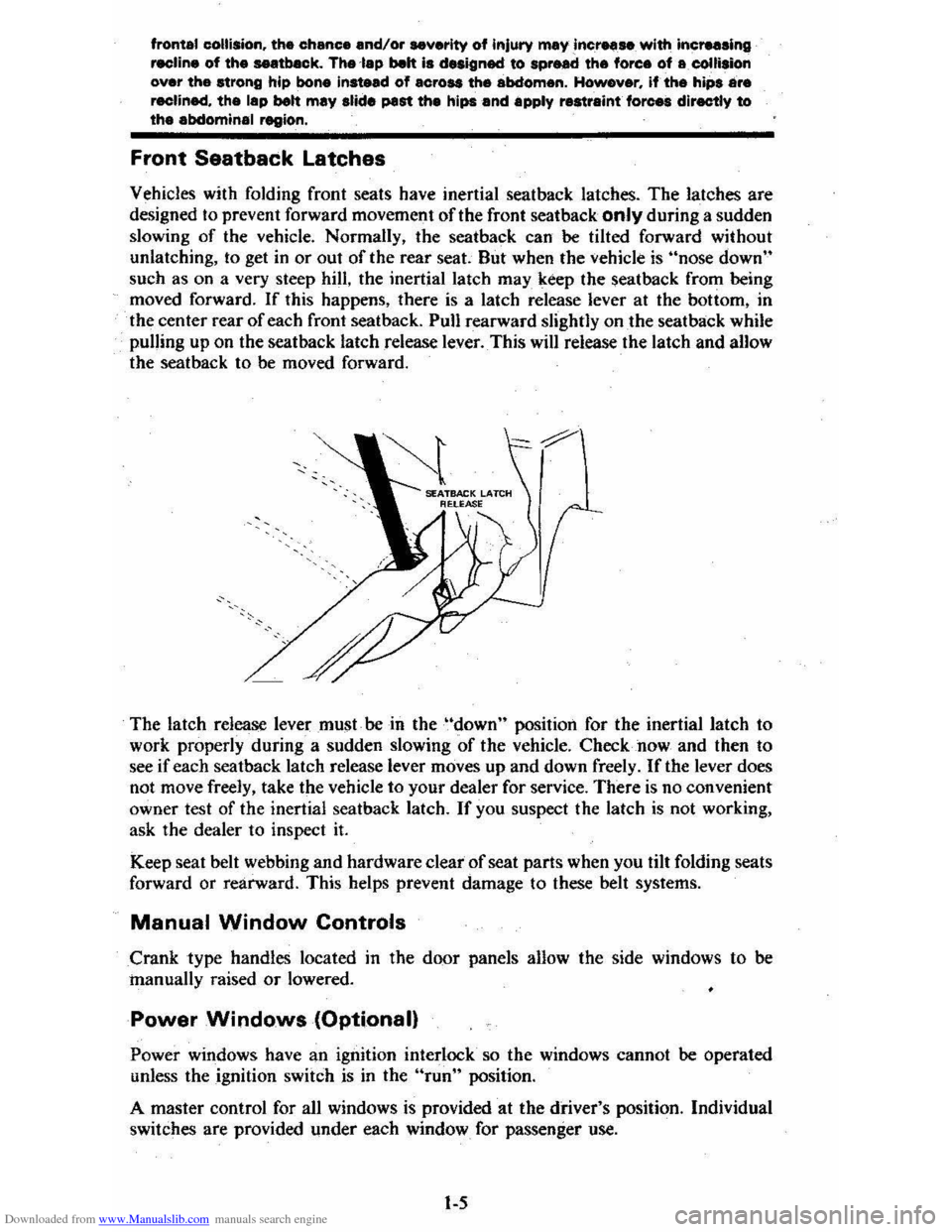
Vehicles with folding front seats have inertial seatback latches. The latches are
designed to prevent forward movement of the front seatback only during a sudden
slowing
of the vehicle. Normally, the seatback can be tilted forward without
unlatching, to get in
or out of the rear seat. But when the vehicle is ""nose down"
such as on a very steep hill, the inertial latch may keep the seat back from being
moved forward. If this happens, there is a latch release lever at the bottom, in
the center rear
of each front seatback. pun rearward slightly on the seat back while
pulling up on the seatback latch release lever .. This will release the latch and alJow
the seat back to be moved forward.
The latch release lever must.
be in the "down" position for the inertial latch to
work properly during a sudden slowing of the vehicle. Checkrtow and then to
see
if each seatback latch release lever moves up and down freely. If the lever does
not move freely, take the vehicle to your dealer for service. There is no convenient
owner test of the inertial seatback latch.
If you suspect the latch is not working,
ask the dealer to inspect
it.
Keep seat belt webbing and hardware clear of seat parts when you tilt folding seats
forward or rearward. This helps prevent damage to these belt systems.
Manual Window Controls
Crank type handles located in the door panels anow the side windows to be
manually raised or lowered.
Power Windows (Optional)
Power windows have an ignition interlock so the windows cannot be operated
unless the ignition switch is in the "run" position.
A master control for all windows
is provided at the driver's position. Individual
switches are provided under each window for passenger use.
1-5
Page 12 of 95
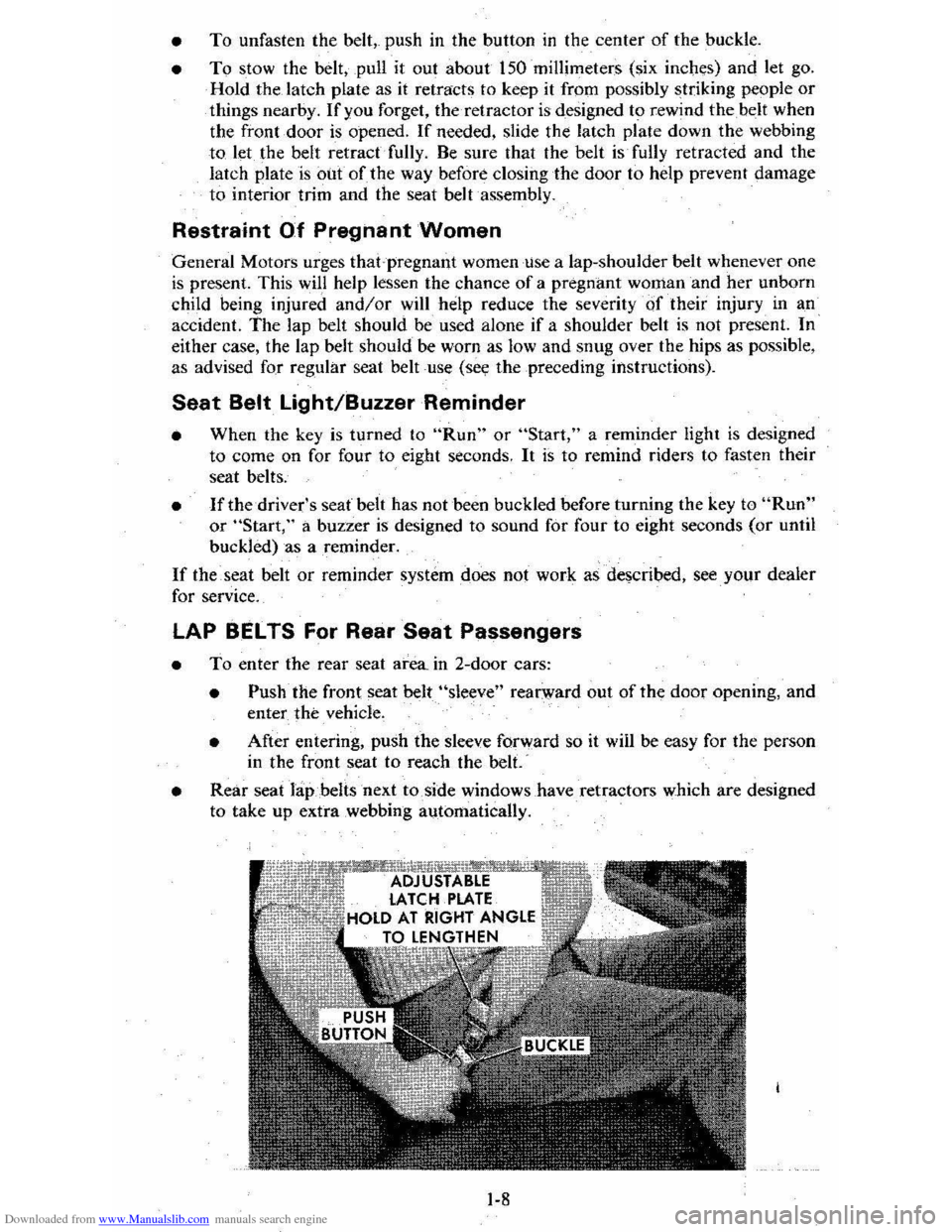
Downloaded from www.Manualslib.com manuals search engine • To unfasten the belt,. push in the button in the center of the buckle.
• To stow the belt, pull it out about 150 millimeters (six incbt::s) and let go.
Hold the latch plate as it retracts to keep it from possibly striking people or things nearby. If you forget, the-retractor is designed to rewind the_belt when
the front door
is opened. If needed, slide the latch plate down the webbing
to let the belt retract fully. Be sure that the belt is fully retracted and the
latch plate is out of the way before closing the door to help prevent damage
to interior trim and the seat belt assembly.
Restreint Of Pregnant Women
General Motors urges that-pregnant women lise a lap-shoulder belt whenever one
is present. This will help lessen the chance of a pregnant woman and her unborn
child being injured
and/or will help reduce the severitYClf their injury in an
accident. The lap belt should be used alone if a shoulder belt is not present. In
either case, the lap belt should be worn as low and snug over the hips as possible,
as advised for regular seat belt
·use (see the preceding instructions).
Seat Belt Light/Buzzer Reminder
• When the key is turned to "Run" or "Start," a reminder light is designed
to come on for four to eight seconds.
It is to remind riders to fasten their
seat belts.
• .If the driver's seat belt has not been buckled before turning the key to "Run" or "Start," a buzzer is designed to sound for four to eight seconds (or until
buckled) as a reminder.
If the seat belt or reminder system does not work as de~cribed. see your dealer
for service.
LAP BELTS For Rear Seat Passengers
• To enter the rear seat area in 2-door cars:
• Pushthe front seat belt "sleeve " rearward out of the door opening, and
enter the vehicle.
• After entering, push the sleeve forward so it wiil be easy for the person
in the front seat to reach the belt.-
• Rear seat lap belts next to side windows have retractors which are designed
to take up extra webbing automatically.
1-8
Page 15 of 95
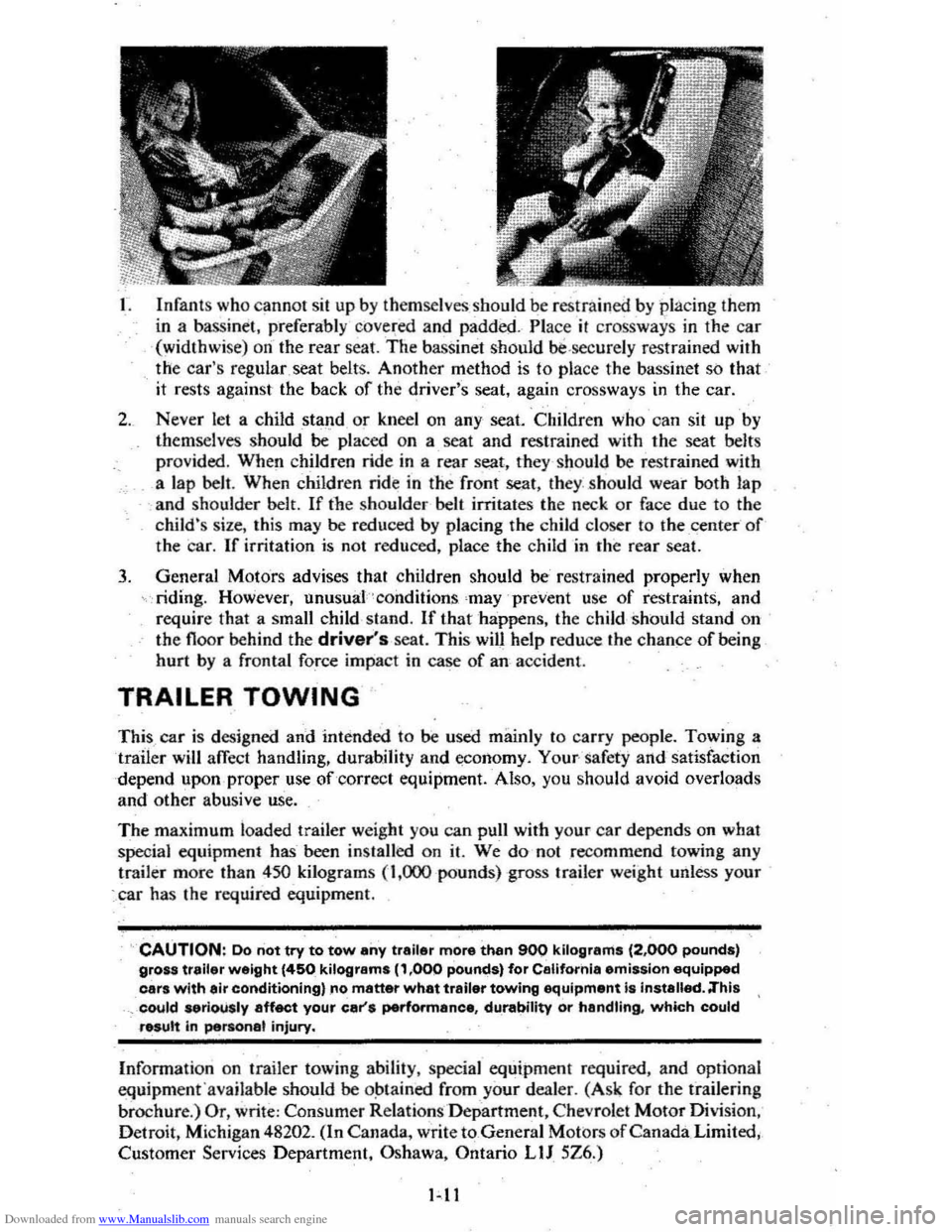
Downloaded from www.Manualslib.com manuals search engine L Infants who cannot sit up by themselves should be restr~ined b y placing them
in a bassinet, preferably cove~ed and padded .- Pl ace il crossways in the car
(widthwise) on-the rear seat.
The bassi net should bi!.secure ly restrained with
the car's reg ular seat belt
s. Another method is to pla ce the bassinet so that
it rests aga,inst the back of the driver's seat, again crossways in the car.
2. Never let a child sta~d or kneel on any seat. Children who can sit up by
them selves should be placed on a seat and restrained with the seat belts
provided. When children ride in a rear se:at, they should be restrained with
a lap
belt. When children ride in the fronf seat, they . ,should wear both lap
and
shou'lder belt. If the shoulder bell irritates the neck or face due to th e
child's size, this may be reduced by placing the child closer to the center of the car. If irritation is not red uced, place the child in the rear seat.
3. General Motors advises that children should be restr ained properly when
riding . However, unusual'~conditions 'may prevent use of restraints, and
requir e that a small child,
sland. If that happens, the c hild should stand on
the floo r behind the driver's seat. This will help reduce the chance of being
hurt
by a frontal force impact in case of an accident.
TRAILER TOWING
This car is designed and intended to be used mainly to car ry people. Towing a
trailer will affect handling, durability and economy_ Your'"safcty and satisfaction
depend upon,proper use
of correct equipment. Also. you should avoid overloads
and other abusive use.
The maximum loaded trailer weight you can pull with your car depends
on what special equipment has-been inst alled o n it. We do-n o t recommend towing any
trailer more than 450
kilograms (1,000 pounds) -gross trailer weight unless your
'car ha s .he required equipment.
CAUTION: Do not try to tow any trailer more than 900 kilograms (2.000 pounds)
gross trailer weight (450 kilograms (' .000 pounds) for California emission equipped
cars with air conditioning) no matter what trailer towing equipment is installed. ;This ,could .eriously affect your car'S performance. durability or handling. which could
result in personel injury.
Infonnati on on trailer towing ability, special equipment requir ed, and optional
equipm e
nfavailable should be o~lained from your dea ler . (Ask for the trailering
brochur e.)
Or, write: Consumer Relat ions Department , Chevrolet Motor Division ,
Detroit , Mi chigan
48202. (In Canada, write to General Motors of Canada Limited .
Custom
er Services Department, Oshawa. Ontario LlJ 5Z6.)
Page 17 of 95
Downloaded from www.Manualslib.com manuals search engine NOTICE: Use only trailer hitches which permit normal operation of the Energy Absorbing Bumper System. if so equipped. For example. a rigid fore and .iUt connection between the bumper and any other part.of. the car may increase .damage in the event of II collision.
TRAILER TOWING TIPS
Getting Started
Before entering traffic with a frailer that has electric brakes, start the car and
trailer moving and apply the trailer brakes
by hand to be sure the trailer brakes
are working and the trailer electrical system
is connected .
. Engine Cooling
:
When going up long grades, you, can reduce the chance 'of engine overheating by
turning
off the air conditioner, if so equipped.
Transaxle
,See the method for checking the transaxle fluid le ve l. in "Service and
,.;.Maintenance," Section 5 of this manual .
Parking
You should not park cars with trailers on a grade (hill). However, if you must
park on a grade, these steps must be followed:
1. Apply the regular brakes.
2. Have someone place wheel' chocks under the trailer wheels.
3. When the wheel chocks are in place, release the regular brakes until the
chocks absorb the load .
4; Apply Ihe parking brake.
S. Shift Ihe transaxle 10 ··P"(Park).
If the car is parked on a grade. don't shift the transaxle 10 "P"(Park) until the
trailer wheels
are chocked and the parkinghrake, is set~ If you do, the weight of . the car and trailer may put so much force on the parking pawl in the transaxle
.
that it may be hard to shift oul of "P"(Park).
When starting , after being parked ' on a grade:
(; Apply the regular brakes and hold.
2 .
Stan th e engine in ··P"(Park) .
-3. Shift into gear and release the parking brake.
4. Release the regular brakes and drive until the chock s are free.
5. Apply the regular brakes and have your helper remove the chocks.
J.]3
Page 19 of 95
Downloaded from www.Manualslib.com manuals search engine • Adjust the heating or cooling system to force outside air into the car as . d esc ribed abo ve bUI set the fan to high speed .
• On cars with outside air vents in or under the instrument panel, open the vents fully.
New. Car "Break-In" Period
You can drive your new car from its very first mile/kilometer without following .
a
formal"break~in" schedule. However, there'are things you can do during the
fir st few hundred miles/kilometers of driving that will add to the future
perf orm ance and econ omy of your car.
We recommend you limit your speed during the first 500 miles (800 kiJomet ers) ~
to a maximum of 55 mph (90 km/h) ; but do not drive for long period s al any'
one constant speed, either Jast
or slow. During this time , avoid fulllhronJe start s _ and, if possible, avoid h"ard stops especially during the first 200 miles (320
kilometers) of driving.
Always drive at moderate speed until the engine has completely warmed
up.
If yo u plan to use your new car for trailer towing, see additional information in Section 1 under "Trailer Towing."
GUARD AGAINST THEFT
Your new Citation has many features to help prevent theft of the car itself, its
equ ipment, and its content s. But these ami-theft features depend upon you to
work .
THE TIME TO BE MOST ON GUARD IS WHEN LEAVING THE CAR ...
• PARK IN A LIGHTED SPOT WHEN YOU CAN.
• LOCK THE STEERING COLUMN AND TAKE THE KEYS,
•
Turn the key to "Lock," and remove the key. This locks the igniti on and
both steering and shift connols unless your car has a manual transaxle.
In that case, the shift control- is not locked .
• If you must leave a key with the car, leave the square-head key .only .
Take the oval-Read key with you. This will help prevent unwanted entry into your car at a later date, or into your -trunk.
•
FULLY CLOSE ALL WINDOWS AND ANY ROOF PANELS. AND LOCK ALL DOORS.
•
KEEP COSTLY ITEMS OUT OF SIGHT AND LOCKED UP,
•
Never leave things of value in plain sight on seats or noor.
• The glove box offers a place -to hide small items.
• Lock larger items in the trunk or place them in the rear storage .
FUEL REQUIREMENTS
Your engine is designed to use only unleaded gasoline. Unleaded gasoline must
be' used for the emission control $ystem to operate properly. Its use will also reduce
s park plug fouling , -exhaust system corrosion and engine oil deterionition .
Using leaded gasoline can damage the emiS5ion control system and could result
in loss of warranty coverage. This is especially true on cars that have the C-4
System . Leaded gasoline will damage tbe oxygen sensor, which may affect
emission control, fuel economy
and drivabiJity . See "C-4 (Computer Controlled
Catalytic Converter) System" in "Service and Maintenance" Section 5 of this
manual for more information.
2-2
Page 20 of 95
Downloaded from www.Manualslib.com manuals search engine Federa1 regulations require that pumps delivering unleaded gasoline be labeled
with the word UNLEADED. Only these pumps have nozzles which fit the filler
neck of your vehicle gasoline tank.
In -the United
States, Federal law also requires that gasoline octane ratings be
posted on the pumps. The octane rating shown -is an average of Research octa!1e (R) and Motor octane(M). In most parts of the United States, you should use
unleaded gasoline with an octane rating
of at least 87. However, you may use
unleaded gaSOline with an octane rating as low as 85 in thes:e high-altitude areas:
Colorado , Montana, New Mexico, Utah. Wyoming. northeastern Nevada.
southern Idaho, western South Dakota, and that part
of Texas which is directly south of New Mexico.
Using unleaded gasoline with an octane rating
lower _than staled above can cause persistent , heavy "spark knock." (''Spark knock" is a metallic rapping noise.) This
can lead to engine damage. If you detect heavy spark knock even when using
gasoline of the stated octane rating, or if you hear steady spark knock while
holding a steady speed on level roads, have your dealer correct the problem.
However. now and then you may
notice light spark knock for a short time while
accelerating or driving up hills. This is no cause for concern, because you get the
greatest
fuel economy benefit from the gasoline's octane rating when there is occasional light spark knock~ Using gasoline with a higher octane rating than that
which allows occasional spark knock is an unneceSsary expense.
Gasohol
Gasohol , a mixture of unlead ed gasoline and ethanol (grain alcohol), is
available in some areas. You may use gasohol in your vehicle, provided it
is
no more than 10% ethanol. 'Be: sure the gasohol has the same octane
ratings as stated above for unleaded gasoline. If drivability problems are
encountered because _of the use of gasohol, you should switch back to
unleaded gas oline.
NOTICE: Take care to not spill gasohol on painted surfaces. Gasohol can cause paint damage, which may not be covered under the New Vehicle Warranty.
OPERATION IN FOREIGN COUNTRIES
Your engin~ is designed to run on unleaded gasoline with the octane ratings given
under '''Fuel Requirements" above .
If you plan to drive your vehicle outside the United States and its jurisdictions
or Canada, there is a chance the gasolines available in some count,ries will not meet the needs of your engine. Low octane rated gasolines may cause engine knocking
or serious engine damage,: for which Chevrolet is not respon sible .
Using leaded gasoline
in-a vehicle equipped with a catalytic converter may cause
the converter to lose its effectiveness as an emission control.
It could also affect
the emission warranty.
If you must use leaded gasoline in a vehicle designed for
unleaded fuel, converter modification and different maintenance intervals will be
required.
For gasoline information and a maintenance schedule for the countries
in which you plan to travel, write to: Chevrolet Motor Division, Consumer
Relations Department, Detroit, Michigan 48202, (in Canada , write to General
Motors of Canada Limited. Customer Service Department , Oshawa, Ontario LlJ
5Z6).
When writing, please include :
• the Vehicle Identification Number and
• the countries in which you plan to travel.
2-3
Page 35 of 95
Downloaded from www.Manualslib.com manuals search engine • This warning light docs no t do away with the need f or ~rake il),s.-pectio n and
maintenanc e. The brake fluid level must be checked regularly . See yo ur
Maint enance Schedule folder for
other brake checks.
If th e light comes on and stays o n when the ig nition key is on, after the brak e
pedal ha s been firmly pushed do wn, it may mean that there is somethin g wrong
wit'h one part of the brake system.
Wh at 10 do:
I. C heck to see that the pa rkin g brake has been released. If it has been ...
2. Pull off the road and sto p ca refully. And rememb er that:
• Stopping di stan ces may be longer .
• You may ha ve to pu sh hard er on the ped al.
• The pedal may go down farther {han no rm al.
3. Tryout the brake s by sta rrin g and stopping on the ro ad shoulder--then :
• If you judge it to be safe, drive cautiously at a safe speed to the neat est
dealer for repair , or
• Have vehicl e to w ed to dealer for repair .
Co ntinu ed dri ving with o
ut getting necessary re p a ir s co uld be dangerou s.
"EMISSIONS" INDICATOR
On so me cars, the word "EMISSIONS" is des ig ned to appear in a window in the spe ed om eter faceat certain int~rvals. This is a reminder that maintenan ce se rv ice
mu st
be performed on your ca r. One of two type s' o f se rvice is required :
• On cars equipped with the C-4 System, the oxygen sensor must be replaced with · a new sensor, or
• On
ca rs without the C -4 System, the cataly st in the catalyti c converter must
b e c han ged.
In either case, see yo ur Chl!~rolet dealer fo r se rvice when the "EMISSIONS "
indicat or appears. .
F or more information , see
"C-4 (Computer Contr olled Catalytic Conv erte r)
Syste m " and "Catalyti c Co nverter," both in "Service and Maintenance," Section
5 of thi s manual.
"CHECK ENGINE" LIGHT
If yo ur car has the C-4 System, a "CHECK ENGINE" light on the instrum ent
panel is des ig ned t o come on
during engine starting to le t y ou know th e bulb is
w orkin g. (The light will sla y o n a short time after th e e ngine s tarts .) If th e light
c o m es on whil e
drivin g, se rv ic e to the emi ssion contr ol sy stem may be re quired . Sc:e your Chevrolet deal er as soo n as: possible fo r an in spec tion of the sy ste m .
COlltinu ed driving without having [he C-4System serviced could eventually cause
d am age to the emission control system. It could also affect fuel economy and
driv ability.
See also '; C-4 (Comput er Co ntrolled Catalytic Converter) System" in ;'Ser vic e a nd
Mainte n ance, " Section 5 o f this manual.
Tachometer
The opti onal Tachomet ers indi cat e the speed of th e e ngin e in revoluti ons pe r minute. The indicated number, tim es ](x>o .. gives the engine s peed. Operatil.lg th e
engine w ith the tachom ete r r eading in the color- coded high ~peed area could lead to s~rious engine damage. The re are two tachom .e ter s us ed in the car depending on the e ngine option install ed in your car.
2-18