stop start CHEVROLET CITY EXPRESS 2015 User Guide
[x] Cancel search | Manufacturer: CHEVROLET, Model Year: 2015, Model line: CITY EXPRESS, Model: CHEVROLET CITY EXPRESS 2015Pages: 297, PDF Size: 3.5 MB
Page 157 of 297
Black plate (16,1)Chevrolet City Express Owner Manual (GMNA-Localizing-U.S./Canada-
7707496) - 2015 - CRC - 11/26/14
9-16 Driving and Operating START position. Release the
key when the engine starts.
If the engine starts, but fails to
run, repeat the above procedure. .
If the engine is very hard to
start in extremely cold
weather or when restarting,
depress the accelerator
pedal a little (approximately
1/3 to the floor) and hold it
and then crank the engine.
Release the key and the
accelerator pedal when the
engine starts. .
If the engine is very hard to
start because it is flooded,
depress the accelerator
pedal all the way to the floor
and hold it. Crank the engine
for five to six seconds.
After cranking the engine,
release the accelerator
pedal. Crank the engine with
your foot off the accelerator
pedal by turning the ignition
key to START. Release the
key when the engine starts. If the engine starts, but fails
to run, repeat the above
procedure.
{ CautionDo not operate the starter for
more than 15 seconds at a time.
If the engine does not start, turn
the key off and wait 10 seconds
before cranking again, otherwise
the starter could be damaged.
4. Allow the engine to idle for at
least 30 seconds after starting.
Do not race the engine while
warming it up. Drive at moderate
speed for a short distance first,
especially in cold weather.
In cold weather, keep the engine
running for a minimum of two to
three minutes before shutting it
off. Starting and stopping the
engine over a short period of
time may make the vehicle more
difficult to start. Note: Care should be taken to
avoid situations that can lead to
potential battery discharge and
potential no-start conditions
such as:
1. Installation or extended use of
electronic accessories that
consume battery power when
the engine is not running (Phone
chargers, GPS, DVD
players, etc.).
2. Vehicle is not driven regularly
and/or only driven short
distances. In these cases, the
battery may need to be charged
to maintain battery health.
Page 160 of 297
Black plate (19,1)Chevrolet City Express Owner Manual (GMNA-Localizing-U.S./Canada-
7707496) - 2015 - CRC - 11/26/14
Driving and Operating 9-19The CVT in your vehicle is
electronically controlled to produce
maximum power and smooth
operation.
The recommended operating
procedures for this transmission are
shown on the following pages.
Follow these procedures for
maximum vehicle performance and
driving enjoyment.
Note: Engine power may be
automatically reduced to protect the
CVT if the engine speed increases
quickly when driving on slippery
roads or while being tested on some
dynamometers.
Starting the Vehicle
1. After starting the engine, fully
depress the foot brake pedal
before moving the shift lever out
of the P (Park) position.
2. Keep the foot brake pedal
depressed and move the shift
lever into a driving gear. 3. Release the foot brake, then
gradually start the vehicle in
motion.
4. Stop the vehicle completely
before moving the shift lever into
the P (Park) position.
The CVT is designed so the foot
brake pedal MUST be depressed
before shifting from P (Park) to any
drive position while the ignition
switch is in the ON position.
The shift lever cannot be moved out
of P (Park) and into any of the other
gear positions if the ignition switch
is placed in the LOCK, OFF or ACC
position or if the key is removed. Shifting
After starting the engine, fully
depress the brake pedal and move
the shift lever from P (Park) to any
of the desired shift positions.
{ Warning
Apply the parking brake if the shift
lever is in any position while the
engine is not running. Failure to
do so could cause the vehicle to
move unexpectedly or roll away
and result in serious personal
injury or property damage.
Page 161 of 297
Black plate (20,1)Chevrolet City Express Owner Manual (GMNA-Localizing-U.S./Canada-
7707496) - 2015 - CRC - 11/26/14
9-20 Driving and Operating If the ignition switch is placed in the
OFF or ACC position for any reason
while the vehicle is in N (Neutral),
or any drive position, the key cannot
be turned to the LOCK position and
be removed from the ignition switch.
If this occurs, perform the following
steps:
1. Apply the parking brake when
the vehicle is stopped.
2. Move the shift lever to P (Park)
to park the vehicle and place the
ignition switch in the LOCK
position to remove the key.
{ Caution
To prevent transmission damage,
use the P (Park) or R (Reverse)
position only when the vehicle is
completely stopped.
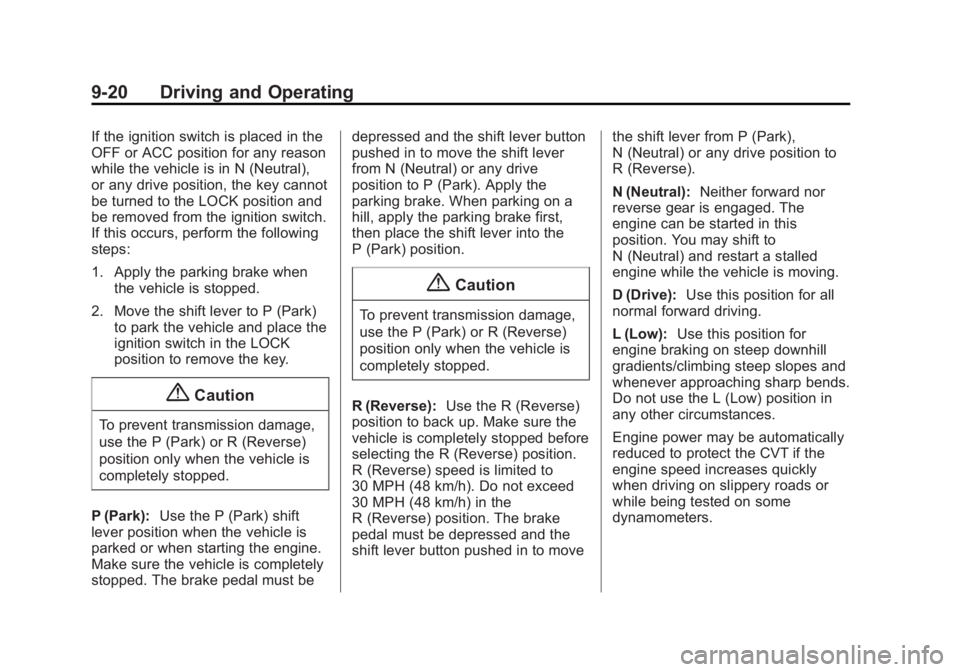
P (Park): Use the P (Park) shift
lever position when the vehicle is
parked or when starting the engine.
Make sure the vehicle is completely
stopped. The brake pedal must be depressed and the shift lever button
pushed in to move the shift lever
from N (Neutral) or any drive
position to P (Park). Apply the
parking brake. When parking on a
hill, apply the parking brake first,
then place the shift lever into the
P (Park) position.
{ CautionTo prevent transmission damage,
use the P (Park) or R (Reverse)
position only when the vehicle is
completely stopped.
R (Reverse): Use the R (Reverse)
position to back up. Make sure the
vehicle is completely stopped before
selecting the R (Reverse) position.
R (Reverse) speed is limited to
30 MPH (48 km/h). Do not exceed
30 MPH (48 km/h) in the
R (Reverse) position. The brake
pedal must be depressed and the
shift lever button pushed in to move the shift lever from P (Park),
N (Neutral) or any drive position to
R (Reverse).
N (Neutral): Neither forward nor
reverse gear is engaged. The
engine can be started in this
position. You may shift to
N (Neutral) and restart a stalled
engine while the vehicle is moving.
D (Drive): Use this position for all
normal forward driving.
L (Low): Use this position for
engine braking on steep downhill
gradients/climbing steep slopes and
whenever approaching sharp bends.
Do not use the L (Low) position in
any other circumstances.
Engine power may be automatically
reduced to protect the CVT if the
engine speed increases quickly
when driving on slippery roads or
while being tested on some
dynamometers.
Page 163 of 297
Black plate (22,1)Chevrolet City Express Owner Manual (GMNA-Localizing-U.S./Canada-
7707496) - 2015 - CRC - 11/26/14
9-22 Driving and Operating Each time the engine is started,
or when the shift lever is shifted to
any position other than D (Drive),
the Overdrive off mode will be
automatically turned off.
Accelerator Downshift in D
Position For passing or hill climbing, depress
the accelerator pedal to the floor.
This shifts the transmission down
into a lower gear, depending on the
vehicle speed.
Fail Safe
When the fail-safe operation occurs,
the CVT will not be shifted into the
selected driving position.
If the vehicle is driven under
extreme conditions, such as
excessive wheel spinning and
subsequent hard braking, the
fail-safe system may be activated.
The MIL may come on to indicate
the fail-safe mode is activated. See
Malfunction Indicator Lamp on
page 5-11 . This will occur even if all
electrical circuits are functioning properly. In this case, place the
ignition switch in the OFF position
and wait for 10 seconds. Then place
the ignition switch back in the ON
position. The vehicle should return
to its normal operating condition. If it
does not return to its normal
operating condition, have a dealer
check the transmission and repair if
necessary.
{ WarningWhen the high fluid temperature
protection mode or fail-safe
operation occurs, vehicle speed
may be gradually reduced. The
reduced speed may be lower than
other traffic, which could increase
the chance of a collision. Be
especially careful when driving.
If necessary, pull to the side of
the road at a safe place and allow
the transmission to return to
normal operation, or have it
repaired if necessary. Brakes Antilock Brake
System (ABS)
{ Warning .
The ABS is a sophisticated
device, but it cannot prevent
accidents resulting from
careless or dangerous driving
techniques. It can help
maintain vehicle control
during braking on slippery
surfaces. Remember that
stopping distances on
slippery surfaces will be
longer than on normal
surfaces even with ABS.
Stopping distances may also
be longer on rough, gravel or
snow covered roads, or if you
are using tire chains. Always
maintain a safe distance from
(Continued)
Page 195 of 297
Black plate (12,1)Chevrolet City Express Owner Manual (GMNA-Localizing-U.S./Canada-
7707496) - 2015 - CRC - 11/26/14
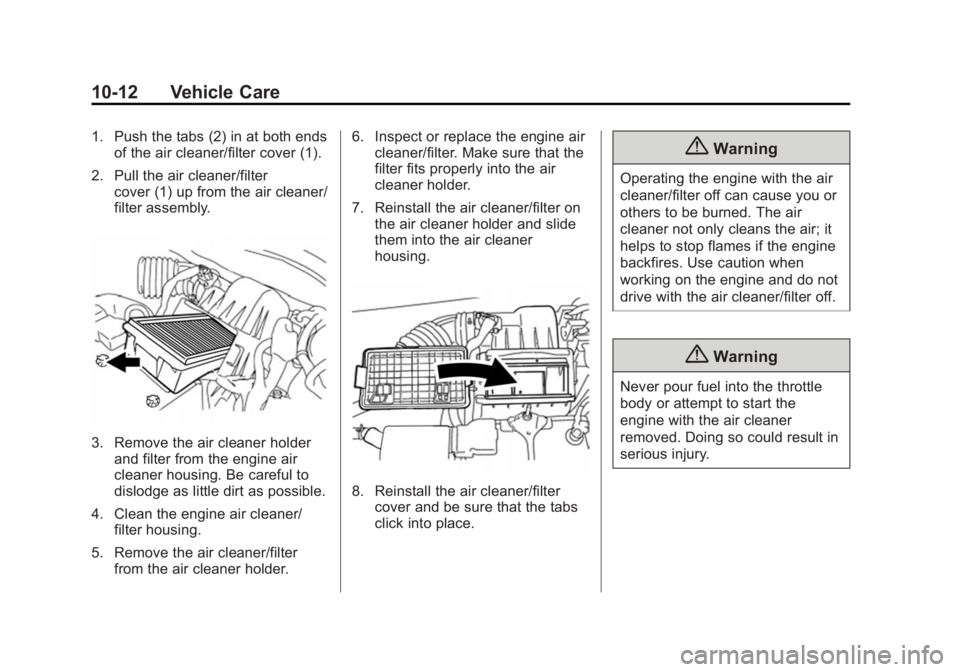
10-12 Vehicle Care 1. Push the tabs (2) in at both ends
of the air cleaner/filter cover (1).
2. Pull the air cleaner/filter
cover (1) up from the air cleaner/
filter assembly.
3. Remove the air cleaner holder
and filter from the engine air
cleaner housing. Be careful to
dislodge as little dirt as possible.
4. Clean the engine air cleaner/
filter housing.
5. Remove the air cleaner/filter
from the air cleaner holder. 6. Inspect or replace the engine air
cleaner/filter. Make sure that the
filter fits properly into the air
cleaner holder.
7. Reinstall the air cleaner/filter on
the air cleaner holder and slide
them into the air cleaner
housing.
8. Reinstall the air cleaner/filter
cover and be sure that the tabs
click into place. { WarningOperating the engine with the air
cleaner/filter off can cause you or
others to be burned. The air
cleaner not only cleans the air; it
helps to stop flames if the engine
backfires. Use caution when
working on the engine and do not
drive with the air cleaner/filter off.
{ WarningNever pour fuel into the throttle
body or attempt to start the
engine with the air cleaner
removed. Doing so could result in
serious injury.
Page 207 of 297
Black plate (24,1)Chevrolet City Express Owner Manual (GMNA-Localizing-U.S./Canada-
7707496) - 2015 - CRC - 11/26/14
10-24 Vehicle Care Lamp Bulb
Number
Cargo Lamp W5W
High-Mounted
Stop Lamp W16W
Tail Lamp 3047
Back-Up Lamp 921
Rear Turn
Signal Lamp 3157AK
License
Plate Lamp T10
For replacement bulbs not listed
here, contact your dealer. Electrical System Electrical System
Overload The vehicle has fuses and circuit
breakers to protect against an
electrical system overload.
When the current electrical load is
too heavy, the circuit breaker opens
and closes, protecting the circuit
until the current load returns to
normal or the problem is fixed. This
greatly reduces the chance of circuit
overload and fire caused by
electrical problems.
Fuses and circuit breakers protect
power devices in the vehicle.
Replace a bad fuse with a new one
of the identical size and rating.
If there is a problem on the road and
a fuse needs to be replaced, the
same amperage fuse can be
borrowed. Choose some feature of
the vehicle that is not needed to use
and replace it as soon as possible. Headlamp Wiring An electrical overload may cause
the lamps to go on and off, or in
some cases to remain off. Have the
headlamp wiring checked right away
if the lamps go on and off or
remain off.
Windshield Wipers If the wiper motor overheats due to
heavy snow or ice, the windshield
wipers will stop until the motor cools
and will then restart.
Although the circuit is protected
from electrical overload, overload
due to heavy snow or ice may
cause wiper linkage damage.
Always clear ice and heavy snow
from the windshield before using the
windshield wipers.
If the overload is caused by an
electrical problem and not snow or
ice, be sure to get it fixed.
Page 220 of 297
Black plate (37,1)Chevrolet City Express Owner Manual (GMNA-Localizing-U.S./Canada-
7707496) - 2015 - CRC - 11/26/14
Vehicle Care 10-37The TPMS malfunction indicator is
combined with the low tire pressure
telltale. When the system detects a
malfunction, the telltale will flash for
approximately one minute and then
remain continuously illuminated.
This sequence will continue upon
subsequent vehicle start-ups as
long as the malfunction exists.
When the malfunction indicator is
illuminated, the system may not be
able to detect or signal low tire
pressure as intended. TPMS
malfunctions may occur for a variety
of reasons, including the installation
of replacement or alternate tires or
wheels on the vehicle that prevent
the TPMS from functioning properly.
Always check the TPMS malfunction
telltale after replacing one or more
tires or wheels on your vehicle to
ensure that the replacement or
alternate tires and wheels allow the
TPMS to continue to function
properly.
See Tire Pressure Monitor
Operation on page 10-37 . See Radio Frequency Statement on
page 13-12 .
Tire Pressure Monitor
Operation This vehicle may have a Tire
Pressure Monitor System (TPMS).
The TPMS is designed to warn the
driver when a low tire pressure
condition exists. TPMS sensors are
mounted onto each tire and wheel
assembly, excluding the spare tire
and wheel assembly. The TPMS
sensors monitor the air pressure in
the tires and transmit the tire
pressure readings to a receiver
located in the vehicle.
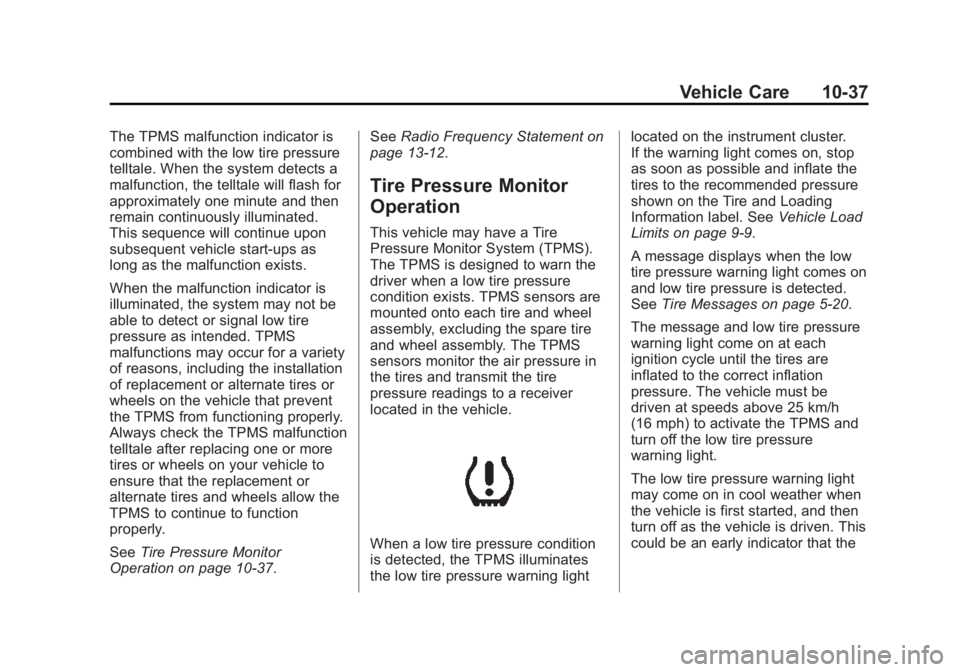
When a low tire pressure condition
is detected, the TPMS illuminates
the low tire pressure warning light located on the instrument cluster.
If the warning light comes on, stop
as soon as possible and inflate the
tires to the recommended pressure
shown on the Tire and Loading
Information label. See Vehicle Load
Limits on page 9-9 .
A message displays when the low
tire pressure warning light comes on
and low tire pressure is detected.
See Tire Messages on page 5-20 .
The message and low tire pressure
warning light come on at each
ignition cycle until the tires are
inflated to the correct inflation
pressure. The vehicle must be
driven at speeds above 25 km/h
(16 mph) to activate the TPMS and
turn off the low tire pressure
warning light.
The low tire pressure warning light
may come on in cool weather when
the vehicle is first started, and then
turn off as the vehicle is driven. This
could be an early indicator that the
Page 238 of 297
Black plate (55,1)Chevrolet City Express Owner Manual (GMNA-Localizing-U.S./Canada-
7707496) - 2015 - CRC - 11/26/14
Vehicle Care 10-55
Full-Size Spare Tire If this vehicle came with a full-size
spare tire, it was fully inflated when
new, however, it can lose air over
time. Check the inflation pressure
regularly. See Tire Pressure on
page 10-35 and Vehicle Load Limits
on page 9-9 . For instructions on
how to remove, install, or store a
spare tire, see Tire Changing on
page 10-48 .
After installing the spare tire on the
vehicle, stop as soon as possible
and check that the spare is correctly
inflated. The spare tire is made to
perform well at speeds up to
112 km/h (70 mph) at the
recommended inflation pressure, so
you can finish your trip. Have the damaged or flat road tire
repaired or replaced back onto the
vehicle, as soon as possible, so the
spare tire will be available in case it
is needed again.
Do not mix tires and wheels of
different sizes, because they will not
fit. Keep the spare tire and its wheel
together.
Jump Starting For more information about the
vehicle battery, see Battery on
page 10-21 .
If the vehicle battery has run down,
you may want to use another
vehicle and jumper cables to start
your vehicle. Use the following
steps to do it safely.
{ WarningWARNING: Battery posts,
terminals, and related
accessories contain lead and lead
compounds, chemicals known to
the State of California to cause
cancer and birth defects or other
reproductive harm. Wash hands
after handling. See California
Proposition 65 Warning on
page 10-2 .