key CHEVROLET CITY EXPRESS 2015 Owner's Guide
[x] Cancel search | Manufacturer: CHEVROLET, Model Year: 2015, Model line: CITY EXPRESS, Model: CHEVROLET CITY EXPRESS 2015Pages: 297, PDF Size: 3.5 MB
Page 160 of 297
Black plate (19,1)Chevrolet City Express Owner Manual (GMNA-Localizing-U.S./Canada-
7707496) - 2015 - CRC - 11/26/14
Driving and Operating 9-19The CVT in your vehicle is
electronically controlled to produce
maximum power and smooth
operation.
The recommended operating
procedures for this transmission are
shown on the following pages.
Follow these procedures for
maximum vehicle performance and
driving enjoyment.
Note: Engine power may be
automatically reduced to protect the
CVT if the engine speed increases
quickly when driving on slippery
roads or while being tested on some
dynamometers.
Starting the Vehicle
1. After starting the engine, fully
depress the foot brake pedal
before moving the shift lever out
of the P (Park) position.
2. Keep the foot brake pedal
depressed and move the shift
lever into a driving gear. 3. Release the foot brake, then
gradually start the vehicle in
motion.
4. Stop the vehicle completely
before moving the shift lever into
the P (Park) position.
The CVT is designed so the foot
brake pedal MUST be depressed
before shifting from P (Park) to any
drive position while the ignition
switch is in the ON position.
The shift lever cannot be moved out
of P (Park) and into any of the other
gear positions if the ignition switch
is placed in the LOCK, OFF or ACC
position or if the key is removed. Shifting
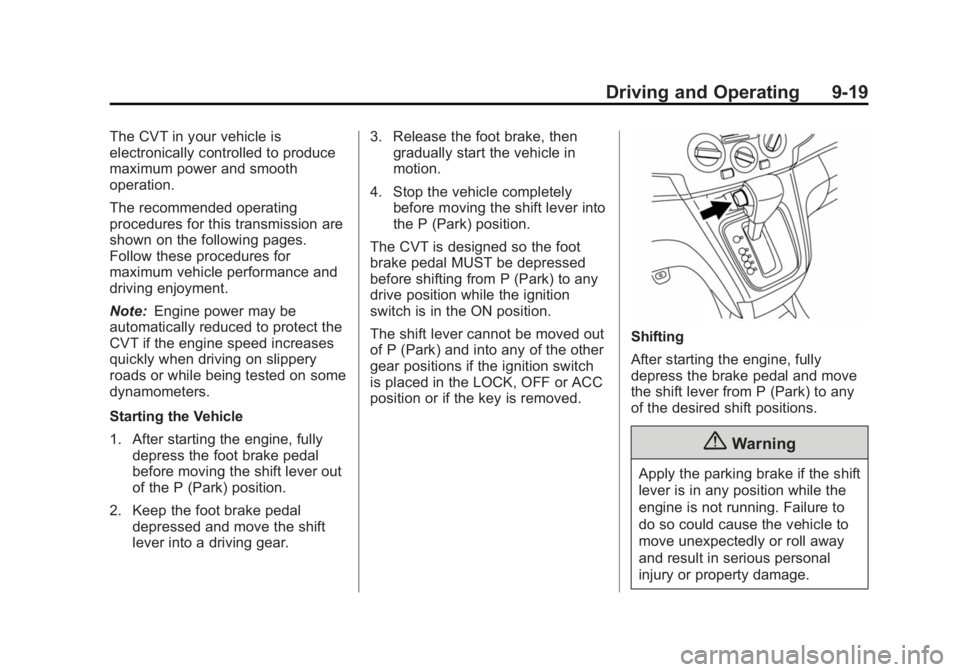
After starting the engine, fully
depress the brake pedal and move
the shift lever from P (Park) to any
of the desired shift positions.
{ Warning
Apply the parking brake if the shift
lever is in any position while the
engine is not running. Failure to
do so could cause the vehicle to
move unexpectedly or roll away
and result in serious personal
injury or property damage.
Page 161 of 297
Black plate (20,1)Chevrolet City Express Owner Manual (GMNA-Localizing-U.S./Canada-
7707496) - 2015 - CRC - 11/26/14
9-20 Driving and Operating If the ignition switch is placed in the
OFF or ACC position for any reason
while the vehicle is in N (Neutral),
or any drive position, the key cannot
be turned to the LOCK position and
be removed from the ignition switch.
If this occurs, perform the following
steps:
1. Apply the parking brake when
the vehicle is stopped.
2. Move the shift lever to P (Park)
to park the vehicle and place the
ignition switch in the LOCK
position to remove the key.
{ Caution
To prevent transmission damage,
use the P (Park) or R (Reverse)
position only when the vehicle is
completely stopped.
P (Park): Use the P (Park) shift
lever position when the vehicle is
parked or when starting the engine.
Make sure the vehicle is completely
stopped. The brake pedal must be depressed and the shift lever button
pushed in to move the shift lever
from N (Neutral) or any drive
position to P (Park). Apply the
parking brake. When parking on a
hill, apply the parking brake first,
then place the shift lever into the
P (Park) position.
{ CautionTo prevent transmission damage,
use the P (Park) or R (Reverse)
position only when the vehicle is
completely stopped.
R (Reverse): Use the R (Reverse)
position to back up. Make sure the
vehicle is completely stopped before
selecting the R (Reverse) position.
R (Reverse) speed is limited to
30 MPH (48 km/h). Do not exceed
30 MPH (48 km/h) in the
R (Reverse) position. The brake
pedal must be depressed and the
shift lever button pushed in to move the shift lever from P (Park),
N (Neutral) or any drive position to
R (Reverse).
N (Neutral): Neither forward nor
reverse gear is engaged. The
engine can be started in this
position. You may shift to
N (Neutral) and restart a stalled
engine while the vehicle is moving.
D (Drive): Use this position for all
normal forward driving.
L (Low): Use this position for
engine braking on steep downhill
gradients/climbing steep slopes and
whenever approaching sharp bends.
Do not use the L (Low) position in
any other circumstances.
Engine power may be automatically
reduced to protect the CVT if the
engine speed increases quickly
when driving on slippery roads or
while being tested on some
dynamometers.
Page 162 of 297
Black plate (21,1)Chevrolet City Express Owner Manual (GMNA-Localizing-U.S./Canada-
7707496) - 2015 - CRC - 11/26/14
Driving and Operating 9-21Shift Lock Release
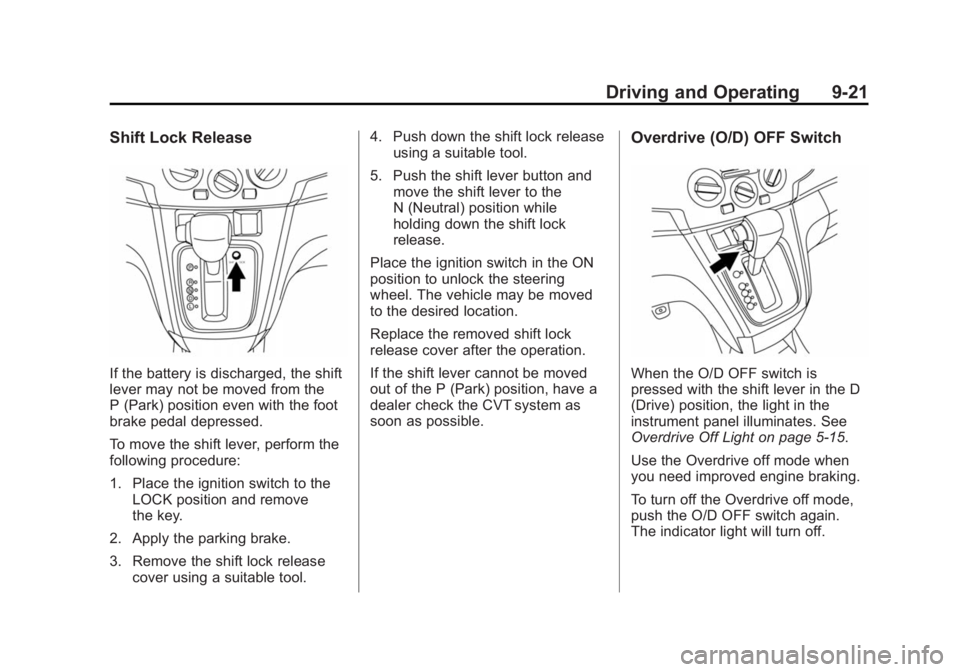
If the battery is discharged, the shift
lever may not be moved from the
P (Park) position even with the foot
brake pedal depressed.
To move the shift lever, perform the
following procedure:
1. Place the ignition switch to the
LOCK position and remove
the key.
2. Apply the parking brake.
3. Remove the shift lock release
cover using a suitable tool. 4. Push down the shift lock release
using a suitable tool.
5. Push the shift lever button and
move the shift lever to the
N (Neutral) position while
holding down the shift lock
release.
Place the ignition switch in the ON
position to unlock the steering
wheel. The vehicle may be moved
to the desired location.
Replace the removed shift lock
release cover after the operation.
If the shift lever cannot be moved
out of the P (Park) position, have a
dealer check the CVT system as
soon as possible. Overdrive (O/D) OFF Switch
When the O/D OFF switch is
pressed with the shift lever in the D
(Drive) position, the light in the
instrument panel illuminates. See
Overdrive Off Light on page 5-15 .
Use the Overdrive off mode when
you need improved engine braking.
To turn off the Overdrive off mode,
push the O/D OFF switch again.
The indicator light will turn off.
Page 174 of 297
Black plate (33,1)Chevrolet City Express Owner Manual (GMNA-Localizing-U.S./Canada-
7707496) - 2015 - CRC - 11/26/14
Driving and Operating 9-33Guidelines indicating the vehicle
width and distance to objects with
reference to the vehicle body line
are shown on the RVC display.
The guidelines can be turned on or
off. When the shift lever is in
R (Reverse), press the CAMERA
button to switch the guidelines on
and off. When the shift lever is in
any other position, press the
CAMERA button and then touch the
Show Guidelines key to switch the
guidelines on and off.
Difference Between Predicted
and Actual Distances The distance guideline and the
vehicle width guideline should be
used as a reference only when the
vehicle is on a level, paved surface.
The distance viewed on the display
is for reference only and may be
different than the actual distance
between the vehicle and displayed
objects. Backing up on a Steep Uphill
1. Displayed Distance 2. Actual Distance
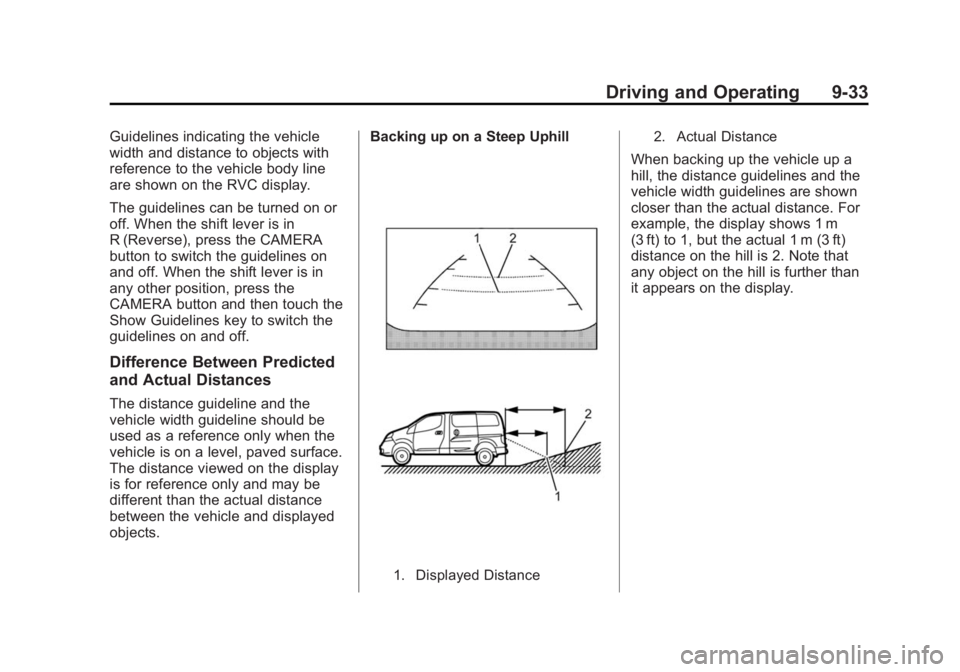
When backing up the vehicle up a
hill, the distance guidelines and the
vehicle width guidelines are shown
closer than the actual distance. For
example, the display shows 1 m
(3 ft) to 1, but the actual 1 m (3 ft)
distance on the hill is 2. Note that
any object on the hill is further than
it appears on the display.
Page 185 of 297
Black plate (2,1)Chevrolet City Express Owner Manual (GMNA-Localizing-U.S./Canada-
7707496) - 2015 - CRC - 11/26/14
10-2 Vehicle Care If a Tire Goes Flat . . . . . . . . . . 10-47
Tire Changing . . . . . . . . . . . . . . 10-48
Full-Size Spare Tire . . . . . . . . 10-55
Jump Starting Jump Starting . . . . . . . . . . . . . . 10-55
Towing the Vehicle Towing the Vehicle . . . . . . . . . 10-59
Recreational Vehicle
Towing . . . . . . . . . . . . . . . . . . . . 10-59
Appearance Care Exterior Care . . . . . . . . . . . . . . . 10-61
Interior Care . . . . . . . . . . . . . . . . 10-65
Floor Mats . . . . . . . . . . . . . . . . . . 10-69 General Information For service and parts needs, visit
your dealer. You will receive
genuine GM parts and GM-trained
and supported service people.
Genuine GM parts have one of
these marks:
California Proposition
65 Warning WARNING: Most motor vehicles,
including this one, contain and/or
emit chemicals known to the State of California to cause cancer and
birth defects or other reproductive
harm. Engine exhaust, many parts
and systems, many fluids, and
some component wear by-products
contain and/or emit these
chemicals.
See Battery on page 10-21 and
Jump Starting on page 10-55 .
California Perchlorate
Materials Requirements Certain types of automotive
applications, such as airbag
initiators, safety belt pretensioners,
and lithium batteries contained in
Remote Keyless Entry transmitters,
may contain perchlorate materials.
Special handling may be necessary.
For additional information, see
www.dtsc.ca.gov/hazardouswaste/
perchlorate.
Page 241 of 297
Black plate (58,1)Chevrolet City Express Owner Manual (GMNA-Localizing-U.S./Canada-
7707496) - 2015 - CRC - 11/26/14
10-58 Vehicle Care 5. Check that the jumper cables do
not have loose or missing
insulation. If they do, you could
get a shock. The vehicles could
be damaged too.
Before you connect the cables,
here are some basic things you
should know. Positive (+) will go
to positive (+) or to a remote
positive (+) terminal if equipped.
Negative ( − ) will go to an
unpainted metal part or to a
remote negative ( − ) terminal if
equipped.
Do not connect positive (+) to
negative ( − ) or you will get a
short that would damage the
battery and possibly other parts
too. Do not connect the
negative ( − ) cable to the
negative ( − ) terminal on the dead
battery because this can cause
sparks.
6. Connect the red positive (+)
cable to the positive (+)
terminal (1) of the dead battery.
Use a remote positive (+) terminal if equipped. Do not let
the other end touch metal.
Connect it to the positive (+)
terminal (4) of the good battery.
Use a remote positive (+)
terminal if equipped.
7. Connect the black negative ( − )
cable to the negative ( − )
terminal (3) of the good battery.
Use a remote negative ( − )
terminal if equipped.
Do not let the other end touch
anything until the next step. The
other end of the negative ( − )
cable does not go to the dead
battery. It goes to the shock
tower, or to a remote
negative ( − ) terminal on the
vehicle with the dead battery.
8. Connect the other end of the
negative ( − ) cable to the
negative ( − ) grounding point (2)
on the shock tower of the vehicle
with the dead battery. { CautionMake sure the jumper cables do
not touch moving parts in the
engine compartment and that the
cable clamps do not contact any
other metal.
9. Start the vehicle with the good
battery and run the engine for a
few minutes.
10. Keep the engine speed of the
booster vehicle at about
2,000 rpm, and start the engine
of the vehicle being jump
started.
{ Caution
Do not keep the starter motor
engaged for more than
10 seconds. If the engine does
not start right away, turn the key
off and wait three to four seconds
before trying again.
Page 248 of 297
Black plate (65,1)Chevrolet City Express Owner Manual (GMNA-Localizing-U.S./Canada-
7707496) - 2015 - CRC - 11/26/14
Vehicle Care 10-65Brake System Visually inspect brake lines and
hoses for proper hook-up, binding,
leaks, cracks, chafing, etc. Inspect
disc brake pads for wear and rotors
for surface condition. Inspect drum
brake linings/shoes for wear or
cracks. Inspect other brake parts,
including drums, wheel cylinders,
calipers, parking brake, master
cylinder, brake fluid reservoir,
vacuum pipes, electric vacuum
pump including bracket and vent
hose, if equipped.
Steering, Suspension, and
Chassis Components Visually inspect steering,
suspension, and chassis
components for damaged, loose,
or missing parts or signs of wear at
least once a year.
Inspect power steering for proper
hook-up, binding, leaks, cracks,
chafing, etc.
Visually check constant velocity joint
boots and axle seals for leaks. Body Component Lubrication Lubricate all key lock cylinders,
hood hinges, liftgate hinges, steel
fuel door hinge, unless the
components are plastic. Applying
silicone grease on weatherstrips
with a clean cloth will make them
last longer, seal better, and not stick
or squeak.
Underbody Maintenance At least twice a year, spring and fall
use plain water to flush any
corrosive materials from the
underbody. Take care to thoroughly
clean any areas where mud and
other debris can collect.
Sheet Metal Damage If the vehicle is damaged and
requires sheet metal repair or
replacement, make sure the body
repair shop applies anti-corrosion
material to parts repaired or
replaced to restore corrosion
protection. Original manufacturer replacement
parts will provide the corrosion
protection while maintaining the
vehicle warranty.
Finish Damage Quickly repair minor chips and
scratches with touch-up materials
available from your dealer to avoid
corrosion. Larger areas of finish
damage can be corrected in your
dealer's body and paint shop.
Chemical Paint Spotting Airborne pollutants can fall upon
and attack painted vehicle surfaces
causing blotchy, ring-shaped
discolorations, and small, irregular
dark spots etched into the paint
surface. See “ Finish Care ”
previously in this section.
Interior Care To prevent dirt particle abrasions,
regularly clean the vehicle's interior.
Immediately remove any soils. Note
that newspapers or dark garments
that can transfer color to home
Page 264 of 297
Black plate (11,1)Chevrolet City Express Owner Manual (GMNA-Localizing-U.S./Canada-
7707496) - 2015 - CRC - 11/26/14
Service and Maintenance 11-11
Recommended Fluids Recommended Fluids and Lubricants Fluids and lubricants identified below by name, part number, or specification can be obtained from your dealer.
Usage Fluid/Lubricant
Engine Oil Use only engine oil meeting the dexos1 ™ specification of the proper SAE
viscosity grade. Look for the dexos1 approved logo for GM approved
engine oil. See Engine Oil on page 10-8 .
Engine Coolant Prediluted ACDelco CE Long Life Antifreeze Coolant (blue) or equivalent
(GM Part No. 19317140). See Engine Coolant on page 10-13 .
Hydraulic Brake System DOT 3 Hydraulic Brake Fluid (GM Part No. 19299818, in
Canada 19299819).
Windshield Washer Automotive windshield washer fluid that meets regional freeze protection
requirements.
Continuously Variable
Transmission (CVT) ACDelco CVT Fluid (Part No. 19260800, in Canada 19299096).
Key Lock Cylinders Multi-Purpose Lubricant, Superlube (GM Part No. 12346241, in
Canada 10953474).
Chassis Lubrication Chassis Lubricant (GM Part No. 12377985, in Canada 88901242) or
lubricant meeting requirements of NLGI #2, Category LB or GC-LB.
Page 283 of 297
Black plate (12,1)Chevrolet City Express Owner Manual (GMNA-Localizing-U.S./Canada-
7707496) - 2015 - CRC - 11/26/14
13-12 Customer Information Current and Past Models Technical Service Bulletins and
Manuals are available for current
and past model GM vehicles.
ORDER TOLL FREE:
1-800-551-4123 Monday – Friday
8:00 AM – 6:00 PM Eastern Time
For Credit Card Orders Only
(VISA-MasterCard-Discover), see
Helm, Inc. at: www.helminc.com.
Or write to:
Helm, Incorporated
Attention: Customer Service
47911 Halyard Drive
Plymouth, MI 48170
Prices are subject to change without
notice and without incurring
obligation. Allow ample time for
delivery.
All listed prices are quoted in U.S.
funds. Make checks payable in U.S.
funds. Radio Frequency
Identification (RFID) RFID technology is used in some
vehicles for functions such as tire
pressure monitoring and ignition
system security, as well as in
connection with conveniences such
as Remote Keyless Entry (RKE)
transmitters for remote door locking/
unlocking and starting, and
in-vehicle transmitters for garage
door openers. RFID technology in
GM vehicles does not use or record
personal information or link with any
other GM system containing
personal information. Radio Frequency
Statement This vehicle has systems that
operate on a radio frequency that
complies with Part 15/Part 18 of the
Federal Communications
Commission (FCC) rules and with
Industry Canada Standards
RSS-GEN/210/220/310, ICES ‐ 001.
Operation is subject to the following
two conditions:
1. The device may not cause
harmful interference.
2. The device must accept any
interference received, including
interference that may cause
undesired operation of the
device.
Changes or modifications to any of
these systems by other than an
authorized service facility could void
authorization to use this equipment.
Page 292 of 297
Black plate (5,1)Chevrolet City Express Owner Manual (GMNA-Localizing-U.S./Canada-
7707496) - 2015 - CRC - 11/26/14
INDEX i-5Headlamps (cont'd)
Flash-to-Pass . . . . . . . . . . . . . . . . . . 6-2
High-Beam On Light . . . . . . . . . . 5-19
High/Low Beam Changer . . . . . . 6-1
Heated Mirrors . . . . . . . . . . . . . . . . . 2-13
Heating and Air Conditioning . . . 8-1
High-Beam On Light . . . . . . . . . . . 5-19
Hill and Mountain Roads . . . . . . . . 9-6
Hood . . . . . . . . . . . . . . . . . . . . . . . . . . 10-5
Horn . . . . . . . . . . . . . . . . . . . . . . . . . . . . 5-2
How to Wear Safety Belts
Properly . . . . . . . . . . . . . . . . . . . . . . . 3-9
IIgnition Positions . . . . . . . . . . . . . . 9-14
Immobilizer . . . . . . . . . . . . . . . . . . . . 2-11
Infants and Young Children,
Restraints . . . . . . . . . . . . . . . . . . . . 3-32
Infotainment . . . . . . . . . . . . . . . . . . . . 7-1
Infotainment System . . . . . . . . . . 13-15
Instrument Cluster . . . . . . . . . . . . . . 5-7
Interior Rearview Mirrors . . . . . . . 2-13
Introduction . . . . . . . . . . . . . . . . . . . . . . . iii J Jack
Auxiliary . . . . . . . . . . . . . . . . . . . . . . . 7-9
Jump Starting . . . . . . . . . . . . . . . . . 10-55
Jump Starting - California
Proposition 65 Warning . . . . . . 10-2
K Keyless Entry
Remote (RKE) System . . . . . . . . 2-3
Keys . . . . . . . . . . . . . . . . . . . . . . . . . . . . 2-1
L Labeling, Tire Sidewall . . . . . . . . 10-28
Lamps
Cargo . . . . . . . . . . . . . . . . . . . . . . . . . . 6-4
Daytime Running (DRL) . . . . . . . 6-2
Dome . . . . . . . . . . . . . . . . . . . . . . . . . . 6-4
Exterior Controls . . . . . . . . . . . . . . . 6-1
Exterior Lamps Off
Reminder . . . . . . . . . . . . . . . . . . . . 6-1
Exterior Lighting Battery
Saver . . . . . . . . . . . . . . . . . . . . . . . . 6-5 Lamps (cont'd)
Headlamps, Front Turn
Signal, and Parking
Lamps . . . . . . . . . . . . . . . . . . . . 10-23
Malfunction Indicator . . . . . . . . . 5-11
Reading . . . . . . . . . . . . . . . . . . . . . . . 6-5
Lap-Shoulder Belt . . . . . . . . . . . . . 3-10
LATCH System
Replacing Parts after a
Crash . . . . . . . . . . . . . . . . . . . . . . . 3-42
LATCH, Lower Anchors and
Tethers for Children . . . . . . . . . . 3-38
Light
Electronic Stability Control
(ESC), Off . . . . . . . . . . . . . . . . . . . 5-16
Lighter, Cigarette . . . . . . . . . . . . . . . 5-5
Lighting
Illumination Control . . . . . . . . . . . . 6-3
Lights
Airbag Readiness . . . . . . . . . . . . . . 5-9
Antilock Brake System
(ABS) Warning . . . . . . . . . . . . . . 5-15
Brake System Warning . . . . . . . 5-14
Charging System . . . . . . . . . . . . . 5-11
Cruise Control . . . . . . . . . . . . . . . . 5-19
Door Ajar . . . . . . . . . . . . . . . . . . . . . 5-19