lock CHEVROLET CITY EXPRESS 2015 Repair Manual
[x] Cancel search | Manufacturer: CHEVROLET, Model Year: 2015, Model line: CITY EXPRESS, Model: CHEVROLET CITY EXPRESS 2015Pages: 297, PDF Size: 3.5 MB
Page 164 of 297
Black plate (23,1)Chevrolet City Express Owner Manual (GMNA-Localizing-U.S./Canada-
7707496) - 2015 - CRC - 11/26/14
Driving and Operating 9-23Warning (Continued) the vehicle in front of you.
Ultimately, the driver is
responsible for safety. .
Tire type and condition may
also affect braking
effectiveness. .
When replacing tires, install
the specified size of tires on
all four wheels. .
When installing a spare tire,
make sure that it is the proper
size and type as specified on
the Tire and Loading
Information label. .
For additional information,
refer to “ Wheels and Tires ” in
the “ Vehicle Care ” section of
this manual.
This vehicle has ABS, an advanced
electronic braking system that helps
prevent a braking skid. The ABS operates at speeds above
5 – 10 km/h (3 – 6 mph). The speed
varies according to road conditions.
When the vehicle begins to drive
away, ABS checks itself.
A momentary motor or clicking noise
might be heard while this test is
going on, and it might even be
noticed that the brake pedal moves
a little. This is normal.
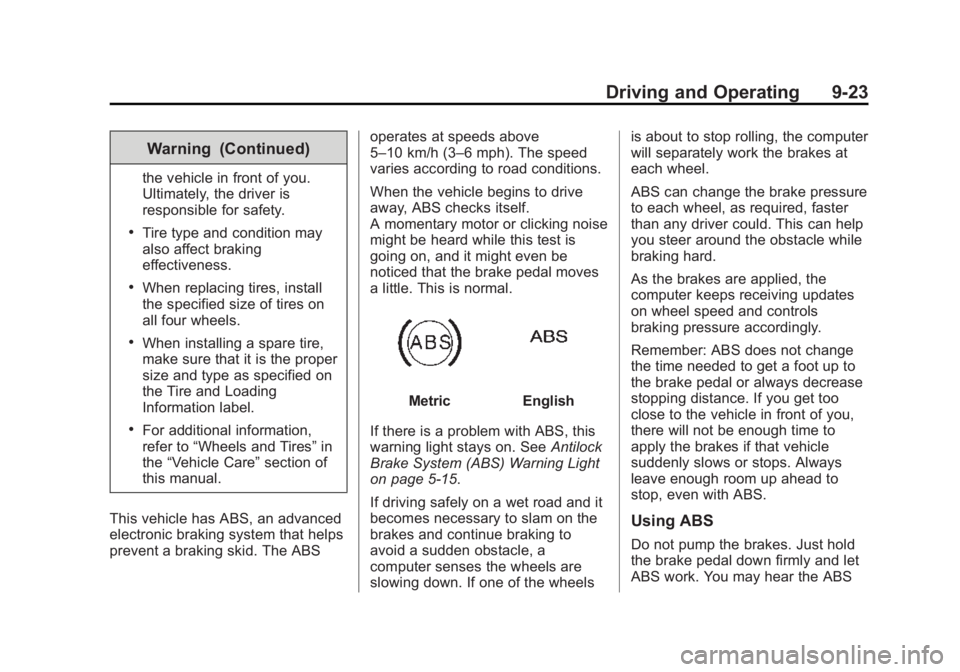
Metric English
If there is a problem with ABS, this
warning light stays on. See Antilock
Brake System (ABS) Warning Light
on page 5-15 .
If driving safely on a wet road and it
becomes necessary to slam on the
brakes and continue braking to
avoid a sudden obstacle, a
computer senses the wheels are
slowing down. If one of the wheels is about to stop rolling, the computer
will separately work the brakes at
each wheel.
ABS can change the brake pressure
to each wheel, as required, faster
than any driver could. This can help
you steer around the obstacle while
braking hard.
As the brakes are applied, the
computer keeps receiving updates
on wheel speed and controls
braking pressure accordingly.
Remember: ABS does not change
the time needed to get a foot up to
the brake pedal or always decrease
stopping distance. If you get too
close to the vehicle in front of you,
there will not be enough time to
apply the brakes if that vehicle
suddenly slows or stops. Always
leave enough room up ahead to
stop, even with ABS.
Using ABS
Do not pump the brakes. Just hold
the brake pedal down firmly and let
ABS work. You may hear the ABS
Page 180 of 297
Black plate (39,1)Chevrolet City Express Owner Manual (GMNA-Localizing-U.S./Canada-
7707496) - 2015 - CRC - 11/26/14
Driving and Operating 9-39
Filling the Tank
{ WarningFuel vapors and fuel fires burn
violently and can cause injury or
death. .
To help avoid injuries to you
and others, read and follow
all the instructions on the fuel
pump island. .
Turn off the engine when
refueling. .
Keep sparks, flames, and
smoking materials away
from fuel. .
Do not leave the fuel pump
unattended. .
Do not reenter the vehicle
while pumping fuel. .
Keep children away from the
fuel pump and never let
children pump fuel.
(Continued) Warning (Continued) .
Fuel can spray out if the fuel
cap is opened too quickly.
This spray can happen if the
tank is nearly full, and is
more likely in hot weather.
Open the fuel cap slowly and
wait for any hiss noise to stop
then unscrew the cap all
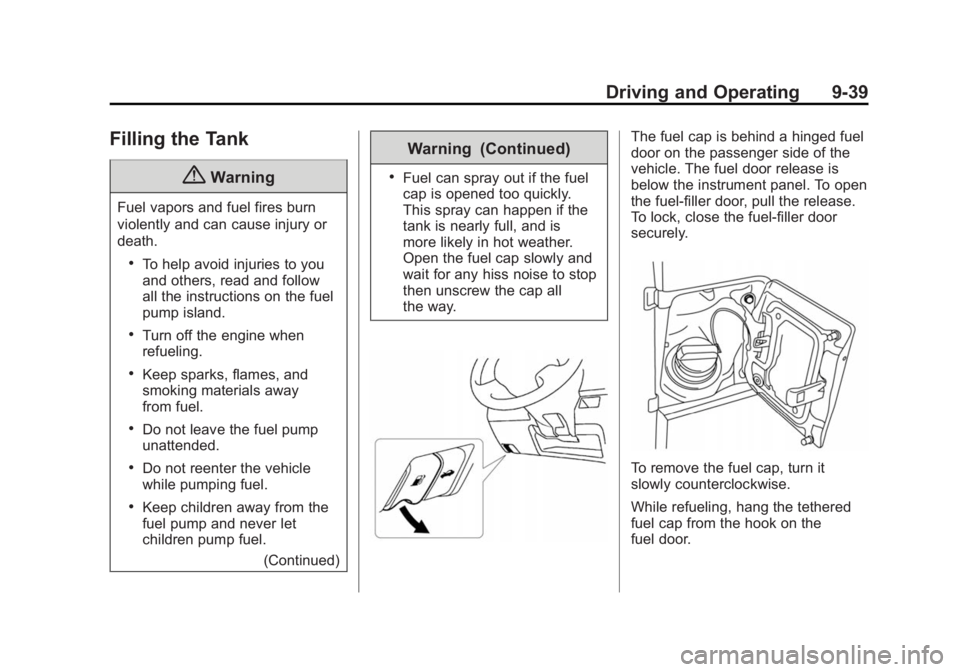
the way. The fuel cap is behind a hinged fuel
door on the passenger side of the
vehicle. The fuel door release is
below the instrument panel. To open
the fuel-filler door, pull the release.
To lock, close the fuel-filler door
securely.
To remove the fuel cap, turn it
slowly counterclockwise.
While refueling, hang the tethered
fuel cap from the hook on the
fuel door.
Page 181 of 297
Black plate (40,1)Chevrolet City Express Owner Manual (GMNA-Localizing-U.S./Canada-
7707496) - 2015 - CRC - 11/26/14
9-40 Driving and Operating Be careful not to spill fuel. Do not
top off or overfill the tank and wait a
few seconds after you have finished
pumping before removing the
nozzle. Clean fuel from painted
surfaces as soon as possible. See
Exterior Care on page 10-61 .
When replacing the fuel cap, turn it
clockwise until it clicks. Make sure
the cap is fully installed.
{ WarningIf a fire starts while you are
refueling, do not remove the
nozzle. Shut off the flow of fuel by
shutting off the pump or by
notifying the station attendant.
Leave the area immediately. { CautionIf a new fuel cap is needed, be
sure to get the right type of cap
from your dealer. The wrong type
of fuel cap may not fit properly,
may cause the malfunction
indicator lamp to light, and could
damage the fuel tank and
emissions system. See
Malfunction Indicator Lamp on
page 5-11 .
LOOSE FUEL CAP Warning
Message
The LOOSE FUEL CAP message
displays in the odometer when the
fuel cap is not tightened correctly
after the vehicle has been refueled.
See Fuel System Messages on
page 5-20 .
Failure to tighten the fuel cap
properly after the LOOSE FUEL
CAP warning message is displayed
may cause the malfunction indicator light (MIL) to turn on. See
Malfunction Indicator Lamp on
page 5-11 .
Filling a Portable Fuel
Container
{ WarningFilling a portable fuel container
while it is in the vehicle can cause
fuel vapors that can ignite either
by static electricity or other
means. You or others could be
badly burned and the vehicle
could be damaged. Always: .
Use approved fuel
containers. .
Remove the container from
the vehicle, trunk, or pickup
bed before filling. .
Place the container on the
ground.
(Continued)
Page 184 of 297
Black plate (1,1)Chevrolet City Express Owner Manual (GMNA-Localizing-U.S./Canada-
7707496) - 2015 - CRC - 11/26/14
Vehicle Care 10-1
Vehicle Care General Information General Information . . . . . . . . . . 10-2
California Proposition
65 Warning . . . . . . . . . . . . . . . . . 10-2
California Perchlorate
Materials Requirements . . . . 10-2
Accessories and
Modifications . . . . . . . . . . . . . . . 10-3
Vehicle Checks Doing Your Own
Service Work . . . . . . . . . . . . . . . 10-4
Hood . . . . . . . . . . . . . . . . . . . . . . . . 10-5
Engine Compartment
Overview . . . . . . . . . . . . . . . . . . . 10-7
Engine Oil . . . . . . . . . . . . . . . . . . . 10-8
Continuously Variable
Transmission (CVT)
Fluid . . . . . . . . . . . . . . . . . . . . . . 10-11
Engine Air Cleaner/Filter . . . . 10-11
Cooling System . . . . . . . . . . . . 10-13
Engine Coolant . . . . . . . . . . . . . 10-13
Engine Overheating . . . . . . . . 10-16
Overheated Engine
Protection
Operating Mode . . . . . . . . . . . 10-17 Washer Fluid . . . . . . . . . . . . . . . 10-18
Brakes . . . . . . . . . . . . . . . . . . . . . 10-19
Brake Fluid . . . . . . . . . . . . . . . . . 10-19
Battery . . . . . . . . . . . . . . . . . . . . . 10-21
Wiper Blade
Replacement . . . . . . . . . . . . . . 10-22
Headlamp Aiming Headlamp Aiming . . . . . . . . . . 10-23
Bulb Replacement Bulb Replacement . . . . . . . . . . 10-23
Halogen Bulbs . . . . . . . . . . . . . . 10-23
Headlamps, Front Turn
Signal and Parking
Lamps . . . . . . . . . . . . . . . . . . . . 10-23
Replacement Bulbs . . . . . . . . . 10-23
Electrical System Electrical System
Overload . . . . . . . . . . . . . . . . . . 10-24
Fuses and Circuit
Breakers . . . . . . . . . . . . . . . . . . 10-25
Engine Compartment Fuse
Block . . . . . . . . . . . . . . . . . . . . . 10-25
Instrument Panel Fuse
Block . . . . . . . . . . . . . . . . . . . . . 10-26 Wheels and Tires Tires . . . . . . . . . . . . . . . . . . . . . . . . 10-26
All-Season Tires . . . . . . . . . . . . 10-27
Winter Tires . . . . . . . . . . . . . . . . 10-27
Summer Tires . . . . . . . . . . . . . . 10-28
All-Terrain Tires . . . . . . . . . . . . 10-28
Tire Sidewall Labeling . . . . . . 10-28
Tire Designations . . . . . . . . . . . 10-30
Tire Terminology and
Definitions . . . . . . . . . . . . . . . . 10-32
Tire Pressure . . . . . . . . . . . . . . . 10-35
Tire Pressure Monitor
System . . . . . . . . . . . . . . . . . . . 10-36
Tire Pressure Monitor
Operation . . . . . . . . . . . . . . . . . 10-37
Tire Inspection . . . . . . . . . . . . . . 10-39
Tire Rotation . . . . . . . . . . . . . . . 10-39
When It Is Time for New
Tires . . . . . . . . . . . . . . . . . . . . . . 10-41
Buying New Tires . . . . . . . . . . . 10-41
Different Size Tires and
Wheels . . . . . . . . . . . . . . . . . . . 10-43
Uniform Tire Quality
Grading . . . . . . . . . . . . . . . . . . . 10-44
Wheel Alignment and Tire
Balance . . . . . . . . . . . . . . . . . . . 10-45
Wheel Replacement . . . . . . . . 10-45
Tire Chains . . . . . . . . . . . . . . . . . 10-46
Page 186 of 297
Black plate (3,1)Chevrolet City Express Owner Manual (GMNA-Localizing-U.S./Canada-
7707496) - 2015 - CRC - 11/26/14
Vehicle Care 10-3
Accessories and
Modifications Adding non-dealer accessories or
making modifications to the vehicle
can affect vehicle performance and
safety, including such things as
airbags, braking, stability, ride and
handling, emissions systems,
aerodynamics, durability, and
electronic systems like antilock
brakes, traction control, and stability
control. These accessories or
modifications could even cause
malfunction or damage not covered
by the vehicle warranty.
Damage to vehicle components
resulting from modifications or the
installation or use of non-GM
certified parts, including control
module or software modifications, is
not covered under the terms of the
vehicle warranty and may affect
remaining warranty coverage for
affected parts.
GM Accessories are designed to
complement and function with other
systems on the vehicle. See your dealer to accessorize the vehicle
using genuine GM Accessories
installed by a dealer technician.
Also, see Adding Equipment to the
Airbag-Equipped Vehicle on
page 3-29 .
{ WarningAny modifications or alterations of
this vehicle may affect the safety
of the vehicle which may result in
a collision, serious personal injury
or death.
Modifications made to this vehicle
by conversion companies or
dealers may affect the final
certification of the engine, vehicle,
or equipment. The conversion
company or dealer has the
responsibility to certify that the
altered vehicle and equipment
complies or continues to comply
with all applicable motor vehicle
safety standards and emissions
(Continued) Warning (Continued) regulations. The conversion
company or dealer is responsible
for making sure the modifications
or installed equipment does not
affect the safety of the vehicle.
GM does not assume the
responsibility as the final stage
manufacturer for modified or
altered vehicles. GM is not
responsible for the final
certification, product liability
claims, or warranty claims,
resulting from any component,
assembly, or system being
altered. GM is not responsible for
modifications which cause the
vehicle to become non-compliant
with any of the motor vehicle
safety standards, emissions
regulations, or modifications that
cause the vehicle to be or
become defective or unsafe.
(Continued)
Page 187 of 297
Black plate (4,1)Chevrolet City Express Owner Manual (GMNA-Localizing-U.S./Canada-
7707496) - 2015 - CRC - 11/26/14
10-4 Vehicle Care Warning (Continued)Your vehicle ’ s warranty may not
cover damage resulting from
alterations, modifications,
installation of non-approved
accessories, or improper
installation of accessories. Refer
to your Warranty Information
Booklet for complete details.
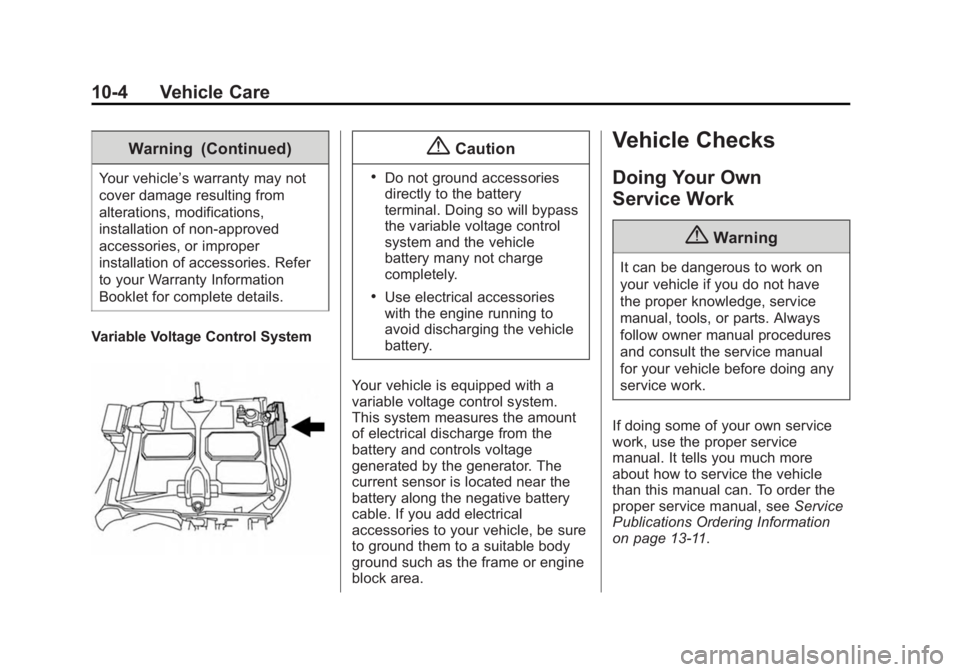
Variable Voltage Control System
{ Caution .
Do not ground accessories
directly to the battery
terminal. Doing so will bypass
the variable voltage control
system and the vehicle
battery many not charge
completely. .
Use electrical accessories
with the engine running to
avoid discharging the vehicle
battery.
Your vehicle is equipped with a
variable voltage control system.
This system measures the amount
of electrical discharge from the
battery and controls voltage
generated by the generator. The
current sensor is located near the
battery along the negative battery
cable. If you add electrical
accessories to your vehicle, be sure
to ground them to a suitable body
ground such as the frame or engine
block area. Vehicle Checks Doing Your Own
Service Work
{ WarningIt can be dangerous to work on
your vehicle if you do not have
the proper knowledge, service
manual, tools, or parts. Always
follow owner manual procedures
and consult the service manual
for your vehicle before doing any
service work.
If doing some of your own service
work, use the proper service
manual. It tells you much more
about how to service the vehicle
than this manual can. To order the
proper service manual, see Service
Publications Ordering Information
on page 13-11 .
Page 188 of 297
Black plate (5,1)Chevrolet City Express Owner Manual (GMNA-Localizing-U.S./Canada-
7707496) - 2015 - CRC - 11/26/14
Vehicle Care 10-5This vehicle has an airbag system.
Before attempting to do your own
service work, see Servicing the
Airbag-Equipped Vehicle on
page 3-28 .
Keep a record with all parts receipts
and list the mileage and the date of
any service work performed. See
Maintenance Records on
page 11-13 .
{ CautionEven small amounts of
contamination can cause damage
to vehicle systems. Do not allow
contaminants to contact the fluids,
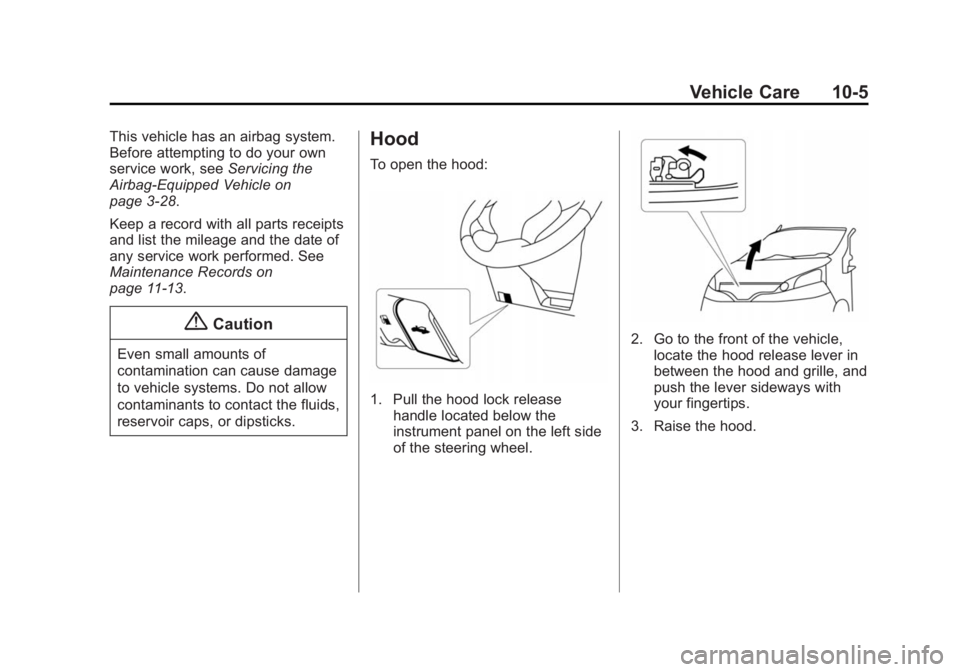
reservoir caps, or dipsticks. Hood To open the hood:
1. Pull the hood lock release
handle located below the
instrument panel on the left side
of the steering wheel. 2. Go to the front of the vehicle,
locate the hood release lever in
between the hood and grille, and
push the lever sideways with
your fingertips.
3. Raise the hood.
Page 191 of 297
Black plate (8,1)Chevrolet City Express Owner Manual (GMNA-Localizing-U.S./Canada-
7707496) - 2015 - CRC - 11/26/14
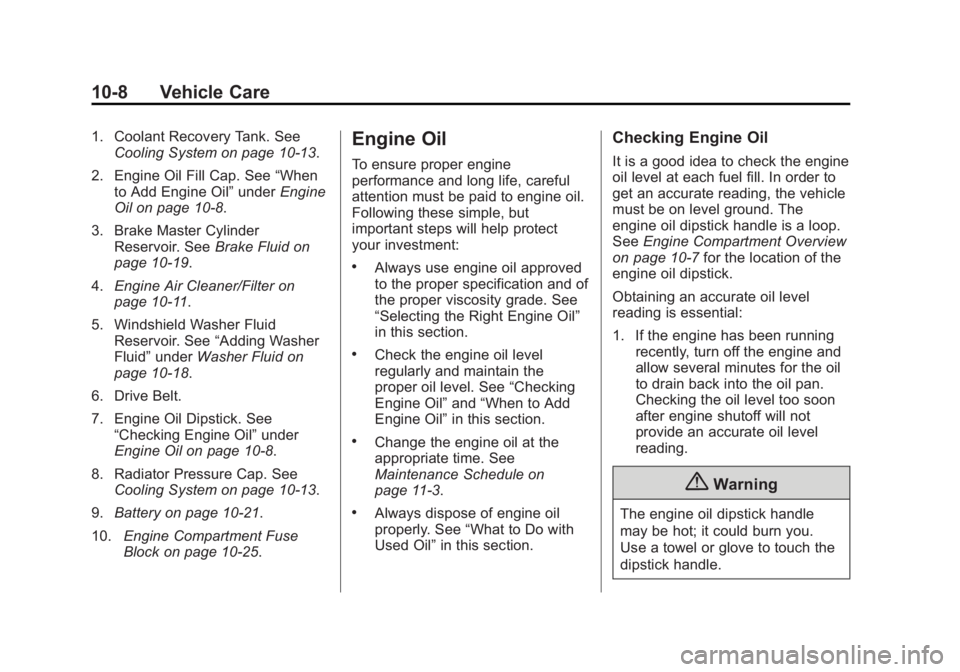
10-8 Vehicle Care 1. Coolant Recovery Tank. See
Cooling System on page 10-13 .
2. Engine Oil Fill Cap. See “ When
to Add Engine Oil ” under Engine
Oil on page 10-8 .
3. Brake Master Cylinder
Reservoir. See Brake Fluid on
page 10-19 .
4. Engine Air Cleaner/Filter on
page 10-11 .
5. Windshield Washer Fluid
Reservoir. See “ Adding Washer
Fluid ” under Washer Fluid on
page 10-18 .
6. Drive Belt.
7. Engine Oil Dipstick. See
“ Checking Engine Oil ” under
Engine Oil on page 10-8 .
8. Radiator Pressure Cap. See
Cooling System on page 10-13 .
9. Battery on page 10-21 .
10. Engine Compartment Fuse
Block on page 10-25 . Engine Oil To ensure proper engine
performance and long life, careful
attention must be paid to engine oil.
Following these simple, but
important steps will help protect
your investment: .
Always use engine oil approved
to the proper specification and of
the proper viscosity grade. See
“ Selecting the Right Engine Oil ”
in this section. .
Check the engine oil level
regularly and maintain the
proper oil level. See “ Checking
Engine Oil ” and “ When to Add
Engine Oil ” in this section. .
Change the engine oil at the
appropriate time. See
Maintenance Schedule on
page 11-3 . .
Always dispose of engine oil
properly. See “ What to Do with
Used Oil ” in this section. Checking Engine Oil It is a good idea to check the engine
oil level at each fuel fill. In order to
get an accurate reading, the vehicle
must be on level ground. The
engine oil dipstick handle is a loop.
See Engine Compartment Overview
on page 10-7 for the location of the
engine oil dipstick.
Obtaining an accurate oil level
reading is essential:
1. If the engine has been running
recently, turn off the engine and
allow several minutes for the oil
to drain back into the oil pan.
Checking the oil level too soon
after engine shutoff will not
provide an accurate oil level
reading.
{ Warning
The engine oil dipstick handle
may be hot; it could burn you.
Use a towel or glove to touch the
dipstick handle.
Page 205 of 297
Black plate (22,1)Chevrolet City Express Owner Manual (GMNA-Localizing-U.S./Canada-
7707496) - 2015 - CRC - 11/26/14
10-22 Vehicle Care Note: The extended storage switch
is used for long term vehicle
storage. Even if the extended
storage switch is broken it is not
necessary to replace it. Replace
only the open fuse in the switch with
a new fuse.
How to replace the extended
storage switch:
1. To remove the extended storage
switch, be sure the ignition
switch is in the OFF or LOCK
position.
2. Be sure the headlight switch is
in the OFF position.
3. Remove the fuse box cover.
4. Pinch the locking tabs (1)
and (2) found on each side of
the storage switch.
5. Pull the storage switch straight
out from the fuse box (3). Wiper Blade Replacement Windshield wiper blades should be
inspected for wear and cracking.
See Maintenance Schedule on
page 11-3 .
Replacement blades come in
different types and are removed in
different ways. For proper type and
length, see Maintenance
Replacement Parts on page 11-12 .
{ CautionAllowing the wiper arm to touch
the windshield when no wiper
blade is installed could damage
the windshield. Any damage that
occurs would not be covered by
the vehicle warranty. Do not allow
the wiper arm to touch the
windshield.
1. Lift the wiper arm away from the
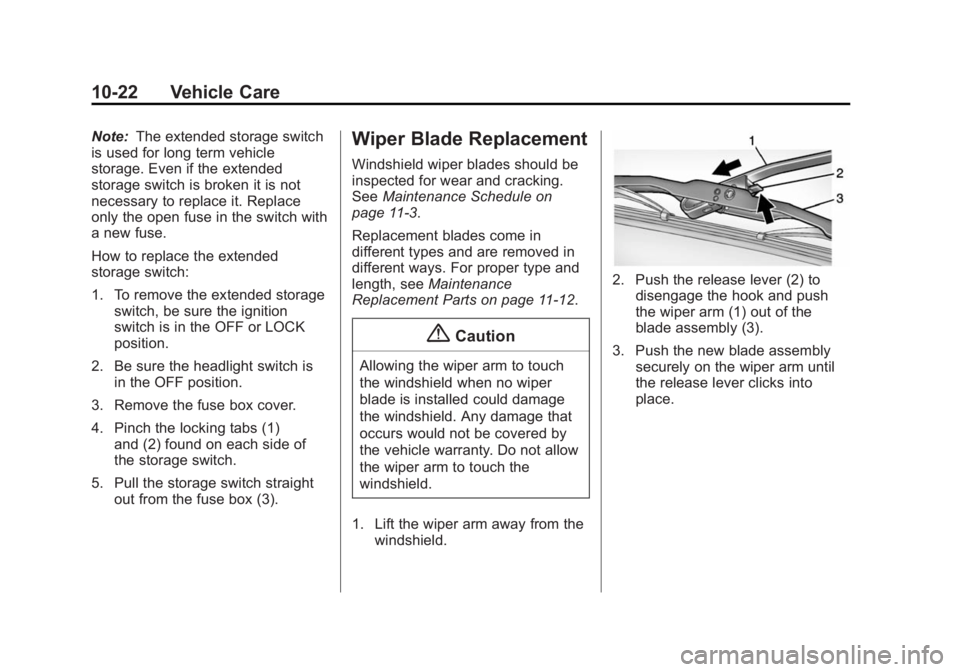
windshield. 2. Push the release lever (2) to
disengage the hook and push
the wiper arm (1) out of the
blade assembly (3).
3. Push the new blade assembly
securely on the wiper arm until
the release lever clicks into
place.
Page 206 of 297
Black plate (23,1)Chevrolet City Express Owner Manual (GMNA-Localizing-U.S./Canada-
7707496) - 2015 - CRC - 11/26/14
Vehicle Care 10-23
Headlamp Aiming Headlamp aim has been preset and
should need no further adjustment.
If the vehicle is damaged in a crash,
the headlamp aim may be affected.
If adjustment to the headlamps is
necessary, see your dealer.
Bulb Replacement For the proper type of replacement
bulbs, see Replacement Bulbs on
page 10-23 .
For any bulb ‐ changing procedure
not listed in this section, contact
your dealer.
Halogen Bulbs
{ WarningHalogen bulbs have pressurized
gas inside and can burst if you
drop or scratch the bulb. You or
others could be injured. Be sure
to read and follow the instructions
on the bulb package. Headlamps, Front Turn
Signal and Parking
Lamps High-Beam Headlamp/
Low-Beam Headlamp 1. Open the hood.
2. Release the clip on the
connector.
3. Turn the bulb counterclockwise
and pull straight back.
Turn Signal and Parking Lamp 1. Open the hood.
2. Turn the bulb counterclockwise
and pull straight back.
Replacement Bulbs Lamp Bulb
Number
Headlamp H13
Front Turn Signal
and Parking Lamp 3457K
Map Lamp W5W