check engine CHEVROLET CITY EXPRESS 2016 Owner's Manual
[x] Cancel search | Manufacturer: CHEVROLET, Model Year: 2016, Model line: CITY EXPRESS, Model: CHEVROLET CITY EXPRESS 2016Pages: 297, PDF Size: 4.52 MB
Page 196 of 297
Black plate (13,1)Chevrolet City Express Owner Manual (GMNA-Localizing-U.S./Canada-
7707496) - 2015 - CRC - 11/26/14
Vehicle Care 10-13
{ CautionIf the air cleaner/filter is off, dirt
can easily get into the engine,
which could damage it. Always
have the air cleaner/filter in place
when you are driving.
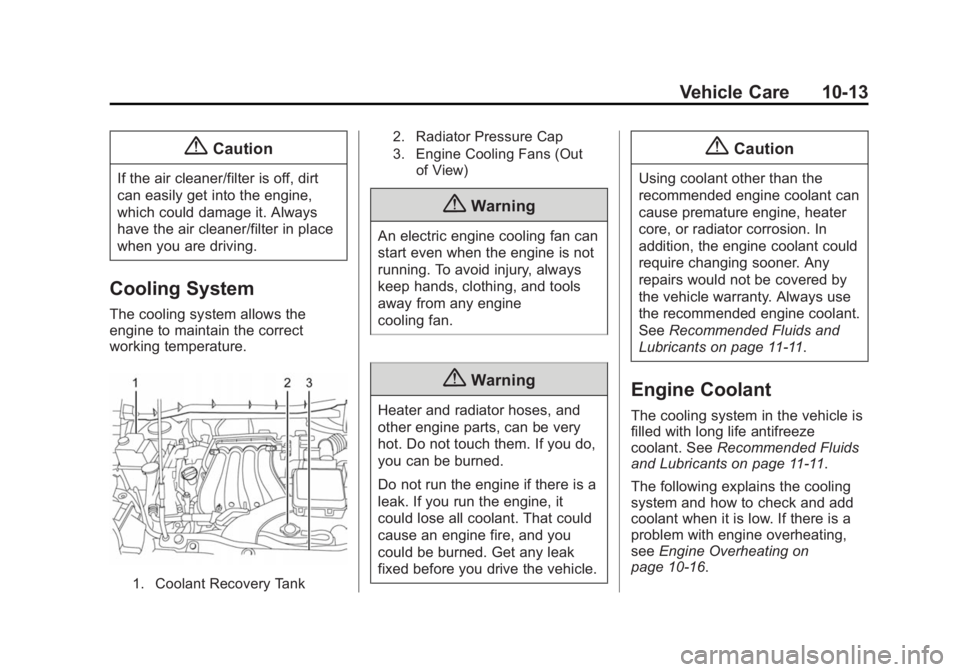
Cooling System The cooling system allows the
engine to maintain the correct
working temperature.
1. Coolant Recovery Tank 2. Radiator Pressure Cap
3. Engine Cooling Fans (Out
of View)
{ WarningAn electric engine cooling fan can
start even when the engine is not
running. To avoid injury, always
keep hands, clothing, and tools
away from any engine
cooling fan.
{ Warning
Heater and radiator hoses, and
other engine parts, can be very
hot. Do not touch them. If you do,
you can be burned.
Do not run the engine if there is a
leak. If you run the engine, it
could lose all coolant. That could
cause an engine fire, and you
could be burned. Get any leak
fixed before you drive the vehicle. { CautionUsing coolant other than the
recommended engine coolant can
cause premature engine, heater
core, or radiator corrosion. In
addition, the engine coolant could
require changing sooner. Any
repairs would not be covered by
the vehicle warranty. Always use
the recommended engine coolant.
See Recommended Fluids and
Lubricants on page 11-11 .
Engine Coolant The cooling system in the vehicle is
filled with long life antifreeze
coolant. See Recommended Fluids
and Lubricants on page 11-11 .
The following explains the cooling
system and how to check and add
coolant when it is low. If there is a
problem with engine overheating,
see Engine Overheating on
page 10-16 .
Page 198 of 297
Black plate (15,1)Chevrolet City Express Owner Manual (GMNA-Localizing-U.S./Canada-
7707496) - 2015 - CRC - 11/26/14
Vehicle Care 10-15Checking Engine Coolant
Level
{ WarningYou can be burned if you spill
coolant on hot engine parts.
Coolant contains ethylene glycol
and it will burn if the engine parts
are hot enough. Do not spill
coolant on a hot engine.
{ CautionThis vehicle has a specific
coolant fill procedure. Failure to
follow this procedure could cause
the engine to overheat and be
severely damaged. { WarningSteam and scalding liquids from a
hot cooling system can blow out
and burn you badly. Never turn
the cap when the cooling system,
including the surge tank pressure
cap, is hot. Wait for the cooling
system and surge tank pressure
cap to cool.
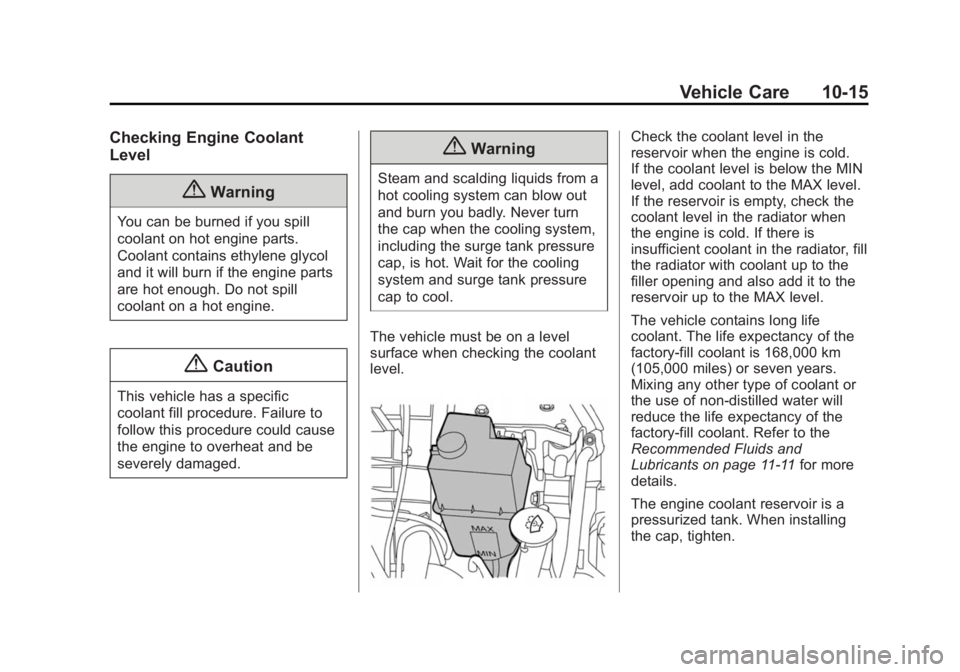
The vehicle must be on a level
surface when checking the coolant
level. Check the coolant level in the
reservoir when the engine is cold.
If the coolant level is below the MIN
level, add coolant to the MAX level.
If the reservoir is empty, check the
coolant level in the radiator when
the engine is cold. If there is
insufficient coolant in the radiator, fill
the radiator with coolant up to the
filler opening and also add it to the
reservoir up to the MAX level.
The vehicle contains long life
coolant. The life expectancy of the
factory-fill coolant is 168,000 km
(105,000 miles) or seven years.
Mixing any other type of coolant or
the use of non-distilled water will
reduce the life expectancy of the
factory-fill coolant. Refer to the
Recommended Fluids and
Lubricants on page 11-11 for more
details.
The engine coolant reservoir is a
pressurized tank. When installing
the cap, tighten.
Page 199 of 297
Black plate (16,1)Chevrolet City Express Owner Manual (GMNA-Localizing-U.S./Canada-
7707496) - 2015 - CRC - 11/26/14
10-16 Vehicle Care If the cooling system frequently
requires coolant, have it checked by
your dealer.
Changing Engine Coolant A dealer can change the engine
coolant. The service procedure can
be found in the service manual. See
Service Publications Ordering
Information on page 13-11 .
Improper servicing can result in
reduced heater performance and
engine overheating.
{ Warning.
To avoid the danger of being
scalded, never change the
coolant when the engine
is hot. .
Never remove the radiator or
engine coolant reservoir cap
when the engine is hot.
Serious burns could be
caused by high pressure fluid
escaping from the radiator.
(Continued) Warning (Continued) .
Avoid direct skin contact with
used coolant. If skin contact
is made, wash thoroughly
with soap or hand cleaner as
soon as possible. .
Keep coolant out of the reach
of children and pets.
Engine coolant must be disposed of
properly. Check your local
regulations.
Engine Overheating The vehicle has an engine coolant
temperature warning light on the
instrument cluster to warn of engine
overheating. See Engine Coolant
Temperature Warning Light on
page 5-17 .
If the decision is made not to lift the
hood when this warning appears,
but instead get service help right
away, see Roadside Assistance
Program on page 13-5 . If the decision is made to lift the
hood, make sure the vehicle is
parked on a level surface.
Then check to see if the engine
cooling fans are running. If the
engine is overheating, the fans
should be running. If they are not,
do not continue to run the engine
and have the vehicle serviced.
See if the engine cooling fan speed
increases when idle speed is
doubled by pushing the accelerator
pedal down. If it does not, the
vehicle needs service. Turn off the
engine.
{ Caution
Running the engine without
coolant may cause damage or a
fire. Vehicle damage would not be
covered by the vehicle warranty.
Page 200 of 297
Black plate (17,1)Chevrolet City Express Owner Manual (GMNA-Localizing-U.S./Canada-
7707496) - 2015 - CRC - 11/26/14
Vehicle Care 10-17If Steam is Coming from the
Engine Compartment
{ WarningSteam from an overheated engine
can burn you badly, even if you
just open the hood. Stay away
from the engine if you see or hear
steam coming from it. Just turn it
off and get everyone away from
the vehicle until it cools down.
Wait until there is no sign of
steam or coolant before you open
the hood.
If you keep driving when the
engine is overheated, the liquids
in it can catch fire. You or others
could be badly burned. Stop the
engine if it overheats, and get out
of the vehicle until the engine
is cool. Overheated Engine
Protection
Operating Mode The engine has an engine
protection mode to reduce the
chance of damage if the coolant
temperature goes too high (for
example, when climbing steep
grades in high temperature with
heavy loads, such as when towing a
trailer). When the engine
temperature reaches a certain level: .
The engine coolant temperature
warning light will illuminate. .
Engine power may be reduced. .
The air conditioning cooling
function may be automatically
turned OFF for a short time (the
blower will continue to operate).
Engine power and under certain
conditions, vehicle speed will
decrease. Vehicle speed can be
controlled with the accelerator
pedal, but the vehicle may not
accelerate at the desired speed. The transmission will downshift or
upshift as it reaches prescribed shift
points. You can also shift manually.
As driving conditions change and
engine coolant temperature is
reduced, vehicle speed can be
increased using the accelerator
pedal, and air conditioning cooling
function will automatically be turned
back ON.
If:
1. The engine coolant temperature
is not reduced.
2. The air conditioning cooling
function does not turn back ON.
3. The engine oil pressure low/
engine coolant temperature high
warning light illuminates, this
may indicate a malfunction.
Move the vehicle off the road in
a safe area and allow the engine
to cool. If after checking the oil
and coolant, the oil pressure
low/engine coolant temperature
Page 203 of 297
Black plate (20,1)Chevrolet City Express Owner Manual (GMNA-Localizing-U.S./Canada-
7707496) - 2015 - CRC - 11/26/14
10-20 Vehicle Care .
A fluid leak in the brake
hydraulic system can also cause
a low fluid level. Have the brake
hydraulic system fixed, since a
leak means that sooner or later
the brakes will not work well.
Do not top off the brake fluid.
Adding fluid does not correct a leak.
If fluid is added when the linings are
worn, there will be too much fluid
when new brake linings are
installed. Add or remove brake fluid,
as necessary, only when work is
done on the brake hydraulic system.
{ Warning
If too much brake fluid is added, it
can spill on the engine and burn,
if the engine is hot enough. You
or others could be burned, and
the vehicle could be damaged.
Add brake fluid only when work is
done on the brake hydraulic
system. See “ Checking Brake
Fluid ” in this section. Refer to the Maintenance Schedule
to determine when to check the
brake fluid. See Maintenance
Schedule on page 11-3 .
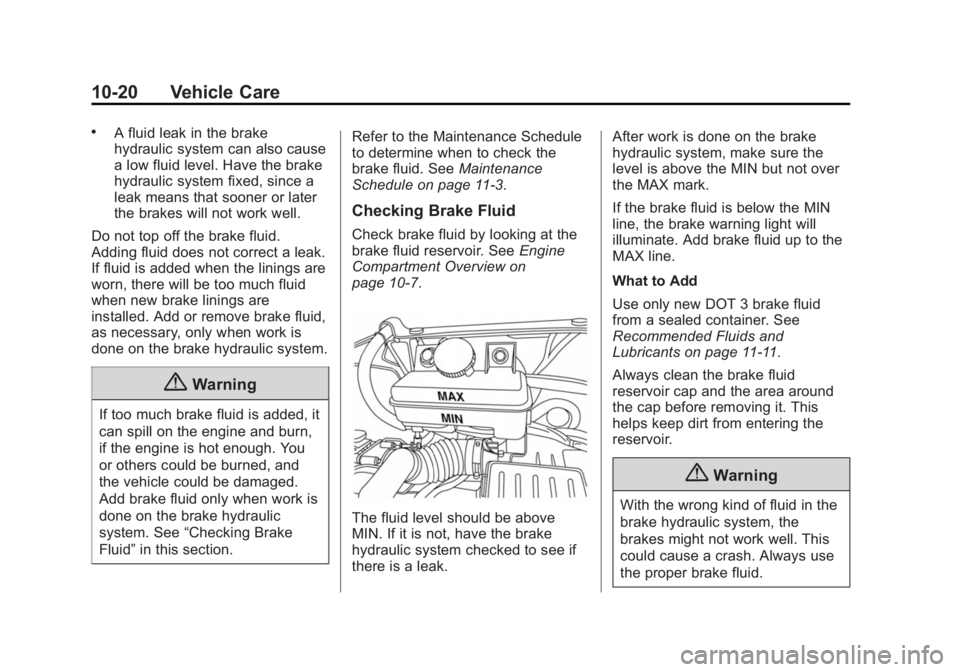
Checking Brake Fluid Check brake fluid by looking at the
brake fluid reservoir. See Engine
Compartment Overview on
page 10-7 .
The fluid level should be above
MIN. If it is not, have the brake
hydraulic system checked to see if
there is a leak. After work is done on the brake
hydraulic system, make sure the
level is above the MIN but not over
the MAX mark.
If the brake fluid is below the MIN
line, the brake warning light will
illuminate. Add brake fluid up to the
MAX line.
What to Add
Use only new DOT 3 brake fluid
from a sealed container. See
Recommended Fluids and
Lubricants on page 11-11 .
Always clean the brake fluid
reservoir cap and the area around
the cap before removing it. This
helps keep dirt from entering the
reservoir.
{ Warning
With the wrong kind of fluid in the
brake hydraulic system, the
brakes might not work well. This
could cause a crash. Always use
the proper brake fluid.
Page 204 of 297
Black plate (21,1)Chevrolet City Express Owner Manual (GMNA-Localizing-U.S./Canada-
7707496) - 2015 - CRC - 11/26/14
Vehicle Care 10-21
{ Caution .
Using the wrong fluid can
badly damage brake
hydraulic system parts. For
example, just a few drops of
mineral-based oil, such as
engine oil, in the brake
hydraulic system can damage
brake hydraulic system parts
so badly that they will have to
be replaced. Do not let
someone put in the wrong
kind of fluid. .
If brake fluid is spilled on the
vehicle's painted surfaces,
the paint finish can be
damaged. Be careful not to
spill brake fluid on the
vehicle. If you do, wash it off
immediately.
Battery The original equipment battery is
maintenance free. Do not remove
the cap and do not add fluid. Refer to the replacement number
shown on the original battery label
when a new battery is needed. See
Engine Compartment Overview on
page 10-7 for battery location.
{ WarningWARNING: Battery posts,
terminals, and related
accessories contain lead and lead
compounds, chemicals known to
the State of California to cause
cancer and birth defects or other
reproductive harm. Wash hands
after handling. See California
Proposition 65 Warning on
page 10-2 .
Vehicle Storage
{ Warning
Batteries have acid that can burn
you and gas that can explode.
You can be badly hurt if you are
(Continued) Warning (Continued) not careful. See Jump Starting on
page 10-55 for tips on working
around a battery without
getting hurt.
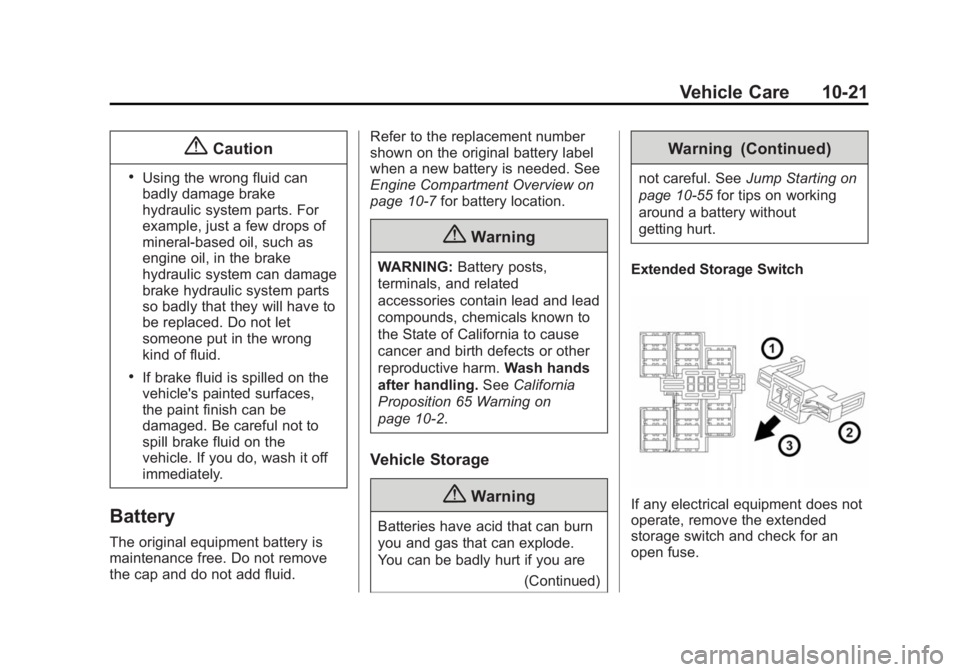
Extended Storage Switch
If any electrical equipment does not
operate, remove the extended
storage switch and check for an
open fuse.
Page 208 of 297
Black plate (25,1)Chevrolet City Express Owner Manual (GMNA-Localizing-U.S./Canada-
7707496) - 2015 - CRC - 11/26/14
Vehicle Care 10-25
Fuses and Circuit
Breakers The wiring circuits in the vehicle are
protected from short circuits by a
combination of fuses and circuit
breakers. This greatly reduces the
chance of fires caused by electrical
problems.
Look at the silver-colored band
inside the fuse. If the band is broken
or melted, replace the fuse. Be sure
you replace a bad fuse with a new
one of the identical size and rating.
Spare fuses are provided and can
be found in the passenger
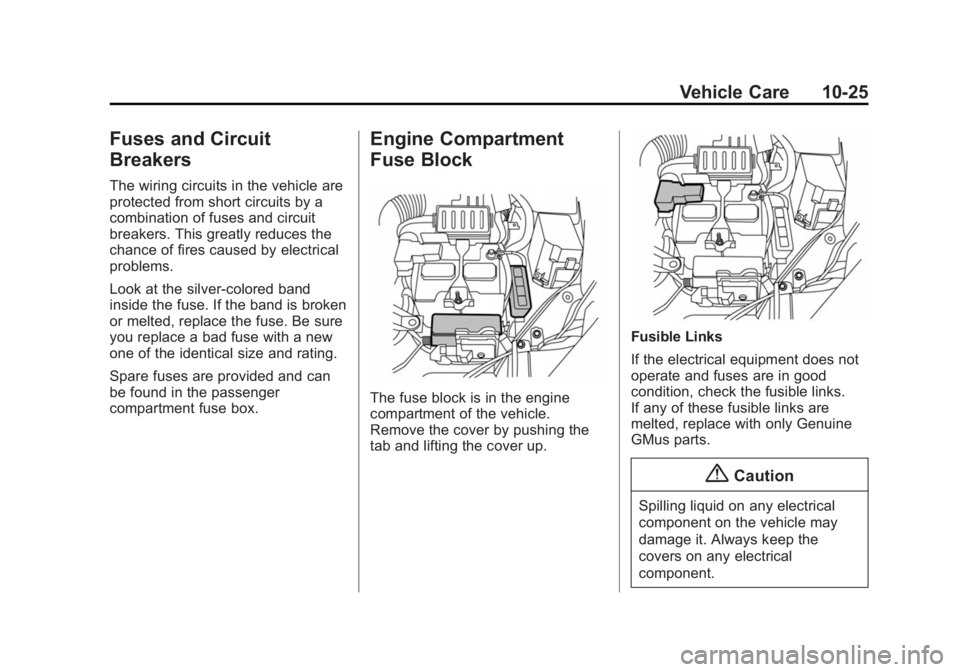
compartment fuse box. Engine Compartment
Fuse Block
The fuse block is in the engine
compartment of the vehicle.
Remove the cover by pushing the
tab and lifting the cover up. Fusible Links
If the electrical equipment does not
operate and fuses are in good
condition, check the fusible links.
If any of these fusible links are
melted, replace with only Genuine
GMus parts.
{ Caution
Spilling liquid on any electrical
component on the vehicle may
damage it. Always keep the
covers on any electrical
component.
Page 241 of 297
Black plate (58,1)Chevrolet City Express Owner Manual (GMNA-Localizing-U.S./Canada-
7707496) - 2015 - CRC - 11/26/14
10-58 Vehicle Care 5. Check that the jumper cables do
not have loose or missing
insulation. If they do, you could
get a shock. The vehicles could
be damaged too.
Before you connect the cables,
here are some basic things you
should know. Positive (+) will go
to positive (+) or to a remote
positive (+) terminal if equipped.
Negative ( − ) will go to an
unpainted metal part or to a
remote negative ( − ) terminal if
equipped.
Do not connect positive (+) to
negative ( − ) or you will get a
short that would damage the
battery and possibly other parts
too. Do not connect the
negative ( − ) cable to the
negative ( − ) terminal on the dead
battery because this can cause
sparks.
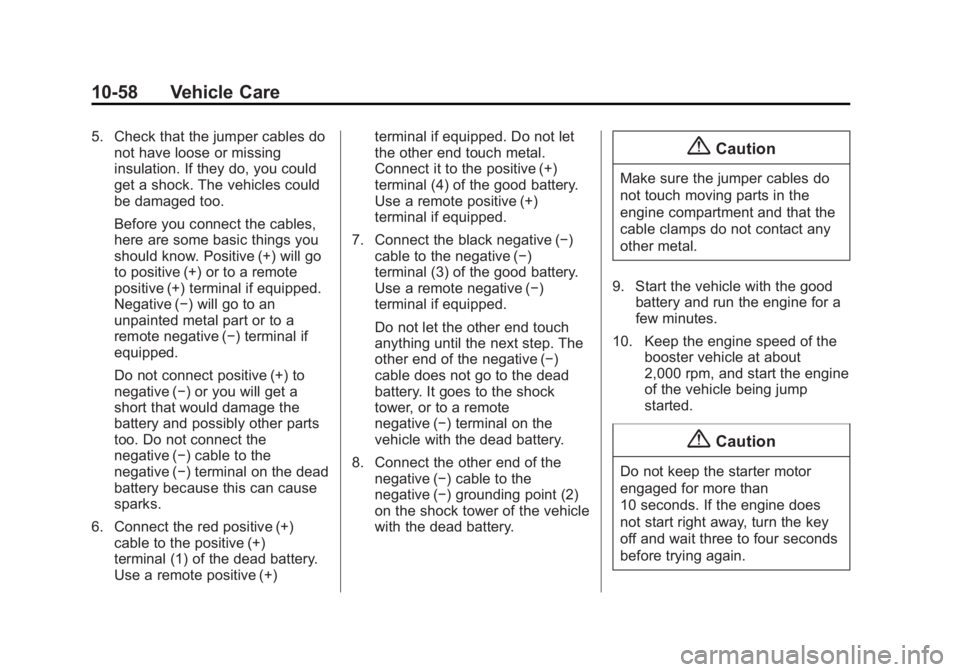
6. Connect the red positive (+)
cable to the positive (+)
terminal (1) of the dead battery.
Use a remote positive (+) terminal if equipped. Do not let
the other end touch metal.
Connect it to the positive (+)
terminal (4) of the good battery.
Use a remote positive (+)
terminal if equipped.
7. Connect the black negative ( − )
cable to the negative ( − )
terminal (3) of the good battery.
Use a remote negative ( − )
terminal if equipped.
Do not let the other end touch
anything until the next step. The
other end of the negative ( − )
cable does not go to the dead
battery. It goes to the shock
tower, or to a remote
negative ( − ) terminal on the
vehicle with the dead battery.
8. Connect the other end of the
negative ( − ) cable to the
negative ( − ) grounding point (2)
on the shock tower of the vehicle
with the dead battery. { CautionMake sure the jumper cables do
not touch moving parts in the
engine compartment and that the
cable clamps do not contact any
other metal.
9. Start the vehicle with the good
battery and run the engine for a
few minutes.
10. Keep the engine speed of the
booster vehicle at about
2,000 rpm, and start the engine
of the vehicle being jump
started.
{ Caution
Do not keep the starter motor
engaged for more than
10 seconds. If the engine does
not start right away, turn the key
off and wait three to four seconds
before trying again.
Page 256 of 297
Black plate (3,1)Chevrolet City Express Owner Manual (GMNA-Localizing-U.S./Canada-
7707496) - 2015 - CRC - 11/26/14
Service and Maintenance 11-3
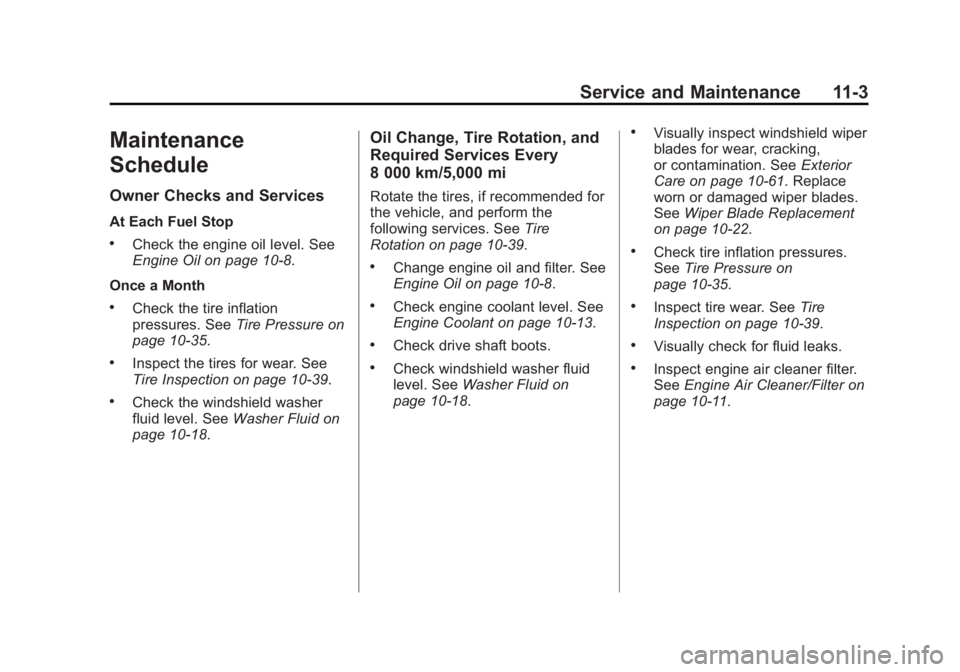
Maintenance
Schedule Owner Checks and Services At Each Fuel Stop .
Check the engine oil level. See
Engine Oil on page 10-8 .
Once a Month .
Check the tire inflation
pressures. See Tire Pressure on
page 10-35 ..
Inspect the tires for wear. See
Tire Inspection on page 10-39 ..
Check the windshield washer
fluid level. See Washer Fluid on
page 10-18 . Oil Change, Tire Rotation, and
Required Services Every
8 000 km/5,000 mi Rotate the tires, if recommended for
the vehicle, and perform the
following services. See Tire
Rotation on page 10-39 . .
Change engine oil and filter. See
Engine Oil on page 10-8 . .
Check engine coolant level. See
Engine Coolant on page 10-13 ..
Check drive shaft boots. .
Check windshield washer fluid
level. See Washer Fluid on
page 10-18 . .
Visually inspect windshield wiper
blades for wear, cracking,
or contamination. See Exterior
Care on page 10-61 . Replace
worn or damaged wiper blades.
See Wiper Blade Replacement
on page 10-22 . .
Check tire inflation pressures.
See Tire Pressure on
page 10-35 . .
Inspect tire wear. See Tire
Inspection on page 10-39 . .
Visually check for fluid leaks. .
Inspect engine air cleaner filter.
See Engine Air Cleaner/Filter on
page 10-11 .
Page 258 of 297
Black plate (5,1)Chevrolet City Express Owner Manual (GMNA-Localizing-U.S./Canada-
7707496) - 2015 - CRC - 11/26/14
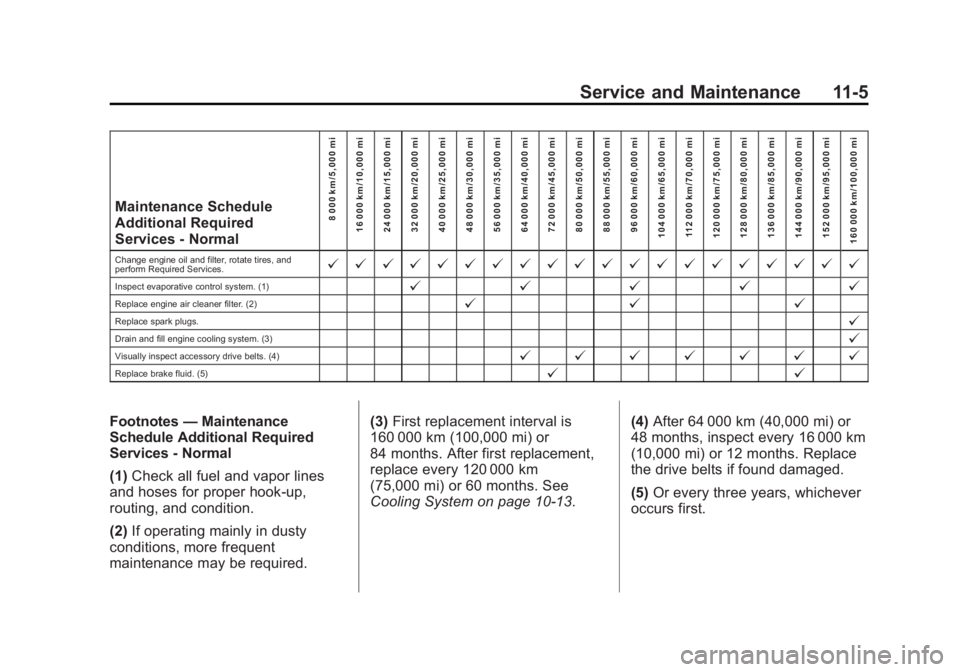
Service and Maintenance 11-5Maintenance Schedule
Additional Required
Services - Normal
8 000 km/5,000 mi
16 000 km/10,000 mi
24 000 km/15,000 mi
32 000 km/20,000 mi
40 000 km/25,000 mi
48 000 km/30,000 mi
56 000 km/35,000 mi
64 000 km/40,000 mi
72 000 km/45,000 mi
80 000 km/50,000 mi
88 000 km/55,000 mi
96 000 km/60,000 mi
104 000 km/65,000 mi
112 000 km/70,000 mi
120 000 km/75,000 mi
128 000 km/80,000 mi
136 000 km/85,000 mi
144 000 km/90,000 mi
152 000 km/95,000 mi
160 000 km/100,000 miChange engine oil and filter, rotate tires, and
perform Required Services.
@ @ @ @ @ @ @ @ @ @ @ @ @ @ @ @ @ @ @ @Inspect evaporative control system. (1)
@ @ @ @ @Replace engine air cleaner filter. (2)
@ @ @Replace spark plugs.
@Drain and fill engine cooling system. (3)
@Visually inspect accessory drive belts. (4)
@ @ @ @ @ @ @Replace brake fluid. (5)
@ @
Footnotes — Maintenance
Schedule Additional Required
Services - Normal
(1) Check all fuel and vapor lines
and hoses for proper hook-up,
routing, and condition.
(2) If operating mainly in dusty
conditions, more frequent
maintenance may be required. (3) First replacement interval is
160 000 km (100,000 mi) or
84 months. After first replacement,
replace every 120 000 km
(75,000 mi) or 60 months. See
Cooling System on page 10-13 . (4) After 64 000 km (40,000 mi) or
48 months, inspect every 16 000 km
(10,000 mi) or 12 months. Replace
the drive belts if found damaged.
(5) Or every three years, whichever
occurs first.