ECO mode CHEVROLET CITY EXPRESS 2017 Owner's Manual
[x] Cancel search | Manufacturer: CHEVROLET, Model Year: 2017, Model line: CITY EXPRESS, Model: CHEVROLET CITY EXPRESS 2017Pages: 348, PDF Size: 4.84 MB
Page 213 of 348
Chevrolet Express Owner Manual (GMNA-Localizing-U.S./Canada/Mexico-
9967827) - 2017 - crc - 9/26/16
212 Driving and Operating
Tow/Haul Mode
This button is on the instrument
panel, to the right of the steering
wheel.
Pressing this button turns on and off
the Tow/Haul Mode.
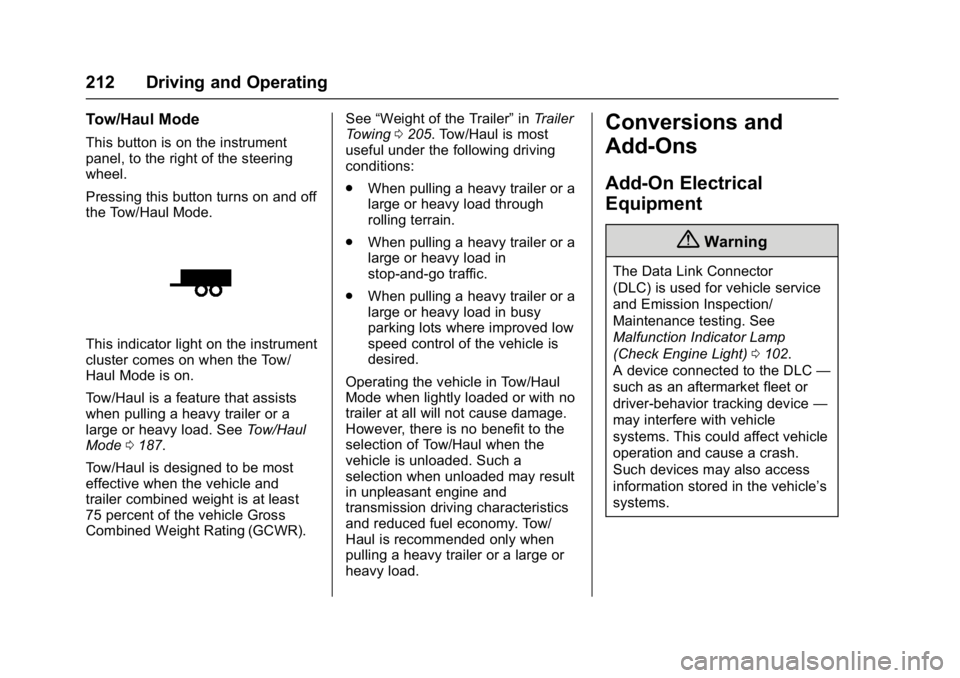
This indicator light on the instrument
cluster comes on when the Tow/
Haul Mode is on.
Tow/Haul is a feature that assists
when pulling a heavy trailer or a
large or heavy load. SeeTow/Haul
Mode 0187.
Tow/Haul is designed to be most
effective when the vehicle and
trailer combined weight is at least
75 percent of the vehicle Gross
Combined Weight Rating (GCWR). See
“Weight of the Trailer” inTrailer
Towing 0205. Tow/Haul is most
useful under the following driving
conditions:
. When pulling a heavy trailer or a
large or heavy load through
rolling terrain.
. When pulling a heavy trailer or a
large or heavy load in
stop-and-go traffic.
. When pulling a heavy trailer or a
large or heavy load in busy
parking lots where improved low
speed control of the vehicle is
desired.
Operating the vehicle in Tow/Haul
Mode when lightly loaded or with no
trailer at all will not cause damage.
However, there is no benefit to the
selection of Tow/Haul when the
vehicle is unloaded. Such a
selection when unloaded may result
in unpleasant engine and
transmission driving characteristics
and reduced fuel economy. Tow/
Haul is recommended only when
pulling a heavy trailer or a large or
heavy load.
Conversions and
Add-Ons
Add-On Electrical
Equipment
{Warning
The Data Link Connector
(DLC) is used for vehicle service
and Emission Inspection/
Maintenance testing. See
Malfunction Indicator Lamp
(Check Engine Light) 0102.
A device connected to the DLC —
such as an aftermarket fleet or
driver-behavior tracking device —
may interfere with vehicle
systems. This could affect vehicle
operation and cause a crash.
Such devices may also access
information stored in the vehicle’s
systems.
Page 260 of 348
Chevrolet Express Owner Manual (GMNA-Localizing-U.S./Canada/Mexico-
9967827) - 2017 - crc - 9/26/16
Vehicle Care 259
Maximum Loaded Vehicle
Weight
:The sum of curb
weight, accessory weight,
vehicle capacity weight, and
production options weight.
Normal Occupant Weight
:The
number of occupants a vehicle
is designed to seat multiplied by
68 kg (150 lb). See Vehicle Load
Limits 0171.
Occupant Distribution
:
Designated seating positions.
Outward Facing Sidewall
:The
side of an asymmetrical tire that
has a particular side that faces
outward when mounted on a
vehicle. The side of the tire that
contains a whitewall, bears
white lettering, or bears
manufacturer, brand, and/or
model name molding that is
higher or deeper than the same
moldings on the other sidewall
of the tire. Passenger (P-Metric) Tire
:A
tire used on passenger cars and
some light duty trucks and
multipurpose vehicles.
Recommended Inflation
Pressure
:Vehicle
manufacturer's recommended
tire inflation pressure as shown
on the tire placard.
See Tire Pressure 0260 and
Vehicle Load Limits 0171.
Radial Ply Tire
:A pneumatic
tire in which the ply cords that
extend to the beads are laid at
90 degrees to the centerline of
the tread.
Rim
:A metal support for a tire
and upon which the tire beads
are seated.
Sidewall
:The portion of a tire
between the tread and the bead.
Speed Rating
:An
alphanumeric code assigned to
a tire indicating the maximum
speed at which a tire can
operate. Traction
:The friction between
the tire and the road surface.
The amount of grip provided.
Tread
:The portion of a tire that
comes into contact with
the road.
Treadwear Indicators
:Narrow
bands, sometimes called wear
bars, that show across the tread
of a tire when only 1.6 mm
(1/16 in) of tread remains. See
When It Is Time for New Tires
0 267.
UTQGS (Uniform Tire Quality
Grading Standards)
:A tire
information system that provides
consumers with ratings for a
tire's traction, temperature, and
treadwear. Ratings are
determined by tire
manufacturers using
government testing procedures.
The ratings are molded into the
sidewall of the tire. See Uniform
Tire Quality Grading 0270.
Page 265 of 348
Chevrolet Express Owner Manual (GMNA-Localizing-U.S./Canada/Mexico-
9967827) - 2017 - crc - 9/26/16
264 Vehicle Care
the sensor matching process is
performed successfully. See
your dealer for service.
. Replacement tires or wheels do
not match the original equipment
tires or wheels. Tires and wheels
other than those recommended
could prevent the TPMS from
functioning properly. See Buying
New Tires 0268.
. Operating electronic devices or
being near facilities using radio
wave frequencies similar to the
TPMS could cause the TPMS
sensors to malfunction.
If the TPMS is not functioning
properly, it cannot detect or signal a
low tire condition. See your dealer
for service if the TPMS malfunction
light and DIC message come on
and stay on.
TPMS Sensor Matching
Process
Each TPMS sensor has a unique
identification code. The identification
code needs to be matched to a new
tire/wheel position after rotating the
vehicle’s tires or replacing one or more of the TPMS sensors. Also,
the TPMS sensor matching process
should be performed after replacing
a spare tire with a road tire
containing the TPMS sensor. The
malfunction light and the DIC
message should go off at the next
ignition cycle. The sensors are
matched to the tire/wheel positions,
using a TPMS relearn tool, in the
following order: driver side front tire,
passenger side front tire, passenger
side rear tire, and driver side rear.
See your dealer for service or to
purchase a relearn tool. A TPMS
relearn tool can also be purchased.
See Tire Pressure Monitor Sensor
Activation Tool at
www.gmtoolsandequipment.com or
call 1-800-GM TOOLS
(1-800-468-6657).
There are two minutes to match the
first tire/wheel position, and
five minutes overall to match all four
tire/wheel positions. If it takes
longer, the matching process stops
and must be restarted.
The TPMS sensor matching
process is:
1. Set the parking brake.
2. Turn the ignition to ON/RUN with the engine off.
3. Press the Remote Keyless Entry (RKE) transmitter's
Q
andKbuttons at the same
time for approximately
five seconds. The horn sounds
twice to signal the receiver is in
relearn mode and TIRE
LEARNING ACTIVE message
displays on the DIC screen.
If the vehicle does not have
RKE, press the Driver
Information Center (DIC)
vehicle information button until
the PRESS VTO RELEARN
TIRE POSITIONS message
displays. The horn sounds
twice to signal the receiver is in
relearn mode and TIRE
LEARNING ACTIVE message
displays on the DIC screen.
4. Start with the driver side front tire.
Page 274 of 348
Chevrolet Express Owner Manual (GMNA-Localizing-U.S./Canada/Mexico-
9967827) - 2017 - crc - 9/26/16
Vehicle Care 273
Caution (Continued)
chains on the tires of the front
axle. Tighten them as tightly as
possible with the ends securely
fastened. Drive slowly and follow
the chain manufacturer's
instructions. If the chains contact
the vehicle, stop and retighten
them. If the contact continues,
slow down until it stops. Driving
too fast or spinning the wheels
with chains on will damage the
vehicle.
For Cutaway models with LT245/
75R16, LT225/75R16 or LT215/
85R16 size single or dual rear tires,
use Low Profile Z-Chain or SAE
Class S cables.
For Cargo or Passenger models
with P245/70R17, LT225/75R16 or
LT245/75R16 size tires, use Low
Profile Z-Chain cables. SAE Class S
chains are not recommended. If the vehicle has dual rear tires, do
not use individual tire chains. Use
tire chains that fit across both dual
tires.
If a Tire Goes Flat
It is unusual for a tire to blow out
while driving, especially if the tires
are maintained properly. See
Tires
0 252. If air goes out of a tire, it is
much more likely to leak out slowly.
But if there ever is a blowout, here
are a few tips about what to expect
and what to do:
If a front tire fails, the flat tire
creates a drag that pulls the vehicle
toward that side. Take your foot off
the accelerator pedal and grip the
steering wheel firmly. Steer to
maintain lane position, and then
gently brake to a stop, well off the
road, if possible.
A rear blowout, particularly on a
curve, acts much like a skid and
may require the same correction as
used in a skid. Stop pressing the
accelerator pedal and steer to
straighten the vehicle. It may be very bumpy and noisy. Gently brake
to a stop, well off the road,
if possible.
{Warning
Driving on a flat tire will cause
permanent damage to the tire.
Re-inflating a tire after it has been
driven on while severely
underinflated or flat may cause a
blowout and a serious crash.
Never attempt to re-inflate a tire
that has been driven on while
severely underinflated or flat.
Have your dealer or an authorized
tire service center repair or
replace the flat tire as soon as
possible.
Page 318 of 348

Chevrolet Express Owner Manual (GMNA-Localizing-U.S./Canada/Mexico-
9967827) - 2017 - crc - 9/26/16
Customer Information 317
.Find the
Chevrolet-recommended
maintenance services.
GM Mobility
Reimbursement Program
This program is available to
qualified applicants for cost
reimbursement of eligible
aftermarket adaptive equipment
required for the vehicle, such as
hand controls or a wheelchair/
scooter lift for the vehicle.
For more information on the limited
offer, visit www.gmmobility.com or
call the GM Mobility Assistance
Center at 1-800-323-9935. Text
Telephone (TTY) users, call
1-800-833-9935. General Motors of Canada also has
a Mobility Program. Visit www.gm.ca
or call 1-800-GM-DRIVE (463-7483)
for details. TTY users call
1-800-263-3830.
Roadside Assistance
Program
For U.S.-purchased vehicles, call
1-800-243-8872. (Text Telephone
(TTY): 1-888-889-2438.)
For Canadian-purchased vehicles,
call 1-800-268-6800.
Service is available 24 hours a day,
365 days a year.
Calling for Assistance
When calling Roadside Assistance,
have the following information
ready:
.
Your name, home address, and
home telephone number.
. Telephone number of your
location.
. Location of the vehicle.
. Model, year, color, and license
plate number of the vehicle. .
Odometer reading, Vehicle
Identification Number (VIN), and
delivery date of the vehicle.
. Description of the problem.
Coverage
Services are provided for the
duration of the vehicle’s powertrain
warranty.
In the U.S., anyone driving the
vehicle is covered. In Canada, a
person driving the vehicle without
permission from the owner is not
covered.
Roadside Assistance is not a part of
the New Vehicle Limited Warranty.
General Motors North America and
Chevrolet reserve the right to make
any changes or discontinue the
Roadside Assistance program at
any time without notification.
General Motors North America and
Chevrolet reserve the right to limit
services or payment to an owner or
driver if they decide the claims are
made too often, or the same type of
claim is made many times.
Page 323 of 348
Chevrolet Express Owner Manual (GMNA-Localizing-U.S./Canada/Mexico-
9967827) - 2017 - crc - 9/26/16
322 Customer Information
.Vehicle make, model, and
model year.
. Vehicle Identification
Number (VIN).
. Insurance company and policy
number.
. General description of the
damage to the other vehicle.
Choose a reputable repair facility
that uses quality replacement parts.
See “Collision Parts” earlier in this
section.
If the airbag has inflated, see What
Will You See after an Airbag
Inflates? 060.
Managing the Vehicle Damage
Repair Process
In the event that the vehicle requires
damage repairs, GM recommends
that you take an active role in its
repair. If you have a pre-determined
repair facility of choice, take the
vehicle there, or have it towed there.
Specify to the facility that any
required replacement collision parts
be original equipment parts, either
new Genuine GM parts or recycled original GM parts. Remember,
recycled parts will not be covered by
the GM vehicle warranty.
Insurance pays the bill for the repair,
but you must live with the repair.
Depending on your policy limits,
your insurance company may
initially value the repair using
aftermarket parts. Discuss this with
the repair professional, and insist on
Genuine GM parts. Remember,
if the vehicle is leased, you may be
obligated to have the vehicle
repaired with Genuine GM parts,
even if your insurance coverage
does not pay the full cost.
If another party's insurance
company is paying for the repairs,
you are not obligated to accept a
repair valuation based on that
insurance company's collision policy
repair limits, as you have no
contractual limits with that company.
In such cases, you can have control
of the repair and parts choices as
long as the cost stays within
reasonable limits.
Service Publications
Ordering Information
Service Manuals
Service Manuals have the diagnosis
and repair information on the
engines, transmission, axle,
suspension, brakes, electrical,
steering, body, etc.
Owner Information
Owner publications are written
specifically for owners and intended
to provide basic operational
information about the vehicle. The
Owner Manual includes the
Maintenance Schedule for all
models.
In-Portfolio: Includes a Portfolio,
Owner Manual, and Warranty
Manual.
RETAIL SELL PRICE: $35.00
–
$40.00 (U.S.) plus handling and
shipping fees.
Without Pouch: Owner Manual only.
RETAIL SELL PRICE:
$25.00 (U.S.) plus handling and
shipping fees.
Page 324 of 348
Chevrolet Express Owner Manual (GMNA-Localizing-U.S./Canada/Mexico-
9967827) - 2017 - crc - 9/26/16
Customer Information 323
Current and Past Models
Service and Owner publications are
available for many current and past
model year GM vehicles.
ORDER TOLL FREE:
1-800-551-4123 Monday–Friday
8:00 AM –6:00 PM Eastern Time
For Credit Card Orders Only
(VISA-MasterCard-Discover), see
Helm, Inc. at: www.helminc.com.
Or write to:
Helm, Incorporated
Attention: Customer Service
47911 Halyard Drive
Plymouth, MI 48170
Prices are subject to change without
notice and without incurring
obligation. Allow ample time for
delivery.
All listed prices are quoted in U.S.
funds. Make checks payable in U.S.
funds.
Radio Frequency
Statement
This vehicle has systems that
operate on a radio frequency that
complies with Part 15/Part 18 of the
Federal Communications
Commission (FCC) rules and with
Industry Canada Standards
RSS-GEN/210/216/220/251/310,
ICES‐001.
Operation is subject to the following
two conditions:
1. The device may not cause harmful interference.
2. The device must accept any interference received, including
interference that may cause
undesired operation of the
device.
Changes or modifications to any of
these systems by other than an
authorized service facility could void
authorization to use this equipment.
Reporting Safety
Defects
Reporting Safety Defects
to the United States
Government
If you believe that your vehicle
has a defect which could cause
a crash or could cause injury or
death, you should immediately
inform the National Highway
Traffic Safety Administration
(NHTSA) in addition to notifying
General Motors.
If NHTSA receives similar
complaints, it may open an
investigation, and if it finds that
a safety defect exists in a group
of vehicles, it may order a recall
and remedy campaign.
However, NHTSA cannot
become involved in individual
problems between you, your
dealer, or General Motors.
Page 343 of 348

Chevrolet Express Owner Manual (GMNA-Localizing-U.S./Canada/Mexico-
9967827) - 2017 - crc - 9/26/16
342 Index
LATCH SystemReplacing Parts after a
Crash . . . . . . . . . . . . . . . . . . . . . . . . . 79
LATCH, Lower Anchors and Tethers for Children . . . . . . . . . . . . 73
Lighter, Cigarette . . . . . . . . . . . . . . . . 94
Lighting Entry/Exit . . . . . . . . . . . . . . . . . . . . . 130
Illumination Control . . . . . . . . . . . 129
Lights Airbag On-Off . . . . . . . . . . . . . . . . . 100
Airbag Readiness . . . . . . . . . . . . . . . 99
Antilock Brake System
(ABS) Warning . . . . . . . . . . . . . . 104
Brake System Warning . . . . . . . 104
Charging System . . . . . . . . . . . . . 101
Cruise Control . . . . . . . . . . . . . . . . 107
Engine Oil Pressure . . . . . . . . . . 106
Flash-to-Pass . . . . . . . . . . . . . . . . . 126
High-Beam On . . . . . . . . . . . . . . . . 107
High/Low Beam Changer . . . . . 126
Low Fuel Warning . . . . . . . . . . . . 107
Safety Belt Reminders . . . . . . . . . . 99
Security . . . . . . . . . . . . . . . . . . . . . . 107
StabiliTrak
®OFF . . . . . . . . . . . . . 105
Tire Pressure . . . . . . . . . . . . . . . . . 106
Tow/Haul Mode . . . . . . . . . . . . . . . 105 Lights (cont'd)
Traction Control System
(TCS)/StabiliTrak
®. . . . . . . . . . 105
Locking Rear Axle . . . . . . . . . . . . . . 191
Locks
Automatic Door . . . . . . . . . . . . . . . . . 30
Cargo Door Relocking . . . . . . . . . . 29
Delayed Locking . . . . . . . . . . . . . . . . 29
Door . . . . . . . . . . . . . . . . . . . . . . . . . . . . 28
Lockout Protection . . . . . . . . . . . . . . 30
Power Door . . . . . . . . . . . . . . . . . . . . . 29
Safety . . . . . . . . . . . . . . . . . . . . . . . . . . 30
Loss of Control . . . . . . . . . . . . . . . . . 167
Low Fuel Warning Light . . . . . . . . . 107
Lower Anchors and Tethers for Children (LATCH
System) . . . . . . . . . . . . . . . . . . . . . . . . 73
M
MaintenanceRecords . . . . . . . . . . . . . . . . . . . . . . 308
Maintenance and Care Additional . . . . . . . . . . . . . . . . . . . . . 303
Maintenance Schedule . . . . . . . . . 298
Recommended Fluids andLubricants . . . . . . . . . . . . . . . . . . . 306
Malfunction Indicator Lamp . . . . . 102
Manual Mirrors . . . . . . . . . . . . . . . . . . 35
Manual Mode . . . . . . . . . . . . . . . . . . . 186 Manual Windows . . . . . . . . . . . . . . . . 37
Media
Avoiding Untrusted Devices . . 141
Messages Airbag System . . . . . . . . . . . . . . . . .117
Battery Voltage andCharging . . . . . . . . . . . . . . . . . . . . .112
Brake System . . . . . . . . . . . . . . . . .112
Compass . . . . . . . . . . . . . . . . . . . . . .113
Door Ajar . . . . . . . . . . . . . . . . . . . . . .113
Engine Cooling System . . . . . . . .113
Engine Oil . . . . . . . . . . . . . . . . . . . . .114
Engine Power . . . . . . . . . . . . . . . . .114
Fuel System . . . . . . . . . . . . . . . . . . .115
Key and Lock . . . . . . . . . . . . . . . . . .115
Lamp . . . . . . . . . . . . . . . . . . . . . . . . . .115
Object Detection System . . . . . .115
Ride Control System . . . . . . . . . . .116
Security . . . . . . . . . . . . . . . . . . . . . . .117
Service Vehicle . . . . . . . . . . . . . . . .117
Tire . . . . . . . . . . . . . . . . . . . . . . . . . . . .118
Transmission . . . . . . . . . . . . . . . . . .118
Vehicle . . . . . . . . . . . . . . . . . . . . . . . .112
Vehicle Reminder . . . . . . . . . . . . . .119
Mirrors
Convex . . . . . . . . . . . . . . . . . . . . . . . . . 35
Heated . . . . . . . . . . . . . . . . . . . . . . . . . 36
Manual . . . . . . . . . . . . . . . . . . . . . . . . . 35
Page 347 of 348

Chevrolet Express Owner Manual (GMNA-Localizing-U.S./Canada/Mexico-
9967827) - 2017 - crc - 9/26/16
346 Index
Tires (cont'd)Terminology and Definitions . . 257
Uniform Tire Quality
Grading . . . . . . . . . . . . . . . . . . . . . 270
Wheel Alignment and Tire Balance . . . . . . . . . . . . . . . . . . . . . 271
Wheel Replacement . . . . . . . . . . 271
When It Is Time for New Tires . . . . . . . . . . . . . . . . . . . . . . . . 267
Winter . . . . . . . . . . . . . . . . . . . . . . . . 253
Tow/Haul Mode . . . . . . . . . . . . . . . . . 187
Tow/Haul Mode Light . . . . . . . . . . . 105
Towing Driving Characteristics . . . . . . . . 202
Equipment . . . . . . . . . . . . . . . . . . . . 210
General Information . . . . . . . . . . 202
Recreational Vehicle . . . . . . . . . . 286
Trailer . . . . . . . . . . . . . . . . . . . . . . . . 205
Vehicle . . . . . . . . . . . . . . . . . . . . . . . 286
Traction Control System (TCS)/StabiliTrak
®Light . . . . . . . . . . . . 105
Traction Control/Electronic
Stability Control . . . . . . . . . . . . . . . 190
Trailer Tow Mirrors . . . . . . . . . . . . . . . . . . . . . 35
Towing . . . . . . . . . . . . . . . . . . . . . . . . 205 Transmission
Automatic . . . . . . . . . . . . . . . . . . . . . 183
Fluid, Automatic . . . . . . . . . . . . . . 222
Messages . . . . . . . . . . . . . . . . . . . . .118
Transportation Program, Courtesy . . . . . . . . . . . . . . . . . . . . . . 319
Trip Odometer . . . . . . . . . . . . . . . . . . . 96
Turn and Lane-Change
Signals . . . . . . . . . . . . . . . . . . . . . . . . 128
U
Uniform Tire Quality Grading . . . 270
Using This Manual . . . . . . . . . . . . . . . . 2
V
VehicleCanadian Owners . . . . . . . . . . . . . . . 2
Control . . . . . . . . . . . . . . . . . . . . . . . 166
Identification Number (VIN) . . . 309
Load Limits . . . . . . . . . . . . . . . . . . . 171
Messages . . . . . . . . . . . . . . . . . . . . .112
Personalization . . . . . . . . . . . . . . . .119
Reminder Messages . . . . . . . . . . .119
Remote Start . . . . . . . . . . . . . . . . . . . 27
Security . . . . . . . . . . . . . . . . . . . . . . . . 33
Towing . . . . . . . . . . . . . . . . . . . . . . . . 286 Vehicle Care
Tire Pressure . . . . . . . . . . . . . . . . . 260
Vehicle Data Recording and Privacy . . . . . . . . . . . . . . . . . . . . . . . . 324
Ventilation, Air . . . . . . . . . . . . . . . . . . 163
Visors . . . . . . . . . . . . . . . . . . . . . . . . . . . 39
Voltmeter Gauge . . . . . . . . . . . . . . . . 99
W
Warning Brake System Light . . . . . . . . . . . 104
Caution and Danger . . . . . . . . . . . . . 3
Warning Lights, Gauges, and Indicators . . . . . . . . . . . . . . . . . . . . . . 94
Warnings Hazard Flashers . . . . . . . . . . . . . . 128
Washer Fluid . . . . . . . . . . . . . . . . . . . 233
Wheels
Alignment and Tire Balance . . 271
Different Size . . . . . . . . . . . . . . . . . 269
Replacement . . . . . . . . . . . . . . . . . 271
When It Is Time for New Tires . . . . . . . . . . . . . . . . . . . . . . . . . . 267
Where to Put the Restraint . . . . . . 72
Wi-Fi . . . . . . . . . . . . . . . . . . . . . . . . . . . 329
Windows . . . . . . . . . . . . . . . . . . . . . . . . 36 Enhanced Technology Glass . . . 38
Manual . . . . . . . . . . . . . . . . . . . . . . . . . 37
Power . . . . . . . . . . . . . . . . . . . . . . . . . . 37