clock CHEVROLET CITY EXPRESS 2017 Owner's Manual
[x] Cancel search | Manufacturer: CHEVROLET, Model Year: 2017, Model line: CITY EXPRESS, Model: CHEVROLET CITY EXPRESS 2017Pages: 348, PDF Size: 4.84 MB
Page 246 of 348
Chevrolet Express Owner Manual (GMNA-Localizing-U.S./Canada/Mexico-
9967827) - 2017 - crc - 9/26/16
Vehicle Care 245
2. License Plate BulbAssembly
3. Screws
To replace one of these bulbs:
1. Remove the screws (3) that secure the license plate bulb
assembly (2).
2. Turn the bulb socket (1) counterclockwise and pull the
bulb straight out of the socket.
3. Install the new bulb.
4. Reverse Steps 1 and 2 to reinstall the license plate bulb
assembly.
Replacement Bulbs
Exterior Lamp Bulb
Number
Back-up, Rear
Parking, Stoplamp,
and Turn
Signal Lamp 3157KX
Center
High-Mounted
Stoplamp
(CHMSL) 912LLExterior Lamp
Bulb
Number
Front Parking and
Turn Signal Lamp 3157KX
Front
Sidemarker Lamp 194LL
License
Plate Lamp 194LL
Headlamps Composite
High-Beam
Headlamp 9005LL
Composite
Low-Beam
Headlamp 9006LL
Sealed Beam
Headlamp H6054
For replacement bulbs not listed
here, contact your dealer.
Electrical System
Electrical System
Overload
The vehicle has fuses and circuit
breakers to protect against an
electrical system overload.
When the current electrical load is
too heavy, the circuit breaker opens
and closes, protecting the circuit
until the current load returns to
normal or the problem is fixed. This
greatly reduces the chance of circuit
overload and fire caused by
electrical problems.
Fuses and circuit breakers protect
power devices in the vehicle.
Replace a bad fuse with a new one
of the identical size and rating.
If there is a problem on the road and
a fuse needs to be replaced, the
same amperage fuse can be
borrowed. Choose some feature of
the vehicle that is not needed to use
and replace it as soon as possible.
Page 277 of 348
Chevrolet Express Owner Manual (GMNA-Localizing-U.S./Canada/Mexico-
9967827) - 2017 - crc - 9/26/16
276 Vehicle Care
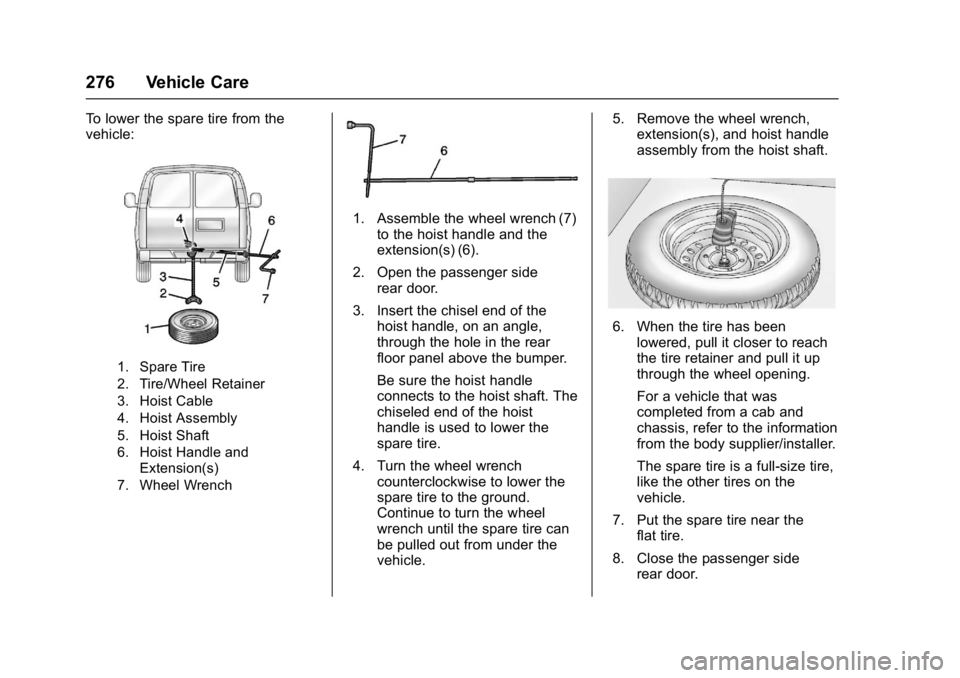
To lower the spare tire from the
vehicle:
1. Spare Tire
2. Tire/Wheel Retainer
3. Hoist Cable
4. Hoist Assembly
5. Hoist Shaft
6. Hoist Handle andExtension(s)
7. Wheel Wrench
1. Assemble the wheel wrench (7) to the hoist handle and the
extension(s) (6).
2. Open the passenger side rear door.
3. Insert the chisel end of the hoist handle, on an angle,
through the hole in the rear
floor panel above the bumper.
Be sure the hoist handle
connects to the hoist shaft. The
chiseled end of the hoist
handle is used to lower the
spare tire.
4. Turn the wheel wrench counterclockwise to lower the
spare tire to the ground.
Continue to turn the wheel
wrench until the spare tire can
be pulled out from under the
vehicle. 5. Remove the wheel wrench,
extension(s), and hoist handle
assembly from the hoist shaft.
6. When the tire has been
lowered, pull it closer to reach
the tire retainer and pull it up
through the wheel opening.
For a vehicle that was
completed from a cab and
chassis, refer to the information
from the body supplier/installer.
The spare tire is a full-size tire,
like the other tires on the
vehicle.
7. Put the spare tire near the flat tire.
8. Close the passenger side rear door.
Page 278 of 348
Chevrolet Express Owner Manual (GMNA-Localizing-U.S./Canada/Mexico-
9967827) - 2017 - crc - 9/26/16
Vehicle Care 277
Removing the Flat Tire and
Installing the Spare Tire
If the vehicle has plastic wheel nut
caps, loosen them by turning the
wheel wrench counterclockwise.
The wheel nut caps are designed to
remain with the center cap. Remove
the center cap.
If the wheel has a smooth center
piece, place the chisel end of the
wheel wrench in the slot on the
wheel and gently pry it out.
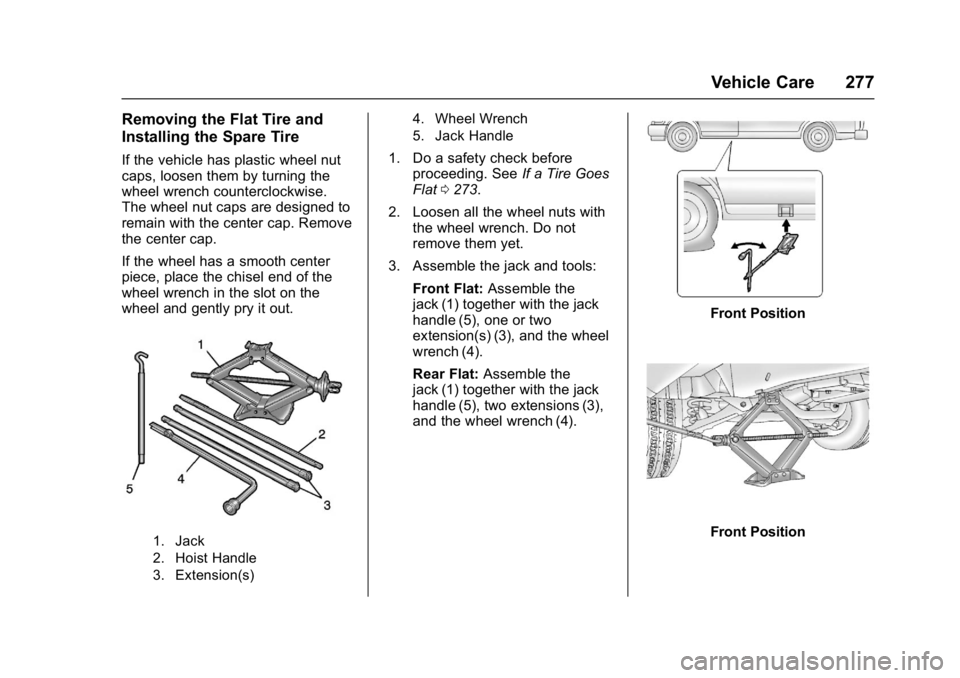
1. Jack
2. Hoist Handle
3. Extension(s)4. Wheel Wrench
5. Jack Handle
1. Do a safety check before
proceeding. See If a Tire Goes
Flat 0273.
2. Loosen all the wheel nuts with the wheel wrench. Do not
remove them yet.
3. Assemble the jack and tools: Front Flat: Assemble the
jack (1) together with the jack
handle (5), one or two
extension(s) (3), and the wheel
wrench (4).
Rear Flat: Assemble the
jack (1) together with the jack
handle (5), two extensions (3),
and the wheel wrench (4).
Front Position
Front Position
Page 279 of 348
Chevrolet Express Owner Manual (GMNA-Localizing-U.S./Canada/Mexico-
9967827) - 2017 - crc - 9/26/16
278 Vehicle Care
Rear Position
Rear Alternative Position (DieselVehicles)
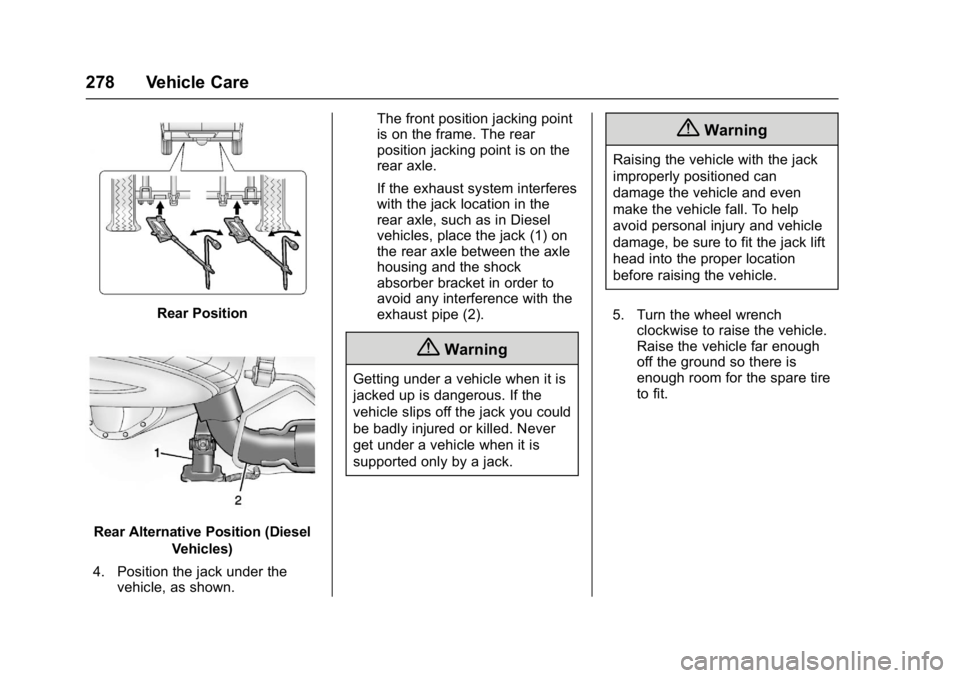
4. Position the jack under the vehicle, as shown. The front position jacking point
is on the frame. The rear
position jacking point is on the
rear axle.
If the exhaust system interferes
with the jack location in the
rear axle, such as in Diesel
vehicles, place the jack (1) on
the rear axle between the axle
housing and the shock
absorber bracket in order to
avoid any interference with the
exhaust pipe (2).
{Warning
Getting under a vehicle when it is
jacked up is dangerous. If the
vehicle slips off the jack you could
be badly injured or killed. Never
get under a vehicle when it is
supported only by a jack.
{Warning
Raising the vehicle with the jack
improperly positioned can
damage the vehicle and even
make the vehicle fall. To help
avoid personal injury and vehicle
damage, be sure to fit the jack lift
head into the proper location
before raising the vehicle.
5. Turn the wheel wrench clockwise to raise the vehicle.
Raise the vehicle far enough
off the ground so there is
enough room for the spare tire
to fit.
Page 281 of 348
Chevrolet Express Owner Manual (GMNA-Localizing-U.S./Canada/Mexico-
9967827) - 2017 - crc - 9/26/16
280 Vehicle Care
10. Turn the jack handlecounterclockwise to lower the
vehicle. Lower the jack
completely.
{Warning
Wheel nuts that are not tight can
work loose. If all the nuts on a
wheel come off, the wheel can
come off the vehicle, causing a
crash. All wheel nuts must be
properly tightened. Follow the
rules in this section to be sure
they are.
{Warning
If wheel studs are damaged, they
can break. If all the studs on a
wheel broke, the wheel could
come off and cause a crash.
If any stud is damaged because
of a loose-running wheel, it could
be that all of the studs are
damaged. To be sure, replace all
(Continued)
Warning (Continued)
studs on the wheel. If the stud
holes in a wheel have become
larger, the wheel could collapse in
operation. Replace any wheel if
its stud holes have become larger
or distorted in any way. Inspect
hubs and hub‐piloted wheels for
damage. Because of loose
running wheels, piloting pad
damage may occur and require
replacement of the entire hub, for
proper centering of the wheels.
When replacing studs, hubs,
wheel nuts or wheels, be sure to
use GM original equipment parts.
{Warning
Wheel nuts that are improperly or
incorrectly tightened can cause
the wheels to become loose or
come off. The wheel nuts should
be tightened with a torque wrench
to the proper torque specification(Continued)
Warning (Continued)
after replacing. Follow the torque
specification supplied by the
aftermarket manufacturer when
using accessory locking wheel
nuts. SeeCapacities and
Specifications 0310 for original
equipment wheel nut torque
specifications.
Caution
Improperly tightened wheel nuts
can lead to brake pulsation and
rotor damage. To avoid expensive
brake repairs, evenly tighten the
wheel nuts in the proper
sequence and to the proper
torque specification. See
Capacities and Specifications
0 310 for the wheel nut torque
specification.
Page 282 of 348
Chevrolet Express Owner Manual (GMNA-Localizing-U.S./Canada/Mexico-
9967827) - 2017 - crc - 9/26/16
Vehicle Care 281
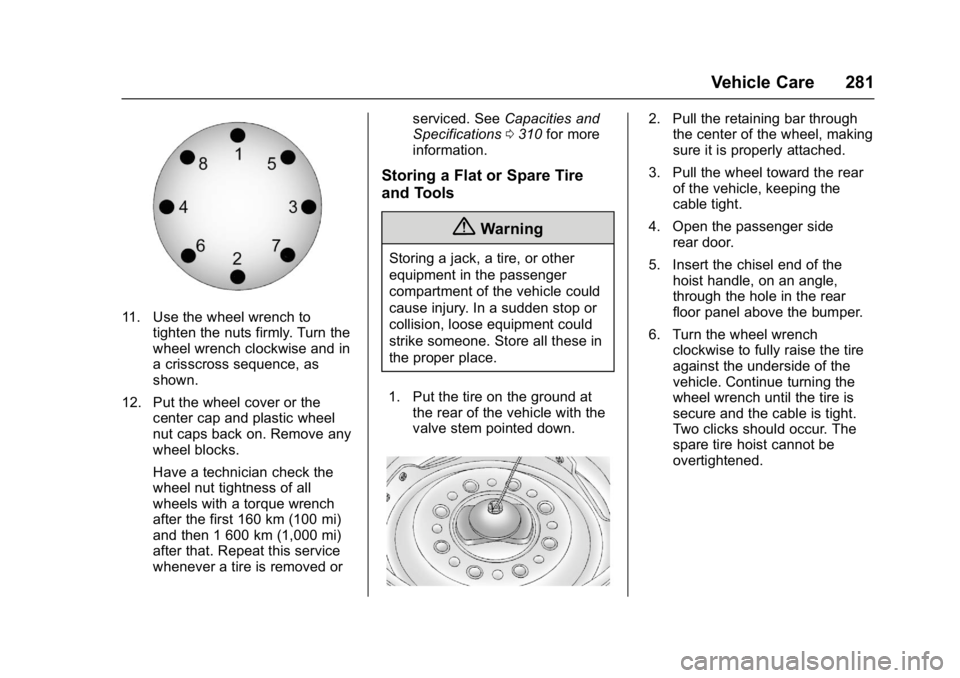
11. Use the wheel wrench totighten the nuts firmly. Turn the
wheel wrench clockwise and in
a crisscross sequence, as
shown.
12. Put the wheel cover or the center cap and plastic wheel
nut caps back on. Remove any
wheel blocks.
Have a technician check the
wheel nut tightness of all
wheels with a torque wrench
after the first 160 km (100 mi)
and then 1 600 km (1,000 mi)
after that. Repeat this service
whenever a tire is removed or serviced. See
Capacities and
Specifications 0310 for more
information.
Storing a Flat or Spare Tire
and Tools
{Warning
Storing a jack, a tire, or other
equipment in the passenger
compartment of the vehicle could
cause injury. In a sudden stop or
collision, loose equipment could
strike someone. Store all these in
the proper place.
1. Put the tire on the ground at the rear of the vehicle with the
valve stem pointed down.
2. Pull the retaining bar throughthe center of the wheel, making
sure it is properly attached.
3. Pull the wheel toward the rear of the vehicle, keeping the
cable tight.
4. Open the passenger side rear door.
5. Insert the chisel end of the hoist handle, on an angle,
through the hole in the rear
floor panel above the bumper.
6. Turn the wheel wrench clockwise to fully raise the tire
against the underside of the
vehicle. Continue turning the
wheel wrench until the tire is
secure and the cable is tight.
Two clicks should occur. The
spare tire hoist cannot be
overtightened.
Page 340 of 348

Chevrolet Express Owner Manual (GMNA-Localizing-U.S./Canada/Mexico-
9967827) - 2017 - crc - 9/26/16
Index 339
Climate Control Systems (cont'd)Air Conditioning . . . . . . . . . . . . . . 158
Heating . . . . . . . . . . . . . . . . . . . . . . . 158
Rear . . . . . . . . . . . . . . . . . . . . . . . . . . 160
Rear Heating System . . . . . . . . . 160
Clock . . . . . . . . . . . . . . . . . . . . . . . . . . . . 92
Cluster, Instrument . . . . . . . . . . . . . . 95
Collision Damage Repair . . . . . . . 320
Compartments Storage . . . . . . . . . . . . . . . . . . . . . . . . . 85
Compass . . . . . . . . . . . . . . . . . . . . . . . . 90 Messages . . . . . . . . . . . . . . . . . . . . .113
Connections OnStar
®. . . . . . . . . . . . . . . . . . . . . . 329
Control Traction and ElectronicStability . . . . . . . . . . . . . . . . . . . . . 190
Control of a Vehicle . . . . . . . . . . . . . 166
Convex Mirrors . . . . . . . . . . . . . . . . . . 35
Coolant
Engine . . . . . . . . . . . . . . . . . . . . . . . . 227
Engine Temperature Gauge . . . . 98
Cooling . . . . . . . . . . . . . . . . . . . . 158, 160
Cooling System . . . . . . . . . . . . . . . . . 226
Engine Messages . . . . . . . . . . . . .113
Courtesy Transportation Program . . . . . . . . . . . . . . . . . . . . . . . 319
Cruise Control . . . . . . . . . . . . . . . . . . 192 Cruise Control (cont'd)
Light . . . . . . . . . . . . . . . . . . . . . . . . . . 107
Customer Assistance . . . . . . . . . . . 316 Offices . . . . . . . . . . . . . . . . . . . . . . . . 315
Text Telephone (TTY)
Users . . . . . . . . . . . . . . . . . . . . . . . 316
Customer Information Service PublicationsOrdering Information . . . . . . . . 322
Customer Satisfaction Procedure . . . . . . . . . . . . . . . . . . . . . 313
D
Damage Repair, Collision . . . . . . . 320
Danger, Warning, and Caution . . . . 3
Data CollectionInfotainment System . . . . . . . . . . 326
OnStar . . . . . . . . . . . . . . . . . . . . . . . 325
Data Recorders, Event . . . . . . . . . 325
Daytime Running
Lamps (DRL) . . . . . . . . . . . . . . . . . . 126
Defensive Driving . . . . . . . . . . . . . . . 165
Delayed Locking . . . . . . . . . . . . . . . . . 29
Devices Auxiliary . . . . . . . . . . . . . . . . . . . . . . 146
Diagnostics OnStar
®. . . . . . . . . . . . . . . . . . . . . . 331
Distracted Driving . . . . . . . . . . . . . . . 165
Dome Lamps . . . . . . . . . . . . . . . . . . . 129 Door
Ajar Messages . . . . . . . . . . . . . . . .113
Cargo Door Relocking . . . . . . . . . . 29
Delayed Locking . . . . . . . . . . . . . . . . 29
Locks . . . . . . . . . . . . . . . . . . . . . . . . . . . 28
Power Locks . . . . . . . . . . . . . . . . . . . . 29
Rear Doors . . . . . . . . . . . . . . . . . . . . . 32
Side . . . . . . . . . . . . . . . . . . . . . . . . . . . . 31
Sliding . . . . . . . . . . . . . . . . . . . . . . . . . . 32
Drive Belt Routing, Engine . . . . . . 312
Driver Information Center (DIC) . . . . . . . . . . . . . . . . . . 108
Driving Characteristics andTowing Tips . . . . . . . . . . . . . . . . . 202
Defensive . . . . . . . . . . . . . . . . . . . . . 165
Drunk . . . . . . . . . . . . . . . . . . . . . . . . . 166
For Better Fuel Economy . . . . . . . 22
Hill and Mountain Roads . . . . . . 169
If the Vehicle is Stuck . . . . . . . . . 171
Loss of Control . . . . . . . . . . . . . . . 167
Off-Road Recovery . . . . . . . . . . . 167
Vehicle Load Limits . . . . . . . . . . . 171
Wet Roads . . . . . . . . . . . . . . . . . . . 168
Winter . . . . . . . . . . . . . . . . . . . . . . . . 169
Dual Tire Rotation . . . . . . . . . . . . . . . . . . . . . . 266