parking brake CHEVROLET CLASSIC 2004 Owner's Manual
[x] Cancel search | Manufacturer: CHEVROLET, Model Year: 2004, Model line: CLASSIC, Model: CHEVROLET CLASSIC 2004Pages: 348, PDF Size: 5.32 MB
Page 270 of 348
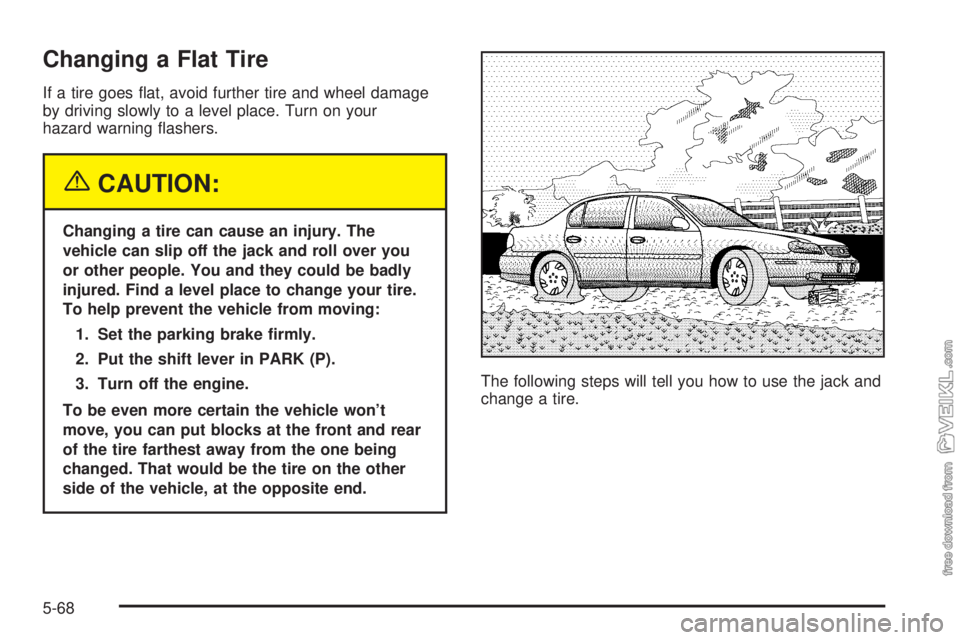
Changing a Flat Tire
If a tire goes flat, avoid further tire and wheel damage
by driving slowly to a level place. Turn on your
hazard warning flashers.
{CAUTION:
Changing a tire can cause an injury. The
vehicle can slip off the jack and roll over you
or other people. You and they could be badly
injured. Find a level place to change your tire.
To help prevent the vehicle from moving:
1. Set the parking brake rmly.
2. Put the shift lever in PARK (P).
3. Turn off the engine.
To be even more certain the vehicle won’t
move, you can put blocks at the front and rear
of the tire farthest away from the one being
changed. That would be the tire on the other
side of the vehicle, at the opposite end.The following steps will tell you how to use the jack and
change a tire.
5-68
Page 296 of 348
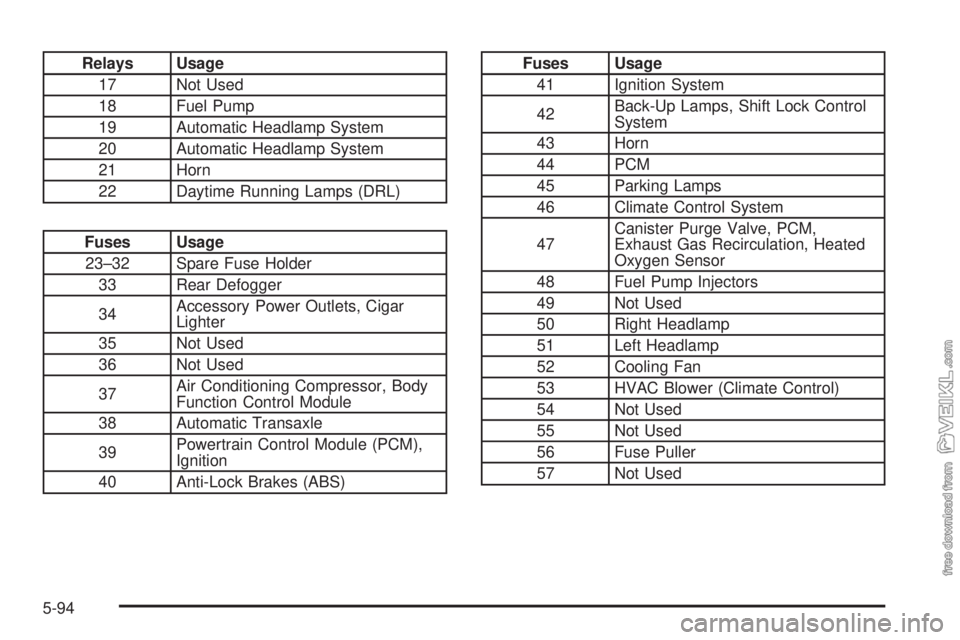
Relays Usage
17 Not Used
18 Fuel Pump
19 Automatic Headlamp System
20 Automatic Headlamp System
21 Horn
22 Daytime Running Lamps (DRL)
Fuses Usage
23–32 Spare Fuse Holder
33 Rear Defogger
34Accessory Power Outlets, Cigar
Lighter
35 Not Used
36 Not Used
37Air Conditioning Compressor, Body
Function Control Module
38 Automatic Transaxle
39Powertrain Control Module (PCM),
Ignition
40 Anti-Lock Brakes (ABS)
Fuses Usage
41 Ignition System
42Back-Up Lamps, Shift Lock Control
System
43 Horn
44 PCM
45 Parking Lamps
46 Climate Control System
47Canister Purge Valve, PCM,
Exhaust Gas Recirculation, Heated
Oxygen Sensor
48 Fuel Pump Injectors
49 Not Used
50 Right Headlamp
51 Left Headlamp
52 Cooling Fan
53 HVAC Blower (Climate Control)
54 Not Used
55 Not Used
56 Fuse Puller
57 Not Used
5-94
Page 316 of 348
Starter Switch Check
{CAUTION:
When you are doing this inspection, the
vehicle could move suddenly. If the vehicle
moves, you or others could be injured.
1. Before you start, be sure you have enough room
around the vehicle.
2. Firmly apply both the parking brake and the regular
brake. SeeParking Brake on page 2-23if
necessary.
Do not use the accelerator pedal, and be ready to
turn off the engine immediately if it starts.
3. Try to start the engine in each gear. The starter
should work only in PARK (P) or NEUTRAL (N).
If the starter works in any other position, your
vehicle needs service.
Automatic Transaxle Shift Lock Control
System Check
{CAUTION:
When you are doing this inspection, the
vehicle could move suddenly. If the vehicle
moves, you or others could be injured.
1. Before you start, be sure you have enough room
around the vehicle. It should be parked on a level
surface.
2. Firmly apply the parking brake. SeeParking Brake
on page 2-23if necessary.
Be ready to apply the regular brake immediately if
the vehicle begins to move.
3. With the engine off, turn the key to the ON position,
but don’t start the engine. Without applying the
regular brake, try to move the shift lever out
of PARK (P) with normal effort. If the shift lever
moves out of PARK (P), your vehicle needs service.
6-18
Page 317 of 348

Ignition Transaxle Lock Check
While parked, and with the parking brake set, try to turn
the ignition key to OFF in each shift lever position.
The key should turn to OFF only when the shift lever is
in PARK (P).
On all vehicles, the key should come out only in OFF.
Parking Brake and Automatic
Transaxle Park (P) Mechanism Check
{CAUTION:
When you are doing this check, your vehicle
could begin to move. You or others could be
injured and property could be damaged. Make
sure there is room in front of your vehicle in
case it begins to roll. Be ready to apply the
regular brake at once should the vehicle begin
to move.Park on a fairly steep hill, with the vehicle facing
downhill. Keeping your foot on the regular brake, set the
parking brake.
•To check the parking brake’s holding ability: With
the engine running and transaxle in NEUTRAL
(N), slowly remove foot pressure from the regular
brake pedal. Do this until the vehicle is held by the
parking brake only.
•To check the PARK (P) mechanism’s holding
ability: With the engine running, shift to PARK (P).
Then release the parking brake followed by the
regular brake.
Underbody Flushing Service
At least every spring, use plain water to flush any
corrosive materials from the underbody. Take care to
clean thoroughly any areas where mud and other debris
can collect.
6-19
Page 319 of 348
Engine Cooling System Inspection
Inspect the hoses and have them replaced if they
are cracked, swollen or deteriorated. Inspect all pipes,
fittings and clamps; replace as needed. Clean the
outside of the radiator and air conditioning condenser.
To help ensure proper operation, a pressure test of
the cooling system and pressure cap is recommended
at least once a year.
Throttle System Inspection
Inspect the throttle system for interference or binding,
and for damaged or missing parts. Replace parts
as needed. Replace any components that have high
effort or excessive wear. Do not lubricate accelerator
and cruise control cables.
Brake System Inspection
Inspect the complete system. Inspect brake lines and
hoses for proper hook-up, binding, leaks, cracks,
chafing, etc. Inspect disc brake pads for wear and rotors
for surface condition. Also inspect drum brake linings
for wear and cracks. Inspect other brake parts, including
drums, wheel cylinders, calipers, parking brake, etc.
The parking brake is self-adjusting and no manual
adjustment is required. You may need to have your
brakes inspected more often if your driving habits
or conditions result in frequent braking.
6-21
Page 336 of 348
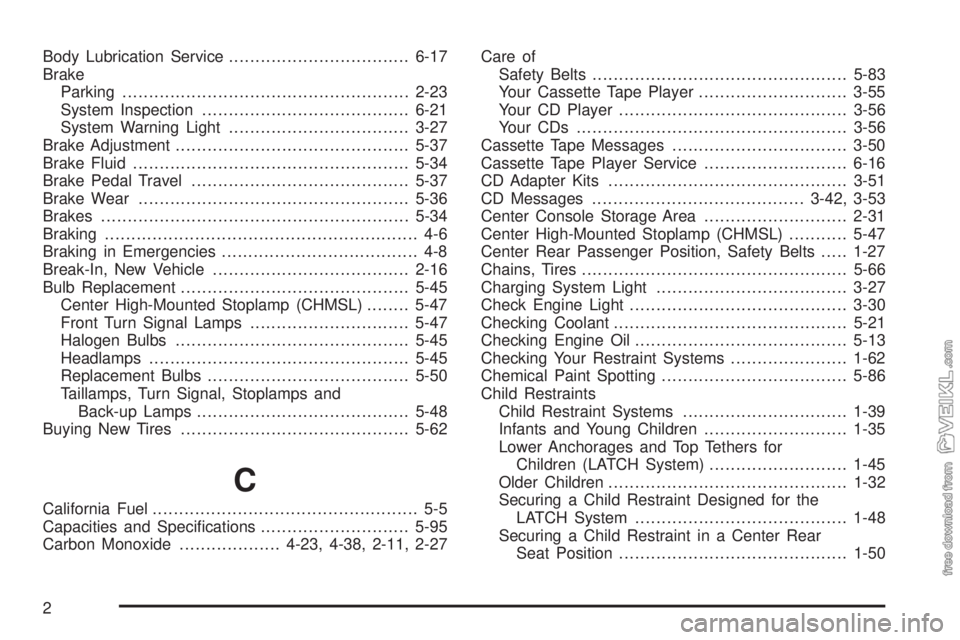
Body Lubrication Service..................................6-17
Brake
Parking......................................................2-23
System Inspection.......................................6-21
System Warning Light..................................3-27
Brake Adjustment............................................5-37
Brake Fluid....................................................5-34
Brake Pedal Travel.........................................5-37
Brake Wear...................................................5-36
Brakes..........................................................5-34
Braking........................................................... 4-6
Braking in Emergencies..................................... 4-8
Break-In, New Vehicle.....................................2-16
Bulb Replacement...........................................5-45
Center High-Mounted Stoplamp (CHMSL)........5-47
Front Turn Signal Lamps..............................5-47
Halogen Bulbs............................................5-45
Headlamps.................................................5-45
Replacement Bulbs......................................5-50
Taillamps, Turn Signal, Stoplamps and
Back-up Lamps........................................5-48
Buying New Tires...........................................5-62
C
California Fuel.................................................. 5-5
Capacities and Specifications............................5-95
Carbon Monoxide...................4-23, 4-38, 2-11, 2-27Care of
Safety Belts................................................5-83
Your Cassette Tape Player............................3-55
Your CD Player...........................................3-56
Your CDs ...................................................3-56
Cassette Tape Messages.................................3-50
Cassette Tape Player Service...........................6-16
CD Adapter Kits.............................................3-51
CD Messages........................................3-42, 3-53
Center Console Storage Area...........................2-31
Center High-Mounted Stoplamp (CHMSL)...........5-47
Center Rear Passenger Position, Safety Belts.....1-27
Chains, Tires..................................................5-66
Charging System Light....................................3-27
Check Engine Light.........................................3-30
Checking Coolant............................................5-21
Checking Engine Oil........................................5-13
Checking Your Restraint Systems......................1-62
Chemical Paint Spotting...................................5-86
Child Restraints
Child Restraint Systems...............................1-39
Infants and Young Children...........................1-35
Lower Anchorages and Top Tethers for
Children (LATCH System)..........................1-45
Older Children.............................................1-32
Securing a Child Restraint Designed for the
LATCH System........................................1-48
Securing a Child Restraint in a Center Rear
Seat Position...........................................1-50
2
Page 343 of 348
Mirrors
Manual Rearview Mirror................................2-29
Outside Convex Mirror.................................2-30
Outside Power Mirrors..................................2-30
Outside Remote Control Mirrors.....................2-29
MyGMLink.com................................................ 7-3
N
New Vehicle Break-In......................................2-16
Normal Maintenance Replacement Parts............5-96
O
Odometer......................................................3-24
Off-Road Recovery..........................................4-11
Oil
Engine.......................................................5-13
Pressure Light.............................................3-33
Older Children, Restraints................................1-32
Online Owner Center........................................ 7-3
Operation......................................................3-18
Operation Tips................................................3-21
Other Warning Devices...................................... 3-5
Outlet Adjustment............................................3-21Outside
Convex Mirror.............................................2-30
Power Mirrors.............................................2-30
Remote Controls Mirrors...............................2-29
Overseas – Customer Assistance........................ 7-5
Owner’s Information........................................7-12
P
Park (P)
Shifting Into................................................2-24
Shifting Out of............................................2-26
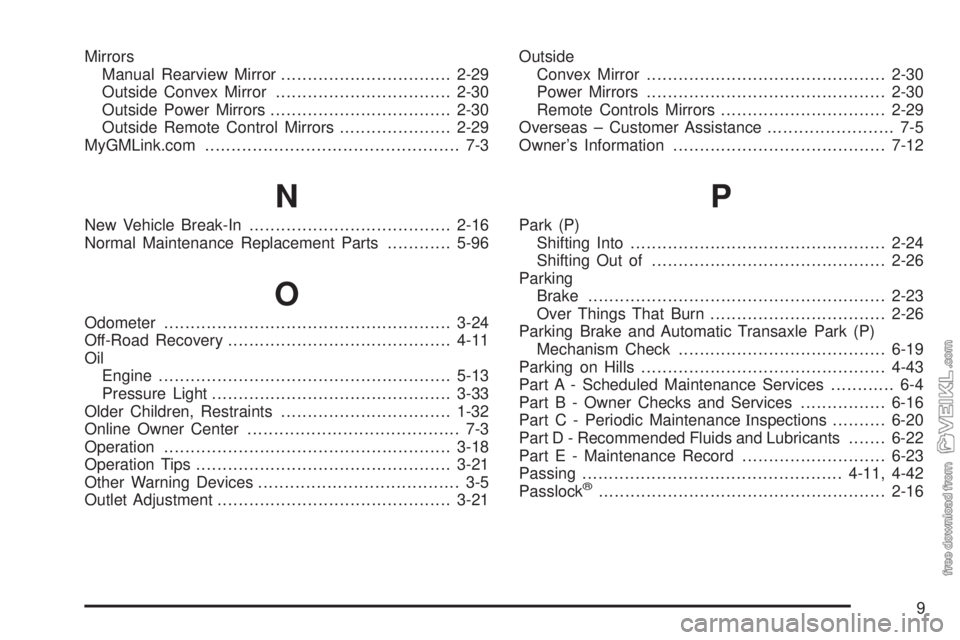
Parking
Brake........................................................2-23
Over Things That Burn.................................2-26
Parking Brake and Automatic Transaxle Park (P)
Mechanism Check.......................................6-19
Parking on Hills..............................................4-43
Part A - Scheduled Maintenance Services............ 6-4
Part B - Owner Checks and Services................6-16
Part C - Periodic MaintenanceInspections..........6-20
Part D - Recommended Fluids and Lubricants.......6-22
Part E - Maintenance Record...........................6-23
Passing.................................................4-11, 4-42
Passlock
®......................................................2-16
9