towing CHEVROLET CLASSIC 2004 Owner's Manual
[x] Cancel search | Manufacturer: CHEVROLET, Model Year: 2004, Model line: CLASSIC, Model: CHEVROLET CLASSIC 2004Pages: 348, PDF Size: 5.32 MB
Page 202 of 348
When You Are Ready to Leave After
Parking on a Hill
1. Apply your regular brakes and hold the pedal down
while you:
•start your engine,
•shift into a gear, and
•release the parking brake.
2. Let up on the brake pedal.
3. Drive slowly until the trailer is clear of the chocks.
4. Stop and have someone pick up and store the
chocks.
Maintenance When Trailer Towing
Your vehicle will need service more often when you are
pulling a trailer. SeePart A: Scheduled Maintenance
Services on page 6-4for more on this. Things that are
especially important in trailer operation are automatic
transaxle fluid (do not overfill), engine oil, drive
belt, cooling system and brake system. Each of these is
covered in this manual, and the Index will help you
find them quickly. If you’re trailering, it is a good idea to
review this information before you start your trip.
Check periodically to see that all hitch nuts and bolts
are tight.
Engine Cooling When Trailer Towing
Your cooling system may temporarily overheat during
severe operating conditions. SeeEngine Overheating on
page 5-22.
4-44
Page 221 of 348
Automatic Transaxle Fluid
It is not necessary to check the transaxle fluid level. A
transaxle fluid leak is the only reason for fluid loss. If a
leak occurs, take the vehicle to the dealership service
department and have it repaired as soon as possible. You
may also have your fluid level checked by your dealer or
service center when you have your oil changed.
Change both the fluid and filter every 50,000 miles
(83 000 km) if the vehicle is mainly driven under one or
more of these conditions:
•In heavy city traffic where the outside temperature
regularly reaches 90°F (32°C) or higher.
•In hilly or mountainous terrain.
•When doing frequent trailer towing.
•Uses such as found in taxi, police or delivery
service.
If you do not use your vehicle under any of these
conditions, the fluid and filter do not require changing.
Notice:Use of automatic transaxle uid labeled
other than DEXRON
®-III may damage your vehicle,
and the damages may not be covered by your
warranty. Always use DEXRON
®-III labeled automatic
transaxle uid.
Engine Coolant
The cooling system in your vehicle is filled with
DEX-COOL®engine coolant. This coolant is designed
to remain in your vehicle for 5 years or 150,000 miles
(240 000 km), whichever occurs first, if you add
only DEX-COOL
®extended life coolant.
The following explains your cooling system and how to
add coolant when it is low. If you have a problem with
engine overheating, seeEngine Overheating on
page 5-22.
A 50/50 mixture of clean, drinkable water and
DEX-COOL
®coolant will:
•Give freezing protection down to−34°F (−37°C).
•Give boiling protection up to 265°F (129°C).
•Protect against rust and corrosion.
•Help keep the proper engine temperature.
•Let the warning lights and gages work as they
should.
Notice:Using coolant other than DEX-COOL
®may
cause premature engine, heater core or radiator
corrosion. In addition, the engine coolant may
require changing sooner, at 30,000 miles (50 000 km)
or 24 months, whichever occurs rst. Any repairs
would not be covered by your warranty. Always use
DEX-COOL
®(silicate-free) coolant in your vehicle.
5-19
Page 304 of 348
Long Trip/Highway Denition
Follow this scheduled maintenanceonlyif none of the
conditions from the Short Trip/City Scheduled
Maintenance are true. Do not use this schedule if the
vehicle is used for trailer towing, driven in a dusty area
or used off paved roads. Use the Short Trip/City
schedule for these conditions.
Driving a vehicle with a fully warmed engine under
highway conditions will cause engine oil to break down
slower.
Long Trip/Highway Intervals
Every 7,500 Miles (12 500 km):Engine Oil and Filter
Change (or every 12 months, whichever occurs
first). Tire Rotation.
Every 15,000 Miles (25 000 km):Engine Air Cleaner
Filter Inspection.
Every 30,000 Miles (50 000 km):Engine Air Cleaner
Filter Replacement.Every 50,000 Miles (83 000 km):Automatic Transaxle
Service (severe conditions only).
Every 100,000 Miles (166 000 km):Spark Plug Wire
Inspection. Spark Plug Replacement.
Every 150,000 Miles (240 000 km):Cooling System
Service (or every 60 months, whichever occurs
first). Engine Accessory Drive Belt Inspection.
These intervals only summarize maintenance services.
Be sure to follow the complete scheduled maintenance
on the following pages.Short Trip/City Scheduled
Maintenance
The services shown in this schedule up to 100,000 miles
(166 000 km) should be repeated after 100,000 miles
(166 000 km) at the same intervals for the life of
this vehicle. The services shown at 150,000 miles
(240 000 km) should be repeated at the same interval
after 150,000 miles (240 000 km) for the life of this
vehicle.
SeePart B: Owner Checks and Services on page 6-16
andPart C: Periodic MaintenanceInspections on
page 6-20.
6-6
Page 307 of 348
48,000 Miles (80 000 km)
❑Change engine oil and filter (or every 3 months,
whichever occurs first).An Emission Control Service.
❑Rotate tires. SeeTire Inspection and Rotation
on page 5-60for proper rotation pattern and
additional information.(See footnote +.)
50,000 Miles (83 000 km)
❑Change automatic transaxle fluid and filter if the
vehicle is mainly driven under one or more of
these conditions:
- In heavy city traffic where the outside
temperature regularly reaches 90°F (32°C) or
higher.
- In hilly or mountainous terrain.
- When doing frequent trailer towing.
- Uses such as found in taxi, police or delivery
service.
If you do not use your vehicle under any of these
conditions, the uid and lter do not require changing.
51,000 Miles (85 000 km)
❑Change engine oil and filter (or every 3 months,
whichever occurs first).An Emission Control Service.
54,000 Miles (90 000 km)
❑Change engine oil and filter (or every 3 months,
whichever occurs first).An Emission Control Service.
❑Rotate tires. SeeTire Inspection and Rotation
on page 5-60for proper rotation pattern and
additional information.(See footnote +.)
57,000 Miles (95 000 km)
❑Change engine oil and filter (or every 3 months,
whichever occurs first).An Emission Control Service.
60,000 Miles (100 000 km)
❑Change engine oil and filter (or every 3 months,
whichever occurs first).An Emission Control Service.
❑Replace engine air cleaner filter. SeeEngine
Air Cleaner/Filter on page 5-17for more information.
An Emission Control Service.
❑Rotate tires. SeeTire Inspection and Rotation on
page 5-60for proper rotation pattern and additional
information.(See footnote +.)
63,000 Miles (105 000 km)
❑Change engine oil and filter (or every 3 months,
whichever occurs first).An Emission Control Service.
6-9
Page 309 of 348
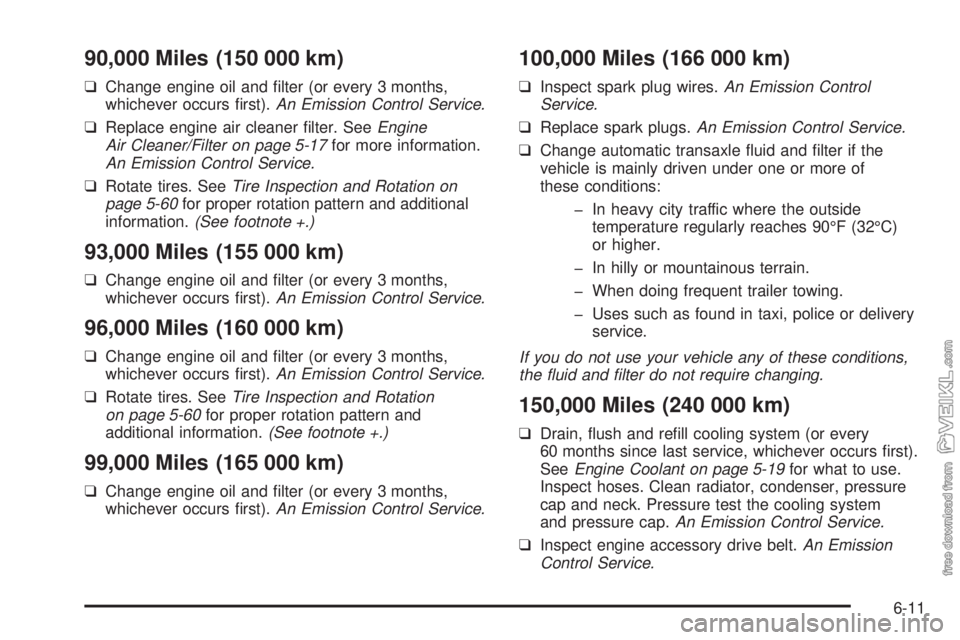
90,000 Miles (150 000 km)
❑Change engine oil and filter (or every 3 months,
whichever occurs first).An Emission Control Service.
❑Replace engine air cleaner filter. SeeEngine
Air Cleaner/Filter on page 5-17for more information.
An Emission Control Service.
❑Rotate tires. SeeTire Inspection and Rotation on
page 5-60for proper rotation pattern and additional
information.(See footnote +.)
93,000 Miles (155 000 km)
❑Change engine oil and filter (or every 3 months,
whichever occurs first).An Emission Control Service.
96,000 Miles (160 000 km)
❑Change engine oil and filter (or every 3 months,
whichever occurs first).An Emission Control Service.
❑Rotate tires. SeeTire Inspection and Rotation
on page 5-60for proper rotation pattern and
additional information.(See footnote +.)
99,000 Miles (165 000 km)
❑Change engine oil and filter (or every 3 months,
whichever occurs first).An Emission Control Service.
100,000 Miles (166 000 km)
❑Inspect spark plug wires.An Emission Control
Service.
❑Replace spark plugs.An Emission Control Service.
❑Change automatic transaxle fluid and filter if the
vehicle is mainly driven under one or more of
these conditions:
- In heavy city traffic where the outside
temperature regularly reaches 90°F (32°C)
or higher.
- In hilly or mountainous terrain.
- When doing frequent trailer towing.
- Uses such as found in taxi, police or delivery
service.
If you do not use your vehicle any of these conditions,
the uid and lter do not require changing.
150,000 Miles (240 000 km)
❑Drain, flush and refill cooling system (or every
60 months since last service, whichever occurs first).
SeeEngine Coolant on page 5-19for what to use.
Inspect hoses. Clean radiator, condenser, pressure
cap and neck. Pressure test the cooling system
and pressure cap.An Emission Control Service.
❑Inspect engine accessory drive belt.An Emission
Control Service.
6-11
Page 311 of 348
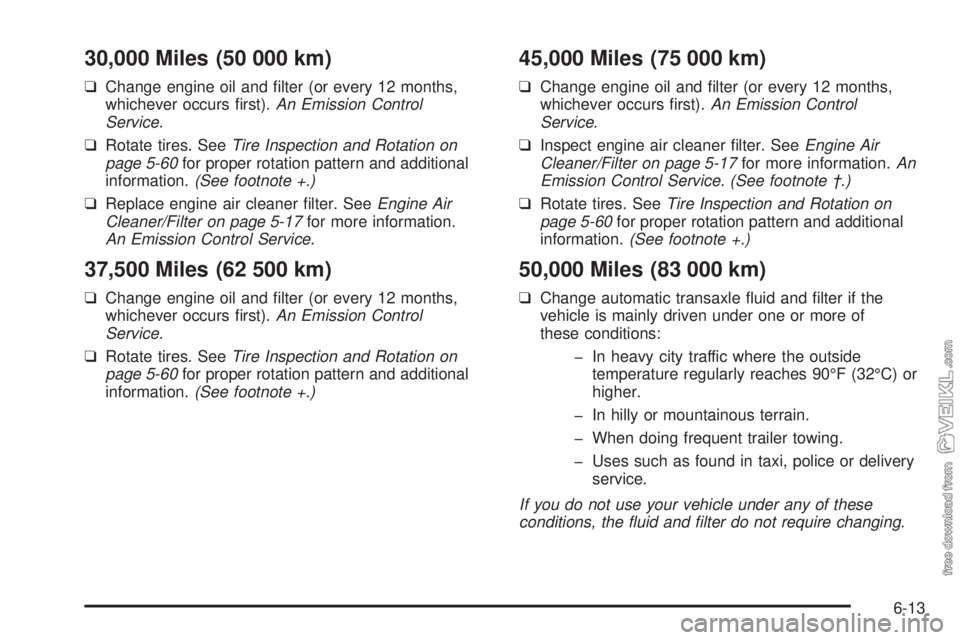
30,000 Miles (50 000 km)
❑Change engine oil and filter (or every 12 months,
whichever occurs first).An Emission Control
Service.
❑Rotate tires. SeeTire Inspection and Rotation on
page 5-60for proper rotation pattern and additional
information.(See footnote +.)
❑Replace engine air cleaner filter. SeeEngine Air
Cleaner/Filter on page 5-17for more information.
An Emission Control Service.
37,500 Miles (62 500 km)
❑Change engine oil and filter (or every 12 months,
whichever occurs first).An Emission Control
Service.
❑Rotate tires. SeeTire Inspection and Rotation on
page 5-60for proper rotation pattern and additional
information.(See footnote +.)
45,000 Miles (75 000 km)
❑Change engine oil and filter (or every 12 months,
whichever occurs first).An Emission Control
Service.
❑Inspect engine air cleaner filter. SeeEngine Air
Cleaner/Filter on page 5-17for more information.An
Emission Control Service. (See footnote †.)
❑Rotate tires. SeeTire Inspection and Rotation on
page 5-60for proper rotation pattern and additional
information.(See footnote +.)
50,000 Miles (83 000 km)
❑Change automatic transaxle fluid and filter if the
vehicle is mainly driven under one or more of
these conditions:
- In heavy city traffic where the outside
temperature regularly reaches 90°F (32°C) or
higher.
- In hilly or mountainous terrain.
- When doing frequent trailer towing.
- Uses such as found in taxi, police or delivery
service.
If you do not use your vehicle under any of these
conditions, the uid and lter do not require changing.
6-13
Page 313 of 348
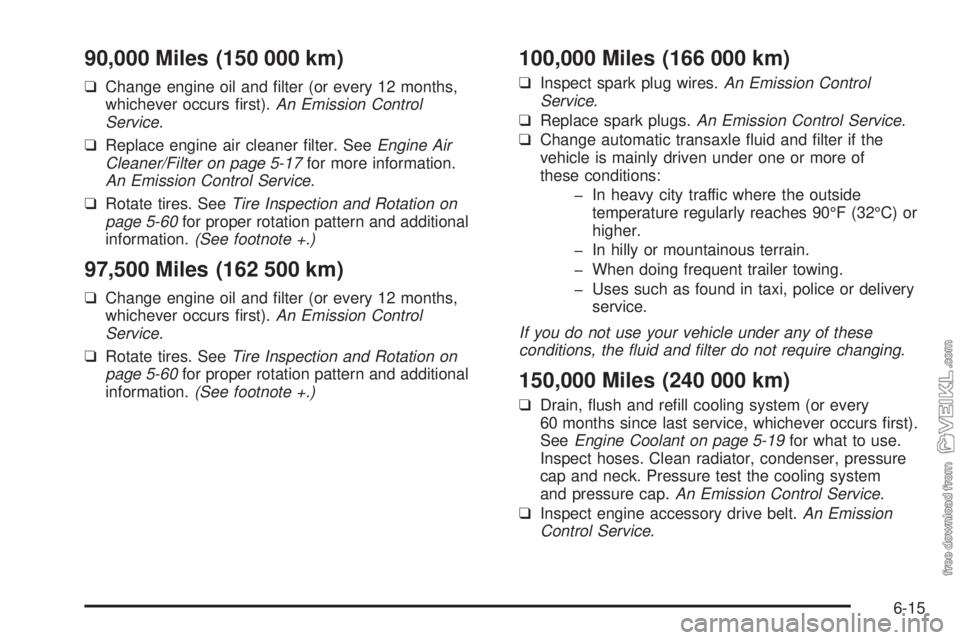
90,000 Miles (150 000 km)
❑Change engine oil and filter (or every 12 months,
whichever occurs first).An Emission Control
Service.
❑Replace engine air cleaner filter. SeeEngine Air
Cleaner/Filter on page 5-17for more information.
An Emission Control Service.
❑Rotate tires. SeeTire Inspection and Rotation on
page 5-60for proper rotation pattern and additional
information.(See footnote +.)
97,500 Miles (162 500 km)
❑Change engine oil and filter (or every 12 months,
whichever occurs first).An Emission Control
Service.
❑Rotate tires. SeeTire Inspection and Rotation on
page 5-60for proper rotation pattern and additional
information.(See footnote +.)
100,000 Miles (166 000 km)
❑Inspect spark plug wires.An Emission Control
Service.
❑Replace spark plugs.An Emission Control Service.
❑Change automatic transaxle fluid and filter if the
vehicle is mainly driven under one or more of
these conditions:
- In heavy city traffic where the outside
temperature regularly reaches 90°F (32°C) or
higher.
- In hilly or mountainous terrain.
- When doing frequent trailer towing.
- Uses such as found in taxi, police or delivery
service.
If you do not use your vehicle under any of these
conditions, the uid and lter do not require changing.
150,000 Miles (240 000 km)
❑Drain, flush and refill cooling system (or every
60 months since last service, whichever occurs first).
SeeEngine Coolant on page 5-19for what to use.
Inspect hoses. Clean radiator, condenser, pressure
cap and neck. Pressure test the cooling system
and pressure cap.An Emission Control Service.
❑Inspect engine accessory drive belt.An Emission
Control Service.
6-15
Page 328 of 348
Roadside Assistance Program
To enhance Chevrolet’s strong commitment to customer
satisfaction, Chevrolet is excited to announce the
establishment of the Chevrolet Roadside Assistance
Center. As the owner of a 2004 Chevrolet, membership
in Roadside Assistance is free.
Roadside Assistance is available 24 hours a day,
365 days a year, by calling 1-800-CHEV-USA
(243-8872). This toll-free number will provide you
over-the-phone roadside assistance with minor
mechanical problems. If your problem cannot be
resolved over the phone, our advisors have access to a
nationwide network of dealer recommended service
providers. Roadside membership is free; however some
services may incur costs.
Roadside offers two levels of service to the customer,
Basic CareandCourtesy Care:
RoadsideBasic Careprovides:
•Toll-free number, 1-800-CHEV-USA (243-8872),
text telephone (TTY) users, call 1-888-889-2438
•Free towing for warranty repairs
•Basic over-the-phone technical advice
•Available dealer services at reasonable costs (i.e.,
wrecker services, locksmith/key service, glass
repair, etc.)RoadsideCourtesy Careprovides:
•RoadsideBasic Careservices (as outlined
previously)
Plus:
•FREE Non-Warranty Towing (to the closest dealer
from a legal roadway)
•FREE Locksmith/Key Service (when keys are lost
on the road or locked inside)
•FREE Flat Tire Service (spare installed on the road)
•FREE Jump Start (at home or on the road)
•FREE Fuel Delivery ($5 of fuel delivered on the road)
Chevrolet offers Courtesy Transportation for customers
needing warranty service. Courtesy Transportation
will be offered in conjunction with the coverage provided
by the Bumper-to-Bumper New Vehicle Limited
Warranty to eligible purchasers of 2004 Chevrolet
passenger cars and light duty trucks. (See your selling
dealer for details.)
Courtesy Careis available to retail and retail lease
customers operating 2004 and newer Chevrolet vehicles
for a period of 3 years/36,000 miles (60 000 km),
whichever occurs first. AllCourtesy Careservices must
be pre-arranged by Chevrolet Roadside or dealer
service management.
7-6
Page 338 of 348
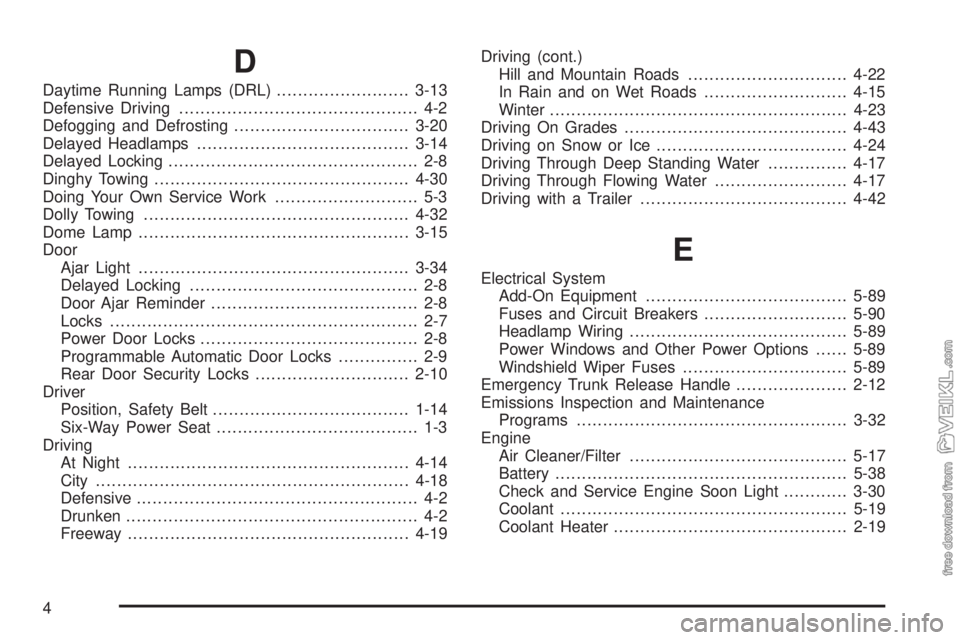
D
Daytime Running Lamps (DRL).........................3-13
Defensive Driving............................................. 4-2
Defogging and Defrosting.................................3-20
Delayed Headlamps........................................3-14
Delayed Locking............................................... 2-8
Dinghy Towing................................................4-30
Doing Your Own Service Work........................... 5-3
Dolly Towing..................................................4-32
Dome Lamp...................................................3-15
Door
Ajar Light...................................................3-34
Delayed Locking........................................... 2-8
Door Ajar Reminder....................................... 2-8
Locks.......................................................... 2-7
Power Door Locks......................................... 2-8
Programmable Automatic Door Locks............... 2-9
Rear Door Security Locks.............................2-10
Driver
Position, Safety Belt.....................................1-14
Six-Way Power Seat...................................... 1-3
Driving
At Night.....................................................4-14
City...........................................................4-18
Defensive..................................................... 4-2
Drunken....................................................... 4-2
Freeway.....................................................4-19Driving (cont.)
Hill and Mountain Roads..............................4-22
In Rain and on Wet Roads...........................4-15
Winter........................................................4-23
Driving On Grades..........................................4-43
Driving on Snow or Ice....................................4-24
Driving Through Deep Standing Water...............4-17
Driving Through Flowing Water.........................4-17
Driving with a Trailer.......................................4-42
E
Electrical System
Add-On Equipment......................................5-89
Fuses and Circuit Breakers...........................5-90
Headlamp Wiring.........................................5-89
Power Windows and Other Power Options......5-89
Windshield Wiper Fuses...............................5-89
Emergency Trunk Release Handle.....................2-12
Emissions Inspection and Maintenance
Programs...................................................3-32
Engine
Air Cleaner/Filter.........................................5-17
Battery.......................................................5-38
Check and Service Engine Soon Light............3-30
Coolant......................................................5-19
Coolant Heater............................................2-19
4
Page 339 of 348
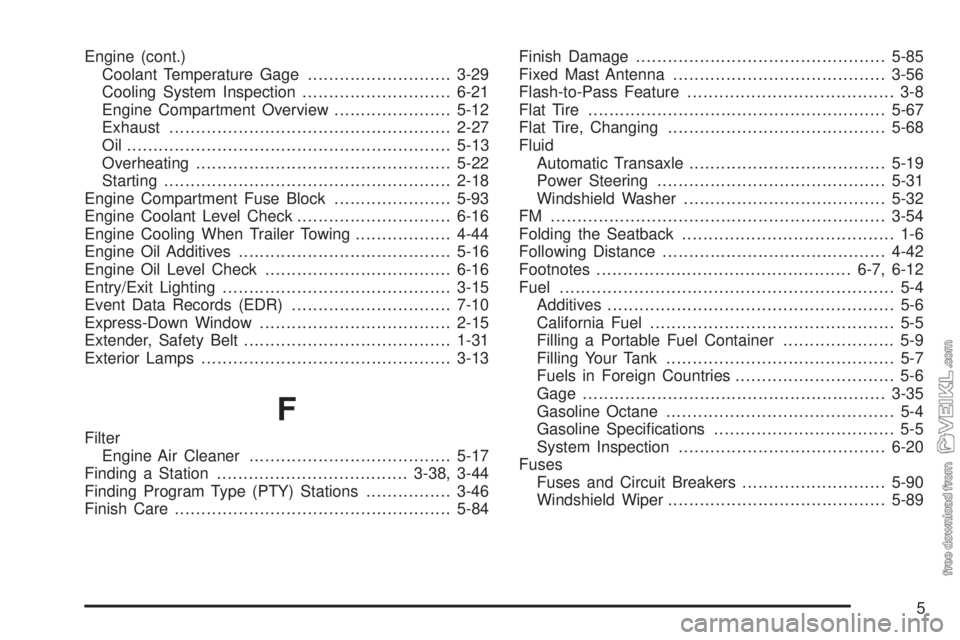
Engine (cont.)
Coolant Temperature Gage...........................3-29
Cooling System Inspection............................6-21
Engine Compartment Overview......................5-12
Exhaust.....................................................2-27
Oil .............................................................5-13
Overheating................................................5-22
Starting......................................................2-18
Engine Compartment Fuse Block......................5-93
Engine Coolant Level Check.............................6-16
Engine Cooling When Trailer Towing..................4-44
Engine Oil Additives........................................5-16
Engine Oil Level Check...................................6-16
Entry/Exit Lighting...........................................3-15
Event Data Records (EDR)..............................7-10
Express-Down Window....................................2-15
Extender, Safety Belt.......................................1-31
Exterior Lamps...............................................3-13
F
Filter
Engine Air Cleaner......................................5-17
Finding a Station....................................3-38, 3-44
Finding Program Type (PTY) Stations................3-46
Finish Care....................................................5-84Finish Damage...............................................5-85
Fixed Mast Antenna........................................3-56
Flash-to-Pass Feature....................................... 3-8
Flat Tire........................................................5-67
Flat Tire, Changing.........................................5-68
Fluid
Automatic Transaxle.....................................5-19
Power Steering...........................................5-31
Windshield Washer......................................5-32
FM ...............................................................3-54
Folding the Seatback........................................ 1-6
Following Distance..........................................4-42
Footnotes................................................6-7, 6-12
Fuel............................................................... 5-4
Additives...................................................... 5-6
California Fuel.............................................. 5-5
Filling a Portable Fuel Container..................... 5-9
Filling Your Tank........................................... 5-7
Fuels in Foreign Countries.............................. 5-6
Gage.........................................................3-35
Gasoline Octane........................................... 5-4
Gasoline Specifications.................................. 5-5
System Inspection.......................................6-20
Fuses
Fuses and Circuit Breakers...........................5-90
Windshield Wiper.........................................5-89
5