change wheel CHEVROLET CLASSIC 2005 User Guide
[x] Cancel search | Manufacturer: CHEVROLET, Model Year: 2005, Model line: CLASSIC, Model: CHEVROLET CLASSIC 2005Pages: 320, PDF Size: 4.86 MB
Page 217 of 320
Properly torqued wheel nuts are necessary to help
prevent brake pulsation. When tires are rotated, inspect
brake pads for wear and evenly tighten wheel nuts in
the proper sequence to GM torque specifications.
Your rear drum brakes do not have wear indicators, but
if you ever hear a rear brake rubbing noise, have the
rear brake linings inspected immediately. Also, the rear
brake drums should be removed and inspected each
time the tires are removed for rotation or changing.
When you have the front brake pads replaced, have the
rear brakes inspected, too.
Brake linings should always be replaced as complete
axle sets.
SeeBrake System Inspection on page 6-21.
Brake Pedal Travel
See your dealer if the brake pedal does not return to
normal height, or if there is a rapid increase in
pedal travel. This could be a sign of brake trouble.
Brake Adjustment
Every time you make a moderate brake stop, your disc
brakes adjust for wear. If you rarely make a moderate or
heavier stop, then your brakes might not adjust correctly.
If you drive in that way, then — very carefully — make a
few moderate brake stops about every 1,000 miles
(1 600 km), so your brakes will adjust properly.If your brake pedal goes down farther than normal,
your rear drum brakes may need adjustment. Adjust
them by backing up and firmly applying the brakes a
few times.
Replacing Brake System Parts
The braking system on a vehicle is complex. Its many
parts have to be of top quality and work well together if
the vehicle is to have really good braking. Your
vehicle was designed and tested with top-quality GM
brake parts. When you replace parts of your braking
system — for example, when your brake linings
wear down and you need new ones put in — be sure
you get new approved GM replacement parts. If you do
not, your brakes may no longer work properly. For
example, if someone puts in brake linings that are wrong
for your vehicle, the balance between your front and
rear brakes can change — for the worse. The braking
performance you have come to expect can change
in many other ways if someone puts in the wrong
replacement brake parts.
5-33
Page 239 of 320
Do not include the compact spare tire in your tire
rotation.
After the tires have been rotated, adjust the front and
rear inflation pressures as shown on the Tire and
Loading Information label. Make certain that all wheel
nuts are properly tightened. See “Wheel Nut Torque”
underCapacities and Specications on page 5-85.
{CAUTION:
Rust or dirt on a wheel, or on the parts to
which it is fastened, can make wheel nuts
become loose after a time. The wheel could
come off and cause an accident. When you
change a wheel, remove any rust or dirt from
places where the wheel attaches to the vehicle.
In an emergency, you can use a cloth or a
paper towel to do this; but be sure to use a
scraper or wire brush later, if needed, to get
all the rust or dirt off. SeeChanging a Flat Tire
on page 5-60.
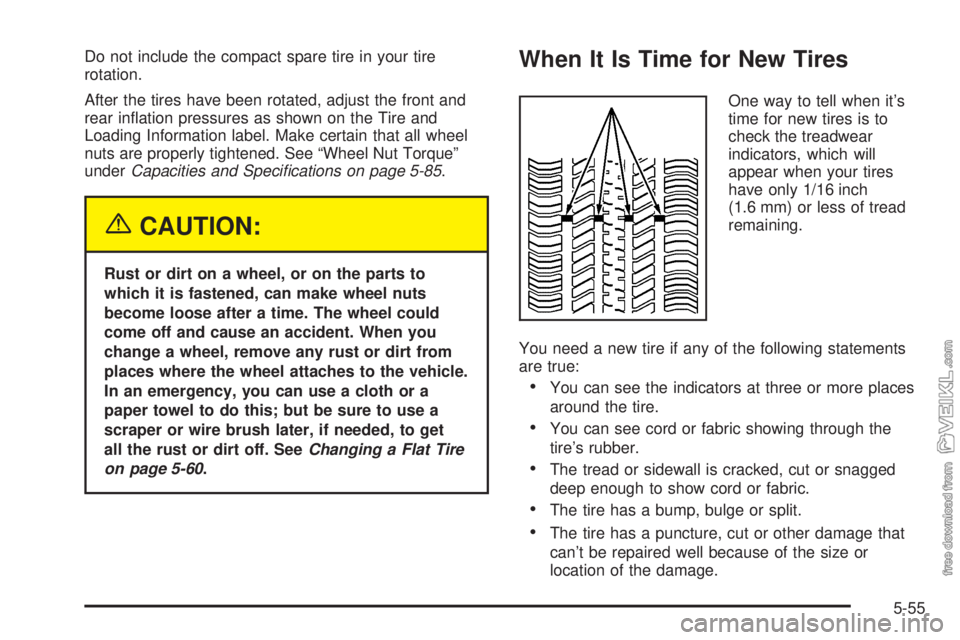
When It Is Time for New Tires
One way to tell when it’s
time for new tires is to
check the treadwear
indicators, which will
appear when your tires
have only 1/16 inch
(1.6 mm) or less of tread
remaining.
You need a new tire if any of the following statements
are true:
•You can see the indicators at three or more places
around the tire.
•You can see cord or fabric showing through the
tire’s rubber.
•The tread or sidewall is cracked, cut or snagged
deep enough to show cord or fabric.
•The tire has a bump, bulge or split.
•The tire has a puncture, cut or other damage that
can’t be repaired well because of the size or
location of the damage.
5-55
Page 244 of 320
If a Tire Goes Flat
It is unusual for a tire to blowout while you’re driving,
especially if you maintain your tires properly. If air goes
out of a tire, it is much more likely to leak out slowly.
But if you should ever have a blowout, here are a
few tips about what to expect and what to do:
If a front tire fails, the flat tire will create a drag that
pulls the vehicle toward that side. Take your foot off the
accelerator pedal and grip the steering wheel firmly.
Steer to maintain lane position, and then gently brake to
a stop well out of the traffic lane.
A rear blowout, particularly on a curve, acts much like a
skid and may require the same correction you would;
use in a skid. In any rear blowout, remove your foot from
the accelerator pedal. Get the vehicle under control
by steering the way you want the vehicle to go. It may
be very bumpy and noisy, but you can still steer. Gently
brake to a stop, well off the road if possible.{CAUTION:
Lifting a vehicle and getting under it to do
maintenance or repairs is dangerous without
the appropriate safety equipment and training.
The jack provided with your vehicle is
designed only for changing a at tire. If it is
used for anything else, you or others could be
badly injured or killed if the vehicle slips off
the jack. Use the jack provided with your
vehicle only for changing a at tire.
If a tire goes flat, the next part shows how to use your
jacking equipment to change a flat tire safely.
Changing a Flat Tire
If a tire goes flat, avoid further tire and wheel damage
by driving slowly to a level place. Turn on your vehicle’s
hazard warning flashers. SeeHazard Warning Flashers
on page 3-6for more information.
5-60
Page 245 of 320
{CAUTION:
Changing a tire can be dangerous. The vehicle
can slip off the jack and roll over or fall on you
or other people. You and they could be badly
injured or even killed. Find a level place to
change your tire. To help prevent the vehicle
from moving:
1. Set the parking brake rmly.
2. Put the shift lever in PARK (P).
3. Turn off the engine and do not restart
while the vehicle is raised.
4. Do not allow passengers to remain in
the vehicle.
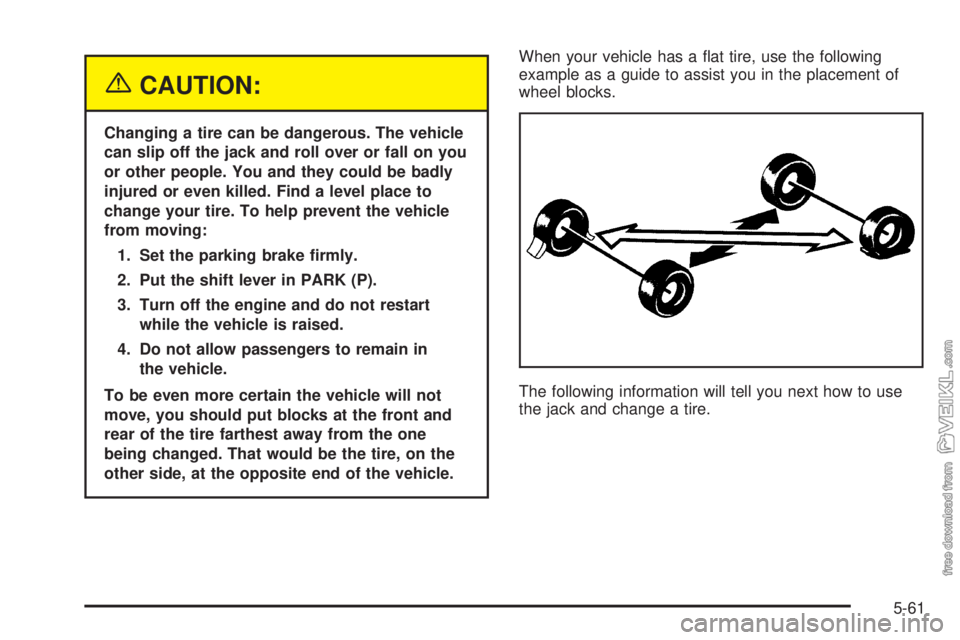
To be even more certain the vehicle will not
move, you should put blocks at the front and
rear of the tire farthest away from the one
being changed. That would be the tire, on the
other side, at the opposite end of the vehicle.When your vehicle has a flat tire, use the following
example as a guide to assist you in the placement of
wheel blocks.
The following information will tell you next how to use
the jack and change a tire.
5-61
Page 250 of 320
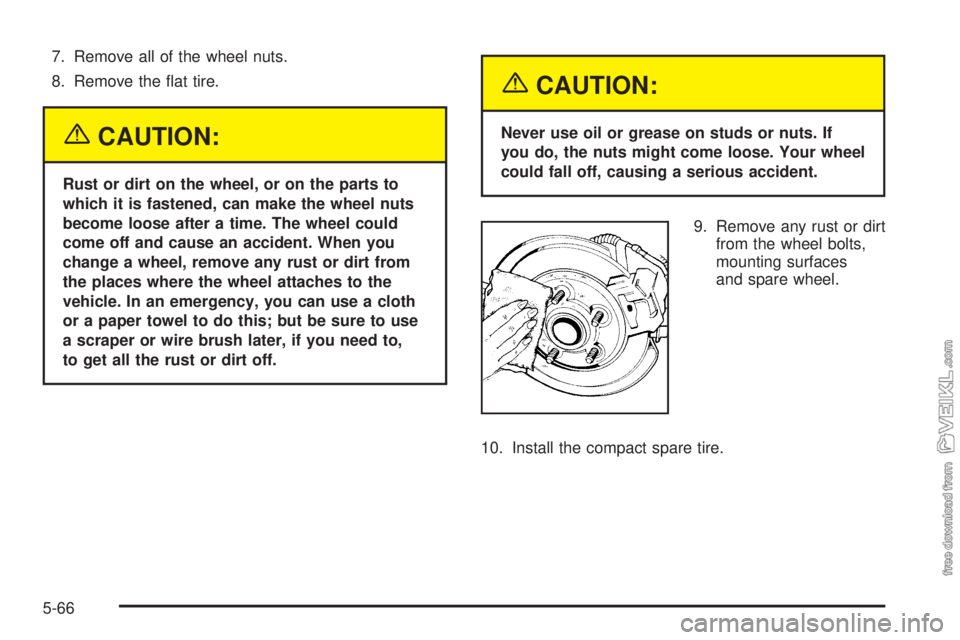
7. Remove all of the wheel nuts.
8. Remove the flat tire.
{CAUTION:
Rust or dirt on the wheel, or on the parts to
which it is fastened, can make the wheel nuts
become loose after a time. The wheel could
come off and cause an accident. When you
change a wheel, remove any rust or dirt from
the places where the wheel attaches to the
vehicle. In an emergency, you can use a cloth
or a paper towel to do this; but be sure to use
a scraper or wire brush later, if you need to,
to get all the rust or dirt off.
{CAUTION:
Never use oil or grease on studs or nuts. If
you do, the nuts might come loose. Your wheel
could fall off, causing a serious accident.
9. Remove any rust or dirt
from the wheel bolts,
mounting surfaces
and spare wheel.
10. Install the compact spare tire.
5-66
Page 301 of 320
GM Mobility Reimbursement
Program
This program, available to qualified applicants, can
reimburse you up to $1,000 toward eligible aftermarket
driver’s or passenger’s adaptive equipment you may
require for your vehicle, such as hand controls and
wheelchair/scooter lifts.
The offer is available for a limited period of time
from the date of vehicle purchase/lease. For more
details, or to determine your vehicle’s eligibility, visit
gmmobility.com or call the GM Mobility Assistance
Center at 1-800-323-9935. Text telephone (TTY)
users, call 1-800-833-9935.
GM of Canada also has a Mobility Program.
Call 1-800-GM-DRIVE (463-7483) for details.
TTY users call 1-800-263-3830.
Roadside Assistance Program
As the owner of a new Chevrolet vehicle, you are
automatically enrolled in the Chevrolet Roadside
Assistance program. This value-added service is
intended to provide you with peace of mind as
you drive in the city or travel the open road. Call
Chevrolet’s Roadside Assistance at 1-800-CHEV-USA,
(1-800-243-8872) 24 hours a day, 365 days a year
to speak with a Chevrolet Roadside Assistance
representative.We will provide the following services during the
Bumper-to-Bumper warranty period, at no expense
to you:
•Fuel Delivery:Delivery of enough fuel
($5 maximum) for the customer to get to
the nearest service station.
•Lock-out Service (identication required):
Replacement keys or locksmith service will
be covered at no charge if you are unable to gain
entry into your vehicle. Delivery of the replacement
key will be covered within 10 miles (16 km).
•Emergency Tow:Tow to the nearest dealership
for warranty service or in the event of a
vehicle-disabling accident. Assistance provided
when the vehicle is mired in sand, mud, or snow.
•Flat Tire Change:Installation of a spare tire will be
covered at no charge. The customer is responsible
for the repair or replacement of the tire if not
covered by a warrantable failure.
•Jump Start:No-start occurrences which require a
battery jump start will be covered at no charge.
•Dealer Locator Service
7-5
Page 318 of 320
Safety Belts (cont.)
Rear Seat Passengers.................................1-19
Right Front Passenger Position......................1-19
Safety Belt Extender....................................1-25
Safety Belt Use During Pregnancy.................1-18
Safety Belts Are for Everyone......................... 1-6
Shoulder Belt Height Adjuster........................1-18
Safety Warnings and Symbols.............................. iii
Seats
Head Restraints............................................ 1-5
Manual........................................................ 1-2
Reclining Seatbacks...................................... 1-4
Six-Way Power Driver.................................... 1-3
Second-Gear Start..........................................2-22
Securing a Child Restraint
Center Rear Seat Position............................1-42
Designed for the LATCH System...................1-40
Rear Outside Seat Position...........................1-40
Right Front Seat Position..............................1-44
Selecting the Right Schedule, Maintenance.......... 6-5
Service........................................................... 5-3
Adding Equipment to the Outside of
Your Vehicle.............................................. 5-5
Doing Your Own Work................................... 5-4
Engine Soon Light.......................................3-30
Publications Ordering Information...................7-10
Vehicle Soon Light.......................................3-34
Servicing Your Airbag-Equipped Vehicle..............1-52Setting the Time
Radios with Radio Data Systems (RDS).........3-36
Radios without Radio Data Systems (RDS).....3-36
Sheet Metal Damage.......................................5-76
Shifting Into Park (P).......................................2-23
Shifting Out of Park (P)...................................2-24
Short Trip/City Scheduled Maintenance................ 6-6
Shoulder Belt Height Adjuster...........................1-18
Signals, Turn and Lane-Change.......................... 3-8
Spare Tire
Compact....................................................5-70
Installing....................................................5-63
Removing...................................................5-62
Storing.......................................................5-69
Specifications, Capacities.................................5-85
Speedometer..................................................3-24
Starting Your Engine.......................................2-17
Steering.......................................................... 4-8
Steering, Suspension and Front Drive Axle
Boot and Seal Inspection..............................6-20
Steering Wheel, Tilt Wheel................................. 3-6
Storage Areas
Center Console Storage Area........................2-28
Cupholder(s)...............................................2-28
Glove Box..................................................2-28
Stuck in Sand, Mud, Ice or Snow......................4-26
Sun Visors.....................................................2-14
10
Page 319 of 320
T
Tachometer....................................................3-25
Taillamps
Turn Signal, Stoplamps and Back-up Lamps....5-43
Theft-Deterrent, Radio.....................................3-51
Theft-Deterrent Systems...................................2-15
Passlock
®...................................................2-15
Throttle System Inspection...............................6-21
Tilt Wheel........................................................ 3-6
Tires.............................................................5-47
Aluminum Wheels, Cleaning..........................5-75
Buying New Tires........................................5-56
Chains.......................................................5-59
Changing a Flat Tire....................................5-60
Cleaning....................................................5-76
Compact Spare Tire.....................................5-70
If a Tire Goes Flat.......................................5-60
Inflation -- Tire Pressure...............................5-53
Inspection and Rotation................................5-54
Installing the Spare Tire................................5-63
Removing the Flat Tire.................................5-63
Removing the Spare Tire and Tools...............5-62
Storing a Flat or Spare Tire and Tools............5-69
Tire Sidewall Labelling..................................5-48
Tire Terminology and Definitions....................5-50Tires (cont.)
Uniform Tire Quality Grading.........................5-57
Wheel Alignment and Tire Balance.................5-58
Wheel Replacement.....................................5-58
When It Is Time for New Tires......................5-55
Top Strap......................................................1-36
Top Strap Anchor Location...............................1-37
Towing
Recreational Vehicle.....................................4-33
Towing a Trailer..........................................4-35
Your Vehicle...............................................4-32
Transaxle
Fluid, Automatic...........................................5-18
Transaxle Operation, Automatic.........................2-19
Trip Odometer................................................3-24
Trunk............................................................2-11
Trunk Lamps..................................................3-16
Turn and Lane-Change Signals.......................... 3-8
Turn Signal/Multifunction Lever........................... 3-7
U
Understanding Radio Reception........................3-51
Uniform Tire Quality Grading............................5-57
11