seats CHEVROLET CLASSIC 2005 User Guide
[x] Cancel search | Manufacturer: CHEVROLET, Model Year: 2005, Model line: CLASSIC, Model: CHEVROLET CLASSIC 2005Pages: 320, PDF Size: 4.86 MB
Page 50 of 320
Securing a Child Restraint in the
Right Front Seat Position
If your child restraint is equipped with the LATCH
system, seeLower Anchorages and Top Tethers for
Children (LATCH System) on page 1-38.
There is no top strap anchor in the right front
passenger’s position. Do not secure a child seat in
this position if a national or local law requires that
the top strap be anchored, or if the instructions that
come with the child restraint say that the top strap must
be anchored. SeeTop Strap on page 1-36if the child
restraint has one.
Your vehicle has a right front passenger airbag.Never
put a rear-facing child restraint in this seat. Here is why:
{CAUTION:
A child in a rear-facing child restraint can be
seriously injured or killed if the right front
passenger’s airbag inates. This is because the
back of the rear-facing child restraint would be
very close to the inating airbag. Always secure
a rear-facing child restraint in a rear seat.A rear seat is a safer place to secure a forward-facing
child restraint. If you need to secure a forward-facing
child restraint in the right front seat, you will be using the
lap-shoulder belt to secure the restraint in this position.
Be sure to follow the instructions that came with the
child restraint. Secure the child in the child restraint
when and as the instructions say.
1. Because your vehicle has a right front passenger
airbag, always move the seat as far back as it will
go before securing a forward-facing child restraint.
SeeManual Seats on page 1-2.
2. Put the child restraint on the seat.
3. Pick up the latch plate, and run the lap and shoulder
portions of the vehicle’s safety belt through or
around the restraint. The child restraint instructions
will show you how.
1-44
Page 79 of 320
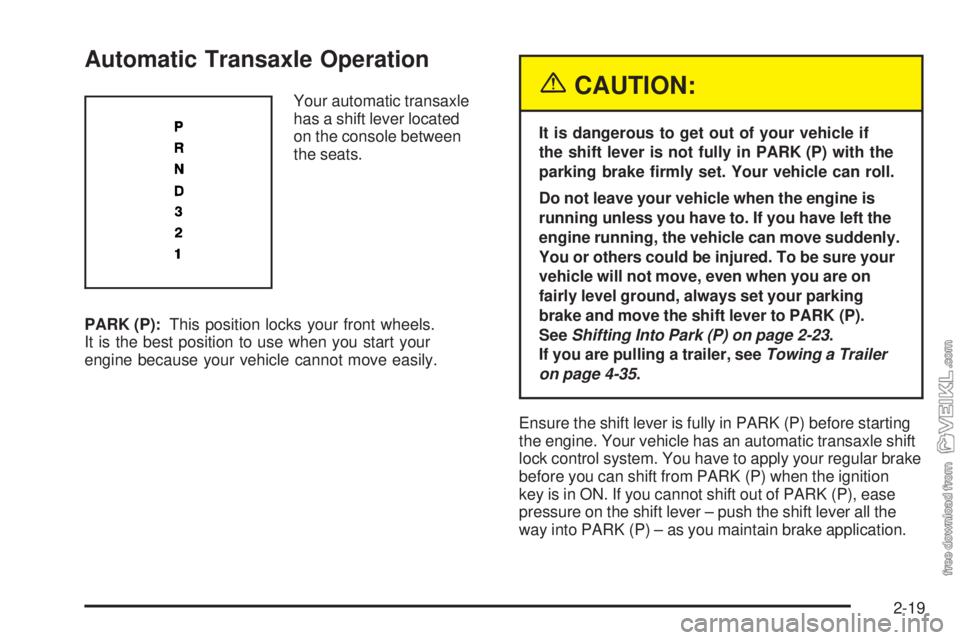
Automatic Transaxle Operation
Your automatic transaxle
has a shift lever located
on the console between
the seats.
PARK (P):This position locks your front wheels.
It is the best position to use when you start your
engine because your vehicle cannot move easily.{CAUTION:
It is dangerous to get out of your vehicle if
the shift lever is not fully in PARK (P) with the
parking brake rmly set. Your vehicle can roll.
Do not leave your vehicle when the engine is
running unless you have to. If you have left the
engine running, the vehicle can move suddenly.
You or others could be injured. To be sure your
vehicle will not move, even when you are on
fairly level ground, always set your parking
brake and move the shift lever to PARK (P).
SeeShifting Into Park (P) on page 2-23.
If you are pulling a trailer, seeTowing a Trailer
on page 4-35.
Ensure the shift lever is fully in PARK (P) before starting
the engine. Your vehicle has an automatic transaxle shift
lock control system. You have to apply your regular brake
before you can shift from PARK (P) when the ignition
key is in ON. If you cannot shift out of PARK (P), ease
pressure on the shift lever – push the shift lever all the
way into PARK (P) – as you maintain brake application.
2-19
Page 109 of 320
Rear Window Defogger
The rear window defogger uses a warming grid to
remove fog or frost from the rear window.
will come on to let your know that the rear window
defogger is activated. Be sure to clear as much snow
from the rear window as possible.
The rear window defogger will turn off approximately
10 minutes after the button is pressed. If turned on
again, the defogger will only run for approximately
five minutes before turning off. The defogger can also
be turned off by pressing the button again or by turning
off the engine.
Notice:Do not use anything sharp on the inside
of the rear window. If you do, you could cut or
damage the warming grid, and the repairs would
not be covered by your warranty. Do not attach
a temporary vehicle license, tape, a decal or
anything similar to the defogger grid.
Outlet Adjustment
Use the louvers located on the air outlets to change the
direction of the airflow.
Operation Tips
•
Clear away any ice, snow, or leaves from the air
inlets at the base of the vehicle that may block
the flow of air into your vehicle.
•Use of non-GM approved hood deflectors may
adversely affect the performance of the system.
•Keep the path under the front seats clear of objects
to help circulate the air inside of your vehicle more
effectively.
3-21
Page 174 of 320
If you put things inside your vehicle — like suitcases,
tools, packages, or anything else — they will go as fast
as the vehicle goes. If you have to stop or turn
quickly, or if there is a crash, they will keep going.
{CAUTION:
Things you put inside your vehicle can strike
and injure people in a sudden stop or turn, or
in a crash.
Put things in the trunk or rear area of your
vehicle. In a trunk, put them as far forward
as you can. Try to spread the weight
evenly. If you have fold-down rear seats,
you will nd four anchors on the back wall
of your trunk. You can use these anchors
to tie down lighter loads. They are not
strong enough for heavy things, however,
so put them as far forward as you can in
the trunk or rear area.
CAUTION: (Continued)
CAUTION: (Continued)
Never stack heavier things, like suitcases,
inside the vehicle so that some of them
are above the tops of the seats.
Do not leave an unsecured child restraint
in your vehicle.
When you carry something inside the
vehicle, secure it whenever you can.
Do not leave a seat folded down unless
you need to.
Towing
Towing Your Vehicle
Consult your dealer or a professional towing service
if you need to have your disabled vehicle towed.
SeeRoadside Assistance Program on page 7-5.
If you want to tow your vehicle behind another vehicle
for recreational purposes (such as behind a motorhome),
see “Recreational Vehicle Towing” following.
4-32
Page 234 of 320
Tire Size
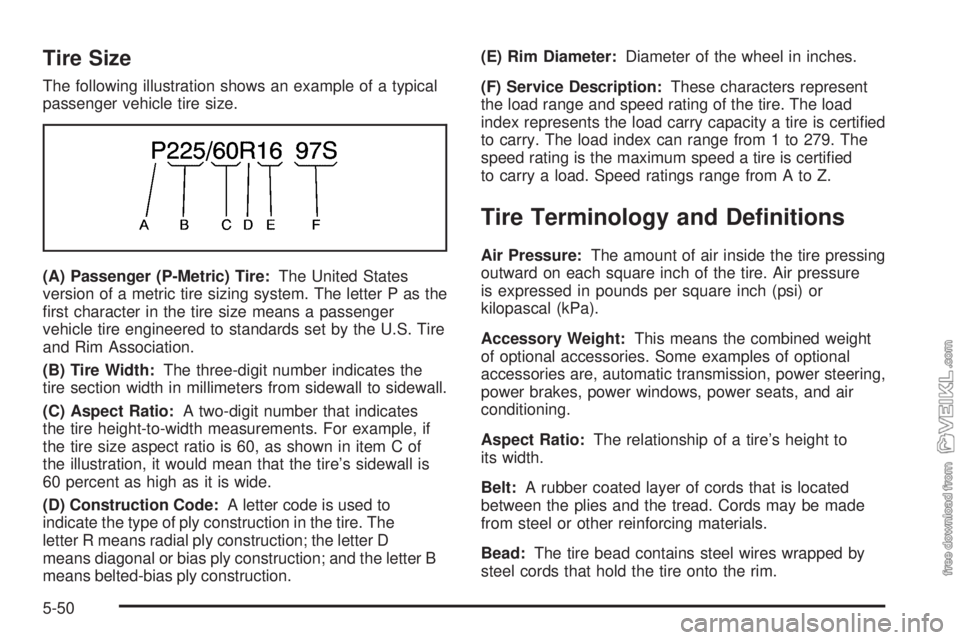
The following illustration shows an example of a typical
passenger vehicle tire size.
(A) Passenger (P-Metric) Tire:The United States
version of a metric tire sizing system. The letter P as the
first character in the tire size means a passenger
vehicle tire engineered to standards set by the U.S. Tire
and Rim Association.
(B) Tire Width:The three-digit number indicates the
tire section width in millimeters from sidewall to sidewall.
(C) Aspect Ratio:A two-digit number that indicates
the tire height-to-width measurements. For example, if
the tire size aspect ratio is 60, as shown in item C of
the illustration, it would mean that the tire’s sidewall is
60 percent as high as it is wide.
(D) Construction Code:A letter code is used to
indicate the type of ply construction in the tire. The
letter R means radial ply construction; the letter D
means diagonal or bias ply construction; and the letter B
means belted-bias ply construction.(E) Rim Diameter:Diameter of the wheel in inches.
(F) Service Description:These characters represent
the load range and speed rating of the tire. The load
index represents the load carry capacity a tire is certified
to carry. The load index can range from 1 to 279. The
speed rating is the maximum speed a tire is certified
to carry a load. Speed ratings range from A to Z.
Tire Terminology and Denitions
Air Pressure:The amount of air inside the tire pressing
outward on each square inch of the tire. Air pressure
is expressed in pounds per square inch (psi) or
kilopascal (kPa).
Accessory Weight:This means the combined weight
of optional accessories. Some examples of optional
accessories are, automatic transmission, power steering,
power brakes, power windows, power seats, and air
conditioning.
Aspect Ratio:The relationship of a tire’s height to
its width.
Belt:A rubber coated layer of cords that is located
between the plies and the tread. Cords may be made
from steel or other reinforcing materials.
Bead:The tire bead contains steel wires wrapped by
steel cords that hold the tire onto the rim.
5-50
Page 265 of 320
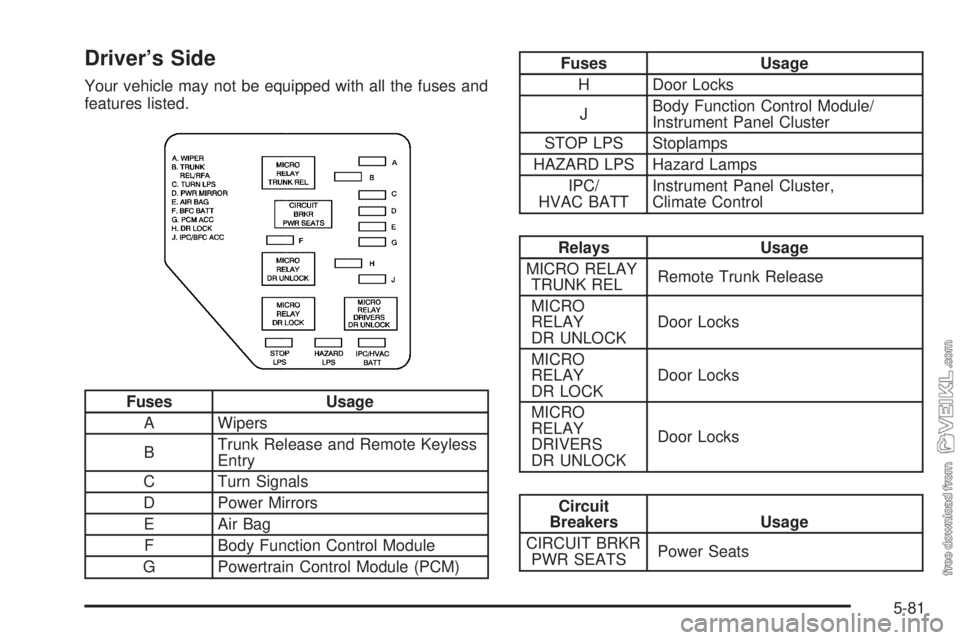
Driver’s Side
Your vehicle may not be equipped with all the fuses and
features listed.
Fuses Usage
A Wipers
BTrunk Release and Remote Keyless
Entry
C Turn Signals
D Power Mirrors
E Air Bag
F Body Function Control Module
G Powertrain Control Module (PCM)
Fuses Usage
H Door Locks
JBody Function Control Module/
Instrument Panel Cluster
STOP LPS Stoplamps
HAZARD LPS Hazard Lamps
IPC/
HVAC BATTInstrument Panel Cluster,
Climate Control
Relays Usage
MICRO RELAY
TRUNK RELRemote Trunk Release
MICRO
RELAY
DR UNLOCKDoor Locks
MICRO
RELAY
DR LOCKDoor Locks
MICRO
RELAY
DRIVERS
DR UNLOCKDoor Locks
Circuit
Breakers Usage
CIRCUIT BRKR
PWR SEATSPower Seats
5-81
Page 267 of 320
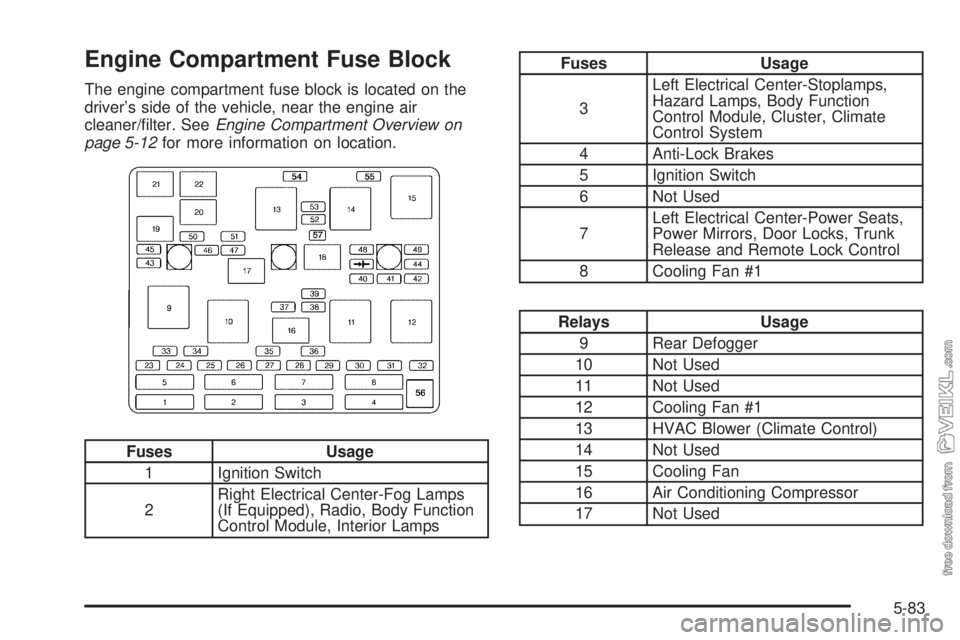
Engine Compartment Fuse Block
The engine compartment fuse block is located on the
driver’s side of the vehicle, near the engine air
cleaner/filter. SeeEngine Compartment Overview on
page 5-12for more information on location.
Fuses Usage
1 Ignition Switch
2Right Electrical Center-Fog Lamps
(If Equipped), Radio, Body Function
Control Module, Interior Lamps
Fuses Usage
3Left Electrical Center-Stoplamps,
Hazard Lamps, Body Function
Control Module, Cluster, Climate
Control System
4 Anti-Lock Brakes
5 Ignition Switch
6 Not Used
7Left Electrical Center-Power Seats,
Power Mirrors, Door Locks, Trunk
Release and Remote Lock Control
8 Cooling Fan #1
Relays Usage
9 Rear Defogger
10 Not Used
11 Not Used
12 Cooling Fan #1
13 HVAC Blower (Climate Control)
14 Not Used
15 Cooling Fan
16 Air Conditioning Compressor
17 Not Used
5-83
Page 316 of 320
Maintenance Schedule (cont.)
Using.......................................................... 6-4
Your Vehicle and the Environment................... 6-2
Malfunction Indicator Light................................3-30
Manual Seats................................................... 1-2
Mirrors
Manual Rearview Mirror................................2-27
Outside Convex Mirror.................................2-28
Outside Power Mirrors..................................2-27
MyGMLink.com................................................ 7-3
N
New Vehicle Break-In......................................2-15
Normal Maintenance Replacement Parts............5-86
O
Odometer......................................................3-24
Odometer, Trip...............................................3-24
Off-Road Recovery..........................................4-10
Oil
Engine.......................................................5-13
Pressure Light.............................................3-32
Older Children, Restraints................................1-26
Online Owner Center........................................ 7-3
Other Warning Devices...................................... 3-6
Outlet Adjustment............................................3-21Outside
Convex Mirror.............................................2-28
Power Mirrors.............................................2-27
P
Park (P)
Shifting Into................................................2-23
Shifting Out of............................................2-24
Park (P) Headlamps Off in Park (P)..................3-14
Parking
Brake........................................................2-22
Over Things That Burn.................................2-25
Part A - Scheduled Maintenance Services............. 6-4
Part B - Owner Checks and Services.................6-16
Part C - Periodic Maintenance Inspections..........6-20
Part D - Recommended Fluids and Lubricants....6-22
Part E - Maintenance Record...........................6-23
Passing.........................................................4-10
Passlock
®......................................................2-15
Power............................................................. 1-3
Accessory Outlets........................................3-17
Door Locks.................................................. 2-8
Electrical System.........................................5-79
Retained Accessory (RAP)............................2-17
Steering Fluid.............................................5-29
Windows....................................................2-14
Programmable Automatic Door Locks.................. 2-9
8
Page 318 of 320
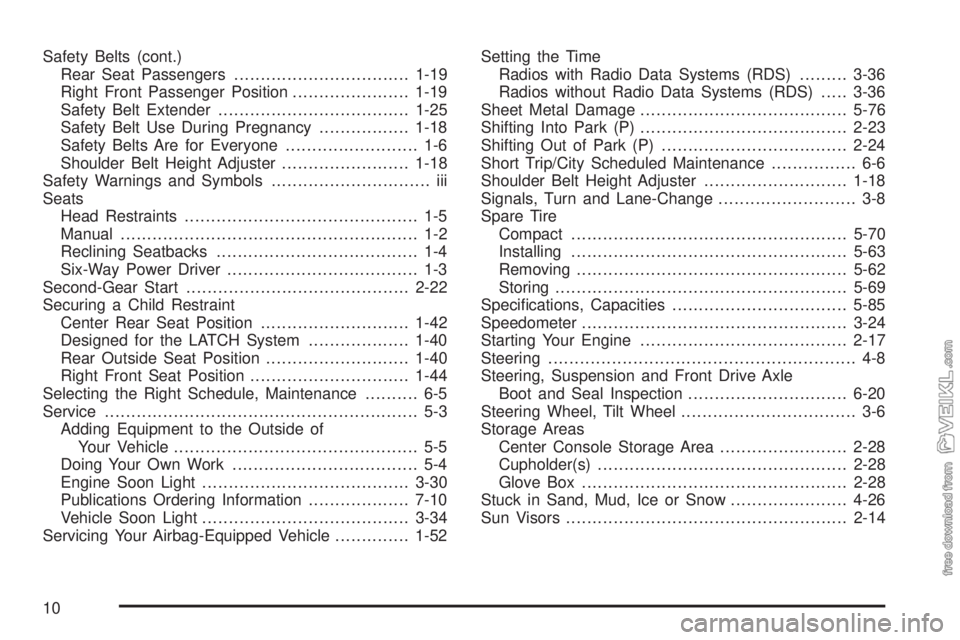
Safety Belts (cont.)
Rear Seat Passengers.................................1-19
Right Front Passenger Position......................1-19
Safety Belt Extender....................................1-25
Safety Belt Use During Pregnancy.................1-18
Safety Belts Are for Everyone......................... 1-6
Shoulder Belt Height Adjuster........................1-18
Safety Warnings and Symbols.............................. iii
Seats
Head Restraints............................................ 1-5
Manual........................................................ 1-2
Reclining Seatbacks...................................... 1-4
Six-Way Power Driver.................................... 1-3
Second-Gear Start..........................................2-22
Securing a Child Restraint
Center Rear Seat Position............................1-42
Designed for the LATCH System...................1-40
Rear Outside Seat Position...........................1-40
Right Front Seat Position..............................1-44
Selecting the Right Schedule, Maintenance.......... 6-5
Service........................................................... 5-3
Adding Equipment to the Outside of
Your Vehicle.............................................. 5-5
Doing Your Own Work................................... 5-4
Engine Soon Light.......................................3-30
Publications Ordering Information...................7-10
Vehicle Soon Light.......................................3-34
Servicing Your Airbag-Equipped Vehicle..............1-52Setting the Time
Radios with Radio Data Systems (RDS).........3-36
Radios without Radio Data Systems (RDS).....3-36
Sheet Metal Damage.......................................5-76
Shifting Into Park (P).......................................2-23
Shifting Out of Park (P)...................................2-24
Short Trip/City Scheduled Maintenance................ 6-6
Shoulder Belt Height Adjuster...........................1-18
Signals, Turn and Lane-Change.......................... 3-8
Spare Tire
Compact....................................................5-70
Installing....................................................5-63
Removing...................................................5-62
Storing.......................................................5-69
Specifications, Capacities.................................5-85
Speedometer..................................................3-24
Starting Your Engine.......................................2-17
Steering.......................................................... 4-8
Steering, Suspension and Front Drive Axle
Boot and Seal Inspection..............................6-20
Steering Wheel, Tilt Wheel................................. 3-6
Storage Areas
Center Console Storage Area........................2-28
Cupholder(s)...............................................2-28
Glove Box..................................................2-28
Stuck in Sand, Mud, Ice or Snow......................4-26
Sun Visors.....................................................2-14
10